
Welcome to the Soccer Awareness Coaches Corner. Browse through soccer drills, small sided games, tactical thoughts, full sessions and a variety of resources. Posts marked “Training Center Exclusive” are for members only.

How to Teach Freedom of Movement for the 4-2-3-1
Attacking and Defensive Positioning; and Covering for Each Other in Brief
To play such a fluid and imaginative style of play as we do; where players are offered such freedom offensively all over the field; there is always a "weakness" to this we need to address. In this case we look at the defensive consequences for which we need to cover and correct.
Attacking and Defensive Positioning; and Covering for Each Other in Brief
To play such a fluid and imaginative style of play as we do; where players are offered such freedom offensively all over the field; there is always a "weakness" to this we need to address. In this case we look at the defensive consequences for which we need to cover and correct. Full version is 39 pages.
Defensive Adjustment and Organization
The potential weakness in this system and STYLE of play is the defensive adjustments needed to ensure our fluidity of attacking movement doesn’t cost us when we lose possession of the ball.
This presentation shows how we can make sure; defensively; we are disciplined and solid by teaching the players where to immediately press; where and when to recover; and how to fill in and cover for each other immediately the ball is lost.



Therefore we transition (in MIND and BODY) from incredible freedom of attacking momentum; which brings imagination, interchanges and rotations, to the opposite; intense, concentrated and positionally disciplined defense.
This is a simple way to show how we can make sure the team is well organized to allow the attacking freedom to take place; knowing we can cover ourselves if we lose the ball.
Interchanging Positions in Attack and what it means. We attack with freedom and rotation of positions knowing we are covered by team mates.

So now, as close as possible to identify the change; Nine is 10, Eleven is 9, Eight is 6, Six is 8, Ten is 11; and so on. Three is in an Inside Left position, Two is in an Inside Right position. A six player attack.
Our Players have attacked and interchanged positions in the attack but we have lost the ball. They get the ball out and keep possession; we have to press and also recover at the same time.
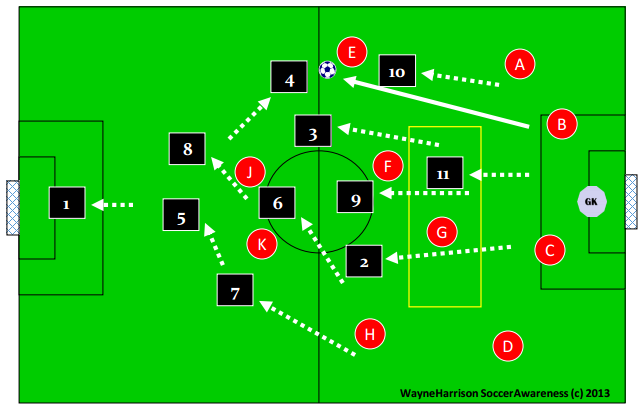
Now we must press thru (4) who MUST delay (E), and the rest of the team can then get compact behind; alongside and in front of the opponents. (3) and (10) can recover to the press also.
In theory our players are out of position but are they? It depends how you teach them; how we press and recover and who does what, where and why.
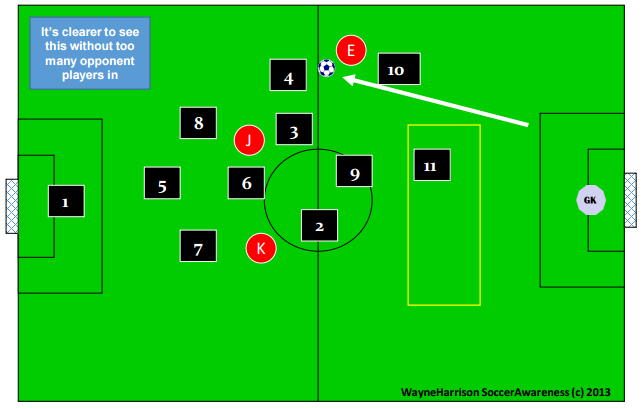
Changes: Our Center back (4) is now a left fullback 3; our linking midfielder (8) is a center back 4; our left back (3) is a center midfielder 8, our striker (9) is a number 10; our attacking midfielder (10) is in the wide left position 11; our wide left (11) is in the (9) position and (2) is in 7s position and (7) is in 2s position.
Changes in Previous Diagrams:
To recap on the previous defensive recovery set up which was our offensive set up initially:
Our Center back (4) is now a left fullback 3;
Our linking midfielder (8) is a center back 4;
Our left back (3) is a center midfielder 8,
Our striker (9) is now a number 10;
Our attacking midfielder (10) is in the wide left position 11;
Our wide left striker (11) is in the (9) central striker position;
Our right fullback (2) is in 7s wide striker position;
Our wide right striker (7) is in right fullback 2s position.
How we press and recover and who does what, where and why and rotation back into original positions and defensive set up.

The Ball goes out of play, for example, the players then rotate back into their own positions; or any part of the game they have time to do this they must try to work back into their own positions. We then start again to win back the ball and continue the freedom futbol method of playing.

Coach Bain Mused Podcast with Wayne Harrison
Wayne joined Alistair Bain on his podcast series, Coach Bain Mused. The Coach Bain Mused Podcast series covers all areas related to Football & discusses the complexities of development & how coaching methods can be applied to learning.
In this podcast, Wayne discusses his background, influence, philosophies and thoughts on the game.

Developing Play from the Back
We develop play from the back. Work on that initially practicing all ways to get out.
Have opponents only intercepting passes to begin. Then let it go free.
When opponents win it back we work on the defending team condensing and defending correctly.
So certain plays are recognized consciously first of all with particular CUES offering identification of these.
If one or two ways to develop play are done very frequently then it becomes a subconscious decision to move in to position so no decision making required as such.
Distribution from the Keeper and Playing Out from the Back
We develop play from the back. Work on that initially practicing all ways to get out.
Have opponents only intercepting passes to begin. Then let it go free.
When opponents win it back we work on the defending team condensing and defending correctly.
So certain plays are recognized consciously first of all with particular CUES offering identification of these.
If one or two ways to develop play are done very frequently then it becomes a subconscious decision to move in to position so no decision making required as such.
Distribution from the keeper and Playing from the back

Perhaps use cones instead of actual players to practice to make it work initially and to gain confidence (better still use Mannequins).

Our starting position, the team is in defensive shape and ready to attack. A 6 v 3 makes it easy to get out, but decrease the number of opponents if necessary to gain success initially.
1. Distribution from the keeper using one attacking fullback

We attack down one side and we slide across with the other three of the back four to cover the spaces behind
2. Distribution through Both center backs or (6)

A simple starting position on distribution from the back using only those players in the immediate vicinity. A 3 v 2 at the back in our favor.
3. Distribution through Number (6) in a wide area

Now (6) breaks wide to receive the ball and escape being marked in the middle. The same can happen with (6) breaking out to the right also replacing (5) who stays central.
4. Distribution from the keeper: One centre back breaks wide

(3) stays, (6) doesnt drop in, (4) stays central, (5) goes wide, (2) pushes on and we get out down one side. Opponents (9) and (10) stop our (4) and (3), (5) gets free to play out.
5. Distribution from the keeper thru wingbacks

They push 3 up we get out through our wingbacks. Have opponents make different choices to force the keeper to make relevant decisions in training.
Distribution from the keeper through Both wing backs

We can start to add players and build the session up. Here we close off one side so the keeper has to recognize he cant go to (3) but can go to (2).
6. Distribution from the keeper thru INVERTED wingbacks By Ally Bain

Wing fullbacks 2 and 3 cut inside to receive the ball.
7. Distribution from the keeper thru INVERTED wingbacks by Ally Bain

Wing fullbacks 2 and 3 cut inside to receive the ball and can receive the pass from (4) , (5) or (6) also in the buildup.
8. Distribution from the keeper thru central midfield rotation of (6) and (8)

(6) Clears the space and takes the opponents (8) with him and our (8) drops in free to start the attack. Can also be with (6) and (10).
9. Distribution through Both wing backs dropping back

Centre backs both push out quickly and they are tracked by the two strikers. This releases spaces behind them. Both wing backs drop back into those spaces to receive the ball.
10. Distribution through Center backs pushing out

Wing full backs drop back in. They are tracked by the two strikers. This releases spaces down the sides. Both wing backs drop back into those spaces to open it up for the center backs.
Distribution from the keeper and Playing from the back 11 v 11

Now in an 11 v 11. Our normal way to get out from the back. We should always try this initially if it is on to do so. Try to get out thru (4), (5) or (6).
Distribution from the keeper 11 v 11

Another way to get out thru one center back and one wingback and even (8).
Distribution from the keeper 11 v 11

Another way to get out thru one center back (5) and (7). Wingback (2) tucks inside and may take opponents 11 with them to clear the pass for (7). A nice area to play into circled also.
Distribution from the keeper 11 v 11

They go 3 v 3 against us to stop us playing out of the back so we try to get out through (2) and (3). Otherwise we have to push up, condense and kick it long.
This takes lots of practice with the keepers to make this pass happen consistently.

They go 3 v 3 against us so we try to get out through (2) and (3). Otherwise we have to push up, condense and kick it long. Thye “may” see what we are doing and push 7 and 11 onto our wingbacks (2) and (3).
They push two players onto our wingbacks (2) and (3)

This outlet is now stopped. So we have to change our team shape from “wide and long” to “short and tight” getting ready for the long kick from the keeper.
11. They have pushed onto our Wingbacks so this outlet is stopped; we have to go long as a last resort

This can still be EFFECTIVE: Now we condense as a team “short and tight”. Our (10) is good in the air so we hit him and we have a lot of players around him to win the 2nd ball. Of course opponents will readjust also. Its cat and mouse.
11. We leave their 3 strikers offside.

Players can gamble for the flick on from (10). Players position behind, in front and alongside (10) so wherever the 2nd ball goes we have players to pick it up. WE ABSOLUTELY MUST get better at this. Obviously opponents will position better than this defensively; but you get the point.
Wayne Harrison Podcast Interview
In this interview, hosted by John Matich, a renown football/soccer coach in San Diego, CA, from The Kicking System , Wayne Harrison, talks about soccer formations & tactics, the modern soccer game and developing his soccer awareness philosophy.
In this interview, hosted by John Matich, a renown football/soccer coach in San Diego, CA, from The Kicking System , Wayne Harrison, talks about soccer formations & tactics, the modern soccer game and developing his soccer awareness philosophy. You can also download this podcast in the ITUNES store under “The Kicking System.”
Click the image below to listen.


4-2-3-1 Basic Ideas Video
Here is the latest video on the 4-2-3-1, which entails a few basic ideas on the formation. In this video you will see the defensive shape to the attacking team shape of this formation. Please feel free to comment and provide feedback.
Here is the latest video on the 4-2-3-1, which entails a few basic ideas on the formation. In this video you will see the defensive shape to the attacking team shape of this formation. Please feel free to comment and provide feedback.
Enjoy!
Coach Wayne
54 Pages
We want to stay with our own game plan as closely as possible; based on what we practice and to keep it simple for us; as we dictate to our opponents; and we impose OUR WAY on them.
But there will be many occasions where we must change the system of play and we may have to adjust to suit the opponents.
Here are some ideas for you to consider for your team starting with the 13313 and 14231 systems of play.