
How to Teach “Third Man Runs” in Isolation AND in Team Play
/ Wayne HarrisonThird man runs are incredibly effective when they are timed right. Plus runs OFF the ball are more difficult to pick up by opponents than runs ON the ball and so we can catch teams out with these when planned.
These animations show several players making third man runs; in actual fact it might be only one making this run in behind and the passer has to “spot” that run. In reality; we would like 3 or 4 players making third man runs to offer different options for the ultimate passing player.
Absolutely swamp the opposition with players attacking from all areas.
What we are trying to show is almost any player can make these third man runs if they have defensive cover. The player making the initial pass can make the run in behind and / or other players can too.
Our aim is to make this a “subconscious” sequence of events in the players minds, they just “do it” without thinking, its automatic.
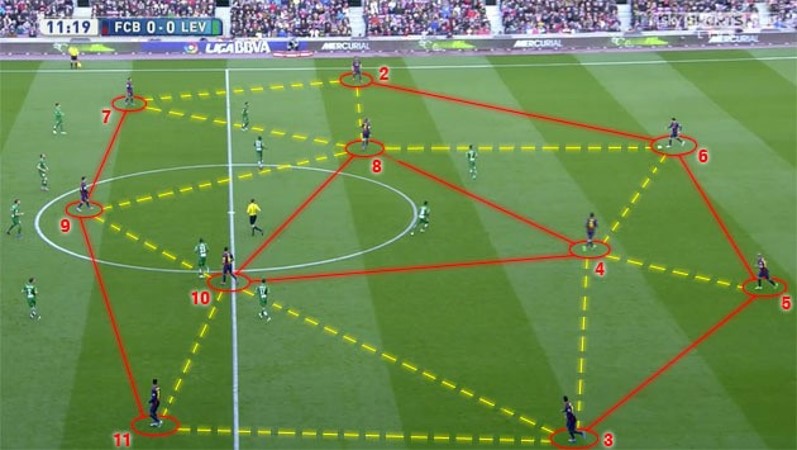
Here are 9 ways to distribute from the keeper and play out from the back. We owe it to the players to teach them this as Young as is possible.
I work on this initially practicing all ways to get out. Have opponents only intercepting passes to begin. Then let it go free. When opponents win it back we work on the defending team condensing and defending correctly.
If three or four ways to develop play are done very frequently then it becomes a subconscious decision to move into position so no decision making required as such.
Linking foot preparation, body position and mental preparation to the technique involved in making a one touch pass leads us to a discussion on one touch play and its benefits.
One touch play teaches the value of being able to take your eye off the ball when keeping your eye on the ball can be a disadvantage.
To make this work, players need to have good teamwork and positional sense and therefore must work hard for each other.

Working with three teams (numbers depends on how many players you have, e.g. it can be 4 v 4 + 4 or 5 v 5 + 5 etc). Teams (1) and (2) work together to keep the ball from team (3). If team (3) regains possession the team who gave it away becomes the defenders. The defenders reward is they keep the ball and link with the other team.

In this game we are working on finishing, dribbling and breakaways. This is a great activity to work on both attacker and goalkeeper skills.

Just a one-word signal can organize a defense, so everyone on the team knows what to do and reacts together as a unit. Also midfield players close by can react off the call too as can strikers. These One-word calls ensure everyone will know quickly and effectively what they should do as a unit and as a team. Hence the back players (and the keeper) can organize their movement as a unit (and therefore influence those in front of them) from Five VERY simple one-word commands. The momentum is triggered from the back and runs forward through the team to the strikers. We must have a very vocal and confident leader at the back organizing this and making the decisions.

Here are 3 simple drills to help your players develop good technique for shooting at goal.

Development of the mental side of the game in terms of the Awareness program, i.e. seeing situations quickly and acting upon them is very important to the player to help him or her have success by scoring goals. The shorter and sharper the practice then the less time the players have to make the correct decisions to be successful, the more important it is to train them to be able to cope with these pressure situations.

In this session, we are ensuring there is timing between the players in terms of the pass and the run to receive. We are doing simple passing in two’s back and forth, first two touch, then one touch where possible. Ask the players to look into “each other’s eyes” as they pass and NOT at the ball to see if they can keep possession between them. This will be difficult at first but it helps to teach them to look up and not down at the ball. during games and hence helping their “Awareness” development as players.
*Membership Required

In this warm-up, players pass, receive and move off the ball at GAME speed. We are getting them mentally and physically prepared for the speed of the game.



Often players position to receive the ball with their back to play. These session plans show some ideas on how to position and instead "Face Forward" or at least Half Turned or three quarters turned rather than positioning square and facing back.