
Welcome to the Soccer Awareness Coaches Corner. Browse through soccer drills, small sided games, tactical thoughts, full sessions and a variety of resources. Posts marked “Training Center Exclusive” are for members only.

How We Set Our Teams Up At 8 v 8
This is a recommended set-up to relate the field positions of the 8 v 8 players in the 3-3-1 to the 4-2-3-1 formation for the 11 v 11.
The following is an excerpt from The Ultimate Youth Coaches Training Guide; A Complete 6 to 10 Year Old Developmental Coaching and Training Program.
This program is perfect for youth coaches wanting practices to start their soccer coaching education and it is also for those more advanced and experienced coaches wanting to train their players as best they can at these wonderful open minded ages for development and education of both the mind and body. Our plan is to help all coaches at whatever level of experience they are at. Find Out More
To relate the field positions of the 8 v 8 players in the 3-3-1 to the 4-2-3-1 formation for the 11 v 11 we do the following:
We do not include center backs 4 or 5.
Number 10 in 8 v 8 can be represented as EITHER a number 8 or a number 10 in 11 v 11.
Both types of player work for this.
The rest of the players mirror the positions of the same numbered players in 11 v 11 that being: the keeper 1, fullbacks / wing backs 2 and 3.
Central defensive midfielder 6 (who can play center back or center midfield)
7 being wide right (midfielder / winger / wide striker),
11 wide left (midfielder / winger / wide striker) and
9 is the central striker.
So using this method, we are creating really consistent and relevant developmental training that can be easily transferred from the 8 v 8 model to the 11 v 11 model.
This means the movements and types of plays technically and tactically we want to teach at U11 and 11 v 11 are already being established at U7, U8; U9 and U10
Using Cones as reference points for team shape defensively then team shape offensively. This is the team shape start.
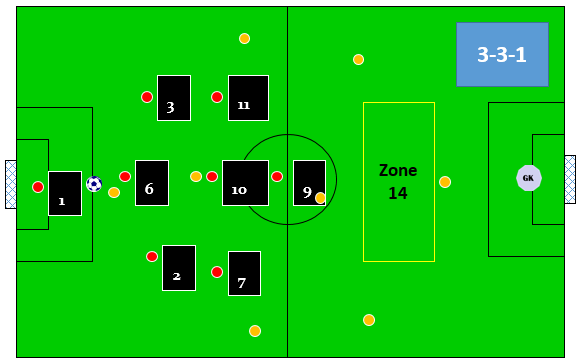
Attacking shape is now a 3-1-3. Zone 14 is the area between the opponents.
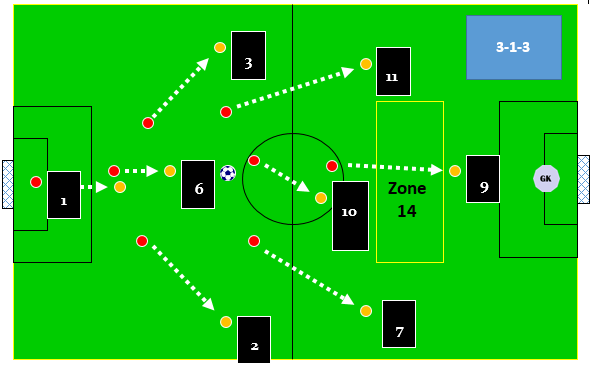

Patterns of Play: Building from the Back in an 8 v 8
8 v 8 is at the younger ages; and not wanting to baffle them with science too early; we will choose far fewer ways to build out from the back than we do at 11 v 11.
But we will establish patterns of play they can learn to do that are very simple; but also very effective when done correctly; and we will change the boot ball mentality many clubs follow; and teach the game correctly without fear of failure.
Please watch your games and ask yourself:
- How many times does your team try to build out of the back?
- How many times do they play Boot-Ball from back to front?
8 v 8 is at the younger ages; and not wanting to baffle them with science too early; we will choose far fewer ways to build out from the back than we do at 11 v 11.
But we will establish patterns of play they can learn to do that are very simple; but also very effective when done correctly; and we will change the boot ball mentality many clubs follow; and teach the game correctly without fear of failure.
Mistakes will occur when we build from the back because we are taking risks, but that's okay, players will learn from them.
Yes, it's much safer to boot it long to the fast striker to run and score but that teaches exactly nothing for the long term development of our players; plus all that the midfielders and defenders get out of are stiff necks from watching the ball go over their heads from back to front.
The striker gets all the glory but it means nothing; and as they get older; long term the one who suffers the most is ultimately the striker who learnt absolutely nothing but "running fast or dribbling in a straight line."
As the players get older, defenders are faster, stronger and more cleaver. The fast dynamic striker is no more. So let's teach the game correctly now; for everyone to succeed. I want EVERY player to learn, improve and succeed. That includes the striker as much as anyone. Good strikers are worth their weight in gold but they have to be trained correctly like everyone else.
Distribution from the Keeper and Playing from the Back
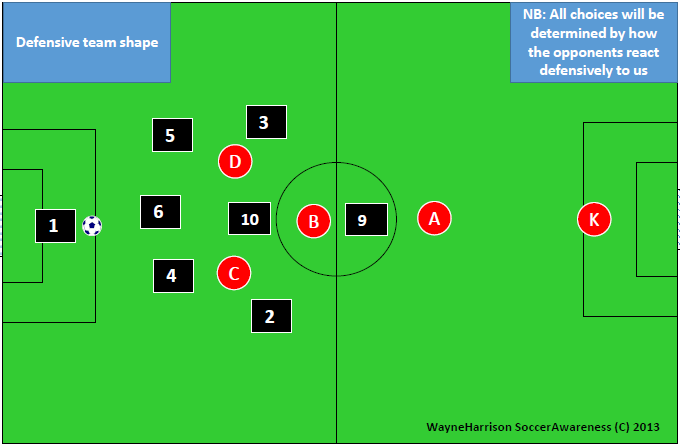
Perhaps use cones instead of actual players to practice in a shadow play to make it work initially and to gain confidence (better still use Mannequins). Or, if we are beyond needing to do shadow plays we can start with an overload for us to train to pass out from the back so we have initial success. As we improve we can make it an 8 v 8 and an actual game situation. Here we start with an 8 v 5. We are not saying these will work all the time. Sometimes we will get them wrong. Sometimes the opponents will work out what we are doing and stop us. And sometimes it will work great.



Developing Play from the Back in an 8 v 8 through the Centerbacks / Wingbacks

Now (4) breaks wide to receive the ball and escape being marked in the middle. The same can happen with (5) breaking out to the right also with (6) who stays central.
We must ALWAYS try first of all to play out from the back. The ABSOLUTE last resort is for the keeper to kick it long. This is Great preparation for playing the 11 v 11 and developing the game from the back. Players must spread touchline wide both sides to offer up the largest spaces to play in as they can. Keeper has 3 choices here and the ball must be passed on the ground for ease of reception.
Distribution from the Keeper thru Wide Midfielders/ Strikers

They push 3 up we get out through our wide strikers. Have opponents make different choices to force the keeper to make relevant decisions in training. Here we would NOT try to develop play through the back three players as each one is marked. Therefore we go to the next line of attack to get out.
Rotation of Wide Players to get Free

Here is a simple rotation between (3) and (4) which opens up a passing lane for (3). Opponent (D) follows our (4). If (D) stays then we don't pass to (3) but rather try something else. Introducing 2 player rotations like this is important as we can eventually make this happen all over the field of play. The sooner they learn this the sooner it is embedded in their soccer DNA.
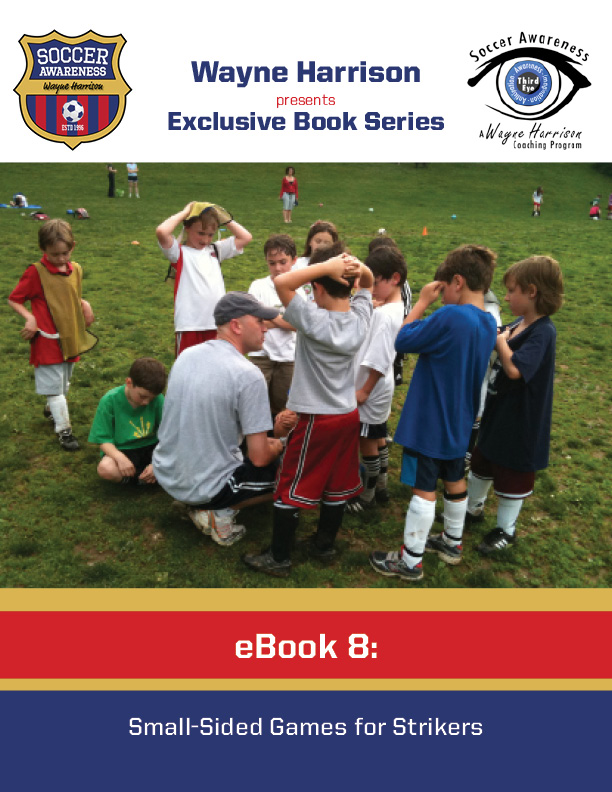
This 54 page eBook combines striker training with small-sided games into eight full training sessions, each with coaching points, multiple progressions and developments.
Striker movement is one of the greatest and most difficult ARTS to master. The situation is constantly changing and the striker is constantly moving to create space for him or herself but also for teammates.
Small-sided games are important in the development of younger players through increased touches with the ball and more experience with basic tactical challenges.
Rotation of Wide Players to get Free

Here a simple rotation between (3) and (4) opens up a passing lane for (3). Opponent (D) stays in the space (3) runs in to, so perhaps (4) can get free? Introducing 2 player rotations like this is important as we can eventually make this happen all over the field of play. The sooner they learn this the sooner it is embedded in their soccer DNA.
Distribution from the Keeper through a Central Midfielder Rotation

They push 3 up we get out through a rotation with (6) and (10). Have opponents make different choices to force the keeper to make relevant decisions in training. (6) Sprints forward and takes his or her marker with them, in this case (B). This opens up space where (6) originally was for (10) to drop in unopposed to be free to start the play. In this if we do it quickly enough (10)’s marker may not see it in time and (10) will get free.
Inverted Runs Inside by Wide Midfielders/Strikers

They push 3 up we get out through our wide strikers. Have opponents make different choices to force the keeper to make relevant decisions in training. Here we would NOT try to develop play through the back three players as each one is marked. Therefore we go to the next line of attack to get out. Build up to 8 v 8.
Complete 6 to 10 Year Old Developmental Coaching and Training Program
More than 750 pages of session, drills, theory and more to get you started or take your team to the next level.
This program is perfect for youth coaches wanting practices to start their soccer coaching education and it is also for those more advanced and experienced coaches wanting to train their players as best they can at these wonderful open minded ages for development and education of both the mind and body. Our plan is to help all coaches at whatever level of experience they are at.
This book aims to provide the best educational information possible for all coaches of players from 6 to 10 years old in terms of the Technical, Tactical, Skill, Psychological and Physical attributes players need at these ages and then bring it all together in a team concept. As the age group raises so does the type of training required.
Limited Time: Get a free copy of Best of Soccer Awareness ($12.95 value) with your purchase