Welcome to the Soccer Awareness Coaches Corner. Browse through soccer drills, small sided games, tactical thoughts, full sessions and a variety of resources. Posts marked “Training Center Exclusive” are for members only.

Distribution from the Keeper and Playing Out from the Back Using the 3-1-3-3 - Training Center Exclusive
Here are 9 ways to distribute from the keeper and play out from the back. We owe it to the players to teach them this as Young as is possible.
I work on this initially practicing all ways to get out. Have opponents only intercepting passes to begin. Then let it go free. When opponents win it back we work on the defending team condensing and defending correctly.
If three or four ways to develop play are done very frequently then it becomes a subconscious decision to move into position so no decision making required as such.
I am a real purist at heart so this would be how I want my teams to play from the back. Ok its risky sometimes but to me we have to try it. We have to defeat the long ball from the keeper way of playing that to me is completely wrong to play. Using this method, what are we teaching the players? Boot it and hope you win the 2nd ball? Bad, sad and it makes me mad !!
We owe it to the players to teach them this as Young as is possible. So here we develop play from the back. I work on this initially practicing all ways to get out.
Have opponents only intercepting passes to begin. Then let it go free.
When opponents win it back we work on the defending team condensing and defending correctly.
So certain plays are recognized consciously first of all with particular CUES offering identification of these.
If three or four ways to develop play are done very frequently then it becomes a subconscious decision to move into position so no decision making required as such.
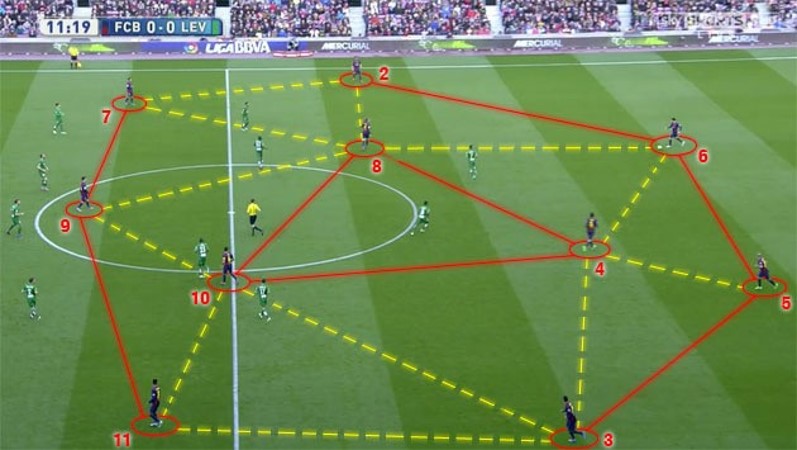
This is Barcelona: We are using different numbers but the principles are the same. At any one time this can be a 3-1-3-3; it looks more like a 3-3-1-3 here

Basically we do it with (4), (5) and (6) as the first three, (8) is the single player, (2), (3) and (10) the next line of three and finally (7), (9) and (11) as the front three. But players rotate within this system to create a distinctive angled possession STYLE within the system / formation.
Distribution from the keeper and Playing from the back in a 3-1-3-3
Perhaps use cones instead of actual players to practice to make it work initially and to gain confidence (better still use Mannequins). Attacking team work the ball to the coach and then work it back to the keeper, back and forth.

Distribution from the keeper and Playing from the back in a 3-1-3-3
Our starting position, the team is in defensive shape and ready to attack. A 7 v 4 makes it easy to get out, but decrease the number of opponents if necessary to gain success initially; or increase if too easy.

How to coach it: Getting the ball to the Coach (or use small goals if you prefer)
Our team building from the back get wide and long. We maintain possession passing up and down and can go back to the keeper and constantly start again; or give it to the coach.

The coach can give it to the attacking red team
Coach gives it to the attacking red team and the defending team (your team) must get back to defensive shape asap. Add more players if this is too easy to defend against.

The coach can give it back to the keeper to start again
Coach can pass it to the keeper, your team resorts back to defensive shape as the ball travels and then starts to build again with the ball

1. Distribution from the keeper using one attacking wing fullback
We attack down one side and we slide across with the back three to cover the spaces behind

2. Distribution through Both center backs or (6)
A simple starting position on distribution from the back using only those players in the immediate vacinity. A 3 v 2 at the back in our favor.

3. Distribution through Number (6) in a wide area
Now (6) breaks wide to receive the ball and escape being marked in the middle and switches with (4) and perhaps opponent (9) goes with (4). The same can happen with (6) breaking out to the right also replacing (5) who moves centrally.

4. Distribution from the keeper: One centre back breaks wide
(4) Stays tight, (6) stays central, (5) goes wide, (2) pushes on and we get out down one side. Opponents (9) and (10) stop our (6) and (4), (5) gets free to play out. Only 2 defending now so risky against a counter attack.

OR, (3) stays tight too (4) moves central, (6) takes (5)s place at the back, (5) goes wide, (2) pushes on and we get out down one side. Opponents (9) and (10) stop our (6) and (4), (5) gets free to play out. (2) becomes (7), (5) becomes (2). Three defending now.

5. Distribution from the keeper thru wingbacks
They push 3 up we get out through our wingbacks. Have opponents make different choices to force the keeper to make relevant decisions in training.

Distribution from the keeper through Both wing backs
We can start to add players and build the session up. Here we close off one side so the keeper has to recognize he cant go to (3) but can go to (2).

6. Distribution from the keeper thru central midfield rotation of (6) and (8)
(6) Clears the space and takes the opponents (8) with him and our (8) drops in free to start the attack. Can also be with (6) and (10).

7. Distribution through Both wing backs dropping back
Centre backs both push out quickly,. And they are tracked by the two strikers. This releases spaces behind them. Both wing backs drop back into those spaces to receive the ball.

8. Distribution through centerbacks getting free
Centre backs both push out quickly,. Opponent strikers press the wing backs and centre backs get free so can bring the ball out and attack. Wing backs fill their positions by rotation. (2) and (3) become centre backs and tuck in either side of (6). Also (6) and (8) tried to rotate to get out.

How it may look if we lose the ball and have to recover
We tried (6) and (8) rotation, also center backs and wingbacks rotated, then we lost the ball and this is how we recover with players in different positions but in the same defensive framework.

Distribution from the keeper and Playing from the back 11 v 11
Now in an 11 v 11. Our normal way to get out from the back. We should always try this initially if it is on to do so. Try to get out thru (4), (5) or (6).

Distribution from the keeper 11 v 11
Another way to get out thru one center back and one wingback and even (8). (6) fills (5)s position (4) fills (6)s and (3) fills (4)s

Another way to get out thru one center back (5) and (7). Wingback (2) tucks inside and may take opponents 11 with them to clear the pass for (7). A nice area to play into circled also.

They go 3 v 3 against us to stop us playing out of the back so we try to get out through (2) and (3). Otherwise we have to push up, condense and kick it long.

This takes lots of practice with the keepers to make this pass happen consistently.
They go 3 v 3 against us so we try to get out through (2) and (3). Otherwise we have to push up, condense and kick it long. They “may” see what we are doing and push 7 and 11 onto our wingbacks (2) and (3).

They push two players onto our wingbacks (2) and (3)
This outlet is now stopped.
So we have to change our team shape from “wide and long” to “short and tight” getting ready for the long kick from the keeper.

9. They have pushed onto our Wingbacks so this outlet is stopped; we have to go long as a last resort
This can still be EFFECTIVE: Now we condense as a team “short and tight”. Our (10) is good in the air so we hit him and we have a lot of players around him to win the 2nd ball. Of course opponents will readjust also. Its cat and mouse.

This can still be EFFECTIVE: Now we condense as a team “short and tight”. Our (10) is good in the air so we hit him and we have a lot of players around him to win the 2nd ball. Of course opponents will readjust also. Its cat and mouse.

We leave their 3 strikers offside.
Players can gamble for the flick on from (10). Players position behind, in front and alongside (10) so wherever the 2nd ball goes we have players to pick it up. WE ABSOLUTELY MUST get better at this. Obviously opponents will position better than this defensively; but you get the point.


The Three Team Awareness One Touch Game
Working with three teams (numbers depends on how many players you have, e.g. it can be 4 v 4 + 4 or 5 v 5 + 5 etc). Teams (1) and (2) work together to keep the ball from team (3). If team (3) regains possession the team who gave it away becomes the defenders. The defenders reward is they keep the ball and link with the other team.
The following clinic is part of the New "Soccer Awareness Age Group Specific Awareness Developmental Training" eBook from Soccer Awareness! Click here to preview the full table of contents!
Working with three teams (numbers depends on how many players you have, e.g. it can be 4 v 4 + 4 or 5 v 5 + 5 etc). Teams (1) and (2) work together to keep the ball from team (3). If team (3) regains possession the team who gave it away becomes the defenders. The defenders reward is they keep the ball and link with the other team.

Rules: Once possession is gained, to establish who gave the ball away the player who gave the ball away calls the color of his team and then everyone knows they are now defending and the game continues without a stoppage.
With younger players it may be best to do this (because the ball may be given away a lot more for one thing); whoever won the ball puts his or her foot on the ball to stop play and the coach can call out the team who gave it away. Play begins again working on transitions.
Develop: Increase difficulty for attackers by
Reducing the zone size.
Decreasing the number of touches on the ball of each player.
Conditioning the passing to be only to the other attacking team’s players e.g. (1) only passes to (2) and vice versa, therefore only half the numbers of passes are available per player.
Using two balls so that as they pass one ball they are now increasing their awareness and vision by looking for the other ball coming.
Players take off their pinnies so they really have to look and can’t rely on color identification.
No talking or pointing, so players have to rely on their own vision.
Prohibiting verbal communication
ULTIMATELY PLAY ONE TOUCH
Three Team Possession Game
Three teams, two teams work together, one defends, creates an overload situation in attack, for example 15 players, three teams of 5, a 10 v 5 game.
Possession changes as one of the two team’s players gives the ball away to the defending team then they become the next defending team this is a good transition game also from attack to defense and defense to attack. This game can be in an area of 40 x 40 yards for example and the challenge to the players can also be to move inside to outside (outside being just inside the touchline) and outside to inside to ensure they avoid standing in one area. Plus it takes greater vision or awareness inside the area; where they need to look around and open their stance up to potentially change the direction of play; than on the outside where they can see everything easily.
Encourage players who play centrally on the team to get in the middle of the area and dictate the play, be the pivot for the team, the player who transfers the ball from one side to the other, the link player, this can be one, two or even three players at a time, but they can rotate between themselves too.
Equal numbered teams in a possession keep away game; this would be the next progression from the overload game being a more difficult challenge of the players. Same principles and ideas as above apply.
Transition games: In two halves, creating overloads in each half as each team gains possession. Team A have to get the ball in one half and play a 7 v 3 for example, team B have to win it back with the 3 defenders and get it back to the other half and have a 7 v 3 in their favor, and so on.

Breakaway Game
In this game we are working on finishing, dribbling and breakaways. This is a great activity to work on both attacker and goalkeeper skills.
Finishing, dribbling, breakaways
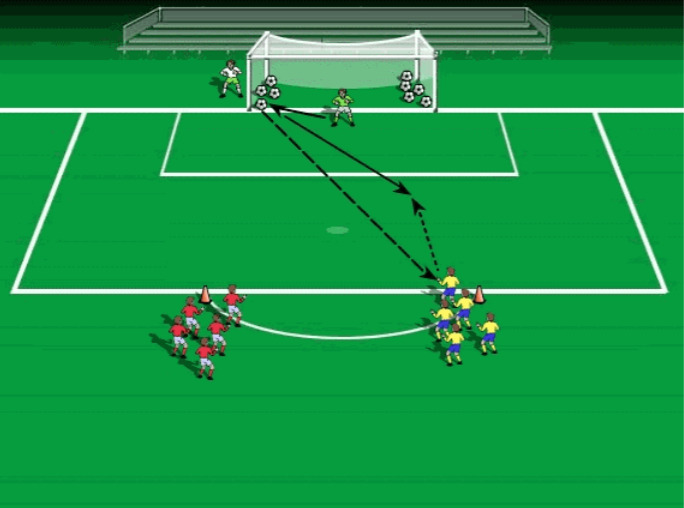
Use the penalty area. The balls are placed in the side of the net and easily accessible for the goalkeepers. All players are at the top of box on either side.
The goalkeeper starts the exercise by distributing the ball to the first person in line at the top of the box.
The attacker must control the ball and immediately breakaway to goal.
As soon as the ball has touched the attacker for the first time, the goalkeeper can leave his/her goal line and close down the shooter.
The attacker has five seconds to score.
The goalkeeper allowing the fewest amounts of goals wins. Keep track of the goals.
The team or individual with the most goals wins. Alternate the goalkeepers every time.

Progression:
The goalkeeper must find the attackers chest.
The attacker has three seconds to score.
Coaching Points:
The goalkeeper must react to an errant touch by the attacker.
The attacker’s first touch must be out at a 45 degree angle away from the body.
If the goalkeeper’s feet are moving, shoot quickly.

This drill comes from the Soccer Awareness Youth Coaches Guide!
A Complete 6 to 10 Year Old Developmental Coaching and Training Program. More than 750 pages of session, drills, theory and more to get you started or take your team to the next level.
This program is perfect for youth coaches wanting practices to start their soccer coaching education and it is also for those more advanced and experienced coaches wanting to train their players as best they can at these wonderful open minded ages for development and education of both the mind and body. Our plan is to help all coaches at whatever level of experience they are at.

Defensive Pressing to Push Up Without Touching the Ball with a Back Three
This is a great session to teach the players and shows how they can push opponents back even when THE OPPONENTS have the ball.
We will try to push them back without even touching the ball ourselves. We start on the edge of our box we try to get our back three up to the half way line. Set Conditions will help us do this to start the process off.
Conditions:
Defending team cannot tackle.
Defending team CAN intercept a pass.
Attacking team must play 1 or 2 touches due to the fact defenders cannot tackle so opponents cant dribble 1 v 1.
Coaching Points:
Defenders press the ball as quickly as possible.
Try to stop the forward pass, try to force a pass across the field or backwards.
Defenders must recognize every opportunity to push up no matter how small a distance it may be.
Sometimes its 5 yards up 3 yards back for example depending on the position of ball and if there is pressure on it.
Try to intercept the pass and gain possession.
Download this free 20 page session by joining our mailing list below


Awareness Numbers Game Working in Three Zones
Here players pass and move into other zones to receive the next ball that is coming. This ensures players get the idea of passing and MOVING off the ball, not passing and then standing.

Conditioning the players to pass and move by setting the rule they need to move into another area once they have passed.
Divide the field up into sixth’s and then have the players make a pass in one area then they must move to another area to receive the next pass. This can cause players to pass long or pass short and vary the range and distance of the passes and the support as they are required to move once they have made their pass.
Here we are using three teams of four players.
Here players pass and move into other zones to receive the next ball that is coming. This ensures players get the idea of passing and MOVING off the ball, not passing and then standing.
Can say players must pass to space so they pass into another zone next to the one the player they are passing to in order to force them to move to the ball
Non-Competitive Awareness Numbers Game: Passing in Sequence

This is a great game for forcing players to observe what is ahead of the ball in terms of knowing what they need to do with the ball “before” they receive it. Players (1) and (2) work together and players (3) and (4) work together.
Players must pass in sequence i.e. 1 passes to 2; 2 passes to 3; 3 to 4 and 4 passes to 1 and we begin again. You can have players static to begin then have them passing and moving. Player receives from the same person and passes to the same person each time. This develops great awareness of time, space and player positions. This is continuous work on and off the ball.
Awareness of: where the player you receive from is and where the player you pass to is. Because of this players begin to anticipate the pass to them and where it is coming from. Also they must look to where it is going to (where is the player they are passing to?).
We are trying to create a situation where players are looking two moves ahead not just one. For instance as (1) is about to pass to (2), (3) should be looking to support (2) for the next pass already, looking two moves ahead before the ball leaves (1). Peripheral Vision Development results from this.
(3) should recognize if they need to move into a space early or late based on this observation, but know in their mind already what the next best option is. Moving into the space too early in a game situation for example may result in being marked too easily. But knowing in advance “when and where” to move to is an advantage and this game helps players develop this thought process.

Ask players to make it difficult to find them by lots of movement off the ball to test their team mate’s vision.
Progression: Use two balls then three balls at the same time. Start with a ball at (1) and (4) then at (1), (4) and (6). To keep the sequence going players must move the balls quickly with few touches hence their peripheral vision development improves dramatically. As soon as they have passed one ball off the next one is arriving so quick thinking is needed to make the correct decisions. Divide the field up into third’s and ask players to make a pass in one third then they must move to another third to receive the next pass. This can cause players to pass long or pass short and vary the range and distance of the passes and the support.
Here (3) passes to (4) and moves into another zone to receive the next ball that is coming. This ensures players get the idea of passing and MOVING off the ball, not passing and then standing. (2) Does the same with a pass to (1) then moving into another zone supporting the next ball to come along.



Triangle Rondo and Angled Support for 6 Players
Two balls going at once. 1 touch if possible otherwise two touches maximum to keep the timing going. Players don’t rotate positions. Repeats every 5th pass. Coordinated movements and rhythm between groups.
The following drill comes from the new Rondos section of the Soccer Awareness Training Center. Soccer Awareness Training Center provides unlimited access to Wayne Harrison's Soccer Awareness systems, training sessions, drills and more. Wayne's system helps develop world class youth soccer players and teams in a systematic and imaginative manner that guarantees performance at the highest level of competition. Whether you’re a beginning coach who needs help getting started or someone who wants to add some variety to their training sessions, the Soccer Awareness Training Center offers a wide variety of drills to choose from. Join Today
Two balls going at once. 1 touch if possible otherwise two touches maximum to keep the timing going.
Players don’t rotate positions. Repeats every 5th pass. Coordinated movements and rhythm between groups.


Barcelona Double Rondos with a Neutral Player Added

Sliding Rondo Playing 1 and 2 Touches

Double Diamond Rondos for 10 Players


Positional Possession Areas to Create Superiority - Training Center Exclusive
This game and its many progressions are designed to get the most out of the thinking processes of the players. Many mental challenges to overcome and learn from. In the game players must develop the ability to be calm under pressure, to be confident to receive the ball in tight spaces and to have the confidence of teammates to give the ball to you under pressure. Players need to develop their ability to look ahead of the ball even more, to assess options and make decisions even faster because the time on the ball is even more restricted than usual.
This article is available for Training Center Members Only. Get more information about joining here.
This game and its many progressions are designed to get the most out of the thinking processes of the players. Many mental challenges to overcome and learn from. In the game players must develop the ability to be calm under pressure, to be confident to receive the ball in tight spaces and to have the confidence of teammates to give the ball to you under pressure. Players need to develop their ability to look ahead of the ball even more, to assess options and make decisions even faster because the time on the ball is even more restricted than usual.

Overloading Players in the Zone 14 eBook - Training Center Exclusive
Teams may work out that we are good at playing penetrating passes and making great runs in behind them so the way to try to stop this is to defend deep. If they defend deep we need a tactical solution to counter this. This presentation gives you ideas on how to do this and play initially IN-FRONT of the opponents back four.
Teams may work out that we are good at playing penetrating passes and making great runs in behind them so the way to try to stop this is to defend deep.
If they defend deep we need a tactical solution to counter this.
This presentation gives you ideas on how to do this and play initially IN-FRONT of the opponents back four.
Bayern Munich and Barcelona are very good at this, both motivated and taught by Pep Guardiola.
We can do it at our age level just as effectively.
We can practice this in a tight area, with the relevant players in their usual positions in the attacking third and just play possession.
Soccer Awareness Training Center Members can download this 11 page eBook for free below. Now a member? See all the benefits of joining here. Try a monthly membership for free.

Passing Game for Spatial Awareness Development
Players have the ball at their feet for approximately 5 minutes out of 90. What do they do the rest of the 85 minutes? They must learn to move off the ball and to move into open passing lanes to be open at all times to help the player on the ball or the next player on the ball. Here is a great session to teach this.
We can use many upright cones to represent opponents rather than mannequins. We set the cones up in triangles and diamonds. We ask players to position between the cones in the best space available. Try to balance their position to find the best space in the middle of the triangle or diamond of cones (opponents). Players beyond the ball try to position in triangles and diamonds of support also.

The following is an excerpt from Soccer Awareness eBook 16: Soccer Awareness “One Touch” Training: Developing its Relationship with Movement Off the Ball.
This 103 page eBook explores one touch training and movement off the ball and includes 90 pages of drills that you can do with your team.
Passing Game with Cones for Spatial Awareness Development using Mannequins or Cones in Training for Movement Off the Ball
Players have the ball at their feet for approximately 5 minutes out of 90. What do they do the rest of the 85 minutes? They must learn to move off the ball and to move into open passing lanes to be open at all times to help the player on the ball or the next player on the ball. Here is a great session to teach this.

Getting into passing lanes to help each other
We can use many upright cones to represent opponents rather than mannequins. We set the cones up in triangles and diamonds. We ask players to position between the cones in the best space available.
Try to balance their position to find the best space in the middle of the triangle or diamond of cones (opponents). Players beyond the ball try to position in triangles and diamonds of support also.

OBJECTIVE: To improve movement off the ball by providing mannequins to act as opponents to fill important space
A non-directional training practice
Mannequins represent opponents on the field. They fill important spaces so the players need to pass and move around and between them. This ensures players move off the ball to help the player on the ball have as many options as possible for a pass. The goal of the players is to find as much space as they can between the mannequins to give themselves as much space as possible to play in.
Every now and again stop the practice and see where the players are positioned. Are they in free space? Are they too close to a mannequin and hence in a game situation not available for a pass? If they are then ASK THE PLAYERS to SHOW you a better position to be in.
Possible problems here are the positioning of players behind opponents so the player on the ball cannot see them to pass to.
Develop:
Restrict the number of touches on the ball to 3 touches, two touches then one touch; if it is on to do so. To enable one touch to be possible movement off the ball has to be intelligent, fast and into space to help the passer play one touch. Thinking AHEAD of the ball arriving is paramount here otherwise one touch play cannot be performed successfully. Try to think two moves ahead. Movement OFF the ball by others is paramount here also otherwise the person receiving the pass will not be able to play one touch successfully.
Play the Numbers Game: 1 passing to 2, 2 to 3, 3 to 4 and so on. Increase the number of balls being used.
Two teams playing in the same area with a ball each. Now players need to avoid the other team AND the mannequins to find space to receive the pass.
Coaching Points:
Thinking and looking before receiving of the receiving player so they have assessed their options before receiving and in advance of the ball
Ability to play ONE touch if possible for speed of play
Movement OFF the ball of teammates to help the player on the ball
Movement INTO spaces between and around the mannequins to enable this to happen using the mannequins as guides.
Thinking TWO moves ahead to support.
Playing in triangles of support offering several options for the player on the ball in many directions.
An exaggerated situation but this shows what happens when players do not move to space to help the player on the ball; and do not open up the angle for a pass, instead standing behind an opponent and not being free to receive. How many times do you see this?
To defeat this problem; the player on the ball can pass to a space hoping that this will force the receiver to move to that space to receive the ball. Then the weight; timing and accuracy of the pass has to be particularly good; but this is not ideal.
Whilst players can still be successful with later movement off the ball of supporting players; if the player on the ball hastime on it to take more touches; it is always better to provide options of a pass as early as possible to increase speed of play and give opponents less time to work out their movements.
Working in threes
Here showing possible passing routes with each group of three players also showing how they get free and into as much space as possible, based on the positions of the mannequins who act as opponents filling spaces.
Different colors to pass to in order to develop color coordination.

Game situation
Have players passing in two teams to begin as a warm up, with a ball each team, then two and three balls each team. Then they pass to opposite colors only.
Now play a 6 v 6 (or any number you like) and make it a possession game. Mannequins make it more difficult by filling spaces so players have to play around them as well as their opponents. This should improve them playing in tight situations.
Use a 2 player overload if required initially until they get really good; then make it equal numbers each team, you dictate this based on the ability of your players. Of course change the numbers of touches on the ball decreasing the number as they become proficient to increase the difficulty.

The focus is again passing and movement off the ball to receive with as many players as possible offering an option of a pass for the player on the ball.
Here we show potential positioning of players in the biggest spaces they can find between the mannequins.
More space means more time to play on the ball so the player has the choice to play quickly or not; also depending on the individual situation presented; and often dictated to by the support positions of his teammates.
Develop: Have two teams playing through each other avoiding each other and also avoiding the mannequins. This is now a big challenge to each player on the field where there will be less space to play in and their peripheral vision will really be tested to its fullest.

Game Situation
Try an overload first of all maybe a 9 v 4 building it up to a full game. This is a big challenge meaning fewer spaces to play in and forcing more movement off the ball to support each other.

Here is a great video of FC Barcelona YouTube showing how this works.
Get more like this in Soccer Awareness eBook 16: Soccer Awareness “One Touch” Training: Developing its Relationship with Movement Off the Ball.
This 103 page eBook explores one touch training and movement off the ball and includes 90 pages of drills that you can do with your team.

A Rondo Overloading Players In The Zone 14 - Training Center Exclusive
This Rondo is perfect for a starting point on rotation and movement in front of opponents defense. Teams may work out that we are good at playing penetrating passes and making great runs in behind them so the way to try to stop this is to defend deep.
If they defend deep we need a tactical solution to counter this. This presentation gives you ideas on how to do this and play initially IN-FRONT of the opponents back four.
Bayern Munich and Barcelona are very good at this, both motivated and taught by Pep Guardiola.
Soccer Awareness Training Center members can download this full 20 page session below.

This Rondo is perfect for a starting point on rotation and movement in front of opponents defense. Teams may work out that we are good at playing penetrating passes and making great runs in behind them so the way to try to stop this is to defend deep.
If they defend deep we need a tactical solution to counter this. This presentation gives you ideas on how to do this and play initially IN-FRONT of the opponents back four.
Bayern Munich and Barcelona are very good at this, both motivated and taught by Pep Guardiola.
We can do it at our age level just as effectively. We can practice this in a tight area, with the relevant players in their usual positions in the attacking third and just play possession as a warm up.
Lots of repetition in training to embed the ideas in the players minds.
Setting Conditions To Make It Work
We overload zone 14 as shown. Condition the back four to not be able to go past the blue cones to keep them defending deep. Condition the attacking players to stay inside the Zone 14 orange coned off area so they MUST condense and get tight and get close to each other.

Getting Shots In On Goal
Again short and sharp build up, good positions in tight spaces between opponents and movements OFF the ball to get free to get into a shooting position. Other players follow in for rebounds but time it so they are not offside. Typical Messi run.

Overloading Players In Front Of The Opponents Two Center Backs
We want to overload Zone 14 in the center of the field by maintaining two wide players so there is an option to play wide. The idea is to get up in numbers in front of the two center backs. If the fullbacks tuck in to help as they have here and equal the numbers up then we can go wide to (2) and (11). Here a 3 v 2 centrally. (A) and / or (D) may tuck in but this frees up (11) and (2) wide.

This can be one full session practicing playing short and tight and with quick 1 and 2 touch play. Players must move subtly to get into open very tight passing lanes between opponents.
Play quickly.
Soccer Awareness Training Center Members can download this 11 page eBook for free below. Now a member? See all the benefits of joining here. Try a monthly membership for free.

Quick Pressing Game
This game is an excellent example of how a small change to the structure of a standard game changes the game to allow a specific skill or topic you want to work on. You don’t need to say anything; the explanation is in the game.
This game is an excellent example of how a small change to the structure of a standard game changes the game to allow a specific skill or topic you want to work on. You don’t need to say anything; the explanation is in the game.
Organization:
Age Group U10s to adults
Pitch sizes 30/40 x 20– or at the discretion of the coach
Number of teams – 2
Team sizes 4-6 players
Bibs optional
Goals – full size adult goals or made with cones

Progression: This is a standard small sided game but with big goals and no keepers. Players can score from anywhere on the pitch. It is very easy to score a goal in this game, so players quickly understand they have to put pressure on the ball and not allow players to shoot. They must close quickly. Players need to concentrate as a poor defensive position will ultimately lead to conceding a goal. Alternatively you can add a keeper in each goal and the players have to JUST pass the ball to the opposing keeper to score.




Training Vialli Opposite Runs
Here is one way to train striker movements “off the ball” to find space and receive.
The following presentation is an example of what can be found in the Striker Movement Section of the Soccer Awareness Training Center. Soccer Awareness Training Center provides unlimited access to Wayne Harrison's Soccer Awareness systems, training sessions, drills and more. Wayne's system helps develop world class youth soccer players and teams in a systematic and imaginative manner that guarantees performance at the highest level of competition. Whether you’re a beginning coach who needs help getting started or someone who wants to add some variety to their training sessions, the Soccer Awareness Training Center offers a wide variety of drills to choose from. Join Today
Here is one way to train striker movements “off the ball” to find space and receive.
A simple set up to practice movement off the ball. (A) and (B) pass the ball back and forth, on the third pass the movement begins and (A) makes the desired pass. Do BOTH sides so players get to finish both sides with both feet. Or the Striker can use a code word for when the pass is made “Code Word” can be anything you like. You can create new ideas yourself and using this set up means it is easy to recreate. Sequence is (S) shoots, then (D) becomes (S) and (A) becomes (D) and (S) becomes (B) and we rotate through each player so everyone gets the chance to finish on goal. Or you may have more players to keep the momentum going. You can use this session as young as U8 in my opinion obviously simplifying it for the younger players.
Opposite Striker Movement 6
(A) And (B) pass back and forth. (S) makes a run to receive the ball. (S) wants to draw (D) towards the ball and create space in behind for himself to check and run into.

Opposite Striker Movement (The Vialli)
Striker (S) checks towards the ball. Have a “code word” which means he goes short to go long and perform an OPPOSITE RUN and (B) knows this so passes in behind. He creates space behind him by drawing the defender to the ball. Must be a sharp checking movement.

Opposite Striker Movement
Here striker (S) has left defender (D) for dead and is in on goal with a 1 v 1 with the keeper. (S) calls the “code word” as the ball is travelling to (A) and (A) then knows (S) wants the ball behind and beyond (D) and not to feet.

Include the striker in the build up
(A) To (B), (B) to (S), (S) to (A), (A) to (S).

New Striker Movement Presentations in the Soccer Awareness Training Center

Teaching Players to Face Up and Not Play with Their Backs to Goal in the 3 Team Transition Finishing Game

Details of Striker Movements “Off the Ball” to Find Space and Receive; And Finishing Techniques

Triangular Set Up for Striker Movement

Third Man Runs in the Attacking Third and Simple Off the Shoulder Runs of Strikers
Soccer Awareness Training Center provides unlimited access to Wayne Harrison's Soccer Awareness systems, training sessions, drills and more. Wayne's system helps develop world class youth soccer players and teams in a systematic and imaginative manner that guarantees performance at the highest level of competition. Join Now

How to Play and Teach the 1-4-2-3-1
Here we have a 6 part video series showcasing Wayne Harrison presenting the 1-4-2-3-1 at the NSCAA Annual Convention in front of over 1200 coaches from around the world.. The series begins with developing play out the back to ultimately fashioning attacking and finishing movements off the ball in the attacking third and the 5 phases of play as he creates it. Wayne goes through the thirds of attacking development for you from back to front.
Here we have a 6 part video series showcasing Wayne Harrison presenting the 1-4-2-3-1 at the NSCAA (now United Soccer Coaches) Annual Convention in front of over 1200 coaches from around the world.. The series begins with developing play out the back to ultimately fashioning attacking and finishing movements off the ball in the attacking third and the 5 phases of play as he creates it. Wayne goes through the thirds of attacking development for you from back to front.

Ball Control and Dribbling Skills Ideas
Dribbling is a ball skill that's crucial in soccer. The best soccer players in the world can control the ball when sprinting at full speed and avoiding defenders. Better dribbling skills allows players to create space and time and therefore better control the ball and make plays. Here are two drills you can add to your practices to improve your teams dribbling skills.
The following two drills come from eBook 27: Dribbling Technique and Skill for U6 to U9. This eBook includes drills and teaches technique that you can use in practice to help your team perfect their dribbling. You will learn different techniques to control the ball, specific dribbling moves, awareness dribbling work, dribbling for possession and more than 50 pages of drills that you can use with your team.
Wayne Harrison has put together this collection of dribbling drills from his wealth of knowledge at the highest levels of the game both as a professional player and professional coach. Find Out More
He Says She Says

Emphasis: Ball control and motor skills
Set-up: Use the penalty box or the center circle. Grid size depends on the number of players. Each player has a ball.
Objective: The players must follow the instruction of the coach. For example, if the coach shouts “touch the ball quickly side to side”, then the players must do so. Complete 10 commands successfully and then stretch for a minute. Repeat using different commands.
Progression:
Tap the top of the ball with the bottoms of your feet, alternating feet each time.
Jump over the ball.
Hop around the ball.
Skip around the ball.
Toss the ball up, hit it with your head, and catch it.
Use the bottom of your foot and move it in a circle.
Kick the ball in the air, turn, and catch it.
Coaching Points:
Get the touches right.
Don’t run into anyone.

Indianapolis 500

Emphasis: Dribbling, ball control
Set-up: Set up a 15x20 yard grid (race track). Place all of your players in the grid with a ball.
Objective: The players must not crash into the cones (rails). If the players (collide) with each other or the cones (rails), they must go outside the grid, and do fast footwork with the ball. For example; toe touches on the ball, quick passes side to side, or quick turns with the left and right foot. The players (cars) must obey the coaches (race director) shout. “Shift gears”-change directions, “red flag”-stop the ball, “blue flag”-stop the ball with the knee, “yellow flag”-dribble slower, and “green flag”-accelerate to top speed.
Progression:
Make the grid smaller and more congested.
Players must only use the left foot only.
Coaching Points:
Keep the ball close to your body.
Concentrate on change of direction away from pressure (other cars).

Diagonal Runs Without the Ball in a 6 v 6 Game
The theme is making diagonal runs with or without the ball to receive or create space for a teammate. When it is a forward diagonal run the player making it must avoid running offside in a game situation.
The following comes from Soccer Awareness eBook 12: 16 Team Shape Games. Soccer shape teaches players how to defend and attack as a team. No matter what formation you choose to play, Team Shape is a vital component to how successful your team will play on the weekend. In this book we will look at various options based on age groups for the size of the games. Get the book here.
The theme here is making diagonal runs with or without the ball to receive or create space for a teammate. When it is a forward diagonal run the player making it must avoid running offside in a game situation.

Coaching Points:
Creating Space.
Decision – when and where to pass into the receiver.
Technique – Quality of pass particularly the weight, accuracy and timing.
Angle and Timing of the Diagonal Runs both to create space and to receive the ball.
Support Positions of the players.
In the above example (2) is on the ball to pass it forward. (6) Makes a diagonal run away from the center taking man marking (B) with them. (4) Also makes a diagonally opposite run away from the central area taking (C) away also. This leaves space for (5) to come short with another diagonal run to receive the pass. As in receiving and turning (5) may have run (A) off to check back if time was available to do so thus creating more time and space on the ball.
Another way to create space for (5) coming short to receive would be for (6) to make a run towards (5) and cut across the path of (5)’s marker (A) to hold up their run.


With this 94 page eBook, we are taking the Soccer Awareness thinking process to the next level by identifying what is relevant at each age group. That said, you the coach, will decide perhaps a 9 year old team can cope with the 11 year old sessions and perhaps a 12 year old lower level team will need to use younger age group session plans.
We hope you enjoy these sessions and as always our Soccer Awareness training material is simple to understand, user friendly and we try to offer a great attention to detail.
Feedback is always welcome as we want to keep improving our product.
Best wishes, Wayne Harrison