Welcome to the Soccer Awareness Coaches Corner. Browse through soccer drills, small sided games, tactical thoughts, full sessions and a variety of resources. Posts marked “Training Center Exclusive” are for members only.

Playing in 5 Corridors and 3 Zones Using the 3-3-1-3 for Attacking and Defending Team Shape
Using Corridors is a great way to work out individual and collective field positioning as a team both offensively and defensively and it also gives players real a “focal point” to work off. We use “Corridors” width wise and then introduce “Zones” lengthwise later. These “focal points of reference” I believe are a great way to really teach players to understand the differences between attacking and defending team shapes both widthwise and lengthwise. A great session to help players identify positional variations, the 4 lines are used as a clear guide widthwise.
The following is part of a 60 page presentation on the 3-3-1-3 that can be found in the recently added 3-3-1-3 System of Play page in the Soccer Awareness Training Center. Soccer Awareness Training Center provides unlimited access to Wayne Harrison's Soccer Awareness systems, training sessions, drills and more. Wayne's system helps develop world class youth soccer players and teams in a systematic and imaginative manner that guarantees performance at the highest level of competition. Whether you’re a beginning coach who needs help getting started or someone who wants to add some variety to their training sessions, the Soccer Awareness Training Center offers a wide variety of drills to choose from. Join Today
You can use this method of teaching with any system you like.
We divide the field up into Corridors and Zones to help players understand the major differences in spacing between attacking and defending team shape. We call them Corridors Widthwise and Zones Lengthwise. Below are some parameters to work off in my opinion. We first discuss the use of the Corridors.
Team Attacking Shape: Based on the 5 corridors width-wise we want all 5 corridors to have players in them. Based length–wise we want a maximum of 2 of 3 zones filled; with the exception of the keeper.
Team Defending Shape: Based on the 5 corridors width-wise we want a maximum of 3 corridors filled with players preferably 2.5 if possible.
Based length-wise we want a maximum of 2 of 3 zones filled preferably the whole team is condensed into 1.5 zones or at most half a field.
Playing in 5 Corridors Using the 3-3-1-3
Using Corridors is a great way to work out individual and collective field positioning as a team both offensively and defensively and it also gives players real a “focal point” to work off.
We use “Corridors” width wise and then introduce “Zones” lengthwise later.
These “focal points of reference” I believe are a great way to really teach players to understand the differences between attacking and defending team shapes both widthwise and lengthwise.
Particularly in defensive set ups (in my opinion); it shows players how to mark in zones and how much tighter it should be than they will likely imagine and especially shows those players furthest from the ball defensively how important zonal marking is.
Example, the balls is on our left with the other team and our right back is marking the opponents opposite side winger far too wide, by having designated lines this becomes much clearer to understand.
The Theme is positioning OFF the ball as a team
A great session to help players identify positional variations, the 4 lines are used as a clear guide widthwise.
Using such a fluid system of play as ours; putting the lines in as a condition is a great help.
Example if (7) goes outside (2) has to be inside (Phase 2 to Phase 3)
Defining lines also force players to play at angles to each other thus improving their peripheral vision and their preferred side-on body shape.
Divide the field in thirds lengthways also for attacking and defending principles to be worked on.
High pressing is vital to allow us to push many players forward so if we lose the ball in the attacking third we don’t let them out.
This is our starting position of 3-1-3-3. The keeper wins the ball and we change shape completely. This is Phase 1 of our 5 phases of play.

This is our defending position of 5-4-1 possibly after recovering back and playing more defensively.. The keeper wins the ball and we change shape completely.

Here we have a good balance with players positioning at angles to each other. This is Phase two of the 5 phases of play are wide and long.

Here we have a good balance with players positioning at angles to each other. This is Phase three of the 5 phases of play where (7) and (11) cut inside to overload in and around zone 14.

Get the rest of this 60 page presentation and much more on the 3-3-1-3 in the Soccer Awareness Training Center. We have just added 9 presentations on this very fluid system of play. Check it out.




Developing Attacking Play in the Opponents Defending Third
The attacking team has the ball. This is the start position of the game situation.
The idea is to have this phase, being the attacking one, and working on various ideas of movement, rotation and interchange to try to score.
You can focus on this until success is achieved from an attacking point of view.

The following is the beginning of Soccer Awareness eBook 31: Developing the Four Phases of the Game.
The game is really all about 4 Phases of Play. It can be divided up further into sub phases but the essence of the game are these 4. This eBook is what one of my main training sessions is based on. We actually train very often with this precise game situational model as it totally mirrors what I expect my team to do in the actual games. In doing so, we practice the same ideas over and over until they become AUTOMATIC when it matters.
The attacking team has the ball. This is the start position of the game situation.
The idea is to have this phase, being the attacking one, and working on various ideas of movement, rotation and interchange to try to score.
You can focus on this until success is achieved from an attacking point of view.
The starting point of the session: attacking team shape in a “Phase of Play”

Starting position of the attacking team. We can begin with an overload to get things moving positively in an attacking sense by not including (7) and (11) on the defending team. 16 players.
Attacking team shape in a Phase of Play: Using the full width of the field

To begin, our advantage is in wide areas where we have 2 v 1s on each side of the field. Draw defending fullbacks a Little wider in the process.
Wide attackers (7) and (11) cut inside to attack the inside áreas of the field


(7) And (11) cut inside to support (9) and draw defenders in to créate space wide for (2) and (3) to attack in.
(8) and (10) pull away from their markers to get free. Here we must attack through the wide areas of the field.
Defending fullbacks stay wide
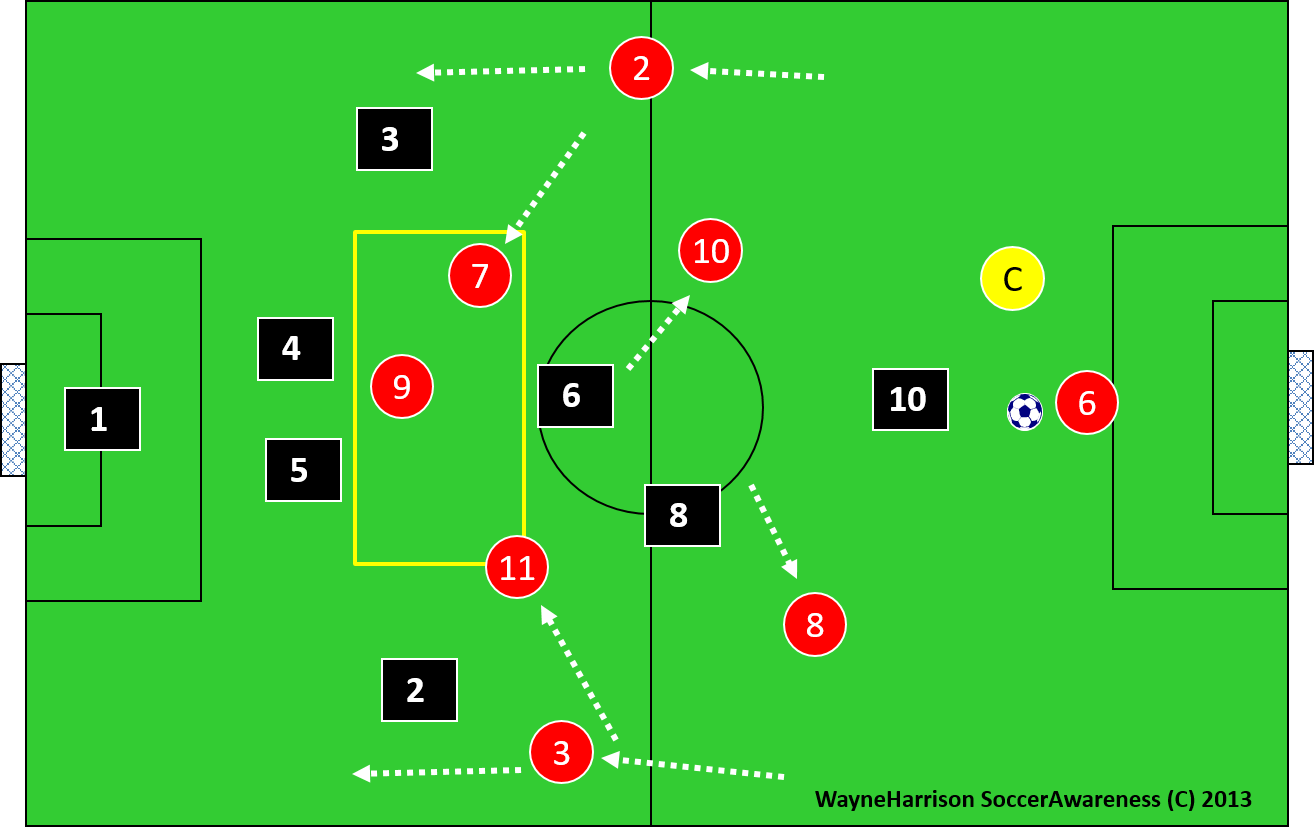
Defenders (2) and (3) are distracted by the runs of the attacking (2) and (3). Now (7) and (11) overload the central área in front of the two center backs. This is the área we must attack now.
Attacking wingbacks cut inside

Defenders (2) and (3) are distracted by the runs of the attacking (7) and (1). Now (2) and (3) overload the central área in front of the two center backs. This is the área we must attack now, this is a less predictable movement by the attacking team.
Movement OFF the shoulder of defender (4)

Striker (9) moves off the shoulder of defender (4) in the build up to get free for a pass into the open channel from (3).
Attacking wingback (2) cuts inside to score

(9) Drags defender (4) short thinking he is receiving to feet and (2) exploits the space left in behind defender (4). This kind of move is a rarity because not many teams teach wingbacks to get into central shooting areas like this.
Get the rest of this session and more like it in Soccer Awareness eBook 31: Developing the Four Phases of the Game

1 v 1 Attacking Technique Session
In this training session we are developing awareness in possession of the ball through a kick out game with a ball each. This is a practice that is fun but ensures relevant skills are practiced by the players.
The following session is an excerpt from “Soccer Awareness Coaching Curriculums presented by Game Sizes: 4 v 4, 7 v 7, 9 v 9 through to 11 v 11”
This eBook covers up to 14 weeks of training for each game size presented as one session per week. All sessions have small sided games scrimmage set ups as close as we can get it to finish to reflect the theme of the session As the program moves from 4 v 4 through to 11 v 11 the focus changes from individual teachings at 4 v 4, to small sided situations at 7 v 7, to Phases of play and tactical needs at 9 v 9; through to team tactical development at 11 v 11. 11 v 11 focuses on advanced training ideas to teach the “team”.

Each of 12 players has a ball to play with. They must protect their own soccer ball but at the same time try to kick someone else’s ball out the area. When your ball is kicked out you cannot kick anyone else’s ball out. You can vary the game by allowing them chances, maybe up to three each before they are ultimately out of the game. When they are out have them juggle the ball to keep practicing skills.
Play until the last player is left with their own ball still and everyone else’s ball has been kicked out. This player is the winner.
Variations can be you have three areas of play they can work in. They start in one then if they are kicked out they go to the next and so on, this way they get two chances but also you can have two winners in each group with an overall winner at the end. Or you can just decrease the area they are playing in to make it harder as there is less space to work in.
Coaching Points
Awareness of where other players are whilst maintaining possession of the ball ensuring players are looking around away from their own ball
Dribbling and Turning,
Shielding,
Tackling,
Anaerobic Fitness work.
This is a practice that is fun but ensures relevant skills are practiced by the players.
Kick out game working on dribbling, turning, observation
1. There are 12 players in this clinic (it can be any number), 9 with a ball, 3 without. The 3 players without a ball have to try and win a ball off a player with a ball and kick it out the area. If a player has their soccer ball kicked out and then they can join in with the other players helping them keep possession by passing and support play.
2. To make this competitive rotate the players so different groups of 3 work together, time each group to see who does this in the quickest time.

3. Progression: To decrease the time it takes if the defenders can win a ball and pass it to the coach (who is constantly moving around outside the area) for example 3 times out of the 9 balls won, then the clock stops. This represents winning the ball and keeping possession in a game rather than kicking it out of play and losing possession again in a game. It may be the first 3 balls the defenders win.
4. The session develops from an individual 1 v 1 attacking / defending work out to a passing and support situation. You can work on the defenders by encouraging them to work as a team, maybe in 2’s for instance to have a better chance of winning the soccer balls. The defenders can pass the ball around between themselves until one can find the coach with a pass. Attackers during this time can try to win it back before it goes out the area and keep possession.
This is showing the progression of the session where the defenders have won 6 balls and got 3 to the coach thus maintaining possession if it were likened to a game.
The reward for them getting the soccer balls to the coach and keeping possession and working as a team to win them is that it may take a lot less time to have to work in the clinic. Coaches can move around so the players have to look to find their position; so they can pass to them. Attacking players who have possession of the ball can also use the coach to play wall passes with them; so the coach is a target for the attacking players and the defending players.
Coaching Points:

Attackers with the ball –
Dribbling and turning practice,
Shielding the ball,
Moving and support play,
Quality of passing, players keep possession by passing between each other once one or more lose their ball.
Awareness of positions of both sets of players and where the spaces are.
Defenders without the ball –
Practicing defensive pressurizing skills,
Team work (in 2’s or more) to win the ball using supporting defensive skills – Angle / Distance / Communication,
Maintaining possession after winning the ball,
Awareness of the player to pass to (the coach or a team mate to get it to the coach),
Quality of the pass once they win the ball.
The essence of this game is it is fun and competitive for the player’s but it also provides a situation where they are learning important skills.

Progression One – Every ball won by a defender must be passed to the coach to show they have won the ball but also kept possession of the ball. This presents a bigger challenge to the players and teaches the players the importance of not just winning possession of the ball but also trying to maintain possession after winning it. If the defending player passes the ball to the coach and it is not accurate and does not get to the coach’s feet; then the attacker who had the ball gets it back to continue in possession. This ensures quality of passing from the defender who has won back the ball in the first place.
Progression Two – Make it a two-team game, one defends, one attacks, time each team as to how long it takes for them to win possession of each ball and make a successful pass to the coach. The clock stops when all the 6 balls have been passed successfully to the coach.
Now defenders need to have awareness too as when they win the ball they need to know quickly where the coach is to pas the ball to and consequently be successful. So, whilst they are defending trying to win the ball they are also watching the coach in their peripheral vision to see where he or she is.

Pressure: When, Where and How as a Unit in the Attacking 1/3rd
The majority of goals in the game of soccer are results of mistakes and most mistakes occur when players are put under pressure, especially in dangerous areas. When you are attacking and you lose possession your first goal should be to regain possession. You will be surprised the number of times your opponent will give the ball away in front of the goal when your team closes them down in an organized fashion.
The majority of goals in the game of soccer are results of mistakes and most mistakes occur when players are put under pressure, especially in dangerous areas. When you are attacking and you lose possession your first goal should be to regain possession. You will be surprised the number of times your opponent will give the ball away in front of the goal when your team closes them down in an organized fashion.
Activity #1: Warm Up
Set Up: Players move on a half pitch with a partner as shown below. Partners pass and move freely.

Explanation: Players pass and move - on coaches command - one player sprints to "pressure" his opponent. This pressure can be passive at first and progress to full pressure as the warm-up continues.
Coaching Points:
- Speed of pressure
- Angle of pressure
- Tenacity to win ball
Activity #2: 5v5 Game
Set Up: One team has 5 field players (Yellow): the other team has 4 field players and a goalkeeper (Red) as shown below. Three mini-goals are created using flags as shown.

Explanation: Play starts with a pass from the goalkeeper to any of his teammates. Emphasis is placed on the defensive shape and responsibilities of the "defensive" (Yellow) team. The "attacking" team (Red above) must attempt to score in any of the three mini-goals near the half-way line. If the "defensive" team gains possession of the ball they must attack quickly and attempt to score in the full-size goal. Play is continuous until a goal is scored. In the Diagram above, the "defensive" unit has adjusted their positions to try to win the ball - Player (A) is forcing the play inside; Player (B) has stepped to ball-side on Red (G). Players (C) and (D) have moved to confine the playing area. The 4 "attacking" players get the ball on every re-start.
Coaching Points:
- Defensive team must work as a "UNIT"
- Communicate at all times.
- "Read the Game" - try to intercept passes etc.
- Move as the ball moves - positioning in relation to teammates, opponents, ball.
- Speed of counter-attack after winning possession.
- Use the man advantage to maintain possession if a quick counter-attack is not possible.
Activity #3: 7v7 + Goalkeepers
Set Up: Two-thirds of a pitch is used as the playing area. A half-way line is created using cones. Two teams of 7 players are organized within the playing area as shown below.

Explanation: Play starts with a pass to the Yellow attacking team. One team is designated as the "attacking" team (Yellow above) and the other team is designated as the "defending " team (Red above). Both teams compete for possession of the ball and attempt to score in their opponent’s goal. The offside law is in effect. Emphasis is placed on the defensive responsibilities and shape of the Red team. The "defensive" team are encouraged to create pressure areas / pockets in certain areas of the pitch in order to win possession of the ball. All re-starts go to the Yellow "attacking" team.
See Diagram below - the Red "defensive" team has created a "pressure pocket" on one side of the pitch making it very difficult for the Yellow team to maintain possession - this may force a turn-over in an advanced area of the pitch. Player (A) has stepped to put immediate pressure on the ball as well as force the opponent inside towards the pressure; Players (B) and (C) have stepped to the ball-side shoulder of their opponents in anticipation of intercepting any potential pass. Player (D) has moved to deny a passing option for the wide Yellow player. Players (E), (F), (G) have all adjusted their positions to squeeze the space and make the pitch more compact while still providing adequate cover and balance.

Progression: Have the players play "low pressure" at first and switch to "pressing" at coaches command or on certain visual cues - bad pass, back-pass to goalkeeper etc. This can help develop an understanding of the right moments to apply pressure and in what areas.
Coaching Points:
- Move as a "UNIT"
- Communicate at all times.
- Read the game - anticipate the play.
- Counter-Attack quickly if possible.
- Force the attacking team into tight areas - dictate what the opponents do!

Switching the Point of Attack
Here we show how to overload one side of the field to leave the other side open to catch opponents with a very fast switch of play. Rather than player rotation; this is BALL rotation and retention.
Soccer Awareness has partnered with Edufii to provide unlimited access to Wayne Harrison's Soccer Awareness systems, in a private mobile TrainingSpace, where Wayne will share his training processes, answer your questions and collaborate with other coaches at all levels.
Wayne's system helps develop world class youth soccer players and teams in a systematic and imaginative manner that guarantees performance at the highest level of competition.
JOIN OUR TEAM
Here we show how to overload one side of the field to leave the other side open to catch opponents with a very fast switch of play. Rather than player rotation; this is BALL rotation and retention.
Attacking Setup
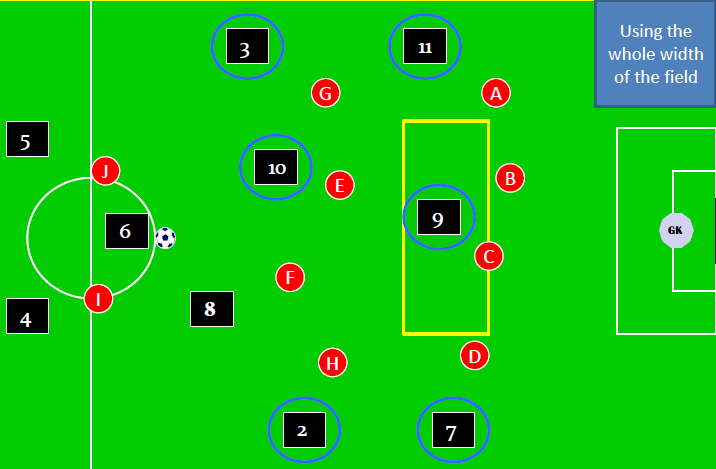
Start positions for the attack players forming big spaces between each other to open up passing lanes. We get as BIG as possible. We will next begin to overload one side of the field and make it the strong side.
Drawing Defenders Towards the Ball

We play (11) in wide but keep players on the weak side of the field wide and open. We want to draw the opponents towards the ball with our initial movements of players close to the ball and drawing them away from the WEAK side. Now here you see (2) and (7) almost forgotten and on the BLIND / WEAK SIDE of play.
Switching the Point of Attack

Now we play two very fast passes to change the point of attack and we see (8) getting involved also on the blind / weak side of the field catching the opponents off guard.
Being Patient to Create the Switch

We may even keep the ball there for a few passes to draw them in even more and being patient and showing no interest for the other side of the field. Then we hit them hard with the fast switch of play and we have 3 players in wide open space to attack the goal.
Now Showing Defenders Obvious Recovery Runs for Clarity

Now (2) overlaps (7) to get into a crossing position and in the meantime as the switch is happening (8), (9), (10) and (11) get in finishing positions in and around the box. (6) ready to drop back in should the opponents win the ball and counter attack.

A Short and Simple Explanation on How to Defend
Attacking: Based on the 5 corridors width-wise we want all 5 corridors to have players in them.
Based length–wise we want a maximum of 2 of 3 zones filled; with the exception of the keeper.
Defending: Based on the 5 corridors width-wise we want a maximum of 3 corridors filled with players preferably 2.5 if possible.
Based length-wise we want a maximum of 2 of 3 zones filled preferably the whole team is condensed into 1.5 zones or at most half a field.
Get more like this in Soccer Awareness eBook 19: The Principles of Defending for U8 to U14.
This book takes you through simple individual beginnings to more complex unit and team ideas on defending. We address all the important facets of defending such as pressure on the ball and how to tackle or delay, immediate supporting positions, covering positions beyond the support player, the importance of recovery runs to get back goal side of the ball (which many players don't like or want to do), the need for players to track back individual opponents so they do not overload areas against us; and ultimately how we must develop compactness as a team.
Attacking to Defensive Team Shape
Attacking: Based on the 5 corridors width-wise we want all 5 corridors to have players in them.
Based length–wise we want a maximum of 2 of 3 zones filled; with the exception of the keeper.
Defending: Based on the 5 corridors width-wise we want a maximum of 3 corridors filled with players preferably 2.5 if possible.
Based length-wise we want a maximum of 2 of 3 zones filled preferably the whole team is condensed into 1.5 zones or at most half a field.
Dividing the field into fifths widthwise and thirds lengthwise: The Offensive Set Up

Playing in 5 Corridors widthwise to help define the positioning of players. Also playing in 3 thirds from goal to goal lengthwise (lets call these ZONES FOR CLARITY). Here we have a good balance with players positioning at angles to each other. Must get the team into 2 thirds only, except for the keeper, both offensively and defensively.
Shadow Play: The Defensive Set Up

Play without opponents and show our basic attacking shape then offer alternatives for pressing as a group and have them do it as fast as possible. Use different color cones to represent where we lost the ball then organize the team around this defensive starting point having the players decide where they think they should be and why.
Can extend this back to the middle third also

We lose it wide in the middle third; purple cone; try to press them inside still to where our strength is with numbers. Wing full backs have to be brave and stay in midfield but condense in. (3) delays, shows inside to (10), the rest condense. (10) cuts off passing lane forward as does (11) inside or back.. It will NEVER be this picture perfect but all the same it shows what we should strive for. Pivot (6) is the key for cover.
Playing a Pressing game comes from the back

If we want to play a pressing game then we must have the back four as high as possible (essentially a back 3 now) and then the responsibility of the front players is to press asap when we lose it to stop a counter attack. Same in midfield where we now have our wing fullbacks positioned.
Pressing in attacking third condensing to 3 corridors

Condensing the spaces close to the ball. (11) forces (A) inside to the support and blocks the pass to (I). (3) is already up there and so is the next pressing player. Don’t worry about (D) and (G) and (4) already has covered the space should (A) be able to play the ball long. Defending just inside our own half.

5 Phases of Play for 4-2-3-1
- This is a very simple way to show how the team movement works. The system changes as we advance.
- Players can interchange positions as we develop the play.
- We offer great dynamics and fluidity to the players to allow them to express themselves on the field moving to a very attacking 3-1-3-3.
- With this we can show the discipline also involved when we lose the ball and recover back.
- Teams will develop their style of play within these frameworks, it will never be as picture perfect as this due to the nature of the game. It is more a guide. We teach this from U11 to U18.
- How we do it per team will be determined by the level of play.
- We strive to enable all teams at all levels to be able to master the attacking and defending defining team shapes of 1 and 2.
54 Pages
We want to stay with our own game plan as closely as possible; based on what we practice and to keep it simple for us; as we dictate to our opponents; and we impose OUR WAY on them.
But there will be many occasions where we must change the system of play and we may have to adjust to suit the opponents.
Here are some ideas for you to consider for your team starting with the 13313 and 14231 systems of play.