
Welcome to the Soccer Awareness Coaches Corner. Browse through soccer drills, small sided games, tactical thoughts, full sessions and a variety of resources. Posts marked “Training Center Exclusive” are for members only.

Breakaway Game
In this game we are working on finishing, dribbling and breakaways. This is a great activity to work on both attacker and goalkeeper skills.
Finishing, dribbling, breakaways
Use the penalty area. The balls are placed in the side of the net and easily accessible for the goalkeepers. All players are at the top of box on either side.
The goalkeeper starts the exercise by distributing the ball to the first person in line at the top of the box.
The attacker must control the ball and immediately breakaway to goal.
As soon as the ball has touched the attacker for the first time, the goalkeeper can leave his/her goal line and close down the shooter.
The attacker has five seconds to score.
The goalkeeper allowing the fewest amounts of goals wins. Keep track of the goals.
The team or individual with the most goals wins. Alternate the goalkeepers every time.

Progression:
The goalkeeper must find the attackers chest.
The attacker has three seconds to score.
Coaching Points:
The goalkeeper must react to an errant touch by the attacker.
The attacker’s first touch must be out at a 45 degree angle away from the body.
If the goalkeeper’s feet are moving, shoot quickly.

This drill comes from the Soccer Awareness Youth Coaches Guide!
A Complete 6 to 10 Year Old Developmental Coaching and Training Program. More than 750 pages of session, drills, theory and more to get you started or take your team to the next level.
This program is perfect for youth coaches wanting practices to start their soccer coaching education and it is also for those more advanced and experienced coaches wanting to train their players as best they can at these wonderful open minded ages for development and education of both the mind and body. Our plan is to help all coaches at whatever level of experience they are at.

Developing Attacking Play in the Opponents Defending Third
The attacking team has the ball. This is the start position of the game situation.
The idea is to have this phase, being the attacking one, and working on various ideas of movement, rotation and interchange to try to score.
You can focus on this until success is achieved from an attacking point of view.

The following is the beginning of Soccer Awareness eBook 31: Developing the Four Phases of the Game.
The game is really all about 4 Phases of Play. It can be divided up further into sub phases but the essence of the game are these 4. This eBook is what one of my main training sessions is based on. We actually train very often with this precise game situational model as it totally mirrors what I expect my team to do in the actual games. In doing so, we practice the same ideas over and over until they become AUTOMATIC when it matters.
The attacking team has the ball. This is the start position of the game situation.
The idea is to have this phase, being the attacking one, and working on various ideas of movement, rotation and interchange to try to score.
You can focus on this until success is achieved from an attacking point of view.
The starting point of the session: attacking team shape in a “Phase of Play”

Starting position of the attacking team. We can begin with an overload to get things moving positively in an attacking sense by not including (7) and (11) on the defending team. 16 players.
Attacking team shape in a Phase of Play: Using the full width of the field

To begin, our advantage is in wide areas where we have 2 v 1s on each side of the field. Draw defending fullbacks a Little wider in the process.
Wide attackers (7) and (11) cut inside to attack the inside áreas of the field


(7) And (11) cut inside to support (9) and draw defenders in to créate space wide for (2) and (3) to attack in.
(8) and (10) pull away from their markers to get free. Here we must attack through the wide areas of the field.
Defending fullbacks stay wide
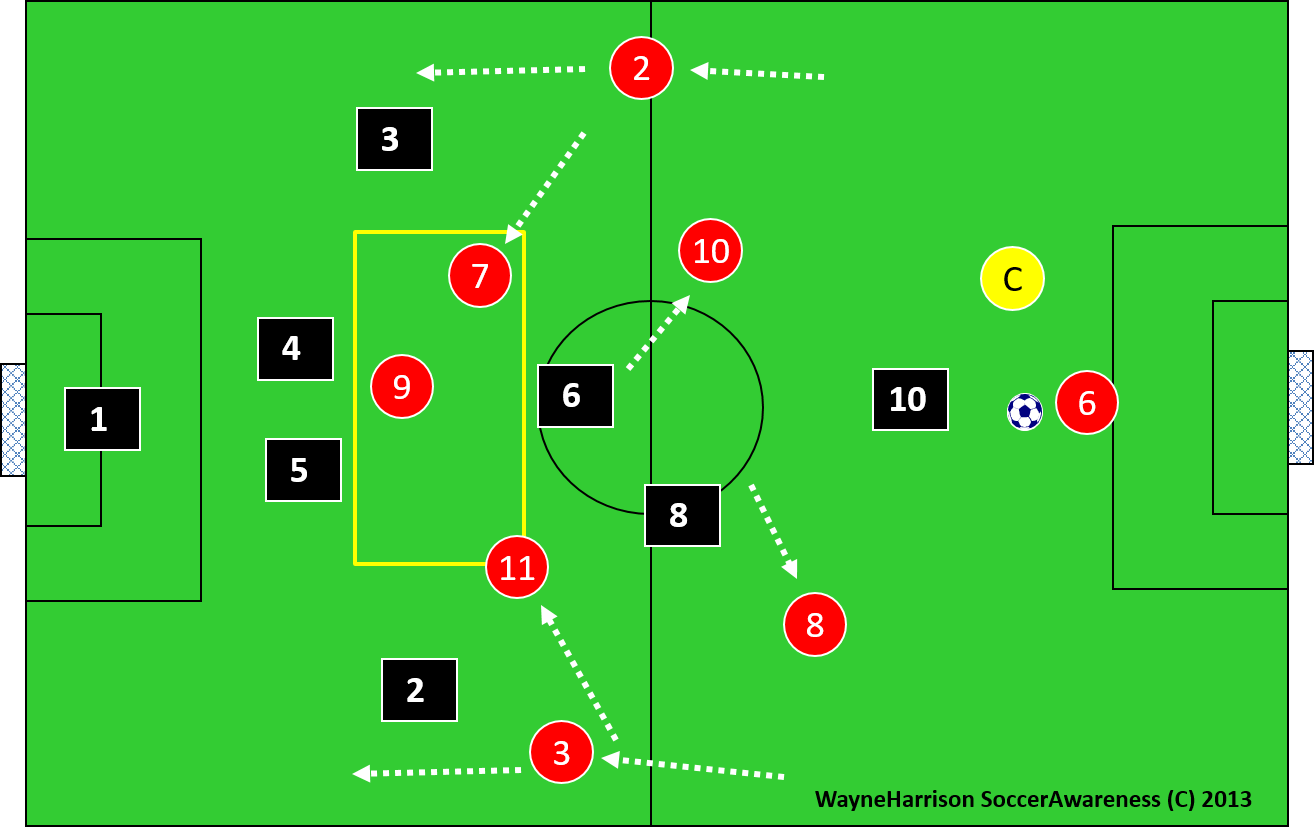
Defenders (2) and (3) are distracted by the runs of the attacking (2) and (3). Now (7) and (11) overload the central área in front of the two center backs. This is the área we must attack now.
Attacking wingbacks cut inside

Defenders (2) and (3) are distracted by the runs of the attacking (7) and (1). Now (2) and (3) overload the central área in front of the two center backs. This is the área we must attack now, this is a less predictable movement by the attacking team.
Movement OFF the shoulder of defender (4)

Striker (9) moves off the shoulder of defender (4) in the build up to get free for a pass into the open channel from (3).
Attacking wingback (2) cuts inside to score

(9) Drags defender (4) short thinking he is receiving to feet and (2) exploits the space left in behind defender (4). This kind of move is a rarity because not many teams teach wingbacks to get into central shooting areas like this.
Get the rest of this session and more like it in Soccer Awareness eBook 31: Developing the Four Phases of the Game




Individual Striker Movements Off the Shoulder Part 2
This is the usual position of the strikers, they stand alongside the defender and do not open the angle up to help them receive a pass, and these are the disadvantages to this.
This is part 2 of 4 on our Individual Striker Movements Off the Shoulder Series.
We are excited to provide you with one of our popular soccer coaching ebooks today... Learn the "Look and Think" Model Of Player Development which will get ever player on your team to think and act several steps ahead of play and think fast! Click here to download the popular Coaching Soccer Awareness E-Book FREE!

This is the usual position of the strikers, they stand alongside the defender and do not open the angle up to help them receive a pass, and these are the disadvantages to this:

- Striker has their back to the defender. Defender has control.
- Striker‘s body position is square on to the ball, defender and the goal, facing back.
- Striker can’t see the defender clearly nor see the goal directly.
- If the ball is played in behind the defender, the striker has to first turn, then run forward and probably is second best to the ball against the defender who has a yard or two starts and is probably side on already so only needs to do half a turn.
- It is easy for the defender to mark the striker as he or she can see the ball and the striker at the same time and be in control of the situation.


- The ball is played straight and behind the defender (A) and this player is likely to be first to the ball as the striker (10) has to turn and run after the ball and in behind the defender.
- The ball is played wide into the corner, same idea the defender (B) should be first to it based on the Starting Position of the striker (9), which is back to goal, back to the direction of the ball and where it is traveling to, having to turn and chase it losing vital seconds.
- It is all about the Starting Position of the striker and his or her body stance in terms of open or closed, open being half or fully turned in the direction the ball is going or closed as in their back to where the ball is going. Too often they start from a closed body stance.
54 Pages
We want to stay with our own game plan as closely as possible; based on what we practice and to keep it simple for us; as we dictate to our opponents; and we impose OUR WAY on them.
But there will be many occasions where we must change the system of play and we may have to adjust to suit the opponents.
Here are some ideas for you to consider for your team starting with the 13313 and 14231 systems of play.