Welcome to the Soccer Awareness Coaches Corner. Browse through soccer drills, small sided games, tactical thoughts, full sessions and a variety of resources. Posts marked “Training Center Exclusive” are for members only.

Teaching Defending as a Team in an 11 v 11
The best form of attacking is expert defending. As a team we need to improve on this. Therefore a big part of our game MUST be heavy pressing all over the field with ALL players tuned into the way to do it. Players on the opposite side of the field when the ball is with opponents especially should understand their roles and the need to condense the spaces.
The best form of attacking is expert defending. As a team we need to improve on this. Therefore a big part of our game MUST be heavy pressing all over the field with ALL players tuned into the way to do it. Players on the opposite side of the field when the ball is with opponents especially should understand their roles and the need to condense the spaces.
Defending as a team in a 1-3-3-1-3
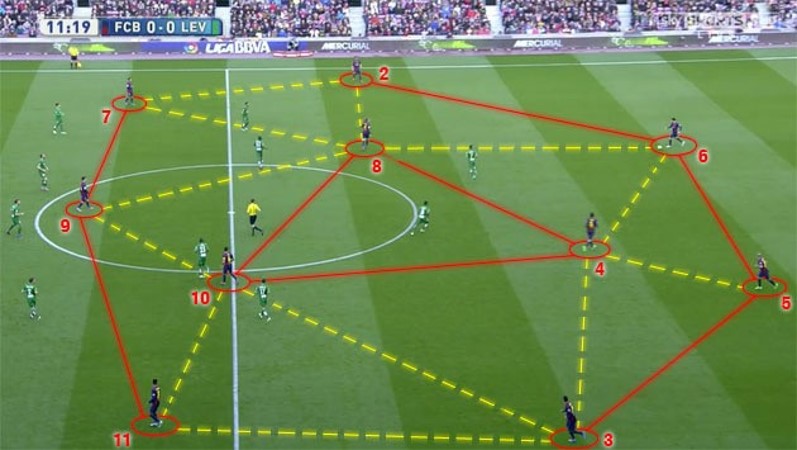
Our set up is keeper (1), three center backs (4), (5) and (6) three midfield players (2, 3 and 8), that is right, left and center midfielders; a false nine (10), two wingers (7 and 11) and our central striker (9). I am avoiding calling (2) and (3) fullbacks or wingbacks because I want an attacking mentality in the players playing these positions. You could call them a “hybrid” of a wingback and a wide midfield player.
We set up in our defensive shape and the opponents pass the ball around. The coach decides when the pass is made to give our team time to adjust their positions and be able to show the players what is needed. So for example, (B) receives the ball and must keep it until we get our defensive team shape correct. Once the shape is correct the coach can shout go again.
Rules:
Our team cannot tackle just shadow the ball to begin.
Opponents must play 2 touches.
If we win the ball to pass it to their keeper and they opponents start again with it OR we counter attack.
It depends on What you want out of the session.
For this I like the opponents to have the ball as soon we gain it to test our defending shape again.

Set up cones for opponents to stand still beside
Opponents continue to stand still beside each of the designated cones. You can set up the cones based on the formation of the team you are playing next. We are marking both players and spaces.
Here we are a 1-3-4-2-1.
Movements of our team. (7) shows INSIDE to our Strength in numbers. (9) covers the back pass.(5) marks (K) CHANNEL side to put off (D) paying the long ball into the channel for (H) or (K) to run into. (11) drops in to add an extra player into midfield. OR, (11) can become part of a back four and (10) drops into midfield. If (F) pushed on then (11) or (3) would drop into a back four so we are 4 v 3 at the back.

Try to close down “passing lanes” as well as closing down players. (10) For example is doing a good job of this knowing (8) behind is marking (E) anyway.
Here we are a 1-3-3-3-1.
(9) Immediately presses to show one way in this case wide. (11) hedges their bets by half supporting but ready to press (A) if (A) receives it. (10) supports (9). Midfield three move across and close down the spaces that side of the field.. Three Center backs move across to fill spaces (B) may play the ball into. (7) has a choice of dropping back and inside to aid the 3 midfielders to staying up but inside to support (9).

Once you get your players positioning correctly wherever the ball goes and they understand their individual and team roles you can now let the opponents move. Our team can press and intercept but not tackle. Opponents are still 2 touches maximum. Now it becomes more of a game situation.
Here we are a 1-4-4-1-1.
(2) Can only press and show down the line. Three center backs drop back and across and (5) fills the open space CHANNEL SIDE of (K) that (H) can see to pass into. (3) drops in to make a back four to give us extra strength. (8) slides across to support (2) and either (10) or (11) whoever is closest will make up a midfield defensive three. OR both drop in to make a midfield four.




(7) Can only show outside and not stop the delivery
Before the ball is delivered; in fact as the ball is travelling to (D) the back three should be adjusting already. Now we mark through (5) the big SPACE down the side; NOT the player (K). (3) Now can drop in to make it a back four for extra security. If (D) passes down the line then as you see, we will be first to the ball.
Now with a free ball down the line if (K) is quick we can be in trouble therefore (5)’s positioning is REALLY VITAL now. He MUST defend CHANNEL SIDE or more or less where the ball is likely to go. Most coaches will tell defenders to always defend GOALSIDE, this is one occasion where that instruction would be wrong.

(5) Out of position as happens with us
(5) Is still marking GOALSIDE and allowing a long pass down the line to (K). (K) Is fast so now we have a very dangerous 1 v 1 in a wide area against us. So our wide center back on each side where the ball could be delivered this way MUST mark CHANNEL SIDE of the striker not goal side.
We do not adjust quickly enough and see AHEAD of the play. This is especially so when we attack with numbers and our vulnerability is usually in wide areas on the counter attack.

There must be real condensed team shape closing down immediate spaces around the ball.
Now we are a 1-3-3-3-1.
The ball is forced to be played back to (D). (7) is the VITAL pressing player. If possible (7) should close down to force the ball “Inside” to our strength in numbers. A pass to (H) should be totally blocked now so (2) can tuck inside to where we want the ball to go. Three Center backs push up as does the keeper. (9) is ready for a back pass. (8) and (10) condense across the field to the ball. (11) also but also pushes forward.

Throw in
There must be real condensed team shape closing down immediate spaces around the ball. Man marking now is imperative and we get tight to the opponent to allow no time on the ball.
Here we see we MUST get as many players around the immediate area the throw in is as possible. This makes it VERY difficult for the opponents to regain possession from their OWN throw. Even wide left (11) can run across the field to add an extra player to the mix. (7) shadows the thrower incase they throw it and look to get it back.





Soccer Awareness Philosophy of Team Play
#1 - Keep Possession - If players chase for the ball a long time they get frustrated, get tired and commit fouls. So keep possession and force this upon them
- Keep Possession - If players chase for the ball a long time they get frustrated, get tired and commit fouls. So keep possession and force this upon them
- Develop Play from the back - When it is on to do so to help maintain possession of the ball and not rely on a 2nd ball pick up
- Pass and Move - Movement off the ball is a major part of our team development
- Form triangles and diamonds of support all over the field - Creating open body stances and increasing peripheral awareness
- Inter-Change Positions - Offensively and defensively cover for each other
- Create space for your teammates; not just for yourself - Unselfish team play; Play for the TEAM
- Attacking Fullbacks using Width in Attack - Offense is the best form of defense
- Keep a very high line defensively - Squeeze opponents into their own half of the field
- Pressure opponent’s high up the field - Winning the ball back 30 yards from the opponent’s goal is better than 80 yards away
- Counter Attacking and Quick Breakaway - Developing different ways to counter attack
- You need skilful players to make this all work - We have the raw material so let’s develop them

Hi Coach,
We are excited to provide you with one of our popular soccer coaching ebooks today...
In this Soccer Coaching Ebook you will Learn The SECRETS To Coaching Decision Making And Awareness From Pro Academy Coach Wayne Harrison!
Learn the "Look and Think" Model Of Player Development which will get ever player on your team to think and act several steps ahead of play and think fast!
Click here to download the popular Coaching Soccer Awareness E-Book FREE!
Problems to Solve
- How to get FREE AND FIND SPACE TO RECEIVE the ball and to maintain possession of the ball
- How do we do this?
- Using the Thinking Process
- Players must learn to think AHEAD of the ball, to think two moves ahead in their mind.
- So; Observation of own players positioning / Opponents positioning / SPACE available / where the ball is in relation to all these factors.
- All done BEFORE RECEIVING THE BALL.
- Saving time doing this; Increasing time and space to play in by doing this.
- Also; POSITIONING OFF THE BALL
- Positioning to find SPACE based on their own team mates and the opponents positioning; the position of the ball; and based on these factors: FINDING THE BEST SPACES AVAILABLE.
- Doing all of the above means: we can be successful using fewer touches on the ball.
- Doing all of the above will SAVE a touch or two on the ball; and by doing so:
- Players will: PLAY MORE QUICKLY, THINK MORE QUICKLY, MOVE MORE QUICKLY.

Pressure: When, Where and How as a Unit in the Attacking 1/3rd
The majority of goals in the game of soccer are results of mistakes and most mistakes occur when players are put under pressure, especially in dangerous areas. When you are attacking and you lose possession your first goal should be to regain possession. You will be surprised the number of times your opponent will give the ball away in front of the goal when your team closes them down in an organized fashion.
The majority of goals in the game of soccer are results of mistakes and most mistakes occur when players are put under pressure, especially in dangerous areas. When you are attacking and you lose possession your first goal should be to regain possession. You will be surprised the number of times your opponent will give the ball away in front of the goal when your team closes them down in an organized fashion.
Activity #1: Warm Up
Set Up: Players move on a half pitch with a partner as shown below. Partners pass and move freely.

Explanation: Players pass and move - on coaches command - one player sprints to "pressure" his opponent. This pressure can be passive at first and progress to full pressure as the warm-up continues.
Coaching Points:
- Speed of pressure
- Angle of pressure
- Tenacity to win ball
Activity #2: 5v5 Game
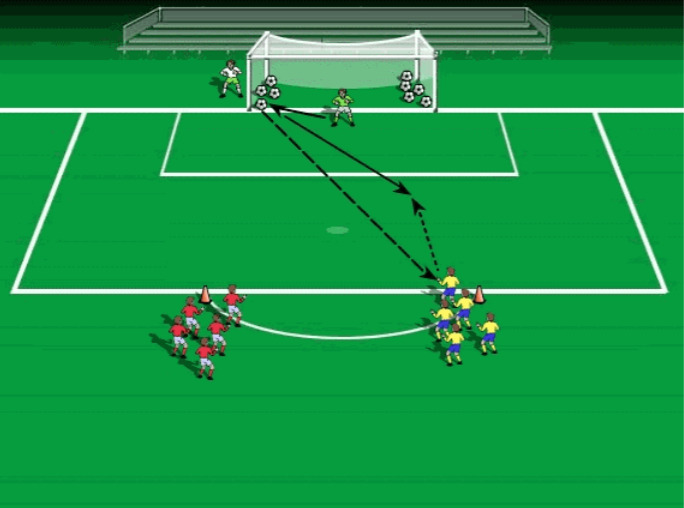
Set Up: One team has 5 field players (Yellow): the other team has 4 field players and a goalkeeper (Red) as shown below. Three mini-goals are created using flags as shown.

Explanation: Play starts with a pass from the goalkeeper to any of his teammates. Emphasis is placed on the defensive shape and responsibilities of the "defensive" (Yellow) team. The "attacking" team (Red above) must attempt to score in any of the three mini-goals near the half-way line. If the "defensive" team gains possession of the ball they must attack quickly and attempt to score in the full-size goal. Play is continuous until a goal is scored. In the Diagram above, the "defensive" unit has adjusted their positions to try to win the ball - Player (A) is forcing the play inside; Player (B) has stepped to ball-side on Red (G). Players (C) and (D) have moved to confine the playing area. The 4 "attacking" players get the ball on every re-start.
Coaching Points:
- Defensive team must work as a "UNIT"
- Communicate at all times.
- "Read the Game" - try to intercept passes etc.
- Move as the ball moves - positioning in relation to teammates, opponents, ball.
- Speed of counter-attack after winning possession.
- Use the man advantage to maintain possession if a quick counter-attack is not possible.
Activity #3: 7v7 + Goalkeepers
Set Up: Two-thirds of a pitch is used as the playing area. A half-way line is created using cones. Two teams of 7 players are organized within the playing area as shown below.

Explanation: Play starts with a pass to the Yellow attacking team. One team is designated as the "attacking" team (Yellow above) and the other team is designated as the "defending " team (Red above). Both teams compete for possession of the ball and attempt to score in their opponent’s goal. The offside law is in effect. Emphasis is placed on the defensive responsibilities and shape of the Red team. The "defensive" team are encouraged to create pressure areas / pockets in certain areas of the pitch in order to win possession of the ball. All re-starts go to the Yellow "attacking" team.
See Diagram below - the Red "defensive" team has created a "pressure pocket" on one side of the pitch making it very difficult for the Yellow team to maintain possession - this may force a turn-over in an advanced area of the pitch. Player (A) has stepped to put immediate pressure on the ball as well as force the opponent inside towards the pressure; Players (B) and (C) have stepped to the ball-side shoulder of their opponents in anticipation of intercepting any potential pass. Player (D) has moved to deny a passing option for the wide Yellow player. Players (E), (F), (G) have all adjusted their positions to squeeze the space and make the pitch more compact while still providing adequate cover and balance.

Progression: Have the players play "low pressure" at first and switch to "pressing" at coaches command or on certain visual cues - bad pass, back-pass to goalkeeper etc. This can help develop an understanding of the right moments to apply pressure and in what areas.
Coaching Points:
- Move as a "UNIT"
- Communicate at all times.
- Read the game - anticipate the play.
- Counter-Attack quickly if possible.
- Force the attacking team into tight areas - dictate what the opponents do!
Often players position to receive the ball with their back to play. These session plans show some ideas on how to position and instead "Face Forward" or at least Half Turned or three quarters turned rather than positioning square and facing back.