Welcome to the Soccer Awareness Coaches Corner. Browse through soccer drills, small sided games, tactical thoughts, full sessions and a variety of resources. Posts marked “Training Center Exclusive” are for members only.

How to Play and Teach the 1-4-2-3-1
Here we have a 6 part video series showcasing Wayne Harrison presenting the 1-4-2-3-1 at the NSCAA Annual Convention in front of over 1200 coaches from around the world.. The series begins with developing play out the back to ultimately fashioning attacking and finishing movements off the ball in the attacking third and the 5 phases of play as he creates it. Wayne goes through the thirds of attacking development for you from back to front.
Here we have a 6 part video series showcasing Wayne Harrison presenting the 1-4-2-3-1 at the NSCAA (now United Soccer Coaches) Annual Convention in front of over 1200 coaches from around the world.. The series begins with developing play out the back to ultimately fashioning attacking and finishing movements off the ball in the attacking third and the 5 phases of play as he creates it. Wayne goes through the thirds of attacking development for you from back to front.

4-2-3-1 Defensive Pressurizing Game
The game is designed to work on pressurizing the player on the ball, prevent a forward pass and ultimately win the ball. Closest player has to pressure the ball. To score, a player has to make a pass from anywhere into the keepers hands. The ball can be played in the air to the targets hands (to practice quality long distance lofted passes) or on the ground to feet (driven passes). All over the field players must work hard to close people on the ball down quickly.
The following drill is part of a 28 page presentation entitled DEFENDING AS A TEAM IN A 4-2-3-1 that can be found on the recently added 4-2-3-1 System of Play page in the Soccer Awareness Training Center. Soccer Awareness Training Center provides unlimited access to Wayne Harrison's Soccer Awareness systems, training sessions, drills and more. Wayne's system helps develop world class youth soccer players and teams in a systematic and imaginative manner that guarantees performance at the highest level of competition. Whether you’re a beginning coach who needs help getting started or someone who wants to add some variety to their training sessions, the Soccer Awareness Training Center offers a wide variety of drills to choose from. Join Today
The game is designed to work on pressurizing the player on the ball, prevent a forward pass and ultimately win the ball. Closest player has to pressure the ball. To score, a player has to make a pass from anywhere into the keepers hands. The ball can be played in the air to the targets hands (to practice quality long distance lofted passes) or on the ground to feet (driven passes). All over the field players must work hard to close people on the ball down quickly.

Develop –
A) As a reward when a team scores a goal they keep possession so they play to the opposite goal to score. Previously they played to the same goal and the opposition got the ball when they scored.
B) Go to man –marking so in possession players must get free and defenders must work hard to stop them scoring. Show by high pressure as a team how defenders can win the ball back early and close to the opponent’s goal to score. Need to push up from the back to start this.

Coaching Points:
Quick Pressure on the ball
2nd defender supplying close Support for first defender
Deeper Cover from third defender
Recovery runs from players in front of the ball
Regain possession
Here the job of player (G) is to pressure the ball as quickly as possible to win it back. (F) supports across, (G) shows the player on the ball inside towards (F) and between them they try to win the ball back quickly. (E) Offers a balanced covering deeper position behind them.
Players cannot go into the keeper’s area.

Here (6) gets free of defender (D) and chips the ball into the keeper to score a goal. Once this has happened a few times players get the idea they need to work hard to close down quickly opponents on the ball.
This game improves the urgency with which players need to close opponents down as they are so easily punished in this game if they don’t.
New 4-2-3-1 System of Play Presentations in the Soccer Awareness Training Center

Playing The 4-2-3-1 And Changing Systems of Play Depending on the Game Situation
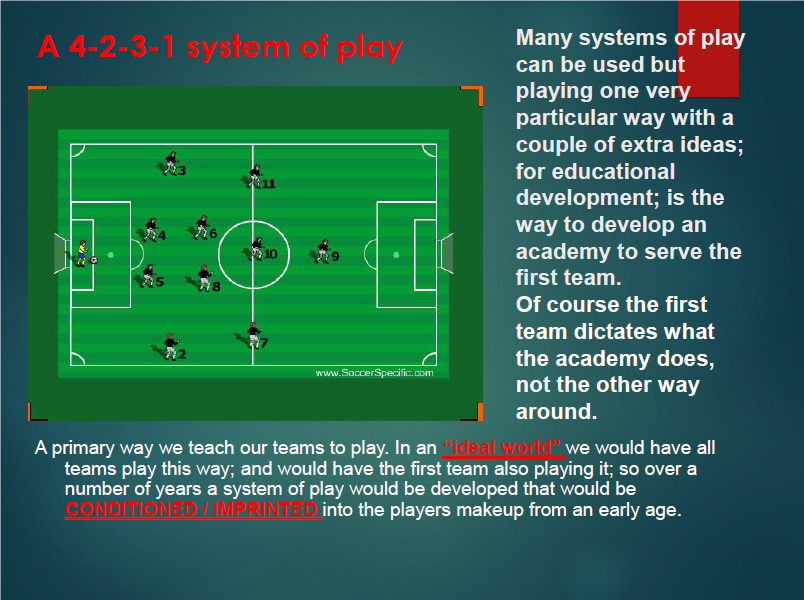
4-2-3-1 System of Play; An 80 Page Guide

Defending as A Team in A 4-2-3-1

Playing The 4-2-3-1 Showing the Defensive Discipline Needed to Allow the Fluidity Of Attack
Soccer Awareness Training Center provides unlimited access to Wayne Harrison's Soccer Awareness systems, training sessions, drills and more. Wayne's system helps develop world class youth soccer players and teams in a systematic and imaginative manner that guarantees performance at the highest level of competition. Join Now

Changing shape to counter the opponents who are playing a 4-3-3
This is an excerpt from "Important alternative information on how to play the 4-2-3-1." We don’t like to change our team shape and way of playing. Rather; we like to force opponents to change their shape to accommodate us. Sometimes against top opponents who may dominate us it is necessary to do so. Here are some ideas we can use against a 4-3-3 which many teams play now. We wont come up against this too often.

This is an excerpt from "Important Alternative Information on How to Play the 4-2-3-1." We don’t like to change our team shape and way of playing. Rather; we like to force opponents to change their shape to accommodate us. Sometimes against top opponents who may dominate us it is necessary to do so. Here are some ideas we can use against a 4-3-3 which many teams play now. We wont come up against this too often. Get It Now
Dealing with a 4-3-3 who have an extra player in Central Midfield
We lose possession. (6) Stays in his position protecting in front of the back four. They now have a 3 v 2 in their favor in central midfield; almost a 3 v 1 initially. In this case (11) has to see this and tuck in and help (6).

As the ball travels (6) gets tight to the opponents 6 and (11) tucks in the opposite side to make a 3 v 3. This has to happened rapidly and their passing may be too fast for us to adjust in time. Likewise this can be done with (7) tucking in instead of (11). A bit risky as it takes great communication; insight and immediate action.

Creating a 4 v 3 in our favor in Central Midfield
Another way is to play a very condensed defensive midfield 4 to outnumber them 4 v 3. Problem: Their fullbacks then have more freedom. Now our (2) and (3) may be open to 2 v 1’s against them. (6) can still patrol in front of the centre backs and drop back when needed.

Creating a 3 v 3 in Central Midfield
This is the simplest way to sort it out. Just go 3 for 3. (10) Has to take on a MUCH “greater defensive responsibility”. So we get a 3 v 3 match up in central midfield (8) on 8, (10) on 6 and (6) on 10.

The best solution: Still our same team shape but (10) more defensively positioned
The START position of (10) defensively HAS to be picking up the opponents number 6. It means (10) has to work MUCH harder defensively. This way we ensure we match them up 3 v 3 in central midfield. This way we still take care of their fullbacks. If 6 is their playmaker he must NEVER be allowed time on the ball.

The resulting situation is we are on the back foot but at least controlling them defensively.
Our team situation is defensively set up now. We will need to counter quickly when we get the ball; OR; keep the ball to give us time to spread out offensively again and play our game. We will practice this in training.

A Simple Explanation on How to Defend as a Team in 11 v 11
Playing in 5 Corridors widthwise to help define the positioning of players. Also playing in 3 thirds from goal to goal lengthwise (lets call these ZONES FOR CLARITY). Here we have a good balance with players positioning at angles to each other. Must get the team into 2 thirds only, except for the keeper, both offensively and defensively.

The following drill is an example presentation that can be found on the 4-2-3-1 System of Play page in the Soccer Awareness Training Center. Soccer Awareness Training Center provides unlimited access to Wayne Harrison's Soccer Awareness systems, training sessions, drills and more. Wayne's system helps develop world class youth soccer players and teams in a systematic and imaginative manner that guarantees performance at the highest level of competition. Whether you’re a beginning coach who needs help getting started or someone who wants to add some variety to their training sessions, the Soccer Awareness Training Center offers a wide variety of drills to choose from. Join Today
Attacking to Defensive Team Shape
Attacking: Based on the 5 corridors width-wise we want all 5 corridors to have players in them. Based length–wise we want a maximum of 2 of 3 zones filled; with the exception of the keeper.
Defending: Based on the 5 corridors width-wise we want a maximum of 3 corridors filled with players preferably 2.5 if possible. Based length-wise we want a maximum of 2 of 3 zones filled preferably the whole team is condensed into 1.5 zones or at most half a field.
Dividing the field into fifths widthwise and thirds lengthways: the Offensive Set Up

Playing in 5 Corridors widthwise to help define the positioning of players. Also playing in 3 thirds from goal to goal lengthwise (lets call these ZONES FOR CLARITY). Here we have a good balance with players positioning at angles to each other. Must get the team into 2 thirds only, except for the keeper, both offensively and defensively.
Shadow Play: The Defensive Set Up

Play without opponents and show our basic attacking shape then offer alternatives for pressing as a group and have them do it as fast as possible. Use different color cones to represent where we lost the ball then organize the team around this defensive starting point having the players decide where they think they should be and why.
Can extend this back to the middle third also

We lose it wide in the middle third; purple cone; try to press them inside still to where our strength is with numbers. Wing full backs have to be brave and stay in midfield but condense in. (3) delays, shows inside to (10), the rest condense. (10) cuts off passing lane forward as does (11) inside or back.. It will NEVER be this picture perfect but all the same it shows what we should strive for. Pivot (6) is the key for cover.
Playing a Pressing game comes from the back

If we want to play a pressing game then we must have the back four as high as possible (essentially a back 3 now) and then the responsibility of the front players is to press asap when we lose it to stop a counter attack. Same in midfield where we now have our wing fullbacks positioned.
Pressing in attacking third condensing to 3 corridors

Condensing the spaces close to the ball. (11) forces (A) inside to the support and blocks the pass to (I). (3) is already up there and so is the next pressing player. Don’t worry about (D) and (G) and (4) already has covered the space should (A) be able to play the ball long. Defending just inside our own half.
New 4-2-3-1 System of Play Presentations in the Soccer Awareness Training Center
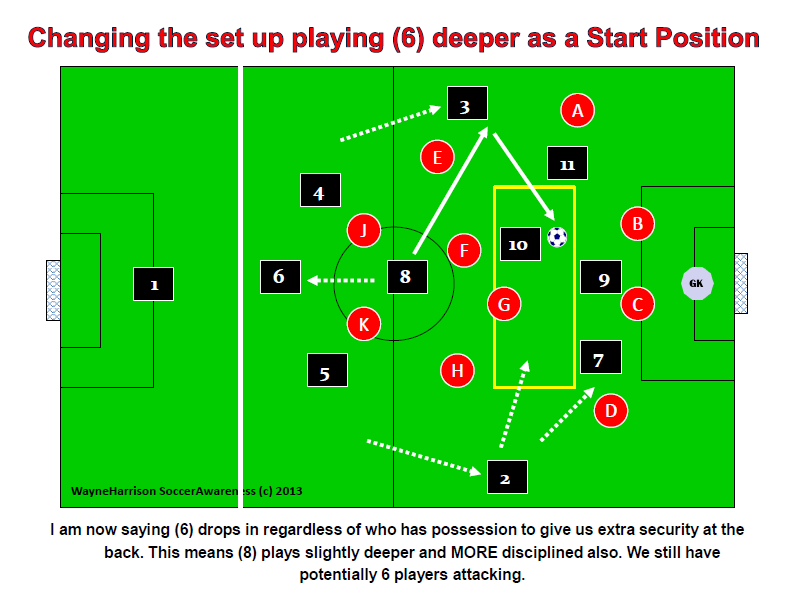
Correcting Potential Weaknesses in the 4-2-3-1 System of Play from a Defensive Perspective

How to Teach Freedom of Movement for the 4-2-3-1; Attacking and Defensive Positioning and Covering for Each Other
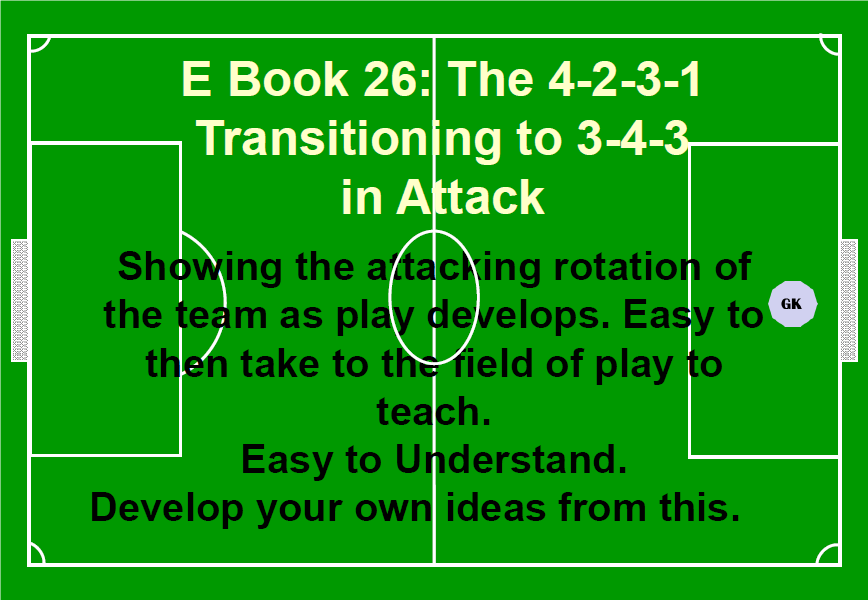
Showing the 4-2-3-1 Transitioning to the 3-4-3 in Attack

The Attacking and Defending Roles and Responsibilities of Each Player in the 4-2-3-1
Soccer Awareness Training Center provides unlimited access to Wayne Harrison's Soccer Awareness systems, training sessions, drills and more. Wayne's system helps develop world class youth soccer players and teams in a systematic and imaginative manner that guarantees performance at the highest level of competition. Join Now

Video Presentation: 6 Phases of Play for 4-2-3-1
In this video, Coach Wayne Harrison explains in a simple way the 6 phases of the 4-2-3-1 style of play.
In this video, Coach Wayne Harrison explains in a simple way the 6 phases of the 4-2-3-1 style of play.




Free Coaching the 4-2-3-1 eBook
Most of the coaches I know look at the trends at the highest level of the game for ideas of what might be effective for their teams. In the last 10 years the most popular system has been the 4-3-3. The Dutch have been using it for much longer it became used more widely by clubs like, Jose Mourinho’s FC Porto and later Chelsea FC as well as Barcelona FC, AS Roma, the US Women’s National Team and many others. As this shift occured at the top level we began to see more youth, high school and college teams move to this highly flexible system.
Below is an excerpt from Wayne Harrison's free Coaching the 4-2-3-1 eBook produced by World Class Coaching. You can get the full eBook for free below.
SPAIN PLAYING THE 4-2-3-1 AT THE EURO’S
This article describes how Spain used the 4-2-3-1 formation in it’s successful Euro 2012 campaign. Each game presented different challenges and opportunities. Here is an explanation of the base system and also how they approached their game against Italy.
To see how you can train your team to play the same system as some of the best teams in the world You can get access videos that will show you the attacking, defending and transitional properties of the 4-2-3-1 by visiting the World Class Coaching Soccer Tactics web site.
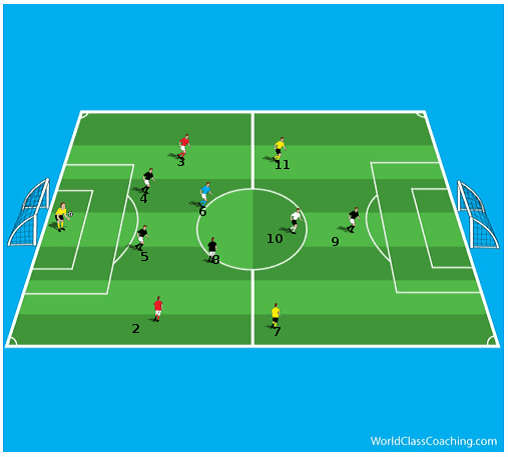
The starting position phase formation is approximately a 4-2-3-1; the attacking phase is 4-2-1-3 or 3-3-1-3; and the defending phase is a 4-4-1-1, so we have four formations coming from one; depending on where the ball is and who has it.
Fabragas played as the (9) in this diagram but rotated with Iniesta; Xavi and Silva; (11), (10) and (7) respectfully here.
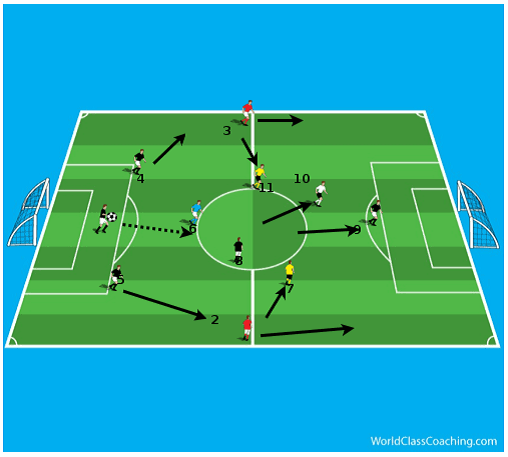
Here we show how Alba (3) and Arbeloa (2) attack high up the field. Iniesta (11) and Silva (7) tuck in to take the Italian defenders inside to create space outside for the fullbacks. If they are not followed by defenders then this created a BIG overload of players centrally for Spain to Exploit.
Where (6) passes to will depend on how the opponent defenders react to these combination movements but with the left footer on the right and right footer on the left plus the fullbacks the team has two great options, one coming inside to attack the space inside and possibly shoot with his strongest foot; and one overlapping with width to get a good cross in, again with his strongest foot.
Coaching Points:
Observe:
- Initial team shape (4-2-3-1)
- Timing of the runs (late and fast is best)
- Timing of the pass (if the choice is to pass)
- Where the pass goes (based on the opponents set up and individual and team reactions)
- The next phase of play as each event (a pass, run; dribble etc) starts a new phase of play
- Buildup Phase of play team shape (4-2-1-3) or (3-3-1-3)
- End Product Phase of play team shape
Spain v Italy
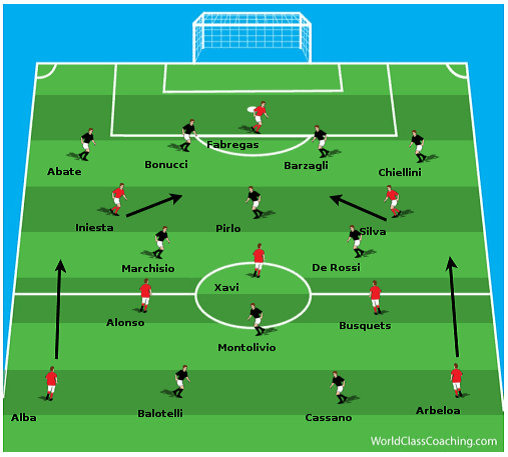
Here you see how Spain exploited the width of the field against Italy’s narrow midfield with both fullbacks attacking throughout the game, Alba in particular showed the value of this with a great forward run that resulted in him scoring the second goal.
TEAM GAME PLAN AND INDIVIDUAL ATTRIBUTES NEEDED BY PLAYERS PLAYING THIS SYSTEM OF PLAY
As shown above; the 4-2-3-1 is a flexible way to play employing four units rather than the usual three. It can transform quickly into a more offensive pattern of play of 4-2-1-3 by moving forward the wide outside midfielders and with this push on the two fullbacks to fill the spaces they have left.
THE BEAUTY AND FLEXIBILITY OF THIS SYSTEM OF 4-2-3-1
- Wide players (Iniesta and Silva) attack the space between the fullback and the center back on both sides. Left on right, right on left; coming onto their stronger foot is an advantage because they come in against the full back’s weaker foot
- Fullbacks (Arbeloa and Alba) attack wide to get crosses in and can cut inside also to do the job of the wide player
- Center back’s (Pique and Ramos) spread wide to open up the attack from the back
- Defensive midfielder (6) (Busquets) drops back in to cover and to start the movement also; he can fill in centrally or to the side
- Attacking midfielder (10) (Xavi) plays between the opponent’s defense and midfield. He can interchange with the wide players or the striker (9).
- 2nd defensive midfielder (8) (Alonso) is more offensive and creates support between the back and the front
- The two defensive midfielders can interchange.
- (8) positions off center to (10) and off centre to (6) to maintain angles of support between them when attacking
Some of this is thinking outside the box and addressing issues not always covered in this format.