Welcome to the Soccer Awareness Coaches Corner. Browse through soccer drills, small sided games, tactical thoughts, full sessions and a variety of resources. Posts marked “Training Center Exclusive” are for members only.

A Crossing Phase of Play Including an Overlap
We are looking to get the ball wide in this phase of play so overlap work comes in. Primarily working with wide players and how they create positions to cross the ball from. For your preparation you can play against a back four or a back three depending on what the opposition play like (better to plan for both).
Introduce this and the crossing and finishing game following this when you think the players are ready to follow and understand it fully.
Start with the overload situation to help gain success and breed confidence in the players. If defenders win the ball they pass to the targets and the play starts again.
We are looking to get the ball wide in this phase of play so overlap work comes in. Primarily working with wide players and how they create positions to cross the ball from. For your preparation you can play against a back four or a back three depending on what the opposition play like (better to plan for both).
Coaching Points of an Overlap:
1. Does the player need support behind or in front?
2. Create Space – Move inside with the ball to open it up outside.
3. Communicate – Support player can call “hold” to gain time to get into position
4. Timing of the Run – Go wide (angle and distance).
5. Player on the ball passes or uses the run as a decoy to come inside and attack.

The end product of the attacking movement.
I have left the defenders out to be able to show more easily where the attacking players need to finish up, (obviously they will track the players back towards their own goal). (9) And (10) may switch positions as to where they attack and do a crossover between them.
We have players attacking: the near post (10), the far post (9), beyond the far post for anything over hit from the crosser (11), around the edge of the box and in the center for the pull back (8), (3) and (7) in anticipation areas around the box also and (6) naturally moves forward to maintain the shape of the attack and fill spaces in behind (8).
The cross arrives at the far post area for (10) to try and score.


1 v 1 Crossing Game
Work on your goalkeepers ability to attack the ball, aggression, timing and competitiveness with this 1 v 1 crossing drill from Soccer Awareness.
The following drill comes from the Soccer Awareness Training Center. Soccer Awareness Training Center provides unlimited access to Wayne Harrison's Soccer Awareness systems, training sessions, drills and more. Wayne's system helps develop world class youth soccer players and teams in a systematic and imaginative manner that guarantees performance at the highest level of competition. Whether you’re a beginning coach who needs help getting started or someone who wants to add some variety to their training sessions, the Soccer Awareness Training Center offers a wide variety of drills to choose from. Join Today
Set-up: Place two goals 18 yards apart with a goalkeeper in each goal. A server stands on the side of the penalty box with a group of balls.
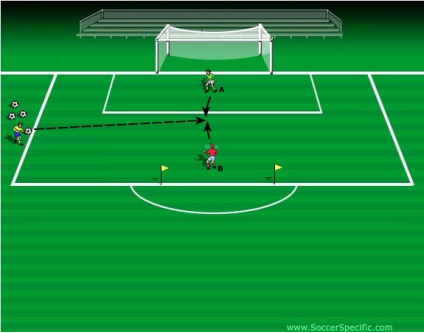
The server punts the ball high into the air and aims for it to land on the penalty spot.
Goalkeeper A and B must compete for the high ball save.
Whoever catches the ball in the air gets 2 points. If the ball drops to the ground, whoever wins possession gets 1 point.
The first one to 10 points wins.
Progression:
After the goalkeeper catches the ball in the air, he/she must set it down immediately and try and dribble a breakaway across the opponents’ goal line.
The server can also put the ball down at his feet and shoot on target to either goal.
Coaching Points:
Attack the ball and catch it at the highest possible catching point.
Drive your knee up to protect yourself from the other goalkeeper.
Decide early and arrive on time.




Coaching Points in Crossing and Finishing
Crossing the ball is a skilled technique, often resulting in great results if performed correctly. Here are 8 coaching points on how to train crossing and finishing.
Head Up – Glance from the crosser, an awareness using the A.I.A. principles of: where are the players (attackers, defenders, the keeper). Sometimes they don’t have time to do this they just get the ball into the danger area and expect players to be there.
Decision – When, Where and How to cross. As early as possible to give defenders as little time as possible to position themselves.
Technique of the Cross –
- A good first touch out of your feet to set the cross up but looking also to where the ball is going and where the attackers are to receive to cross.
- Balanced position with the non kicking foot alongside the ball pointing in the direction you want the cross to go. Use of techniques to produce the type of delivery below , kicking through the ball with correct timing.
Types of Cross – They can include:
- Crosses that are driven low with power (usually to the near post).
- Swerved crosses for example around a defenders using the body position as a guide (near or far post).
- Chipped crosses from the goal line (usually to the far post).
- Longer, higher trajectory crosses to the far post and past it (to opposite wide player who can shoot at goal or head or pass it back into the danger zone).
- Pull back crosses or passes to a midfield player coming in late.
Runs of the Players – Near post / Far post, away from the ball initially to come back if possible (to lose markers). When a striker runs away from the ball the defender has the problem that when they look at the ball, they can’t see the player they are marking or that players movement; when they look at the player, they can’t see the delivery of the ball. Anticipation of where the ball will arrive.
Timing of the Run – As Late as possible and as Fast as possible (so you are difficult to mark plus you don’t get into the correct position too early).The player making the near post run must use the post as a guide. If they run past the near post to receive then it’s difficult to get a shot or header on target.Try to time the run so the ball is arriving as you are arriving then it’s a straight shot or header. The only time it should happen is if the near post players run beyond that post is designed to pull a defender out of position to create space for a team mate coming in behind.
Angle of the Run – Into the line of the crossed ball not across it.
The Attacking Finish – Contact on the ball is probably one touch only using the head or foot. Use the momentum of the crossed ball for power so you time the contact almost let it hit your foot rather than the player forcing it.


Functional Crossing and Finishing Session
This is a great crossing and finishing routine to practice as it is on going and you can keep a lot of players working. As soon as the three central attackers have made their runs and got back to the start they are ready to go again. Rotate defenders and wide players. You can have fifteen players and more working constantly.

Shadow Play to begin. Attack in two’s to begin. Movement away from the ball initially if there is time in the build up. Working on timing of runs. Attack near post and far post areas. Cross from both sides.
Position off the near post don’t go beyond it to meet the ball; unless drawing a defender out of position for the second striker to attack. Winger plays a 1–2 and crosses as early as possible. Strikers know this and must get in position to meet the cross. The cross should be between knee and head height. Service could be a driven pass from a striker to a wide player or the play starts wide (timing is better).

Develop:
- Introduce a defender who must choose a striker to mark. The defender starts from the same area as the striker as if retreating towards goal. The crosser finds a free player.
- Introduce a third attacking player in behind the front two for the pull back.
- Have the opposite wide player coming inside as an additional attacker to cover the area beyond the far post, and the crosser has another player to pick out (now it is a 4 v 1 situation).
- Introduce another defender to mark up another attacker (4 v 2).

Players have made their runs into the correct positions to receive the crossed ball. The crosser has four choices of cross to make, near post, far post, pull back for the midfield player and past the far post for the opposite wide player. See who is free or just get the ball in if there’s no time to look (for example in a game where the defender puts the crosser under pressure).
Take the set up ten yards closer so the wide players are crossing from the goal line and the striker’s runs are shorter and sharper. Include a chipped cross to the far post if the keeper is at the near post.
This is a great routine to practice as it is on going and you can keep a lot of players working. As soon as the three central attackers have made their runs and got back to the start they are ready to go again. Rotate defenders and wide players. You can have fifteen players and more working constantly (two sets of strikers, two sets of defenders or even more sets of players etc).
54 Pages
We want to stay with our own game plan as closely as possible; based on what we practice and to keep it simple for us; as we dictate to our opponents; and we impose OUR WAY on them.
But there will be many occasions where we must change the system of play and we may have to adjust to suit the opponents.
Here are some ideas for you to consider for your team starting with the 13313 and 14231 systems of play.