Welcome to the Soccer Awareness Coaches Corner. Browse through soccer drills, small sided games, tactical thoughts, full sessions and a variety of resources. Posts marked “Training Center Exclusive” are for members only.

Functional Crossing And Finishing: Short And Sharp One Touch Play
The session is great work for one touch play both from the crossers and the receiver’s points of view. This session builds confidence in the players as there is no opposition and they can relax and shoot at goal.
The following sessions comes from the Soccer Awareness Training Center. Whether you’re a beginning coach who needs help getting started or someone who wants to add some variety to their training sessions, the Soccer Awareness Training Center offers a wide variety of drills to choose from. Find out more.

Move the session close to the edge of the box and have the players attack with pace.
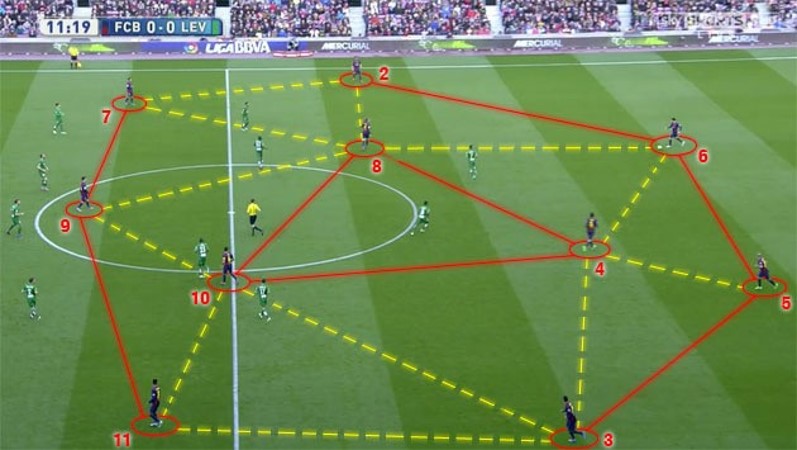
(10) can play the ball wide and (7) must try to play it in first time. (10), (9) and (8) make runs, near, far and in the middle but (8) is staggered if the ball goes behind the two strikers so they don’t attack in a straight line and it goes behind all of them and the opportunity is missed.
(11) or (3) can attack the area beyond these three as a fourth player.
It is all short and sharp and mainly one touch play if possible.
If there is time, strikers can make their runs away to come back or cross over as they attack, if no time then they just get into the position to score. We should then have a player in most areas the ball can be played into and this takes the pressure off the crosser.

This shows the end product of the short and sharp finishing in this session. The session is great work for one touch play both from the crossers and the receiver’s points of view.
Other players follow in for rebounds off the keeper.
This session builds confidence in the players as there is no opposition and they can relax and shoot at goal.
Progression: To develop it you can add a defender or two in the box to challenge the attacking players and put them under pressure in their finishing ability



Coaching Points in Crossing and Finishing
Crossing the ball is a skilled technique, often resulting in great results if performed correctly. Here are 8 coaching points on how to train crossing and finishing.
Head Up – Glance from the crosser, an awareness using the A.I.A. principles of: where are the players (attackers, defenders, the keeper). Sometimes they don’t have time to do this they just get the ball into the danger area and expect players to be there.
Decision – When, Where and How to cross. As early as possible to give defenders as little time as possible to position themselves.
Technique of the Cross –
- A good first touch out of your feet to set the cross up but looking also to where the ball is going and where the attackers are to receive to cross.
- Balanced position with the non kicking foot alongside the ball pointing in the direction you want the cross to go. Use of techniques to produce the type of delivery below , kicking through the ball with correct timing.
Types of Cross – They can include:
- Crosses that are driven low with power (usually to the near post).
- Swerved crosses for example around a defenders using the body position as a guide (near or far post).
- Chipped crosses from the goal line (usually to the far post).
- Longer, higher trajectory crosses to the far post and past it (to opposite wide player who can shoot at goal or head or pass it back into the danger zone).
- Pull back crosses or passes to a midfield player coming in late.
Runs of the Players – Near post / Far post, away from the ball initially to come back if possible (to lose markers). When a striker runs away from the ball the defender has the problem that when they look at the ball, they can’t see the player they are marking or that players movement; when they look at the player, they can’t see the delivery of the ball. Anticipation of where the ball will arrive.
Timing of the Run – As Late as possible and as Fast as possible (so you are difficult to mark plus you don’t get into the correct position too early).The player making the near post run must use the post as a guide. If they run past the near post to receive then it’s difficult to get a shot or header on target.Try to time the run so the ball is arriving as you are arriving then it’s a straight shot or header. The only time it should happen is if the near post players run beyond that post is designed to pull a defender out of position to create space for a team mate coming in behind.
Angle of the Run – Into the line of the crossed ball not across it.
The Attacking Finish – Contact on the ball is probably one touch only using the head or foot. Use the momentum of the crossed ball for power so you time the contact almost let it hit your foot rather than the player forcing it.


Functional Crossing and Finishing Session
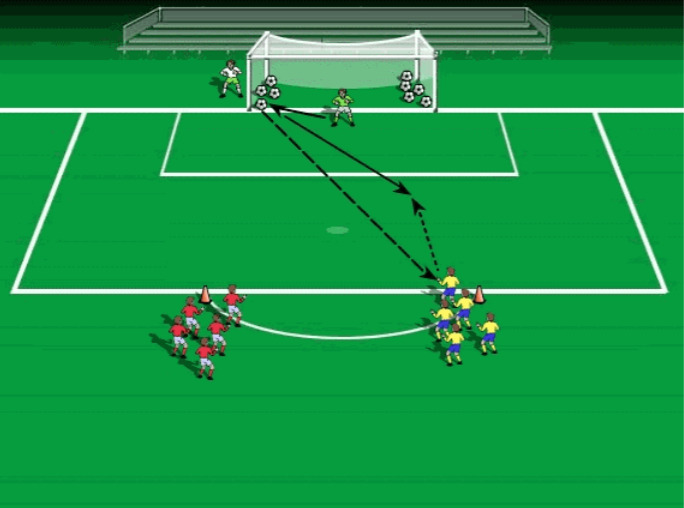
This is a great crossing and finishing routine to practice as it is on going and you can keep a lot of players working. As soon as the three central attackers have made their runs and got back to the start they are ready to go again. Rotate defenders and wide players. You can have fifteen players and more working constantly.

Shadow Play to begin. Attack in two’s to begin. Movement away from the ball initially if there is time in the build up. Working on timing of runs. Attack near post and far post areas. Cross from both sides.
Position off the near post don’t go beyond it to meet the ball; unless drawing a defender out of position for the second striker to attack. Winger plays a 1–2 and crosses as early as possible. Strikers know this and must get in position to meet the cross. The cross should be between knee and head height. Service could be a driven pass from a striker to a wide player or the play starts wide (timing is better).

Develop:
- Introduce a defender who must choose a striker to mark. The defender starts from the same area as the striker as if retreating towards goal. The crosser finds a free player.
- Introduce a third attacking player in behind the front two for the pull back.
- Have the opposite wide player coming inside as an additional attacker to cover the area beyond the far post, and the crosser has another player to pick out (now it is a 4 v 1 situation).
- Introduce another defender to mark up another attacker (4 v 2).

Players have made their runs into the correct positions to receive the crossed ball. The crosser has four choices of cross to make, near post, far post, pull back for the midfield player and past the far post for the opposite wide player. See who is free or just get the ball in if there’s no time to look (for example in a game where the defender puts the crosser under pressure).
Take the set up ten yards closer so the wide players are crossing from the goal line and the striker’s runs are shorter and sharper. Include a chipped cross to the far post if the keeper is at the near post.
This is a great routine to practice as it is on going and you can keep a lot of players working. As soon as the three central attackers have made their runs and got back to the start they are ready to go again. Rotate defenders and wide players. You can have fifteen players and more working constantly (two sets of strikers, two sets of defenders or even more sets of players etc).



Often players position to receive the ball with their back to play. These session plans show some ideas on how to position and instead "Face Forward" or at least Half Turned or three quarters turned rather than positioning square and facing back.