Welcome to the Soccer Awareness Coaches Corner. Browse through soccer drills, small sided games, tactical thoughts, full sessions and a variety of resources. Posts marked “Training Center Exclusive” are for members only.

Breakaway Game
In this game we are working on finishing, dribbling and breakaways. This is a great activity to work on both attacker and goalkeeper skills.
Finishing, dribbling, breakaways
Use the penalty area. The balls are placed in the side of the net and easily accessible for the goalkeepers. All players are at the top of box on either side.
The goalkeeper starts the exercise by distributing the ball to the first person in line at the top of the box.
The attacker must control the ball and immediately breakaway to goal.
As soon as the ball has touched the attacker for the first time, the goalkeeper can leave his/her goal line and close down the shooter.
The attacker has five seconds to score.
The goalkeeper allowing the fewest amounts of goals wins. Keep track of the goals.
The team or individual with the most goals wins. Alternate the goalkeepers every time.

Progression:
The goalkeeper must find the attackers chest.
The attacker has three seconds to score.
Coaching Points:
The goalkeeper must react to an errant touch by the attacker.
The attacker’s first touch must be out at a 45 degree angle away from the body.
If the goalkeeper’s feet are moving, shoot quickly.

This drill comes from the Soccer Awareness Youth Coaches Guide!
A Complete 6 to 10 Year Old Developmental Coaching and Training Program. More than 750 pages of session, drills, theory and more to get you started or take your team to the next level.
This program is perfect for youth coaches wanting practices to start their soccer coaching education and it is also for those more advanced and experienced coaches wanting to train their players as best they can at these wonderful open minded ages for development and education of both the mind and body. Our plan is to help all coaches at whatever level of experience they are at.

1 v 1 Crossing Game
Work on your goalkeepers ability to attack the ball, aggression, timing and competitiveness with this 1 v 1 crossing drill from Soccer Awareness.
The following drill comes from the Soccer Awareness Training Center. Soccer Awareness Training Center provides unlimited access to Wayne Harrison's Soccer Awareness systems, training sessions, drills and more. Wayne's system helps develop world class youth soccer players and teams in a systematic and imaginative manner that guarantees performance at the highest level of competition. Whether you’re a beginning coach who needs help getting started or someone who wants to add some variety to their training sessions, the Soccer Awareness Training Center offers a wide variety of drills to choose from. Join Today
Set-up: Place two goals 18 yards apart with a goalkeeper in each goal. A server stands on the side of the penalty box with a group of balls.
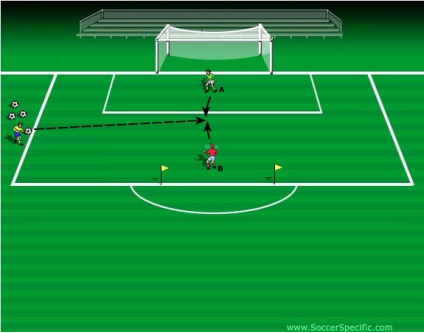
The server punts the ball high into the air and aims for it to land on the penalty spot.
Goalkeeper A and B must compete for the high ball save.
Whoever catches the ball in the air gets 2 points. If the ball drops to the ground, whoever wins possession gets 1 point.
The first one to 10 points wins.
Progression:
After the goalkeeper catches the ball in the air, he/she must set it down immediately and try and dribble a breakaway across the opponents’ goal line.
The server can also put the ball down at his feet and shoot on target to either goal.
Coaching Points:
Attack the ball and catch it at the highest possible catching point.
Drive your knee up to protect yourself from the other goalkeeper.
Decide early and arrive on time.



Developing Play from the Back
We develop play from the back. Work on that initially practicing all ways to get out.
Have opponents only intercepting passes to begin. Then let it go free.
When opponents win it back we work on the defending team condensing and defending correctly.
So certain plays are recognized consciously first of all with particular CUES offering identification of these.
If one or two ways to develop play are done very frequently then it becomes a subconscious decision to move in to position so no decision making required as such.
Distribution from the Keeper and Playing Out from the Back
We develop play from the back. Work on that initially practicing all ways to get out.
Have opponents only intercepting passes to begin. Then let it go free.
When opponents win it back we work on the defending team condensing and defending correctly.
So certain plays are recognized consciously first of all with particular CUES offering identification of these.
If one or two ways to develop play are done very frequently then it becomes a subconscious decision to move in to position so no decision making required as such.
Distribution from the keeper and Playing from the back

Perhaps use cones instead of actual players to practice to make it work initially and to gain confidence (better still use Mannequins).

Our starting position, the team is in defensive shape and ready to attack. A 6 v 3 makes it easy to get out, but decrease the number of opponents if necessary to gain success initially.
1. Distribution from the keeper using one attacking fullback

We attack down one side and we slide across with the other three of the back four to cover the spaces behind
2. Distribution through Both center backs or (6)

A simple starting position on distribution from the back using only those players in the immediate vicinity. A 3 v 2 at the back in our favor.
3. Distribution through Number (6) in a wide area

Now (6) breaks wide to receive the ball and escape being marked in the middle. The same can happen with (6) breaking out to the right also replacing (5) who stays central.
4. Distribution from the keeper: One centre back breaks wide

(3) stays, (6) doesnt drop in, (4) stays central, (5) goes wide, (2) pushes on and we get out down one side. Opponents (9) and (10) stop our (4) and (3), (5) gets free to play out.
5. Distribution from the keeper thru wingbacks

They push 3 up we get out through our wingbacks. Have opponents make different choices to force the keeper to make relevant decisions in training.
Distribution from the keeper through Both wing backs

We can start to add players and build the session up. Here we close off one side so the keeper has to recognize he cant go to (3) but can go to (2).
6. Distribution from the keeper thru INVERTED wingbacks By Ally Bain

Wing fullbacks 2 and 3 cut inside to receive the ball.
7. Distribution from the keeper thru INVERTED wingbacks by Ally Bain

Wing fullbacks 2 and 3 cut inside to receive the ball and can receive the pass from (4) , (5) or (6) also in the buildup.
8. Distribution from the keeper thru central midfield rotation of (6) and (8)

(6) Clears the space and takes the opponents (8) with him and our (8) drops in free to start the attack. Can also be with (6) and (10).
9. Distribution through Both wing backs dropping back

Centre backs both push out quickly and they are tracked by the two strikers. This releases spaces behind them. Both wing backs drop back into those spaces to receive the ball.
10. Distribution through Center backs pushing out

Wing full backs drop back in. They are tracked by the two strikers. This releases spaces down the sides. Both wing backs drop back into those spaces to open it up for the center backs.
Distribution from the keeper and Playing from the back 11 v 11

Now in an 11 v 11. Our normal way to get out from the back. We should always try this initially if it is on to do so. Try to get out thru (4), (5) or (6).
Distribution from the keeper 11 v 11

Another way to get out thru one center back and one wingback and even (8).
Distribution from the keeper 11 v 11

Another way to get out thru one center back (5) and (7). Wingback (2) tucks inside and may take opponents 11 with them to clear the pass for (7). A nice area to play into circled also.
Distribution from the keeper 11 v 11

They go 3 v 3 against us to stop us playing out of the back so we try to get out through (2) and (3). Otherwise we have to push up, condense and kick it long.
This takes lots of practice with the keepers to make this pass happen consistently.

They go 3 v 3 against us so we try to get out through (2) and (3). Otherwise we have to push up, condense and kick it long. Thye “may” see what we are doing and push 7 and 11 onto our wingbacks (2) and (3).
They push two players onto our wingbacks (2) and (3)

This outlet is now stopped. So we have to change our team shape from “wide and long” to “short and tight” getting ready for the long kick from the keeper.
11. They have pushed onto our Wingbacks so this outlet is stopped; we have to go long as a last resort

This can still be EFFECTIVE: Now we condense as a team “short and tight”. Our (10) is good in the air so we hit him and we have a lot of players around him to win the 2nd ball. Of course opponents will readjust also. Its cat and mouse.
11. We leave their 3 strikers offside.

Players can gamble for the flick on from (10). Players position behind, in front and alongside (10) so wherever the 2nd ball goes we have players to pick it up. WE ABSOLUTELY MUST get better at this. Obviously opponents will position better than this defensively; but you get the point.
54 Pages
We want to stay with our own game plan as closely as possible; based on what we practice and to keep it simple for us; as we dictate to our opponents; and we impose OUR WAY on them.
But there will be many occasions where we must change the system of play and we may have to adjust to suit the opponents.
Here are some ideas for you to consider for your team starting with the 13313 and 14231 systems of play.