
Welcome to the Soccer Awareness Coaches Corner. Browse through soccer drills, small sided games, tactical thoughts, full sessions and a variety of resources. Posts marked “Training Center Exclusive” are for members only.

Defensive Pressing to Push Up Without Touching the Ball with a Back Three
This is a great session to teach the players and shows how they can push opponents back even when THE OPPONENTS have the ball.
We will try to push them back without even touching the ball ourselves. We start on the edge of our box we try to get our back three up to the half way line. Set Conditions will help us do this to start the process off.
Conditions:
Defending team cannot tackle.
Defending team CAN intercept a pass.
Attacking team must play 1 or 2 touches due to the fact defenders cannot tackle so opponents cant dribble 1 v 1.
Coaching Points:
Defenders press the ball as quickly as possible.
Try to stop the forward pass, try to force a pass across the field or backwards.
Defenders must recognize every opportunity to push up no matter how small a distance it may be.
Sometimes its 5 yards up 3 yards back for example depending on the position of ball and if there is pressure on it.
Try to intercept the pass and gain possession.
Download this free 20 page session by joining our mailing list below

Defensive Pressing to Push Up Without Touching the Ball
This is a great session to teach the players and shows how they can push opponents back even when THE OPPONENTS have the ball. We will try to push them back without even touching the ball ourselves. We start on the edge of our box we try to get our back three up to the half way line. Set Conditions will help us do this to start the process off.
This is part two of a full session on defensive pressing from the Soccer Awareness Training Center. In this session we are developing play from the back with inverted runs into "No Mans Land" central areas. Get the full series and more than 500 other drills and full training sessions in the Soccer Awareness Training Center.
This is a great session to teach the players and shows how they can push opponents back even when THE OPPONENTS have the ball.
We will try to push them back without even touching the ball ourselves. We start on the edge of our box we try to get our back three up to the half way line. Set Conditions will help us do this to start the process off.
Conditions:
Defending team cannot tackle.
Defending team CAN intercept a pass.
Attacking team must play 1 or 2 touches due to the fact defenders cannot tackle so opponents cant dribble 1 v 1.
Coaching Points:
Defenders press the ball as quickly as possible.
Try to stop the forward pass, try to force a pass across the field or backwards.
Defenders must recognize every opportunity to push up no matter how small a distance it may be.
Sometimes its 5 yards up 3 yards back for example depending on the position of ball and if there is pressure on it.
Try to intercept the pass and gain possession.

This session is teaching defenders how to push up and force the opponents back without touching the ball. The goal is to start on the edge of the box, the opponents have possession but by pressing and pushing up at the right times we force opponents back. Our aim is to get our back 3 up to the half way line. So this is moving approximately 40 yards up the field.
Start with equal numbers so success can be achieved.

v 7 plus the keeper. Set conditions are introduced to help the session. Coach to (E) and (10) presses to try to stop a forward pass. Defending team may sneak up 2 or 3 yards if (1) can delay.
Sliding up and across the field

(10) forces the sideways pass and this can also result in a pushing up a few yards from the back as well as pressing the ball. The coach is the target for the defending team to play to when they win the ball plus is a support player for the attacking team.
The longer the arrows the greater the distance travelled up the field each time

(3) Presses so well (B) has only a back pass to make. (8) and (10) are in passing lanes to stop a forward pass with an interception potentially. (3) positions to stop a pass to (A). As the ball travels this gives the team a real chance to get up several more yards. A the same time leave (E) offside.
Danger from a first time delivery from the coach to (A) or (C).

(10) Does not press the coach to then be out of position as the coach is too far away to stop a delivery. (3) presses inside to press (G), (8) moves up and across to press (F). If the coach passes to (D) then (2) can slide across quickly as will (8) and (10).

(E) is still offside but not interfering with play. (A) and (C) move wide to find more space and the coach plays to (C). The defending team now need to drop back and across and lose some ground. Midfield three condense back and across to where the ball is. Back 4 try to leave (E) offside still so don’t recover all the way goal-side. But still in good defensive shape.

Italian Pressing and Conditioning Play Part 3: Identifying When and Where to Drop; Hold the Line, Slide; Press the Ball and Push or Sprint Up
Add players to the practice. Have the game set up as a normal phase play, attackers against defenders. Attackers have to try to score, defenders try to win the ball back and score in the little goals. The defenders have five passes to score once they win the ball then it goes back to the attacking side.
This is part 3 of a four part series on Italian Pressing and Conditioning Play.
Get Part 1: Pressing from the Back and Condensing Play
Get Part 2: Pressing with a Back Four and Defensive Midfielder
Identifying When and Where to Drop; Hold the Line, Slide; Press the Ball and Push or Sprint Up

- Using the Calls UP, OUT, HOLD, DROP, SLIDE RIGHT, and SLIDE LEFT. These are quite self explanatory but UP means edging up a few yards, then reassessing the situation; OUT means sprinting out, potentially many yards.
- This is set up to practice when to drop, when to hold the line and where to press up as a unit.
- Start with an overload of defenders to give you a better chance of success.
- A line of cones are placed where the back four should try not to drop behind.
- Dropping, holding the line or even pressing up (pressing even when you haven’t the ball) can depend on the following:
Dropping Off (using the DROP call)
- Opponents have the ball, and they make deep penetrating running in front of the ball; and there is no pressure or very poor pressure on the ball. At this moment the back four should drop off as the player on the ball has the freedom to pass the ball forward and can read the timing of when and where to do it due to this; and based on the back four’s position. This is unless the back four are so together and in tune they can push up the moment before the ball is delivered; but this can be a very risky decision.
Holding the Line or Pressing up (Using the HOLD; UP or OUT one word commands)
- Opponents have the ball, If the attackers make deep penetrating runs and there is very good pressure on the ball in front of the back four by another team mate, thus preventing a forward pass; at this moment they should hold the line and let the attackers run offside, or even press up as a unit to make it even more obvious their opponents have run offside.
- Opponents have the ball, If there is; very poor pressure or no pressure on the ball; but also no penetrating forward runs by opponent’s designed to get in behind the back four, then the back four can hold the line or even press up slightly.
- If the opponents have the ball and the player on the ball is facing forward, but has his or her head down looking at the ball, and is not observing what is ahead, nor any runs made by team mates, and there even is poor or no pressure on the ball; then that is a time to hold the line or step up too. The player looking down at the ball is the CUE to the back four to HOLD or step UP.
- Opponents have the ball: If there is very good pressure on the ball and the ball cannot be passed forward; and the opponents do not make penetrating forward runs beyond the back four, then the back four can actually press up even though we do not have possession of the ball.
- When Opponents have the ball, this is emphasized even more if the opponents are forced to pass the ball backwards, and cannot immediately play it forward again (due to good pressure). Distances we can push up depends on the distance of the ball from the back four and the immediate pressure on the next player receiving the back pass; it can be a substantial step up from the back and may result in opponent’s strikers being left offside as a by - product. This is turn pushes our midfield on and further presses the ball if it in the midfield area.
- We have the ball. When we win possession and play the ball forward and maintain possession that is a cue to push up quickly and immediately.
- If there is ANY DOUBT in any given situation then the back four should ALWAYS DROP DEEPER to be on the safe side, as that is the easiest decision to make.

Hi Coach,
We are excited to provide you with one of our popular soccer coaching ebooks today...
In this Soccer Coaching Ebook you will Learn The SECRETS To Coaching Decision Making And Awareness From Pro Academy Coach Wayne Harrison!
Learn the "Look and Think" Model Of Player Development which will get ever player on your team to think and act several steps ahead of play and think fast!
Click here to download the popular Coaching Soccer Awareness E-Book FREE!
Phase Play Set Up
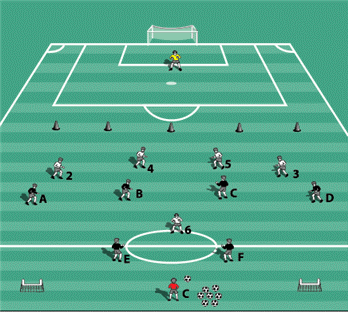
Add players to the practice. Have the game set up as a normal phase play, attackers against defenders. Attackers have to try to score, defenders try to win the ball back and score in the little goals. The defenders have five passes to score once they win the ball then it goes back to the attacking side.
Use the stepping up method of defending where appropriate, it will not be on every time to use it. The cones act as a guide but defenders can use this method of defending higher up the field in their own half.
Coaching Points:
- Is there Pressure on the ball or not?
- The Timing of when to drop, when to hold the line and when to step up, individually and collectively depending on the situation
- Regaining possession or opponents caught offside
A sign they are being successful from this is when the back four ends high up the field, away from the cones even though their opponents still have the ball.
Develop The Phase Play

- Overload the attacking team to make it more difficult for the defending team.
- Here we have an 8 v 6.
- Using the one word commands and identifying the moments to implement each one with the team.
- The coach can start each attack off with a pass.
- The coach can also be a target for the defenders should they win the ball as well as the side goals. Each represents a front player on their team that they have to pass to, thus when they get it to the goals or the coach they push up quickly using the OUT word.




Italian Pressing and Conditioning Play Part 2: Pressing with a Back Four and Defensive Midfielder
Same idea as previously, if there is no pressure on the ball then the defenders drop to prevent the ball being played into the space behind them for the strikers to run onto. Don’t get caught flat.
This is part 2 of a four part series on Italian Pressing and Conditioning Play.
Pressing with a Back Four and Defensive Midfielder

- Same idea as previously, if there is no pressure on the ball then the defenders drop to prevent the ball being played into the space behind them for the strikers to run onto. Don’t get caught flat.
- By defenders dropping slower than the attacker with the ball and the other two attackers, the distance between them decreases. As this happens (6) is pressing the ball.
- Once pressure on the ball is able to be applied, they all step up off the step and pressing on the ball of (6). Use a command call (e.g. STEP; as mentioned earlier).

Back four have dropped, two strikers are moving forward quickly and along the same line as them (6) has good pressure on the ball initially.

- Defenders hold the line now or push up, (as in this case).
- The good pressure on the ball from (6) allows them to do this, and as it can’t be played forward easily, that is the cue to press as a unit following the call.
- Same principles as in the previous 3 v 3.
- Wide players (fullbacks) must ensure they do not drop deeper than the center backs and play an attacker onside from a wide area where they cannot then affect them because they are too far away.
- (A) and (C) are offside and we should have won the ball and continued pushing up leaving opponents having to recover a long way back.
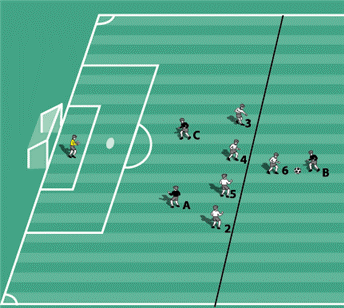
Here we have the end product; (A) and (C) are well offside even if (B) can pass the ball through.
Players have condensed towards the ball. This takes a well orchestrated movement by All the players, if one forgets then there is a possibility if (B) can pass the ball through then a striker in advance of the ball may be onside.

- Here defender (3) has not pushed up and is playing (A) and (C) onside from a wide position so if the ball is able to be passed through this player cannot get close to, certainly (A), and maybe even (C) in this case, to prevent either of them shooting on goal.
- Whilst it is unlikely (B) can thread the ball through to either striker if the defenders have condensed and gotten close enough to the ball, if that player can pass it through then we are in trouble,
- Is this a risky policy for defending, it can be if the defenders are not ALL tuned in at the same time; nor if there is not a leader who can identify the moment to do this as it has to be an instant decision and command call.
- If you are unsure as a coach of your players being able to do this then never use this tactic, if you have players capable of making it happen then work on it and have it as an alternative to dropping off all the time, then opponents are not quite sure what you will do to defend this particular situation.
They will think: “Will they press or will they drop?” and by having different means of defending this may delay their decision making; which is to your advantage.

Italian Pressing and Conditioning Play Part 1: Pressing from the Back and Condensing Play
Pressing from the Back and Condensing Play. Defenders drop off slower than attackers to allow them to get close and to delay their forward momentum. The defenders attack the ball the moment the furthest attacker is along the defensive line of the last defender. They move together to the ball, in this case treble- teaming the man on the ball.
This is part 1 of a four part series on Italian Pressing and Conditioning Play
Pressing from the Back and Condensing Play

- Defenders drop off slower than attackers to allow them to get close and to delay their forward momentum.
- The defenders attack the ball the moment the furthest attacker is along the defensive line of the last defender.
- They move together to the ball, in this case treble- teaming the man on the ball.

- Here the strikers are along the line of the last defender and that is the instance the three defenders step and leave them offside and press the ball collectively.
- Use a command call, the best player to do it is the last defender who has to have good awareness of the positions of the other two opponent’s players as well as the player on the ball.
- The Command can be STEP, a short and sweet command that has to be instantly adhered to.
- Then you are relying on the officials seeing this and getting the decision right!! Good luck with that.

- (A) and (C) are offside if they receive the ball.
- (B) has 3 players challenging. Timing of the movement is crucial, all players attacking the ball at the same time.
- You need good talkers to do this.
- Slowing the opponent’s forward movement helps the recovering defensive players get back to help too; such as midfield players recovering back.
- Defenders must make sure the player on the ball does not get past them. Keeper acts as sweeper if the trap fails.
Part 2 Coming Soon
54 Pages
We want to stay with our own game plan as closely as possible; based on what we practice and to keep it simple for us; as we dictate to our opponents; and we impose OUR WAY on them.
But there will be many occasions where we must change the system of play and we may have to adjust to suit the opponents.
Here are some ideas for you to consider for your team starting with the 13313 and 14231 systems of play.