Welcome to the Soccer Awareness Coaches Corner. Browse through soccer drills, small sided games, tactical thoughts, full sessions and a variety of resources. Posts marked “Training Center Exclusive” are for members only.

Game Strategies and Different Systems of Play to Learn
This is Part 1 in our Game Strategies series. There will be many occasions where we must change the system of play to suit the moment. We want to be able to play several different ways depending on the course of the game. We have chosen a few systems of play here to highlight (it could be others depending on your needs and beliefs).
There will be many occasions where we must change the system of play to suit the moment. We want to be able to play several different ways depending on the course of the game. We have chosen these systems of play below (it could be others depending on your needs and beliefs).
1-4-2-3-1: Attacking and defending shape
1-3-3-1-3: Note the different way the wing fullbacks defend positionally to the 1-4-2-3-1
1-2-3-2-3: We are losing and must take chances and attack
1-5-4-1 and counter attacking: We are winning but under intense pressure switch from 1-4-2-3-1.
Alternative way : 1-3-3-1-3 we are winning but under intense pressure we change to 1-4-4-1-1 or 1-4-1-4-1 and counterattack
We are down to 10 players and losing : Game Strategy Changes : Set up in an offensive 1-4-2-3 (1-2-3-1-3)
We are down to 10 players and winning : Game Strategy changes : We set up in a 1-4-4-1
We are down to 10 players and winning : Game Strategy changes : we set up in a 1-5-3-1
This guarantees us NOTHING results wise ; but it does give us the best possible chance to win ; by at the very least ; being prepared
This post is part 1 of a 4 part series on game strategies. Part 2-4 are only available to Soccer Awareness Training Center Members.
Differences and changes for positions based on our formations: We work with a back 3, 4 or 5.
1-4-2-3-1: Fullbacks a part of a four defensively; but more like wing fullbacks in attacking formation. Formation Changes to 1-3-3-1-3 in attack.
1-3-3-1-3: And 1 0 down so chasing the game with a High press all over the field and especially up front.
1-3-3-1-3: Right or left full back pushes on into a wide much more attacking wing fullback position; meaning we attack with BOTH 2 and 7 or 3 and 11 as an overload . Perhaps pick their weak side defensively to exploit.
1-3-3-1-3: Wing full back is much more attacking positioning perhaps 20 yards higher up the field and more like a wide midfielder . Number 8 pushes on between 6 and 10 offensively.
1-3-3-1-3: Now attacking with 6 players (or more if needed) defending with 4 plus the keeper.
1-5-4-1: And 1 0 up but being pressured: defend deeper don’t allow to much space in behind for them to play into. Forces them to play in front of you where we are strong. If defend high one ball in behind can beat a back 3, 4 or 5; numbers don't matter; so don’t encourage them to play in behind unless your central center back defends much deeper for this (If clever; they push a player onto our deep center back?).
1-5-4-1: Wing backs are now regular fullbacks perhaps 20 yards deeper and a part of a back five . 2 main changes, center midfielder moves into the back five and number 10 moves into center midfield. DEFEND WITH PATIENCE we are winning; no need to chase the game.
1-5-4-1: Counter attack when we win it; meaning the 2 wide midfielders become attacking wingers with the striker and a center midfielder attacking also (likely the number 10 who has previously dropped into center midfield). So when counter attacking defend with 6 plus keeper; attack with 4 (or more depending on the moment)
1-2-3-2-3: Ultra attacking 1 0 down , now both wing fullbacks attacking. Number 6 in front of the 2 center backs must have discipline defensively.
Initially showing the 4 systems of play and how they change from one to the other in their simplest form for ease of understanding; and depending on the game situation and WHY we need to change.
Our advantage is our opponents do NOT know what we are changing to from our pre-planning work..
Playing the 1-4-2-3-1 to begin
This is the defending team shape (defending start position) of a 1-4-2-3-1.

A simple way to change to 1-3-3-1-3
Switch to 1-3-3-1-3 attacking. May need to change personnel to suit these changes.



OR: Attacking shape of 1-4-2-3-1 AND 1-3-3-1-3
This is the attacking team shape (attacking “start position”) is 1-3-3-1-3. May need to change personnel to suit these changes.

1-3-3-1-3: Simplicity of change from 1-4-2-3-1
This is the defending team shape (defending start position) of a 1 3 3 1 3. The positioning of the wing fullbacks defensively is somewhat alien to most set ups in other formations; and you must explain and show in detail to your players how this works and why. May need to change personnel to suit these changes; but this is for “speed” of change.
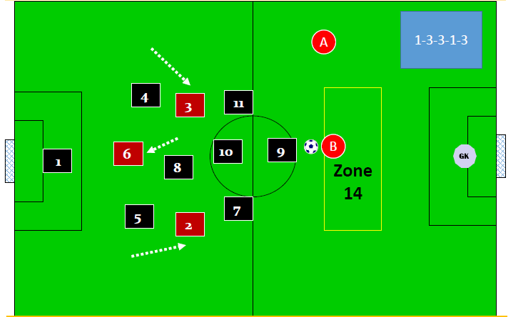
We move defensively as a TEAM
Still maintaining compactness and team shape defensively. The WHOLE team moves to the left and condense spaces.

1-2-3-2-3 Ultra offensive from a 1-3-3-1-3
Push (6), (8) and (10) even higher up the field offensively.(2) and (3) also. This is the attacking team shape now; a 1 3 1 3 3 or 1 2 3 2 3 depending on the moment. This can also be the attacking team shape we change to when we are chasing a game perhaps losing 1 0 and wanting to be more positive in attack. So this now would be the “attacking start position”.

1-5-4-1: Simplicity of change from 1-4-2-3-1
We drop (6) into a sweeper role and attacking midfielder (10) into a central midfield role.. Only 2 major changes of positioning so its very easy for players to understand. May need to change personnel to suit these changes. Midfield four must stay tight.

Playing a 1-5-4-1 when pressured and then Counter Attacking
Opponents are doing a full team press on us and GAMBLING playing a high back line. We drop (6) into a sweeper role. A Bad pas s t o 8. Our counterattack policy is to hit (7), (9) or (11) early and support quickly. Back four stay intact unless a wing back is advanced.

This post is part 1 of a 4 part series on game strategies. Part 2-4 are only available to Soccer Awareness Training Center Members.

1-4-2-3-1 System of Play in Detail
Part 2 of our Game Strategies Series: This is a more in-depth look at the 1-4-2-3-1 System of Play
*Membership Required
Playing the 1-4-2-3-1 and staying this way with more detail
This is the defending team shape (defending start position) of a 1-4-2-3-1.

Attacking Shape
This is the attacking team shape (attacking “start position”) is 1-3-3-1-3.

Overload in Zone 14
This is the attacking team shape now a or 1-3-1-3-3 or 1-2-3-2-3 depending on the moment. This can also be the attacking team shape we change to when we are chasing a game perhaps losing 1-0 and wanting to be more positive in attack. So this now would be the start position.

Interchanging Positions in Attack
A lot of interchanges between positions in attack. If we lose the ball, we have to be tuned into being defensively concentrated and disciplined.
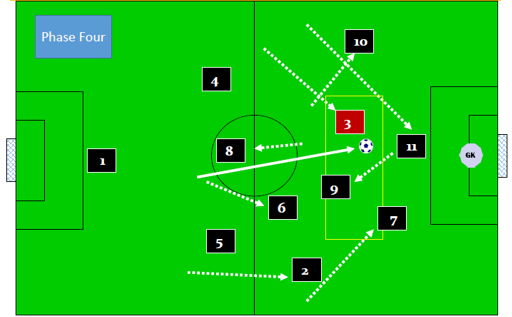
Defensive Discipline
If we cannot win the ball back quickly, we can alternatively drop into a compact defensive unit. Perhaps (9) can try to delay the opponents attack until we get into our best defensive set up.

Regaining Possession very close to THEIR goal so immediate high pressing as a team. A Full Team Press from back to front.
We must press up from the back too leaving opponents offside; should they get a chance of a counterattack. First pressing player should stop the attempted forward pass. Defenders must decide in a split second which course of action they take.
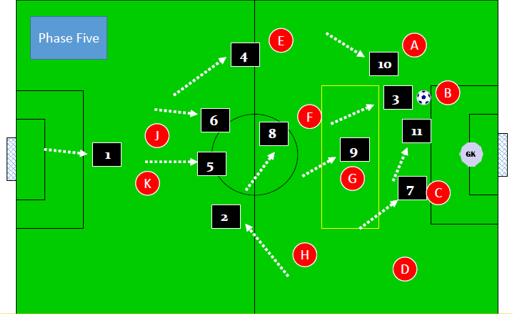

1-3-3-1-3 System of Play in Detail
Part 3 in our Game Strategies Series: This is a more in-depth look at the 1-3-3-1-3 System of Play.
*Membership Required
This is part 3 of our Game Strategies Series.
How Chile Played under coach Marcelo Bielsa
One of the National teams to play this way was Chile with Marcelo Bielsa in 2010. This was the basic set up which can be seen as a 1-3-1-3-3 or a 1-3-3-1-3 or 1-3-diamond-3 (1-3-1-2-1-3). Pep Guardiola formerly of BARCELONA experiments with Bayern Munich at times using this system philosophy; as well as other systems of play also now; so with this in mind I believe it is time to discuss this method of play in full; as top coaches like him start to look at how it works. Guardiola is one of the top managers in the world of soccer and at the same time is a great admirer of Bielsa so I believe it is time to look at this system of play that both employ. Perhaps this is the future of Soccer?

How Bayern Munich sometimes Play under Pep Guardiola
Note the fullbacks / WING BACKS OF Bayern tuck in to overload the center and middle of the field (Thiago and Lahm).
One can also have these two players touchline wide when in possession to spread out the midfield and open up spaces between opponents to play through.
The same can apply to right and left center backs breaking touchline wide also so we have 3 players in wide areas on both sides of the field in possession of the ball.

Staying this way with More Detail
This is the defending team shape (defending start position) of a 1-3-3-1-3. The positioning of the wing fullbacks defensively is somewhat alien to most set ups in other formations and you must explain and show in detail to your players how this works and why.

The players in our system of play
This is the attacking team shape (attacking “start position”) for a 1-3-3-1-3. Zone 14 is the area between the opponents back three or four and their midfield..

This is the attacking team shape now possibly a 1-2-3-2-3 depending on the moment. This can also be the attacking team shape we change to when we are chasing a game perhaps losing 1-0 and wanting to be more positive in attack. So this now would be the start position.

Changing the team shape if we lose the ball from the attacking set up
Let's say we passed the ball forward and lost it on the edge of the opponents penalty area. Immediately both fullbacks tuck inside to offer to fill central spaces and overload the area. (7) presses INSIDE towards (9) and (10).
Always try to force the ball INSIDE in the attacking and middle thirds to where our numbers are.

Forcing the ball inside to our strength in numbers
Even in a wide position, based on the pressing player (7) showing the ball inside both wing fullbacks tuck inside because the ball is being forced into the central areas.

Forcing the ball wide and adjustment of defenders
(7) Cannot get positioned quickly enough to force the ball inside so forces wide and this means some adjustment behind him or her for the right wing fullback and the right center back especially.
NOTE: (2) and (5) positional changes.

Interchange and rotation
Movements up front have been effected creating a diamond of support for striker 9 who becomes 10 and so on. These movements will be described in much more detail later.

Potential interchange movements
Great rotation between players should cause a lot of confusion in the opponents defending set up. We can establish some set routines initially using a situation to set it off (6 gets the ball to feet with time for example). Like a set play in open play to teach the players simply.

A preferred Phase Five when losing the ball: A Full Team Press
We may press up from the back too leaving opponents offside; should they get a chance of a counterattack. Defenders must decide in a split second which course of action they take.


Game Strategies and Different Systems of Play to Learn
There will be many occasions where you have to change the system of play to suit the moment. This article from Soccer Awareness will help you be able to play several different ways depending on the course of the game.
The following post if an excerpt from a full presentation on game strategies and systems of play in the Featured Presentations section of the Soccer Awareness Training Center. Soccer Awareness Training Center provides unlimited access to Wayne Harrison's Soccer Awareness systems, training sessions, drills and more. Wayne's system helps develop world class youth soccer players and teams in a systematic and imaginative manner that guarantees performance at the highest level of competition. Whether you’re a beginning coach who needs help getting started or someone who wants to add some variety to their training sessions, the Soccer Awareness Training Center offers a wide variety of drills to choose from. Join Today
There will be many occasions where we have to change the system of play to suit the moment.
I want us to be able to play several different ways depending on the course of the game.
4-2-3-1: Attacking and defending shape
3-3-1-3: Note the different way the wing fullbacks defend positionally to the 4231
2-3-2-3: We are losing and must take chances and attack
5-4-1 and counter attacking: We are winning but under intense pressure
We are down to 10 players and losing: Game Strategy Changes: Set up in an offensive 4-2-3 (2-3-1-3)
We are down to 10 players and winning: Game Strategy changes: We set up in a 4-4-1
We are down to 10 players and winning: Game Strategy changes: we set up in a 5-3-1
Playing the 4-2-3-1
This is the defending team shape (defending start position) of a 4-2-3-1

Attacking Shape
This is the attacking team shape (attacking “start position”) for a 4-2-3-1. Zone 14 is the area between the opponents back three or four and their midfield. For U11, U12 and U13 to affect the minds of 7 and 11 we may call it a 4-2-1-3 so they think positive and in an attacking mode.

Overload in Zone 14
This is the attacking team shape now a 2-3-2-3 or 3-1-3-3 depending on the moment. This can also be the attacking team shape we change to when we are chasing a game perhaps losing 1-0 and wanting to be more positive in attack. So this now would be the start position.

Interchanging Positions in Attack
A lot of interchanges between positions in attack. If we lose the ball we have to be tuned into being defensively concentrated and disciplined .

Defensive Discipline
If we cannot win the ball back quickly we can alternatively drop into a compact defensive unit. Perhaps (9) can try to delay the opponents attack until we get into our best defensive set up.

Regaining Possession very close to THEIR goal so immediate high pressing as a team. A Full Team Press from back to front.
We must press up from the back too leaving opponents offside; should they get a chance of a counter attack. First pressing player should stop the attempted forward pass. Defenders must decide in a split second which course of action they take.

Get the rest of this presentation and much more like this in the Featured Presentations section of the Soccer Awareness Training Center. Not a member? Try for one week free!


Now Available: Coaching the Ultra Fluid 3-3-1-3
Wayne Harrison's new book, his 15th publication on Soccer Coaching, will be soon!
Playing a 1-3-3-1-3 might be the way forward in the future. Chile won the Copa America Championship this year for the first time in their history using it. Pep Guardiola head coach of Bayern Munich uses it at times.
Wayne Harrison's new book, his 15th publication on Soccer Coaching, will be out soon!
Playing a 3-3-1-3 might be the way forward in the future. Marcelo Bielsa's signature formation in his squads is the 3-3-1-3 formation, which he made famous and brought to the front of the world's mainstream football scene during his coaching tenures in the Argentina national football team, Chile national football team, Athletic Bilbao and Olympique de Marseille.
He plays a high pressing game, as does Pep Guardiola at Bayern Munich; which will be explained in this book.
Jorge Sampaoli is the Chile head coach who played the 1-3-3-1-3 to win the Copa America for the first time in their history..
A Coach from Robert E lee Lancers from Springfield VA wrote this too Wayne and said we could share his experience so far with the Flex System.
Hey coach, first two games into the season and the tactics / high pressure of the FLEX has really been the key. We have scored 12 goals in the first two game. We won 7-2 and 5-3. The 5-3 game was against the number #16 team in the nation according to the top drawer site. Anyway, still have a lot of improving and finessing of our FLEX system however it is def a distruptor to the traditional formation! So glad I came across your book last fall!
Oh I forgot to mention that we didn't win a game last year and scored only 11 goals over 14 games. After 2 games we have scored more and have more Ws than the entire season last year. It's boggling my mind!

The changing game now and in the future
The game is changing and we all must keep up with the changes happening if we are to provide a real service to the players.
Is playing the game now about players decision making over the coaches? The way I see it we as coaches set up the framework from within which the players make the decisions. In this case we set up the 3-3-1-3 framework, we teach players various ideas to use within it and THEY decide when; where; how and why to use them.
This book is aimed at youth teams but also at professional level and senior teams; all can benefit from the information provided and coaches use it to the extent that each of their teams at whatever level of play can understand.
Get It Now

Soccer Awareness Model of Team Development
My model is implemented at professional Academy level. I believe in developing teams to reflect the most up to date and successful Professional European models of Soccer development.
The FIVE Phases of Play at the 8 v 8
We employ the 3-3-1 system of play. Using it from U6 to U10 with all our teams; we endeavor to teach a particular style of play that is popular, fun to play and successful and which teaches the players all the best aspects of soccer development.
This is how we develop our individual players and at the same time we are encouraging and helping players on how to use their imagination in 1 v 1 dribbling situations in the attacking thirds of the field. We want to develop technically great passers AND dribblers.
Remember the Art of great coaching includes changing the team shape / plan / style; based on the game situation; so prepare your teams with this in mind.
Please Click on this Link to Download this Information.
54 Pages
We want to stay with our own game plan as closely as possible; based on what we practice and to keep it simple for us; as we dictate to our opponents; and we impose OUR WAY on them.
But there will be many occasions where we must change the system of play and we may have to adjust to suit the opponents.
Here are some ideas for you to consider for your team starting with the 13313 and 14231 systems of play.