Welcome to the Soccer Awareness Coaches Corner. Browse through soccer drills, small sided games, tactical thoughts, full sessions and a variety of resources. Posts marked “Training Center Exclusive” are for members only.

Three Team Awareness Game with Measured Outcomes
With these drills our players are developing awareness of where the player they receive from is and where the player they pass to is. Because of this players begin to anticipate the pass to them and where it is coming from. Also they must look to where it is going to (where is the player they are passing to?). We are trying to create a situation where players are looking two moves ahead not just one.
Non – Competitive Awareness Numbers “Game” With Teams: Passing in Sequence
Divide the players up into three teams

30 x 30
Using 3 teams. Within each numbered team each player is numbered off. Teams (1) and (2) work together (with two balls) and team (3) works alone (with one ball). Players must pass in sequence i.e. with teams (1) and (2) working together 1 passes to 2; 2 passes to 3; 3 to 4 and so on up to 8 who passes to 1 and we begin again whilst team (3) players pass 1 to 4.
Awareness of: where the player you receive from is and where the player you pass to is. Because of this players begin to anticipate the pass to them and where it is coming from. Also they must look to where it is going to (where is the player they are passing to?). We are trying to create a situation where players are looking two moves ahead not just one.
For instance as (1) is about to pass to (2), (3) should be looking to support (2) for the next pass already, looking two moves ahead before the ball leaves (1).
Peripheral Vision Development results from this.
Develop: Reduce the number of touches players are allowed each time they receive a pass, all in free play to begin, then three touch, then two touch then one touch if it is on to do so. This speeds up the decision making process and forces them to look earlier as to where they are passing to.
Semi – Competitive Awareness Numbers Game: Passing in Sequence
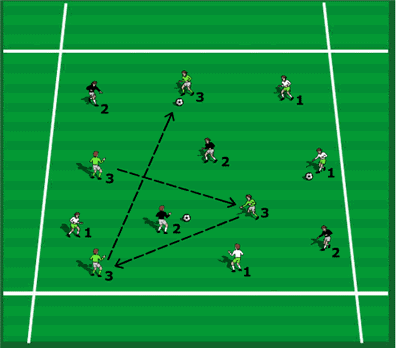

Coaching Points:
There are many things that the player needs to process before they even touch the ball involved in this. The breakdown is:
Good Footwork to receive the ball; which in turn helps the first touch
Taking a look around for all options to increase their peripheral vision
An open body stance to be able to change the direction of play if needed
Communication from the player about to receive the ball to teammates; and from teammates to that same player to help him or her recognize the options available
Then the first touch occurs.
An Open body stance is needed to allow a yard or more extra space away from defenders by letting the ball run across the body into preconceived space.
Looking before receiving to know in advance of the receiving pass; where the defending players are, where the space is, where team mates are free to receive a pass, how many options there are to move the ball on.
Movement OFF the ball is a priority both to receive it and after passing it.

Competitive Directional Three Team Awareness Game Introducing Goals As Targets
Here is an interesting way to work on awareness training and passing, movement off the ball, fitness and looking for the penetrating pass. Add triangular goals to score through, this means the game continues after a goal is scored as the ball must be received and possession maintained by another player on the other side of the triangle to count as a goal. This ensures continuous play.

The following post if an excerpt from the One Touch Training Section in the Soccer Awareness Training Center. Soccer Awareness Training Center provides unlimited access to Wayne Harrison's Soccer Awareness systems, training sessions, drills and more. Wayne's system helps develop world class youth soccer players and teams in a systematic and imaginative manner that guarantees performance at the highest level of competition. Whether you’re a beginning coach who needs help getting started or someone who wants to add some variety to their training sessions, the Soccer Awareness Training Center offers a wide variety of drills to choose from. Join Today
- Here is an interesting way to work on awareness training and passing, movement off the ball, fitness and looking for the penetrating pass. Add triangular goals to score through, this means the game continues after a goal is scored as the ball must be received and possession maintained by another player on the other side of the triangle to count as a goal. This ensures continuous play.
- It is a more directional method of playing and more specific to the game in general. The defenders are NOT allowed inside the triangle so they must be constantly working their way around the triangle trying to cut off the penetrating passes.
- Team (3) defends teams (1) and (2) work together. The combined attacking teams can attack both goals alternatively. Attacking both goals encourages “Switching the Field”.
- Ultimately reduce the game to two equal number teams for the greatest challenge and begin with as many touches as possible reducing the number of touches each is allowed as they improve and are able to keep possession effectively. Reducing the number of touches allowed inevitably increases their awareness and forces them to look for options earlier and improves and speeds up their decision making. This should result in them keeping possession more effectively.

Measuring / Assessing Performance
When training; as a method of self-assessment or measurement (or as close as one can get without an entirely objective process); I like to ask players to count; just for themselves; how many times they each give the ball away in a given timed period. I ask them to add them up to a final number and then think about what happened in each situation and if there was a certain aspect of their play that was causing them to give the ball away.
Hence whilst they are working on playing as a team player they are also at the same time focusing on themselves as individual players and assessing their own efficiency.
Therefore, they had to think about what the reasons were for giving possession of the ball away and if one stood out then that would be the most likely skill they needed to work on to become a better player, and thus not give possession way to the same extent, as they develop more as a player.
Examples could be:
- Poor footwork, the feet are not ready to receive the ball (a very common one, perhaps the most common one), so they are getting it wrong even before they touch the ball and this leads on to a poor first touch.
- Next perhaps then a poor first touch (that perhaps was caused by the poor footwork in the first place), or
- Not looking before receiving and knowing options in advance of the ball and thus getting caught in possession unnecessarily (this is in the mind, not thinking quickly enough), because they did not see the defender coming in to close them down or did not see their next options quickly enough, or
- Poor body position (closed stance) so their directional options for the next decision are limited (they may still maintain possession by going back to the player whom they face but they will miss out on better options if they opened their stance up and looked).
- For players off the ball to help the player receiving the pass it needed good communication from them (but I told the player receiving to not expect this often and that they needed to rely on their own awareness by looking for themselves, this is a fact of life with soccer and communication because players do not talk enough to help each other)
- They also needed to make movement into space to help the player receiving the ball to thus aid their next decision.
So a two-way support mechanism; the player receiving scans the options themselves, as the ball is arriving; players off the ball move to; create several options preferably for the player receiving; for his or her next pass or phase of play.
Reward System
Having done this, I then encourage their quick thinking using one touch play by asking them to add up the number of times they made a successful one touch pass during the time period, and that they could then deduct a mistake or giveaway from their score. This was a form of a rewards system I use.
Use this with free play, as many touches as they like and one touch reward, or three touches and a one touch reward, then two touches and a one touch reward (the most difficult of these). I call this lose a life and gain a life (or you can call it positive or negative point scores if you like); as they add up their score in their heads as they proceed.
It was important they did not get obsessed with passing one touch just to get one life (or point) back as not every situation warrants or needs a one touch pass and they may lose a life because of it, making a bad decision. Of course this is not an entirely objective measurement but it can be an indicator to them of the things they are good at and the things they need to improve upon.
If players mentally focus and use this idea they can identify for themselves their strengths and weaknesses and therefore have a somewhat objective idea of what they need to work on to improve themselves. You can apply this method of self-assessment to many game set ups and situations in training.
Age Related
For younger players meaning 6 to 9 year olds in general terms; it is best to introduce these ideas in a non-pressurized situation, where they are likely to give up the ball at times without pressure anyway; and you can analyze this with them.
Without pressure means the focus could be on foot work as much as anything which is the best place to start to help them; as many of the reasons the ball is given up in this is due to excessive pressure. No pressure narrows the field of possibility for error.
Choosing Options
Guard against them just passing the easy pass for the sake of, challenge them to really look to see all the options and try to choose the one that hurts the opponents’ the most, there may be a simple 4-yard pass that won’t affect the defenders, but there may be a one touch switching play pass to the other side of the field that will hurt them more, as we have a free player there and the change in play will be more effective than the easy pass.
You the coach can observe players and see those who attempt to take the right choices (being the most difficult sometimes but if successful causing the most damage to the opponents).
You may get a player, who takes every easy option and gets a good score, and never takes chances, well he or she is good for maintaining possession of the ball (and that is good in itself) but won’t unlock the door for the team with a telling but perhaps risky decision; as they didn’t test themselves, this is where your observation will come into the equation.
It can be a balancing act between making the right choice (perhaps a more difficult one), making the easy choice; and mixing them up, as sometimes only the easy pass is on anyway.
This is why it is not a totally objective process, it can’t be in such a dynamic game as this, but also where the subjectivity of the coach’s experience comes into play when assessing players with this system in mind.
Playing Percentages and Performing in Safety and Risk Areas
You can also apply logic to the decision made by players when you look at the safety and risk areas that players are in. You would encourage the easy option in the defending third of the field; as if the ball is lost there through a risky play then the opponents may score.
You would encourage the riskier but potentially damaging option against the opponents in the attacking third of the field because if possession is lost there then we can still recover the ball quickly and not be too open to a damaging attack against us.
But if it is successful this riskier option may lead to a goal that the easy option might not have. Yes, it would be a higher percentage chance of keeping possession with the easy option, but the rewards are greater if using the lower percentage option.
Example: In the attacking third we have two options; an easy pass that has a 9 out of 10 (90%) chance of success but it doesn’t penetrate the opponents defense, or a difficult pass between defenders that penetrates and puts the striker in a position to score but has a maybe 3 out of ten (30%) chance of being successful because of the limited space to pass it into and the number of defenders between the passing player and the striker receiving your pass. Which does the player take? Fear of failure would suggest the easy one, taking the chance would be the difficult one; but it may result in a goal. The player has to decide was the difficult option the best one to take? Maybe it was the best option at that moment even though its percentage of success was low.
Hence the higher percentage option with the most chance of maintaining possession is not necessarily the best option to take; it can depend on the individual situation at any given moment in time; and also on which part of the field it is happening.
The better the player, the more often they will make the right decision, using both the easy and more difficult options that present themselves all the time in the game.
Conditioning Games in Training
Free Play, Two Touches and One Touch Play
Conditioning the game situation in training can help identify what players are good at in these continuums. Playing a game with each player able to have an unlimited number of touches allows them to “get out of jail” as I call it, meaning get out of trouble and keep possession; even if their decision was not the best option to take at that particular moment. As an example; perhaps they did not look early to scan their options as the ball was coming to them (as in the best continuums) so they missed the opportunity for the one touch pass (which at that moment was the best option available) but their dribbling skills allowed them to still maintain possession of the ball.
Making the game a two touch maximum each time they receive the ball starts to focus their minds in quick thinking and quick decisions thereof; and does not allow them to get out of trouble (get out of jail should their decision making be poor) with lots of touches.
Rotating between games of two touches and free play all in (as many touches as they like); but including the one touch successful pass option in both; is a good way to focus their minds on the job in hand and understand the options they have available to be successful.
Players could for example be minus 6 meaning they are more successful, or positive 6 meaning they gave the ball away more; as they add one when they give it away and take one away when they perform the reward theme successfully.
Examples of good games to play for this are such as:
Three Team Possession Game: Three teams, two teams work together, one defends, creates an overload situation in attack, for example 15 players, three teams of 5, a 10 v 5 game. Possession changes as one of the two team’s players gives the ball away to the defending team then they become the next defending team this is a good transition game also from attack to defense and defense to attack. This game can be in an area of 40 x 40 yards for example and the challenge to the players can also be to move inside to outside (outside being just inside the touchline) and outside to inside to ensure they avoid standing in one area. Plus, it takes greater vision or awareness inside the area; where they need to look around and open their stance up to potentially change the direction of play; than on the outside where they can see everything easily.
Encourage players who play centrally on the team to get in the middle of the area and dictate the play, be the pivot for the team, the player who transfers the ball from one side to the other, the link player, this can be one, two or even three players at a time, but they can rotate between themselves too.
Equal numbered teams in a possession keep away game: this would be the next progression from the overload game being a more difficult challenge of the players. Same principles and ideas as above apply.
Transition games: In two halves, creating overloads in each half as each team gains possession. Team A have to get the ball in one half and play a 7 v 3 for example, team B have to win it back with the 3 defenders and get it back to the other half and have a 7 v 3 in their favor, and so on.
Themes of Play
You can work on different THEMES in these possession games based on how you reward the players; for example, each of the situations below constitutes a different reward mechanism to adhere to:
Quick thinking / Quick Passing: One touch successful passing; this improves quick thinking, early identification of options, in advance of the ball, quick passing.
Switching the Play or point of attack: Playing in thirds and being able to pass from one outside third to the other outside third successfully across the middle third can create a switching the play reward.
Defending 1 v 1: For a defending team, the individual winning possession and keeping it can be a reward, so they get a life / point for that.
Success in a 1 v 1 dribbling situation, beating a player with a dribble and maintaining possession. You can use this in free play all in games where players have unlimited touches each time they receive the ball.
Several themes in one can also be used; just playing the game or scrimmage you can incorporate all of these into the equation and ask the players to process in their minds all the ideas as to where they go right and where they need to improve.



Competitive Three Team Game
Working with three teams (4 v 4 + 4). Teams (1) and (2) work together to keep the ball from team (3). If team (3) regains possession the team who gave it away becomes the defenders. The defenders reward is they keep the ball and link with the other team.
Competitive Three Team Game

40 x 40
Working with three teams (4 v 4 + 4). Teams (1) and (2) work together to keep the ball from team (3). If team (3) regains possession the team who gave it away becomes the defenders. The defenders reward is they keep the ball and link with the other team.
Rules: Once possession is gained, to establish who gave the ball away the defender who won the ball puts their foot on the ball to stop play and the coach can call out the team who gave it away (or have the players themselves drive this by calling the color of the team who gave the ball away), or just keep the momentum of the practice going by playing on but the first touch or pass of the player who won the ball back is free.. Play begins again working on transitions.
Develop: Increase difficulty for attackers by:
- Reducing the zone size.
- Decreasing the number of touches on the ball of each player.
- Condition the passing to be only to the other attacking teams players e.g. (1) only pass to (2) and vice versa therefore only half the number of passes available per player.
- Increase the numbers to suit how many players you have, e.g. 4 v 4 + 4 or 5 v 5 + 5 etc
- Have two balls to play with so as they pass one ball they are now increasing their awareness and vision by looking for the other ball coming.
- Ask players to take off their pennies so they really have to look and not be able to use color identification.
- No talking or pointing, so players have to rely on their own vision.
Competitive Non - Directional Three Team Awareness Possession Game (4 V 4 V 4)

Further Progressions: Making it more competitive, have each team be the defending team for a certain time span. If they win the ball they then give it back to the combined attacking teams. Count the number of times they win the ball. The defending team to win the ball the most times wins the game, or alternatively the combined teams which give up the ball the fewest times win the game.
Attacking players individually count the number of times they give the ball away as an indication to each and every one of them how well they can maintain possession under pressure.
Begin with players able to have as many touches as they like, then break it down to 3 touch, then 2 touch with one touch passing the aim if it is on to do so.
Coaching Points:
- Open body stance to allow a yard or more extra space away from defenders by letting the ball run across the body into preconceived space.
- Looking before receiving to know in advance of the receiving pass; where the defending players are, where the space is, where team mates are free to receive a pass, how many options there are to move the ball on
- Movement OFF the ball is a priority both to receive it and after passing it.
Competitive Four Team Game

Competitive: The same idea as the introductory session only the player’s count the number of passes they make in a given time as a team. Compare the totals. They can’t pass back to the same player they received from.
Introduce several small goals for the players to pass through and count the number of goals scored. Ensure the players arrive at the goal (timing of the run) as the ball is passed through the goal (timing of the pass).
Players must not stand by a goal waiting for a pass as in a game they would not stand still like this to receive the ball as they would be easily marked.
Progression: Increase the number of balls per team (two balls per team). Combine two teams and have them passing to the other color and have three balls going at once, the variations can be numerous.
54 Pages
We want to stay with our own game plan as closely as possible; based on what we practice and to keep it simple for us; as we dictate to our opponents; and we impose OUR WAY on them.
But there will be many occasions where we must change the system of play and we may have to adjust to suit the opponents.
Here are some ideas for you to consider for your team starting with the 13313 and 14231 systems of play.