Welcome to the Soccer Awareness Coaches Corner. Browse through soccer drills, small sided games, tactical thoughts, full sessions and a variety of resources. Posts marked “Training Center Exclusive” are for members only.

Soccer Awareness: Basic Principles of Development (One Touch Play)
Linking foot preparation, body position and mental preparation to the technique involved in making a one touch pass leads us to a discussion on one touch play and its benefits.
One touch play teaches the value of being able to take your eye off the ball when keeping your eye on the ball can be a disadvantage.
To make this work, players need to have good teamwork and positional sense and therefore must work hard for each other.
This article is the intro to Wayne’s eBook 16: Soccer Awareness “One Touch” Training Developing its Relationship with Movement Off the Ball. Get the full book.
The Importance of Teaching One Touch Play: Improving One Touch Play
Maintaining an Awareness of What Is In Advance and Beyond the Ball
Linking foot preparation, body position and mental preparation to the technique involved in making a one touch pass leads us to a discussion on one touch play and its benefits.
One touch play teaches the value of being able to take your eye off the ball when keeping your eye on the ball can be a disadvantage.
To make this work, players need to have good teamwork and positional sense and therefore must work hard for each other.
A Gradual Training Introduction: Training the Psyche of the Players through One Touch Play
Introduce the training in a gradual way; don’t jump straight into a scrimmage. Set it up so it is easy to do initially. For example, one touch passing in two’s. Here, no great amount of awareness is needed because they are facing each other, but they must look into each other’s eyes and not at the ball. This is teaching them to get their heads up, and is the first most basic stage. It is also working on the pace and direction of the pass, getting foot sensitivity started in terms of that first touch on the ball that is now in effect a pass.
Then move to groups of three where a little more peripheral vision is needed. Then ask them to pass and move in a small area.
Next, add more players so there are more passing options and more awareness is needed. Now introduce the Numbers Game, passing in sequence; this really starts to introduce the awareness concept, but with one touch only.
Communication: Good communication is a must, so have players talk to each other, passing messages on to help each other all of the time.
Also, have them do this without any verbal communication as they then have to rely on themselves alone and in games. Unfortunately as much as we try, this very often happens anyway.
So do this WITH communication and WITHOUT communication. Even compare the two, some may get so good at this they can work it out for themselves most of the time as their peripheral vision improves.
So practice one touch with your team, then play games / scrimmages with your team and insist on it being ONE TOUCH ONLY.
There will be times when 2 touches are needed but do not allow it. Force the error if need be by insisting on one touch only.
Example: A player does not get his feet ready to receive and as a result does not make correct contact with the ball and possession is lost. Everyone can see that his feet were the problem, especially the player involved, and this will register in his mind for the next time.
Example: The ball is passed too heavily and quickly (pace and timing of the pass is wrong) and the receiver needs a touch to control the pass initially and then make a 2nd touch pass to keep possession. That is the passer’s fault, not the receiver’s; and they will learn that from this single pass. It is likely that a one touch play at this moment will not work, which is fine, because this will help them learn why it didn’t work for the next time.
Example: No teammates move to give the player receiving the ball an option to pass it one touch.
This is the fault of the player or players off the ball and not the receiving player, but you must insist it is passed one touch still so they pass it into the space the player should have moved into. Again, this will probably result in giving the ball away, but they will learn from that.
The players will recognize if possession was lost because there was not enough support off the ball, the pass was too heavy, or if it was the fault of the player’s first touch if there were options off the ball.
When you first do it, particularly in a competitive scrimmage situation whether within your own team training or against another team, you may find it is incredibly ugly play; the players will more than likely really struggle with it (or maybe not, they may surprise you).
And it may be ugly for quite a while; but just let it go.
Do not be disheartened and don’t let your players get discouraged. And do not coach, just let them play and work it out for themselves. Tell them you expect it to go wrong more than go right to relax them about it...
They will find with practice that they need to adjust the weight of the pass to help the next player, so foot sensitivity in passing will improve.
They will learn this through their own trial and error, not necessarily just what you tell them.
Get eBook 16: Soccer Awareness “One Touch” Training Developing its Relationship with Movement Off the Ball. This 103 page eBook explores one touch training and movement off the ball and includes 90 pages of drills that you can do with your team. Table of contents is below.
One Touch Training: Teaches the player WHEN to play one touch; and when NOT to play one touch. We are teaching players to have a ONE TOUCH MENTALITY. A One touch mentality teaches players to recognize the best options; and therefore make the best DECISIONS; BEFORE and in ADVANCE of receiving the ball.
Movement OFF the ball: This mentality conditions the mind of players OFF the ball to position and move to help the player who is receiving the ball. This means we want players to always; at every moment; THINK: “I only have One touch”; therefore this will force players to always do what I call the “LOOK and THINK” before they receive the ball to see several options and pick out their best option, which may actually be to DRIBBLE!!
When you use these training sessions consistently you will see the development of that relationship between having a ONE TOUCH mentality and Movement OFF the ball.
So in a nutshell:
LOOK (before receiving the ball);
MOVE (find space off the ball based on positioning of teammates and opponents):
THINK (what is my best option?):
EXECUTE (the Decision; or the SKILL Factor).



Structuring a Training Session
It would be useful if we all worked at structuring our sessions along the same lines to ensure we provide the correct coaching for all the players in all the teams. The following presentation is one way to set it up and it helps you organize your time management for a session.
It would be useful if we all worked at structuring our sessions along the same lines to ensure we provide the correct coaching for all the players in all the teams. The following presentation is one way to set it up and it helps you organize your time management for a session. This is how we want to do our winter training sessions for everyone. We have one hour per session you can change the amount of time spent on each phase depending on how long your session is.
1) WARM UP: (10 Minutes) - Ball each and / or Awareness workout. They must get lots of touches to get comfortable on the ball to begin the session.
2) THEME OF THE DAY (35 min.)
3) SCRIMMAGE: (30 min.) - To practice when, where, and how to apply the theme. They must be S.S.G’s and preferably 3 v 3 game size.
4) COORDINATION AND SPEED WORK: (10 min.) - Balance / quick feet. Also power work for the older ages.
5) COOL DOWN: (5 min.) - Ball each and / or Awareness workout if time allows.
6) CONCLUDING DISCUSSION: What did they learn today?
TOTAL = ONE HOUR AND 30 MINUTES
By using a structure you can focus the minds of yourself and the players thereby increasing the work time and decreasing the talk time. Players arrive for training and know what to expect and can get straight into the warm up without prompting.
More Demonstration and less Explanation works best. If you have time use the session planner to have a record of what you did; how it fared and what you may change for next time to make it better. Build up your own record of what you did over a season and from this you can plan a program for yourself in time.
How to Organize a Training Session
1) Organize The Equipment (Bibs, Balls And Cones)
2) Coach Only One Team At A Time To Avoid Confusion
3) Coach (Affect The Attitude) Of Each Individual Player In That Team
4) Stick To The Same Theme
5) Use Designated Start Positions To Begin Each Practice To Paint The Picture You Want To Create
6) List The Key Coaching Points
7) Think Individual / Unit / Team – Simple To Complex And Develop Logical Progressions Into The Session
8) Specify The Size Of Area Used And Make It Relevant To The Numbers And Ability Of Players Used
9) Divide The Field Into Thirds For Easier Points Of Reference In Small - Sided Games
10) Use Target Goals, Target Players, Or Lines For Opponents To Play To In Phase Plays And Functions
11) Isolate The Areas And Players In Functional Practices To Keep It Specific
12) Use Offside Where Necessary For Realism
13) Coaching Method: Freeze The Coaching Moment (Stop, Stand Still), Review What Went Wrong, Re-Run Slowly (Can Be Walking Pace), Re-Create The Set Up And Go At Match Speed. Let Them Play
14) Use A Questioning / Guiding Coaching Method Rather Than Command
15) For Attacking Themes Limit The Number Of Touches The Opponents Have If They Win The Ball
16) For Defending Themes Limit The Number Of Touches The Defending Team You Are Coaching Has When They Win The Ball. This Ensures The Opponents Have The Ball For The Defenders To Try To Win Back

Developing Attacking Play in the Opponents Defending Third
The attacking team has the ball. This is the start position of the game situation.
The idea is to have this phase, being the attacking one, and working on various ideas of movement, rotation and interchange to try to score.
You can focus on this until success is achieved from an attacking point of view.

The following is the beginning of Soccer Awareness eBook 31: Developing the Four Phases of the Game.
The game is really all about 4 Phases of Play. It can be divided up further into sub phases but the essence of the game are these 4. This eBook is what one of my main training sessions is based on. We actually train very often with this precise game situational model as it totally mirrors what I expect my team to do in the actual games. In doing so, we practice the same ideas over and over until they become AUTOMATIC when it matters.
The attacking team has the ball. This is the start position of the game situation.
The idea is to have this phase, being the attacking one, and working on various ideas of movement, rotation and interchange to try to score.
You can focus on this until success is achieved from an attacking point of view.
The starting point of the session: attacking team shape in a “Phase of Play”

Starting position of the attacking team. We can begin with an overload to get things moving positively in an attacking sense by not including (7) and (11) on the defending team. 16 players.
Attacking team shape in a Phase of Play: Using the full width of the field

To begin, our advantage is in wide areas where we have 2 v 1s on each side of the field. Draw defending fullbacks a Little wider in the process.
Wide attackers (7) and (11) cut inside to attack the inside áreas of the field


(7) And (11) cut inside to support (9) and draw defenders in to créate space wide for (2) and (3) to attack in.
(8) and (10) pull away from their markers to get free. Here we must attack through the wide areas of the field.
Defending fullbacks stay wide
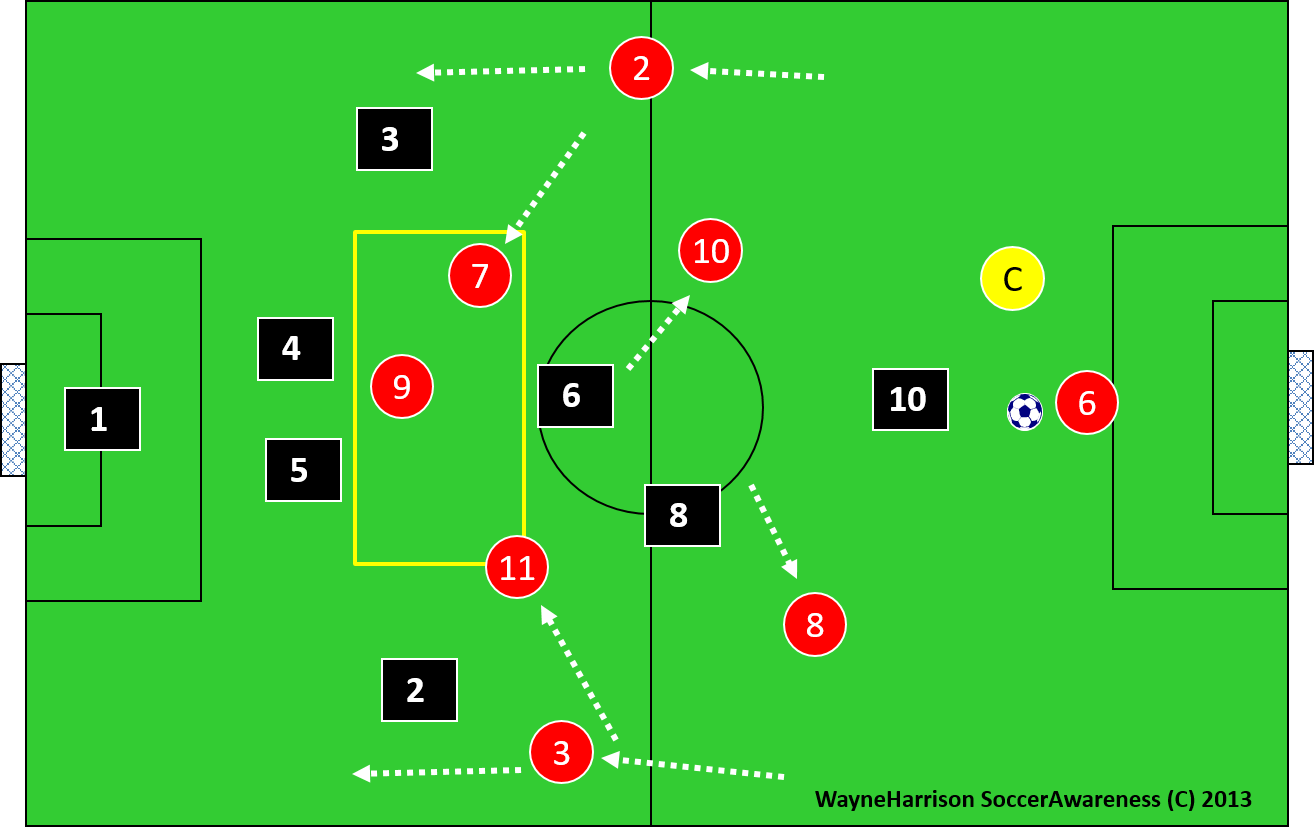
Defenders (2) and (3) are distracted by the runs of the attacking (2) and (3). Now (7) and (11) overload the central área in front of the two center backs. This is the área we must attack now.
Attacking wingbacks cut inside

Defenders (2) and (3) are distracted by the runs of the attacking (7) and (1). Now (2) and (3) overload the central área in front of the two center backs. This is the área we must attack now, this is a less predictable movement by the attacking team.
Movement OFF the shoulder of defender (4)

Striker (9) moves off the shoulder of defender (4) in the build up to get free for a pass into the open channel from (3).
Attacking wingback (2) cuts inside to score

(9) Drags defender (4) short thinking he is receiving to feet and (2) exploits the space left in behind defender (4). This kind of move is a rarity because not many teams teach wingbacks to get into central shooting areas like this.
Get the rest of this session and more like it in Soccer Awareness eBook 31: Developing the Four Phases of the Game

The "Awareness" Numbers Game
Game Objective: Teaching Players to be Aware of their Next Option “Before” They Receive the Ball and Not After
You can have players static to begin then have them passing and moving. Player receives from the same person and passes to the same person each time. This develops great awareness of time, space and player positions. Continuous work on and off the ball. Awareness of : where the player you receive from is and where the player you pass to is. Because of this players begin to anticipate the pass to them and where it is coming from. Also they must look to where it is going to (where is the player they are passing to?).
Coaching Points:
- Creating Space
- Quality Passing
- Support positioning; early movement off the ball
- Players look before they receive to see own players positions, opponents players positions and space.
- Players are looking two moves ahead not just one.For instance as (1) is about to pass to (2), (3) should be looking to support (2) for the next pass already, looking two moves ahead before the ball leaves (1). Peripheral Vision Development results from this.

Soccer Awareness Session: Quick Break Counter Attack
The team in possession has to make three passes then they can pass into the lone striker. Two
midfield players break quickly to support (making a 4 v 2 overloads in favor of the attacking team) and / or one defensive midfielder can recover. Start with a big overload then introduce the recovering midfielder later when the session is working well to offer a bigger challenge. This leaves a 4 v 1 situation in the middle zone in favor of the other team who are currently defending, if no recovering midfielder is used to begin. If the defenders win the ball or the keeper receives it, the ball is played quickly into the middle zone (to a 4 v 1 overload again) where they make three passes then get the ball into the striker to attack in the other direction.
Key Points we worked on:
- Possession play
- Patience in building; changing tempos of the game
- Opening up as a team in possession
- Condensing play out of possession
- Recovery runs when losing the ball
- Fast break when the time is right so fast tempo
- Different ways to counter attack
- High pressing when on to do so
- Developing transition and rotations of players from the back to the middle to the front third.
- Filling in and covering for each other to allow this
- Ultimately awareness of all situations but rapid observation AWAY from the ball at ALL times possible.
Constant Transitions From Attack To Defense

Directional Session
The team in possession has to make three passes then they can pass into the lone striker. Two
midfield players break quickly to support (making a 4 v 2 overloads in favor of the attacking team) and / or one defensive midfielder can recover. Start with a big overload then introduce the recovering midfielder later when the session is working well to offer a bigger challenge. This leaves a 4 v 1 situation in the middle zone in favor of the other team who are currently defending, if no recovering midfielder is used to begin. If the defenders win the ball or the keeper receives it, the ball is played quickly into the middle zone (to a 4 v 1 overload again) where they make three passes then get the ball into the striker to attack in the other direction.
Players in the previous attack from the other team must recover as quickly as possible to try to win the ball back before they get it into the striker.

Combination Plays
(6) Passes to (8) who has come off at an angle to receive, and gets the pass back. (9) Checks and receives a pass from (6).
(9) Then turns and moves infield with the ball and plays an angled pass to (10).
The following is an excerpt from Soccer Awareness eBook 5: Attacking Combination Plays.
(6) Passes to (8) who has come off at an angle to receive, and gets the pass back. (9) Checks and receives a pass from (6).
(9) Then turns and moves infield with the ball and plays an angled pass to (10).

Coaching Points:
- Communication.
- Receiving the pass “side – on”.
- Timing and angle of the run from (10).
- Timing and pace of the pass from (9). Try to pass with the outside of the front foot for deception.
During any of these progressions you can include defenders if you feel it is more realistic, you can have them defending passively to begin just “getting in the way”.
Sometimes players can make their movements easier if there is a defender as a reference point.

Example Soccer Awareness Training Session
All training is match specific. Our work is based upon developing a balance between ball handling and functional running and sprinting in combination with jumping, stopping and turning.
Quick feet, changing stride length exercises will be particularly important.
Repetition of the exercises is important throughout the season on a weekly basis to develop good and correct habits regarding co-ordination, comfort in running, awareness of the efficient use of arms and legs in running and the synchronization of limbs.
- Footwork and coordination movements for balance and changing direction,
- Dribbling techniques are practiced & reinforced every time,
- Rondos to teach positioning, footwork and foot preparation and body stance as well as improve and speed up decision making
- Developing the thinking process through specific “training the mind” exercises,
- 1 v 1s plus 1 possession games with support and building them up in numbers to 2 v 2 plus 1 and so on using and transitioning with outside players to develop rotational patterns of play;
- Finishing Techniques focusing on “Movements to get free” and shooting in both the corners of the goal;
- A small sided game situation bringing it all together based on a particular theme (so many different game situations taught) which is vital for the players to end on.
- Examples of SSG’s; One touch development; Movement off and “away” from the ball; Switching the point of attack; Zonal defending; High pressure games to speed up decision making; Shooting and Finishing games; Transition games highlighting the importance of when “possession changes” and what players need to do; Pressing games to improve immediate defending principles and so on.
Download the rest of the example session and all that can be taught (PDF)
54 Pages
We want to stay with our own game plan as closely as possible; based on what we practice and to keep it simple for us; as we dictate to our opponents; and we impose OUR WAY on them.
But there will be many occasions where we must change the system of play and we may have to adjust to suit the opponents.
Here are some ideas for you to consider for your team starting with the 13313 and 14231 systems of play.