Welcome to the Soccer Awareness Coaches Corner. Browse through soccer drills, small sided games, tactical thoughts, full sessions and a variety of resources. Posts marked “Training Center Exclusive” are for members only.

Awareness One Touch Theme Developmental Training: Incorporating Movement Off the Ball
Players are generally all very good at playing using many touches; that is; dribbles, turns and running with the ball, that is more technical training / playing.
But often not so good at one touch quick thinking and quick decision making training, that is more skill training / playing.
Hence why we must increasingly do this training with them.
This article is the intro to Wayne’s eBook 16: Soccer Awareness “One Touch” Training Developing its Relationship with Movement Off the Ball. This 103 page eBook explores one touch training and movement off the ball and includes 90 pages of drills that you can do with your team. Get the full book.

One Touch Training: Teaches the player WHEN to play one touch; and when NOT to play one touch. We are teaching players to have a ONE TOUCH MENTALITY. A One touch mentality teaches players to recognize the best options; and therefore make the best DECISIONS; BEFORE and in ADVANCE of receiving the ball.
Movement OFF the ball: This mentality conditions the mind of players OFF the ball to position and move to help the player who is receiving the ball. This means we want players to always; at every moment; THINK: “I only have One touch”; therefore this will force players to always do what I call the “LOOK and THINK” before they receive the ball to see several options and pick out their best option, which may actually be to DRIBBLE!!
When you use these training sessions consistently you will see the development of that relationship between having a ONE TOUCH mentality and Movement OFF the ball.
So in a nutshell:
LOOK (before receiving the ball);
MOVE (find space off the ball based on positioning of teammates and opponents):
THINK (what is my best option?):
EXECUTE (the Decision; or the SKILL Factor).
Introduction:
Players are generally all very good at playing using many touches; that is; dribbles, turns and running with the ball, that is more technical training / playing.
But often not so good at one touch quick thinking and quick decision making training, that is more skill training / playing.
Hence why we must increasingly do this training with them.
For the ONE TOUCH AWARENESS training game with three teams that I want everyone to do each training session for 10 minutes; to ensure we improve the players quick thinking and decision making, as well as their awareness of how to get free OFF THE BALL, here are some more ideas with the same theme so you do not have to do the same game every training session.
This will also ensure the players do not get bored with the repetition of it all.
Really try to have the players play one touch but depending on their developmental level perhaps start with two touches for them to gain early success and to increase their confidence.
But, As Soon As You Can; Play One Touch Only
Please ensure you do this every session as it is imperative we work on this theme with them.
Coaches choose which session they use each training session please, there are many choices to go at for you.
Shown below are many variations of the theme but the simplest theme to use is focusing on:
“ONE TOUCH PASSING AND MOVING OFF THE BALL”
Many may struggle with this but in time and with patience and practice you will be amazed how much improvement comes in quick decision making using this game. As each player only has one touch to pass the ball this should improve players movement off the ball to support due to this as they know the player receiving needs immediate help and as many options as possible. The two aspects of play go hand in hand, one touch play and movement off the ball.
Players in 90 minutes touch the ball themselves, depending on their position, perhaps 3 to 6 minutes, so what do they do in the other 84 to 87 minutes?
They must understand how best to move OFF THE BALL in that time span to help their teammates.
Hence why the focus and teaching of Movement OFF the ball is so vital and important in the greater scheme of things in the game.

Passing Game for Spatial Awareness Development
Players have the ball at their feet for approximately 5 minutes out of 90. What do they do the rest of the 85 minutes? They must learn to move off the ball and to move into open passing lanes to be open at all times to help the player on the ball or the next player on the ball. Here is a great session to teach this.
We can use many upright cones to represent opponents rather than mannequins. We set the cones up in triangles and diamonds. We ask players to position between the cones in the best space available. Try to balance their position to find the best space in the middle of the triangle or diamond of cones (opponents). Players beyond the ball try to position in triangles and diamonds of support also.
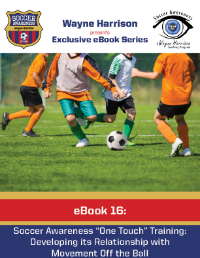
The following is an excerpt from Soccer Awareness eBook 16: Soccer Awareness “One Touch” Training: Developing its Relationship with Movement Off the Ball.
This 103 page eBook explores one touch training and movement off the ball and includes 90 pages of drills that you can do with your team.
Passing Game with Cones for Spatial Awareness Development using Mannequins or Cones in Training for Movement Off the Ball
Players have the ball at their feet for approximately 5 minutes out of 90. What do they do the rest of the 85 minutes? They must learn to move off the ball and to move into open passing lanes to be open at all times to help the player on the ball or the next player on the ball. Here is a great session to teach this.
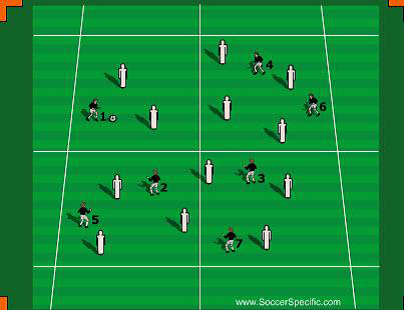
Getting into passing lanes to help each other
We can use many upright cones to represent opponents rather than mannequins. We set the cones up in triangles and diamonds. We ask players to position between the cones in the best space available.
Try to balance their position to find the best space in the middle of the triangle or diamond of cones (opponents). Players beyond the ball try to position in triangles and diamonds of support also.
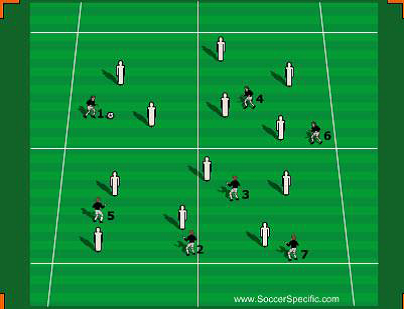
OBJECTIVE: To improve movement off the ball by providing mannequins to act as opponents to fill important space
A non-directional training practice
Mannequins represent opponents on the field. They fill important spaces so the players need to pass and move around and between them. This ensures players move off the ball to help the player on the ball have as many options as possible for a pass. The goal of the players is to find as much space as they can between the mannequins to give themselves as much space as possible to play in.
Every now and again stop the practice and see where the players are positioned. Are they in free space? Are they too close to a mannequin and hence in a game situation not available for a pass? If they are then ASK THE PLAYERS to SHOW you a better position to be in.
Possible problems here are the positioning of players behind opponents so the player on the ball cannot see them to pass to.
Develop:
Restrict the number of touches on the ball to 3 touches, two touches then one touch; if it is on to do so. To enable one touch to be possible movement off the ball has to be intelligent, fast and into space to help the passer play one touch. Thinking AHEAD of the ball arriving is paramount here otherwise one touch play cannot be performed successfully. Try to think two moves ahead. Movement OFF the ball by others is paramount here also otherwise the person receiving the pass will not be able to play one touch successfully.
Play the Numbers Game: 1 passing to 2, 2 to 3, 3 to 4 and so on. Increase the number of balls being used.
Two teams playing in the same area with a ball each. Now players need to avoid the other team AND the mannequins to find space to receive the pass.
Coaching Points:
Thinking and looking before receiving of the receiving player so they have assessed their options before receiving and in advance of the ball
Ability to play ONE touch if possible for speed of play
Movement OFF the ball of teammates to help the player on the ball
Movement INTO spaces between and around the mannequins to enable this to happen using the mannequins as guides.
Thinking TWO moves ahead to support.
Playing in triangles of support offering several options for the player on the ball in many directions.
An exaggerated situation but this shows what happens when players do not move to space to help the player on the ball; and do not open up the angle for a pass, instead standing behind an opponent and not being free to receive. How many times do you see this?
To defeat this problem; the player on the ball can pass to a space hoping that this will force the receiver to move to that space to receive the ball. Then the weight; timing and accuracy of the pass has to be particularly good; but this is not ideal.
Whilst players can still be successful with later movement off the ball of supporting players; if the player on the ball hastime on it to take more touches; it is always better to provide options of a pass as early as possible to increase speed of play and give opponents less time to work out their movements.
Working in threes
Here showing possible passing routes with each group of three players also showing how they get free and into as much space as possible, based on the positions of the mannequins who act as opponents filling spaces.
Different colors to pass to in order to develop color coordination.

Game situation
Have players passing in two teams to begin as a warm up, with a ball each team, then two and three balls each team. Then they pass to opposite colors only.
Now play a 6 v 6 (or any number you like) and make it a possession game. Mannequins make it more difficult by filling spaces so players have to play around them as well as their opponents. This should improve them playing in tight situations.
Use a 2 player overload if required initially until they get really good; then make it equal numbers each team, you dictate this based on the ability of your players. Of course change the numbers of touches on the ball decreasing the number as they become proficient to increase the difficulty.

The focus is again passing and movement off the ball to receive with as many players as possible offering an option of a pass for the player on the ball.
Here we show potential positioning of players in the biggest spaces they can find between the mannequins.
More space means more time to play on the ball so the player has the choice to play quickly or not; also depending on the individual situation presented; and often dictated to by the support positions of his teammates.
Develop: Have two teams playing through each other avoiding each other and also avoiding the mannequins. This is now a big challenge to each player on the field where there will be less space to play in and their peripheral vision will really be tested to its fullest.
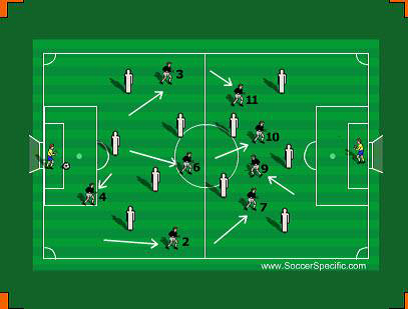
Game Situation
Try an overload first of all maybe a 9 v 4 building it up to a full game. This is a big challenge meaning fewer spaces to play in and forcing more movement off the ball to support each other.

Here is a great video of FC Barcelona YouTube showing how this works.
Get more like this in Soccer Awareness eBook 16: Soccer Awareness “One Touch” Training: Developing its Relationship with Movement Off the Ball.
This 103 page eBook explores one touch training and movement off the ball and includes 90 pages of drills that you can do with your team.



The Conscious and Sub-Conscious Mind and Myelin Production in the Development of Soccer Players
The more you practice, the more you know how to do something better. However, if you believe, for even one second, that a habit cannot be undone, you are right! There is no way of undoing what you have learnt – so you might ask then, how do we get rid of a habit?
The answer is putting in more practice to learn something else than you did into learning the habit you are trying to undo. It's just that simple!
Every soccer player, like every human being, has two distinct parts of the mind whose primary role is thought and recollection: the conscious state and the sub-conscious state. As the names suggest, when you are completely aware of what you are doing, you are letting your conscious state guide you through the process.
On the other hand, when you react instinctively, or automatically even, your actions are being controlled by your sub-conscious mind. This isn't just true for football, by the way! Even when you are driving or cooking or swimming both these aspects come into the picture.
Our natural tendency is to think that we are how we think! We tend to define ourselves by our conscious mind or thoughts, which is not completely accurate. When it comes to making a decision after thinking about it, the conscious mind is the king. However, everything that we do, using our conscious mind, only helps create a belief system or habit for our sub-conscious mind.
What does that mean? It means that as we keep making a particular kind of decision, based on a particular kind of thought process, we convince our mind about our thinking patterns, which slowly becomes a habit for us.
To quote a simple example – say you are asked to pick your favorite color between Red & Green, and you choose Green. If this question is repeatedly asked to you, over and over again, there will come a point in time when you won't even need to think about the answer – you will just choose "Green" without blinking. It might even get to the point where you will speak out the answer even before the question is completed or earlier still.
Basically, what you are doing is training your mind to handle that situation in a way where you know exactly what you are going to do.
Being asked the same thing, over and over again, is just a way of reinforcing that idea into your sub-conscious mind. The decision, originally, was being made by the conscious segment of your mind. However, over time that role was slowly and gradually handed over to the sub-conscious mind, which made it instinctive.
That is the exact same reason why you can apply the brakes quickly, when the car in front of you suddenly comes to a halt. That is also why you know how to instantly use a spoon or even how to tie your shoe-laces.
MAKING HABITS
There is a gross misunderstanding about forming habits and breaking them. The general belief is that once a habit has been formed, it cannot be broken or is very hard to break. In actuality, it's all about chemicals in our brain!
When you do something, anything, you trigger chemical reactions that produce something called Myelin. This myelin forms a cover around your brain's neuron.
That is the beginning of the formation of a habit. Every time you do that same thing again, your brain adds another layer of myelin to the existing layer – which makes it thicker.
The thicker the myelin, the stronger the habit! The stronger the habit, the more instinctive you are! That means exactly what you already know –"practice makes perfect"! (Well, permanent more like.)
The more you practice, the more you know how to do something better. However, if you believe, for even one second, that a habit cannot be undone, you are right! There is no way of undoing what you have learnt – so you might ask then, how do we get rid of a habit?
The answer is putting in more practice to learn something else than you did into learning the habit you are trying to undo. It's just that simple!
HENCE WHY THE YOUNGER WE GET PLAYERS TO OUR TRAINING THE BETTER WITH FEWER BAD HABITS TO BREAK / CHANGE.
If you put in enough hours, more than what you have done before, you will put on more and more myelin on your neurons for a second habit and your second habit will become stronger, pushing the first behind in the pecking order.
Basically, your habits are instilled in your sub-conscious mind, allowing your body to respond to environmental triggers a particular kind of reaction, instinctively. Get the right kind of triggers for your mind and you will have the right kind of Myelin layers forming in the right place and the reaction becomes ANTICIPATION..
When you arrive at Barcelona the first thing they teach is LOOK and THINK; LOOK and THINK; LOOK and THINK.
When you see Xavi Hernandez of Barcelona threading an inch-perfect pass through 4-opposition players, finding a team-mate, commentators & fans call it vision.
However, what they don't realise is that the reason a player can pick out a pass like that is because they have practiced it, studied it, run through that same routine over and over and over again, in practice!
What is the purpose of a training session in soccer? It is to prepare for the team you are about to face over the weekend. You play the reserve line-up or break up your squad, and play one team like the opposition plays, and build your strategies by employing solutions to the problems they will pose.
You run those plays/situations over and over again; make your players watch videos, and constantly reinforce these ideas until your players are able to recognize and react instinctively.
So, when they face their opposition on the pitch, it's all about reacting instinctively and allowing the training to lead each individual through.
The game is so fast, it is almost impossible to stop the ball, look up and think about what you are going to do, assess your options and then make a decision. Instead, training helps your players understand patterns of play, patterns of runs and patterns of passes that they should make or expect. OUR Training focused almost conditions the LOOK and THINK.
What is the Look and Think?
The Continuums “Look and Think” Model of Development
Word Association combining thought and deed
“Look and Think” MUST come first before everything else; decisionmaking in advance of the ball.
- LOOK / OBSERVE / THINK (ALWAYS BEFORE receiving the ball; assessing all options in “Anticipation” not as a Reaction)
- SKILL: THE DECISION (How, why; when and where of Technique; plus its success or not; and why?)
- FOOT PREPARATION (flat footed, off balance?)
- BODY POSITION (open or closed?)
- COMMUNICATION (Verbal and visual)
- CONTROL (If not a one touch pass on, the 1sttouch control)
- TECHNIQUE (the pass, the run, the dribble, the turn, the shot; etc)
- TACTICAL MOBILITY (Movement off the ball, finding space; 90% of the game)
- MENTAL and PHYSICAL TRANSITION (Possession changes, Player tunes in immediately?)
Relating Word Association with Actions to identify the Strengths and Areas of Improvement needed in players. Focusing particularly on teaching a ONE TOUCH MENTALITY.
1. Most players will mentally prepare to make a decision AFTER receiving the ball; we teach them to mentally prepare to make decisions BEFORE they receive the ball. This saves them time and space and can be the difference between maintaining possession and losing the ball. As the game gets faster, so is the need for players to master this VITAL innate ability.
2. One Touch Development: We ask Players at our training to THINK with a “One Touch Mentality”, like every time the ball is coming to them they imagine they only have one touch to play the ball with.
This will literally FORCE them to LOOK around and THINK of their options before receiving the ball
On deciding the best option thru a “one touch thought process” It could result in a pass, a dribble, a receive and turn and run; a run with the ball, a one touch pass, a short pass, a long pass;, few touches, many touches on the ball as the next option; anything at all. The secret is they enabled themselves to save time and space; to play really “quickly”; or even playmore “slowly”; based on the “Tempo of the Game” needed at that moment.
3. In the Zone: Training your mind as well as your body
Being in the zone generally means being in a state in which your mind and body are working in harmony. You're calm yet energized, challenged yet confident, focused yet instinctive.
4. Mental training: Keep your focus
Training your mind is an important step toward getting in the zone. Aspects of mental training for sports include increasing concentration and focus, controlling emotions, trying to feel relaxed but energized, being calm and positive, and aiming to feel challenged and confident.
Soccer is played in the mind and preparing the mind for the game is an extremely scientific and sequential process.By breaking things down, sequentially arranging and explaining them, and through incredible amounts of repetition, you create a team that knows exactly what team-mates are up to and what they need to do next.
Hence why playing a specific system and STYLE of play consistently is so important. The sub-conscious mind is the most important weapon on the soccer pitch. It gives you the speed of thought you need to survive and excel. The more natural you are at reading a situation and picking up cues, the better you will be at soccer.
The more you train, the better you will be able to visualize everything and the better you can visualize, the more trained your subconscious mind will be. You will then be a step ahead of everyone else. You will hit those perfect passes or strike the top-corner nearly every time till it comes to a point where making split-second decisions will come naturally to you, and also look magical !
THIS is EXACTLY what we will teach your child where their game will become “automatic” but it takes a lot of time and training, it’s a marathon not a sprint. Most players play CONSCIOUSLY because they haven’t been trained to play beyond that thought process; many are at the stage where they still don’t decision make a head of the ball.. Our training teaches them to think both SUBCONSCIOUSLY and in advance of the ball.
The Conscious and Sub Conscious Mind and Myelin Production
The process is:
a) Playing Consciously and making decisions but not before receiving the ball, and then;
b) Playing consciously and making decisions before receiving the ball, and then;
c) Playing subconsciously and the decision is already made without thinking.
When a player is consistently acting and performing at stage c) then that player sees the field in slow motion, is relaxed, everything comes easy (as long as they put the work rate in); and off the ball they have intensity and desire.
And the more the players trains in the right way the better they will become, it doesn’t suddenly happen and its done, it is a constant work in progress to maintain this level of thought and action.
The players who think they have it made and don’t need to work as hard anymore invariably fail.
A BALANCE BETWEEN RELAXATION ON THE BALL AND INTENSITY OFF THE BALL IS THE GOAL

Soccer Awareness Philosophy of Team Play
#1 - Keep Possession - If players chase for the ball a long time they get frustrated, get tired and commit fouls. So keep possession and force this upon them
- Keep Possession - If players chase for the ball a long time they get frustrated, get tired and commit fouls. So keep possession and force this upon them
- Develop Play from the back - When it is on to do so to help maintain possession of the ball and not rely on a 2nd ball pick up
- Pass and Move - Movement off the ball is a major part of our team development
- Form triangles and diamonds of support all over the field - Creating open body stances and increasing peripheral awareness
- Inter-Change Positions - Offensively and defensively cover for each other
- Create space for your teammates; not just for yourself - Unselfish team play; Play for the TEAM
- Attacking Fullbacks using Width in Attack - Offense is the best form of defense
- Keep a very high line defensively - Squeeze opponents into their own half of the field
- Pressure opponent’s high up the field - Winning the ball back 30 yards from the opponent’s goal is better than 80 yards away
- Counter Attacking and Quick Breakaway - Developing different ways to counter attack
- You need skilful players to make this all work - We have the raw material so let’s develop them

Hi Coach,
We are excited to provide you with one of our popular soccer coaching ebooks today...
In this Soccer Coaching Ebook you will Learn The SECRETS To Coaching Decision Making And Awareness From Pro Academy Coach Wayne Harrison!
Learn the "Look and Think" Model Of Player Development which will get ever player on your team to think and act several steps ahead of play and think fast!
Click here to download the popular Coaching Soccer Awareness E-Book FREE!
Problems to Solve
- How to get FREE AND FIND SPACE TO RECEIVE the ball and to maintain possession of the ball
- How do we do this?
- Using the Thinking Process
- Players must learn to think AHEAD of the ball, to think two moves ahead in their mind.
- So; Observation of own players positioning / Opponents positioning / SPACE available / where the ball is in relation to all these factors.
- All done BEFORE RECEIVING THE BALL.
- Saving time doing this; Increasing time and space to play in by doing this.
- Also; POSITIONING OFF THE BALL
- Positioning to find SPACE based on their own team mates and the opponents positioning; the position of the ball; and based on these factors: FINDING THE BEST SPACES AVAILABLE.
- Doing all of the above means: we can be successful using fewer touches on the ball.
- Doing all of the above will SAVE a touch or two on the ball; and by doing so:
- Players will: PLAY MORE QUICKLY, THINK MORE QUICKLY, MOVE MORE QUICKLY.

Spacial Awareness Training Using Poles
These videos show players how to position in open spaces. We use poles positioned closely to each other to represent opponents and the team in possession must position between them in the best spaces possible.
Preview: These videos show players how to position in open spaces. We use poles positioned closely to each other to represent opponents and the team in possession must position between them in the best spaces possible.
We also have opponents we are playing against to position in between also to test players understanding of positioning off the ball.
Can start this without opposition, in other words, 2 or 3 teams each with a ball passing and moving using the poles only.
Then make it competitive.

How Do You Define Soccer Intelligence?
I call it Soccer Awareness
This is the “thinking” part of the game. The game starts in the head of the player and we as coaches must guide the players to think more quickly and with better accuracy in decision making.
Therefore soccer intelligence is based around players being able to identify their options BEFORE they receive the ball; and pick out the best option of hopefully several available to advance it; and maintain possession of it in the next phase of play.
I call it Soccer Awareness
1. This is the “thinking” part of the game. The game starts in the head of the player and we as coaches must guide the players to think more quickly and with better accuracy in decision making.
Therefore soccer intelligence is based around players being able to identify their options BEFORE they receive the ball; and pick out the best option of hopefully several available to advance it; and maintain possession of it in the next phase of play.
2. Another VITAL part of developing soccer intelligence in a player is the “Coaching Methodology” a coach uses.
You will never know how much a player understands until you ask them.
How often does your coach ask the players questions in training, how often do they ask the players to “decide themselves” where would be a better position to stand, what would be a better pass to make, where would it be best to dribble, where would it be best to play one touch; and then have the player SHOW the coach through their own movement and decision making?
How many times do you see a coach tell the player to do this, do that, go here; go there?
The player does it but doesn’t necessarily understand it; they did it because the coach told them to.
So with this current and prevalent style of coaching how does the player learn soccer intelligence for themselves when they are being told what to do all the time and not allowed to think for themselves? EXACTLY, they DON’T.
So from this my directive would be from the earliest age possible the coach should engage the players in conversation about the game, get their opinion, the coach doesn’t ram their opinion down the players throats, after a minute are the players listening anyway?
Half time team talk, have the players run it, yes even at U8. Ask them questions don’t tell them everything that happened unless they clearly do not understand for themselves and need the help.
In time you will see they are thinking for themselves; identifying situations that happened in the first half that they did well, that can improve on.
Of course the coach must offer advice also, but mix it up so everyone has a chance to add constructive information.
From this you would find the players begin to talk more on the field of play which is a serious problem in youth soccer in the USA where players play and hardly say anything.
They should ALL be communicating on the field which means less need for the coach to offer direction, and therefore offer direction sparingly when they really need it.
So start this process as early as possible.
I recently watched a team practice and hardly heard a player speak on the field. They wait until the coach tells them what to do, this is wrong but has developed because they have not been taught / guided correctly to think for themselves; from U8 and onwards and allowed / encouraged to develop their “own” soccer intelligence.
We can fix this at U8 and every year beyond if the coaching methodology of “question and answer” and “guided discovery” is used as opposed to the traditional “COMMAND” style that is out of date; though can still be used when needed; but sparingly rather than as the norm.
Why is it Important?
Without soccer intelligence a player cannot assess situations quickly enough through thinking and movement and therefore cannot maintain possession of the ball especially in pressure situations that occur every second on the field of play.
How Does Soccer Intelligence give players and teams a winning advantage?
Players assessing the game more quickly cerebrally than then opponents can play faster and think faster and make better decisions through identifying the best options as early as possible than opponents; and hence be one step ahead of them.
In player development is soccer intelligence the most important? Where does it fit in with tactical and technical development?
I would say it is the key to being a great soccer player. It is the SKILL FACTOR in player development, the when, where, how and why of technical development in terms of decision making. I will explain more and in greater detail below.
At what age should soccer intelligence training start?
It depends on the player. Some can start at 7 years old some might not be able to grasp it until 10 years old. Generally speaking the earlier the better; introducing very simple decision making training at 7 or 8 years.
Development of technique with closed skill training is the most important at these ages, repetition of the same things without too much thought; so they are capable of making successful dribbles and turns and passes without pressure and then introducing decision making to see if the players know where, where, how and why to make that pass, that dribble that turn and so on with pressure included.
How young is too young and why?
As I said it depends on the player.
How do you train soccer intelligence?
By systematically training the players with an awareness training model.
For example creating situations in training where the player MUST look around before they receive the ball, and so setting “conditions of training” to ensure this happens.
Simply put it goes like this and in this order:
- Observe where the ball is coming from
- Observe how it is coming? In the air; on the ground; and position accordingly
- Know where “teammates” are before receiving the ball
- Know where “opponents” are before receiving the ball
- Know where the “space” is to play into before receiving the ball
- Decide what to do with the ball before the ball arrives (one touch pass, two touch, dribble, run with it etc)
- Observe “where” the ball is to be moved to (where is the free space for example)
- Decide “when” the ball has to be moved (quickly due to pressure or keep it as you have time)
- Decide how the ball needs to be moved (one touch pass, two touch, dribble, run with it etc)
- Decide why that is the best option (compare all options with the teams tactical objectives in mind and pick the best one)
All this must be processed in the players mind BEFORE they get the ball.
I have created a “Continuums of Development Model” to identify what a player needs to do to develop soccer intelligence / awareness and it identifies all the component parts needed for a player to receive the ball and be successful in maintaining possession of it.
Therefore based on this above the Continuum looks like this:
All below done and worked out before receiving the ball:
- Look / Observe: what are my options?
- Body position: Open stance
- Feet preparation: not flat footed; but fleet of foot
- Communication: with your own eyes, vocally or from teammates
All done below after receiving the ball:
- Technique: the first touch; could be a controlling touch so 2 touches or more; or a one touch execution
- Skill: the when, where; how and why of the technique; the decision making process
- Mobility: Movement off the ball by the player and preparing for the next phase of play
- Transition: we lose possession we immediately tune into a defending mentality from an attacking mentality
To add, many players have the first part (the most important part), the look / observe assessment of options after e) and before f) when it should be at a) and be the first thing they do.
They don’t assess their options until they have received the ball and often this is too late and they lose possession.
Therefore the Look / Observe; if done before receiving the ball; actually may give them more “time” and offer three or four yards of space “in their head” or tell them they need to move it one touch because there is quick pressure on them.
How can parents help?
By learning more about the game, reading coaching books; by watching the top teams in the world on TV with their children, by going to live games with them when able. Even passing back and forth helping their kids develop their first touch or if they want throwing it to them as the first touch is a vital part of the players makeup.
I believe parent education of the game is vitally important to help them understand it more and they then can further understand even just the fundamentals of what we as the coaches / teachers are trying to develop with their children.
It might result in more questions for coaches to answer but coaches who know what they are doing will not or should not be afraid of that.
Is anyone really doing this today?
Good question, ask the coaches wherever your child plays to describe it; then you will know.
Please name a few professional players from clubs around the world who you think display soccer intelligence on the field today
Every professional player has soccer intelligence to a high level otherwise they could not play at the pace of the game today and be successful.
That said Paul Scholes of Manchester United has been the best in England, a great one touch player and interestingly enough whilst he hardly ever loses possession of the ball at the vast pace of the game today, he himself is not particularly quick of limb; but rather quick of MIND and has identified the game 3 moves ahead even before he gets the ball. He only needs half a touch he thinks so quickly J
Xavi; Buschets, Iniesta and Messi of Barcelona all completely different players who bring different qualities to soccer intelligence
Now there is another chapter for the future to explain all that!!
In essence, but not limited to: Buschets the set up player; one touch (especially good at awareness, possibly the best one touch player in the world), Xavi the link man, one and two touch, Iniesta the feeder player with quick passing and dribbling and Messi the finisher with EVERYTHING A PLAYER COULD EVER WISH FOR.

Book Endorsement from The Institute for Jugendfussball
The 4-2-3-1 is the favored formation of many top teams in world soccer at both club and national team level. This fluid, attack minded system has come to the forefront thanks to its success at the highest levels. Most notably, Spain utilized the 4-2-3-1 in winning both the 2008 European Championship and the 2010 World Cup. Top club sides Arsenal, Real Madrid, Inter Milan and Bayern Munich have also had success with the system. In this book, Wayne Harrison breaks down the 4-2-3-1 and discusses the principles, player roles and responsibilities, variations and adjustments based on the opponent´s strategy.
From The Institute for Jugendfussball:
Today we want to recommend an online-book that covers the 4-2-3-1 System.
Pages: 284 – Author: Wayne Harrison.
Wayne Harrison is the guru of the 4-2-3-1. He uses his experience to compare the system with others. In addition, he analyzes team play at professional level relative to the 4-2-3-1.
INSTITUTE FOR YOUTH SOCCER 06. JUNE 2013
Description:
The 4-2-3-1 is the favored formation of many top teams in world soccer at both club and national team level. This fluid, attack minded system has come to the forefront thanks to its success at the highest levels. Most notably, Spain utilized the 4-2-3-1 in winning both the 2008 European Championship and the 2010 World Cup. Top club sides Arsenal, Real Madrid, Inter Milan and Bayern Munich have also had success with the system. In this book, Wayne Harrison breaks down the 4-2-3-1 and discusses the principles, player roles and responsibilities, variations and adjustments based on the opponent´s strategy.
He also offers a complete coaching plan to implement this system including specific training exercises complete with detailed diagrams and coaching points. This is the most comprehensive coaching manual dealing specifically with the 4-2-3-1 ever written.
Regularly presented in the MYSA “SOCCER TIMES” state newspaper and on the MYSA Coaches Emailing Service.

Wayne Harrison Joins San Diego Surf SC as Boys Director of Coaching
Wayne Harrison, a former professional player with Blackpool F.C. in England and former Youth Director at Al Ain Football Club in the UAE, will join San Diego Surf SC as Boys Director of Coaching beginning on December 1, 2012. Harrison holds a UEFA ‘A’ license, the NSCAA Premier Diploma and a Bachelor’s Degree in Applied Physiology and Sports Psychology. In addition, Harrison is a well known and respected author with eleven books published on soccer player development and coaching.
Wayne Harrison, a former professional player with Blackpool F.C. in England and former Youth Director at Al Ain Football Club in the UAE, will join San Diego Surf SC as Boys Director of Coaching beginning on December 1, 2012. Harrison holds a UEFA ‘A’ license, the NSCAA Premier Diploma and a Bachelor’s Degree in Applied Physiology and Sports Psychology. In addition, Harrison is a well known and respected author with eleven books published on soccer player development and coaching.
“Wayne comes highly recommended and is enthusiastic to join our organization,” said Surf Director of Coaching Colin Chesters. “His experience implementing a consistent style of play from grassroots to the Academy level is what our Club needs right now.”
Chesters continued, “Harrison’s teaching background will help move our entire coaching staff to the next level. One of his real passions in soccer is coach education and helping others improve themselves. His enthusiasm and personality will energize our boys’ side.”
Harrison spent three years as an English Football Association County Coaching Director, teaching coaching courses and licensing for local coaches in his region. He was also Center of Excellence Director for Youth Player and Coach Development for four years at Blackpool, a famous professional club in England, after playing there as a professional player.
After coming to the United States, Harrison was Director of Coaching with Eden Prairie SC in Minnesota for nine years, as well as presenting development clinics at state, regional and national coaching education conventions. He has worked extensively with the ODP and NSCAA organizations and also teaches licensing for the NSCAA as a staff coach.
In his work with player development, Harrison created what he calls Awareness Training to help improve and accelerate training. He implemented this methodology while at Al Ain, a professional soccer club in the United Arab Emirates and a former Asian Champions League winner. In his two years as Academy Director, overseeing 42 full-time coaches, the club had the most successful professional academy in the country, winning seven youth national championships.
“The ultimate goal in coaching is helping each player develop his or her talents and abilities to the fullest,” Harrison told SoccerNationNews in an earlier interview. “With this in mind, I created my Awareness Training philosophy of developmental coaching and training over many years of experimentation. It simply means training the mind before the body.”
During his time at Al Ain, the Abu Dhabi Sports Council, through Inter Milan Consultant Marco Monte, and the Asian Soccer Federation voted the club’s academy as the top professional academy and the best youth academy in the country. They called it the closest model to the top academies in European professional soccer clubs.
“Wayne has written eleven soccer coaching books,” said Chesters, “one of which is on the 4-2-3-1 system, which we will be considering for our boys program from U11 to U18. The goal is to develop consistency throughout the program, per the U.S. Soccer Federation Academy directives.”
“Additionally, he has developed coaching developmental training programs for all the age groups, from U7 to U18, which we will develop further at the Surf soccer club to fall in line with the U.S. Federation Directives for coach and player education development,” Chesters explained.
Looking forward, Chesters is enthusiastic about the knowledge and experience Harrison will bring to the club. “Our plan for him for the remainder of 2012-2013 season is to evaluate the current state of the boys side of the club, get to know the coaches and players and help us follow U.S. Soccer’s recommendations of a consistent style of play and best practices. He will also be taking responsibility for two boys’ teams within the club. Beginning in 2013-2014 season, he will be heading up the Academy program in addition to being the Boys Director.”
Chesters sees exhilarating changes on the horizon with Harrison on board. “We have a excellent group of existing coaches,” he said, “and with the addition of Wayne and his focus on the boys’ side of our program, I am excited for the Surf Soccer Club’s future.”
Harrison says, “I am really thrilled to join Surf Soccer Club and I can’t wait to get started. I am very impressed with everything I have seen and eager to meet all the Surf coaches, players and families. I have been dedicated to developing youth soccer players for decades and being the Director of the Boys program offers me a great opportunity to help develop the next generation of top notch soccer players.”
54 Pages
We want to stay with our own game plan as closely as possible; based on what we practice and to keep it simple for us; as we dictate to our opponents; and we impose OUR WAY on them.
But there will be many occasions where we must change the system of play and we may have to adjust to suit the opponents.
Here are some ideas for you to consider for your team starting with the 13313 and 14231 systems of play.