Welcome to the Soccer Awareness Coaches Corner. Browse through soccer drills, small sided games, tactical thoughts, full sessions and a variety of resources. Posts marked “Training Center Exclusive” are for members only.

Finishing In and Around the Box with the 4-2-3-1 Diamond Attacking Set-Up
Striker movement is one of the greatest and most difficult ARTS to master. The situation is constantly changing and the striker is constantly moving to create space for him or herself but also for teammates. Small-sided games are important in the development of younger players through increased touches with the ball and more experience with basic tactical challenges.
The following session is an excerpt from Soccer Awareness eBook 8: Small-Sided Games for Strikers. This 54 page eBook combines striker training with small-sided games into eight full training sessions, each with coaching points, multiple progressions and developments.
Striker movement is one of the greatest and most difficult ARTS to master. The situation is constantly changing and the striker is constantly moving to create space for him or herself but also for teammates. Small-sided games are important in the development of younger players through increased touches with the ball and more experience with basic tactical challenges.
- Use the players on the team in their specific positions at all times, you could have two sets of 3 and 3 as attackers so they learn to switch on to defend also; like defending from the front. A 3 v 3 + 1 attacking and defending game.
- Emphasize the diamond set up as in the attacking phase of the 4-2-3-1 is between the opponents back players and their midfield to gain an overload advantage.
- Good for teaching strikers how to switch on immediately from at-tacking to defending so have 6 attacking players in there unless you want to work on defending so have the relevant defenders in place.
- Build up can be slower using the outside players until the right moment appears then it has to be as fast as possible with quick combinations plays by the attacking team.
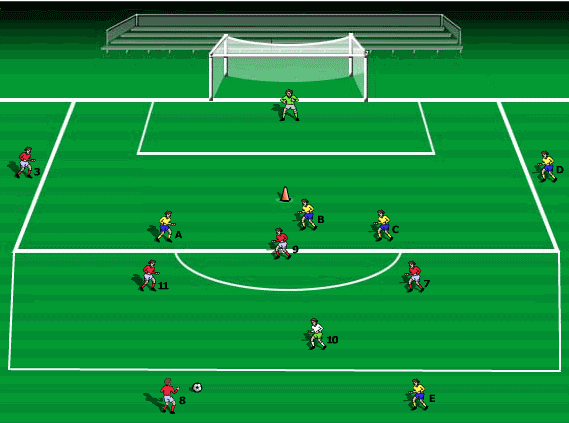
- This is a Functional practice, a 3 v 3 + 1 with support players involving Receiving, Turning, Dribbling and Shooting. First priority of the striker is “Can I shoot?” Composure in the box is the key factor, defenders don’t want to concede a penalty so strikers have more time than they realize.
- No conditions to start but support players stay outside the box. Defenders win the ball they play to the coach or just clear it to outside players. Start again with a new ball to the strikers. Strikers try to receive the ball at an angle so they are half turned and facing the goal so they can get a quick shot in. Others take up positions off this for rebounds etc.
- Outside players can be passing a ball around between each other to keep active and when the play is finished inside the box whoever is on the second ball passes it in to restart.
- Looking for quick shots, working off rebounds, combination work, 1 – 2’s, quick movement to create space, support play
- Use the cone for an offside line likening to the deepest defender so inside attacking players can time their runs off it.
- So one team attacks the other defends. How many goals can the attacking team score in 5 minutes?
- If the defending team win the ball they pass to their own players on the outside (same as winning and keeping possession in a game) who then give the ball to an outside attacking player and the sequence begins again.
- Rotate the teams and each team gets a chance to attack for 5 minutes. Add up all the goals scored for either side in the 20 minutes for a combined winning team. Alternatively have two goals at opposite ends so it is more like a game situation.
- Rotate the players within each team.
Coaching Points In Shooting And Finishing
Make it a competition between two teams. Each team has 15 at-tempts at goal, see who can score the most goals. Attacking team continue each attempt until the ball is out of play or a goal is scored or the opponents win possession. Rotate the defenders to keep them fresh. Here the coach passes to (8) who lays it off for (9) who shoots and scores. (8) And (10) follow the shot in for any rebounds.
Coaching Points in Shooting:
- Positive Attitude to shoot, quick shooting. Every opportunity try to get a shot in.
- Receive on the Half Turn if possible (create space for yourself), take the chance
- Accuracy and Power (accuracy first). Be composed
- Shooting High or Low (low best because it’s more difficult for the keeper)
- Selection of Shot (driven, chip, side foot, swerve etc). You can use defenders to shoot around for placement. Check keepers position (if time!)
- Near Post or Far Post (can depend on keepers position, also if you shot and miss at the near post the ball is out of play, if shooting at the far post and it’s missing, the keeper may palm it to a striker following up, a striker may intercept it on its way and score, (it may hit a defender and go in off them)
- Rebounds (follow all shots in)
Get this full training session including multiple progressions, attacking from crosses, making transitions and switching positions, a 3 v 3 attacking and defending transition game and more small-sided games for strikers in Soccer Awareness eBook 8: Small-Sided Games for Strikers.
This full training session is also available in the Soccer Awareness Training Center. The Soccer Awareness Training Center powered by Edufii is the ultimate youth soccer coaches learning platform. Join Our Team

Game Situation Problem: Getting Tight To A Striker Dropping Deep To Receive To Feet
Striker comes short, center back lets the striker go, and the striker receives and
turns and runs at the back four who now are in a vulnerable position. Being able to
immediately run at the back four means the striker and teammates have not been
delayed which would help other players on our team recover back.
The following game is an excerpt from Soccer Awareness eBook 18: Identifying and Solving Common Game Situation Problems in the Training Environment. This eBook shows a different way to look at the game. Instead of highlighting what we need to do well, it shows what often goes wrong and how to fix it.
We will also be posting more like this in the Soccer Awareness Training Center over the next month. Join Our Team!
Getting Tight To A Striker Dropping Deep To Receive To Feet
This is what not to do.
Striker comes short, center back lets the striker go, and the striker receives and turns and runs at the back four who now are in a vulnerable position. Being able to immediately run at the back four means the striker and teammates have not been delayed which would help other players on our team recover back.

Resulting situation is that they get a break on us and can attack with numbers and we are then at a big disadvantage because they have several players running AT us with and without the ball and the player on the ball is facing forwards and not backwards; which would be to our advantage if we got tight initially to them and prevented them from turning.
All can be corrected JUST by the center back getting tight (or a fullback depending on the part of the field).

You can stop this simply by getting tight and making the striker receive to feet with their back to goal, this slows down the forward momentum and allows our players to recover back and get into good defensive positions.
It also allows the other center back and the fullbacks time to position correctly behind the pressing center back by condensing the spaces behind them.



Now Available: Coaching the Ultra Fluid 3-3-1-3
Wayne Harrison's new book, his 15th publication on Soccer Coaching, will be soon!
Playing a 1-3-3-1-3 might be the way forward in the future. Chile won the Copa America Championship this year for the first time in their history using it. Pep Guardiola head coach of Bayern Munich uses it at times.
Wayne Harrison's new book, his 15th publication on Soccer Coaching, will be out soon!
Playing a 3-3-1-3 might be the way forward in the future. Marcelo Bielsa's signature formation in his squads is the 3-3-1-3 formation, which he made famous and brought to the front of the world's mainstream football scene during his coaching tenures in the Argentina national football team, Chile national football team, Athletic Bilbao and Olympique de Marseille.
He plays a high pressing game, as does Pep Guardiola at Bayern Munich; which will be explained in this book.
Jorge Sampaoli is the Chile head coach who played the 1-3-3-1-3 to win the Copa America for the first time in their history..
A Coach from Robert E lee Lancers from Springfield VA wrote this too Wayne and said we could share his experience so far with the Flex System.
Hey coach, first two games into the season and the tactics / high pressure of the FLEX has really been the key. We have scored 12 goals in the first two game. We won 7-2 and 5-3. The 5-3 game was against the number #16 team in the nation according to the top drawer site. Anyway, still have a lot of improving and finessing of our FLEX system however it is def a distruptor to the traditional formation! So glad I came across your book last fall!
Oh I forgot to mention that we didn't win a game last year and scored only 11 goals over 14 games. After 2 games we have scored more and have more Ws than the entire season last year. It's boggling my mind!

The changing game now and in the future
The game is changing and we all must keep up with the changes happening if we are to provide a real service to the players.
Is playing the game now about players decision making over the coaches? The way I see it we as coaches set up the framework from within which the players make the decisions. In this case we set up the 3-3-1-3 framework, we teach players various ideas to use within it and THEY decide when; where; how and why to use them.
This book is aimed at youth teams but also at professional level and senior teams; all can benefit from the information provided and coaches use it to the extent that each of their teams at whatever level of play can understand.
Get It Now

1 v 1 Receiving and Turning Drill
Receiving and turning is a technique that every player in every field position must have in their locker. The sooner they are taught this ability the better; that is why we focus here on such young ages.
The following is an excerpt from Soccer Awareness eBook 11: Turning Technique And Skill For 6 To 10 Year Olds.
Receiving and turning is a technique that every player in every field position must have in their locker. The sooner they are taught this ability the better; that is why we focus here on such young ages.
Which way do they turn? Too many players turn into opponents rather than away from opponents so coaches should emphasize this in their training. Also, do they turn with the inside or the outside of their foot or with both? They must practice both ways and with both feet to be effective as they gain more understanding of the technique that becomes a skill when decision making is added.
We hope these exercises help you teach the correct techniques to players and help them with their decision making.

Receiving and turning to attack and score in the defender (A)’s goal. (2) Passes the ball into (1) who has to receive and turn and beat (A) and score a goal. Have the attacker run the ball into the goal to score or shot it in.
Coaching Points in Receiving and Turning:
- Support in a diagonal position not in a straight line (off at an angle).
- Receiver face the player with the ball (eye contact) so they know the receiver is ready.
- Receiver move to the ball to avoid anticipation of a defender intercepting or away to create space to come back into.
- Receiver is aware of where the space is to turn. Body position half turned to receive moving the ball on the first touch (changing direction). Use upper body to create an element of surprise or disguise. Get your body between the ball and your opponent (screen the ball).
- On receiving and changing direction with the first touch change pace (away from a defender). Use your arms to protect yourself and keep your knees bent for good balance.
Progression: Have two pairs working in the same area to develop awareness of player’s positions and space.

Methods of Turning:
- Check off, receive and turn inside and face up to defender in one movement off first touch.
- Receiver backs into defender and receives ball to feet, spin defender using their body as a screen and using the inside or outside of either foot.
- Turn away with outside / inside of each foot.
- Turning without the ball pull defender short creating space behind, spin quickly and receive the ball behind the defender
- Play 1-2 and go.
- Run defender off and away from the ball then check back into space you have created to receive and turn in one touch to face your opponent.
- Above, attacker (1) checks off at an angle to receive and turn and face up to defender (A) in a much better position now to attack them in a 1 v 1.

A Game Situation for 1 v 1 Defending
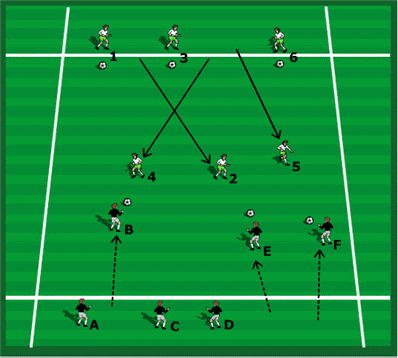
Divide the teams up into two 3 v 3 games with teams attacking the short side lines to score a goal. Play with one ball then two balls so there is some 1 v 1’s and also some support play. Then they attack the long sides as targets making it a little harder to defend successfully.
The following is an excerpt from Soccer Awareness eBook 19: The Principles of Defending for U8 to U14.
Defending can be an overlooked Art in the game. Many of us love attacking play and train our teams a lot in it but to attack we need to defend well to win the ball in the first place to then allow us to attack. This book helps explain the importance of great defending and how vital it is to teach players the principles of it. These principles do not just apply to defenders per se; in this book we also teach strikers how to defend as if they win it then they are directly on goal to score. When we defend as a team everyone; all 11; are defenders and must be trained in it as when we attack we are all attackers and likewise we have to teach all 11 players to think offensively. We hope you enjoy this book and appreciate the importance of this great Art of Defending in soccer.
Divide the teams up into two 3 v 3 games with teams attacking the short side lines to score a goal. Play with one ball then two balls so there is some 1 v 1’s and also some support play. Then they attack the long sides as targets making it a little harder to defend successfully.
Defending In 1 V 1’s, 2 V 1’s And 2 V 2’s
Two goals for each team to attack, players have to attack 1 v 1 to score. Defenders have to stop them and try to score themselves As soon as the attack is over; the attacker becomes the defender and the other team attacks.
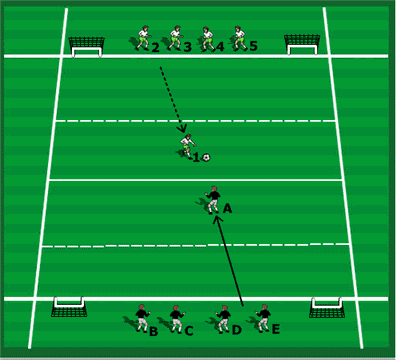
If a defender wins the ball they can attack and score but they must defend again. To score the player must be over the shooting line (5 yards out).
Develop – A 2 v 1 situation, the attacker who doesn’t finish the move becomes the new defender. The new defender must position outside the shooting zone. New attackers must begin with a pass and overlap to make it more difficult for the defenders.
Develop – 2 v 2 situation, the team who takes a shot becomes the defenders. The same rules apply as above. If the ball goes out of bounds a new team starts.

Free Coaching the 4-2-3-1 eBook
Most of the coaches I know look at the trends at the highest level of the game for ideas of what might be effective for their teams. In the last 10 years the most popular system has been the 4-3-3. The Dutch have been using it for much longer it became used more widely by clubs like, Jose Mourinho’s FC Porto and later Chelsea FC as well as Barcelona FC, AS Roma, the US Women’s National Team and many others. As this shift occured at the top level we began to see more youth, high school and college teams move to this highly flexible system.
Below is an excerpt from Wayne Harrison's free Coaching the 4-2-3-1 eBook produced by World Class Coaching. You can get the full eBook for free below.
SPAIN PLAYING THE 4-2-3-1 AT THE EURO’S
This article describes how Spain used the 4-2-3-1 formation in it’s successful Euro 2012 campaign. Each game presented different challenges and opportunities. Here is an explanation of the base system and also how they approached their game against Italy.
To see how you can train your team to play the same system as some of the best teams in the world You can get access videos that will show you the attacking, defending and transitional properties of the 4-2-3-1 by visiting the World Class Coaching Soccer Tactics web site.
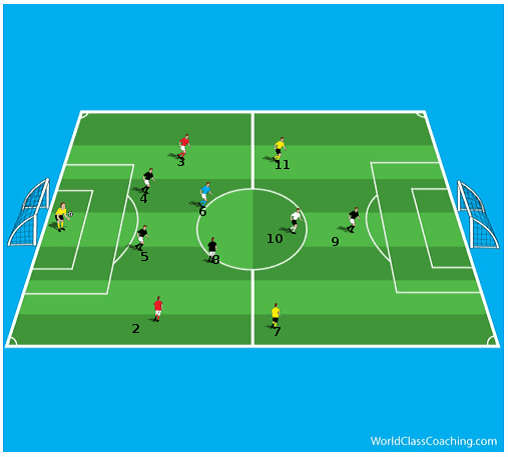
The starting position phase formation is approximately a 4-2-3-1; the attacking phase is 4-2-1-3 or 3-3-1-3; and the defending phase is a 4-4-1-1, so we have four formations coming from one; depending on where the ball is and who has it.
Fabragas played as the (9) in this diagram but rotated with Iniesta; Xavi and Silva; (11), (10) and (7) respectfully here.
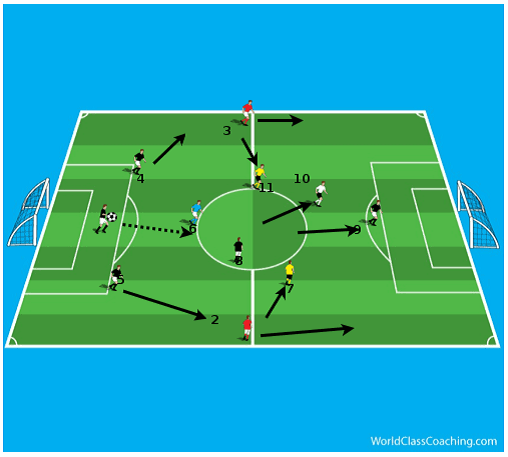
Here we show how Alba (3) and Arbeloa (2) attack high up the field. Iniesta (11) and Silva (7) tuck in to take the Italian defenders inside to create space outside for the fullbacks. If they are not followed by defenders then this created a BIG overload of players centrally for Spain to Exploit.
Where (6) passes to will depend on how the opponent defenders react to these combination movements but with the left footer on the right and right footer on the left plus the fullbacks the team has two great options, one coming inside to attack the space inside and possibly shoot with his strongest foot; and one overlapping with width to get a good cross in, again with his strongest foot.
Coaching Points:
Observe:
- Initial team shape (4-2-3-1)
- Timing of the runs (late and fast is best)
- Timing of the pass (if the choice is to pass)
- Where the pass goes (based on the opponents set up and individual and team reactions)
- The next phase of play as each event (a pass, run; dribble etc) starts a new phase of play
- Buildup Phase of play team shape (4-2-1-3) or (3-3-1-3)
- End Product Phase of play team shape
Spain v Italy
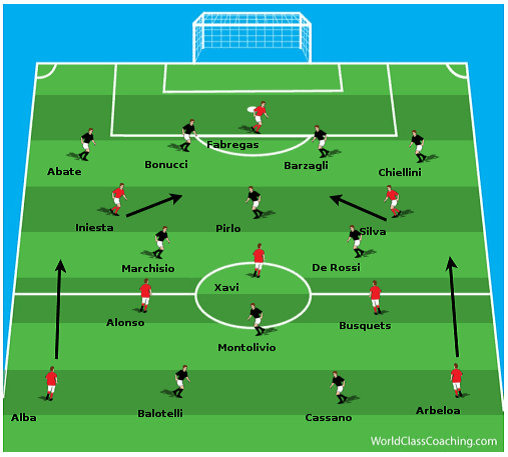
Here you see how Spain exploited the width of the field against Italy’s narrow midfield with both fullbacks attacking throughout the game, Alba in particular showed the value of this with a great forward run that resulted in him scoring the second goal.
TEAM GAME PLAN AND INDIVIDUAL ATTRIBUTES NEEDED BY PLAYERS PLAYING THIS SYSTEM OF PLAY
As shown above; the 4-2-3-1 is a flexible way to play employing four units rather than the usual three. It can transform quickly into a more offensive pattern of play of 4-2-1-3 by moving forward the wide outside midfielders and with this push on the two fullbacks to fill the spaces they have left.
THE BEAUTY AND FLEXIBILITY OF THIS SYSTEM OF 4-2-3-1
- Wide players (Iniesta and Silva) attack the space between the fullback and the center back on both sides. Left on right, right on left; coming onto their stronger foot is an advantage because they come in against the full back’s weaker foot
- Fullbacks (Arbeloa and Alba) attack wide to get crosses in and can cut inside also to do the job of the wide player
- Center back’s (Pique and Ramos) spread wide to open up the attack from the back
- Defensive midfielder (6) (Busquets) drops back in to cover and to start the movement also; he can fill in centrally or to the side
- Attacking midfielder (10) (Xavi) plays between the opponent’s defense and midfield. He can interchange with the wide players or the striker (9).
- 2nd defensive midfielder (8) (Alonso) is more offensive and creates support between the back and the front
- The two defensive midfielders can interchange.
- (8) positions off center to (10) and off centre to (6) to maintain angles of support between them when attacking
54 Pages
We want to stay with our own game plan as closely as possible; based on what we practice and to keep it simple for us; as we dictate to our opponents; and we impose OUR WAY on them.
But there will be many occasions where we must change the system of play and we may have to adjust to suit the opponents.
Here are some ideas for you to consider for your team starting with the 13313 and 14231 systems of play.