Welcome to the Soccer Awareness Coaches Corner. Browse through soccer drills, small sided games, tactical thoughts, full sessions and a variety of resources. Posts marked “Training Center Exclusive” are for members only.

The Three Team Awareness One Touch Game
Working with three teams (numbers depends on how many players you have, e.g. it can be 4 v 4 + 4 or 5 v 5 + 5 etc). Teams (1) and (2) work together to keep the ball from team (3). If team (3) regains possession the team who gave it away becomes the defenders. The defenders reward is they keep the ball and link with the other team.
The following clinic is part of the New "Soccer Awareness Age Group Specific Awareness Developmental Training" eBook from Soccer Awareness! Click here to preview the full table of contents!
Working with three teams (numbers depends on how many players you have, e.g. it can be 4 v 4 + 4 or 5 v 5 + 5 etc). Teams (1) and (2) work together to keep the ball from team (3). If team (3) regains possession the team who gave it away becomes the defenders. The defenders reward is they keep the ball and link with the other team.

Rules: Once possession is gained, to establish who gave the ball away the player who gave the ball away calls the color of his team and then everyone knows they are now defending and the game continues without a stoppage.
With younger players it may be best to do this (because the ball may be given away a lot more for one thing); whoever won the ball puts his or her foot on the ball to stop play and the coach can call out the team who gave it away. Play begins again working on transitions.
Develop: Increase difficulty for attackers by
Reducing the zone size.
Decreasing the number of touches on the ball of each player.
Conditioning the passing to be only to the other attacking team’s players e.g. (1) only passes to (2) and vice versa, therefore only half the numbers of passes are available per player.
Using two balls so that as they pass one ball they are now increasing their awareness and vision by looking for the other ball coming.
Players take off their pinnies so they really have to look and can’t rely on color identification.
No talking or pointing, so players have to rely on their own vision.
Prohibiting verbal communication
ULTIMATELY PLAY ONE TOUCH
Three Team Possession Game
Three teams, two teams work together, one defends, creates an overload situation in attack, for example 15 players, three teams of 5, a 10 v 5 game.
Possession changes as one of the two team’s players gives the ball away to the defending team then they become the next defending team this is a good transition game also from attack to defense and defense to attack. This game can be in an area of 40 x 40 yards for example and the challenge to the players can also be to move inside to outside (outside being just inside the touchline) and outside to inside to ensure they avoid standing in one area. Plus it takes greater vision or awareness inside the area; where they need to look around and open their stance up to potentially change the direction of play; than on the outside where they can see everything easily.
Encourage players who play centrally on the team to get in the middle of the area and dictate the play, be the pivot for the team, the player who transfers the ball from one side to the other, the link player, this can be one, two or even three players at a time, but they can rotate between themselves too.
Equal numbered teams in a possession keep away game; this would be the next progression from the overload game being a more difficult challenge of the players. Same principles and ideas as above apply.
Transition games: In two halves, creating overloads in each half as each team gains possession. Team A have to get the ball in one half and play a 7 v 3 for example, team B have to win it back with the 3 defenders and get it back to the other half and have a 7 v 3 in their favor, and so on.

Improving Awareness In First And Second Touch Development - Training Center Exclusive
In this session, we are ensuring there is timing between the players in terms of the pass and the run to receive. We are doing simple passing in two’s back and forth, first two touch, then one touch where possible. Ask the players to look into “each other’s eyes” as they pass and NOT at the ball to see if they can keep possession between them. This will be difficult at first but it helps to teach them to look up and not down at the ball. during games and hence helping their “Awareness” development as players.
*Membership Required
Passing In Two’s
Simple passing in two’s back and forth, first two touch, then one touch where possible. Coach can dictate the distance between them.
Ask the players to look into “each other’s eyes” as they pass and NOT at the ball to see if they can keep possession between them.
This will be difficult at first but it helps to teach them to look up and not down at the ball. during games and hence helping their “Awareness” development as players..
They should be able to see their ball in the “peripheral vision”.
Using both feet to pass the ball.
Competitive: Count how many passes they can get in between them during a given time.

1st And 2nd Touches On The Ball In Teams Of Two
Ensure there is timing between the players in terms of the pass and the run to receive.
a) Two touch passing. Practice using both feet.
b) Side of foot passing getting a rhythm going one touch to control then a second touch to pass back. Then the passer is moving in to meet the ball and pass, and then out after passing the ball. Get a rhythm moving in and out, don’t stand still.
c) One touch side of foot passing, moving in to meet the ball, one touch pass and then back again. Weight and Accuracy MUST be good now to allow the team mate to pass back with one touch.
d) Decision Making: Player passing points their arm to one side the player receiving has to pass to the other side.
e) Two footed Control and Pass: Inside and Inside receive the ball with the inside of the right foot, move the ball first touch and inside and off line to yourself, then a second pass with the inside of the left foot. Do left foot first touch also.
f) One footed Control and Pass: Inside and outside of the foot passing using the same foot. Move the ball inside and off line with the inside of the right foot and pass with the outside of the right foot. Repeat with the left foot.
g) One footed Control and Pass: Outside and inside of the foot passing using the same foot. Move the ball outside and off line with the outside of the right foot and pass with the inside of the right foot. Repeat with the left foot.
h) Feinting and Receiving: Fake to kick the ball one way and go the other. Perform this action with the various moves discussed previously.
i) Receiving and controlling the ball: Three touches on the ball. First movement is forward to receive the pass, first touch on the ball is forward again, second touch is to the side, and then third touch is the forward pass back to the team mate.
j) Pointing: Introduce pointing again, passer points one way, receiver fakes that way and passes to themselves the other way then passes to their teammate.
k) Competition and Pressure. Count the number of passes in a given time and see which pair does the best. Look for a balance between control and speed of passing. Do this for all the different progressions as a finishing point for each one so they need to do it under pressure.

Place a cone in front of each player as a target object to play around. This also helps the player receiving the ball to judge their first touch and how far it needs to go across the field before they pass the ball forward again, with their second touch, to their teammate.
Player (1) pass the ball down the side of the cone to player (2) who must move the ball on their first touch to themselves and to the other side of it, then pass the ball back on their second touch. Player (1) then repeats the process.
Try to make the first touch to themselves a short, tight distance with the ball under control for the second touch which is the pass back down the other side of the cone. Keep this continuous rhythm going but you can dictate which part of the foot you can do this with as previously highlighted, inside to outside, outside to inside, inside to inside and transferring feet and so on.
Work the ball also from left to right so players practice moving the ball both ways not just one way.
Competitive: How many successful passes can the pairs of players make in a given time using the required techniques?

Now use the cone as a target to get in front of. As the ball is passed the player receiving must get in front of the cone to receive the pass, perform the movement required and pass back then move back behind the cone again.
This forces the player to move towards the ball as they receive it. This is an important movement because players often wait for the ball to come to them in a game and an opponent steps in front of them to steal it before it gets to them.
The movements are continuously back and forward, in front of the cone, receive the pass, move across with one touch, pass again with a second touch then behind the cone moving backwards and back across to receive again. Have the players develop a rhythm to this to get the best out of this practice.
Increase the distance between the players so they do not get too close to each other when both have moved in front of the cones to both pass the ball and receive the ball.
Competitive: How many successful passes can the pairs of players make in a given time using the required techniques?


Develop: As above have the players now make a first touch pass to themselves to the side then a diagonal second touch pass back across the field to their teammate.
Now have the players come in front of the cone to receive the pass as before forcing them to come and meet the pass. (1) Passes the ball from in front of the cone, then drops back, moves across to receive the diagonal pass back and move forward again to receive and so on.


Awareness Numbers Game Working in Three Zones
Here players pass and move into other zones to receive the next ball that is coming. This ensures players get the idea of passing and MOVING off the ball, not passing and then standing.

Conditioning the players to pass and move by setting the rule they need to move into another area once they have passed.
Divide the field up into sixth’s and then have the players make a pass in one area then they must move to another area to receive the next pass. This can cause players to pass long or pass short and vary the range and distance of the passes and the support as they are required to move once they have made their pass.
Here we are using three teams of four players.
Here players pass and move into other zones to receive the next ball that is coming. This ensures players get the idea of passing and MOVING off the ball, not passing and then standing.
Can say players must pass to space so they pass into another zone next to the one the player they are passing to in order to force them to move to the ball
Non-Competitive Awareness Numbers Game: Passing in Sequence

This is a great game for forcing players to observe what is ahead of the ball in terms of knowing what they need to do with the ball “before” they receive it. Players (1) and (2) work together and players (3) and (4) work together.
Players must pass in sequence i.e. 1 passes to 2; 2 passes to 3; 3 to 4 and 4 passes to 1 and we begin again. You can have players static to begin then have them passing and moving. Player receives from the same person and passes to the same person each time. This develops great awareness of time, space and player positions. This is continuous work on and off the ball.
Awareness of: where the player you receive from is and where the player you pass to is. Because of this players begin to anticipate the pass to them and where it is coming from. Also they must look to where it is going to (where is the player they are passing to?).
We are trying to create a situation where players are looking two moves ahead not just one. For instance as (1) is about to pass to (2), (3) should be looking to support (2) for the next pass already, looking two moves ahead before the ball leaves (1). Peripheral Vision Development results from this.
(3) should recognize if they need to move into a space early or late based on this observation, but know in their mind already what the next best option is. Moving into the space too early in a game situation for example may result in being marked too easily. But knowing in advance “when and where” to move to is an advantage and this game helps players develop this thought process.

Ask players to make it difficult to find them by lots of movement off the ball to test their team mate’s vision.
Progression: Use two balls then three balls at the same time. Start with a ball at (1) and (4) then at (1), (4) and (6). To keep the sequence going players must move the balls quickly with few touches hence their peripheral vision development improves dramatically. As soon as they have passed one ball off the next one is arriving so quick thinking is needed to make the correct decisions. Divide the field up into third’s and ask players to make a pass in one third then they must move to another third to receive the next pass. This can cause players to pass long or pass short and vary the range and distance of the passes and the support.
Here (3) passes to (4) and moves into another zone to receive the next ball that is coming. This ensures players get the idea of passing and MOVING off the ball, not passing and then standing. (2) Does the same with a pass to (1) then moving into another zone supporting the next ball to come along.



Testing Players Awareness
Coaches are trying to develop the concept of the player recognizing options before receiving the ball. This exercise is a very simple idea and tests the players to see if they looked over their shoulder away from the ball or not before they receive the pass.
The following drill comes from Best of Soccer Awareness. This 80 page eBook contains 24 of the best sessions from UEFA Professional “A" License Coach Wayne Harrison's Soccer Awareness method.
To develop the Soccer Awareness concept its important to take the process from structured training sessions into free flowing game situational set ups so the players are developing their thinking skills under pressure. We offer various game situational small sided situations here to test this. We hope you enjoy this eBook.
This book is also available as part of the Premium and Elite Plans in the Soccer Awareness Training Center. Find Out More
Coaches are trying to develop the concept of the player recognizing options before receiving the ball. This exercise is a very simple idea and tests the players to see if they looked over their shoulder away from the ball or not before they receive the pass.
The opposite outside player from the ball can decide to close down the middle player or stay away (in this case player 3). If they close down then the middle player must pass the ball back to the player who passed it to them, player 2. If not closed down then they receive and turn and pass to player 3 (below).


Coaching Points:
Look over shoulder before receiving (where you are passing to).
Body Stance – half turned (can see behind).
Support at an angle.
Save a touch – let weight of ball determine this- let it run across the body and move one touch.
Develop - Opposite player stays or closes the middle player down.
If closed down, middle player passes back to same.
If not closed the middle player turns and passes to opposite player.
Go through each progression in the order it is presented here, do one at a time and have each player practice it in the middle at every stage of the progressions.
If the player in the middle (2) turns and looks to pass to player 3 when player 3 has closed them down; this is an indication that player 2 in the middle did not look before receiving, to see where player 3 was. This will likely happen with some players.
Initially and before we set the conditions players will pass from 1 to 2 to 3 and not always look behind them before receiving, after making the reference to this and changing the idea having players close or not close down, you will see the middle player looking over their shoulder as the ball is being passed to them to see if they are closed down or not.
The difference is obvious when you put the conditions in and is a great help in developing awareness in players.


Non – Competitive Awareness Numbers Game With Teams: Passing in Sequence
In this warm-up game, we are working on awareness of where the player you receive from is and where the player you pass to is. Because of this players begin to anticipate the pass to them and where it is coming from.
The following is an excerpt from The Ultimate Youth Coaches Training Guide; A Complete 6 to 10 Year Old Developmental Coaching and Training Program.
This program is perfect for youth coaches wanting practices to start their soccer coaching education and it is also for those more advanced and experienced coaches wanting to train their players as best they can at these wonderful open minded ages for development and education of both the mind and body. Our plan is to help all coaches at whatever level of experience they are at. Find Out More
1. Working with three teams

2. Within each numbered team each player is numbered off. Teams (1) and (2) work together (with two balls) and team (3) works alone (with one ball).
3. Players must pass in sequence i.e. with teams (1) and (2) working together 1 passes to 2; 2 passes to 3; 3 to 4 and so on up to 8 who passes to 1 and we begin again whilst team (3) players pass 1 to 4.
4. A Player receives from the same person and passes to the same person each time. This develops great awareness of time, space and player positions. There is continuous work on and off the ball.
5. Awareness of: where the player you receive from is and where the player you pass to is. Because of this players begin to anticipate the pass to them and where it is coming from.
6. Also they must look to where it is going to (where is the player they are passing to?). We are trying to create a situation where players are looking two moves ahead not just one.
7. For instance as (1) is about to pass to (2), (3) should be looking to support (2) for the next pass already, looking two moves ahead before the ball leaves (1). Peripheral Vision Development results from this.
8. Develop: Reduce the number of touches players are allowed each time they receive a pass, all in to begin, then three touch, then two touch then one touch if it is on to do so. This speeds up the decision making process and forces them to look earlier as to where they are passing to.

3 Zone Awareness Game: Dropping Off to Receive and Turn in Possession
A three zone movement off the ball clinic focusing on zone 14 emphasizing movement back towards the ball to receive and play forward and the consequent interchange of players between the three units.
I really like this game you can bring in so many different ideas to the session and it all involves mental challenges to the players with regard to playing, moving and thinking quickly (and ahead of the ball).
This would be one of my regular training sessions.
Continuums of Development
A) LOOK / OBSERVE / THINK (BEFORE receiving the ball; assessing all options in “Anticipation” not as a Reaction). If time allows take 2 or 3 looks because the situation may have changed after the first look
B) SKILL: THE DECISION (Why; when and where of Technique; plus its success or not; and why?)
C) FOOT PREPARATION: Not flat footed but on your toes and ready for action
D) BODY POSITION: Balanced and open
E) COMMUNICATION: Verbal and visual
F) CONTROL: If not a one touch pass on, the 1st touch control
G) TECHNIQUE: The How; the pass, the run, the dribble, the turn, the shot; etc
H) TACTICAL MOBILITY: Movement off the ball, finding space; 90% of the game
I) MENTAL AND PHYSICAL TRANSITION: Possession changes, Player tunes in immediately to win it back?
Watch Barcelona players making these movements to find space
THIS GAME AND ITS MANY PROGRESSIONS IS DESIGNED TO GET THE MOST OUT OF THE THINKING PROCESSES OF THE PLAYERS. MANY MENTAL CHALLENGES TO OVERCOME AND LEARN FROM.
Coaching Points:
Continuums Model to work off and relate to.
a) An Awareness of the passing player of when and where the receiver drops into the free zone AND where the space is (Look and Think Before receiving)
b) An awareness of the receiving player as to when the passer is ready to pass (Look and Think Before receiving)
c) Good communication via visual cues through eye contact or aural cues through speaking makes this work (Communication)
d) Establishing an open stance in the middle for greater peripheral vision and an angle of support (body position and feet preparation)
e) Movement OFF the ball by the receiver to get free and into open space (Tactical Mobility)
f) Timing and angle of the run (Tactical Mobility)
g) Timing; accuracy and pace of the pass (Technique)
h) Good receiving and turning technique with an awareness of what is behind before receiving it (Technique, Control and Look and Think)
i) Move and join in the next phase of play (Tactical Mobility)
If we lose possession try to win it back immediately (Mental and Physical Transition)
And of course the SKILL FACTOR, decision making is based on all.
3 Zone Awareness Game: Dropping off to receive and turn in possession
Contents and Progressions to Follow in the full presentation:
3 zone game: Dropping off to receive and turn in possession with 4 balls
3 zone game: Developing Peripheral Vision
3 zone game: Straight line support and passing
3 Zone Game: Developing more dimensional thinking and playing
Players support at wider angles to improve peripheral vision and body position
One ball in each side and 2 players receiving
Movement from the back to the front and changing zones
Two Competitive Games playing at once
Defender can close the attacker down on the 1st touch only
Defender can close the attacker down immediately
Receiver moves off the shoulder of the defender
Receiver moves off the shoulder and checks back
End product of the check back
Defender closes the attacker down; attacker cant turn
Attacker cant turn so plays it back
Now one ball only
Now one ball only: players switching sides
One ball only: By pass the middle and go from back to front
Playing Direct: 4 v 4, 1 v 1 and 3 v 3
Neutral Player Added: 3 v 3, 1 v 1 v 1 and 3 v 3
3 v 3, 2 v 2, and 3 v 3
A three zone movement off the ball clinic focusing on zone 14 emphasizing movement back towards the ball to receive and play forward and the consequent interchange of players between the three units.
I really like this game you can bring in so many different ideas to the session and it all involves mental challenges to the players with regard to playing, moving and thinking quickly (and ahead of the ball).
This would be one of my regular training sessions. Thru trial and error we have found it best to have equal numbers in each third so do the session with all the progressions with 3 v 3 or 4 v 4 or whatever number of players you have. Also start with 4 balls going back and forth, one each team of 3 or 4 players.
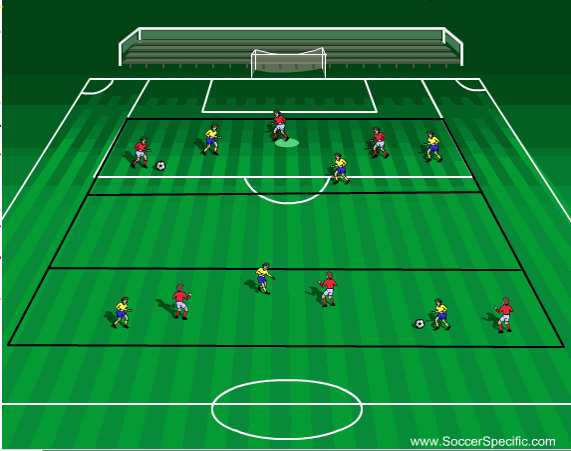
A 3 v 3 in each end zone (can be any number based on the number of players at training).
A Ball each team passing and moving but teams are not playing against each other yet.
The central zone is the shadow striker zone known as zone 14 and usually where the number 10 plays but 9, 7, 11, 8, 2 or 3 or even 6 can also enter this zone..

Coaching Points:
An Awareness of the passing player of when and where the shadow striker drops into the free zone
An awareness of the receiving player as to when the passer is ready to pass
Good communication via visual cues through eye contact or aural cues through speaking makes this work
Movement OFF the ball by the shadow striker to get free and into open space
Timing and angle of the run
Timing; accuracy and pace of the pass
Good receiving and turning skills with an awareness of what is behind before receiving it
Receive or be a decoy for someone else; depending on where the defender is.
Passing and moving, (4) drops in to receive as does (C) going the other way. Movement OFF THE BALL to receive in the middle zone (zone 14). (4) Takes the ball back into his own end zone, as does (C) in the other end zone and play continues. All players are moving finding space to receive the ball. The two teams pass between each other but cannot tackle each other.

Timing of the pass
Timing of the run
Angle of the run
Timing of each has to be exact for it to work.
Have the receiving and dropping off player CALL THE NAME of the person they will pass to next BEFORE they receive the pass.
Development:
Now 2 players come to meet the ball in opposite halves of zone 14 and at different angles and depth to each other. Still no opposition so it is free flowing movements linking the two front players now. Do this going both ways with both teams so there is congestion in the middle.
DEVELOPMENT:
During the warm up: two balls in each side so all 4 teams playing with a ball each and transferring it with good timing. Players pass to the other player dropping in from the other side then follow their pass and switch sides with a give and go in the warm up and then in the competitive part. The same but now they make a third man run to switch sides. Two balls going at once in the competitive 3 v 3 4 v 4 or even 5 v 5 stage.

Teaching a One Touch Mentality Thru the Three Team Awareness Possession Game - Training Center Exclusive
This game and its many progressions are designed to get the most out of the thinking processes of the players. Many mental challenges to overcome and learn from.
We are working on awareness of where the player you receive from is and where the player you pass to is. Because of this players begin to anticipate the pass to them and where it is coming from. Also they must look to where it is going to (where is the player they are passing to?).
We are trying to create a situation where players are looking two moves ahead not just one.
Subscribe to the Soccer Awareness Training Center to get access to all premium Training Center Exclusive articles.
Continuums of Development
LOOK / OBSERVE / THINK (BEFORE receiving the ball; assessing all options in “Anticipation” not as a Reaction) - If time allows take 2 or 3 looks because the situation may have changed after the first look
SKILL: THE DECISION (Why; when and where of Technique; plus its success or not; and why?)
FOOT PREPARATION: Not flat footed but on your toes and ready for action
BODY POSITION: Balanced and open
COMMUNICATION: Verbal and visual
CONTROL: If not a one touch pass on, the 1st touch control
TECHNIQUE: The How; the pass, the run, the dribble, the turn, the shot; etc.
TACTICAL MOBILITY: Movement off the ball, finding space; 90% of the game
MENTAL AND PHYSICAL TRANSITION: Possession changes, Player tunes in immediately to win it back?
Three Team Awareness Possession Game
ALWAYS AN OVERLOAD OF PLAYERS IN POSSESSION
What does it teach?
Soccer Awareness: Assessing options BEFORE receiving the ball
Technique,
Mobility, running form deep to exploit space in behind the opponents
Agility and balance
Body position and Foot preparation,
Communication,
The 1st touch, The 2nd touch, and beyond
Teamwork,
Collective tactical understanding in a small sided game environment,
Positioning OFF the ball,
Problem solving,
And developing creativity and imagination,
Intensity of play,
Physically challenging;
Developing Angles of support;
Opening up passing lanes by movement off the ball;
Speeding up thinking and decision making, The SKILL FACTOR;
Ultimately providing a competitive environment where no one wants to give the ball away and; finally,
The sessions are fun to do. On the flip side often teaching defending and pressing at the same time.
THIS GAME AND ITS MANY PROGRESSIONS IS DESIGNED TO GET THE MOST OUT OF THE THINKING PROCESSES OF THE PLAYERS. MANY MENTAL CHALLENGES TO OVERCOME AND LEARN FROM.
Coaching Points:
Continuums Model to work off and relate to.
An Awareness of the passing player of where the OPPONENTS and his or her OWN PLAYERS ARE AND where the space is (Look and Think Before receiving)
An awareness of the receiving player as to when the passer is ready to pass (Look and Think Before receiving)
Good communication via visual cues through eye contact or aural cues through speaking makes this work (Communication)
Establishing an open stance in the middle for greater peripheral vision and an angle of support (body position and feet preparation)
Movement OFF the ball by the receiver to get free and into open space (Tactical Mobility)
Timing and angle of the run (Tactical Mobility)
Timing; accuracy and pace of the pass (Technique)
Good receiving and turning technique with an awareness of what is behind before receiving it (Technique, Control and Look and Think)
Move and join in the next phase of play (Tactical Mobility)
If we lose possession try to win it back immediately (Mental and Physical Transition)
And of course the SKILL FACTOR, decision making is based on all.
Non-Competitive Awareness Numbers game: Passing in sequence
Awareness of: where the player you receive from is and where the player you pass to is. Because of this players begin to anticipate the pass to them and where it is coming from. Also they must look to where it is going to (where is the player they are passing to?).
We are trying to create a situation where players are looking two moves ahead not just one. For instance as (1) is about to pass to (2), (3) should be looking to support (2) for the next pass already, looking two moves ahead before the ball leaves (1). Peripheral Vision Development results from this.
(3) should recognize if they need to move into a space early or late based on this observation, but know in their mind already what the next best option is. Moving into the space too early in a game situation for example may result in being marked too easily. But knowing in advance “when and where” to move to is an advantage and this game helps players develop this thought process.

Teaching One touch to develop the THINKING PROCESS
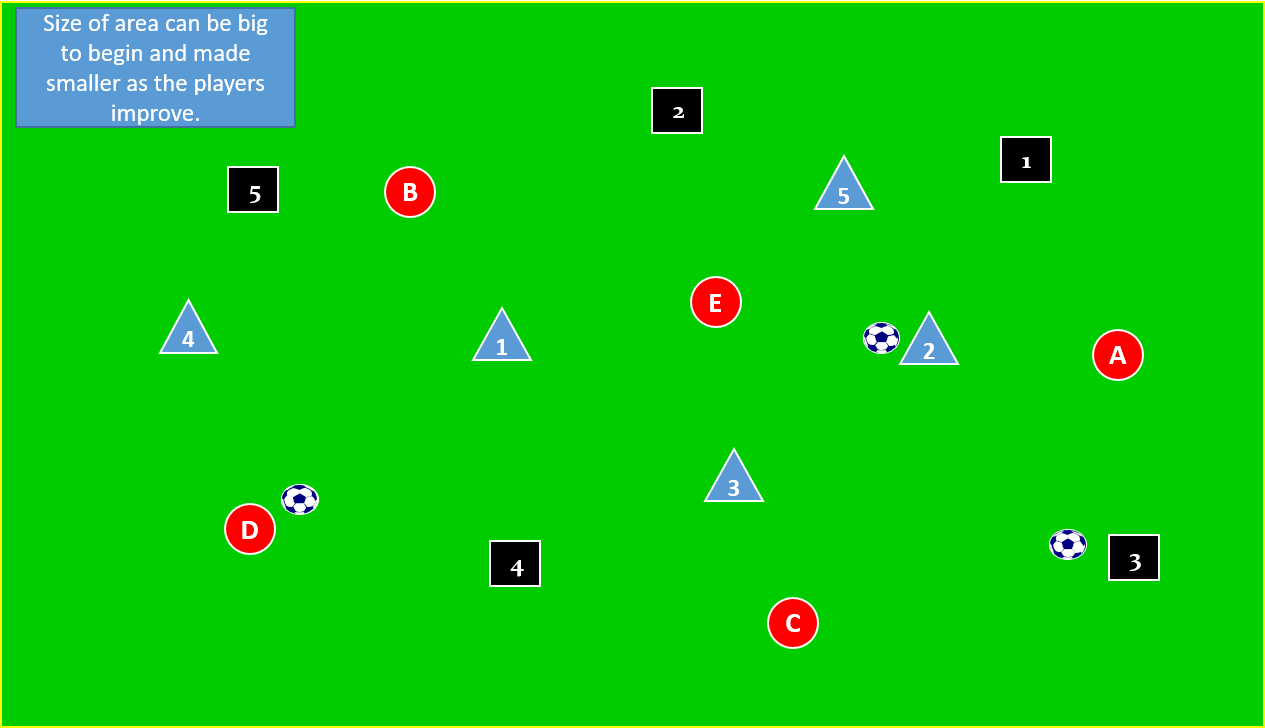
Three teams three balls. Passing and moving playing 1 touch only. Use 2 if necessary. 1 touch is successful if a) the player receiving observes his or her options BEFORE receiving the ball and b) teammates move off the ball to be in passing lanes to receive a pass.
The other teams “get in the way” of the spaces so players must ALSO observe where the other 2 team players are.
Teaching One touch to develop the THINKING PROCESS
Coaching points:
Open body stance to allow a yard or more extra space away from defenders by letting the ball run across the body into preconceived space
Looking before receiving to know in advance of the receiving pass; where the defending players are, where the space is, where team mates are free to receive a pass, how many options there are to move the ball on
Movement OFF the ball is a priority both to receive it and after passing it.

Progressions: Increase difficulty for attackers by:
Reducing the zone size.
Decreasing the number of touches on the ball of each player.
Condition the passing to be only to the other attacking teams players e.g. (1) only pass to (2) and vice versa therefore only half the number of passes available per player.
Increase the numbers to suit how many players you have, e.g. 4 v 4 + 4 or 5 v 5 + 5 etc.
Have two balls to play with so as they pass one ball they are now increasing their awareness and vision by looking for the other ball coming.
Ask players to take off their pennies so they really have to look and not be able to use color identification.
No talking or pointing, so players have to rely on their own vision.
Assessing Options
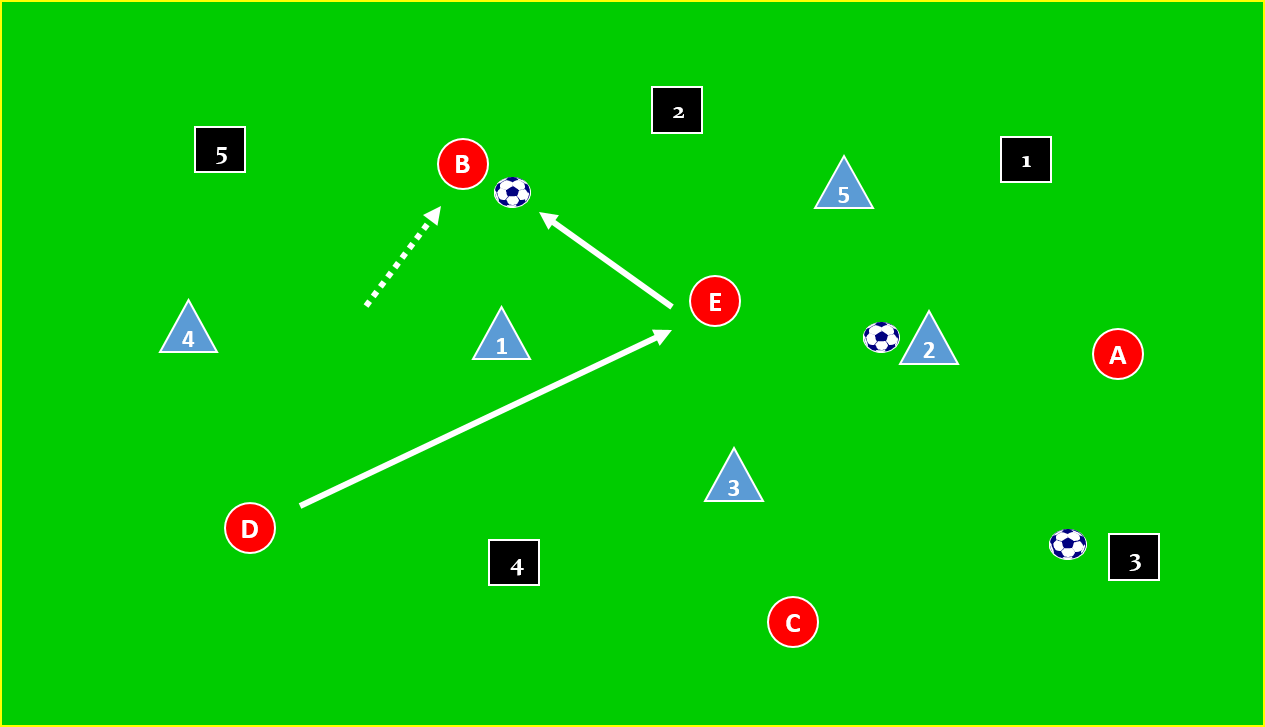
An example of moving into open passing lanes: Here (D) passes to (E). As the ball is traveling, (B) is already on the move to find the best space to support (E) KNOWING (E) has one touch only so has to make a fast decision and be given a good option. (B) positions between the blue and black player and arrives as the ball arrives. At the same time the other players need to be moving also to offer as many options for (B) as possible. Also at the same time as the ball is traveling from (D) to (E), player (B) must be looking AWAY from the ball to see what his or her next options may be and be able to choose the best one available.
Movement OFF the ball to offer options
Bear in mind the other team players are also moving so this is not as simple as it looks as the spaces to play to are constantly changing. Assessing the black players only here, we show as the ball travels from (3) to (4), the other three black players are trying to support (4) in ADVANCE of the ball. Therefore if (4) has assessed these movements and calculated approximately (mentally) where each player will move to then (4) should have numerous choices of a pass to keep possession including passing back to (3).

Offering no options with no movement to support
Exaggerated but just to show how VITAL it is that players move to support the player receiving the ball. Using red players as an example, there are passing lanes to move into to help (D) but red players stand behind opponents so (D) cannot see them nor pass to them. (D) may pass into a passing lane space to MAKE them move but that isn’t ideal, we want everyone thinking and moving together. Lets say in a game situation now (D) may be pressed and lose the ball because no options of a pass are available.

Not assessing options BEFORE receiving the ball
Coaches observe the HEAD MOVEMENT of players as this is a major indicator of if they are scanning the field for options for their next pass or not. If not the obvious will happen a) They will just watch the ball arriving and just focus on it b) They will control and stop the ball at their feet thus meaning a one touch pass is NOT an option now c) They will then lift their head up to see where teammates are d) They will eventually make a pass perhaps needing 2, 3 or 4 touches on the ball e) team mates may be standing still waiting for the pass having already anticipated the best position to be in; but are now too early and marked in a game situation..

Ideas to develop the thinking process
Players passing to different colors so now color coordination and identification is introduced. More difficult for players now, Say, blue passes to red, red passes to black, black passes to blue. This makes observation of the movements of a different color more difficult to process and is a great progressive test for players and really gets the brain cells working overtime.

Forcing movement off the ball thru a Condition
Progression: A ball each team. To keep the sequence going players must move the balls quickly with few touches hence their peripheral vision development improves dramatically.
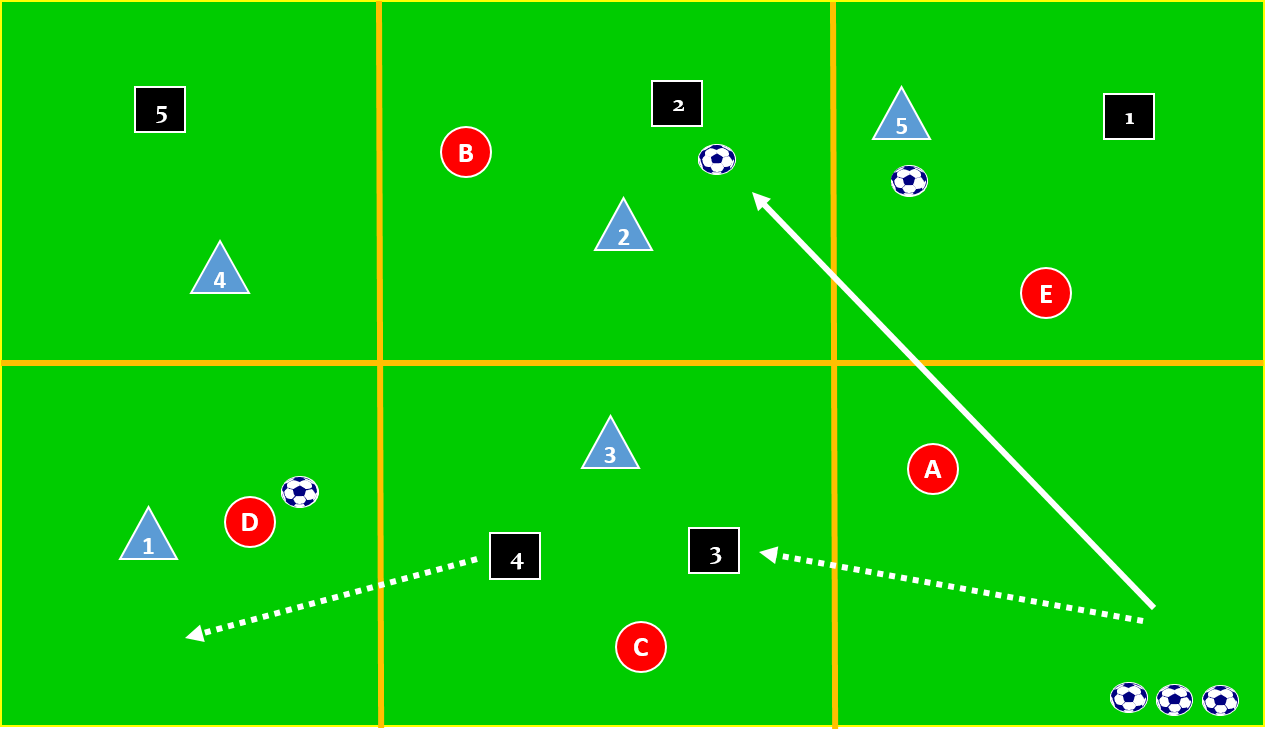
Add another ball per team. As soon as they have passed one ball off the next one is arriving so quick thinking is needed to make the correct decisions. Divide the field up into six zones and ask players to make a pass in one sixth then they must move to another sixth to receive the next pass. This can cause players to pass long or pass short and vary the range and distance of the passes and the support. Here black (3) passes to black (2) and moves into another zone to receive the next ball that is coming. This may make (4) move into a different zone too.
A Condition: Alternatively have a Condition where no players can occupy the same zone for more than a few seconds to FORCE them to move into another space and develop ROTATION of players. This ensures players get the idea of passing and MOVING off the ball, not passing and then standing.
A Competitive Game
One ball only now. 2 teams play together and one team defends. A 10 v 5 so it should not be too tough a challenge to keep the ball. So whoever gives the ball away their team become the defending team so we have a mindset transition here.
Develop: If too easy then lets say blue and black work together against red. But blue can only pass to black and black can only pass to Blue thus greatly reducing the options of a pass and therefore the decision making of each combined team is much harder.

A Competitive Game: Another challenge
1. Making it more competitive, have each team be the defending team for a certain time span. If they win the ball they try to keep it. Count the number of times they win the ball. The defending team to win the ball the most times wins the game, or alternatively the combined teams which give up the ball the fewest times win the game.
2. Attacking players “individually” count the number of times they give the ball away as an indication to each and every one of them how well they can maintain possession under pressure.

A Competitive Game
Another idea: Lets say you have different level teams then play the two strong teams against each other and have the weaker team pass and move to each other at the same time. To play a weaker team against the stronger team is a challenge so have the weaker team play free and the stronger team play one touch only.

Add Mannequins
Now players have to play thru and between mannequins (or cones) also; this is an even bigger challenge for the players. They have to position to enable players to pass into open passing lanes and for supporting players to move into open passing lanes using the mannequins as reference points. Encourage players to pass AWAY from the mannequins because in a game if the pass is close to them then the ball would be intercepted.

Red and Blue play against black. Here we show players moving between mannequins into passing lanes at the same time avoiding and getting free from opponents (the black pinnied players)

A Competitive Game with goals
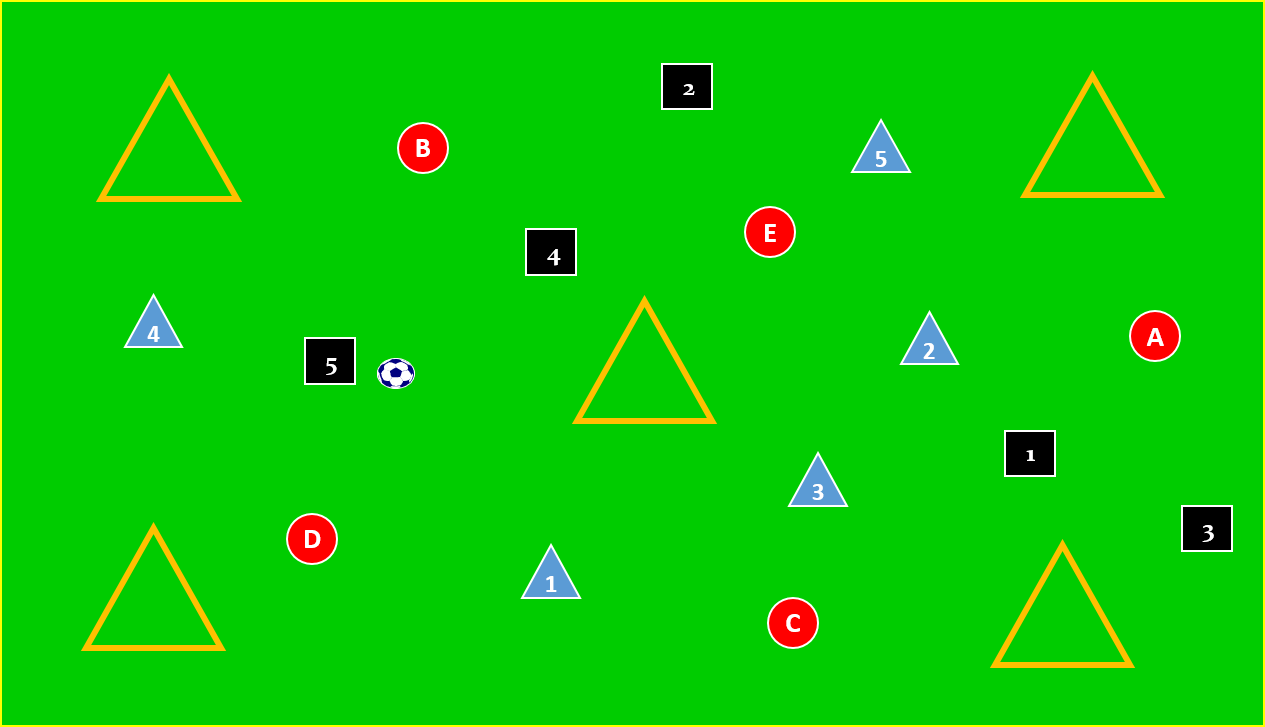
1. Here is an interesting way to work on awareness training and passing, movement off the ball, fitness and looking for the penetrating pass. Add triangular goals to score in, this means the game continues after a goal is scored as the ball must be received and possession maintained by another player in the triangle to count as a goal. This ensures continuous play.
2. It is a more directional method of playing and more specific to the game in general. The defenders are NOT allowed inside the triangle so they must be constantly working their way around the triangle trying to cut off the penetrating passes.
3. The combined attacking teams can attack all goals. Attacking all goals encourages “Switching the Field”.
4. Ultimately reduce the game to two equal number teams for the greatest challenge and begin with as many touches as possible reducing the number of touches each is allowed as they improve and are able to keep possession effectively. Reducing the number of touches allowed inevitably increases their awareness and forces them to look for options earlier and improves and speeds up their decision making. This should result in them keeping possession more effectively.
The ultimate outcome from ONE touch mentality training
One touch training is to teach a ONE TOUCH MENTALITY of the thinking process. It is NOT to teach players to only play one touch. Not at all. Once the head movement, the observation of options BEFORE receiving the ball is established thru One Touch Mentality training then we are ready to open the game up into FREEPLAY.
Now players can do whatever they like, 1 touch pass, 2 touch pass, a dribble, run with the ball, receive and turn, anything they like.
But the objective has been to establish in their minds that 1 touch mentality to enable them to make the best decision possible from potentially several options at this moment in time.
We want great dribblers beating players 1 v 1, we want players who are great at running at defenders with the ball, we want players who are excellent at one touch play, we want players who recognize; thru developing a one touch mentality when; were, how and why to slow the game down, to change the tempo at the correct times in the game; even better if we develop players who are great at all these things.
So having a “one touch mentality” and playing with this thinking process means we can actually achieve the opposite effect of playing as fast as possible; and that is to play more slowly, because that was the correct decision at that moment.


Competitive Directional Three Team Awareness Game Introducing Goals As Targets
Here is an interesting way to work on awareness training and passing, movement off the ball, fitness and looking for the penetrating pass. Add triangular goals to score through, this means the game continues after a goal is scored as the ball must be received and possession maintained by another player on the other side of the triangle to count as a goal. This ensures continuous play.

The following post if an excerpt from the One Touch Training Section in the Soccer Awareness Training Center. Soccer Awareness Training Center provides unlimited access to Wayne Harrison's Soccer Awareness systems, training sessions, drills and more. Wayne's system helps develop world class youth soccer players and teams in a systematic and imaginative manner that guarantees performance at the highest level of competition. Whether you’re a beginning coach who needs help getting started or someone who wants to add some variety to their training sessions, the Soccer Awareness Training Center offers a wide variety of drills to choose from. Join Today
- Here is an interesting way to work on awareness training and passing, movement off the ball, fitness and looking for the penetrating pass. Add triangular goals to score through, this means the game continues after a goal is scored as the ball must be received and possession maintained by another player on the other side of the triangle to count as a goal. This ensures continuous play.
- It is a more directional method of playing and more specific to the game in general. The defenders are NOT allowed inside the triangle so they must be constantly working their way around the triangle trying to cut off the penetrating passes.
- Team (3) defends teams (1) and (2) work together. The combined attacking teams can attack both goals alternatively. Attacking both goals encourages “Switching the Field”.
- Ultimately reduce the game to two equal number teams for the greatest challenge and begin with as many touches as possible reducing the number of touches each is allowed as they improve and are able to keep possession effectively. Reducing the number of touches allowed inevitably increases their awareness and forces them to look for options earlier and improves and speeds up their decision making. This should result in them keeping possession more effectively.

Measuring / Assessing Performance
When training; as a method of self-assessment or measurement (or as close as one can get without an entirely objective process); I like to ask players to count; just for themselves; how many times they each give the ball away in a given timed period. I ask them to add them up to a final number and then think about what happened in each situation and if there was a certain aspect of their play that was causing them to give the ball away.
Hence whilst they are working on playing as a team player they are also at the same time focusing on themselves as individual players and assessing their own efficiency.
Therefore, they had to think about what the reasons were for giving possession of the ball away and if one stood out then that would be the most likely skill they needed to work on to become a better player, and thus not give possession way to the same extent, as they develop more as a player.
Examples could be:
- Poor footwork, the feet are not ready to receive the ball (a very common one, perhaps the most common one), so they are getting it wrong even before they touch the ball and this leads on to a poor first touch.
- Next perhaps then a poor first touch (that perhaps was caused by the poor footwork in the first place), or
- Not looking before receiving and knowing options in advance of the ball and thus getting caught in possession unnecessarily (this is in the mind, not thinking quickly enough), because they did not see the defender coming in to close them down or did not see their next options quickly enough, or
- Poor body position (closed stance) so their directional options for the next decision are limited (they may still maintain possession by going back to the player whom they face but they will miss out on better options if they opened their stance up and looked).
- For players off the ball to help the player receiving the pass it needed good communication from them (but I told the player receiving to not expect this often and that they needed to rely on their own awareness by looking for themselves, this is a fact of life with soccer and communication because players do not talk enough to help each other)
- They also needed to make movement into space to help the player receiving the ball to thus aid their next decision.
So a two-way support mechanism; the player receiving scans the options themselves, as the ball is arriving; players off the ball move to; create several options preferably for the player receiving; for his or her next pass or phase of play.
Reward System
Having done this, I then encourage their quick thinking using one touch play by asking them to add up the number of times they made a successful one touch pass during the time period, and that they could then deduct a mistake or giveaway from their score. This was a form of a rewards system I use.
Use this with free play, as many touches as they like and one touch reward, or three touches and a one touch reward, then two touches and a one touch reward (the most difficult of these). I call this lose a life and gain a life (or you can call it positive or negative point scores if you like); as they add up their score in their heads as they proceed.
It was important they did not get obsessed with passing one touch just to get one life (or point) back as not every situation warrants or needs a one touch pass and they may lose a life because of it, making a bad decision. Of course this is not an entirely objective measurement but it can be an indicator to them of the things they are good at and the things they need to improve upon.
If players mentally focus and use this idea they can identify for themselves their strengths and weaknesses and therefore have a somewhat objective idea of what they need to work on to improve themselves. You can apply this method of self-assessment to many game set ups and situations in training.
Age Related
For younger players meaning 6 to 9 year olds in general terms; it is best to introduce these ideas in a non-pressurized situation, where they are likely to give up the ball at times without pressure anyway; and you can analyze this with them.
Without pressure means the focus could be on foot work as much as anything which is the best place to start to help them; as many of the reasons the ball is given up in this is due to excessive pressure. No pressure narrows the field of possibility for error.
Choosing Options
Guard against them just passing the easy pass for the sake of, challenge them to really look to see all the options and try to choose the one that hurts the opponents’ the most, there may be a simple 4-yard pass that won’t affect the defenders, but there may be a one touch switching play pass to the other side of the field that will hurt them more, as we have a free player there and the change in play will be more effective than the easy pass.
You the coach can observe players and see those who attempt to take the right choices (being the most difficult sometimes but if successful causing the most damage to the opponents).
You may get a player, who takes every easy option and gets a good score, and never takes chances, well he or she is good for maintaining possession of the ball (and that is good in itself) but won’t unlock the door for the team with a telling but perhaps risky decision; as they didn’t test themselves, this is where your observation will come into the equation.
It can be a balancing act between making the right choice (perhaps a more difficult one), making the easy choice; and mixing them up, as sometimes only the easy pass is on anyway.
This is why it is not a totally objective process, it can’t be in such a dynamic game as this, but also where the subjectivity of the coach’s experience comes into play when assessing players with this system in mind.
Playing Percentages and Performing in Safety and Risk Areas
You can also apply logic to the decision made by players when you look at the safety and risk areas that players are in. You would encourage the easy option in the defending third of the field; as if the ball is lost there through a risky play then the opponents may score.
You would encourage the riskier but potentially damaging option against the opponents in the attacking third of the field because if possession is lost there then we can still recover the ball quickly and not be too open to a damaging attack against us.
But if it is successful this riskier option may lead to a goal that the easy option might not have. Yes, it would be a higher percentage chance of keeping possession with the easy option, but the rewards are greater if using the lower percentage option.
Example: In the attacking third we have two options; an easy pass that has a 9 out of 10 (90%) chance of success but it doesn’t penetrate the opponents defense, or a difficult pass between defenders that penetrates and puts the striker in a position to score but has a maybe 3 out of ten (30%) chance of being successful because of the limited space to pass it into and the number of defenders between the passing player and the striker receiving your pass. Which does the player take? Fear of failure would suggest the easy one, taking the chance would be the difficult one; but it may result in a goal. The player has to decide was the difficult option the best one to take? Maybe it was the best option at that moment even though its percentage of success was low.
Hence the higher percentage option with the most chance of maintaining possession is not necessarily the best option to take; it can depend on the individual situation at any given moment in time; and also on which part of the field it is happening.
The better the player, the more often they will make the right decision, using both the easy and more difficult options that present themselves all the time in the game.
Conditioning Games in Training
Free Play, Two Touches and One Touch Play
Conditioning the game situation in training can help identify what players are good at in these continuums. Playing a game with each player able to have an unlimited number of touches allows them to “get out of jail” as I call it, meaning get out of trouble and keep possession; even if their decision was not the best option to take at that particular moment. As an example; perhaps they did not look early to scan their options as the ball was coming to them (as in the best continuums) so they missed the opportunity for the one touch pass (which at that moment was the best option available) but their dribbling skills allowed them to still maintain possession of the ball.
Making the game a two touch maximum each time they receive the ball starts to focus their minds in quick thinking and quick decisions thereof; and does not allow them to get out of trouble (get out of jail should their decision making be poor) with lots of touches.
Rotating between games of two touches and free play all in (as many touches as they like); but including the one touch successful pass option in both; is a good way to focus their minds on the job in hand and understand the options they have available to be successful.
Players could for example be minus 6 meaning they are more successful, or positive 6 meaning they gave the ball away more; as they add one when they give it away and take one away when they perform the reward theme successfully.
Examples of good games to play for this are such as:
Three Team Possession Game: Three teams, two teams work together, one defends, creates an overload situation in attack, for example 15 players, three teams of 5, a 10 v 5 game. Possession changes as one of the two team’s players gives the ball away to the defending team then they become the next defending team this is a good transition game also from attack to defense and defense to attack. This game can be in an area of 40 x 40 yards for example and the challenge to the players can also be to move inside to outside (outside being just inside the touchline) and outside to inside to ensure they avoid standing in one area. Plus, it takes greater vision or awareness inside the area; where they need to look around and open their stance up to potentially change the direction of play; than on the outside where they can see everything easily.
Encourage players who play centrally on the team to get in the middle of the area and dictate the play, be the pivot for the team, the player who transfers the ball from one side to the other, the link player, this can be one, two or even three players at a time, but they can rotate between themselves too.
Equal numbered teams in a possession keep away game: this would be the next progression from the overload game being a more difficult challenge of the players. Same principles and ideas as above apply.
Transition games: In two halves, creating overloads in each half as each team gains possession. Team A have to get the ball in one half and play a 7 v 3 for example, team B have to win it back with the 3 defenders and get it back to the other half and have a 7 v 3 in their favor, and so on.
Themes of Play
You can work on different THEMES in these possession games based on how you reward the players; for example, each of the situations below constitutes a different reward mechanism to adhere to:
Quick thinking / Quick Passing: One touch successful passing; this improves quick thinking, early identification of options, in advance of the ball, quick passing.
Switching the Play or point of attack: Playing in thirds and being able to pass from one outside third to the other outside third successfully across the middle third can create a switching the play reward.
Defending 1 v 1: For a defending team, the individual winning possession and keeping it can be a reward, so they get a life / point for that.
Success in a 1 v 1 dribbling situation, beating a player with a dribble and maintaining possession. You can use this in free play all in games where players have unlimited touches each time they receive the ball.
Several themes in one can also be used; just playing the game or scrimmage you can incorporate all of these into the equation and ask the players to process in their minds all the ideas as to where they go right and where they need to improve.

Awareness “Look, Think and Decide” Challenges with Players in 2s and 3s
These simple ideas are designed to get (forces) players to look away from the ball but at the same time be able to control and pass the ball accurately when it comes. It can be 1 touch or 2 touches. This prevents them from just being focused on the ball as it is arriving and therefore not being aware of their immediate options.
You can do this as a nice warm up to get the players minds working.
These simple ideas are designed to get (forces) players to look away from the ball but at the same time be able to control and pass the ball accurately when it comes. It can be 1 touch or 2 touches. This prevents them from just being focused on the ball as it is arriving and therefore not being aware of their immediate options.
Its all mental training and if you do it quickly then the players have to be constantly looking and thinking BEFORE receiving the ball and making successful decisions and accurate passes. Players are required to look AWAY from the ball to see the signal and then make a decision. They can often see the ball in their Peripheral vision anyway as they look away from it.
Increase the challenges as you see fit, reducing the number of touches, by reducing the amount of space between players. Even ask the signaling player to make the signal as late as possible but still giving the players split second time and a chance to see, decide and perform the correct action before receiving the ball.
Try to get a good rhythm going with the signaling and decision making and passing and moving; so we have constant play with no interruptions and the thinking process is constantly tested.
Awareness Challenges with Players in 2s
(C) Offers 4 challenges: right hand up, left hand up, no hands up, and both hands up.
Players must look away from the ball to see what decision (C) has made and then call out what (C) has done. At the same time one touch passing accuracy should be maintained. You can introduce 2 touch passing with certain footwork challenges also. Start at a distance and reduce it, say 10 years apart to start. This is a very easy introduction to the look; think and decide.

Once they get good at this decrease the distance between the two players so less time to think and anticipate and decision make. Now maybe 5 yards apart. Rotate the players so everyone is involved in the thinking processes developed. Make it competitive and each player counts how many times they made the wrong decision and hence the wrong pass; perhaps because they forgot to look away from the ball in the first place and just focused on the ball as happens VERY often in the game itself.
Awareness Challenges with Players in 3s
(C) Offers 4 challenges: right hand up, left hand up, no hands up, and both hands up. (A) Point right, moves left. (C) turn left; in the hand direction and passes right). (A) moves to the left cone to receive the pass.
Now (C) must receive the ball and work between the two players (A) and (B). Before (C) receives the pass off (B), (C) must look “behind” to see what (A) is signaling. Same ideas; right hand up, left hand up, both hands up (pass back), no hands up (Receive and Turn). If the right hand is up then (C) receives and turns to the right and passes to the left, so the turn is in the direction of the hand; but diagonally opposite with the pass. Here (A) holds the right hand up and moves left.

(A) Brings the ball back with one touch to the middle cone and we start again.
Now (B) must decide where (C) plays the ball by performing the hand signals. Both hands up and (C) must pass the ball back to (A), no hands up (C) must receive and turn and pass to the middle cone to (B). Here (B) has both hands up so must pass back to (A) at the middle cone.

Make it two touches but the middle player now must move side to side and turn their body to receive the ball going the opposite way.
Here (C) comes off at an angle to (A) and (B) getting side-on to have better peripheral vision. As (C ) is moving he or she must be looking at (B) to see what signal they have made to then decide what pass they make. (B) obviously put up the left hand so moves to the right. (C) receives and turns to the outside or left and passes to (B)s left.

As in the 2s idea have it competitive and players count how many decisions they got wrong to test against themselves and also against each other.
(B)'s first touch is back to the middle cone and 2nd touch is a pass to (C) who has switched positions in the mean time. As all this is happening (A) has signaled with NO hands up so (C) must receive and turn and pass to (A) at the middle cone as shown. Now (C) can turn inside or outside. Next, (A) waits until (C) is in position on the other side to then pass the ball.

With this 94 page eBook, we are taking the Soccer Awareness thinking process to the next level by identifying what is relevant at each age group. That said, you the coach, will decide perhaps a 9 year old team can cope with the 11 year old sessions and perhaps a 12 year old lower level team will need to use younger age group session plans.
We hope you enjoy these sessions and as always our Soccer Awareness training material is simple to understand, user friendly and we try to offer a great attention to detail.
Feedback is always welcome as we want to keep improving our product.
Best wishes, Wayne Harrison