Welcome to the Soccer Awareness Coaches Corner. Browse through soccer drills, small sided games, tactical thoughts, full sessions and a variety of resources. Posts marked “Training Center Exclusive” are for members only.

Defensive Pressing to Push Up Without Touching the Ball with a Back Three
This is a great session to teach the players and shows how they can push opponents back even when THE OPPONENTS have the ball.
We will try to push them back without even touching the ball ourselves. We start on the edge of our box we try to get our back three up to the half way line. Set Conditions will help us do this to start the process off.
Conditions:
Defending team cannot tackle.
Defending team CAN intercept a pass.
Attacking team must play 1 or 2 touches due to the fact defenders cannot tackle so opponents cant dribble 1 v 1.
Coaching Points:
Defenders press the ball as quickly as possible.
Try to stop the forward pass, try to force a pass across the field or backwards.
Defenders must recognize every opportunity to push up no matter how small a distance it may be.
Sometimes its 5 yards up 3 yards back for example depending on the position of ball and if there is pressure on it.
Try to intercept the pass and gain possession.
Download this free 20 page session by joining our mailing list below

Teaching Angles of Support
This session shows how to develop Angles of support OFF the ball to receive using corridors. You can use this in any size of game. Every player can move anywhere they like from both teams.
How to develop Angles of support OFF the ball to receive using corridors
You can use this in any size of game. Every player can move anywhere they like from both teams.
Develop:
You can play a straight pass forward thru your own corridor if a player moves into it from another corridor.
If you pass it forward to an existing player in the same corridor then ultimately they receive the ball facing more or less backwards.
If you pass it straight forward to a player entering the same corridor then it is likely they are moving and facing forward as they receive the ball which is what we are essentially trying to create.
To start play unlimited touches, then 3 touches, then 2 touches and then one touch; when it is on to do so.
Always encouraging the players to think and act quickly.
The set up to promote angled support
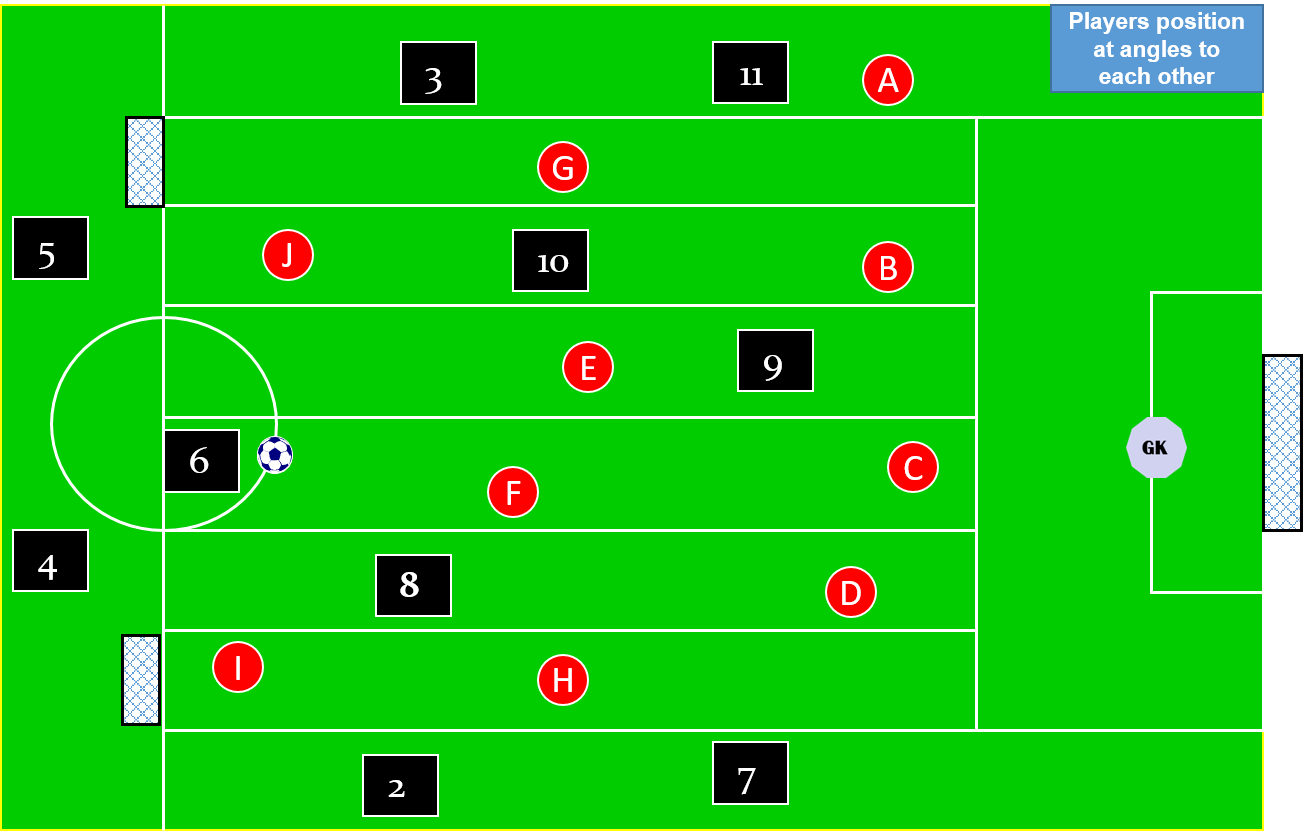
Eight corridors to play in. This teaches players to position to improve their PERIPHERAL VISION. It might only be a case of a couple of yards changing position but it can be vital in terms of retaining the ball. The CONDITION FORCES players to move and position correctly.

(10) cannot receive the pass in the same corridor so has to move into space and into an angled support position. Now (10) receives the ball side on with better PERIPHERAL VISION, forward, back and to the side. (9) then moves off the ball also to create angled support for (10) to pass.
Choices of pass

(10) Is now in a much better position to use awareness instincts to see options. Ultimately (10) should try to position not only side on but ultimately facing forward on their first touch. Here (8) makes a good forward run forming a natural angled position off the ball to receive.
Movements off the ball

This set up also encourages wide players to make movements between zones as they use the coned lines as a guide. Using their own imagination players will begin to interchange between zones and between each other so we get rotational movements.
Rotations and combination plays
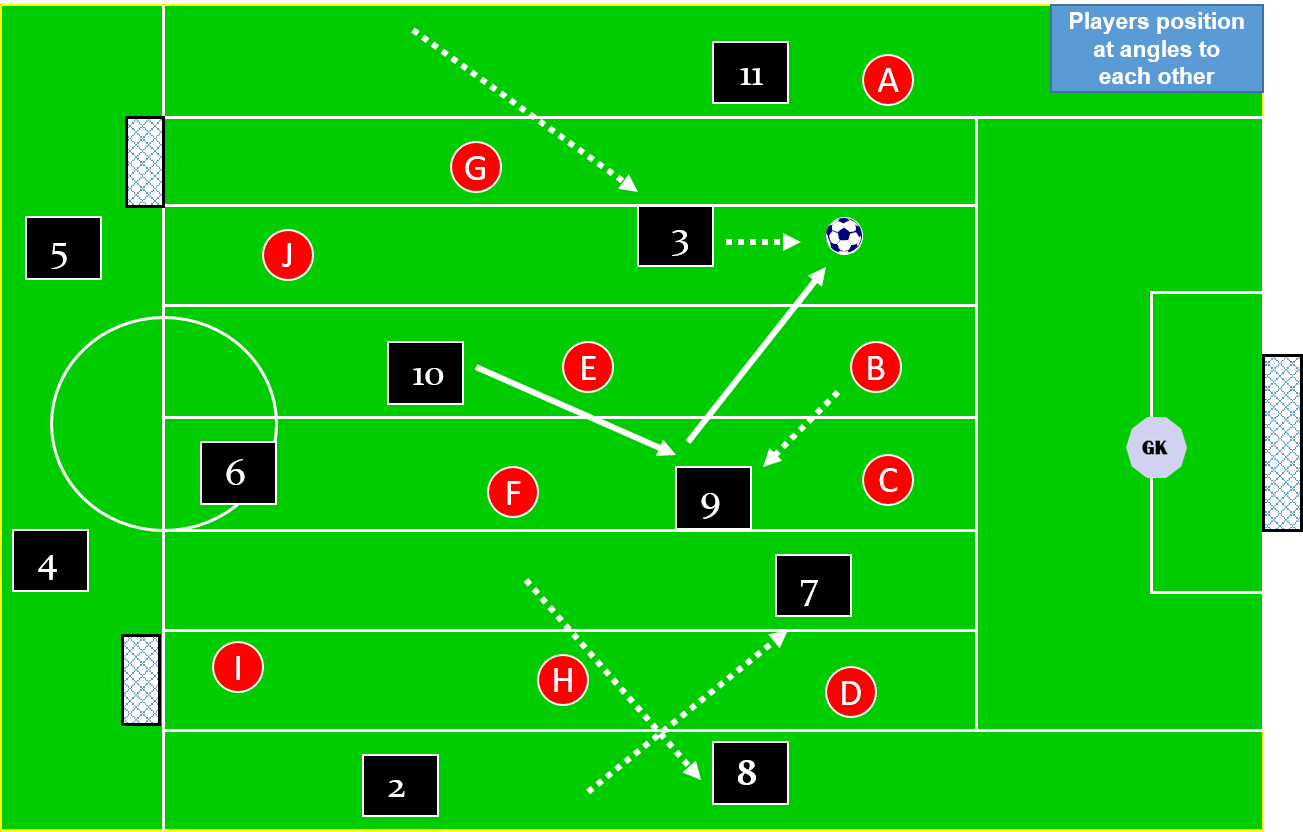
So now we have players dropping back to support and receive (getting free from markers) and moving forward to support and receive; rotations and combinations.
Movement from another corridor into the passing players corridor
Good timing is essential here where the receiving player (9) times the run to accept the pass facing forward and not breaking stride in doing so therefore the timing and weight of the pass has to be perfect too.



Defending in a 2v2 Situation
In a 2 v 2 show the “piston effect” of support movements as the ball travels. Also consider that the closest player can close down the ball as it travels from player to player.
The following session is an excerpt from “Soccer Awareness Coaching Curriculums presented by Game Sizes: 4 v 4, 7 v 7, 9 v 9 through to 11 v 11”
This eBook covers up to 14 weeks of training for each game size presented as one session per week. All sessions have small sided games scrimmage set ups as close as we can get it to finish to reflect the theme of the session - Buy It Here
Develop: 2 v 2 with (B) joining in. In a 2 v 2 show the “piston effect” of support movements as the ball travels. Also consider that the closest player can close down the ball as it travels from player to player.
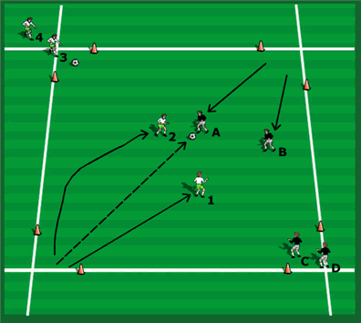
(2) closes (A) down and shows inside to the support player. (1) Supports at a 45 degree angle but is also screening (B). In the 2 v 1 situation (1) only had to think about supporting (2) but now there are two things to consider; supporting (2) and screening the position and movement of (B). Distance of support depends on the position on field and the speed and ability of opponent. The support player can give verbal direction but also can take a position off the way the pressure player shows the attacker to go as previously discussed. It can depend on which happens first, the body position of the pressing player forcing the play one way or the verbal direction of the support player advising forcing the attacker towards their position.

4-2-3-1 Defensive Pressurizing Game
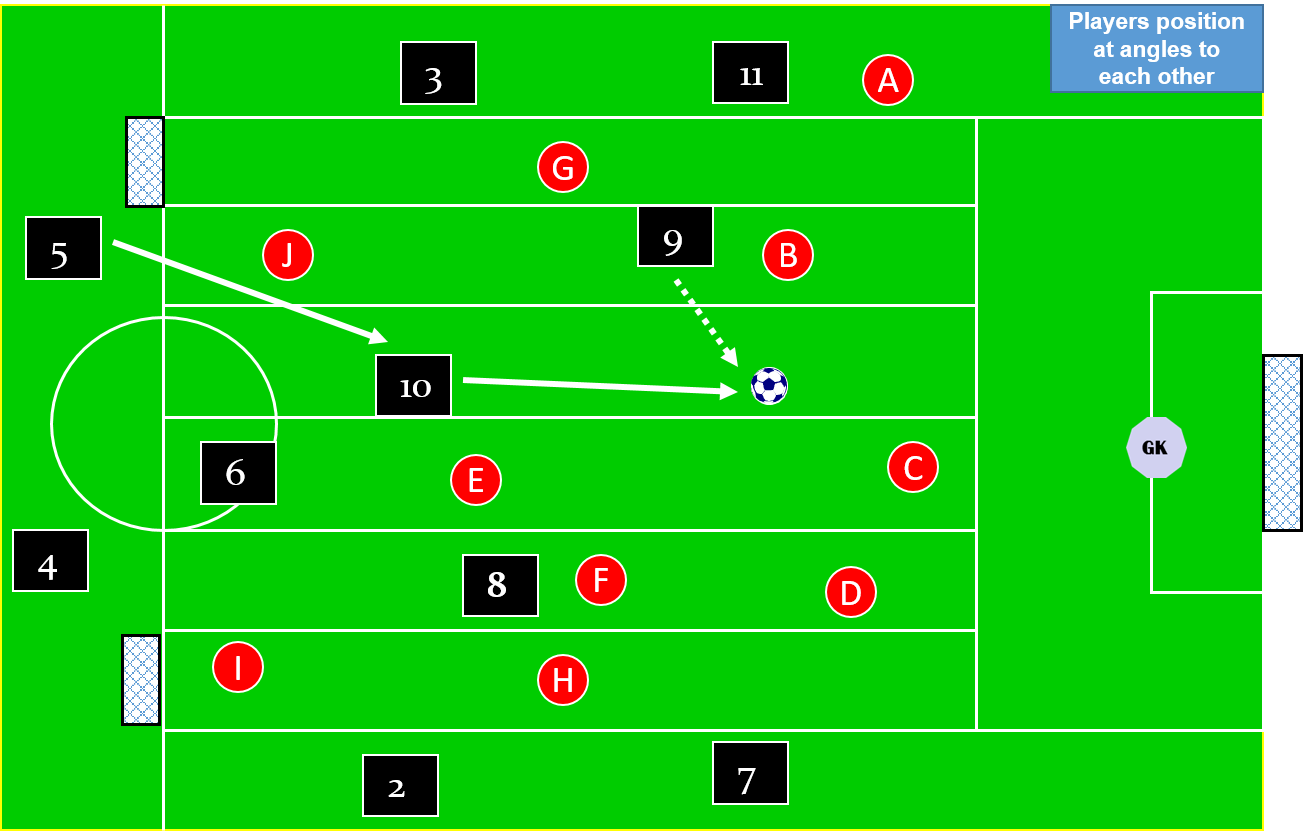
The game is designed to work on pressurizing the player on the ball, prevent a forward pass and ultimately win the ball. Closest player has to pressure the ball. To score, a player has to make a pass from anywhere into the keepers hands. The ball can be played in the air to the targets hands (to practice quality long distance lofted passes) or on the ground to feet (driven passes). All over the field players must work hard to close people on the ball down quickly.
The following drill is part of a 28 page presentation entitled DEFENDING AS A TEAM IN A 4-2-3-1 that can be found on the recently added 4-2-3-1 System of Play page in the Soccer Awareness Training Center. Soccer Awareness Training Center provides unlimited access to Wayne Harrison's Soccer Awareness systems, training sessions, drills and more. Wayne's system helps develop world class youth soccer players and teams in a systematic and imaginative manner that guarantees performance at the highest level of competition. Whether you’re a beginning coach who needs help getting started or someone who wants to add some variety to their training sessions, the Soccer Awareness Training Center offers a wide variety of drills to choose from. Join Today
The game is designed to work on pressurizing the player on the ball, prevent a forward pass and ultimately win the ball. Closest player has to pressure the ball. To score, a player has to make a pass from anywhere into the keepers hands. The ball can be played in the air to the targets hands (to practice quality long distance lofted passes) or on the ground to feet (driven passes). All over the field players must work hard to close people on the ball down quickly.

Develop –
A) As a reward when a team scores a goal they keep possession so they play to the opposite goal to score. Previously they played to the same goal and the opposition got the ball when they scored.
B) Go to man –marking so in possession players must get free and defenders must work hard to stop them scoring. Show by high pressure as a team how defenders can win the ball back early and close to the opponent’s goal to score. Need to push up from the back to start this.

Coaching Points:
Quick Pressure on the ball
2nd defender supplying close Support for first defender
Deeper Cover from third defender
Recovery runs from players in front of the ball
Regain possession
Here the job of player (G) is to pressure the ball as quickly as possible to win it back. (F) supports across, (G) shows the player on the ball inside towards (F) and between them they try to win the ball back quickly. (E) Offers a balanced covering deeper position behind them.
Players cannot go into the keeper’s area.

Here (6) gets free of defender (D) and chips the ball into the keeper to score a goal. Once this has happened a few times players get the idea they need to work hard to close down quickly opponents on the ball.
This game improves the urgency with which players need to close opponents down as they are so easily punished in this game if they don’t.
New 4-2-3-1 System of Play Presentations in the Soccer Awareness Training Center

Playing The 4-2-3-1 And Changing Systems of Play Depending on the Game Situation
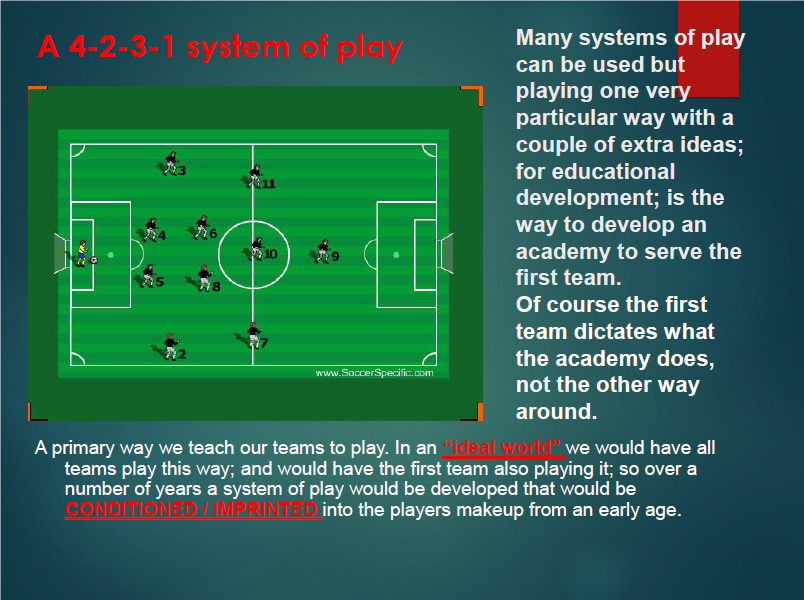
4-2-3-1 System of Play; An 80 Page Guide

Defending as A Team in A 4-2-3-1

Playing The 4-2-3-1 Showing the Defensive Discipline Needed to Allow the Fluidity Of Attack
Soccer Awareness Training Center provides unlimited access to Wayne Harrison's Soccer Awareness systems, training sessions, drills and more. Wayne's system helps develop world class youth soccer players and teams in a systematic and imaginative manner that guarantees performance at the highest level of competition. Join Now

Coaching Points Of Individual Defending – Closing Down
Players should close the opponent down with a curved run forcing the player the way they want them to go. Encourage the players to not only win the ball but also to maintain possession of it if they can. In this session they can win it and try to score into the other goal as a reward for gaining possession. In this instance both players will get a chance to practice defending in the same sequence.
The following is an excerpt from The Ultimate Youth Coaches Training Guide; A Complete 6 to 10 Year Old Developmental Coaching and Training Program.
This program is perfect for youth coaches wanting practices to start their soccer coaching education and it is also for those more advanced and experienced coaches wanting to train their players as best they can at these wonderful open minded ages for development and education of both the mind and body. Our plan is to help all coaches at whatever level of experience they are at. Find Out More
1. Travel as fast as possible as the ball travels to close down opponent.
2. Close the opponent down with a curved run forcing the player the way you want them to go (if you have time to do so).
3. Slow down the last few yards, get balanced, bend knees, sideways on stance forcing the play your way, and slow the attacker up (making play predictable).
4. Feint to tackle – use your front foot this forces the opponent to protect the ball and ultimately look down at the ball and away from you the defender (also prevents awareness of where support players are in a game situation).Try to steal with front foot.
5. Watch the ball not the player so you aren’t thrown by body movement.
6. Stay on your feet and be patient, your chance will come to win the ball if you go to ground you give the initiative to the attacker
Defending In A 1 v 1 Situation
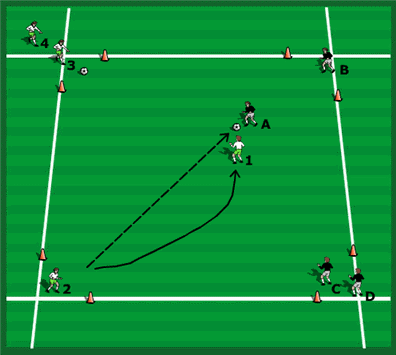
7. Think about the way you want to player to go, it can be onto your opponents weakest foot or to the side you are strongest and most confident to tackle on. It can depend on the side there is less space to work in for the attacker to restrict their movement and options and to make play predictable.
8. Encourage the players to not only win the ball but also to maintain possession of it if they can. In this session they can win it and try to score into the other goal as a reward for gaining possession. In this instance both players will get a chance to practice defending in the same sequence.
Session Plan
Receiver (A) tries to score through defender (1)’s goal. Work both sides and alternate numbered players and lettered players.
All players get the chance to attack or defend.
Encourage and praise good defending.
Correct the faults.
Step in and demonstrate to show the players what is needed if required, demonstration is better than explanation.

1 v 1 Defending and When and Where to Drop Off Against Pace
This is a breakaway 1 v 1 situation with the striker running at the defender in a straight line towards goal and kicking the ball past them and chasing it down. The defender must be “side on” already with their body turned back and ready to run towards their own goal. Defender must increase their speed dropping back; running almost side on and backwards (but head facing forwards watching the striker and the ball until it is played pass them, then they have a full turn and chase) as the striker kicks the ball past them and must start their dropping run early enough to give themselves time and space on the striker.
The following is a sample from the Soccer Awareness Training Center. Soccer Awareness Training Center provides unlimited access to Wayne Harrison's Soccer Awareness systems, training sessions, drills and more. Wayne's system helps develop world class youth soccer players and teams in a systematic and imaginative manner that guarantees performance at the highest level of competition. Whether you’re a beginning coach who needs help getting started or someone who wants to add some variety to their training sessions, the Soccer Awareness Training Center offers a wide variety of drills to choose from. Join Today

This is a breakaway situation.
- A 1 v 1 situation with the striker running at the defender in a straight line towards goal and kicking the ball past them and chasing it down.
- The defender must be “side on” already with their body turned back and ready to run towards their own goal.
- Defender must increase their speed dropping back; running almost side on and backwards (but head facing forwards watching the striker and the ball until it is played pass them, then they have a full turn and chase) as the striker kicks the ball past them and must start their dropping run early enough to give themselves time and space on the striker. Footwork is not side to side but as they would normally run but with the upper body facing forward.
- Watching the body language of the striker on the ball they need to be able to recognize and anticipate when they are going to kick the ball and chase it. So this is a VISUAL CUE for the defender.
- The defender must run across the path of the striker who will be trying to run in a straight line and the shortest route to the ball and to goal. The distance between the defender and the striker on doing this and running across them can vary depending on how fast the striker is but it should be a distance of between a yard and 3 yards to make the striker work around the defender. If it is further then likely the defender has got the run on the striker anyway.
- So, across the path then after the ball; not the other way around; as if they are quicker than the defender they will get there first (just by running past the defender if they are running in the same straight line and not across them) and we will be exposed defensively. The defender must have a yard or more on the striker to be able to get in front and across them I see too many times when they almost start at the same point and beside each other and then if the striker is quicker the defender does not get the chance to get in front and across them.
- Running across their line or path means, the striker may have to divert their run so they have to go AROUND the defender; thus giving the defender a better chance to get to the ball first or they run into the defender and are blocked (though do not make it too obvious if they are blocked by the defenders body).
The “timing” of the stepping across the striker in the recovery run is all important because if the timing is wrong the defender can get called for “obstruction” and thus gives away a free kick; and possibly in a dangerous area for their team. So do it early enough where they are not too close to be called for this.

Here is what happens too much with defenders; they get in a race with the striker, who is facing forward and so is at an advantage to begin, and they allow them to run past them due to them being quicker or just timing their run forward better than the run of the recovering defender; who may start too late, and often do so and are not into their stride by the time the striker is going past them; due to dropping off TOO SLOWLY or TOO LATE and in a straight line alongside the striker.
A slower defender can still get to the ball against a faster striker before them if they time their recovery run correctly, and they allow themselves some space and yardage on the striker as they start their recovery and dropping back run.
Their body position can make this even better and they MUST NOT be in a square on body position to the striker as they drop back because they then have to make a FULL TURN to recover and thus waste time and yardage.
New Defending Presentations in the Soccer Awareness Training Center

1 v 1 Defending and When and Where To Drop Off Against Pace

Defending When the Ball is in Behind

Defending and Pressing in the Attacking Third

Defending Against a Counter Attack in Wide Areas
Soccer Awareness Training Center provides unlimited access to Wayne Harrison's Soccer Awareness systems, training sessions, drills and more. Wayne's system helps develop world class youth soccer players and teams in a systematic and imaginative manner that guarantees performance at the highest level of competition. Join Now
REMEMBER; THESE TRAINING TIPS APPLY TO PLAYERS MAKING FORWARD RUNS “WITH” AND “WITHOUT” THE BALL.
When a defender encounters an attacker who is approaching with pace, they can also try to prepare their body position and movement with a mind to accomplish two things:
When the ball goes past the defender, the defender tries to ensure that his or her hips are facing the same direction as the runner/attacker.
As the attacker approaches, the defender tries to quickly match the foot/leg rhythm in order to match their pace (as close as possible) and also to be capable of using their own foot to stop any pass/cross/shot if the striker has a slight run on them (which they would place in front of the ball at the same moment as the attacker lifts their leg to strike the ball).
So:
- Match the attackers rhythm (and be ready to block a pass/cross initially) and;
- Match the direction of the Hips of the attacker (even when stepping in their path) along with being able to prepare the body and react quick enough to match rhythm with the attacker.
For instance, staying low, getting a solid push off your plant foot (at the moment you plan to turn your hips) and “snapping” the hips around – followed by getting the knees cycling to quickly match the steps of the attacker’s feet.

When to Close in Wide and Central Areas
This session covers when and when not to close down in wide and then central areas. The practice develops into an 11 v 11 game situation, still working with the defending team. The coach serves to the opponents in different locations on the field and the team needs to try to win the ball back individually and collectively.
This is the fourth in a four part series on defending tactics.
To Close or Not to Close in Wide Areas

- This is an example of what can happen if the wide defender is drawn to the ball when it is at (C). Notice as (2) leaves the space and closes (C), the ball is passed into striker (E) who can lay off the ball wide into the open space that has been left by (2) for (A) to run into unopposed.
- This now compromises (4)’s position who now has a 2 v 1 against. If (2) were to anticipate the pass early and be in a position to intercept, only then would it be possible to close (C) down and have success. If you were to tie the four up this would prevent this situation happening and let the players feel how they should position with the restriction of being tied together.
To Close or Not to Close in Central Areas

This is the best course of action when a central player’s position is threatened by a movement short by the striker. (5) Only goes so far then lets striker (F) go deep into midfield. In a game situation a midfielder could pick up (F) on entering their zone. As extra cover, as (5) goes short, (4) moves across to cover the space left by (5) and (2) moves across to cover the space left by (4)’s movement leaving the outside space free. The best scenario is if (5) only goes so far then drops back to establish the chain link of the back four again maybe even dropping into the position (4) left to fill the first space if this player has covered across.

- A position to avoid getting into would be when the striker goes short to receive the ball to feet. The central defender must decide how far to follow but not allow a big hole to be made behind by being pulled away from the other three defenders.
- This shows the defender going too far and being drawn into midfield. The correct decision would be to only go so far as to not lose touch with the back four unit shape, if the striker keeps going short then he / she is moving away from the danger area and into an area where they will be less of a danger to the back four defenders. (4) And (2) can still move across and fill the spaces left but player (5) doesn’t want to get too far away from them to become isolated.
Defending in an 11 v 11 Situation

- Here we have developed the practice into an 11 v 11 game situation, still working with the defending team (numbered team). The coach serves to the opponents lettered team in different locations on the field and the team need to try to win the ball back individually and collectively.
- The target for the defending team when they win the ball could be to just chip the ball into the opponent’s keeper and the defending team has to win the ball again starting from where the coach serves the ball.
- I have shown zonal defending as a team using a 4-3-1-2 system of play with a diamond shaped midfield but the same principles apply with other systems using the zonal method of defending and it is easy to practice this method with different shapes of teams.
- Over the page the same idea with a different set up. You can set the session up in your preferred team system of play and / or set the other team up in the system of play you know your next opponents play to practice defending against. There are numerous variations to use in this set up to achieve your defensive goals.

- Here we are using a 4 – 4 – 2 system to work the defending set up.
- It is the same idea as the previous diagram the coach can play the ball into various situations always to the other team to attack and for the defending team you are coaching to try to win back the ball.
- Once you have used the target plan to allow lots of opportunity for defensive situations to practice, the defending team can now be allowed to attack the opposition as a reward for regaining possession and score a goal if possible.
- Eventually let the game go free.
54 Pages
We want to stay with our own game plan as closely as possible; based on what we practice and to keep it simple for us; as we dictate to our opponents; and we impose OUR WAY on them.
But there will be many occasions where we must change the system of play and we may have to adjust to suit the opponents.
Here are some ideas for you to consider for your team starting with the 13313 and 14231 systems of play.