Welcome to the Soccer Awareness Coaches Corner. Browse through soccer drills, small sided games, tactical thoughts, full sessions and a variety of resources. Posts marked “Training Center Exclusive” are for members only.

Defensive Pressing to Push Up Without Touching the Ball with a Back Three
This is a great session to teach the players and shows how they can push opponents back even when THE OPPONENTS have the ball.
We will try to push them back without even touching the ball ourselves. We start on the edge of our box we try to get our back three up to the half way line. Set Conditions will help us do this to start the process off.
Conditions:
Defending team cannot tackle.
Defending team CAN intercept a pass.
Attacking team must play 1 or 2 touches due to the fact defenders cannot tackle so opponents cant dribble 1 v 1.
Coaching Points:
Defenders press the ball as quickly as possible.
Try to stop the forward pass, try to force a pass across the field or backwards.
Defenders must recognize every opportunity to push up no matter how small a distance it may be.
Sometimes its 5 yards up 3 yards back for example depending on the position of ball and if there is pressure on it.
Try to intercept the pass and gain possession.
Download this free 20 page session by joining our mailing list below


Quick Play Drill Working on Passing and Moving to Create Space
The goal is to teach Playing in tight areas, Developing fast feet, Positioning off the ball, Defending condensing attacking spreading out, Teaching spacing and moving into passing lanes to get free and more.
The goal is to teach:
Playing in tight areas,
Developing fast feet,
Positioning off the ball
Developing a spinning head or rubber neck I call it
Defending condensing attacking spreading out
Teaching spacing and moving into passing lanes (between cones and between opponents) to get free (VERY important)
Scoring goals
Defending team short and tight attacking team wide and long
Warm Up for Quick Play
A ball each passing and moving playing 1 and 2 touches only. Avoiding the cones which represent opponents. Learning to position in the best space possible between cones

Quick Play
Restricted area to play in. Cones represent opponents so players must avoid passing close to them or positioning close to them. Blue cones the free players so always an overload.

Quick Play Adding Goals
Now a REAL GAME SITUATION. Keeping score making it competitive working between restricted number of touches and unlimited touches to test players peripheral vision and awareness.



Warm Up and Cool Down for Training and Match Situations
Warm Up and Cool Down are both important parts of any coaching session or indeed any game situation and should be included at all times particularly at a young age where doing so reinforces good habits in players. Due to the great need for players to have as much contact on the ball as possible to aid technical development, I recommend coaches get away from warming up and cooling down without the ball and introduce its use at every session they do, be it at a game or at practice.
The following is an excerpt from The Ultimate Youth Coaches Training Guide; A Complete 6 to 10 Year Old Developmental Coaching and Training Program.
This program is perfect for youth coaches wanting practices to start their soccer coaching education and it is also for those more advanced and experienced coaches wanting to train their players as best they can at these wonderful open minded ages for development and education of both the mind and body. Our plan is to help all coaches at whatever level of experience they are at. Find Out More
Warm Up and Cool Down are both important parts of any coaching session or indeed any game situation and should be included at all times particularly at a young age where doing so reinforces good habits in players. Due to the great need for players to have as much contact on the ball as possible to aid technical development, I recommend coaches get away from warming up and cooling down without the ball and introduce its use at every session they do, be it at a game or at practice. I will include some practices you can use as a reference.
TECHNICAL ROUTINE TO USE
Players standing in the same position have to use one foot to “pull” the ball back with the “sole” of the foot and “push” the ball forward with the “laces” of the same foot. Do the movement with their heads up.
Do it in a circle facing North, South, East and West on the call of the coach or have for example ten pulls with the sole and pushes with the laces movements at each direction. Quarter turns on each call going around in a circle.
Same idea but drag back with the sole, push forward with the side of the foot not the laces. Bounce on the non-kicking foot as they do it.
Inside and outside of the foot, roll the ball to the outside (on top of the ball contact), cut it back with the inside and roll the ball to the inside and cut it back with the outside of the foot. Repeat 10 times either side.
Using the inside and the outside of the feet and moving side to side. Move the ball with the inside of the foot then the outside to bring it back but with the same foot. Use a cutting motion. Repeat 10 times either side.
Juggling and counting the number of juggles, using both feet and both thighs.
Step-Over Turn
Drag Back Turn
The Cryuff Turn
The Inside Hook Turn
The Outside Hook Turn
Twist Off Turn
Matthews Dribble
Beardsley Dribble (double Touch)
Rivelino Dribble
Scissors Dribble
Double scissors Dribble
Maradona Dribble and turn
For individual dribbles and turns do 10 each one on the calling of that number. It can be three separate routines, 1 to 6, 7 to 12 and 13 to 17. You can create your own routine from all these ideas that the players must do for a warm up at the beginning of every session.
Divide into two teams to start (for the scrimmage later if it’s a coaching session). A Ball each dribbling, turning controlling the ball, practicing skills at a slower pace if it’s a warm up to build to full pace or slowing down if it’s a cool down
Include changes of pace in this, switching balls between players, Coach can provide passive pressure and can condition the content; the players decide when and where to implement it.
Stop on a regular basis to stretch, get them tuned into thinking for themselves and being concentrated early by asking the players to come up with stretches for you.
An example of effective use of a ball during warm up and cool down:
Five minute warm up = 3.5 minutes with the ball (1.5 minutes stretching) i.e. 1 touch / second means 210 extra touches.
Five-minute cool down: as above = 210 extra touches. Total is 420 extra touches on the ball per player by just incorporating the use of the ball (Ten minutes either side of the session would provide 820 extra touches if you have the time, and help to reinforce the awareness session).
Passing and Moving (A Fun Warm Up)
Two balls passing at the same time and across each other.
Player passes then goes to the back of their own line.
One touch passing if possible.

Here it shows the direction they go. Pass forward and check to the back.

Now they are passing the same way but running one place to the left. Now running two places to the left.
Simple exercise but good for one touch passing and movement off the ball and it keeps the players focused and moving.


Developing Play from the Back with Right Center Back (5)
Showing how we can attack from the back through the right center back (5). The same can happen with our left center back. This is not an expected play so it can catch opponents out if we develop this idea.
We start with our attacking team shape of Phase 2 of the 5 phases. I am showing potential options of attack we can use and develop knowing we are covered behind so whichever center back gets forward they are confident they are covered. Here opponents play 4-4-2 then 4-3-3.
This is the attacking team shape (attacking “start position”) for a 3-3-1-3. Zone 14 is the area between the opponents back three or four and their midfield.. Here we develop play through (5). (2) and (7) go touchline wide to open up space inside / OR receive the pass wide. (5) has options, Pass wide, pass inside or run forward with the ball.

(5) attacks the open spaces created by teammates in front of him
Space clears for (5) to push up and attack. (8) clears the space inside by taking defender (F) away. (10) makes a
diagonal run into space to get free of (E). Either (2) or (8) drops in to fill in for (5) so (5) knows he is covered behind
so he has FREEDOM TO ATTACK.

Right center back (5) attacks from the back
(5) can feed (10) play inside defender (J) for (7), can play the diagonal pass to (9) who is off the shoulder of (H), the
long switch to (11), or continue his run and play combinations with his players around him. (2) covers for (5).
Opposite left center back (4) tucks inside once (5) has started to attack.

Combinations as (5) advances up the field
(C) presses (5), and (5) can now play a give and go with (10) or even (7). But here, (7) stays wide to keep defender (J)
wide. If defender (J) marks inside then (5) can play with (7) wide and continue you his run into the attacking third.

Striker (9) makes the blind side channel run
(9) Makes the diagonal run and (5) plays him in. (5) can advance into the box or be on the edge of it for any potential
clearances.


Combinations as (5) advances up the field
Defender (J) marks inside so now (7) is free. (5) attacks and plays to (7) who is free due to positioning on the
touchline, and (5) can still continue into the attack knowing he is covered behind. Now we have a 2 v 1 against defender left back (J).

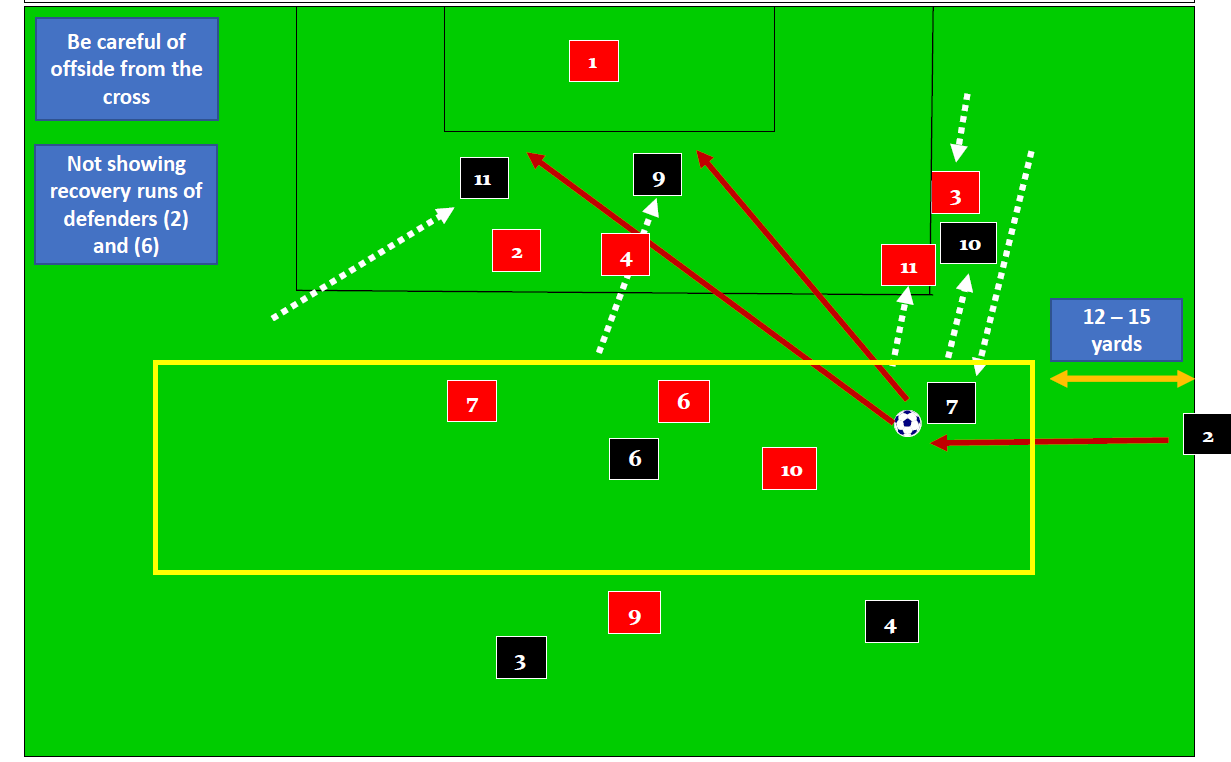
Not showing the dropping back of defenders just to show how we can develop this this shows how we can attack
with a right center back from back to front but still be covered at the back. If it breaks down (5) just drop backs into
(2)s position. Now a shot or cross is available to (5).

We lose it but it’s just a small adjustment to recover back
Simple adjustment if the move doesn’t work so nothing is lost with allowing this freedom of movement forward.
The good part is this type of attacking movement is NOT EXPECTED by opponents.

Opponents play 4-3-3 / 4-5-1
This is the attacking team shape (attacking “start position”) for a 3-3-1-3. Zone 14 is the area between the opponents back
three or four and their midfield.. Here we develop play through (5). (2) and (7) go touchline wide to open up space inside /
OR receive the pass wide. (5) has options, Pass wide, pass inside or run forward with the ball.





Central Goal Game
The game encourages playing from the back as the keeper can’t kick it long over the goals. Because of the unusual pitch lay out and goal positions it really makes the players think.
The following drill comes from the Soccer Awareness Training Center. Soccer Awareness Training Center provides unlimited access to Wayne Harrison's Soccer Awareness systems, training sessions, drills and more. Wayne's system helps develop world class youth soccer players and teams in a systematic and imaginative manner that guarantees performance at the highest level of competition. Whether you’re a beginning coach who needs help getting started or someone who wants to add some variety to their training sessions, the Soccer Awareness Training Center offers a wide variety of drills to choose from. Join Today
Organization:
- Pitch sizes: 40 x 20 – or at the discretion of the coach
- Number of teams: 2
- Team sizes: 4-6
- Bibs optional
- Goals: 5 a side or mini soccer goals

Progression: The big difference with this game is that the goals are positioned in the center of the pitch, back to back.
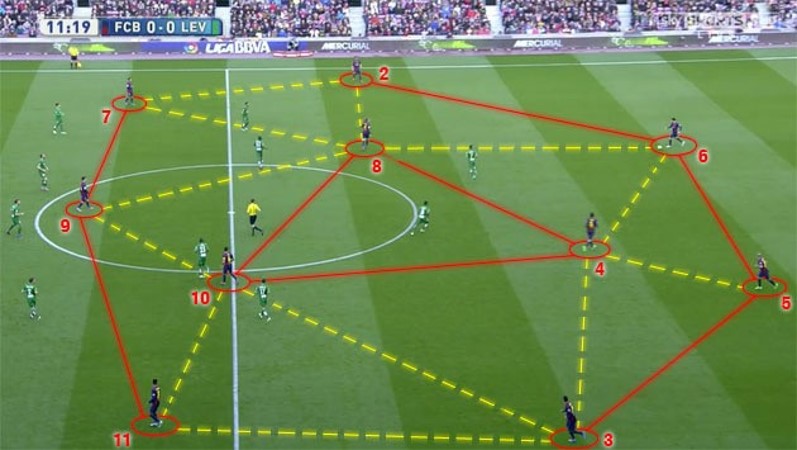
One team defends the goal that is facing south and score in the goal facing north. The other team does the opposite. You must have at least one player in each half at all times and you can’t kick the ball over the goals into the other half. The ball must be played around the goals. The game encourages players to take up wide positions so as to get around the goals. Players naturally form into a diamond shape with two players going wide, one attacking and one playing out of the back.
The game also encourages playing from the back as the keeper can’t kick it long over the goals. Because of the unusual pitch lay out and goal positions it really makes the players think.

Creating Space In A Small Sided Game Of 6 v 6
Here the players work to get free of their markers by their movement off the ball; they create space for themselves and / or for their teammates.
The following drill comes from the Soccer Awareness Training Center. Soccer Awareness Training Center provides unlimited access to Wayne Harrison's Soccer Awareness systems, training sessions, drills and more. Wayne's system helps develop world class youth soccer players and teams in a systematic and imaginative manner that guarantees performance at the highest level of competition. Whether you’re a beginning coach who needs help getting started or someone who wants to add some variety to their training sessions, the Soccer Awareness Training Center offers a wide variety of drills to choose from. Join Today
Here the players work to get free of their markers by their movement off the ball; they create space for themselves and / or for their teammates.

Coaching Points:
- Creating Space – Spreading out as a team.
- Decision – When, where and how to Create Space.
- Technique – of passing and receiving.
- Support Positions of players; angles and distances, movement off the ball.
In the above example (2) and (3) break wide to create space and offer two options to receive a pass from the keeper, (3) receives the pass and (4) runs off (C) to check back to receive the pass in space. (5) And (6) create space in front of the receiving player by making split runs to move (A) and (B) away from where (4) wants to attack and shoot at goal.
If either (A) or (B) do not track the two strikers and stay in the space in front to defend against (4) then (4) can pass to whichever play got free by not being tracked on their run.
54 Pages
We want to stay with our own game plan as closely as possible; based on what we practice and to keep it simple for us; as we dictate to our opponents; and we impose OUR WAY on them.
But there will be many occasions where we must change the system of play and we may have to adjust to suit the opponents.
Here are some ideas for you to consider for your team starting with the 13313 and 14231 systems of play.