Welcome to the Soccer Awareness Coaches Corner. Browse through soccer drills, small sided games, tactical thoughts, full sessions and a variety of resources. Posts marked “Training Center Exclusive” are for members only.

Off the Shoulder Movement and How to Combat It
(3) Watches the ball and allows the wide player (B) to get beyond him. A ball in behind always beats him. Centrally the centre back (4) does the same, he watches the ball and the striker comes off his shoulder and he gets caught with the ball in behind him. This will cost us in unless we work on it with the team.
This often goes wrong. Here’s how you can fix it.
The following is an excerpt from Soccer Awareness eBook 18: Identifying and Solving Common Game Situation Problems in the Training Environment.
This 38 page eBook shows a different way to look at the game, rather than highlighting what we need to do well, it shows what often goes wrong and how to fix it.
These are many very simple situations I have found that happen in many games.
How many of these problems do YOU experience with your team?
Off the Shoulder Movement and How to Combat It
(3) Watches the ball and allows the wide player (B) to get beyond him. A ball in behind always beats him.
Centrally the centre back (4) does the same, he watches the ball and the striker comes off his shoulder and he gets caught with the ball in behind him.
This will cost us in unless we work on it with the team.

Here striker (A) comes off the shoulder of (4) who stays central and the ball in played into the space beyond and behind him.
Likewise wide player (B) makes the same movement with the same end result.

This is the end product where we can get caught.
To counter this center back (4) or fullback (3) should drop off inside the space the ball is going to be played into.
Alternatively the whole back four can press up and leave them offside but this is risky if there is no pressure on the ball being delivered.

Get more like this in Soccer Awareness eBook 18: Identifying and Solving Common Game Situation Problems in the Training Environment.
This 38 page eBook shows a different way to look at the game, rather than highlighting what we need to do well, it shows what often goes wrong and how to fix it.




Teaching Movement “Off the Ball” Through the Transition Directional Target Game - Training Center Exclusive
With this session we are working on the following:
Creating Space by running off the ball to receive or to help a teammate receive.
Quality of Passing; long and short to targets and to teammates.
Support play: working angles and distances incorporating switching play using the side players.
Receiving and Turning in tight situations and dribbling in 1 v 1 situations.
Quick decision making is required in this session because the numbers are small, the area tight and the transitions rapid.
As a coach you can work in this session how to defend properly as individuals and a team or how to attack properly as individuals and a team.
*Membership Required
Rules:

50 x 40 area
Players must pass the ball to their target players to score. To score again they have to work the ball back into their own half of the field to be able to return.
Target players have two touches as do side players.
Coaching Points:
Creating Space by running off the ball to receive or to help a teammate receive.
Quality of Passing; long and short to targets and to teammates.
Support play: working angles and distances incorporating switching play using the side players.
Receiving and Turning in tight situations and dribbling in 1 v 1 situations.
Quick decision making is required in this session because the numbers are small, the area tight and the transitions rapid.
Develop:
No restriction on touches then 3, 2 or 1 touch, but only if it is on to do one touch.
All outside and target players have one touch only where possible
Switch with target players as they receive the ball.
Switch with outside players
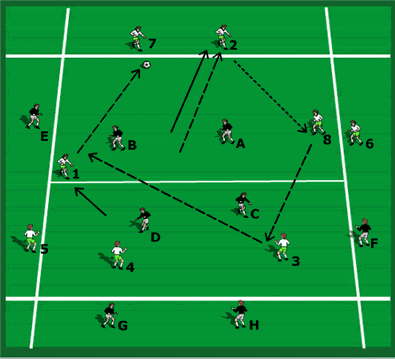
Here is an example of the transition and movement off the ball to make it happen.
(2) passes to target player (8) who brings the ball back into the playing area.
(3) makes a run into the other half of the field on the blind side of (C) to receive the next pass. They need to get the ball into that half to be able to score.
(1) makes a forward run into space to receive the next pass off (3) and passes to target player (7) who can start the play again.
(1) switches with (7) and becomes a target player for the next phase of play.
Observe the Attacking Team – Recognize their movement off the ball for example to work the ball into their own half see if the players make runs early in there as soon as the ball is at a target, some should support short and some long so the target has choices.
Observe the Defending Team – See if they are sucked to the ball or they recognize runs off the ball and track players making runs away from the ball into the other half. To lessen the workload and keep everyone involved have players switch with targets and outside side players when they pass to them.
Elements of play the target game teaches
Attacking as Individuals and as Team
Creating Space by running off the ball to receive or to help a teammate receive.
Developing quick support play working angles and distances incorporating switching play using the side players.
Passing long and short to targets and to teammates.
Receiving and turning in tight situations and dribbling in 1 v 1 situation’s.
Lots of touches on the ball for the players in this practice.
Quick decision making is required in this session because the numbers are small, the area tight and the transitions rapid.
Defending as Individuals and as a Team
Pressurizing players on the ball to regain possession.
Supporting pressuring players and tracking runners off the ball.
High pressure to regain possession in the attacking half to be able to go straight to the target to score.
We have transitions from defense to attack and attack to defense, quick decision making and improved concentration as the switch occurs. There are interchanges of positions between inside players, targets and side support players.
As a coach you can work in this session how to defend properly as individuals and a team or how to attack properly as individuals and a team.
Conditions to impose to change the focus of the game
No restriction on touches then three, two or one touch but only if it is on to do so.
Introduce neutral player so a 5 v 4 overload in the middle if possession isn’t kept easily.
Interchanges of players outside to in, inside to out as they pass the ball observing the quality of the pass and the first touch of the receiver or performing a crossover.
Have one teammate at each end so you are attacking both ends but once you have passed to one target you keep possession and must try to get to the other target. You can’t go back unless the opposition win the ball and then you get it back, only then can you go back to the same target.
To lessen the workload and keep everyone involved have players switch with targets and outside players when they pass to them. This causes a constant transition of players and focuses the player’s concentration.
The team can only score if they get an overlap, crossover or 1 – 2 in during the build up.
No talking so players have to rely on their own vision to play.
Players move into the target zone to receive (timing of run and pass) so we don’t play with actual targets, different players can then become the target player.
Man – Marking – Have the players man mark so they must track a player when they haven’t the ball and they must lose their marker when they have the ball. This is a good test to see who is working hard and who isn’t as they have a designated job to do. You as a coach can see who works to get free of their marker and who works hard to prevent the player they are marking get the ball.
This session is particularly good as a midfield play practice session as you can liken the start when the ball is at a target as it being a target defender passing it in and to get to the other side through midfield to the other target who is now a striker. Then this target player maintains possession and the team can go the other way, the target striker then becomes a defender for the attacking team starting the move and the other target becomes the striker to pass the ball to. So it is consistent movement end to end with the attacking team from a defender into midfield to a striker.
To improve the speed of thought reward a successful one touch pass with a goal or point. To score a goal by passing to the target player now reward this with three goals or 3 points.
The team in possession can pass back to the opponents target players to help keep possession of the ball. Liken this to passing back to the keeper in a game situation.

Individual Striker Movements Off the Shoulder Part 3
Striker moves “OFF THE SHOULDER” of the defender. Only a matter of a few yards can open up wonderful space and attacking opportunities.
This is part 3 of 4 on our Individual Striker Movements Off the Shoulder Series.
We are excited to provide you with one of our popular soccer coaching ebooks today... Learn the "Look and Think" Model Of Player Development which will get ever player on your team to think and act several steps ahead of play and think fast! Click here to download the popular Coaching Soccer Awareness E-Book FREE!

Striker moves “OFF THE SHOULDER” of the defender. Only a matter of a few yards can open up wonderful space and attacking opportunities.
In this case moving off the shoulder of the defender means there is a space in behind the defender that the player on the ball can deliver to (that was previously difficult to see and / or deliver into). If the defender does not adjust their position then this is a great chance to receive and attack the goal.
Striker is now:
- Facing forward, and off at an angle, not having to turn and run forward (saves time and puts the defender at a disadvantage).
- Can see the ball, the goal and the defender at the same time.
- Striker can even take their position off the sweeper (in terms of being offside) if the opposition employs one, so they are almost in advance but also wide of the marking defender. This position (off the shoulder) is very difficult to defend against.
- If not facing forward at least in a side – on position so they can see forward and not have their back to the defender.
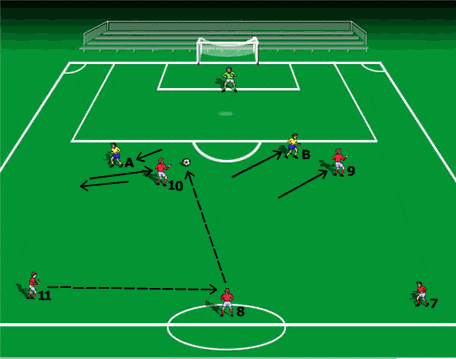
Striker moves “OFF THE SHOULDER” of the defender.
The defender comes with the striker and closes them down. Now the timing of the pass and timing of the run come into play. Striker then checks back inside into the space the defender has vacated and attacks inside and across in front of them. Striker (9) can run off the other center back (B) to create the space inside also. The player on the ball plays it inside the center back.
Also try to time it where as the defender in this case, plants their right foot down (and be flat footed even) so are leaning forward and towards the striker, that is the time to check back inside and across them. The defender is likely to be most off balance at this time, and that is the time to take advantage as they have to spring back on themselves and adjust their feet. It may give a valuable yard or two to the striker which can be the difference between a goal and not a goal.

Striker moves “OFF THE SHOULDER” of the defender.
Same as the previous diagram where the defender closes the striker down but this time the striker makes a run outside and behind the defender rather than inside and across them. Timing of this is important for being on side.
Timing the movement also as previously, when the defender is in an off balanced stance making it more difficult to check back in one movement and cover the strikers run.

Spacial Awareness Training Using Poles
These videos show players how to position in open spaces. We use poles positioned closely to each other to represent opponents and the team in possession must position between them in the best spaces possible.
Preview: These videos show players how to position in open spaces. We use poles positioned closely to each other to represent opponents and the team in possession must position between them in the best spaces possible.
We also have opponents we are playing against to position in between also to test players understanding of positioning off the ball.
Can start this without opposition, in other words, 2 or 3 teams each with a ball passing and moving using the poles only.
Then make it competitive.

Video: Soccer Awareness One Touch Training Drill
This is the first of a typical four part Soccer Awareness training drill. In this exercise, we are teaching players to scan the field and make decisions BEFORE receiving the ball while positioning themselves in passing lanes. There are three progressions of this drill that can be found in the Soccer Awareness Training Center.
Play faster, think faster; move faster through one touch play!
This is the first of a typical four part Soccer Awareness training drill. In this exercise, we are teaching players to scan the field and make decisions BEFORE receiving the ball while positioning themselves in passing lanes. There are three progressions of this drill that can be found in the Soccer Awareness Training Center.
Soccer Awareness has partnered with Edufii to provide unlimited access to Wayne Harrison's Soccer Awareness systems, in a private mobile TrainingSpace, where Wayne will share his training processes, answer your questions and collaborate with other coaches at all levels.
Wayne's system helps develop world class youth soccer players and teams in a systematic and imaginative manner that guarantees performance at the highest level of competition.
JOIN OUR TEAM

Coaching Video: Movement off the Ball
Here is new video coming from Soccer Awareness and Wayne Harrison. This segment is from the 2007 NSCAA Soccer Coaching conference. A great segment of soccer awareness training and movement of the ball. A must see for any level coach!
Here is new video coming from Soccer Awareness and Wayne Harrison. This segment is from the 2007 NSCAA Soccer Coaching conference. A great segment of soccer awareness training and movement of the ball. A must see for any level coach!
54 Pages
We want to stay with our own game plan as closely as possible; based on what we practice and to keep it simple for us; as we dictate to our opponents; and we impose OUR WAY on them.
But there will be many occasions where we must change the system of play and we may have to adjust to suit the opponents.
Here are some ideas for you to consider for your team starting with the 13313 and 14231 systems of play.