
This is part 3 of 4 on our Individual Striker Movements Off the Shoulder Series.
We are excited to provide you with one of our popular soccer coaching ebooks today... Learn the "Look and Think" Model Of Player Development which will get ever player on your team to think and act several steps ahead of play and think fast! Click here to download the popular Coaching Soccer Awareness E-Book FREE!

Striker moves “OFF THE SHOULDER” of the defender. Only a matter of a few yards can open up wonderful space and attacking opportunities.
In this case moving off the shoulder of the defender means there is a space in behind the defender that the player on the ball can deliver to (that was previously difficult to see and / or deliver into). If the defender does not adjust their position then this is a great chance to receive and attack the goal.
Striker is now:
- Facing forward, and off at an angle, not having to turn and run forward (saves time and puts the defender at a disadvantage).
- Can see the ball, the goal and the defender at the same time.
- Striker can even take their position off the sweeper (in terms of being offside) if the opposition employs one, so they are almost in advance but also wide of the marking defender. This position (off the shoulder) is very difficult to defend against.
- If not facing forward at least in a side – on position so they can see forward and not have their back to the defender.
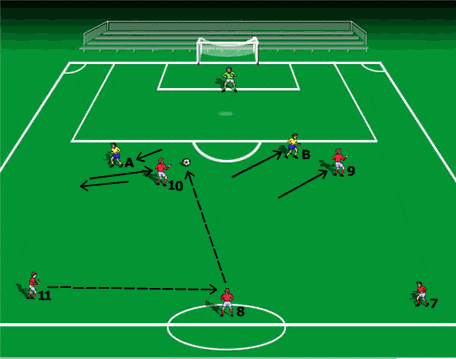
Striker moves “OFF THE SHOULDER” of the defender.
The defender comes with the striker and closes them down. Now the timing of the pass and timing of the run come into play. Striker then checks back inside into the space the defender has vacated and attacks inside and across in front of them. Striker (9) can run off the other center back (B) to create the space inside also. The player on the ball plays it inside the center back.
Also try to time it where as the defender in this case, plants their right foot down (and be flat footed even) so are leaning forward and towards the striker, that is the time to check back inside and across them. The defender is likely to be most off balance at this time, and that is the time to take advantage as they have to spring back on themselves and adjust their feet. It may give a valuable yard or two to the striker which can be the difference between a goal and not a goal.

Striker moves “OFF THE SHOULDER” of the defender.
Same as the previous diagram where the defender closes the striker down but this time the striker makes a run outside and behind the defender rather than inside and across them. Timing of this is important for being on side.
Timing the movement also as previously, when the defender is in an off balanced stance making it more difficult to check back in one movement and cover the strikers run.


The book that started it all — now in a clean, modern edition.
Wayne Harrison began teaching scanning and awareness in 1996, long before it became the most talked-about subject in the game. This is his complete Awareness Coaching Method: how we teach young players to scan, think and decide ahead of receiving the ball — to see their options BEFORE the ball arrives.
Inside, across six chapters:
- Chapter One — Introduction to the Book: areas of awareness, one-touch play, and the decision-making thought process of the player about to receive the ball
- Chapter Two — Developing the Link Between Foot and Body Positioning Leading to the Awareness of Options
- Chapter Three — An Introduction to Awareness and Individual Technical Skills
- Chapter Four — The Thought Processes and Physical Actions Involved in Awareness
- Chapter Five — The Awareness Coaching Method and "Themed" Small Sided Games
- Chapter Six — Developing the Awareness Coaching Method Through "Themed" Team Games
With a foreword by Rene Meulensteen, First Team Coach at Manchester United. This is one of the two books José Mourinho wrote back to Wayne about.
Every word is Wayne's own, exactly as he wrote it — only the presentation is new: clean layout, a KEY POINTS box at the end of every clinic (46 boxes, each lifting that clinic's own coaching points word for word), bullet lists, and 300 session diagrams, so a coach can pick it up and use it on the training ground the same day.
391 pages. Instant PDF download after purchase.