Welcome to the Soccer Awareness Coaches Corner. Browse through soccer drills, small sided games, tactical thoughts, full sessions and a variety of resources. Posts marked “Training Center Exclusive” are for members only.

Soccer Awareness: Basic Principles of Development (One Touch Play)
Linking foot preparation, body position and mental preparation to the technique involved in making a one touch pass leads us to a discussion on one touch play and its benefits.
One touch play teaches the value of being able to take your eye off the ball when keeping your eye on the ball can be a disadvantage.
To make this work, players need to have good teamwork and positional sense and therefore must work hard for each other.
This article is the intro to Wayne’s eBook 16: Soccer Awareness “One Touch” Training Developing its Relationship with Movement Off the Ball. Get the full book.
The Importance of Teaching One Touch Play: Improving One Touch Play
Maintaining an Awareness of What Is In Advance and Beyond the Ball
Linking foot preparation, body position and mental preparation to the technique involved in making a one touch pass leads us to a discussion on one touch play and its benefits.
One touch play teaches the value of being able to take your eye off the ball when keeping your eye on the ball can be a disadvantage.
To make this work, players need to have good teamwork and positional sense and therefore must work hard for each other.
A Gradual Training Introduction: Training the Psyche of the Players through One Touch Play
Introduce the training in a gradual way; don’t jump straight into a scrimmage. Set it up so it is easy to do initially. For example, one touch passing in two’s. Here, no great amount of awareness is needed because they are facing each other, but they must look into each other’s eyes and not at the ball. This is teaching them to get their heads up, and is the first most basic stage. It is also working on the pace and direction of the pass, getting foot sensitivity started in terms of that first touch on the ball that is now in effect a pass.
Then move to groups of three where a little more peripheral vision is needed. Then ask them to pass and move in a small area.
Next, add more players so there are more passing options and more awareness is needed. Now introduce the Numbers Game, passing in sequence; this really starts to introduce the awareness concept, but with one touch only.
Communication: Good communication is a must, so have players talk to each other, passing messages on to help each other all of the time.
Also, have them do this without any verbal communication as they then have to rely on themselves alone and in games. Unfortunately as much as we try, this very often happens anyway.
So do this WITH communication and WITHOUT communication. Even compare the two, some may get so good at this they can work it out for themselves most of the time as their peripheral vision improves.
So practice one touch with your team, then play games / scrimmages with your team and insist on it being ONE TOUCH ONLY.
There will be times when 2 touches are needed but do not allow it. Force the error if need be by insisting on one touch only.
Example: A player does not get his feet ready to receive and as a result does not make correct contact with the ball and possession is lost. Everyone can see that his feet were the problem, especially the player involved, and this will register in his mind for the next time.
Example: The ball is passed too heavily and quickly (pace and timing of the pass is wrong) and the receiver needs a touch to control the pass initially and then make a 2nd touch pass to keep possession. That is the passer’s fault, not the receiver’s; and they will learn that from this single pass. It is likely that a one touch play at this moment will not work, which is fine, because this will help them learn why it didn’t work for the next time.
Example: No teammates move to give the player receiving the ball an option to pass it one touch.
This is the fault of the player or players off the ball and not the receiving player, but you must insist it is passed one touch still so they pass it into the space the player should have moved into. Again, this will probably result in giving the ball away, but they will learn from that.
The players will recognize if possession was lost because there was not enough support off the ball, the pass was too heavy, or if it was the fault of the player’s first touch if there were options off the ball.
When you first do it, particularly in a competitive scrimmage situation whether within your own team training or against another team, you may find it is incredibly ugly play; the players will more than likely really struggle with it (or maybe not, they may surprise you).
And it may be ugly for quite a while; but just let it go.
Do not be disheartened and don’t let your players get discouraged. And do not coach, just let them play and work it out for themselves. Tell them you expect it to go wrong more than go right to relax them about it...
They will find with practice that they need to adjust the weight of the pass to help the next player, so foot sensitivity in passing will improve.
They will learn this through their own trial and error, not necessarily just what you tell them.
Get eBook 16: Soccer Awareness “One Touch” Training Developing its Relationship with Movement Off the Ball. This 103 page eBook explores one touch training and movement off the ball and includes 90 pages of drills that you can do with your team. Table of contents is below.
One Touch Training: Teaches the player WHEN to play one touch; and when NOT to play one touch. We are teaching players to have a ONE TOUCH MENTALITY. A One touch mentality teaches players to recognize the best options; and therefore make the best DECISIONS; BEFORE and in ADVANCE of receiving the ball.
Movement OFF the ball: This mentality conditions the mind of players OFF the ball to position and move to help the player who is receiving the ball. This means we want players to always; at every moment; THINK: “I only have One touch”; therefore this will force players to always do what I call the “LOOK and THINK” before they receive the ball to see several options and pick out their best option, which may actually be to DRIBBLE!!
When you use these training sessions consistently you will see the development of that relationship between having a ONE TOUCH mentality and Movement OFF the ball.
So in a nutshell:
LOOK (before receiving the ball);
MOVE (find space off the ball based on positioning of teammates and opponents):
THINK (what is my best option?):
EXECUTE (the Decision; or the SKILL Factor).



Passing Game for Spatial Awareness Development
Players have the ball at their feet for approximately 5 minutes out of 90. What do they do the rest of the 85 minutes? They must learn to move off the ball and to move into open passing lanes to be open at all times to help the player on the ball or the next player on the ball. Here is a great session to teach this.
We can use many upright cones to represent opponents rather than mannequins. We set the cones up in triangles and diamonds. We ask players to position between the cones in the best space available. Try to balance their position to find the best space in the middle of the triangle or diamond of cones (opponents). Players beyond the ball try to position in triangles and diamonds of support also.

The following is an excerpt from Soccer Awareness eBook 16: Soccer Awareness “One Touch” Training: Developing its Relationship with Movement Off the Ball.
This 103 page eBook explores one touch training and movement off the ball and includes 90 pages of drills that you can do with your team.
Passing Game with Cones for Spatial Awareness Development using Mannequins or Cones in Training for Movement Off the Ball
Players have the ball at their feet for approximately 5 minutes out of 90. What do they do the rest of the 85 minutes? They must learn to move off the ball and to move into open passing lanes to be open at all times to help the player on the ball or the next player on the ball. Here is a great session to teach this.

Getting into passing lanes to help each other
We can use many upright cones to represent opponents rather than mannequins. We set the cones up in triangles and diamonds. We ask players to position between the cones in the best space available.
Try to balance their position to find the best space in the middle of the triangle or diamond of cones (opponents). Players beyond the ball try to position in triangles and diamonds of support also.

OBJECTIVE: To improve movement off the ball by providing mannequins to act as opponents to fill important space
A non-directional training practice
Mannequins represent opponents on the field. They fill important spaces so the players need to pass and move around and between them. This ensures players move off the ball to help the player on the ball have as many options as possible for a pass. The goal of the players is to find as much space as they can between the mannequins to give themselves as much space as possible to play in.
Every now and again stop the practice and see where the players are positioned. Are they in free space? Are they too close to a mannequin and hence in a game situation not available for a pass? If they are then ASK THE PLAYERS to SHOW you a better position to be in.
Possible problems here are the positioning of players behind opponents so the player on the ball cannot see them to pass to.
Develop:
Restrict the number of touches on the ball to 3 touches, two touches then one touch; if it is on to do so. To enable one touch to be possible movement off the ball has to be intelligent, fast and into space to help the passer play one touch. Thinking AHEAD of the ball arriving is paramount here otherwise one touch play cannot be performed successfully. Try to think two moves ahead. Movement OFF the ball by others is paramount here also otherwise the person receiving the pass will not be able to play one touch successfully.
Play the Numbers Game: 1 passing to 2, 2 to 3, 3 to 4 and so on. Increase the number of balls being used.
Two teams playing in the same area with a ball each. Now players need to avoid the other team AND the mannequins to find space to receive the pass.
Coaching Points:
Thinking and looking before receiving of the receiving player so they have assessed their options before receiving and in advance of the ball
Ability to play ONE touch if possible for speed of play
Movement OFF the ball of teammates to help the player on the ball
Movement INTO spaces between and around the mannequins to enable this to happen using the mannequins as guides.
Thinking TWO moves ahead to support.
Playing in triangles of support offering several options for the player on the ball in many directions.
An exaggerated situation but this shows what happens when players do not move to space to help the player on the ball; and do not open up the angle for a pass, instead standing behind an opponent and not being free to receive. How many times do you see this?
To defeat this problem; the player on the ball can pass to a space hoping that this will force the receiver to move to that space to receive the ball. Then the weight; timing and accuracy of the pass has to be particularly good; but this is not ideal.
Whilst players can still be successful with later movement off the ball of supporting players; if the player on the ball hastime on it to take more touches; it is always better to provide options of a pass as early as possible to increase speed of play and give opponents less time to work out their movements.
Working in threes
Here showing possible passing routes with each group of three players also showing how they get free and into as much space as possible, based on the positions of the mannequins who act as opponents filling spaces.
Different colors to pass to in order to develop color coordination.

Game situation
Have players passing in two teams to begin as a warm up, with a ball each team, then two and three balls each team. Then they pass to opposite colors only.
Now play a 6 v 6 (or any number you like) and make it a possession game. Mannequins make it more difficult by filling spaces so players have to play around them as well as their opponents. This should improve them playing in tight situations.
Use a 2 player overload if required initially until they get really good; then make it equal numbers each team, you dictate this based on the ability of your players. Of course change the numbers of touches on the ball decreasing the number as they become proficient to increase the difficulty.

The focus is again passing and movement off the ball to receive with as many players as possible offering an option of a pass for the player on the ball.
Here we show potential positioning of players in the biggest spaces they can find between the mannequins.
More space means more time to play on the ball so the player has the choice to play quickly or not; also depending on the individual situation presented; and often dictated to by the support positions of his teammates.
Develop: Have two teams playing through each other avoiding each other and also avoiding the mannequins. This is now a big challenge to each player on the field where there will be less space to play in and their peripheral vision will really be tested to its fullest.

Game Situation
Try an overload first of all maybe a 9 v 4 building it up to a full game. This is a big challenge meaning fewer spaces to play in and forcing more movement off the ball to support each other.

Here is a great video of FC Barcelona YouTube showing how this works.
Get more like this in Soccer Awareness eBook 16: Soccer Awareness “One Touch” Training: Developing its Relationship with Movement Off the Ball.
This 103 page eBook explores one touch training and movement off the ball and includes 90 pages of drills that you can do with your team.

A Rondo Overloading Players In The Zone 14 - Training Center Exclusive
This Rondo is perfect for a starting point on rotation and movement in front of opponents defense. Teams may work out that we are good at playing penetrating passes and making great runs in behind them so the way to try to stop this is to defend deep.
If they defend deep we need a tactical solution to counter this. This presentation gives you ideas on how to do this and play initially IN-FRONT of the opponents back four.
Bayern Munich and Barcelona are very good at this, both motivated and taught by Pep Guardiola.
Soccer Awareness Training Center members can download this full 20 page session below.

This Rondo is perfect for a starting point on rotation and movement in front of opponents defense. Teams may work out that we are good at playing penetrating passes and making great runs in behind them so the way to try to stop this is to defend deep.
If they defend deep we need a tactical solution to counter this. This presentation gives you ideas on how to do this and play initially IN-FRONT of the opponents back four.
Bayern Munich and Barcelona are very good at this, both motivated and taught by Pep Guardiola.
We can do it at our age level just as effectively. We can practice this in a tight area, with the relevant players in their usual positions in the attacking third and just play possession as a warm up.
Lots of repetition in training to embed the ideas in the players minds.
Setting Conditions To Make It Work
We overload zone 14 as shown. Condition the back four to not be able to go past the blue cones to keep them defending deep. Condition the attacking players to stay inside the Zone 14 orange coned off area so they MUST condense and get tight and get close to each other.

Getting Shots In On Goal
Again short and sharp build up, good positions in tight spaces between opponents and movements OFF the ball to get free to get into a shooting position. Other players follow in for rebounds but time it so they are not offside. Typical Messi run.

Overloading Players In Front Of The Opponents Two Center Backs
We want to overload Zone 14 in the center of the field by maintaining two wide players so there is an option to play wide. The idea is to get up in numbers in front of the two center backs. If the fullbacks tuck in to help as they have here and equal the numbers up then we can go wide to (2) and (11). Here a 3 v 2 centrally. (A) and / or (D) may tuck in but this frees up (11) and (2) wide.

This can be one full session practicing playing short and tight and with quick 1 and 2 touch play. Players must move subtly to get into open very tight passing lanes between opponents.
Play quickly.
Soccer Awareness Training Center Members can download this 11 page eBook for free below. Now a member? See all the benefits of joining here. Try a monthly membership for free.

Ball Control and Dribbling Skills Ideas
Dribbling is a ball skill that's crucial in soccer. The best soccer players in the world can control the ball when sprinting at full speed and avoiding defenders. Better dribbling skills allows players to create space and time and therefore better control the ball and make plays. Here are two drills you can add to your practices to improve your teams dribbling skills.
The following two drills come from eBook 27: Dribbling Technique and Skill for U6 to U9. This eBook includes drills and teaches technique that you can use in practice to help your team perfect their dribbling. You will learn different techniques to control the ball, specific dribbling moves, awareness dribbling work, dribbling for possession and more than 50 pages of drills that you can use with your team.
Wayne Harrison has put together this collection of dribbling drills from his wealth of knowledge at the highest levels of the game both as a professional player and professional coach. Find Out More
He Says She Says

Emphasis: Ball control and motor skills
Set-up: Use the penalty box or the center circle. Grid size depends on the number of players. Each player has a ball.
Objective: The players must follow the instruction of the coach. For example, if the coach shouts “touch the ball quickly side to side”, then the players must do so. Complete 10 commands successfully and then stretch for a minute. Repeat using different commands.
Progression:
Tap the top of the ball with the bottoms of your feet, alternating feet each time.
Jump over the ball.
Hop around the ball.
Skip around the ball.
Toss the ball up, hit it with your head, and catch it.
Use the bottom of your foot and move it in a circle.
Kick the ball in the air, turn, and catch it.
Coaching Points:
Get the touches right.
Don’t run into anyone.

Indianapolis 500

Emphasis: Dribbling, ball control
Set-up: Set up a 15x20 yard grid (race track). Place all of your players in the grid with a ball.
Objective: The players must not crash into the cones (rails). If the players (collide) with each other or the cones (rails), they must go outside the grid, and do fast footwork with the ball. For example; toe touches on the ball, quick passes side to side, or quick turns with the left and right foot. The players (cars) must obey the coaches (race director) shout. “Shift gears”-change directions, “red flag”-stop the ball, “blue flag”-stop the ball with the knee, “yellow flag”-dribble slower, and “green flag”-accelerate to top speed.
Progression:
Make the grid smaller and more congested.
Players must only use the left foot only.
Coaching Points:
Keep the ball close to your body.
Concentrate on change of direction away from pressure (other cars).

Defensive Pressing to Push Up Without Touching the Ball
This is a great session to teach the players and shows how they can push opponents back even when THE OPPONENTS have the ball. We will try to push them back without even touching the ball ourselves. We start on the edge of our box we try to get our back three up to the half way line. Set Conditions will help us do this to start the process off.
This is part two of a full session on defensive pressing from the Soccer Awareness Training Center. In this session we are developing play from the back with inverted runs into "No Mans Land" central areas. Get the full series and more than 500 other drills and full training sessions in the Soccer Awareness Training Center.
This is a great session to teach the players and shows how they can push opponents back even when THE OPPONENTS have the ball.
We will try to push them back without even touching the ball ourselves. We start on the edge of our box we try to get our back three up to the half way line. Set Conditions will help us do this to start the process off.
Conditions:
Defending team cannot tackle.
Defending team CAN intercept a pass.
Attacking team must play 1 or 2 touches due to the fact defenders cannot tackle so opponents cant dribble 1 v 1.
Coaching Points:
Defenders press the ball as quickly as possible.
Try to stop the forward pass, try to force a pass across the field or backwards.
Defenders must recognize every opportunity to push up no matter how small a distance it may be.
Sometimes its 5 yards up 3 yards back for example depending on the position of ball and if there is pressure on it.
Try to intercept the pass and gain possession.

This session is teaching defenders how to push up and force the opponents back without touching the ball. The goal is to start on the edge of the box, the opponents have possession but by pressing and pushing up at the right times we force opponents back. Our aim is to get our back 3 up to the half way line. So this is moving approximately 40 yards up the field.
Start with equal numbers so success can be achieved.

v 7 plus the keeper. Set conditions are introduced to help the session. Coach to (E) and (10) presses to try to stop a forward pass. Defending team may sneak up 2 or 3 yards if (1) can delay.
Sliding up and across the field

(10) forces the sideways pass and this can also result in a pushing up a few yards from the back as well as pressing the ball. The coach is the target for the defending team to play to when they win the ball plus is a support player for the attacking team.
The longer the arrows the greater the distance travelled up the field each time

(3) Presses so well (B) has only a back pass to make. (8) and (10) are in passing lanes to stop a forward pass with an interception potentially. (3) positions to stop a pass to (A). As the ball travels this gives the team a real chance to get up several more yards. A the same time leave (E) offside.
Danger from a first time delivery from the coach to (A) or (C).

(10) Does not press the coach to then be out of position as the coach is too far away to stop a delivery. (3) presses inside to press (G), (8) moves up and across to press (F). If the coach passes to (D) then (2) can slide across quickly as will (8) and (10).

(E) is still offside but not interfering with play. (A) and (C) move wide to find more space and the coach plays to (C). The defending team now need to drop back and across and lose some ground. Midfield three condense back and across to where the ball is. Back 4 try to leave (E) offside still so don’t recover all the way goal-side. But still in good defensive shape.

Directional Awareness Four Team Passing Game - Training Center Exclusive
Objective: Awareness of Teammates and Opponents Positioning on the Field in Advance of Receiving the Ball
We are working on: When and where to pass, Looking before receiving, Awareness of player positions before receiving the ball, Awareness of options on the ball before receiving it, Awareness of Opponents positions before receiving the pass and Maintaining possession of the ball
*Membership Required
Objective:
Awareness of Teammates and Opponents Positioning on the Field in Advance of Receiving the Ball
Coaching Points:

When and where to pass (timing, accuracy, weight)
Looking before receiving
Awareness of player positions before receiving the ball
Awareness of options on the ball before receiving it
Awareness of Opponents positions before receiving the pass
Maintaining possession of the ball
Rules:
Warm Up:
Two balls per inside team (or more). (2)’s pass to (1)’s and (4)’s pass to (3)’s. The two groups work across each other. Four teams working but in pairs.
Directional session now working across each other, needing to know where their teammates are but also where the other numbered players are in the middle. This improves awareness and the peripheral vision of the players.
A good lead in to everyone being free in the area and passing and moving later.
Players need to look before they receive, see what the options are in advance of the ball.
Progressions:
Passing in straight and / or angled lines
Running in straight and / or angled lines
Mixing the two up
Players pass to the end players only, to begin transferring the ball from one side to the other. If both players on the other side have balls at their feet then liken it in a game to the strikers being marked and you have pressure on the ball preventing a forward pass so you have to go back to where you came from, either to the other player you did not receive the pass from or back to the same player.
Passing inside the area to team mates in the buildup not just to the outside players.
Introduce give and go’s with outside players (players then keep the same ball throughout a set time period)
Switching positions with the outside
Passing inside the area first then outside
Outside players can pass to each other on the same side the ball moving and keep the inside players alert as to where the ball is.
Outside players switch positions with and without a ball, if without the ball then they are now moving targets as it would be in a game.
All players communicate with each other to help make each movement and pass successful (above as (4) receives the pass, (3) calls to let him know they are free to receive the next pass.
Ask inside and outside players to pass to space to move players into better positions to receive the pass.
Liken To Working Through The Thirds Of The Field (Defender To Midfielder To Striker And Back)

Above; (2) passes to space to move outside player (1) to receive. (3) Passes to space to move (4) into the path of the pass. (4) And (1) respectively can help (2) and (3) by pointing to where they want the ball if they identify the space to pass it to first.
Where is the space to take my next touch (if it open it could be towards the player they are about to pass to), or can I pass it one touch to (3) on the other side?
Already as this pass is coming in to (3) another (4) player is looking to support the next pass going back.

Competitive: The Game Situation
One ball only. Now we take the session into a game. (2)’s play against (4)’s. It is a 4 v 4 game.
(2) work with (1)’s on the outside and score by completing a pass to the outside players. They then have to get the ball to the other side to score again. (4)’s work with the (3)’s on the outside so teams play in opposite directions. Play to 10 goals then rotate the players so the (1)’s play against the (3)’s. Rotate the teams so the (1)’s play against the (2)’s and the (3)’s against the (4)’s. Here the number (4) team have scored one goal at one end then switched the play to the other end by quick accurate passing to score another goal.
The set up is designed to make it easier to maintain possession because they are going both ways and it is much more difficult to defend against. Players who give the ball away cheaply get punished because of this as it may be a while before they can win it back due to the set up so everyone has to stay focused.

Outside player’s one touch, inside players two or three touch restriction. This forces players to use their awareness to be successful. Outside player has only one touch so as the ball is traveling to them the inside players know this and need to get in position to support early. Player passing to the outside player knows they only have one touch so the weight of the pass must be right.
Progression: To score the player passing to the outside player cannot be the player to receive it back immediately. If they do they maintain possession but it is not a goal. This means at least one other player MUST get into a support position to help the outside players pass (and score a goal).
Progression: the first outside player receiving has to pass to the second outside player, then the inside players have to position and work an angle of support off of the 2nd player.


Off the Shoulder Movement and How to Combat It
(3) Watches the ball and allows the wide player (B) to get beyond him. A ball in behind always beats him. Centrally the centre back (4) does the same, he watches the ball and the striker comes off his shoulder and he gets caught with the ball in behind him. This will cost us in unless we work on it with the team.
This often goes wrong. Here’s how you can fix it.
The following is an excerpt from Soccer Awareness eBook 18: Identifying and Solving Common Game Situation Problems in the Training Environment.
This 38 page eBook shows a different way to look at the game, rather than highlighting what we need to do well, it shows what often goes wrong and how to fix it.
These are many very simple situations I have found that happen in many games.
How many of these problems do YOU experience with your team?
Off the Shoulder Movement and How to Combat It
(3) Watches the ball and allows the wide player (B) to get beyond him. A ball in behind always beats him.
Centrally the centre back (4) does the same, he watches the ball and the striker comes off his shoulder and he gets caught with the ball in behind him.
This will cost us in unless we work on it with the team.

Here striker (A) comes off the shoulder of (4) who stays central and the ball in played into the space beyond and behind him.
Likewise wide player (B) makes the same movement with the same end result.

This is the end product where we can get caught.
To counter this center back (4) or fullback (3) should drop off inside the space the ball is going to be played into.
Alternatively the whole back four can press up and leave them offside but this is risky if there is no pressure on the ball being delivered.

Get more like this in Soccer Awareness eBook 18: Identifying and Solving Common Game Situation Problems in the Training Environment.
This 38 page eBook shows a different way to look at the game, rather than highlighting what we need to do well, it shows what often goes wrong and how to fix it.

Quick Break Transition 2 v 2 Game
A 2 v 2 game going to 4 goals. The team who scores stays on and must quickly defend the 2 new players coming in. We are working on Quick break and counter attack, Quick one and two touch passing and Positioning to open up passing lanes and getting between defenders to pass the ball in early.
The following session is an excerpt from “Soccer Awareness Coaching Curriculums presented by Game Sizes: 4 v 4, 7 v 7, 9 v 9 through to 11 v 11”
This eBook covers up to 14 weeks of training for each game size presented as one session per week. All sessions have small sided games scrimmage set ups as close as we can get it to finish to reflect the theme of the session As the program moves from 4 v 4 through to 11 v 11 the focus changes from individual teachings at 4 v 4, to small sided situations at 7 v 7, to Phases of play and tactical needs at 9 v 9; through to team tactical development at 11 v 11. 11 v 11 focuses on advanced training ideas to teach the “team”.
1. A 2 v 2 game going to 4 goals. The team who scores stays on and must quickly defend the 2 new players coming in (one from each goal that the opposition defends).
Instant transition with the same ball that the opponents scored with, here (3) and (4) are positioned to immediately bring the ball the opponents’ may score with out to attack. The other two players (1) and (2) must get off the field ASAP.
The 1st thought of the player on the ball has to be “Can I score?”
The 1st thought of the 1st defender is can I stop them scoring, win possession immediately, and score myself. First team to 10 goals wins, keeping the competitive element.

Coaching Points Attacking:
Quick break and counter attack
Switching the point of attack if another goal is more open
Quick one and two touch passing
Positioning to open up passing lanes and getting between defenders to pass the ball in early
Creating 2 v 1 situations from a 2 v 2 set up and setting up a give and go.
Coaching Points Defending:

Instant pressure as possession changes (transition after scoring going from being an attacker to being a defender)
Regaining possession at the front with a scoring reward
Getting in front of the passing lanes to prevent the quick pass into the goal.
Working together with pressure and support, the support player supporting the first defender, stepping across and covering the passing lane to the second goal and also keeping an eye on the 2nd attacker.
Transition Coaching Points:
Immediately the team that has been in possession of the ball and has scored then they must switch on mentally to become defenders and high pressure the new attacking team to try to win the ball back.
Develop:

Allow back passes to the players in their own goal so they can support the two (or three) attacking players on the ball.
Allow them only one touch so they have to pass it quickly, make a quick decision and players receiving all need to get open to help them.
Vary the number of touches on the ball depending on the age and level of the players and their ability to perform.
Quick transition 3 against 3
Do the same set up but with three goals either side of the field and 3 v 3 games.
It offers more options of passes in the field of play and starts to get the players thinking about triangular support or diamond support if the ball is with a supporting player off the field. A diamond set up.


Three Team Awareness Game with Measured Outcomes
With these drills our players are developing awareness of where the player they receive from is and where the player they pass to is. Because of this players begin to anticipate the pass to them and where it is coming from. Also they must look to where it is going to (where is the player they are passing to?). We are trying to create a situation where players are looking two moves ahead not just one.
Non – Competitive Awareness Numbers “Game” With Teams: Passing in Sequence
Divide the players up into three teams

30 x 30
Using 3 teams. Within each numbered team each player is numbered off. Teams (1) and (2) work together (with two balls) and team (3) works alone (with one ball). Players must pass in sequence i.e. with teams (1) and (2) working together 1 passes to 2; 2 passes to 3; 3 to 4 and so on up to 8 who passes to 1 and we begin again whilst team (3) players pass 1 to 4.
Awareness of: where the player you receive from is and where the player you pass to is. Because of this players begin to anticipate the pass to them and where it is coming from. Also they must look to where it is going to (where is the player they are passing to?). We are trying to create a situation where players are looking two moves ahead not just one.
For instance as (1) is about to pass to (2), (3) should be looking to support (2) for the next pass already, looking two moves ahead before the ball leaves (1).
Peripheral Vision Development results from this.
Develop: Reduce the number of touches players are allowed each time they receive a pass, all in free play to begin, then three touch, then two touch then one touch if it is on to do so. This speeds up the decision making process and forces them to look earlier as to where they are passing to.
Semi – Competitive Awareness Numbers Game: Passing in Sequence


Coaching Points:
There are many things that the player needs to process before they even touch the ball involved in this. The breakdown is:
Good Footwork to receive the ball; which in turn helps the first touch
Taking a look around for all options to increase their peripheral vision
An open body stance to be able to change the direction of play if needed
Communication from the player about to receive the ball to teammates; and from teammates to that same player to help him or her recognize the options available
Then the first touch occurs.
An Open body stance is needed to allow a yard or more extra space away from defenders by letting the ball run across the body into preconceived space.
Looking before receiving to know in advance of the receiving pass; where the defending players are, where the space is, where team mates are free to receive a pass, how many options there are to move the ball on.
Movement OFF the ball is a priority both to receive it and after passing it.

The Three Zone Directional Game - Training Center Exclusive
This game is based on possessing the ball and the movement off it.
We have several progressions we can use to challenge the players these include:
A simple Warm up to get the idea going
Playing through the thirds with targets
Playing through the thirds without targets
Players must stay in their own thirds so we have 3 combination games going at once
We can add free players therefore creating overload situations
More!
*Membership Required
This game is based on possessing the ball and the movement off it.
We have several progressions we can use to challenge the players these include:
A simple Warm up to get the idea going
Playing through the thirds with targets
Playing through the thirds without targets
Players must stay in their own thirds so we have 3 combination games going at once (e.g. 3 v 3, 2 v 2 and 3 v 3 per zone or whatever numbers of players you have).
We can add free players therefore creating overload situations to make it easier for success competitively and to build confidence initially.
No free players to increase the pressure and the challenge.
Players can rotate between zones now. This is more game related in what we want to teach with players have freedom to interchange as long as they are covered by a team mate.
Add a condition to help improve / focus on body position and footwork: If a player faces backwards when receiving the ball they MUST pass that ball backwards and with only one touch allowed.
Man for man marking; 1 v 1s all over the field and in all three zones. Players in possession can rotate and move around their immediate marker has to follow them.
Touch restriction: Unlimited, then 3 then 2 then 1 touch if on to do so.
All through remind players that they MUST scan the field, must check their shoulders for options; to the side or behind them and not just see in front of them.
Use the yes and no check system to highlight for each player if they looked AWAY from the ball before receiving it.
Can play a longer pass from one end zone to another and missing out the middle third if that’s the best option.
Remember Xavi: In 90 Minutes looked AWAY from the ball 841 times. Amazing.
Joke about only needing half a touch to emphasize the importance of this mental skill.
Add goals at each end include keepers (who should have been in the game anyway for their footwork skills) and make it a game situation whatever the numbers are.
3 Zone Game: Playing Through the Thirds with Targets

4 ball warm up. Three zones, 3 v 3, 2 v 2 and 3 v 3.Players are passing and maintaining possession. Condition it to 1 or 2 touches on the ball to challenge the players. Players stay in their own zones initially. Play to the targets.
3 Zone Game: Playing Through the Thirds Without Targets

4 ball warm up. Three zones, 3 v 3, 2 v 2 and 3 v 3.Players are passing and maintaining possession. Condition it to 1 or 2 touches on the ball to challenge the players. Players stay in their own zones initially.
3 Zone Game: Playing Through the Thirds

Each end zone can be a defensive third or attacking third zone depending on where the ball is. Here for example (G) passes out of the defensive third to the middle third to (C) to the attacking third to (B). Now going the other way the end zones are reversed.
3 Zone Game: Making it Competitive

Now we have three zones each with their own combination play battles. 3 v 3, 2 v 2 and 3 v 3 but add two or three free players to help the game flow initially.
3 Zone Game: Making it Competitive with Targets

Now we have three zones each with their own combination play battles. 3 v 3, 2 v 2 and 3 v 3 but add two or three free players to help the game flow initially. Blues play to the blue target and reds to the red target, each team can use the other target as support. You can keep possession and work the ball back through the middle to the defending third after you reach your own target as the game is about maintaining possession and movement off the ball. You can rotate the targets the passer becoming the new target.
3 Zone Game: Making it Competitive: Stay in Own Zones

Only the free players can move between zones so they create overload situations in each zone, could be a 4 v 3 or a 5 v 3 for example.
3 Zone Game: Making it Competitive: Create Overloads

Only the free players can move between zones so they create overload situations in each zone, could be a 4 v 3 or a 5 v 3 for example. Here we have a 4v3, 3v2 and a 4v3.

Only the free players can move between zones here two move to the middle to create a 4 v 2 overload. Looking to move the ball from one end to the other so its a directional game similar to the actual game itself. Whoever is in possession must work to find the best open spaces in advance of the ball.
3 Zone Game: Making it Competitive: Rotation Between Zones

Now all players can move between the 3 zones but we want to maintain the balance in each. So one player moves from the defending third to the middle third a middle third player must move to the defending third. So within our set framework players can interchange positions and also cover for each other and again emulating the actual game situation we want to teach with players having the freedom to change positions and move around the field. Defenders can track them or not.
3 Zone Game: Making it Competitive: Rotation Between Zones and Man for Man Marking

Now we match up players to play 1 v 1 against each other within the game situation. Now all players can move between the 3 zones. The team in possession dictates the movements off the ball, the team without possession have to track their immediate opponents. If they are heavily marked the free players become a greater source of support.
3 Zone Game: Making it Competitive: Conditioning to Encourage Correct Footwork and Body Position

Now if a player receives the ball facing fully backwards they can only play 1 touch and it has to be a pass backwards also. (1) is marked by (C) and has their back to the way we want to go so must pass back, here to (3).
3 Zone Game: Making it Competitive: Conditioning to Encourage Correct Footwork and Body Position

Due to the condition players should begin to think about preparing their bodies to receive and be able to play and SEE forward. And therefore increase their immediate options. (1) here opens up their body position, is light on their feet; and is facing either sideways or forwards but is now in a position to pass forward and not use their body position and feet preparationto narrow down their options.
3 Zone Game: Making it Competitive with Equal Numbers for a more Pressurized Game

Now no free players so the game is much more competitive. Only move to this when you know you can have success. Here we show the players in possession, the blue team moving OFF the ball into new spaces to get free to receive. Players in the other grids are already on the move but must time it right and not do it too early or too late.
3 Zone Game: Making it Competitive Playing from the Defensive Third Directly to the Attacking Third

There is nothing wrong with a good quality long ball if that's the best option at that particular moment. (8) can play it into open space with the right weight and accuracy to move (1) to meet it.
3 Zone Game: Making it Competitive with Equal Numbers for a More Pressurized Game: What not to do

This will happen so check it if it does and address the problem. Players stand still and wait at the edge of their zone for the ball to come. They have no space to work in and are easily marked by the defenders. This isn’t game realistic at all but it will occur due to the set up and them waiting for the ball to transfer from the defending to middle thirds.
3 Zone Game: Making it Competitive with Equal Numbers for a More Pressurized Game: Restrict the Number of Touches on the Ball

Can be with man marking or without. Now we arrive at the moment we want to happen on the field where awareness training kicks in, players scan the field for options IN ADVANCE of the ball. Everything we have practiced up to this point should include a constant reminder of LOOKING AWAY from the ball. So go free and unlimited touches first, and build to 3 to 2 to 1 touch if its on to do so. At 1 touch add free players to help it work if needed.


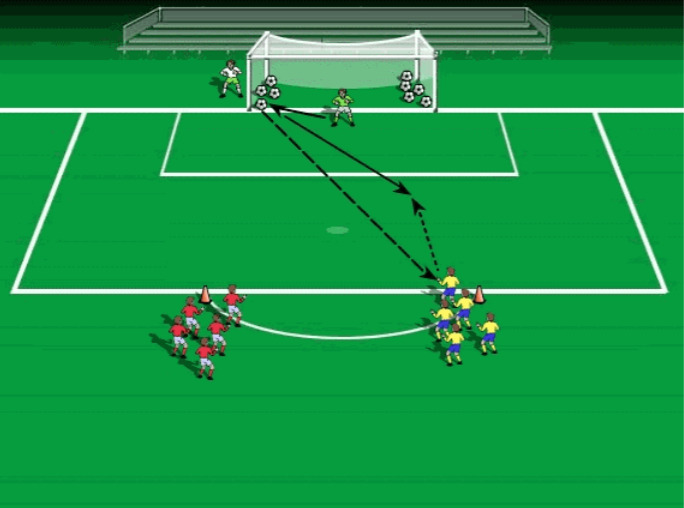


One Word Commands at the Back
This is a wonderful way to teach your team how to move around the field with “one word commands” that are fast and simple and everyone immediately knows what to do per each call.
This is a wonderful way to teach your team how to move around the field with “one word commands” that are fast and simple and everyone immediately knows what to do per each call.
Identifying When and Where to Drop; Hold the Line, Slide; Press the Ball and Push or Sprint Up Using One Word Commands

Using the Calls UP, OUT, HOLD, DROP, SLIDE RIGHT, and SLIDE LEFT. These are quite self-explanatory but UP means edging up a few yards, then reassessing the situation; OUT means sprinting out, potentially many yards.
This is set up to practice when to drop, when to hold the line and where to press up as a unit.
Start with an overload of defenders to give you a better chance of success.
A line of cones are placed where the back four should try not to drop behind.
Dropping, holding the line or even pressing up (pressing even when you haven’t the ball) can depend on the following:
Dropping Off (using the DROP call)
Opponents have the ball, and they make deep penetrating running in front of the ball; and there is no pressure or very poor pressure on the ball.
At this moment the back four should drop off as the player on the ball has the freedom to pass the ball forward and can read the timing of when and where to do it due to this; and based on the back four’s position.
This is unless the back four are so together and in tune they can push up the moment before the ball is delivered; but this can be a very risky decision.
Holding the Line or Pressing up (Using the HOLD; UP or OUT one word commands)
Opponents have the ball, If the attackers make deep penetrating runs and there is very good pressure on the ball in front of the back four by another team mate, thus preventing a forward pass; at this moment they should hold the line and let the attackers run offside, or even press up as a unit to make it even more obvious their opponents have run offside.
Opponents have the ball, If there is; very poor pressure or no pressure on the ball; but also no penetrating forward runs by opponent’s designed to get in behind the back four, then the back four can hold the line or even press up slightly.
If the opponents have the ball and the player on the ball is facing forward, but has his or her head down looking at the ball, and is not observing what is ahead, nor any runs made by team mates, and there even is poor or no pressure on the ball; then that is a time to hold the line or step up too. The player looking down at the ball is the CUE to the back four to HOLD or step UP.
Opponents have the ball: If there is very good pressure on the ball and the ball cannot be passed forward; and the opponents do not make penetrating forward runs beyond the back four, then the back four can actually press up even though we do not have possession of the ball.
When Opponents have the ball, this is emphasized even more if the opponents are forced to pass the ball backwards, and cannot immediately play it forward again (due to good pressure). Distances we can push up depends on the distance of the ball from the back four and the immediate pressure on the next player receiving the back pass; it can be a substantial step up from the back and may result in opponent’s strikers being left offside as a by - product. This is turn pushes our midfield on and further presses the ball if it in the midfield area.
We have the ball. When we win possession and play the ball forward and maintain possession that is a cue to push up quickly and immediately.
We have the ball. When we win possession and play the ball forward and play it in behind their back four causing them to turn and chase back which is ALSO a cue to push up quickly and immediately
If there is ANY DOUBT in any given situation then the back four should ALWAYS DROP DEEPER to be on the safe side, as that is the easiest decision to make.
Phase Play Set Up

Add players to the practice. Have the game set up as a normal phase play, attackers against defenders. Attackers have to try to score, defenders try to win the ball back and score in the little goals. The defenders have five passes to score once they win the ball then it goes back to the attacking side.
Use the stepping up method of defending where appropriate, it will not be on every time to use it. The cones act as a guide but defenders can use this method of defending higher up the field in their own half.
Coaching Points:
Is there Pressure on the ball or not?
The Timing of when to drop, when to hold the line and when to step up, individually and collectively, and depending on the situation above
Regaining possession or opponents caught offside
A sign they are being successful from this is when the back four ends high up the field, away from the cones even though their opponents still have the ball.
Develop The Phase Play

Overload the attacking team now to make it more difficult for the defending team.
Here we have an 8 v 6.
Using the one word commands and identifying the moments to implement each one with the team.
The coach can start each attack off with a pass.
The coach can also be a target for the defenders should they win the ball as well as the side goals. Each represents a front player on their team that they have to pass to, thus when they get it to the goals or the coach they push up quickly using the OUT word.


Teaching Movement “Off the Ball” Through the Transition Directional Target Game - Training Center Exclusive
With this session we are working on the following:
Creating Space by running off the ball to receive or to help a teammate receive.
Quality of Passing; long and short to targets and to teammates.
Support play: working angles and distances incorporating switching play using the side players.
Receiving and Turning in tight situations and dribbling in 1 v 1 situations.
Quick decision making is required in this session because the numbers are small, the area tight and the transitions rapid.
As a coach you can work in this session how to defend properly as individuals and a team or how to attack properly as individuals and a team.
*Membership Required
Rules:

50 x 40 area
Players must pass the ball to their target players to score. To score again they have to work the ball back into their own half of the field to be able to return.
Target players have two touches as do side players.
Coaching Points:
Creating Space by running off the ball to receive or to help a teammate receive.
Quality of Passing; long and short to targets and to teammates.
Support play: working angles and distances incorporating switching play using the side players.
Receiving and Turning in tight situations and dribbling in 1 v 1 situations.
Quick decision making is required in this session because the numbers are small, the area tight and the transitions rapid.
Develop:
No restriction on touches then 3, 2 or 1 touch, but only if it is on to do one touch.
All outside and target players have one touch only where possible
Switch with target players as they receive the ball.
Switch with outside players

Here is an example of the transition and movement off the ball to make it happen.
(2) passes to target player (8) who brings the ball back into the playing area.
(3) makes a run into the other half of the field on the blind side of (C) to receive the next pass. They need to get the ball into that half to be able to score.
(1) makes a forward run into space to receive the next pass off (3) and passes to target player (7) who can start the play again.
(1) switches with (7) and becomes a target player for the next phase of play.
Observe the Attacking Team – Recognize their movement off the ball for example to work the ball into their own half see if the players make runs early in there as soon as the ball is at a target, some should support short and some long so the target has choices.
Observe the Defending Team – See if they are sucked to the ball or they recognize runs off the ball and track players making runs away from the ball into the other half. To lessen the workload and keep everyone involved have players switch with targets and outside side players when they pass to them.
Elements of play the target game teaches
Attacking as Individuals and as Team
Creating Space by running off the ball to receive or to help a teammate receive.
Developing quick support play working angles and distances incorporating switching play using the side players.
Passing long and short to targets and to teammates.
Receiving and turning in tight situations and dribbling in 1 v 1 situation’s.
Lots of touches on the ball for the players in this practice.
Quick decision making is required in this session because the numbers are small, the area tight and the transitions rapid.
Defending as Individuals and as a Team
Pressurizing players on the ball to regain possession.
Supporting pressuring players and tracking runners off the ball.
High pressure to regain possession in the attacking half to be able to go straight to the target to score.
We have transitions from defense to attack and attack to defense, quick decision making and improved concentration as the switch occurs. There are interchanges of positions between inside players, targets and side support players.
As a coach you can work in this session how to defend properly as individuals and a team or how to attack properly as individuals and a team.
Conditions to impose to change the focus of the game
No restriction on touches then three, two or one touch but only if it is on to do so.
Introduce neutral player so a 5 v 4 overload in the middle if possession isn’t kept easily.
Interchanges of players outside to in, inside to out as they pass the ball observing the quality of the pass and the first touch of the receiver or performing a crossover.
Have one teammate at each end so you are attacking both ends but once you have passed to one target you keep possession and must try to get to the other target. You can’t go back unless the opposition win the ball and then you get it back, only then can you go back to the same target.
To lessen the workload and keep everyone involved have players switch with targets and outside players when they pass to them. This causes a constant transition of players and focuses the player’s concentration.
The team can only score if they get an overlap, crossover or 1 – 2 in during the build up.
No talking so players have to rely on their own vision to play.
Players move into the target zone to receive (timing of run and pass) so we don’t play with actual targets, different players can then become the target player.
Man – Marking – Have the players man mark so they must track a player when they haven’t the ball and they must lose their marker when they have the ball. This is a good test to see who is working hard and who isn’t as they have a designated job to do. You as a coach can see who works to get free of their marker and who works hard to prevent the player they are marking get the ball.
This session is particularly good as a midfield play practice session as you can liken the start when the ball is at a target as it being a target defender passing it in and to get to the other side through midfield to the other target who is now a striker. Then this target player maintains possession and the team can go the other way, the target striker then becomes a defender for the attacking team starting the move and the other target becomes the striker to pass the ball to. So it is consistent movement end to end with the attacking team from a defender into midfield to a striker.
To improve the speed of thought reward a successful one touch pass with a goal or point. To score a goal by passing to the target player now reward this with three goals or 3 points.
The team in possession can pass back to the opponents target players to help keep possession of the ball. Liken this to passing back to the keeper in a game situation.

Quick Transition Directional Play Promoting Passing and Movement Off the Ball
This session improves quick decision making, tight control because the spaces are small to play in, and thinking in advance due to the switch in direction of the play. You can also work on the defending players.
The following session is an excerpt from “Soccer Awareness Coaching Curriculums presented by Game Sizes: 4 v 4, 7 v 7, 9 v 9 through to 11 v 11”
This eBook covers up to 14 weeks of training for each game size presented as one session per week. All sessions have small sided games scrimmage set ups as close as we can get it to finish to reflect the theme of the session
As the program moves from 4 v 4 through to 11 v 11 the focus changes from individual teachings at 4 v 4, to small sided situations at 7 v 7, to Phases of play and tactical needs at 9 v 9; through to team tactical development at 11 v 11. 11 v 11 focuses on advanced training ideas to teach the “team”.

Quick continuous attacking play which is good for anaerobic fitness. Here the players are breaking one way passing to an outside player and switching positions, inside player out, outside player in then attack the other side of the zone.
Coaching Points:
Technical ability on the ball in 1 v 1 situations.
Quick Transition in attack - As the transition between players happens for example (3) changes with (5), the numbers team must get the ball to (4) as quickly as possible.
Observe the movement of (1), (2) and (6) in terms of their support positions as the directional change takes place, they must move in anticipation to find space to help the player on the ball as the switch occurs.
Observe also, as the change occurs, the positions of the defending team; has the decision been made quickly enough who presses the ball. Are the other defensive players supporting and covering and especially tracking runners off the ball. The coach must learn to look away from the ball and observe what may happen next before it happens.
This session improves quick decision making, tight control because the spaces are small to play in, and thinking in advance due to the switch in direction of the play. You can also work on the defending players.

Here (3) passes to (5) and (3) leaves the area. As the ball is traveling to (5), (1), (2) and (6) must get into a position to help (5) as early as possible so in theory, (5) can make a one touch pass to any or all of them. Thus (5) already has three options of a pass.
Their movement is OFF THE BALL and away from their markers.
Of course the defenders will move to compensate but for the sake of what I am trying to show it is easier to get the point across by showing the movements of the attacking team only.
The attacking players in the actual practice may get free like this anyway if they time it correctly.

The attacking players each being free to help (5) by being open for a pass.
(5) May elect to run with the ball but at least three are three options available for a pass if needed.
(5) May even elect to play a long pass straight to (4) on the other side of the field if the pressure from the closest defender is not fast enough. You may then ask the closest player (in this case player 2), not necessarily the passing player (5) to be the switching player instead if (5) passes it directly to (4).
You could even then work on defending in this game though focus on defending totally in the session or attacking totally in the session it is better not to try to do both as it can be confusing for the players.
Progression:
If a player beats an opponent in a 1 v 1 situation the team gets an extra point or goal each time.
Play one and two touch; reward each successful one touch pass with a goal to encourage the players to play quickly.
Competitive: Ensure you keep the score and have a finishing score to achieve as this keeps the players focused and motivated to win.


Developing Circle Work Incorporating Passing And Combination Plays
Use this training session to work on good communication between the players, quality of the pass (timing, accuracy and weight) and good first touch by the receiver. To increase the players awareness instincts ask them to call the name of the player out who they will be passing to, before they receive the ball. This ensures they look to see who is free before they receive the ball so they know in advance who is free to receive.
The following training session comes from Soccer Awareness eBook 1: 50 Fun and Developmental Coaching Sessions for 6 to 10 year olds. Get it in the Soccer Awareness eBook Store
To increase the players awareness instincts ask them to call the name of the player out who they will be passing to, before they receive the ball. This ensures they look to see who is free before they receive the ball so they know in advance who is free to receive.
One ball, (1) runs and passes to (4) and takes their place. (4) Takes the ball, runs and passes to (8) and so on.

Progression: Introduce two, then three, then four balls all going at the same time. “Awareness” of where each player is running is needed here so they don’t collide and where potential free players to receive are “before” you make the run and pass.
Coaching Points:
Good communication between the players.
Quality of the pass (timing, accuracy and weight).
Good first touch by the receiver.
Progression: Passer becomes a passive defender who puts the receiver under pressure. The receiver must move the ball away at an angle from the pressure on their first touch.
RUNNING WITH THE BALL

Running with the ball technique:
Head Up – look forward, observing options “before” receiving the ball using the A.I.A. training.
Good first touch out of feet, 2-3 touches maximum, not dribbling.
Run in a straight line, the quickest route.
Running Style, use the front foot to control the ball using the laces.
Decision: Where is the player taking the ball? In this case to (5) but (5) must try to decide as the ball is coming not after he or she has it. Identify who is free early.
Communication: Call the name of the player you are running the ball to.
Timing of take-over: (1) does not pass the ball to (5) but allows (5) to take it using the momentum of the ball. (5) must use a good first touch to get the ball out of the feet.
Progression: Two balls going at once then three.

You can divide the teams into two and have half the players working and half resting. Work a set time then change the players. Here the players are running with the ball then passing and then will get it back to go somewhere else to another player to work with.
Change the emphasis on the movement, running with the ball then during the run the player has to change direction with a clever dribble or turn, or they pass to an outside player, do an overlap around them and get the ball back, play a give and go with them and do a turn when they receive it back.
Many ways to develop this idea to get lots of touches on the ball, practicing running with the ball, receiving and turning with the ball and dribbling with the ball, combination plays, give and go’s, overlap runs and so on. The coach can use his or her imagination to make this work.
PLAYING 1 – 2’S


(1) runs with the ball and passes to (6) that plays a 1 – 2 then (1) passes to (5) who carries the move on. (1) Takes (5)’s place.
Progression: Use two balls at the same time. Awareness of other players in the same spaces comes into play in the movement of the inside players.
Coaching Points as in previous exercise.
If (1) passes to (6) and supports to the right of (6) then the pass is going to the left to (5) making sure we are working angles of support and passing and it lets (5) know the next pass is going there.
OVERLAP RUNS

(1) runs with the ball and plays a 1 – 2 with (6), then lays the ball off to (5). At the same time (6) makes an overlapping run around (5) to receive the pass in front. (1) Takes the place of (6). Develop the usual way.
Coaching Points as the previous exercise but this time the support run is in the form of an overlap.
Timing of the overlap run is important as is the timing of the pass into space in front of the overlapping player to receive.

As the ball is going to (7) he or she have already looked to see where (3) is to pass to. (3) Has already got into a support position to be ready to help (7) and at the same time is viewing the field to see who is available to receive a pass on the outside. As the ball travels to (3) ask them to call the name of the player they intend to pass to, before the ball gets to their feet. To do this they need to look at (7) as the ball arrives, look to see who is free then look back to see the ball coming.
(7) moves to an angled support position to receive the pass from (1). (3) Makes an angle off (7) to receive the ball then passes to (5).
Coaching Points:
Body shape when receiving;
Quality of pass (weight, timing and accuracy)
Support angles
A Good first touch.
Progression:
Three players are working together in the middle
Two pairs working together in the middle.
Pass in the same sequence each time into the middle players, awareness required as to where players are on the outside and also, or more particularly, in the middle where they can get in the way of each other in the two team situation.

Sideways on Soccer Using Corridors
4 v 4 game. Players have to pass diagonally forward because of the condition set. This develops the checking and passing habits of players. Players stay in their same corridors or zones. Theme is to have them check off at an angle and sideways on so they can see the opponent, their team mates and the goal behind them.
The following drill is an excerpt from Soccer Awareness eBook 6: Sideways On or Facing Forward Body Shape for Striker Position; The Brazilian Way.
This book includes In-Depth Information on Striker Movement.
Soccer is a sideways on sport -- players will have much more success when they are able to receive the ball at an angle. Being sideways on allows players, in advance of the ball, to be able to see peripherally advancing defenders.
These exercises are excellent for developing this sideways on aspect of receiving and passing the ball. This aspect of play becomes particularly important when one touch soccer is required. Being able to have the body halfway turned enables attacking players to use a couple of maneuvers to get past defenders. Get it Now

Now we have the two groups play together. Start Position is player (1) passes into Player (4). Defender (B) cannot close that player down until they have had their first touch. It is important to keep the start position passive from a defensive perspective.
Rules:
A player can’t pass forward in their own corridor or zone.
A player can pass forward to the other corridor.
A player can pass back in their own corridor.
4 v 4 game. Players have to pass diagonally forward because of the condition set. This develops the checking and passing habits of players. Players stay in their same corridors or zones. Theme is to have them check off at an angle and sideways on so they can see the opponent, their team mates and the goal behind them.
Strikers work together and link up trying to create angles of support between each other, one short, one long etc.
Develop: Increase the number of corridors and players.

Continuing the movement, (3) is side on to receive and can see opponent (A) and see across to teammate (4) and plays a one touch pass into (4)’s path.
(4) moves into the space where the ball is passed and loses the defender (B) and scores with a one touch finish and shot on goal.
Defender (A) closes down (3) and stops the shot at goal for (3). But the side - on stance of (3) allows (3) to see (4) and affects the pass to (4).
If defender (A) had not closed down the shot at goal for (A) then (3)’s best option was to shoot.
Players have to decide what is the best option a shot or a pass; it may be determined by the positioning of the immediate defender.
Back players can attack also.

More passing ideas
Focus is on scoring where they can. Check the defenders position to see if they can shoot, or need to pass instead. Read the space between the striker and the defender when you pass the ball into them.
Passing away from the striker into space in front of them and the defender or to the side of them and not into feet helps the striker move and receive and get away from the defender. The striker can make the movement first and motion to the passer where they want it by pointing also.
Here (3) checks off short and wide to receive a pass and passer (2) passes the ball away from the defender on the inside of the striker so the striker has their body between the ball and the defender but is also side on to o see in front of them.
Here (1) has a forward pass to (4) or a chance to shoot at goal. (4) Could take (B) away to open up the space for a shot also.
54 Pages
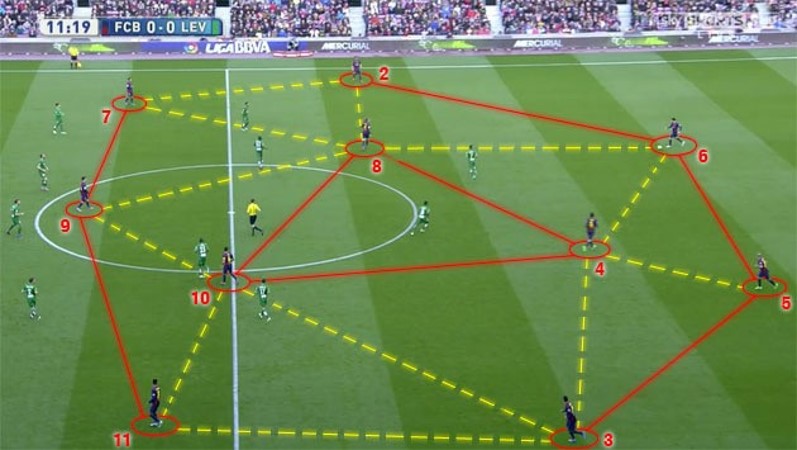
We want to stay with our own game plan as closely as possible; based on what we practice and to keep it simple for us; as we dictate to our opponents; and we impose OUR WAY on them.
But there will be many occasions where we must change the system of play and we may have to adjust to suit the opponents.
Here are some ideas for you to consider for your team starting with the 13313 and 14231 systems of play.