Welcome to the Soccer Awareness Coaches Corner. Browse through soccer drills, small sided games, tactical thoughts, full sessions and a variety of resources. Posts marked “Training Center Exclusive” are for members only.

The Three Team Awareness One Touch Game
Working with three teams (numbers depends on how many players you have, e.g. it can be 4 v 4 + 4 or 5 v 5 + 5 etc). Teams (1) and (2) work together to keep the ball from team (3). If team (3) regains possession the team who gave it away becomes the defenders. The defenders reward is they keep the ball and link with the other team.
The following clinic is part of the New "Soccer Awareness Age Group Specific Awareness Developmental Training" eBook from Soccer Awareness! Click here to preview the full table of contents!
Working with three teams (numbers depends on how many players you have, e.g. it can be 4 v 4 + 4 or 5 v 5 + 5 etc). Teams (1) and (2) work together to keep the ball from team (3). If team (3) regains possession the team who gave it away becomes the defenders. The defenders reward is they keep the ball and link with the other team.

Rules: Once possession is gained, to establish who gave the ball away the player who gave the ball away calls the color of his team and then everyone knows they are now defending and the game continues without a stoppage.
With younger players it may be best to do this (because the ball may be given away a lot more for one thing); whoever won the ball puts his or her foot on the ball to stop play and the coach can call out the team who gave it away. Play begins again working on transitions.
Develop: Increase difficulty for attackers by
Reducing the zone size.
Decreasing the number of touches on the ball of each player.
Conditioning the passing to be only to the other attacking team’s players e.g. (1) only passes to (2) and vice versa, therefore only half the numbers of passes are available per player.
Using two balls so that as they pass one ball they are now increasing their awareness and vision by looking for the other ball coming.
Players take off their pinnies so they really have to look and can’t rely on color identification.
No talking or pointing, so players have to rely on their own vision.
Prohibiting verbal communication
ULTIMATELY PLAY ONE TOUCH
Three Team Possession Game
Three teams, two teams work together, one defends, creates an overload situation in attack, for example 15 players, three teams of 5, a 10 v 5 game.
Possession changes as one of the two team’s players gives the ball away to the defending team then they become the next defending team this is a good transition game also from attack to defense and defense to attack. This game can be in an area of 40 x 40 yards for example and the challenge to the players can also be to move inside to outside (outside being just inside the touchline) and outside to inside to ensure they avoid standing in one area. Plus it takes greater vision or awareness inside the area; where they need to look around and open their stance up to potentially change the direction of play; than on the outside where they can see everything easily.
Encourage players who play centrally on the team to get in the middle of the area and dictate the play, be the pivot for the team, the player who transfers the ball from one side to the other, the link player, this can be one, two or even three players at a time, but they can rotate between themselves too.
Equal numbered teams in a possession keep away game; this would be the next progression from the overload game being a more difficult challenge of the players. Same principles and ideas as above apply.
Transition games: In two halves, creating overloads in each half as each team gains possession. Team A have to get the ball in one half and play a 7 v 3 for example, team B have to win it back with the 3 defenders and get it back to the other half and have a 7 v 3 in their favor, and so on.

Awareness One Touch Theme Developmental Training: Incorporating Movement Off the Ball
Players are generally all very good at playing using many touches; that is; dribbles, turns and running with the ball, that is more technical training / playing.
But often not so good at one touch quick thinking and quick decision making training, that is more skill training / playing.
Hence why we must increasingly do this training with them.
This article is the intro to Wayne’s eBook 16: Soccer Awareness “One Touch” Training Developing its Relationship with Movement Off the Ball. This 103 page eBook explores one touch training and movement off the ball and includes 90 pages of drills that you can do with your team. Get the full book.

One Touch Training: Teaches the player WHEN to play one touch; and when NOT to play one touch. We are teaching players to have a ONE TOUCH MENTALITY. A One touch mentality teaches players to recognize the best options; and therefore make the best DECISIONS; BEFORE and in ADVANCE of receiving the ball.
Movement OFF the ball: This mentality conditions the mind of players OFF the ball to position and move to help the player who is receiving the ball. This means we want players to always; at every moment; THINK: “I only have One touch”; therefore this will force players to always do what I call the “LOOK and THINK” before they receive the ball to see several options and pick out their best option, which may actually be to DRIBBLE!!
When you use these training sessions consistently you will see the development of that relationship between having a ONE TOUCH mentality and Movement OFF the ball.
So in a nutshell:
LOOK (before receiving the ball);
MOVE (find space off the ball based on positioning of teammates and opponents):
THINK (what is my best option?):
EXECUTE (the Decision; or the SKILL Factor).
Introduction:
Players are generally all very good at playing using many touches; that is; dribbles, turns and running with the ball, that is more technical training / playing.
But often not so good at one touch quick thinking and quick decision making training, that is more skill training / playing.
Hence why we must increasingly do this training with them.
For the ONE TOUCH AWARENESS training game with three teams that I want everyone to do each training session for 10 minutes; to ensure we improve the players quick thinking and decision making, as well as their awareness of how to get free OFF THE BALL, here are some more ideas with the same theme so you do not have to do the same game every training session.
This will also ensure the players do not get bored with the repetition of it all.
Really try to have the players play one touch but depending on their developmental level perhaps start with two touches for them to gain early success and to increase their confidence.
But, As Soon As You Can; Play One Touch Only
Please ensure you do this every session as it is imperative we work on this theme with them.
Coaches choose which session they use each training session please, there are many choices to go at for you.
Shown below are many variations of the theme but the simplest theme to use is focusing on:
“ONE TOUCH PASSING AND MOVING OFF THE BALL”
Many may struggle with this but in time and with patience and practice you will be amazed how much improvement comes in quick decision making using this game. As each player only has one touch to pass the ball this should improve players movement off the ball to support due to this as they know the player receiving needs immediate help and as many options as possible. The two aspects of play go hand in hand, one touch play and movement off the ball.
Players in 90 minutes touch the ball themselves, depending on their position, perhaps 3 to 6 minutes, so what do they do in the other 84 to 87 minutes?
They must understand how best to move OFF THE BALL in that time span to help their teammates.
Hence why the focus and teaching of Movement OFF the ball is so vital and important in the greater scheme of things in the game.

Teaching a One Touch Mentality to Improve Player's Decision Making - Training Center Exclusive
To play the game successfully it is vital we keep possession of the ball.
The following presentation is ONE WAY to show how to teach players successful decision making, because the game is about the brain and mind and the thinking processes as much as the body, perhaps more so as the game gets faster and faster.
We have Technical, Tactical, Psychological and Physical and all will be a part of this presentation in terms of decision making, but it will all come down to the “SKILL FACTOR” in my opinion.
*Membership Required
Developing a player's ability to make successful decisions and keep possession of the ball by teaching a One touch mentality
To play the game successfully it is vital we keep possession of the ball.
The following presentation is ONE WAY to show how to teach players successful decision making, because the game is about the brain and mind and the thinking processes as much as the body, perhaps more so as the game gets faster and faster.
We have Technical, Tactical, Psychological and Physical and all will be a part of this presentation in terms of decision making, but it will all come down to the “SKILL FACTOR” in my opinion.
How skillful is the player in maintaining possession of the ball and making the best decisions to keep it?
In my opinion SKILL should be added to the very traditional and historical four elements the player and the game is judged on. There should be FIVE with SKILL being the 5th (and perhaps most important) AND IN A CATEGORY OF ITS OWN.
What is SKILL? Skill is the when, the where, and the why of technique. The decision making process. The ability to problem solve and produce solutions to problems. Yes SKILL (decision making) is all tied into all four elements of game development but does SKILL not deserve to be its own entity? I think it does and will discuss why in this presentation.
On the following continuum I created the thinking process is a major element of it all. So where decision making comes (SKILL) 2nd; and well before technique you see why. For most players; if you think about it; SKILL will likely come after control, so it would be 6th on the continuum. They controlled the ball then looked to see what next to do, often resulting in a rushed decision and / or a bad decision and loss of possession.
Continuums of Development Model
All these factors you get into the game situation
LOOK / OBSERVE / THINK / SCAN: (BEFORE receiving the ball; assessing all options in “Anticipation” not as a Reaction) - If time allows take 2 or 3 looks because the situation may have changed after the first look
SKILL: THE DECISION: (Why; when and where; plus its success or not; and why?)
FOOT PREPARATION: Not flat footed but on your toes and ready for action (Vital)
BODY POSITION: Balanced and open (Vital)
COMMUNICATION: Verbal and visual
CONTROL: If not a one touch pass on, the 1st touch control
TECHNIQUE: The How; the pass, the run, the dribble, the turn, the shot; etc
GAME TEMPO: Do we speed play up / slow it down / does it stay the same?
TACTICAL MOBILITY: Movement off the ball, finding space; 90% of the game
MENTAL AND PHYSICAL TRANSITION: Possession changes, Player tunes in immediately to win it back?
All these aspects of the game relate to Technical, Tactical, Psychological and Physical.
But we want to Add the SKILL FACTOR too.
So this is what will teach the players through the Continuums Model of Development:
Looking before receiving the ball:
Looking away from the ball as well as at it:
Knowing options in advance of receiving:
Weighting the pass correctly to help the receiver:
Getting their foot preparation right (how many play flat footed?? This won’t let them be if they want to be successful).
Getting their body shape right, for the next move; in advance of the ball: OPEN body stance;
Getting into position quickly "Off the ball" to help the player receiving; and it has to be before the receiver gets the ball as they only have one touch to move it on again either to feet or to space: So the second and third phase players are learning to identify the importance of positioning in advance of the ball.
They will recognize what the fault and failure to maintain possession was am I will show some ideas on why losing possession of the ball may happen. It will not be because of pressure or interceptions by defenders because in the early stages there will not be any defenders so the players can play without pressure. It is easy to see for everyone why it works (or not) and how to fix it if they are honest with themselves.
Reasons why a one touch pass may not work?
There are many reasons why a one touch pass doesn’t work. It is not always the fault of the passer; and this has to be established with your players to help build their confidence in any way you can.
But for all reasons it could be due to poor technique, to unprepared body position and feet preparation, to poor communication by the receiver / passer or his or her teammates, to poor positioning by teammates OFF THE BALL for the next phase of play; and ultimately it will be about DECISION Making.
Due to One touch only the decision has to come in advance of the ball, and well in advance of the ball. A decision coming AFTER receiving the ball is most often too late and it will show up clearly in one touch training.
We are really not trying to teach one touch as a way of playing, we are trying to teach a ONE TOUCH MENTALITY by playing one touch. And a one touch mentality relates directly to the thinking process, the decision making, the SKILL FACTOR.
What does that mean? It means we are FORCING players to look around, check over their shoulder, assess their options; make decisions; identify the best decision if they have a couple or more options available, we are FORCING players to LOOK AWAY FROM THE BALL.
Xavi of Barcelona was videoed in a game where they recorded every time he looked AWAY from the ball. In 90 Minutes he looked AWAY from the ball 841 times !!! On average 9 times a minute. WHY? Because every time he got the ball he wanted to have an answer to his next move and maintain possession.
Receiver doesn’t LOOK and make a decision on who to pass to BEFORE receiving the ball so it either sits at their feet after one touch (which makes it totally obvious they haven't assessed their next option) or they pass it for the sake of without thought or decision and give it away.
The Body position and feet preparation were wrong so the receiver isn’t ready to receive the ball. Maybe they saw the next pass, but it wasn’t successful because of this. So the direction / player they passed the ball was a good decision it wasn’t an accurate pass because of not being prepared due to these two reasons.
Poor verbal communication from teammates to help the passer identify where they are but we teach players to learn without this because players most often do not talk to help each other.
Poor Visual and verbal communication by the receiver so doesn’t SEE the next pass early enough (visual), nor calls a players name out to let them know who they are intending passing to (Verbal).
The pass to them was not accurate so even though they knew what they were doing next they were not able to move the ball on successfully. Perhaps they made a great decision on the next pass (which we should focus upon and highlight) but the pass on wasn’t accurate due to the poor pass to them.
The pass to the receiver was accurate but with too much pace on it to them, so moving it on one touch was too difficult and they were unsuccessful.
There were no open passing lanes created by teammates to allow the receiver to play one touch so he or she did not have a decent option to take and therefore gave the ball away.
The decision must be one of two things, a pass to feet or a pass to space, when to space it may have been a great decision by the receiver passing the ball on but their teammate didn’t move to the space to receive it so possession was lost. Emphasize the great decision; even though the ball was given away; it wasn’t the passers fault.
When passing to space it may be a great decision but the weight of pass was too heavy. Emphasize the Great decision.
Three types of soccer player
For the most part, players can be separated into three categories:
1. ·Those who don't know what's happening in a game;
2. ·Those who know what's happening as its happening.
3. ·Those who already know what is going to happen next.
The players, who fit in the first category, really “don't know” what is happening during the game and instead, when the ball comes to them they just kick it away because they don't know what else to do.
The players who fit into the second category are paying attention to what is happening and are always “Reacting” to whatever is happening at that moment.
The players who fit into the third category are the ones who will ultimately be successful. They not only know what is happening at any given time but they are thinking about what the possibilities are next and instead of constantly reacting to a situation; they are being proactive and are dictating what is going to happen next, therefore working “In Anticipation”.
If you want to be successful as a soccer player, you want to be in this third group but the obvious question is: how do you learn how to do this?
First you want to become a student of the game. Watch as many high level soccer games as possible whether in person or on TV. Rather than just watching as a fan, try to figure out why a player did a specific move, where he was on the field, whether it worked or not and then why it worked (or didn't). Then, try to copy the move (assuming it worked) and see if you can use it in a similar type situation. Also, really try to learn from coaches and if you don't understand something be willing to ask additional questions. When you have the chance, play with and against older, more experienced players (but make sure it's not putting yourself in a dangerous situation).
The players who have a general idea of what is going to happen next before receiving the ball (or at least have an idea of what the possibilities are for what is going to happen next) are going to have more fun playing soccer, and be more successful while playing the game.
Which category are you in as a player? If you're not in the third category what are you going to do to get there?
Playing One touch to teach a ONE TOUCH MENTALITY
Coaching Points: Continuums Model to work off and relate to.
An Awareness of the passing player of where the OPPONENTS and his or her OWN PLAYERS ARE; AND where the space is (Look and Think Before receiving)
An awareness of the receiving player as to when the passer is ready to pass (Look and Think Before receiving)
Good communication via visual cues through eye contact or aural cues through speaking makes this work (Communication)
Establishing an open stance in the middle for greater peripheral vision and an angle of support (body position and feet preparation)
Movement OFF the ball by the receiver to get free and into open space (Tactical Mobility)
Timing and angle of the run (Tactical Mobility)
Timing; accuracy and pace of the pass (Technique)
Good receiving and turning technique with an awareness of what is behind before receiving it (Technique, Control and Look and Think)
Move and join in the next phase of play (Tactical Mobility)
If we lose possession try to win it back immediately (Mental and Physical Transition)
And of course the SKILL FACTOR, decision making is based on all.
What does it teach?
Soccer Awareness: Assessing options BEFORE receiving the ball: ALWAYS AN OVERLOAD OF PLAYERS IN POSSESSION
Speeding up thinking and decision making, The SKILL FACTOR
Good Technique,
Mobility, running from deep to exploit space in behind the opponents
Agility and balance
Body position and Foot preparation,
Communication,
The 1st touch, The 2nd touch, and beyond;
Teamwork and support positions,
Collective tactical understanding in a small sided game environment, that equates to the 11 v 11 all over the field in pockets of play;
Positioning OFF the ball,
Problem solving,
And developing creativity and imagination,
Intensity of play,
Physically challenging; Mentally Challenging: Looking AWAY from the ball all the time is tiring mentally as you need to be switched on 100% of the session or you will give the ball away when it arrives;
Developing Angles of support;
Opening up passing lanes by movement off the ball;
Ultimately providing a competitive environment where no one wants to give the ball away and; finally,
The sessions are fun to do. On the flip side often teaching defending and pressing at the same time.
Playing and teaching with a one touch mentality
Two teams a ball each. Two neutral players who play with both teams. Emphasize a One Touch Mentality; the thinking process; by playing One touch initially; but without pressure. So we FORCE them to assess their options BEFORE receiving the ball.

How to be successful
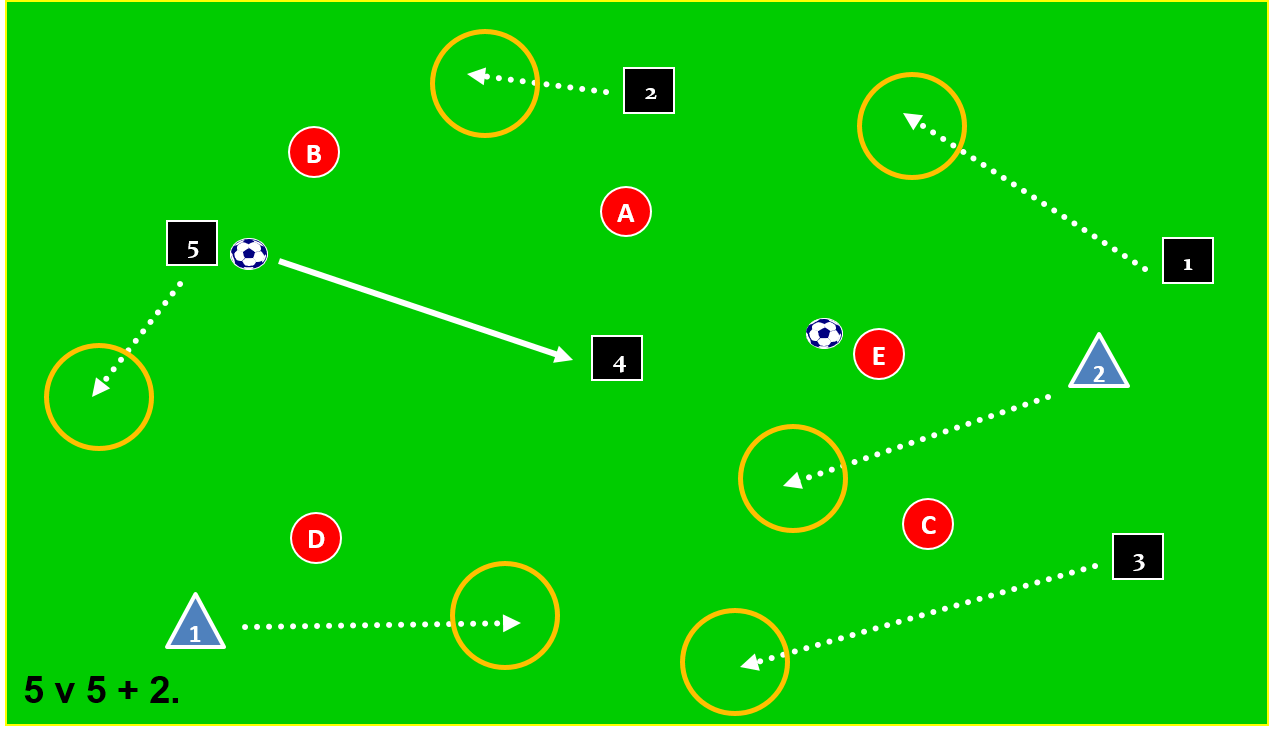
Two teams a ball each. Two neutral players who play with both teams. Emphasize a One Touch Mentality; the thinking process; by playing One touch initially; but without pressure. So we FORCE them to assess their options BEFORE receiving the ball. Using the numbers team, we see the ball about to be passed to (4). (4) is already looking around checking availability of teammates to receive the ball next. Team mates should be moving to get into a passing lane to help (4).

Showing the free spaces
Here we show where players move to in order to help (4). Initially they not in space to receive a pass due to the positioning of the other team. These are just examples they could make other runs equally good. Teammates base their movements on where the space is and where opponents are positioned so they get in open passing lanes as far away from opponents as possible. So in theory (4) has 6 clear options of a pass to keep the ball.
Movement off the ball by teammates
Showing the options available for a pass now. Two ways this can happen: a) Players move off the ball into space to receive, b) The passer (4) passes into a space to force the player off the ball to move into that free space to receive. But it must be a one touch pass by (4) to ensure they looked before they received (some players have this ability naturally, most need to be taught it, this is just ONE way to teach it by playing 1 touch). So a lot of things going through everyone's minds at every moment in the game.

Make it a competitive game that may start UGLY!!
Overload with two neutral players. Now it’s a game situation, with the goal to maintain possession playing one touch but most importantly still focusing on developing that ONE TOUCH MENTALITY. It could get ugly initially with players struggling under pressure to assess options and look away from the ball so the ball constantly changes hands with a loss of possession; but you must perceiver. As this happens you can assess your players as to what is going wrong with each and why (use the Continuums model as a way to do this).

The importance of teaching one touch play: improving one touch play maintaining an awareness of what is in advance and beyond the ball
Linking foot preparation, body position and mental preparation to the technique involved in making a one touch pass leads us to a discussion on one touch play and its benefits. One touch play teaches the value of being able to take your eye off the ball when keeping your eye on the ball can be a disadvantage. To make this work, players need to have good teamwork and positional sense and therefore must work hard for each other to make the options obvious.
And it may be ugly for quite a while; but just let it go. Do not be disheartened and don’t let your players get discouraged. And do not coach, just let them play and work it out for themselves. Tell them you expect it to go wrong more than go right to relax them about it.. They will find with practice that they need to adjust the weight of the pass to help the next player, so foot sensitivity in passing will improve. They will learn this through their own trial and error, not necessarily just what you tell them.
So say nothing; let them FEEL it.
They will find they can't make it work if they just focus and look at the ball all the time.
They will find they can't make it work if their body shape is not right to receive the ball.
They will find they can't make it work if their feet are not ready to receive the ball.
They will find they can’t make it work if their teammates off the ball are not alert.
They will find they can make it work if they start to learn to look away from the ball before they get it; and scan their options in advance of it.
They will find it will work if they get both their body shape and foot preparation right, and in advance of the ball.
They will find it can work if the players off the ball offer early options of support.
They will find they can make it work if their first touch is good (which is a passing touch).
If they only have one touch then it has to be a good one. There are no second chances. This will focus their mind and their body.
Thinking 2 or more moves ahead of the ball
Each player OFF the ball must now be thinking first, I need to move to find space to help (4) before (4) receives the ball. So thinking one move ahead of the ball.
BUT, each player must, as they run into position, be looking away from the space and the ball to assess where EACH of them will next pass the ball, so they are thinking 2 moves ahead.
AND, in the meantime each player assessed initially may have moved AGAIN, by the time this player receives the ball so yet another LOOK away from the ball is needed.
In other words as the player is moving he or she must be constantly looking around as MANY times as possible in the time span of the ball going to (4) and them receiving it.

So reverting back to the Xavi example of 841 looks AWAY from the ball in 90 minutes; that’s about 9 a minute; you can see just in this instant of a few seconds how many times a player may be scanning the whole field with everything around them constantly changing. Hence why this training is so tiring mentally to young players (try it yourself as the coach for 30 minutes even and FEEL it like the kids feel it) but the more they practice the easier it is, the more used to it they become, the more mentally focused and strong they are; the less tired mentally they become, the longer and better their focus is in the game.
Now make it a FREE PLAY game and unlimited touches
Now we have the real test to see; when given the freedom to play and pass, move, dribble and so on, which players make the best decisions in a game of possession. What often happens is they resort to dribbling and losing the ball because they want to keep the ball themselves, the younger the players the more you see this of course. So stop the game and discuss what's happening especially if you see better options they could have made without dribbling. Or they are pressured into making a rushed bad pass because they didn’t look and decided too late where to pass to.

Add Mannequins or tall cones
Here we show players moving between mannequins into passing lanes at the same time avoiding and getting free from opponents (the black pinnied players). Now players have to play thru and between mannequins (or cones) also; this is an even bigger challenge for the players. They have to position to enable players to pass into open passing lanes and for supporting players to move into open passing lanes using the mannequins as reference points. Encourage players to pass AWAY from the mannequins because in a game if the pass is close to them then the ball would be intercepted.

A Competitive Game with goals
1. Here is an interesting way to work on awareness training and passing, movement off the ball, fitness and looking for the penetrating pass. Add triangular goals to score in, this means the game continues after a goal is scored as the ball must be received and possession maintained by another player in the triangle to count as a goal. This ensures continuous play.
2. It is a more directional method of playing and more specific to the game in general. The defenders are NOT allowed inside the triangle so they must be constantly working their way around the triangle trying to cut off the penetrating passes.
3. Attacking all goals encourages “Switching the Field”.
4. So two equal number teams for the greatest challenge and begin with as many touches as possible reducing the number of touches each is allowed as they improve and are able to keep possession effectively. Reducing the number of touches allowed inevitably increases their awareness and forces them to look for options earlier and improves and speeds up their decision making. This should result in them keeping possession more effectively. Or do it the other way around start with one touch and go to free play as I have shown in this presentation but always assessing players decision making and awareness looking AWAY from the ball.

The ultimate outcome from ONE touch mentality training
One touch training is to teach a ONE TOUCH MENTALITY of the thinking process.
It is NOT to teach players to only play one touch. Not at all. Once the head movement, the observation of options BEFORE receiving the ball is established thru One Touch Mentality training then we are ready to open the game up into FREEPLAY.
Now players can do whatever they like, 1 touch pass, 2 touch pass, a dribble, run with the ball, receive and turn, anything they like.
But the objective has been to establish in their minds that 1 touch mentality to enable them to make the best decision possible from potentially several options at this moment in time.
We want great dribblers beating players 1 v 1, we want players who are great at running at defenders with the ball, we want players who are excellent at one touch play, we want players who recognize; thru developing a one touch mentality when; were, how and why to slow the game down, to change the tempo at the correct times in the game; even better if we develop players who are great at all these things.
So having a “one touch mentality” and playing with this thinking process means we can actually achieve the opposite effect of playing as fast as possible; and that is to play more slowly, because that was the correct decision at that moment.


Space Rondos Training a One Touch Mentality - Training Center Exclusive
A great drill for awareness on and off the ball. Passing and moving. Must be one touch and as fast as possible. This one is easy to do on and off the ball.
Objectives:
First touch development
Body positioning
Anticipating situations in advance of the ball
Finding space
Movement OFF the ball
Communication
Mental and physical transitions
*Membership Required
Passing and moving.
Must be one touch and as fast as possible.
A great drill for awareness on and off the ball.
(B) passes to (A) then runs to the free cone the top right of the square.
This one is easy to do on and off the ball.
Objectives:
First touch development
Body positioning
Anticipating situations in advance of the ball
Finding space
Movement OFF the ball
Communication
Mental and physical transitions
A Good Warm Up: Space Rondos using one touch
Passing and moving. Must be one touch and as fast as possible. Here (B) passes to (A) and moved to the free cone. (A) passes to (C) and moves to the free cone. Observation must be away from the ball to see where the free space is BEFORE receiving the pass.

Space Rondos using one touch
One ball, Two balls then 3 balls. Now we add the necessary observation of 2 or 3 balls, as one goes the next one may arrive; so constantly scanning the field.

Players OFF the ball can switch positions now
One ball, Two balls then 3 balls. Now we add the necessary observation of 2 or 3 balls, as one goes the next one may arrive; so constantly scanning the field.

Teaching Anticipation in players
Now we number off each player; you can have 4 to 8 players doing this if you like. If 8 players use 9 cones so always one free one to run to (or more choices if needed). 1 passes to 2, 2 to 3, 3 to 4 and 4 to 5 and so on. So they are watching the player who is passing to them, and scanning where the player they must pass to is at the time; whilst they are moving off the ball too.

Now players position Between the cones (finding space) not on them
Cones represent defenders so players position between them in the best spaces possible. Talk about triangles and diamonds. Pass and move then call stand still. Check positioning.

Now players position Between the cones not on them
Cones represent defenders so players position between them in the best spaces possible. Talk about triangles and diamonds. Pass and move then stand still. Check positioning. Try to position in the biggest space available.
6 points of observation for players:
Team mates positions,
Defenders (cones) positions;
Where Spaces are,
The position of who I'm receiving from,
The position of who I'm passing to,
Where the other balls are which will force each player to consistently scan the field.


Teaching a One Touch Mentality Thru the Three Team Awareness Possession Game - Training Center Exclusive
This game and its many progressions are designed to get the most out of the thinking processes of the players. Many mental challenges to overcome and learn from.
We are working on awareness of where the player you receive from is and where the player you pass to is. Because of this players begin to anticipate the pass to them and where it is coming from. Also they must look to where it is going to (where is the player they are passing to?).
We are trying to create a situation where players are looking two moves ahead not just one.
Subscribe to the Soccer Awareness Training Center to get access to all premium Training Center Exclusive articles.
Continuums of Development
LOOK / OBSERVE / THINK (BEFORE receiving the ball; assessing all options in “Anticipation” not as a Reaction) - If time allows take 2 or 3 looks because the situation may have changed after the first look
SKILL: THE DECISION (Why; when and where of Technique; plus its success or not; and why?)
FOOT PREPARATION: Not flat footed but on your toes and ready for action
BODY POSITION: Balanced and open
COMMUNICATION: Verbal and visual
CONTROL: If not a one touch pass on, the 1st touch control
TECHNIQUE: The How; the pass, the run, the dribble, the turn, the shot; etc.
TACTICAL MOBILITY: Movement off the ball, finding space; 90% of the game
MENTAL AND PHYSICAL TRANSITION: Possession changes, Player tunes in immediately to win it back?
Three Team Awareness Possession Game
ALWAYS AN OVERLOAD OF PLAYERS IN POSSESSION
What does it teach?
Soccer Awareness: Assessing options BEFORE receiving the ball
Technique,
Mobility, running form deep to exploit space in behind the opponents
Agility and balance
Body position and Foot preparation,
Communication,
The 1st touch, The 2nd touch, and beyond
Teamwork,
Collective tactical understanding in a small sided game environment,
Positioning OFF the ball,
Problem solving,
And developing creativity and imagination,
Intensity of play,
Physically challenging;
Developing Angles of support;
Opening up passing lanes by movement off the ball;
Speeding up thinking and decision making, The SKILL FACTOR;
Ultimately providing a competitive environment where no one wants to give the ball away and; finally,
The sessions are fun to do. On the flip side often teaching defending and pressing at the same time.
THIS GAME AND ITS MANY PROGRESSIONS IS DESIGNED TO GET THE MOST OUT OF THE THINKING PROCESSES OF THE PLAYERS. MANY MENTAL CHALLENGES TO OVERCOME AND LEARN FROM.
Coaching Points:
Continuums Model to work off and relate to.
An Awareness of the passing player of where the OPPONENTS and his or her OWN PLAYERS ARE AND where the space is (Look and Think Before receiving)
An awareness of the receiving player as to when the passer is ready to pass (Look and Think Before receiving)
Good communication via visual cues through eye contact or aural cues through speaking makes this work (Communication)
Establishing an open stance in the middle for greater peripheral vision and an angle of support (body position and feet preparation)
Movement OFF the ball by the receiver to get free and into open space (Tactical Mobility)
Timing and angle of the run (Tactical Mobility)
Timing; accuracy and pace of the pass (Technique)
Good receiving and turning technique with an awareness of what is behind before receiving it (Technique, Control and Look and Think)
Move and join in the next phase of play (Tactical Mobility)
If we lose possession try to win it back immediately (Mental and Physical Transition)
And of course the SKILL FACTOR, decision making is based on all.
Non-Competitive Awareness Numbers game: Passing in sequence
Awareness of: where the player you receive from is and where the player you pass to is. Because of this players begin to anticipate the pass to them and where it is coming from. Also they must look to where it is going to (where is the player they are passing to?).
We are trying to create a situation where players are looking two moves ahead not just one. For instance as (1) is about to pass to (2), (3) should be looking to support (2) for the next pass already, looking two moves ahead before the ball leaves (1). Peripheral Vision Development results from this.
(3) should recognize if they need to move into a space early or late based on this observation, but know in their mind already what the next best option is. Moving into the space too early in a game situation for example may result in being marked too easily. But knowing in advance “when and where” to move to is an advantage and this game helps players develop this thought process.

Teaching One touch to develop the THINKING PROCESS
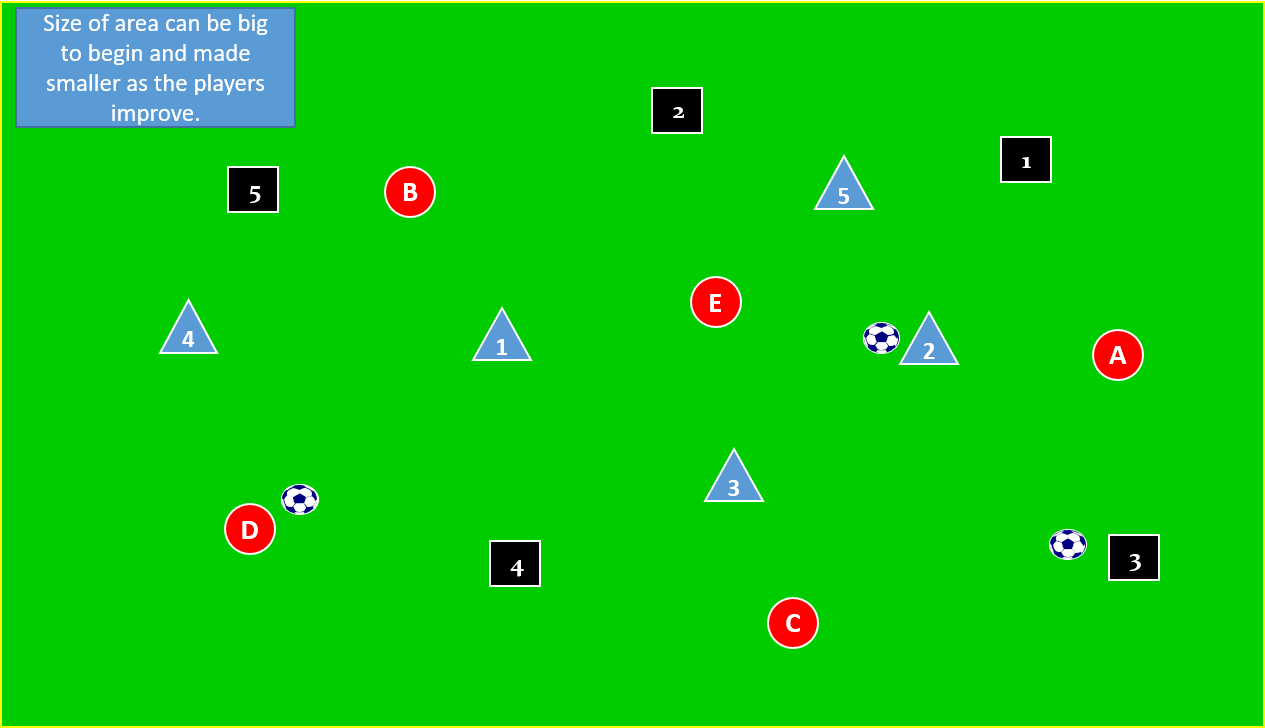
Three teams three balls. Passing and moving playing 1 touch only. Use 2 if necessary. 1 touch is successful if a) the player receiving observes his or her options BEFORE receiving the ball and b) teammates move off the ball to be in passing lanes to receive a pass.
The other teams “get in the way” of the spaces so players must ALSO observe where the other 2 team players are.
Teaching One touch to develop the THINKING PROCESS
Coaching points:
Open body stance to allow a yard or more extra space away from defenders by letting the ball run across the body into preconceived space
Looking before receiving to know in advance of the receiving pass; where the defending players are, where the space is, where team mates are free to receive a pass, how many options there are to move the ball on
Movement OFF the ball is a priority both to receive it and after passing it.

Progressions: Increase difficulty for attackers by:
Reducing the zone size.
Decreasing the number of touches on the ball of each player.
Condition the passing to be only to the other attacking teams players e.g. (1) only pass to (2) and vice versa therefore only half the number of passes available per player.
Increase the numbers to suit how many players you have, e.g. 4 v 4 + 4 or 5 v 5 + 5 etc.
Have two balls to play with so as they pass one ball they are now increasing their awareness and vision by looking for the other ball coming.
Ask players to take off their pennies so they really have to look and not be able to use color identification.
No talking or pointing, so players have to rely on their own vision.
Assessing Options
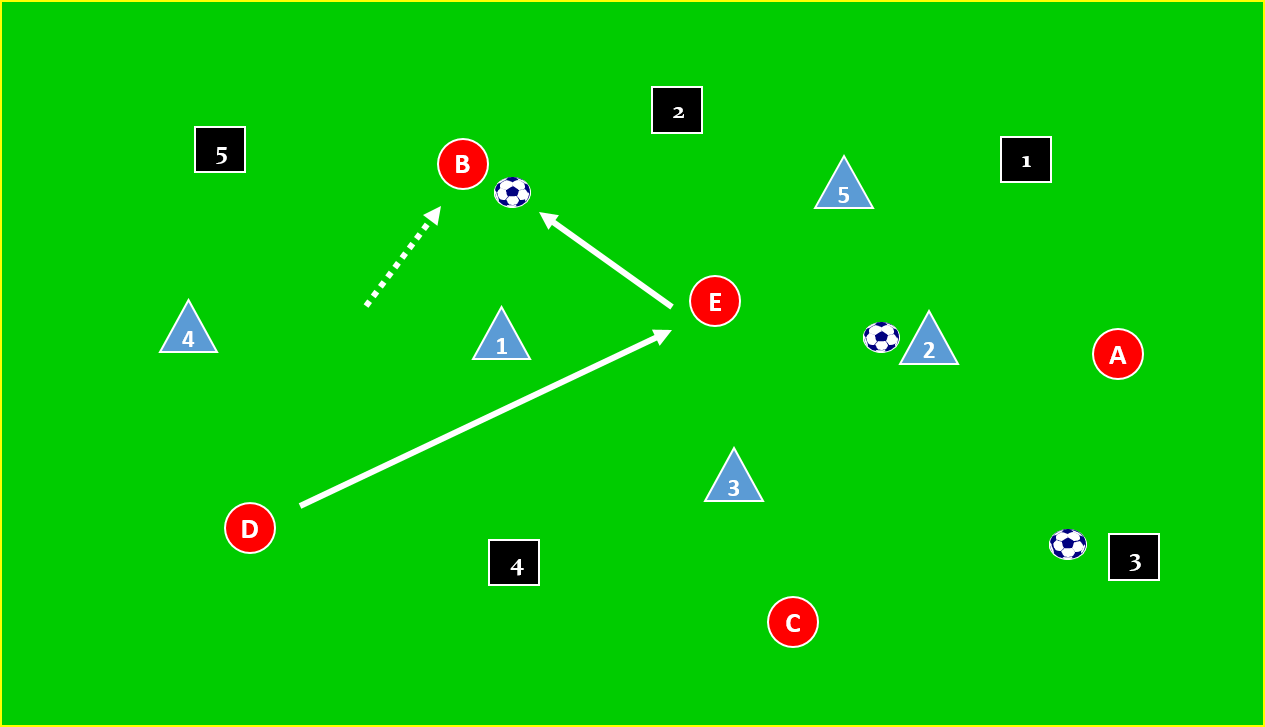
An example of moving into open passing lanes: Here (D) passes to (E). As the ball is traveling, (B) is already on the move to find the best space to support (E) KNOWING (E) has one touch only so has to make a fast decision and be given a good option. (B) positions between the blue and black player and arrives as the ball arrives. At the same time the other players need to be moving also to offer as many options for (B) as possible. Also at the same time as the ball is traveling from (D) to (E), player (B) must be looking AWAY from the ball to see what his or her next options may be and be able to choose the best one available.
Movement OFF the ball to offer options
Bear in mind the other team players are also moving so this is not as simple as it looks as the spaces to play to are constantly changing. Assessing the black players only here, we show as the ball travels from (3) to (4), the other three black players are trying to support (4) in ADVANCE of the ball. Therefore if (4) has assessed these movements and calculated approximately (mentally) where each player will move to then (4) should have numerous choices of a pass to keep possession including passing back to (3).

Offering no options with no movement to support
Exaggerated but just to show how VITAL it is that players move to support the player receiving the ball. Using red players as an example, there are passing lanes to move into to help (D) but red players stand behind opponents so (D) cannot see them nor pass to them. (D) may pass into a passing lane space to MAKE them move but that isn’t ideal, we want everyone thinking and moving together. Lets say in a game situation now (D) may be pressed and lose the ball because no options of a pass are available.

Not assessing options BEFORE receiving the ball
Coaches observe the HEAD MOVEMENT of players as this is a major indicator of if they are scanning the field for options for their next pass or not. If not the obvious will happen a) They will just watch the ball arriving and just focus on it b) They will control and stop the ball at their feet thus meaning a one touch pass is NOT an option now c) They will then lift their head up to see where teammates are d) They will eventually make a pass perhaps needing 2, 3 or 4 touches on the ball e) team mates may be standing still waiting for the pass having already anticipated the best position to be in; but are now too early and marked in a game situation..

Ideas to develop the thinking process
Players passing to different colors so now color coordination and identification is introduced. More difficult for players now, Say, blue passes to red, red passes to black, black passes to blue. This makes observation of the movements of a different color more difficult to process and is a great progressive test for players and really gets the brain cells working overtime.

Forcing movement off the ball thru a Condition
Progression: A ball each team. To keep the sequence going players must move the balls quickly with few touches hence their peripheral vision development improves dramatically.
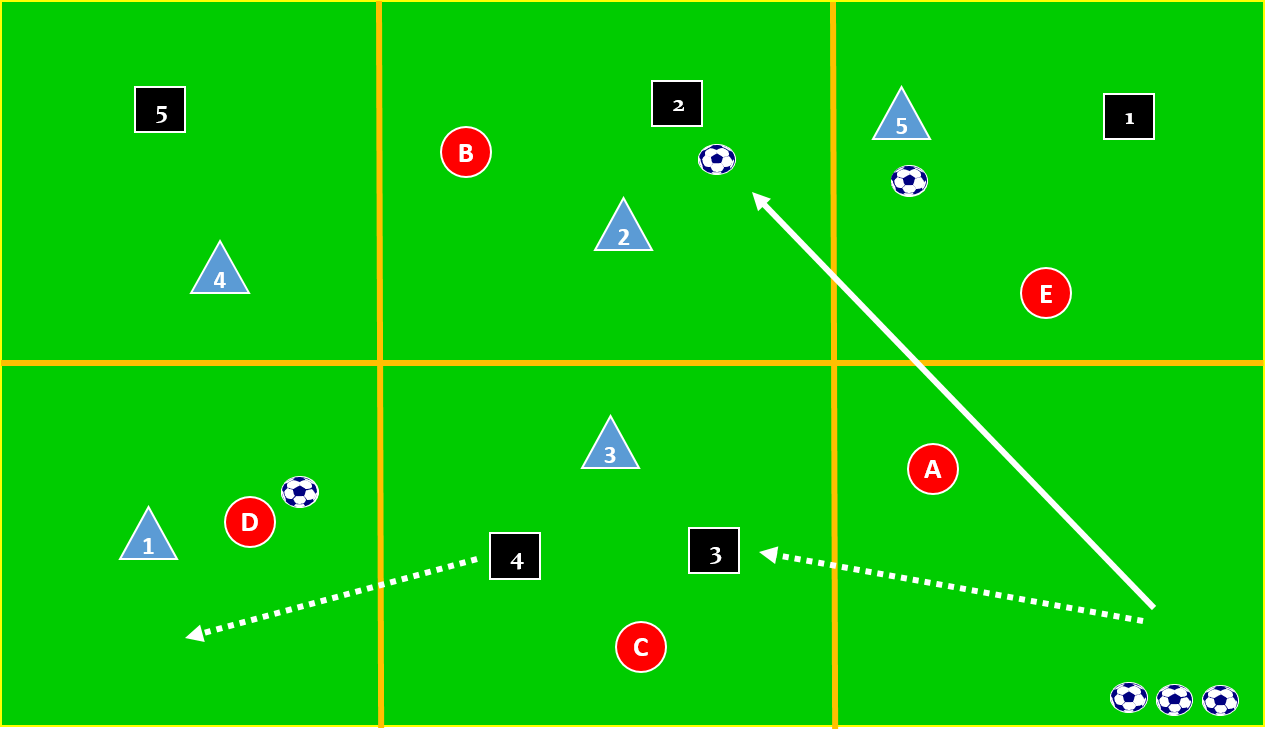
Add another ball per team. As soon as they have passed one ball off the next one is arriving so quick thinking is needed to make the correct decisions. Divide the field up into six zones and ask players to make a pass in one sixth then they must move to another sixth to receive the next pass. This can cause players to pass long or pass short and vary the range and distance of the passes and the support. Here black (3) passes to black (2) and moves into another zone to receive the next ball that is coming. This may make (4) move into a different zone too.
A Condition: Alternatively have a Condition where no players can occupy the same zone for more than a few seconds to FORCE them to move into another space and develop ROTATION of players. This ensures players get the idea of passing and MOVING off the ball, not passing and then standing.
A Competitive Game
One ball only now. 2 teams play together and one team defends. A 10 v 5 so it should not be too tough a challenge to keep the ball. So whoever gives the ball away their team become the defending team so we have a mindset transition here.
Develop: If too easy then lets say blue and black work together against red. But blue can only pass to black and black can only pass to Blue thus greatly reducing the options of a pass and therefore the decision making of each combined team is much harder.

A Competitive Game: Another challenge
1. Making it more competitive, have each team be the defending team for a certain time span. If they win the ball they try to keep it. Count the number of times they win the ball. The defending team to win the ball the most times wins the game, or alternatively the combined teams which give up the ball the fewest times win the game.
2. Attacking players “individually” count the number of times they give the ball away as an indication to each and every one of them how well they can maintain possession under pressure.

A Competitive Game
Another idea: Lets say you have different level teams then play the two strong teams against each other and have the weaker team pass and move to each other at the same time. To play a weaker team against the stronger team is a challenge so have the weaker team play free and the stronger team play one touch only.

Add Mannequins
Now players have to play thru and between mannequins (or cones) also; this is an even bigger challenge for the players. They have to position to enable players to pass into open passing lanes and for supporting players to move into open passing lanes using the mannequins as reference points. Encourage players to pass AWAY from the mannequins because in a game if the pass is close to them then the ball would be intercepted.

Red and Blue play against black. Here we show players moving between mannequins into passing lanes at the same time avoiding and getting free from opponents (the black pinnied players)

A Competitive Game with goals
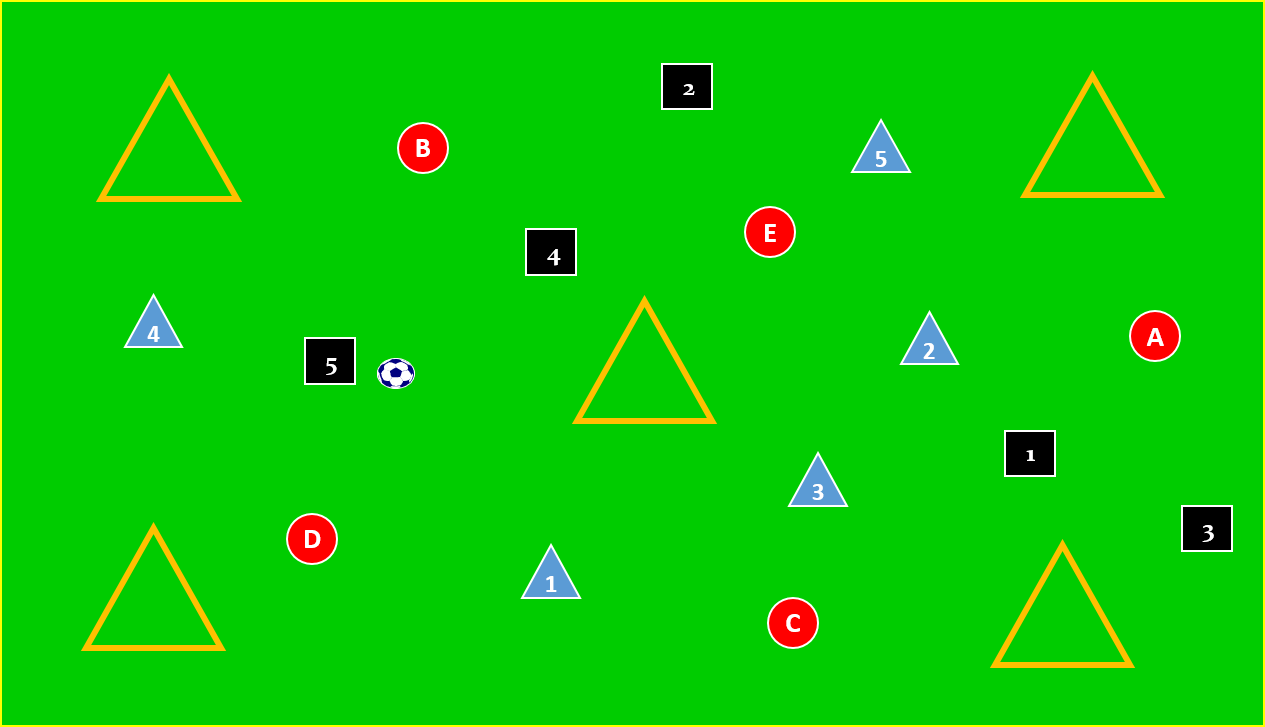
1. Here is an interesting way to work on awareness training and passing, movement off the ball, fitness and looking for the penetrating pass. Add triangular goals to score in, this means the game continues after a goal is scored as the ball must be received and possession maintained by another player in the triangle to count as a goal. This ensures continuous play.
2. It is a more directional method of playing and more specific to the game in general. The defenders are NOT allowed inside the triangle so they must be constantly working their way around the triangle trying to cut off the penetrating passes.
3. The combined attacking teams can attack all goals. Attacking all goals encourages “Switching the Field”.
4. Ultimately reduce the game to two equal number teams for the greatest challenge and begin with as many touches as possible reducing the number of touches each is allowed as they improve and are able to keep possession effectively. Reducing the number of touches allowed inevitably increases their awareness and forces them to look for options earlier and improves and speeds up their decision making. This should result in them keeping possession more effectively.
The ultimate outcome from ONE touch mentality training
One touch training is to teach a ONE TOUCH MENTALITY of the thinking process. It is NOT to teach players to only play one touch. Not at all. Once the head movement, the observation of options BEFORE receiving the ball is established thru One Touch Mentality training then we are ready to open the game up into FREEPLAY.
Now players can do whatever they like, 1 touch pass, 2 touch pass, a dribble, run with the ball, receive and turn, anything they like.
But the objective has been to establish in their minds that 1 touch mentality to enable them to make the best decision possible from potentially several options at this moment in time.
We want great dribblers beating players 1 v 1, we want players who are great at running at defenders with the ball, we want players who are excellent at one touch play, we want players who recognize; thru developing a one touch mentality when; were, how and why to slow the game down, to change the tempo at the correct times in the game; even better if we develop players who are great at all these things.
So having a “one touch mentality” and playing with this thinking process means we can actually achieve the opposite effect of playing as fast as possible; and that is to play more slowly, because that was the correct decision at that moment.


One Touch Give and Go Passing and Receiving Drill - Training Center Exclusive
The emphasis of this drill is on accuracy and weight of one-touch passing.
The following drill comes from the Soccer Awareness Training Center. Soccer Awareness Training Center provides unlimited access to Wayne Harrison's Soccer Awareness systems, training sessions, drills and more. Wayne's system helps develop world class youth soccer players and teams in a systematic and imaginative manner that guarantees performance at the highest level of competition. Whether you’re a beginning coach who needs help getting started or someone who wants to add some variety to their training sessions, the Soccer Awareness Training Center offers a wide variety of drills to choose from. Join Today
Emphasis: Accuracy and weight of one-touch passing
Set-up: 10 x 10 yard grid. 4-5 players per grid with one player designated as server. Two cones are placed at the mid-point of the grid. The server is positioned at the end of the grid with a supply of balls as shown. The remaining players begin at the opposite side of the grid.

Objective: The first player in line must jog forward towards the server. The server must pass (1) a ball to the player when he reaches the cones (midpoint of the grid). The player must attempt to return the ball accurately to the server with a one-touch pass (2). The next player in line begins the sequence immediately after the player in front has completed the pass. Play is continuous for a designated period of time.
Progression: Limit the server to one touch to increase the tempo of the exercise.
Coaching Points:
Lock the ankle with the toe slightly pointed up.
Non-kicking foot must be placed in line with the target.
Follow through and adjust the weight as necessary.



One Touch Finishing Drill - Training Center Exclusive
70% of all goals are scored with one touch so it is important to practice this technique regularly. This is a continuous practice with lots of work for the keeper also.

70% of all goals are scored with one touch so it is important to practice this technique regularly. (1) runs around the cone at pace to receive the pass from (2). Go left then right varying the call to keep the players concentrating. Each player except the one running has a ball to serve. Player switches sides each time. One touch finishing.
This is a continuous practice with lots of work for the keeper also. As soon as a pass has gone in call the next player to start their run.

Develop – Vary the service with easy passes to begin so we get a lot of goals then chip it in for volleys, half volleys, headers, diving headers, and so on (players can throw the ball in to maintain accurate service if needed to ensure strikes on goal). Working on a positive attitude to score, accuracy and/or power, correct shot selection, awareness of rebounds. Have players counting the number of goals they score (competitive).
First team to score 10 goals is the winner. Alternatively the coach can stand behind the cone and receive the pass and vary the service for the end product, creating opportunities to volley and half volley the ball, even head it on goal. Vary the distance from the goal depending on what you want to achieve.

Teaching a One-Touch Mentality
The following is the introduction to a presentation on Teaching a One-Touch Mentality presented by Wayne Harrison, Founder of Soccer Awareness, at the international 2017 Derbystar Youth and Amateur Trainer Congress.
The following is the introduction to a presentation on Teaching a One-Touch Mentality presented by Wayne Harrison, Founder of Soccer Awareness, at the international 2017 Derbystar Youth and Amateur Trainer Congress.
The full presentation can be download in the Soccer Awareness Training Center Featured Presentations Section.

Soccer is a “Thinking” Game that Begins in The “Head” of Each Player. With SOCCER AWARENESS we are developing the MIND of each player.
What is the difference between a One Touch Mentality and Playing One Touch?

So Lets Establish First:
- A 1 Touch Mentality Teaches: WHEN to play 1 touch; when NOT to play 1 touch.
- NOT just about playing One Touch.
- EVERY MOMENT PLAYERS THINK: “I only have One touch” this forces players to do “THE LOOK & THINK”.
- 1 Touch Mentality teaches recognition of the best OPTIONS / DECISIONS; BEFORE and in ADVANCE of receiving the ball.
- Best decision may be actually to DRIBBLE or EVEN to SLOW the TEMPO!!
Thinking ONE TOUCH on AND off the ball
I ask players to THINK in their head that on the ball they only have ONE TOUCH.
SCANNING: This CONDITIONS their mind to SCAN the field in ADVANCE of the ball even though in reality they may have many touches on the ball at that time.
Players OFF the ball also will think “my teammate receiving the ball has only ONE touch to move it on”. So they scan too.
This in turn will challenge / condition their mind / force them to find the best space possible to help them.
Therefore: THINKING ONE TOUCH helps the players OFF the ball as well as the one about to receive it and it speeds up decision making both on and off the ball.

My OWN Thoughts and Experiences

- SPEED OF PLAY: Professional level even in the 70s and 80s the game (1970s not 1870s) was very fast (it seemed at the time). The game now is MUCH faster still.
- I knew I had to LOOK AHEAD and in ANTICIPATION of the ball to be a real success.
- I was never as good as I had hoped to be
- WHY? Because my “One touch mentality” OR SCANNING ABILITY; wasn’t what it should be.
- WHO SHOWED ME THE IMPORTANCE OF IT? Alan Ball, Ex-Arsenal, Everton; Blackpool and 72 caps for England and World Cup Winner in 1966. The original Xavi model. He Became Player – Manager at Blackpool.
- STARTED COACHING: I decided when I became a coach at youth level I would teach this “THINKING GAME MINDSET”
- Ironically; I am very good at this now !
Join the Soccer Awareness Training Center to Download this full presentation and more than 500 sessions, drills, ebooks and more. 1 WEEK FREE! Join Today

Warm Up: Circle Keep Away 1 Touch Only
In this warm-up, players are keeping the ball away from the central player while working on passing and maintaining possession. Use different number of touches (try 2 touches to start). Body position and foot preparation is vital when playing one touch.
The following comes from the Soccer Awareness 12 Week Academy Level Training Plan!
Do you want to get to the next level in your team's soccer development? If so check out this specialized coaching and training program by our Founder, Wayne Harrison, is designed to cover: Technique; Skill; Physical; Tactical and Psychological / Mental Developmental Training.
Area: 8 yards by 8 yards
Progression: Reduce the size of the Circle to play in smaller spaces to test the players
Coaching Points:
- Keeping the ball away from the central player
- Passing and maintaining possession
- Different number of touches (try 2 touches to start)
- Defender must work hard to win the ball; set challenge 10 passes means defender stays in
- Body position and foot preparation is vital when playing one touch
- Assessing the next pass before receiving the ball
- Call the name of the player they are passing to before receiving the ball to show their decision was before receiving the ball
- Add two then three defenders
Warm Up: Circle Keep Away One Touch Only Against 1
Players can move on the outside to help each other and open up,a passing lane, just a yard either side can make all the difference.

Warm Up: Circle Keep Away One Touch Only Against 2
When two defenders are in try to split them with a pass. This is a good warm up for the players and begins the awareness decision making process of rcognizing the pass BEFORE receiving the ball.

Warm Up: Circle Keep Away One Touch Only Against 3
This is a good warm up for the players and begins the awareness decision making process of recognizing the pass BEFORE receiving the ball. A bigger challenge with 3 defenders.

Add an Attacking Player
Try to work with the inside player as often as possible. Rotate the defenders and rotate the inside player. (11) has unlimited touches, outside players one touch only.


With this 94 page eBook, we are taking the Soccer Awareness thinking process to the next level by identifying what is relevant at each age group. That said, you the coach, will decide perhaps a 9 year old team can cope with the 11 year old sessions and perhaps a 12 year old lower level team will need to use younger age group session plans.
We hope you enjoy these sessions and as always our Soccer Awareness training material is simple to understand, user friendly and we try to offer a great attention to detail.
Feedback is always welcome as we want to keep improving our product.
Best wishes, Wayne Harrison