Welcome to the Soccer Awareness Coaches Corner. Browse through soccer drills, small sided games, tactical thoughts, full sessions and a variety of resources. Posts marked “Training Center Exclusive” are for members only.

Passing Game for Spatial Awareness Development
Players have the ball at their feet for approximately 5 minutes out of 90. What do they do the rest of the 85 minutes? They must learn to move off the ball and to move into open passing lanes to be open at all times to help the player on the ball or the next player on the ball. Here is a great session to teach this.
We can use many upright cones to represent opponents rather than mannequins. We set the cones up in triangles and diamonds. We ask players to position between the cones in the best space available. Try to balance their position to find the best space in the middle of the triangle or diamond of cones (opponents). Players beyond the ball try to position in triangles and diamonds of support also.
The following is an excerpt from Soccer Awareness eBook 16: Soccer Awareness “One Touch” Training: Developing its Relationship with Movement Off the Ball.
This 103 page eBook explores one touch training and movement off the ball and includes 90 pages of drills that you can do with your team.
Passing Game with Cones for Spatial Awareness Development using Mannequins or Cones in Training for Movement Off the Ball
Players have the ball at their feet for approximately 5 minutes out of 90. What do they do the rest of the 85 minutes? They must learn to move off the ball and to move into open passing lanes to be open at all times to help the player on the ball or the next player on the ball. Here is a great session to teach this.
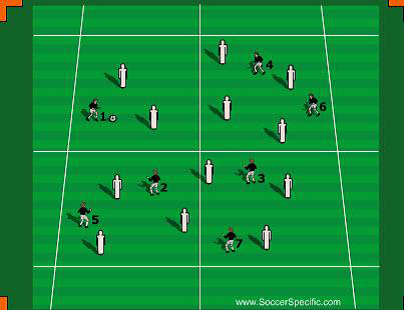
Getting into passing lanes to help each other
We can use many upright cones to represent opponents rather than mannequins. We set the cones up in triangles and diamonds. We ask players to position between the cones in the best space available.
Try to balance their position to find the best space in the middle of the triangle or diamond of cones (opponents). Players beyond the ball try to position in triangles and diamonds of support also.
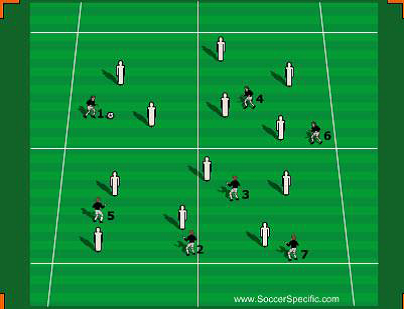
OBJECTIVE: To improve movement off the ball by providing mannequins to act as opponents to fill important space
A non-directional training practice
Mannequins represent opponents on the field. They fill important spaces so the players need to pass and move around and between them. This ensures players move off the ball to help the player on the ball have as many options as possible for a pass. The goal of the players is to find as much space as they can between the mannequins to give themselves as much space as possible to play in.
Every now and again stop the practice and see where the players are positioned. Are they in free space? Are they too close to a mannequin and hence in a game situation not available for a pass? If they are then ASK THE PLAYERS to SHOW you a better position to be in.
Possible problems here are the positioning of players behind opponents so the player on the ball cannot see them to pass to.
Develop:
Restrict the number of touches on the ball to 3 touches, two touches then one touch; if it is on to do so. To enable one touch to be possible movement off the ball has to be intelligent, fast and into space to help the passer play one touch. Thinking AHEAD of the ball arriving is paramount here otherwise one touch play cannot be performed successfully. Try to think two moves ahead. Movement OFF the ball by others is paramount here also otherwise the person receiving the pass will not be able to play one touch successfully.
Play the Numbers Game: 1 passing to 2, 2 to 3, 3 to 4 and so on. Increase the number of balls being used.
Two teams playing in the same area with a ball each. Now players need to avoid the other team AND the mannequins to find space to receive the pass.
Coaching Points:
Thinking and looking before receiving of the receiving player so they have assessed their options before receiving and in advance of the ball
Ability to play ONE touch if possible for speed of play
Movement OFF the ball of teammates to help the player on the ball
Movement INTO spaces between and around the mannequins to enable this to happen using the mannequins as guides.
Thinking TWO moves ahead to support.
Playing in triangles of support offering several options for the player on the ball in many directions.
An exaggerated situation but this shows what happens when players do not move to space to help the player on the ball; and do not open up the angle for a pass, instead standing behind an opponent and not being free to receive. How many times do you see this?
To defeat this problem; the player on the ball can pass to a space hoping that this will force the receiver to move to that space to receive the ball. Then the weight; timing and accuracy of the pass has to be particularly good; but this is not ideal.
Whilst players can still be successful with later movement off the ball of supporting players; if the player on the ball hastime on it to take more touches; it is always better to provide options of a pass as early as possible to increase speed of play and give opponents less time to work out their movements.
Working in threes
Here showing possible passing routes with each group of three players also showing how they get free and into as much space as possible, based on the positions of the mannequins who act as opponents filling spaces.
Different colors to pass to in order to develop color coordination.

Game situation
Have players passing in two teams to begin as a warm up, with a ball each team, then two and three balls each team. Then they pass to opposite colors only.
Now play a 6 v 6 (or any number you like) and make it a possession game. Mannequins make it more difficult by filling spaces so players have to play around them as well as their opponents. This should improve them playing in tight situations.
Use a 2 player overload if required initially until they get really good; then make it equal numbers each team, you dictate this based on the ability of your players. Of course change the numbers of touches on the ball decreasing the number as they become proficient to increase the difficulty.

The focus is again passing and movement off the ball to receive with as many players as possible offering an option of a pass for the player on the ball.
Here we show potential positioning of players in the biggest spaces they can find between the mannequins.
More space means more time to play on the ball so the player has the choice to play quickly or not; also depending on the individual situation presented; and often dictated to by the support positions of his teammates.
Develop: Have two teams playing through each other avoiding each other and also avoiding the mannequins. This is now a big challenge to each player on the field where there will be less space to play in and their peripheral vision will really be tested to its fullest.
Game Situation
Try an overload first of all maybe a 9 v 4 building it up to a full game. This is a big challenge meaning fewer spaces to play in and forcing more movement off the ball to support each other.

Here is a great video of FC Barcelona YouTube showing how this works.
Get more like this in Soccer Awareness eBook 16: Soccer Awareness “One Touch” Training: Developing its Relationship with Movement Off the Ball.
This 103 page eBook explores one touch training and movement off the ball and includes 90 pages of drills that you can do with your team.



Two Touch Prepare and Pass
In this session we are working on accuracy and weight of passing. The activity encourages players to correctly receive the ball into space prior to passing.
Emphasis: Accuracy and weight of passing. Encourages players to correctly receive the ball into space prior to passing.

Set-up: 20 x 10 yard grid. Four players per grid with two balls. Two players (A,B) are positioned at opposite sides of the grid as shown. Two players (C,D) are positioned in the center of the grid.
Objective: Players (A) and (B) must pass the ball to (C) and (D). Players (C) and (D) must take a preparation touch and quickly return the pass to the original player. Players (C) and (D) must quickly change direction to repeat the sequence at opposite ends of the grid.
Outside players must use a two-touch restriction also. Middle player should work for 30-40 seconds before switching with the outside players.
Progression: Create a competitive environment – how many can your group get in 30 seconds.
Coaching Points:
Lock the ankle with the toe slightly pointed up.
Players must take a good preparation touch at an angle to set themselves up for a successful pass.
Non-kicking foot must be placed in line with the target.
Follow through and adjust the weight as necessary.

Small-Sided Passing Support And Combination Work Game
Using two wide positioned goals for each team to attack. This is designed to encourage players to spread out when they attack and switch play; changing direction if one route is blocked. Looking for quick transition and movement off the ball to create space but attacking the space when it is on to do so. The first thought of the player on the ball should still be “Can I run or pass the ball forward.”
The following drill comes from the Soccer Awareness Training Center. Soccer Awareness Training Center provides unlimited access to Wayne Harrison's Soccer Awareness systems, training sessions, drills and more. Wayne's system helps develop world class youth soccer players and teams in a systematic and imaginative manner that guarantees performance at the highest level of competition. Whether you’re a beginning coach who needs help getting started or someone who wants to add some variety to their training sessions, the Soccer Awareness Training Center offers a wide variety of drills to choose from. Join Today
To score players can pass through the goal or dribble through it. The ball stays in play and movement off the ball to support the player in it to score becomes more important.
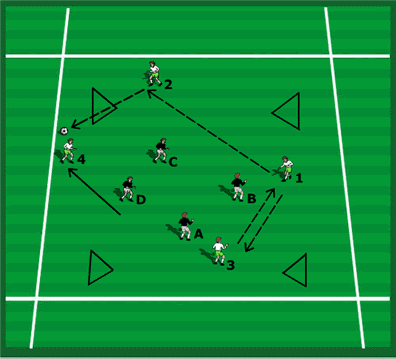
Using two wide positioned goals for each team to attack. This is designed to encourage players to spread out when they attack and switch play; changing direction if one route is blocked. Looking for quick transition and movement off the ball to create space but attacking the space when it is on to do so. The first thought of the player on the ball should still be “Can I run or pass the ball forward.”
Coaching Points:
Creating Space – for yourself and your teammates.
Decision – When, Where and How to pass the ball.
Technique – The Quality of the pass (Accuracy, Weight, Angle).
Support Positions of teammates (Angle, Distance and Communication). Supporting in front and behind
Switching Play using width in attack, drawing defenders to one side of the field then switching the play quickly to attack the other open side to score. Here the ball is played to (3) from (1), the defending team is drawn towards defending their right side goal. The attacking team stay spread out and this situation shows how a pass back to (1) then quickly across to (2) can open up an attack to the other left side goal.

Directional Awareness Four Team Passing Game - Training Center Exclusive
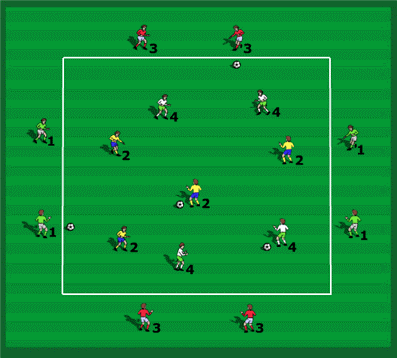
Objective: Awareness of Teammates and Opponents Positioning on the Field in Advance of Receiving the Ball
We are working on: When and where to pass, Looking before receiving, Awareness of player positions before receiving the ball, Awareness of options on the ball before receiving it, Awareness of Opponents positions before receiving the pass and Maintaining possession of the ball
*Membership Required
Objective:
Awareness of Teammates and Opponents Positioning on the Field in Advance of Receiving the Ball
Coaching Points:
When and where to pass (timing, accuracy, weight)
Looking before receiving
Awareness of player positions before receiving the ball
Awareness of options on the ball before receiving it
Awareness of Opponents positions before receiving the pass
Maintaining possession of the ball
Rules:
Warm Up:
Two balls per inside team (or more). (2)’s pass to (1)’s and (4)’s pass to (3)’s. The two groups work across each other. Four teams working but in pairs.
Directional session now working across each other, needing to know where their teammates are but also where the other numbered players are in the middle. This improves awareness and the peripheral vision of the players.
A good lead in to everyone being free in the area and passing and moving later.
Players need to look before they receive, see what the options are in advance of the ball.
Progressions:
Passing in straight and / or angled lines
Running in straight and / or angled lines
Mixing the two up
Players pass to the end players only, to begin transferring the ball from one side to the other. If both players on the other side have balls at their feet then liken it in a game to the strikers being marked and you have pressure on the ball preventing a forward pass so you have to go back to where you came from, either to the other player you did not receive the pass from or back to the same player.
Passing inside the area to team mates in the buildup not just to the outside players.
Introduce give and go’s with outside players (players then keep the same ball throughout a set time period)
Switching positions with the outside
Passing inside the area first then outside
Outside players can pass to each other on the same side the ball moving and keep the inside players alert as to where the ball is.
Outside players switch positions with and without a ball, if without the ball then they are now moving targets as it would be in a game.
All players communicate with each other to help make each movement and pass successful (above as (4) receives the pass, (3) calls to let him know they are free to receive the next pass.
Ask inside and outside players to pass to space to move players into better positions to receive the pass.
Liken To Working Through The Thirds Of The Field (Defender To Midfielder To Striker And Back)

Above; (2) passes to space to move outside player (1) to receive. (3) Passes to space to move (4) into the path of the pass. (4) And (1) respectively can help (2) and (3) by pointing to where they want the ball if they identify the space to pass it to first.
Where is the space to take my next touch (if it open it could be towards the player they are about to pass to), or can I pass it one touch to (3) on the other side?
Already as this pass is coming in to (3) another (4) player is looking to support the next pass going back.

Competitive: The Game Situation
One ball only. Now we take the session into a game. (2)’s play against (4)’s. It is a 4 v 4 game.
(2) work with (1)’s on the outside and score by completing a pass to the outside players. They then have to get the ball to the other side to score again. (4)’s work with the (3)’s on the outside so teams play in opposite directions. Play to 10 goals then rotate the players so the (1)’s play against the (3)’s. Rotate the teams so the (1)’s play against the (2)’s and the (3)’s against the (4)’s. Here the number (4) team have scored one goal at one end then switched the play to the other end by quick accurate passing to score another goal.
The set up is designed to make it easier to maintain possession because they are going both ways and it is much more difficult to defend against. Players who give the ball away cheaply get punished because of this as it may be a while before they can win it back due to the set up so everyone has to stay focused.

Outside player’s one touch, inside players two or three touch restriction. This forces players to use their awareness to be successful. Outside player has only one touch so as the ball is traveling to them the inside players know this and need to get in position to support early. Player passing to the outside player knows they only have one touch so the weight of the pass must be right.
Progression: To score the player passing to the outside player cannot be the player to receive it back immediately. If they do they maintain possession but it is not a goal. This means at least one other player MUST get into a support position to help the outside players pass (and score a goal).
Progression: the first outside player receiving has to pass to the second outside player, then the inside players have to position and work an angle of support off of the 2nd player.


One Touch Weight and Accuracy Passing Drill
The emphasis in this drill is on executing one-touch passes with the correct accuracy and weight. If players can't pass and receive the ball in soccer, they will not be successful. The coach of youth players should emphasize technical training while also having a basic understanding of correct technical execution.
The following drill comes from Soccer Awareness eBook 3: 33 Passing And Receiving Practices For U6 To U10.
If players can't pass and receive the ball in soccer, they will not be successful. The coach of youth players should emphasize technical training while also having a basic understanding of correct technical execution. This can be accomplished using a variety of conditioned games to teach techniques in a way that provides plenty of repetition. This book contains 33 passing and receiving drills that you can implement with your team. Each exercise is explained and important coaching points are emphasized. Click here to preview
Emphasis: Executing one-touch passes with the correct accuracy and weight.
Set-up: 15 x 15 yard grid. Five players per group with one player designated as server. Flags are placed to create a target area at one end of the grid as shown. Players begin at the opposite end of the grid. A supply of balls is placed next to the server.
Objective: The first player in line must run forward, receive a pass from the server and one-touch the ball towards the target area. Points are awarded if the ball comes to rest inside the target area. After each attempt the next player in line repeats the sequence. Each player must quickly retrieve their ball; return it to the server before joining the back of the line. Play is continuous for a predetermined period of time. Switch the server after each round of play.

Progression: Introduce a competition format – first player or group to 5 points wins.
Coaching Points:
Lock the ankle with the toe slightly pointed up.
Non-kicking foot must be placed in line with the target.
Redirect the ball towards the target area.
Follow through and adjust the weight as necessary.
Get more like this in Soccer Awareness eBook 3: 33 Passing And Receiving Practices For U6 To U10.

Spatial Awareness Passing Game - Training Center Exclusive
With cones / mannequins for development in training for movement off the ball
The objective is this session is to improve movement off the ball by providing mannequins to act as opponents to fill important space.
Here you see so much one touch play that needs to be practiced with lots of one touch training (but in overloads to gain success initially). We focused on two touches and beyond but the ultimate way to practice this is one touch; but we are not ready to do that yet. It makes wonderful viewing and is a fantastic visual support tool for raising awareness.
Subscribe to the Soccer Awareness Training Center to get access to all premium Training Center Exclusive articles.
With cones / mannequins for development in training for movement off the ball
Getting into passing lanes to help each other

We can use many upright cones to represent opponents rather than mannequins.
We set the cones up in triangles and diamonds.
We ask players to position between the cones in the best space available.
Try to balance their position to find the best space in the middle of the triangle or diamond of cones (opponents)
Players beyond the ball try to position in triangles and diamonds of support also.
OBJECTIVE: To improve movement off the ball by providing mannequins to act as opponents to fill important space

A non-directional training practice
Mannequins represent opponents on the field. They fill important spaces so the players need to pass and move around and between them. This ensures players move off the ball to help the player on the ball have as many options as possible for a pass. The goal of the players is to find as much space as they can between the mannequins to give themselves as much space as possible to play in.
Every now and again stop the practice and see where the players are positioned. Are they in free space? Are they too close to a mannequin and hence in a game situation not available for a pass? If they are then ASK THE PLAYERS to SHOW you a better position to be in.
Possible problems here are the positioning of players behind opponents so the player on the ball cannot see them to pass to.
Develop: Restrict the number of touches on the ball to 3 touches, two touches then one touch; if it is on to do so. To enable one touch to be possible movement off the ball has to be intelligent, fast and into space to help the passer play one touch. Thinking AHEAD of the ball arriving is paramount here otherwise one touch play cannot be performed successfully. Try to think two moves ahead.

Increasing the number of balls being used to two, then three.
More footballs means more decisions to make as to which ball to support, this should improve peripheral vision.

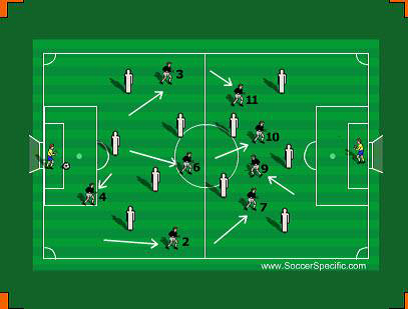
(1) passes to (4) who has moved between the mannequins to the biggest and most open space possible to receive. (6) Moves between the mannequins also to receive the next pass. Show the difference between the timing of (6)’s move and how it will effect (4) in terms of potential possession and number of touches on the ball.
Show when (4) receives the pass and looks for the next pass (6) then moves and then show the difference when (6) moves as the ball is being passed to *(4) or even when (1) shapes up to pass depending on the distance (6) has to move to get free to receive.
Therefore; (6) should be moving as the ball is being passed to (4); or even before, so the ball can be moved more quickly. The other players also are looking to find the best space to be in to offer options for the next pass.

Here we show the end initial movement of the other players to support (6) and offer him as many options as possible. Each player has attempted to find the biggest and best space possible to receive the pass.

Bring in more footballs to increase the intensity of the practice and offer more decisions to make on passing and support and movement off the ball to receive.
With more balls the players now have to avoid and keep free from the mannequins but also the other players.
Passing in threes

Now we have three groups of three passing and moving. 1, 2 and 3, 4, 5 and 6, and 7, 8 and 9. Emphasize the movement off the ball especially by the third player who should be moving to receive based on the ball being in possession with the first player and ready to pass to the second player.
Equate this to ‘THIRD MAN RUNS” off the ball.
Watch Barcelona and how they play, the players are always moving off the ball to find space and to get between opponents to receive, plus they do it “at least” two moves ahead.
Now competitive
Need peripheral vision to know, where opponents are; where cones are (representing opponents too); and where own players are and being in the best space they can be to receive the ball..
We also set up triangles of pinnies to represent areas of freedom to receive a pass (opponents cannot tackle you in them) we can move into that also represented goals being scored.
Different colors in each three

Color identification now becomes a factor. Not only are they looking for their teammate but they are looking for a different color to pass to. These changes are all designed to challenge the players quick thinking, passing and movement off the ball.

Here showing possible passing routes with each group of three players also showing how they get free and into as much space as possible, based on the positions of the mannequins who act as opponents filling spaces.
Game Situation

Have players passing in two teams to begin as a warm up, with a ball each team, then two and three balls each team. Then they pass to opposite colors only.
Now play a 6 v 6 (or any number you like) and make it a possession game. Mannequins make it more difficult by filling spaces so players have to play around them as well as their opponents. This should improve them playing in tight situations.
Use a 2 player overload if required initially until they get really good; then make it equal numbers each team, you dictate this based on the ability of your players. Of course change the numbers of touches on the ball decreasing the number as they become proficient to increase the difficulty.
THIS IN TRAINING
Here you see so much one touch play that needs to be practiced with lots of one touch training (but in overloads to gain success initially).
We focused on two touches and beyond but the ultimate way to practice this is one touch; but we are not ready to do that yet.
Related to this below: (think early/move early/play early) that should be a major focus of our training
It makes wonderful viewing and is a fantastic visual support tool for raising awareness of:
Patterns/shapes - particularly the importance of triangles / diamonds and thinking in shapes
Early good decision-making and the TMP principle (think early/move early/play early)
Anticipation and awareness
Playing early and easy - play the way you're facing
Support play
Creating good options
Switching play quickly and safely
Movement OFF the ball by others is paramount here also otherwise the person receiving the pass will not be able to play one touch successfully.
Play the Numbers Game: 1 passing to 2, 2 to 3, 3 to 4 and so on. Increase the number of balls being used.
Two teams playing in the same area with a ball each. Now players need to avoid the other team AND the mannequins to find space to receive the pass.
Coaching Points:
Thinking and looking before receiving of the receiving player so they have assessed their options before receiving and in advance of the ball
Ability to play ONE touch if possible for speed of play
Movement OFF the ball of teammates to help the player on the ball
Movement INTO spaces between and around the mannequins to enable this to happen using the mannequins as guides.
Thinking TWO moves ahead to support.
Playing in triangles of support offering several options for the player on the ball in many directions.
1. An exaggerated situation but this shows what happens when players do not move to space to help the player on the ball; and do not open up the angle for a pass, instead standing behind an opponent and not being free to receive. How many times do you see this? 2. To defeat this problem; the player on the ball can pass to a space hoping that this will force the receiver to move to that space to receive the ball. Then the weight; timing and accuracy of the pass has to be particularly good; but this is not ideal. 3. Whilst players can still be successful with later movement off the ball of supporting players; if the player on the ball has time on it to take more touches; it is always better to provide options of a pass as early as possible to increase speed of play and give opponents less time to work out their movements.
Develop: Add goals within the area that are both FREE zones and goals. Players can move into them and not be tackled.
Players must arrive in the goal as the ball arrives for timing, not stand in there and wait and be marked in a game situation.

One Touch Give and Go Passing and Receiving Drill - Training Center Exclusive
The emphasis of this drill is on accuracy and weight of one-touch passing.
The following drill comes from the Soccer Awareness Training Center. Soccer Awareness Training Center provides unlimited access to Wayne Harrison's Soccer Awareness systems, training sessions, drills and more. Wayne's system helps develop world class youth soccer players and teams in a systematic and imaginative manner that guarantees performance at the highest level of competition. Whether you’re a beginning coach who needs help getting started or someone who wants to add some variety to their training sessions, the Soccer Awareness Training Center offers a wide variety of drills to choose from. Join Today
Emphasis: Accuracy and weight of one-touch passing
Set-up: 10 x 10 yard grid. 4-5 players per grid with one player designated as server. Two cones are placed at the mid-point of the grid. The server is positioned at the end of the grid with a supply of balls as shown. The remaining players begin at the opposite side of the grid.

Objective: The first player in line must jog forward towards the server. The server must pass (1) a ball to the player when he reaches the cones (midpoint of the grid). The player must attempt to return the ball accurately to the server with a one-touch pass (2). The next player in line begins the sequence immediately after the player in front has completed the pass. Play is continuous for a designated period of time.
Progression: Limit the server to one touch to increase the tempo of the exercise.
Coaching Points:
Lock the ankle with the toe slightly pointed up.
Non-kicking foot must be placed in line with the target.
Follow through and adjust the weight as necessary.

Passing and Support Using Seven Players
With this overload situation it is a very good opportunity to practice overlaps, 1 – 2’s, diagonal runs in front of the ball and takeovers.
The following post if an excerpt from the Combination Movement Section in the Soccer Awareness Training Center. Soccer Awareness Training Center provides unlimited access to Wayne Harrison's Soccer Awareness systems, training sessions, drills and more. Wayne's system helps develop world class youth soccer players and teams in a systematic and imaginative manner that guarantees performance at the highest level of competition. Whether you’re a beginning coach who needs help getting started or someone who wants to add some variety to their training sessions, the Soccer Awareness Training Center offers a wide variety of drills to choose from. Join Today
With this overload situation it is a very good opportunity to practice overlaps, 1 – 2’s, diagonal runs in front of the ball and takeovers.
If you include a keeper then this player can pass the ball into any of the four attackers and (A) and (B) can close them down as the ball travels. Try to create a 2 v 1 set up somewhere on the field of play from the 4 v 2 situation.
Players can make their plays using each other’s movement as a decoy as well as an exchange of possession of the ball.
Playing offside makes this set up more realistic.
Condition the attacking players where they can only score with two touches (or only one touch if possible).

The above set up shows a typical overlap situation. (1) Can make two decisions; to pass to (2) on the overlap or use (2)’s run to take (B) out of position and come inside with the ball creating a 2 v 1 against (A).
It is important for players to realize (in this case player 2) that they make runs to create space for themselves and also for their teammates.

Long-Short Passing Drill
Work on team passing with this long-short video drill from Wayne Harrison and Soccer-Coaches.com.
Get more like this and Soccer Awareness, One-Touch Mentality by Wayne Harrison at Soccer-Coaches.com.
54 Pages
We want to stay with our own game plan as closely as possible; based on what we practice and to keep it simple for us; as we dictate to our opponents; and we impose OUR WAY on them.
But there will be many occasions where we must change the system of play and we may have to adjust to suit the opponents.
Here are some ideas for you to consider for your team starting with the 13313 and 14231 systems of play.