Welcome to the Soccer Awareness Coaches Corner. Browse through soccer drills, small sided games, tactical thoughts, full sessions and a variety of resources. Posts marked “Training Center Exclusive” are for members only.

Positional Possession Areas to Create Superiority - Training Center Exclusive
This game and its many progressions are designed to get the most out of the thinking processes of the players. Many mental challenges to overcome and learn from. In the game players must develop the ability to be calm under pressure, to be confident to receive the ball in tight spaces and to have the confidence of teammates to give the ball to you under pressure. Players need to develop their ability to look ahead of the ball even more, to assess options and make decisions even faster because the time on the ball is even more restricted than usual.
This article is available for Training Center Members Only. Get more information about joining here.
This game and its many progressions are designed to get the most out of the thinking processes of the players. Many mental challenges to overcome and learn from. In the game players must develop the ability to be calm under pressure, to be confident to receive the ball in tight spaces and to have the confidence of teammates to give the ball to you under pressure. Players need to develop their ability to look ahead of the ball even more, to assess options and make decisions even faster because the time on the ball is even more restricted than usual.

Fast Paced Directional Transition And Possession Target Game - Training Center Exclusive
GAME OBJECTIVE: Developing movement off the ball offensively, pressing the ball and tracking movement “off the ball” defensively.
This game and its many progressions is designed to get the most out of the thinking processes of the players. Many mental challenges to overcome and learn from.
*Membership Required
This game and its many progressions is designed to get the most out of the thinking processes of the players. Many mental challenges to overcome and learn from.
On gaining possession players must change the point of attack to score a goal.
Coaching Points:
Continuums Model to work off and relate to.
An Awareness of the passing player of where teammates and opponents are positioned AND where the space is (Look and Think Before receiving)
An awareness of the receiving player as to when the passer is ready to pass (Look and Think Before receiving)
Good communication via visual cues through eye contact or aural cues through speaking makes this work (Communication)
Establishing an open stance for greater peripheral vision and an angle of support (body position and feet preparation)
Movement OFF the ball by the players in possession to get free and into open space (Tactical Mobility)
Timing and angle of the runs (Tactical Mobility)
Timing; accuracy and pace of the pass (Technique)
Good receiving and turning technique with an awareness of what is behind before receiving it (Technique, Control and Look and Think)
Move and join in the next phase of play (Tactical Mobility)
If we lose possession try to win it back immediately (Mental and Physical Transition)
And of course the SKILL FACTOR, decision making; is based on all.
Fast paced directional transition and possession target game
GAME OBJECTIVE: Developing movement off the ball offensively, pressing the ball and tracking movement “off the ball” defensively.
RULES:
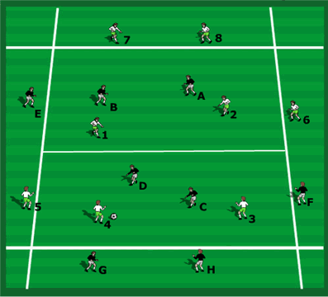
Players must pass the ball to their target players to score. To score again they have to work the ball back into their own half of the field to be able to return.
Target players have two touches as do side players.
COACHING POINTS:
Creating Space by running off the ball to receive or to help a teammate receive.
Quality of Passing; long and short to targets and to teammates.
Support play: working angles and distances incorporating switching play using the side players.
Receiving and Turning in tight situations and dribbling in 1 v 1 situations.
Quick decision making is required in this session because the numbers are small, the area tight and the transitions rapid.
Develop:
No restriction on touches then 3, 2 or 1 touch, but only if it is on to do one touch.
All outside and target players have one touch only where possible
Switch with target players as they receive the ball.
Switch with outside players
Here is an example of the transition and movement off the ball to make it happen.
(2) passes to target player (8) who brings the ball back into the playing area.
(3) makes a run into the other half of the field on the blind side of (C) to receive the next pass. They need to get the ball into that half to be able to score.
(1) makes a forward run into space to receive the next pass off (3) and passes to target player (7) who can start the play again.
(1) switches with (7) and becomes a target player for the next phase of play.

Elements of play the target game teaches
A) Attacking as a Team and as Individuals.
Creating Space by running off the ball to receive or to help a teammate receive.
Developing quick support play working angles and distances incorporating switching play using the side players.
Passing long and short to targets and to teammates.
Receiving and turning in tight situations and dribbling in 1 v 1 situation’s.
Lots of touches on the ball for the players in this practice.
Quick decision making is required in this session because the numbers are small, the area tight and the transitions rapid.
B) Defending as a Team and as Individuals.
Pressurizing players on the ball to regain possession.
Supporting pressuring players and tracking runners off the ball.
High pressure to regain possession in the attacking half to be able to go straight to the target to score.
C) Transitions from defense to attack and attack to defense, quick decision making and improved concentration as the switch occurs. Interchanges of positions between inside players, targets and side support players
D) As a coach you can work in this session how to defend properly as individuals and a team or how to attack properly as individuals and a team.
Progressions
No restriction on touches then three, two or one touch but only if it is on to do so.
Introduce neutral player so a 5 v 4 overload in the middle if possession isn’t kept easily.
Interchanges of players outside to in, inside to out.
Have one teammate at each end so you are attacking both ends but once you have passed to one target you keep possession and must try to get to the other target. You can’t go back unless the opposition win the ball and then you get it back, only then can you go back to the same target.
To lessen the workload and keep everyone involved have players switch with targets and outside players when they pass to them.
The team can only score if they get an overlap, crossover or 1 – 2 in during the buildup.
No talking so players have to rely on their own vision to play.
Players move into the target zone to receive (timing of run and pass) so we don’t play with actual targets, different players can then become the target player.
Man – Marking – Have the players man mark so they must track a player when they haven’t the ball and they must lose their marker when they have the ball.
To improve the speed of thought reward a successful one touch pass with a goal or point. To score a goal by passing to the target player now reward this with three goals or 3 points.
The team in possession can pass back to the opponents target players to help keep possession of the ball. Liken this to passing back to the keeper in

Improving Basic Dribbling & Awareness with Lots of Touches in Possession of the Ball
Four areas of Awareness:
- “On the Ball” Awareness before receiving the ball,
- “On the Ball” awareness as the player receives it and moves it on quickly using one or two touches only;
- "On the Ball” awareness if the player maintains possession of the ball using several touches; and:
- “Off the Ball” awareness in terms of their positioning of players supporting the player On the Ball.
This works if all players are in synch and thinking ahead of the ball and it is not just the player on the ball thinking ahead.
Clinic 1a): Objective: Improving basic dribbling and awareness with lots of touches in possession of the ball
SOCCER AWARENESS DEVELOPMENT FOR COACHES AND PLAYERS
Four areas of Awareness:
- “On the Ball” Awareness before receiving the ball,
- “On the Ball” awareness as the player receives it and moves it on quickly using one or two touches only;
- "On the Ball” awareness if the player maintains possession of the ball using several touches; and:
- “Off the Ball” awareness in terms of their positioning of players supporting the player On the Ball.
This works if all players are in synch and thinking ahead of the ball and it is not just the player on the ball thinking ahead.
This is awareness with lots of touches on the ball.
Principles of Dribbling
- Initial Movement: In a straight line at a slower speed.
- Deception: Unbalance the opponent.
- Accelerate: Into space using change of pace
- Space behind opponent: pass the ball past defender and run.
- Restricted space behind: dribble past defender (in slow, out quick).
Coaching Points:
- Tight close control.
- Skill to use body to dummy and feint.
- Skill in changing direction and pace.
- A positive attitude.
- Use of own or established dribbling
- Looking around with your head up to have an awareness of where the other players are and where the immediate space is to move into.
- This is more looking for yourself and when you are ON the ball.
A way to test if they are really looking around and behind is to ask them to stop, and then ask them, without them looking again, who are immediately behind them. If they were looking they will know.
1. Coaching Points
- Awareness of where other players are whilst maintaining possession of the ball ensuring players are looking around away from their own ball
- Dribbling and Turning
- Shielding
- Anaerobic Fitness work.
2. Moving around with the ball, staying in space with your own team to begin then players mixing in with each other. Stop and check positions. Check how spread out players are, discuss the implications of being in possession of the ball in a game and making it hard for the opposition to mark you by using as much width and length as possible. Therefore the players must use the spaces as effectively as possible.
3. Continue with dribbling and turning but emphasize keeping the head up and not looking at the ball but looking around, in front, and side to side and behind (for younger players equate it to a bird on a fence, that is, a bird on a fence just spends time looking around). The players can see the ball in their peripheral vision without looking at it directly.
4. Emphasize awareness of where other players are who are working in the same area by looking around; in front, to the side, and behind. Set the rule that when a player meets another player they must move to get away from them as if they were a defender in a game situation.
5. Ball each player dribbling and turning in a tight area avoiding other players. Coach can dictate techniques practiced. Work on improving ball control with quickening movement.
6. Keep emphasizing looking away from the ball and not down at it all the time so they get an
awareness of player positions and where space is to play in. This is the basic beginning of awareness training.
7. Have players running INTO traffic testing their ability to control the ball and observe others in the same spaces, again increasing the awareness concept.
8. Commands
- Turn (checking that no one is behind them first of all with a look over the shoulder then a turn if the space behind is free) Doing different turns they are good at.
- Out (they run outside the nearest line and check back in always looking to over the shoulder to see where other players are so they do not run into them.
- Switch (changing soccer balls and continuing dribbling)
- Dribble (using a dribbling skill they are good at in a tight area)
- Right foot only (inside and out) This is more difficult so they will tend to look at the ball but remind them to look up when and where they can
- Left Foot only (as above)
- Quick (change pace and move more quickly for a few seconds but with the ball under control)
- Number (coach will hold their hand up with a number of fingers indicated, the players have to shout the number immediately by looking up and observing but also keeping control of the ball).