Welcome to the Soccer Awareness Coaches Corner. Browse through soccer drills, small sided games, tactical thoughts, full sessions and a variety of resources. Posts marked “Training Center Exclusive” are for members only.

A Rondo Overloading Players in the Zone 14 - Training Center Exclusive
A rondo can be applied on certain parts of the field of play that apply to the game. This exercise is based on the positioning of the players around Zone 14 (the zone in front of the opponents back 3 or 4 and their midfield).
Here we start the exercise off as a typical rondo and develop the idea to take it into the game situation. This example can be the shape within a 4-2-3-1 system of play. I have used this same set up many times in training to bring the ideas out in actual games with my U14 team. Certain moves become almost automatic as each player mentally knows what the other will do; before they do it. Especially good when teams defend deep against you and you have to open them up with imaginative movements OFF the ball. I love this session.
*Membership Required
A Game Situational Soccer Awareness Rondo
A rondo can be applied on certain parts of the field of play that apply to the game.
This exercise is based on the positioning of the players around Zone 14 (the zone in front of the opponents back 3 or 4 and their midfield).
Here we start the exercise off as a typical rondo and develop the idea to take it into the game situation.
This example can be the shape within a 4-2-3-1 system of play.
I have used this same set up many times in training to bring the ideas out in actual games with my U14 team. It works; we ended up ranked 5th in the USA developing these as well as many other moves.
Certain moves become almost automatic as each player mentally knows what the other will do; before they do it.
And that is in a 1-3-3-1-3 system of play also (which is the attacking team shape of the 1-4-2-3-1 anyway).
Especially good when teams defend deep against you and you have to open them up with imaginative movements OFF the ball. I love this session.
An Attacking Team Shape Rondo
2 v 2. (8) and (10) keep the ball away from (6) and (8). They can use outside players as support and play two touches for speed of play. Defenders try to keep the ball if they win it

An attacking Team shape drill with interchanges
Players move in and out on the attacking team to confuse opponents. This is so much more than a typical possession game with players on the outside as each player moves based on the 4-2-3-1

Add wing backs and add a defender
A very attacking way to play now with wing backs included so more options of movement and interchange OFF the ball to further confuse opponents.

An attacking Team shape drill with interchanges
Add Wing backs (2) and (3). Introduce another defender to increase the pressure. Make it a 2 v 3 against in the middle. Players can rotate on the blind side of the ball

Make it a 4 v 2 against on the inside
As we get good at this increase the difficulty inside of Zone 14. Now its a 4 v 2 against so (8) and (10) have to work harder to find open passing lanes to play in and we need to ensure teammates interchange with them to increase the difficulty for the defenders also.

Phase of Play: Movements in the Attacking Third
The set up as a Start Position. We are looking at rotation between the players in a positional sense. Shadow play to begin. Coach can determine certain moves to begin then players invent them for themselves

Phase of Play: Movements in the Attacking Third in a 4-2-3-1
After movement. If defenders are marking them and tracking their runs then this can cause great confusion. Here we have a 4 player rotation.

A Four Player Rotation
After movement. If defenders are marking them and tracking their runs then this can cause great confusion. Here we have a 4 player rotation.

Wing backs in
Introduce Wing Backs and now we have 6 or 7 players attacking and moving around changing positions to attempt to confuse the opposition.

Phase of Play: Movements in the Attacking Third
Show each rotation in 2’s, 3 and 11, 2 and 7, 9 and 10 and so on. A lot of interchanging positions that will set a big challenge to the defenders rather than; as often happens; players run up and down in straight lines which is easy to defend against..

Phase of Play: Movements in the Attacking Third
End Product of all the movements. A lot of interchanging positions that will set a big challenge to the defenders rather than as often happens players run up and down in straight lines which is easy to defend against.

Defenders in to make an 8 v 7 Phase of Play
Introduce OPPONENTS and show how your players movements OFF the ball will affect them.

Positioning in what I call “NO MANS LAND”
You want defenders to have to “second” guess who will mark (2) and (11) as they cut inside so they position BETWEEN (A) and (B) and (C) and (D). Defenders (A) and (D) have a choice track inside or stay wide? To reiterate we want (2) and (11) to position in the spaces between the fullbacks and center backs. Creating 2 v 1’s.

Phase of Play: Example of a Play
(9) Short; defender (C) tight, space behind for (2) to run in to the receive the pass and be in on goal. Defenders (A) and (D) have a choice track inside or stay wide? We want (2) and (11) to position in the space between the fullbacks and center backs. Creating 2 v 1’s.


Triangle Rondo and Angled Support for 6 Players
Two balls going at once. 1 touch if possible otherwise two touches maximum to keep the timing going. Players don’t rotate positions. Repeats every 5th pass. Coordinated movements and rhythm between groups.
The following drill comes from the new Rondos section of the Soccer Awareness Training Center. Soccer Awareness Training Center provides unlimited access to Wayne Harrison's Soccer Awareness systems, training sessions, drills and more. Wayne's system helps develop world class youth soccer players and teams in a systematic and imaginative manner that guarantees performance at the highest level of competition. Whether you’re a beginning coach who needs help getting started or someone who wants to add some variety to their training sessions, the Soccer Awareness Training Center offers a wide variety of drills to choose from. Join Today
Two balls going at once. 1 touch if possible otherwise two touches maximum to keep the timing going.
Players don’t rotate positions. Repeats every 5th pass. Coordinated movements and rhythm between groups.


Barcelona Double Rondos with a Neutral Player Added

Sliding Rondo Playing 1 and 2 Touches

Double Diamond Rondos for 10 Players

A Rondo Overloading Players In The Zone 14 - Training Center Exclusive
This Rondo is perfect for a starting point on rotation and movement in front of opponents defense. Teams may work out that we are good at playing penetrating passes and making great runs in behind them so the way to try to stop this is to defend deep.
If they defend deep we need a tactical solution to counter this. This presentation gives you ideas on how to do this and play initially IN-FRONT of the opponents back four.
Bayern Munich and Barcelona are very good at this, both motivated and taught by Pep Guardiola.
Soccer Awareness Training Center members can download this full 20 page session below.

This Rondo is perfect for a starting point on rotation and movement in front of opponents defense. Teams may work out that we are good at playing penetrating passes and making great runs in behind them so the way to try to stop this is to defend deep.
If they defend deep we need a tactical solution to counter this. This presentation gives you ideas on how to do this and play initially IN-FRONT of the opponents back four.
Bayern Munich and Barcelona are very good at this, both motivated and taught by Pep Guardiola.
We can do it at our age level just as effectively. We can practice this in a tight area, with the relevant players in their usual positions in the attacking third and just play possession as a warm up.
Lots of repetition in training to embed the ideas in the players minds.
Setting Conditions To Make It Work
We overload zone 14 as shown. Condition the back four to not be able to go past the blue cones to keep them defending deep. Condition the attacking players to stay inside the Zone 14 orange coned off area so they MUST condense and get tight and get close to each other.

Getting Shots In On Goal
Again short and sharp build up, good positions in tight spaces between opponents and movements OFF the ball to get free to get into a shooting position. Other players follow in for rebounds but time it so they are not offside. Typical Messi run.

Overloading Players In Front Of The Opponents Two Center Backs
We want to overload Zone 14 in the center of the field by maintaining two wide players so there is an option to play wide. The idea is to get up in numbers in front of the two center backs. If the fullbacks tuck in to help as they have here and equal the numbers up then we can go wide to (2) and (11). Here a 3 v 2 centrally. (A) and / or (D) may tuck in but this frees up (11) and (2) wide.

This can be one full session practicing playing short and tight and with quick 1 and 2 touch play. Players must move subtly to get into open very tight passing lanes between opponents.
Play quickly.
Soccer Awareness Training Center Members can download this 11 page eBook for free below. Now a member? See all the benefits of joining here. Try a monthly membership for free.




The Importance of Developing Players Through Teaching Rondos
Rondos are a great way to prepare players for the game situations and especially the fast decision making needed within the game. Though the foundation of the basic rondo stays the same, it can be made more difficult or easier by the number of touches players are allowed for example so it benefits ALL players who practice with them.
The following comes from Soccer Awareness eBook "Developing Players with Rondos Using the Soccer Awareness Philosophy"
This 222 page eBook explores the use of rondos in youth soccer. Rondos are a great way to prepare players for the game situations and especially the fast decision making needed within the game. I have included as a way to work into these game situations many Rondo ideas that I feel are great foundation builders for players learning to combine and play together. I have stayed with simplistic ideas that all levels of players can try and be successful at. It is up to each coach to work out how to make it work for their players.
Though the foundation of the basic rondo stays the same; we explore different ways to present it. It can be made easier or more difficult based on the number of touches players are allowed, for example, so it benefits ALL players who practice with them; also the size of area they play within can be manipulated to change the challenge. Preview Here
This is an introduction to my book exploring the use of rondos in youth soccer.
I have included as a way to work into these game situations many Rondo ideas I feel are great foundation builders for players learning to combine and play together.
I have stayed with simplistic ideas that all levels of players can try and be successful at, it is up to each coach to work out how to make it work for their players.
Though the foundation of the basic rondo stays the same, we explore different ways to present it. It can be made easier or more difficult based on the number of touches players are allowed for example so it benefits ALL players who practice with them; also the size of area they play within can be manipulated to change the challenge.
Rondos are a great way; in my opinion; to prepare players for the game situations and especially the fast decision making needed within the game.
Pep Guardiola quoted this about rondos at Barcelona: “What I learnt here is everything starts with the ball and ends with the ball. Sometimes we forget that it’s a game of 11 v 11 with ONE BALL. We try to keep this ball, we try to play with this ball, we try to make everything with the ball. This is what we learn when we start as children there.”
What Do Rondos Teach?
A rondo for example isn't just 4 players playing keep away from a single player and a bit of fun (though they Are fun), what you get out of a rondo is the following:
Soccer Awareness: Assessing options BEFORE receiving the ball: The Think and Look
Technique,
Mobility,
Agility and balance
Body position,
Foot preparation,
Communication,
The 1st touch,
The 2nd touch, and beyond
Teamwork,
Collective tactical understanding in a small sided game environment,
Positioning OFF the ball,
Problem solving,
And developing creativity and imagination,
Intensity of play,
Physically challenging;
Developing Angles of support;
Opening up passing lanes by movement off the ball;
Speeding up thinking and decision making, The SKILL FACTOR;
ltimately providing a competitive environment where no one wants to give the ball away nd finally,
They are fun to do.

An example of how we develop a Soccer Awareness Rondo over time and increase the challenges
We begin with a basic Rondo. It is none pressured, unlimited touches, and presented in a simple way to allow the players to easily begin the process of education. It is the attention to detail that is paramount in the learning process. The Ball must be passed around the square not across it. Players adjust their position based on the ball. They use the cones as positional points of reference.
Players MUST always open up their body stance to receive with their BACK FOOT. Ways to build the Rondo and increase challenges:
Playing unlimited touches
Playing 3 touches
Playing two touches;
Playing one touch when able but 2 touches maximum
Adding a defender in the middle so 4 v 1 (can again go back to unlimited touches, 3, then 2, then 1 when able so many more progressions just within the 4 v 1 itself).
Players change position and rotate on the outside
Add another defender, now 4 v 2 (number of touches, size of area change etc)
Challenge outside player to split the 2 defenders with a pass between them
Add a neutral attacking player in the middle who outside players MUST involve consistently so now 4 v 2 plus 1. Neutral player 3 or 2 touches only
Neutral player ONE touch only
Neutral player can rotate in and out with outside players; so very fast decision making in rotations of players added to the passing itself.
Reduce to a 3 v 1 rondo and assess if the players are ready to play 1 or 2 touches yet. A very fast movement off the ball challenge now
Decrease the size of the grid so less space, faster decisions needed; tighter passing lanes to find, better soccer awareness required.
Can you think of any other progressions you could add to this to increase the challenge and intensity of the practice?
Once players are EXCELLENT at all these progressions a logical move now would be to go to double rondos. More players, more options, more decisions, and now mental transitions happen more going from attacking to defending at pace
Get The Book




Quick Transition 2 v 2 Rondos
This is a 2 v 2 game going to 4 goals. The team who scores stays on and must quickly defend the 2 new players coming in (one from each goal that the opposition defends).
The following drill comes from the New Soccer Awareness eBook Developing Players with Rondos Using the Soccer Awareness Philosophy. This 222 page eBook explores the use of rondos in youth soccer. Rondos are a great way to prepare players for the game situations and especially the fast decision making needed within the game. Preview The Book
This is a 2 v 2 game going to 4 goals. The team who scores stays on and must quickly defend the 2 new players coming in (one from each goal that the opposition defends).
Instant transition with the same ball that the opponents scored with, here (3) and (4) are positioned to immediately bring the ball the opponents’ may score with out to attack. The other two players (1) and (2) must get off the field ASAP.
Introduce a target player (can be coaches or players). Now it can be a 3 v 2 effectively.
Players can use the target to play give and goes with each other or with their immediate teammates.
Liken passing into the goal as a midfielder passing into a striker so they get the ball in there as quickly as possible or a defender into a midfielder.
The 1st thought of the player on the ball has to be “Can I score?”
The 1st thought of the 1st defender is can I stop them scoring, win possession immediately, and score myself.
First team to 10 goals wins, keeping the competitive element.
If the ball goes out of play the coach can provide another one to keep things going quickly.
Coaching Points Attacking:
Quick Break and counter attack
Switching the point of attack if another goal is more open
Quick one and two touch passing
Positioning to open up passing lanes and getting between defenders to pass the ball in early
Creating 2 v 1 situations from a 2 v 2 set up and setting up a give and go.
Coaching Points Defending:
Instant pressure as possession changes (transition after scoring going from being an attacker to being a defender)
Regaining possession at the front with a scoring reward
Getting in front of the passing lanes to prevent the quick pass into the goal.
Working together with pressure and support, the support player supporting the first defender, stepping across and covering the passing lane to the second goal and also keeping an eye on the 2nd attacker.
Transition Coaching Points:
Immediately the team that has been in possession of the ball and has scored then they must switch on mentally to being defenders and high pressuring the new attacking team to try to win the ball back and score again.
Area: 15 x 10

A 2 v 2 game going to 2 goals. The team who scores stays on and must quickly defend the 2 new players coming in (one from each goal that the opposition defends).
Offside half way line. Instant transition with the same ball that the opponents scored with.
Players can use the target to play give and goes with each other or with their immediate teammates.

Use the players in the goals to support. They have 1 or 2 touches only so they must play quickly.
Now it is essentially a 3 v 2. For the inside players start with unlimited touches then as they are successful decrease the number to test their peripheral vision and awareness on and off the ball.
Always increasing the challenge each point of success is reached.
Now develop by allowing the balls to transfer

This will really test the players imagination and awareness on and off the ball. In one instant (3) and (4) are defending, in the next they are attacking. Likewise for the letters team.
Here we show how the mental transition works with each team suddenly changing their positions defensively to deal with the change.
Get much more like this in the New Soccer Awareness eBook Developing Players with Rondos Using the Soccer Awareness Philosophy. This 222 page eBook explores the use of rondos in youth soccer. Rondos are a great way to prepare players for the game situations and especially the fast decision making needed within the game. Preview The Book


A Square Passing Rondo Introducing Brain Centered Awareness Training
The goal of this exercise is to help program movements into our players while also helping them develop proper habits to read the game and play in a creative manner.
Groups of 4 players with one ball. Place extra balls either in the grid or nearby to keep the exercise flowing in the event of mistakes.
The Square should be approximately 15×15 yards. There should be three discs at each corner of the square (as pictured).
The Goal of this exercise is to help program movements into our players while also helping them develop proper habits to read the game and play in a creative manner.
Focus: Players should start on the furthest disc from the player they’ll be receiving the ball from.
1st Movement: When player B takes his/her first touch “prepares the ball”, player C should break off the disc “separate from the defender” and show into the space to receive a pass from B. Player D should now be prepared to separate from the defender on player C’s preparation touch. Exercise continues.
Coaching Points:
Crisp Passing
Explosive Separation from defender
Head on a swivel- Can we take a look at where we want to play next as the ball is traveling?
Clean 1st touch

This is an outstanding warm-up to help program players with a proper skill set to meet the demands of the modern game, movement off the ball, timing of runs, crisp passing, taking a look!, but for the exercise to truly be effective, the coach MUST demand that all the movements & requirements of the exercise are carried out at game speed. Coaching Demand: If you let your players get away with things that wouldn’t work in the game during training, what is the point of training?
Add Central Midfield Support Players

Now we have give and goes or 1-2s with each of the four players. Two midfield players rotate in and out and take turns in supporting the outside player. If you only have 5 players use one midfield player only.
If you like this, get much more like it in one of our new ebooks:

Developing Players with Rondos Using the Soccer Awareness Philosophy
This 222 page eBook explores the use of rondos in youth soccer. Rondos are a great way to prepare players for the game situations and especially the fast decision making needed within the game. I have included as a way to work into these game situations many Rondo ideas that I feel are great foundation builders for players learning to combine and play together. I have stayed with simplistic ideas that all levels of players can try and be successful at. It is up to each coach to work out how to make it work for their players. Get It Here

Tactical Thoughts on the Development of the New 4 v 4, 7 v 7 and 9 v 9 Game Sizes
This 407 page eBook shows how these different size games can be taught and also shows different systems of play that might be useful to you.
Run with them as you may and of course come up with your own solutions too as that is what coaching is all about. I have introduced the use of RONDOS to initially aid the development of players for the game situation. Get It Here

How to Develop a Rondo Over Time and Increase the Challenges
This presentations shows the basic Rondo. It is none pressured, unlimited touches, and presented in a simple way to allow the players to easily begin the process of education. It is the attention to detail that is paramount in the learning process. The Ball must be passed around the square not across it. Players adjust their position based on the ball. They use the cones as positional points of reference.
The following is part of Soccer Awareness eBook: Tactical Thoughts on the Development of the New 4 v 4, 7 v 7 and 9 v 9 Game Sizes.
This eBook shows how these different size games can be taught and also shows different systems of play that might be useful to you. I have introduced the use of RONDOS to initially aid the development of players for the game situation. Click Here to Buy the Book
The following diagrams show the basic Rondo we begin with.
It is none pressured, unlimited touches, and presented in a simple way to allow the players to easily begin the process of education. It is the attention to detail that is paramount in the learning process. The Ball must be passed around the square not across it. Players adjust their position based on the ball. They use the cones as positional points of reference.
Players MUST always open up their body stance to receive with their BACK FOOT. Ways to build the Rondo and increase challenges:
Playing unlimited touches
Playing 3 touches
Playing two touches;
Playing one touch when able but 2 touches maximum
Adding a defender in the middle so 4 v 1 (can again go back to unlimited touches, 3, then 2, then 1 when able so many more progressions just within the 4 v 1 itself).
Players change position and rotate on the outside
Add another defender, now 4 v 2 (number of touches, size of area change etc)
Challenge outside player to split the 2 defenders with a pass between them
Add a neutral attacking player in the middle who outside players MUST involve consistently so now 4 v 2 plus 1. Neutral player 3 or 2 touches only
Neutral player ONE touch only
Neutral player can rotate in and out with outside players; so very fast decision making in rotations of players added to the passing itself.
Reduce to a 3 v 1 rondo and assess if the players are ready to play 1 or 2 touches yet. A very fast movement off the ball challenge now
Decrease the size of the grid so less space, faster decisions needed; tighter passing lanes to find, better soccer awareness required.
Can you think of any other progressions you could add to this to increase the challenge and intensity of the practice?
Once players are EXCELLENT at all these progressions a logical move now would be to go to double rondos. More players, more options, more decisions, and now mental transitions happen more going from attacking to defending at pace
Soccer Awareness Sliding Rondos using one and two touches (or more if needed)
SA Sliding Rondos no rotational movement outside to inside

Defending players stay in for one minute then change with outside players. Very fast tempo playing ONE touch where they can. We must play into the central neutral pivot player as often as possible. Do this one with no movement or rotation of players to begin.
SA Sliding Rondos using with only the pivot player changing

Very fast tempo playing ONE touch where they can. Here (E) slides outside and (B) slides inside on the blindside of the ball and (D) makes a one touch pass to (C) who immediately passes to (B) to then pass to (A). Players must slide in and out as often as they can to keep the momentum going.
The Soccer Awareness eBook: Tactical Thoughts on the Development of the New 4 v 4, 7 v 7 and 9 v 9 Game Sizes includes more drills, diagrams and coaching points on utilizing Rondos in your training.


Space Rondos Training a One Touch Mentality - Training Center Exclusive
A great drill for awareness on and off the ball. Passing and moving. Must be one touch and as fast as possible. This one is easy to do on and off the ball.
Objectives:
First touch development
Body positioning
Anticipating situations in advance of the ball
Finding space
Movement OFF the ball
Communication
Mental and physical transitions
*Membership Required
Passing and moving.
Must be one touch and as fast as possible.
A great drill for awareness on and off the ball.
(B) passes to (A) then runs to the free cone the top right of the square.
This one is easy to do on and off the ball.
Objectives:
First touch development
Body positioning
Anticipating situations in advance of the ball
Finding space
Movement OFF the ball
Communication
Mental and physical transitions
A Good Warm Up: Space Rondos using one touch
Passing and moving. Must be one touch and as fast as possible. Here (B) passes to (A) and moved to the free cone. (A) passes to (C) and moves to the free cone. Observation must be away from the ball to see where the free space is BEFORE receiving the pass.

Space Rondos using one touch
One ball, Two balls then 3 balls. Now we add the necessary observation of 2 or 3 balls, as one goes the next one may arrive; so constantly scanning the field.

Players OFF the ball can switch positions now
One ball, Two balls then 3 balls. Now we add the necessary observation of 2 or 3 balls, as one goes the next one may arrive; so constantly scanning the field.

Teaching Anticipation in players
Now we number off each player; you can have 4 to 8 players doing this if you like. If 8 players use 9 cones so always one free one to run to (or more choices if needed). 1 passes to 2, 2 to 3, 3 to 4 and 4 to 5 and so on. So they are watching the player who is passing to them, and scanning where the player they must pass to is at the time; whilst they are moving off the ball too.

Now players position Between the cones (finding space) not on them
Cones represent defenders so players position between them in the best spaces possible. Talk about triangles and diamonds. Pass and move then call stand still. Check positioning.

Now players position Between the cones not on them
Cones represent defenders so players position between them in the best spaces possible. Talk about triangles and diamonds. Pass and move then stand still. Check positioning. Try to position in the biggest space available.
6 points of observation for players:
Team mates positions,
Defenders (cones) positions;
Where Spaces are,
The position of who I'm receiving from,
The position of who I'm passing to,
Where the other balls are which will force each player to consistently scan the field.


Guardiola Rondo Using a 4 v 4 + 3
Here we are showing how this rondo totally relates to the game situation so your training is REALISTIC in its concept development.
The following 4 v 4 + 3 Rondo allows players to understand the principles of width, depth and length to create passing angles and distances. Looking always to create diamond and triangle shapes in supporting each other to create numerical superiority. Here we show a rondo based on building from the keeper and / or building from the center backs. Its actually a very simple way to teach a complex idea.
I put this presentation together off a video of Pep Guardiola training plus a great written piece on this rondo by "The Coaching Manual".
Please take a look - -
Here we are showing how this rondo totally relates to the game situation so your training is REALISTIC in its concept development.
The following 4 v 4 + 3 Rondo allows players to understand the principles of width, depth and length to create passing angles and distances. Looking always to create diamond and triangle shapes in supporting each other to create numerical superiority. Here we show a rondo based on building from the keeper and / or building from the center backs. Its actually a very simple way to teach a complex idea.
You can focus on the attacking players with no defensive transitions with defending players; OR; add transitions when possession changes. I prefer the latter way as it forces players to develop their transitional mentality and physicality. Transition from attacking to defending and defending to attacking must be rapid.
Size of area depends on the ability and skill level of the players; the better they are the smaller the area. Can be 15 x 15 up to 25 x 25 or even larger. Pivot player (6) in particular has to have great composure on and off the ball for this to be successful Can develop the rondo with (6) and (8) in the middle or (8) and (10) depending on how you set your team up.
Equating to the game situation
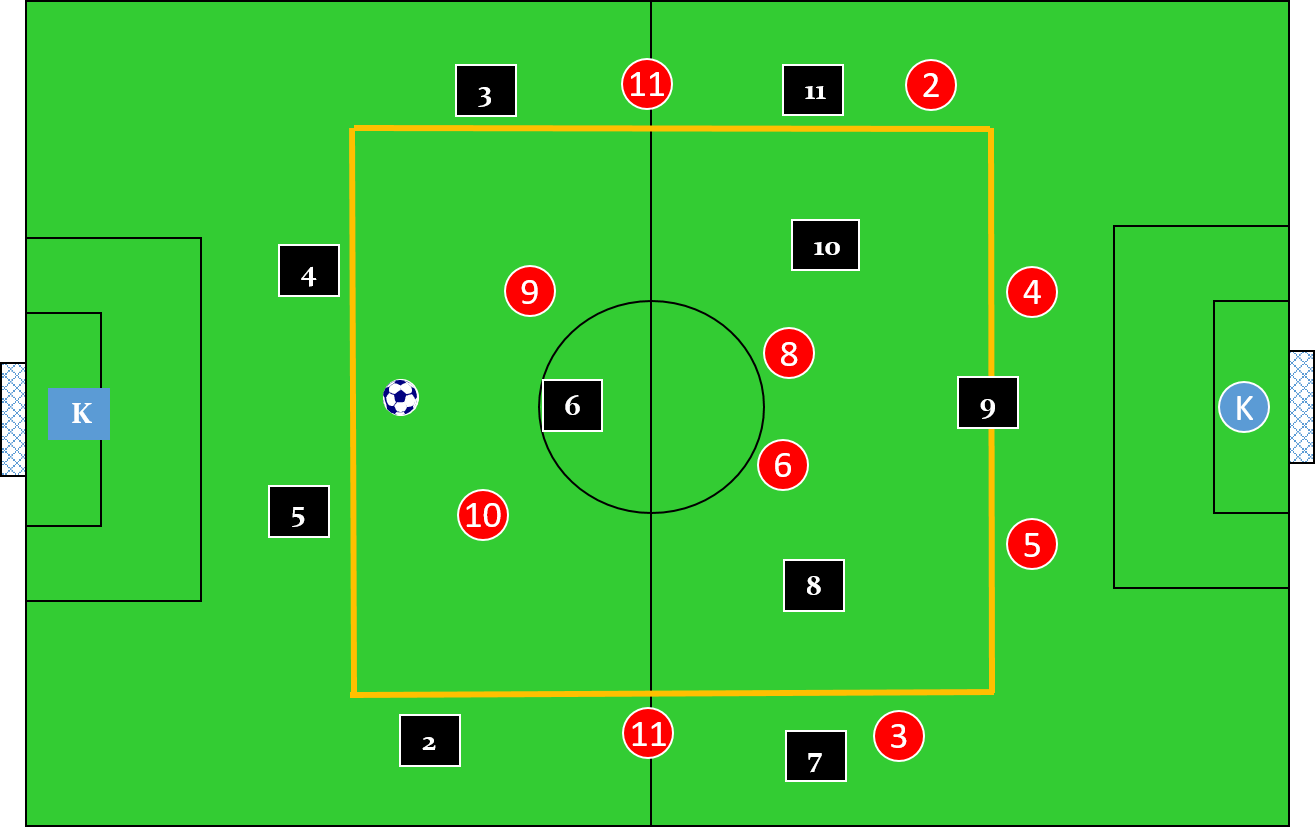
The set up in an 11 v 11 rondo. 1-4-1-4-1- v -1-4-4-2.
Possession Game
The three neutral players maintain possession with the team on the outside. With the inside 4 team players we have a transition moment with the outside 4 team players when possession is lost to the 4 inside players.
Technical Aspects: Offensive
Passing / control / moving to space / open passing lanes / Communication
Tactical Aspects: Offensive
Keep possession / Passes to break lines / 3rd man runs / up, back, through / progression outside to inside
Technical Aspects: Defensive
Body shape / intercept or tackle / Communication / Press / support / cover
Tactical aspects: Defensive
Transition attack to defense / Mental change / Close down the spaces / Pressing / Close passing lanes / defensive team shape
Guardiola Rondo Using a 4 v 4 + 3
Central player attracts pressure from opponents to create space outside. This is a big challenge for the central player (6) particularly; so give every player the opportunity to be that player. Developing width, depth and length.

Continuums model of development
READ THIS AND THEN COMPARE
LOOK / OBSERVE / THINK / DECIDE: BEFORE Receiving the ball
FOOT PREPARATION / BODY POSITION; BEFORE RECEIVING THE BALL: Flat footed, off balance?
COMMUNICATION: Verbal and visual: Before receiving the ball
SKILL FACTOR: DECISION MAKING: How, when; where and why of the technique; plus its success or not? BEFORE RECEIVING THE BALL
CONTROL: If not a one touch pass on, then the 1st touch control
TECHNIQUE: The pass, the run, the dribble, the turn, the shot; the cross etc.
TACTICAL MOBILITY: Movement off the ball in possession, finding space
MENTAL TRANSITION: Possession changes, tunes in immediately? Defends immediately / Attacks Immediately.
This model TOTALLY applies to this session, all the processes it covers must happen in this session for players to be successful. SPEED of play is vital for both THINKING and PLAYING. Space is tight, play is fast so players must be able to play 1 and / or two touches successfully.

Up; back and through
Short pass to draw defenders to the ball to then do a long pass behind and beyond them. So (6) plays with closest player (9) to draw defenders to free the space for the deeper pass as shown.

Drawing defenders apart to open passing lanes up
Defenders press the wide players leaving the central players free. Red (10) is pressed by blue (7) who then passes to Black (5). (5) Passes to the other side and the defender (11) presses red (8) as shown which opens up the central space for (6) receiving the pass back to (5) who now plays to (6) to play to (9).

Creating close triangles and diamonds of support
Outside players always moving to create passing lanes and angles of support. Playing “around” the defenders; preferably ONE touch.

Pressing to intercept or force a bad pass
Defenders must work hard and press as fast as possible to force opponents into errors.

Mental Transitions:
Players often struggle with the mental transitions from defending to attacking as possession changes; but ESPECIALLY when the change is from ATTACKING TO DEFENDING. So the coach must emphasize the importance of rapid physical transition and fast movement as well as mental transition (sprints inside to out and outside to in). This maintains a high tempo on transition as it SHOULD be in a game situation. We play as we train. Players need that INTRINSIC desire to make this happen for themselves though.
Changing possession
Under pressure (6) Makes a bad pass and the defender intercept the ball. When the 4 inside defending players win the ball they switch with the outside 4 players to become offensive players.

Mental and Physical Transition:
This equates to immediate pressing from attacking mode to defensive mode to win the ball back as soon as possible. Also equates to the defending team; now the attacking team; working hard to KEEP possession at the same time. Rotate players positions so all get the chance to be neutral players.
Changing Possession
Here we show the switch. Speed of thought is vital now. Players must change from winning or losing the ball with a switch in mentality and physicality immediately; both in mind and deed.

Outside players rotate
Have the outside players now rotate so the inside player has to have even more of a good peripheral vision. Now attacking players enter the defending area from different points.

Pivot player rotates off the ball
Keep adding to the session with different ideas. This would happen in a game where players rotate positions.

Add poles into the space so now players must position accordingly
The Poles represent defenders so if the central player hits a pole with a pass the two teams of 4 immediate switch (as it is the same as giving possession away). Now players move into open passing lanes based on the pole's as well as the defenders. A Much bigger challenge to keep the ball now.

View this in action on the following video:
Wide Players
Focusing on red right and left fullbacks and red right and left strikers and the central theme of black (5), (6) and (9).

Midfield players
Allowing the central midfield of black (6), red (8) and (10) to connect and receive from fullbacks red (2) and (3) to get the ball to (9).

Keeper and central players
Now the keeper is included connecting with the red center backs (4) and (5).

Central player attracts pressure from opponents with the first pass and so creates space outside by defenders pressing (6). This is a big challenge for the central player (6) particularly; so give every player the opportunity to be that player.

Pressing wide and playing centrally
Defenders press the wide players leaving the central players free.

Creating 3 v 2 situations
Building from the back with (K) and red center backs (4) and (5). Building from the middle with red (6), (8) and (10).

Creating 4 v 2 situations
Creating two 4 v 2 situations and dividing the field up, red pivot (6) being the catalyst and connecting player.

Two players centrally
Now we have 2 players centrally against 4 defenders. You can vary the set up also depending on the number of players you have so everyone is involved. The main session requires 11 players but sometimes you have more and sometimes fewer numbers so you must be able to adjust as necessary.

Two players centrally with another idea
Now we have 2 players centrally against 4 defenders. One step back in the build up from the last slide now starting the rondo at the center back not in central midfield.


Circle Rondos
Passing and movement warm up for quick looking and thinking. Various movements to develop decision making with several progressions. An Introduction to all the basics of the thinking process and how it relates to decision making and movement.
The following comes from Soccer Awareness eBook "Developing Players with Rondos Using the Soccer Awareness Philosophy"
This 222 page eBook explores the use of rondos in youth soccer. Rondos are a great way to prepare players for the game situations and especially the fast decision making needed within the game. I have included as a way to work into these game situations many Rondo ideas that I feel are great foundation builders for players learning to combine and play together. I have stayed with simplistic ideas that all levels of players can try and be successful at. It is up to each coach to work out how to make it work for their players.
Though the foundation of the basic rondo stays the same; we explore different ways to present it. It can be made easier or more difficult based on the number of touches players are allowed, for example, so it benefits ALL players who practice with them; also the size of area they play within can be manipulated to change the challenge. Preview Here
Passing and movement warm up for quick looking and thinking. Various movements to develop decision making with several progressions. An Introduction to all the basics of the thinking process and how it relates to decision making and movement.
Circle coaching for passing and support
To increase the players awareness instincts ask them to call the name of the player out who they will be passing to, before they receive the ball. This ensures they look to see who is free before they receive the ball so they know in advance who is free to receive.
One ball, (1) runs and passes to (4) and takes their place. (4) Takes the ball, runs and passes to (8) and so on.

Progression: Introduce two, then three, then four balls all going at the same time. “Awareness” of where each player is running is needed here so they don’t collide and where potential free players to receive are “before” you make the run and pass.
Coaching Points:
Good communication between the players.
Quality of the pass (timing, accuracy and weight).
Good first touch by the receiver.
Progression – Passer becomes a passive defender who puts the receiver under pressure. The receiver must move the ball away at an angle from the pressure on their first touch.
Running with the ball
Running with the ball technique:
Head Up – look forward, observing options “before” receiving the ball using the A.I.A. training.
Good first touch out of feet, 2-3 touches maximum, not dribbling.
Run in a straight line, the quickest route.
Running Style, use the front foot to control the ball using the laces.
Decision: Where is the player taking the ball? In this case to (5) but (5) must try to decide as the ball is coming not after he or she has it. Identify who is free early.
Communication: Call the name of the player you are running the ball to.
This 222 page eBook explores the use of rondos in youth soccer. Rondos are a great way to prepare players for the game situations and especially the fast decision making needed within the game. I have included as a way to work into these game situations many Rondo ideas that I feel are great foundation builders for players learning to combine and play together. I have stayed with simplistic ideas that all levels of players can try and be successful at. It is up to each coach to work out how to make it work for their players.
Though the foundation of the basic rondo stays the same; we explore different ways to present it. It can be made easier or more difficult based on the number of touches players are allowed, for example, so it benefits ALL players who practice with them; also the size of area they play within can be manipulated to change the challenge.