Welcome to the Soccer Awareness Coaches Corner. Browse through soccer drills, small sided games, tactical thoughts, full sessions and a variety of resources. Posts marked “Training Center Exclusive” are for members only.

Team Shape Development in 9 v 9 - Training Center Exclusive
Here we show how team shape changes from defending to attacking to then how we start to interchange and rotate players. Distances between defending and attacking are bigger than most think. Players learn how to add fluidity and freedom to team play in terms of their offensive movements and how to compact themselves when defending.
Using the 1-3-3-1-1 is a progressive move to playing the 1-3-3-1-3 in the 11 v 11 hence I am starting with this formation at 9 v 9.
*Membership Required
Subscribe to the Soccer Awareness Training Center to get access to all premium Training Center Exclusive articles.
Here we show how team shape changes from defending to attacking to then how we start to interchange and rotate players.
Distances between defending and attacking are bigger than most think.
Players learn how to add fluidity and freedom to team play in terms of their offensive movements and how to compact themselves when defending.
Using the 1-3-3-1-1 is a progressive move to playing the 1-3-3-1-3 in the 11 v 11 hence I am starting with this formation at 9 v 9.
Team shape from defending to attacking in 1-3-3-1-1
Defensive shape is at the red triangle cones. Attacking shape at yellow triangle cones. Player (6) represents center backs (4) or (5) and player (8) can also represent (6) in their roles in an 11 v 11.

Team shape attacking in 1-3-3-1-1
Defensive shape is at the red triangle cones. Attacking shape at yellow triangle cones.

Team shape from defending to attacking in 1-3-2-3
Defensive shape is at the red triangle cones. Attacking shape at yellow triangle cones. Player (6) represents center backs (4) or (5) and player (8) can also represent (6) in their roles in an 11 v 11.

Team shape attacking in 1-3-2-3
Defensive shape is at the red triangle cones. Attacking shape at yellow triangle cones.

Combinations Movements to Teach
Now center back (6) brings the ball out of defense and central midfielder (10) drops in to cover. Wingbacks (2) or (3) could also drop in to cover (6).

More complex Combinations Movements to Teach
(3) Has several options of a pass in-front of the ball. These are now very advanced movements that the players can practice with or without the ball.

A Cut inside and an overlap by a wing back
Start simply with this two player rotation. (11) cuts inside, this is the CUE for (3) to overlap.

Covering for the attacking fullback (3)
(11) Cuts inside to clear the space for (3).(8) Drops in to cover for (3).
(10) may also drop in to Cover for (8) if necessary in case we lose it and the other team counter attack..




Composure Zones to Aid Team Play and Individual Development in a 9 v 9 - Training Center Exclusive
An easy introduction to teaching players to develop play from the back without the pressure they would get in a game situation. Builds confidence and composure in the players and you can increase the pressure as they improve.
Overload at the back. Striker can’t encroach into the 10-yard composure zone. Defenders pass ball across under no pressure until one is free to run it out, attackers can now try to win it back. Defenders can take the ball back into the composure zone for safety and this encourages spreading out and playing from the back. Be patient, keep possession; go forward at the correct moment.
*Membership Required
As an easy introduction to teaching players to develop play from the back without the pressure they would get in a game situation.
Builds confidence and composure in the players and you can increase the pressure as they improve.
Overload at the back. Striker can’t encroach into the 10-yard composure zone. Defenders pass ball across under no pressure until one is free to run it out, attackers can now try to win it back. Defenders can take the ball back into the composure zone for safety and this encourages spreading out and playing from the back. Be patient, keep possession; go forward at the correct moment.

A Transition game maintaining shape and balance throughout the team in a 9 v 9
Building 9 v 9 team play up through various conditions of play
Players stay in their own thirds to establish team shape
Transition between thirds
9 v 9 rotation of players
Possible passing options
Overlap play from wide defenders
Introducing offside
Overload in attack to maintain possession
Transitions between thirds for defending team also
Working with four zones
Players stay in their own thirds to establish team shape
We start with 2 x 1-3-3-1-1 set ups. Players stay in their own zones initially until we get the game going.

Transition between thirds
An example: (6) bring the ball out and creates a 6 v 3 with the neutral player added also. Then a midfield player joins in the attacking third to create a 2 v 3 in there. Defending team players stay in their own zones.

9 v 9 rotation of players
1. Players interchange between zones one at a time always returning to original set-up. Check the balance of the team with and without the ball. We have created a 5 v 3 in midfield zone with player (6) moving up.
2. If they lose possession players either drop back in or you can develop the clinic to include pressing to regain the ball. E.g. If you are losing the game go full high-pressure and PUSH three players into the attacking third, three PLUS A NEUTRAL PLAYER in the midfield third and two in the defensive third.

1. Condition – Can only score if all players are over the defensive third line so reinforcing keeping compact vertically.
2. Restrict number of touches on the ball if they are able to do so to encourage quick passing and movement and to improve the speed of decision-making.
3. Vary play by encouraging defenders to pass directly to the forwards; midfield players can then support them facing the opponent’s goal (easier to support rather than receiving and having to turn with the ball).
4. If you have problems making the session work with equal numbers then reduce the game to a 9 v 5 situation using one forward, one midfielder, two defenders and a keeper on the opponents team until the players are comfortable then go into the full workout.
Possible passing options
1. Player (8) on the ball. 4 possible options to pass forward e.g. to (7), (9), (10, (11) or (N) If can’t go forward because of pressure, can go to the side to (3) or (2) or back to (6), and the keeper to keep possession until the situation allows for a forward pass again (you won’t obviously get all these options to pass but it shows how it can work).
Caution – in attack, be aware of quick counter if opponents win the ball i.e. we have a 2 v 2 at the back.
2. Discussion – You can get so much work into this session, every time you look there may be a new situation to effect. Choose a theme and stick with it and when you have established it with the players, only then move onto another theme (you can again use the same set-up, as it is so flexible).

A Transition game maintaining shape and balance throughout the team
1. To ensure the players have a chance to build up the play from the back have a 3 v 1 overload at each defensive third to begin to session.
2. We are looking to be successful with offensive play building up from the back and this gives it a greater chance of success and thus the positive reinforcement of the players.
3. As they get better at this and gain success you can change it to a 3 v 2 situation so it is more difficult to achieve. Á 3 v 2 means a 9 v 9 situation with the players developing play but staying in their own third to emphasize team shape through the units.

Transitions between thirds
1. Now we are transitioning between thirds and as a defender changes the balance in midfield from a 3 v 3 into a 4 v 3, a midfielder then moves into the attacking third to change the balance from a 1 v 3 into a 2 v 3. (7) Clears the space for (2) to bring the ball forward. (6) And (3) cover across behind the field to support and be in a good position to cover should the move break down. This is clearing the space in front of the ball and filling in behind the ball.
2. (11) Makes a run into the attacking third to be another target for (2) to pass to. If the player can’t go forward and has to play it back ensure the players behind the ball get in positions where they are free to receive it and able to support the player on the ball.

Overlap play from wide defenders
1. Here a full back makes an overlap run to provide an option for (8) to pass to. (2) Passes to (8), (7) clears the space wide to run into for (2) by taking defender (F) inside, and (2) runs onto the return pass from (8). The overlap can occur also from the middle third into the attacking third.
2. Wide defenders need to be constantly encouraged to get into good wide receiving positions to take the ball forward into attacking areas of the field.
3. The fact that (G) can’t track the runner into the middle third yet during this progression helps highlight the importance of this kind of attacking run from a wide area.
4. Likewise, (8) may change the point of attack and (3) can make the overlap run from the other side and on the blind side of striker (G). (8) covers for (3).

Introducing offside
1. Develop – Have offside from the defensive third of the field. (8) Passes the ball forward and (3), (6) and the keeper push up. Striker (G) is left offside.
(8) Passes to,(2) who moves up from the defensive zone to the middle zone to support. This type of transition movement is important because it allows players to move freely between the zones knowing they will have a team mate covering for them. In terms of the opposition this rapid movement and transition makes it difficult for them to pick players up, to read what your team is doing..
2. This means defenders aren’t just defenders, midfielders aren’t just midfielders and attackers aren’t just attackers they work to help each other through the three units of the team and are free to mix the game up. This is total soccer played to encourage the free movement of players throughout the teams.

Overload in attack to maintain possession
1. Here (2) plays the ball to (8) and (7) makes a run off the ball to support in the attacking third. Transitions can depend on the stage of the game; if your team is chasing the game to score being a goal down then (7) would probably stay in the attacking third, not immediately return to help (8) in the middle third but keep an overload in the attacking third situation there but the basis of the session is to show how to maintain a balanced shape in your team.
2. Practice movement (switching) of strikers and midfield players to move defenders around (especially if they man mark), so play isn’t in straight lines all the time.

Transitions between thirds for defending team also
1. Progression – Have players able to transition back into zones from the attacking third to the midfield third, the midfield third to the defensive third. Defenders still cannot move between zones.
2. Develop – Now Allow defending players (as above) to track attacking players into the other zones. When this happens the above situation means the defender (B) follows the striker (9) going short creating space behind for another striker to move into or a midfielder to break forward into (in this case 7 and 11). Ultimately open the game up so the players have no boundaries to use for focus and see if they can work out how to keep that balance and shape on an open field of play.

Working with four zones
1. We have essentially four - thirds to play in. The players can only play in three of the four thirds at any one time.
2. This ensures movement up and down the field maintaining distances between units.
3. Players cannot enter zone 4 until the ball goes into zone 4.

Working with four zones
The ball has been played into zone 4. Here the numbers team has moved forward out of zone 1 and into zone 2 and the whole team has moved forward one zone. This helps them maintain distances between the units and does not allow the team to get too spread out either attacking wise or defensively.

Progression development from start to finish
Set up is as follows; the field is arranged in thirds; defending, midfield and attacking thirds. In the set up we have here we have a 3 v 1, a 4 v 4 + neutral player and a 1 v 3.
Warm up: Objective: 9 v 9 with composure zones to aid team play and individual player development
1. STAY IN OWN THIRD.
Players stay in their own thirds to get a feel for how to maintain shape and how to use width in attack. Spread out in possession in a 3 v 2 overload at the back in the defending third to create a situation where the players are available to receive the ball in space and pass it forward.
2. TRANSITION BETWEEN THIRDS
Players are allowed to transition between thirds but only one at a time. The defending team cannot move between thirds to track the attacking players. When the attacking team loses possession they then become defenders and must immediately drop back into the third they started in. The reason for dropping back and not trying to win it back there and then is because we are working on offensive play and want both teams to have the opportunity to build up play. Can run the ball in, pass it in, or pass it in to a runner from your own third.
3. OVERLAP PLAY FROM WIDE DEFENDERS
This particular type of movement is a very important one to develop in this session and the opportunities presented to do so will be numerous.
4. OFFSIDE FROM THE DEFENDING THIRD
Introduce offside in the final thirds at both ends of the field. This encourages teams to move up as the ball is played forward.
5. OVERLOAD IN ATTACK MAINTAINING POSSESSION
Here we have worked the ball into the attacking third and we leave an overload in this third to regain possession should it be lost. This may depend on the game situation where we are chasing the game being a goal down and have to take chances.
6. TRANSITION BACKWARDS BETWEEN THIRDS
Allow players to transition between thirds coming back as the initial movement, for example a striker may drop back into the middle third to receive. A midfielder may push on into the space the striker created by the movement.
7. TRANSITIONS OF DEFENDING PLAYERS
Allow defenders to track players into the other thirds they venture into. Now all players can move between thirds but still have it only one at a time. This helps highlight how to create space for someone else by the movement of players; a striker comes short, pulls a defender with them and space is created in the area they came from for another striker or a midfielder to move into to receive the pass.
8. FREE PLAY
Open the game up. See if players can maintain their shape without the help of the thirds, if they can transition between units but also keep their balance. Try a game in quarters to establish movement up and down as a team.
9. NUMBER OF TOUCHES RESTRICTION
Introduce a three, two then one touch restriction to see if the players can work more quickly and still gain success. This speeds up there decision making in the game. When it is one touch, condition it so they can take more than one touch (a pass may be so heavy they need two touches) but emphasize they use one touch if it is on to do so. This keeps it realistic.
10. CONCLUSION
We have developed the clinic from working in thirds (or quarters), introduced many progressions to
work up to letting the game go free and observing if the players can incorporate into the free game
situation, all they have learnt.
I would recommend using this clinic on a regular basis and set it up for the scrimmage that is usually done at the end of a coaching clinic session.

Developing Attacking Play in the Opponents Defending Third
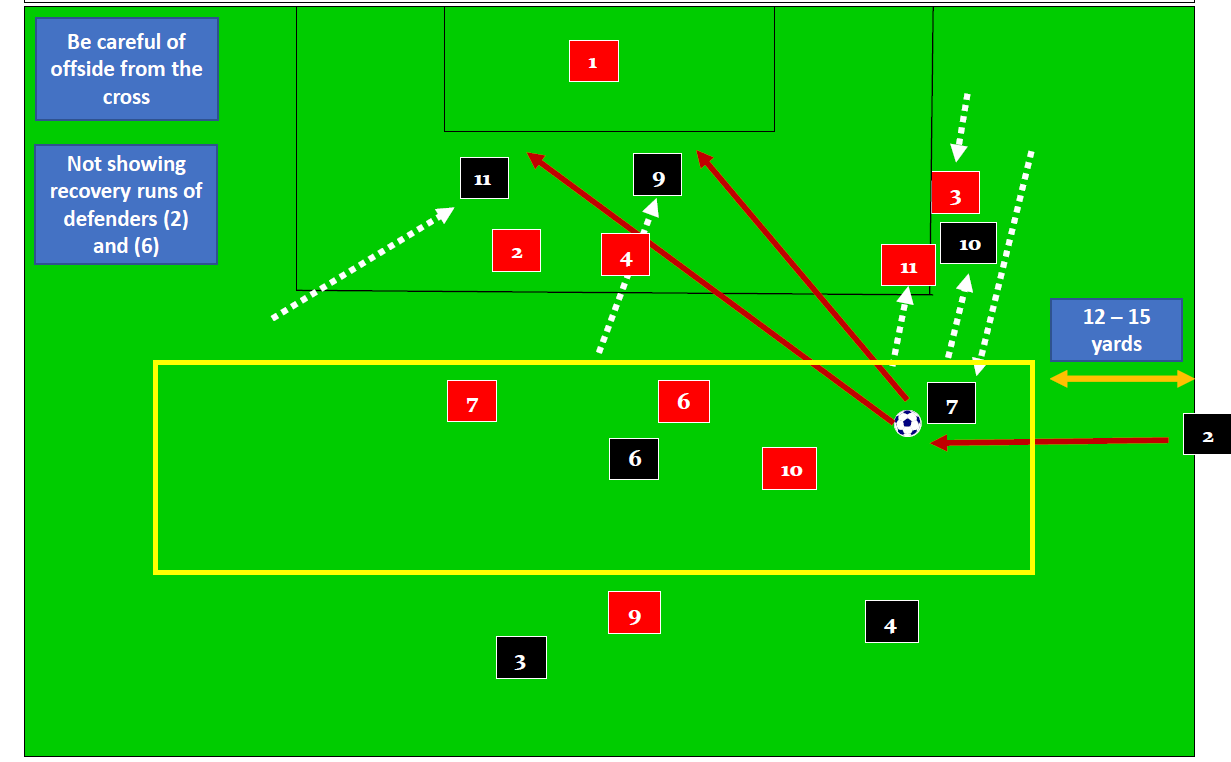
The attacking team has the ball. This is the start position of the game situation.
The idea is to have this phase, being the attacking one, and working on various ideas of movement, rotation and interchange to try to score.
You can focus on this until success is achieved from an attacking point of view.

The following is the beginning of Soccer Awareness eBook 31: Developing the Four Phases of the Game.
The game is really all about 4 Phases of Play. It can be divided up further into sub phases but the essence of the game are these 4. This eBook is what one of my main training sessions is based on. We actually train very often with this precise game situational model as it totally mirrors what I expect my team to do in the actual games. In doing so, we practice the same ideas over and over until they become AUTOMATIC when it matters.
The attacking team has the ball. This is the start position of the game situation.
The idea is to have this phase, being the attacking one, and working on various ideas of movement, rotation and interchange to try to score.
You can focus on this until success is achieved from an attacking point of view.
The starting point of the session: attacking team shape in a “Phase of Play”

Starting position of the attacking team. We can begin with an overload to get things moving positively in an attacking sense by not including (7) and (11) on the defending team. 16 players.
Attacking team shape in a Phase of Play: Using the full width of the field

To begin, our advantage is in wide areas where we have 2 v 1s on each side of the field. Draw defending fullbacks a Little wider in the process.
Wide attackers (7) and (11) cut inside to attack the inside áreas of the field


(7) And (11) cut inside to support (9) and draw defenders in to créate space wide for (2) and (3) to attack in.
(8) and (10) pull away from their markers to get free. Here we must attack through the wide areas of the field.
Defending fullbacks stay wide

Defenders (2) and (3) are distracted by the runs of the attacking (2) and (3). Now (7) and (11) overload the central área in front of the two center backs. This is the área we must attack now.
Attacking wingbacks cut inside

Defenders (2) and (3) are distracted by the runs of the attacking (7) and (1). Now (2) and (3) overload the central área in front of the two center backs. This is the área we must attack now, this is a less predictable movement by the attacking team.
Movement OFF the shoulder of defender (4)

Striker (9) moves off the shoulder of defender (4) in the build up to get free for a pass into the open channel from (3).
Attacking wingback (2) cuts inside to score

(9) Drags defender (4) short thinking he is receiving to feet and (2) exploits the space left in behind defender (4). This kind of move is a rarity because not many teams teach wingbacks to get into central shooting areas like this.
Get the rest of this session and more like it in Soccer Awareness eBook 31: Developing the Four Phases of the Game




How To Set-up A Small-Sided Game
Small-sided games are less than 11 v 11 and can be any number from 3 v 3 to 9 v 9. The general sizes of a game to establish team coaching themes are usually 6 v 6 or 8 v 8. Here are two examples of set ups for these sizes of games and information on U.S. Soccer's small-sided games standards.
The following is an excerpt from The Ultimate Youth Coaches Training Guide; A Complete 6 to 10 Year Old Developmental Coaching and Training Program.
This program is perfect for youth coaches wanting practices to start their soccer coaching education and it is also for those more advanced and experienced coaches wanting to train their players as best they can at these wonderful open minded ages for development and education of both the mind and body. Our plan is to help all coaches at whatever level of experience they are at. Find Out More
This is a game of less than 11 v 11 that can be any number from 3 v 3 to 9 v 9. The general sizes of a game to establish team coaching themes are usually 6 v 6 or 8 v 8. I have included two examples of set ups for these sizes of games and information on U.S. Soccer's small-sided games standards.
Session Plan
Only coach one team at a time.
Try to work with all the players on the team you are coaching, affecting each performance in a positive way.
Stick to one theme / topic at a time don’t jump from one to another during the session this will only confuse the players.
Divide the field into thirds; defending, middle, attacking third, for easier points of reference (for 6 v 6 and upwards). Cone the thirds of the field off to show the boundaries.
Use specific start positions to get the session going.
Develop your theme using the key coaching points and use them as a base for referral to check you have covered them in the session.
List the key points in the order you perceive them in the process of building the session. For example in defending, pressure on the ball comes before support.
Move from simple to complex as you develop the session, for example in the theme defending from the front, coach individual play within the team concept first (working with one striker), move to coaching a unit of players (it could be the two strikers working together), then extend the numbers (it could be working with the strikers and midfield players then finish with coaching the whole team (strikers, midfielders, defenders, keeper).
This is individual, then unit, then team in this order building up the session from simple to complex in a logical order.
This is just an example to how it can be done in a logical order; it is up to the individual coach to develop his / her own method to suit their own style of coaching.
How to Build a Functional Session
Coach only one set of players.
Work with all the players but work primarily with those players in the specific areas you are trying to affect. On a percentage scale consider 75% of the time with the specific players and 25% of the time with the supporting players on the same team.
Stick to the same theme.
Try to isolate the area of the field and the players who function within that area that you are trying to affect. For example the area to work in with central defenders would be centrally around the edge of the penalty area up to the half way line. For wide midfielders it would be on the wings of the field.
Use start positions to determine how the session begins. Servers can be used to start the session and also double up as targets to play to.
Develop your theme using the key coaching points and use them as a base for referral to check you have covered them in the session.
List the key points in the order you perceive them in the process of building the session.
Work with the individual then the pair or unit building up the number of players you work with at any one time.
Use the functional practice to work with a small number of players in key areas of the field. A functional practice is more specific than a small – sided game, phase play or an 11 v 11 and it isolates the players being coached.
How to Present a Phase Play
Only coach one team at a time.
Try to work with all the players on the team you are coaching, affecting each performance in a positive way.
Stick to one theme / topic at a time don’t jump from one to another during the session this will only confuse the players.
Include key coaching points you want to get into the session and list them with the session plan. Try to cover each point within the session itself.
Use specific start positions to begin the session.
The phase play is attacking one set of goals only with target goals for the opponents you aren’t working with to play to, should they win the ball.
In defending phase plays where you are working with the defending team who protect the only goal, the team that needs to have the ball most of the time is the attacking team as it is the defending team’s job to win it back. Once they win it they should get the ball to a target goal quickly and in as few passes as possible as we are coaching them when they haven’t got the ball not when they have it in their possession. As soon as they have won it and have got it to a target the ball goes back to the attacking team and they begin a new attack. You can condition this by allowing the defending team only so many passes (maybe 5 passes) to get the ball to a target then they lose the ball and a new phase play is set up.
It can be numerous combinations of numbers of players ranging from 4 v 4 to 9 v 9, this can depend on the number of players you have to work with on any given day. Often the best number is a 7 v 7 or with an overload with the team you are working with perhaps to help gain initial success in the session (it could be a 7 v 5). For example in an attacking phase play have 7 attacking players against 4 defending players and a keeper to help the session have the chance be a positive experience for the players you are coaching and the theme to be successful.
Coaching Styles
Command, question and answer and guided discovery are the three methods of coaching to be used preferably the third one; guided discovery being the most used as it gets the players to think for themselves though there are always situations where each style is required to be used. Command is telling and / or showing them what to do (doesn’t leave a lot of room for the players to think for themselves and understand), question and answer is just that; asking them to tell you what they think should happen, guided discovery is asking them to show you they understand a coaching point by moving themselves to the position you require them using their own decisions.
The following is from U.S. Soccer's 2015 Player Development Initiatives Release. Read on USSoccer.com here.
From U.S. Soccer:
The small-sided standards are focused at players from the U-6 to U-12 age groups. The field size is based on age groups, providing a more age appropriate environment that will allow players with a better opportunity to develop heightened soccer intelligence and on-the-ball skills.
The field dimensions and number of players on the pitch will increase in size from 4v4 to 7v7 to 9v9 as players age, up until they reach the U-13 age group and begin to play full 11v11 matches.
| Age | U6 | U7 | U8 | U9 | U10 | U11 | U12 | U13 |
|---|---|---|---|---|---|---|---|---|
| Maximum Field Size (yards) | 30x20 | 30x20 | 30x20 | 47x30 | 47x30 | 75x47 | 75x47 | 112x75 |
| Number of Players | 4v4 | 4v4 | 4v4 | 7v7 | 7v7 | 9v9 | 9v9 | 11v11 |
| GK | No | No | No | Yes | Yes | Yes | Yes | Yes |
| Playing Times (minutes) | 4x8 | 4x8 | 3x15 | 2x25 | 2x25 | 2x30 | 2x30 | 2x35 |
| Break Times (minutes) | 5 | 5 | 5 | 10 | 10 | 10 | 10 | 15 |
| Ball Size | 3 | 3 | 3 | 4 | 4 | 4 | 4 | 5 |
| Goal Size (feet) | 4x6 | 4x6 | 4x6 | 6.5x18.5 | 6.5x18.5 | 6.5x18.5 | 6.5x18.5 | 8x24 |
| Offside | No | No | No | Yes | Yes | Yes | Yes | Yes |
“In general we would like for players to be able to process information faster, and when they are in this environment they are going to learn to do that over a number of years," Ramos said. "When you have young players in an 11v11 game there are only so many involved in any one play at a time. By taking numbers away and playing 4v4, 7v7, and 9v9, you are multiplying their chances on the ball, increasing their touches and making it overall more for them by making them an active participant at all times. Fast forward 10 years and there are thousands of game situations added to a player’s development.”

Teaching Defending as a Team in an 11 v 11
The best form of attacking is expert defending. As a team we need to improve on this. Therefore a big part of our game MUST be heavy pressing all over the field with ALL players tuned into the way to do it. Players on the opposite side of the field when the ball is with opponents especially should understand their roles and the need to condense the spaces.
The best form of attacking is expert defending. As a team we need to improve on this. Therefore a big part of our game MUST be heavy pressing all over the field with ALL players tuned into the way to do it. Players on the opposite side of the field when the ball is with opponents especially should understand their roles and the need to condense the spaces.
Defending as a team in a 1-3-3-1-3
Our set up is keeper (1), three center backs (4), (5) and (6) three midfield players (2, 3 and 8), that is right, left and center midfielders; a false nine (10), two wingers (7 and 11) and our central striker (9). I am avoiding calling (2) and (3) fullbacks or wingbacks because I want an attacking mentality in the players playing these positions. You could call them a “hybrid” of a wingback and a wide midfield player.
We set up in our defensive shape and the opponents pass the ball around. The coach decides when the pass is made to give our team time to adjust their positions and be able to show the players what is needed. So for example, (B) receives the ball and must keep it until we get our defensive team shape correct. Once the shape is correct the coach can shout go again.
Rules:
Our team cannot tackle just shadow the ball to begin.
Opponents must play 2 touches.
If we win the ball to pass it to their keeper and they opponents start again with it OR we counter attack.
It depends on What you want out of the session.
For this I like the opponents to have the ball as soon we gain it to test our defending shape again.

Set up cones for opponents to stand still beside
Opponents continue to stand still beside each of the designated cones. You can set up the cones based on the formation of the team you are playing next. We are marking both players and spaces.
Here we are a 1-3-4-2-1.
Movements of our team. (7) shows INSIDE to our Strength in numbers. (9) covers the back pass.(5) marks (K) CHANNEL side to put off (D) paying the long ball into the channel for (H) or (K) to run into. (11) drops in to add an extra player into midfield. OR, (11) can become part of a back four and (10) drops into midfield. If (F) pushed on then (11) or (3) would drop into a back four so we are 4 v 3 at the back.

Try to close down “passing lanes” as well as closing down players. (10) For example is doing a good job of this knowing (8) behind is marking (E) anyway.
Here we are a 1-3-3-3-1.
(9) Immediately presses to show one way in this case wide. (11) hedges their bets by half supporting but ready to press (A) if (A) receives it. (10) supports (9). Midfield three move across and close down the spaces that side of the field.. Three Center backs move across to fill spaces (B) may play the ball into. (7) has a choice of dropping back and inside to aid the 3 midfielders to staying up but inside to support (9).

Once you get your players positioning correctly wherever the ball goes and they understand their individual and team roles you can now let the opponents move. Our team can press and intercept but not tackle. Opponents are still 2 touches maximum. Now it becomes more of a game situation.
Here we are a 1-4-4-1-1.
(2) Can only press and show down the line. Three center backs drop back and across and (5) fills the open space CHANNEL SIDE of (K) that (H) can see to pass into. (3) drops in to make a back four to give us extra strength. (8) slides across to support (2) and either (10) or (11) whoever is closest will make up a midfield defensive three. OR both drop in to make a midfield four.



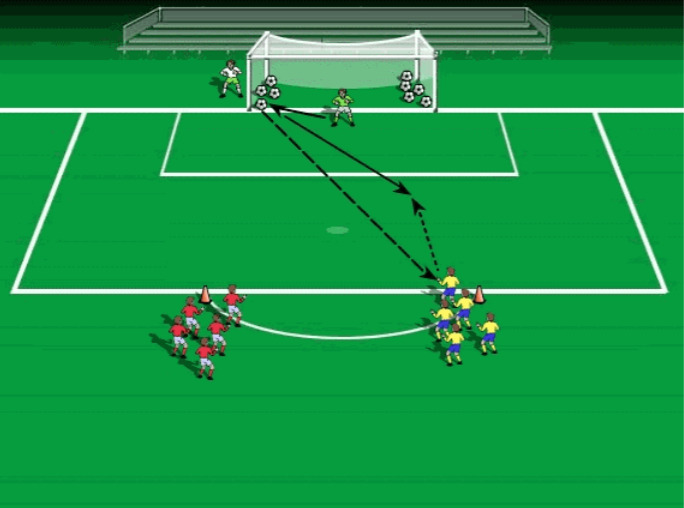


(7) Can only show outside and not stop the delivery
Before the ball is delivered; in fact as the ball is travelling to (D) the back three should be adjusting already. Now we mark through (5) the big SPACE down the side; NOT the player (K). (3) Now can drop in to make it a back four for extra security. If (D) passes down the line then as you see, we will be first to the ball.
Now with a free ball down the line if (K) is quick we can be in trouble therefore (5)’s positioning is REALLY VITAL now. He MUST defend CHANNEL SIDE or more or less where the ball is likely to go. Most coaches will tell defenders to always defend GOALSIDE, this is one occasion where that instruction would be wrong.

(5) Out of position as happens with us
(5) Is still marking GOALSIDE and allowing a long pass down the line to (K). (K) Is fast so now we have a very dangerous 1 v 1 in a wide area against us. So our wide center back on each side where the ball could be delivered this way MUST mark CHANNEL SIDE of the striker not goal side.
We do not adjust quickly enough and see AHEAD of the play. This is especially so when we attack with numbers and our vulnerability is usually in wide areas on the counter attack.

There must be real condensed team shape closing down immediate spaces around the ball.
Now we are a 1-3-3-3-1.
The ball is forced to be played back to (D). (7) is the VITAL pressing player. If possible (7) should close down to force the ball “Inside” to our strength in numbers. A pass to (H) should be totally blocked now so (2) can tuck inside to where we want the ball to go. Three Center backs push up as does the keeper. (9) is ready for a back pass. (8) and (10) condense across the field to the ball. (11) also but also pushes forward.

Throw in
There must be real condensed team shape closing down immediate spaces around the ball. Man marking now is imperative and we get tight to the opponent to allow no time on the ball.
Here we see we MUST get as many players around the immediate area the throw in is as possible. This makes it VERY difficult for the opponents to regain possession from their OWN throw. Even wide left (11) can run across the field to add an extra player to the mix. (7) shadows the thrower incase they throw it and look to get it back.


Teaching Changes in Team Shape in a 1-4-3-3 Incorporating Developing Angles and Timing of Support
In this presentation we are working on moving and passing into HALF SPACES between opponents positioning. Players position so they are AT LEAST side-on improving their PERIPHERAL VISION at ALL times on the field of play. This presentation concludes with attacking in the final third opening to 5 corridors.
Presentation Focus
This presentation also works on intelligent runs OFF the ball and player body positioning to receive and improve their peripheral vision.
1. Attacking: Based on the 5 corridors width-wise we want all 5 corridors to have players in them.
Based length–wise we want a maximum of 2 of 3 zones filled; with the exception of the keeper.
2. Defending: Based on the 5 corridors width-wise we want a maximum of 3 corridors filled with players; preferably 2.5 if possible.
Based length-wise we want a maximum of 2 of 3 zones filled; preferably the whole team is condensed into 1.5 zones or at most half a field.
3. Angles and Timing of Passes and Runs: Moving and passing into HALF SPACES between opponents positioning.
4. Teaching Side on Positioning: Players position so they are AT LEAST side-on improving their PERIPHERAL VISION at ALL times on the field of play.
Phase One: Playing in 5 Corridors from a 1-4-3-3 Widthwise
Defensive Shape Start Position

Playing in 5 corridors and 3 zones to help anddefine the positioning of players. This is our starting position of 1-4-3-3. The keeper wins the ball and we change shape from defensive to attacking shape.
Phase Two: Too Spread Out From Goal To Goal

Team is too big with too much space to allow for a counter attack. So even when attacking we have to think about if we lose it what do we do. Players are spread out in 3 Zones. On the other hand if you don’t want to risk being caught high defensively with a ball in behind you then you may set up deeper like this.
Join the Soccer Awareness Weekly Email Newsletter mailing list below to get this FREE 21 PAGE Presentation

11 Principles of Team Play
These are the 11 principles that make up the Soccer Awareness philosophy of team play along with 12 problems that teams must solve.
These are the 11 principles that make up the Soccer Awareness philosophy of team play.
- Keep Possession - If players chase for the ball a long time they get frustrated, get tired and commit fouls. So keep possession and force this upon them.
- Develop Play from the Back - When it is on to do so to help maintain possession of the ball and not rely on a 2nd ball pick up.
- Pass and Move - Movement off the ball is a major part of our team development.
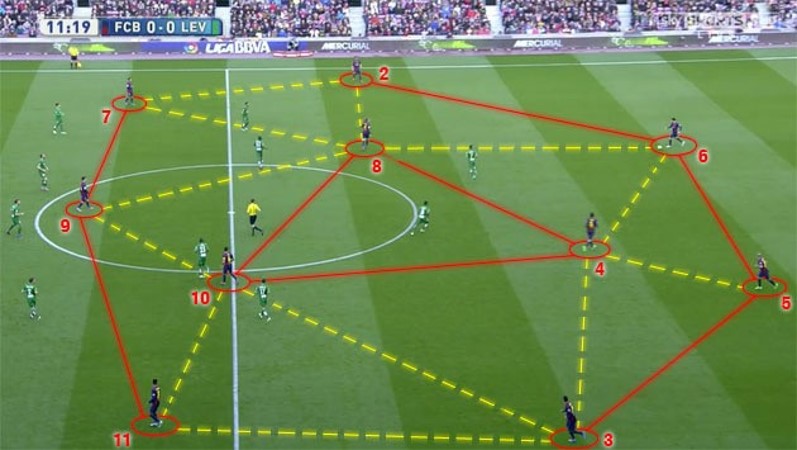
- Form Triangles and Diamonds of Support All Over the Field - Creating open body stances and increasing peripheral awareness.
- Inter-Change Positions - Offensively and defensively cover for each other.
- Create Space for Your Teammates; Not Just for Yourself - Unselfish team play; Play for the TEAM.
- Attacking Fullbacks Using Width in Attack - Offense is the best form of defense
- Keep a Very High Line Defensively - Squeeze opponents into their own half of the field
- Pressure Opponent’s High Up the Field - Winning the ball back 30 yards from the opponent’s goal is better than 80 yards away
- Counter Attacking and Quick Breakaway - Developing different ways to counter attack
- You Need Skillful Players to Make this All Work - We have the raw material so let’s develop them
Problems to Solve
- How to get FREE AND FIND SPACE TO RECEIVE the ball and to maintain possession of the ball
- How do we do this?
- Using the Thinking Process
- Players must learn to think AHEAD of the ball, to think two moves ahead in their mind.
- So; Observation of own players positioning / Opponents positioning / SPACE available / where the ball is in relation to all these factors.
- All done BEFORE RECEIVING THE BALL.
- Saving time doing this; Increasing time and space to play in by doing this.
- Also; POSITIONING OFF THE BALL
- Positioning to find SPACE based on their own team mates and the opponents positioning; the position of the ball; and based on these factors: FINDING THE BEST SPACES AVAILABLE.
- Doing all of the above means: we can be successful using fewer touches on the ball.
- Doing all of the above will SAVE a touch or two on the ball; and by doing so:
- Players will: PLAY MORE QUICKLY, THINK MORE QUICKLY, MOVE MORE QUICKLY.

Defensive Positioning to Fix in Defensive Team Shape
Teams should have 2 basic shapes, an attacking one and a defensive one; wide and long on offense, short and tight on defense. The differences between each should be significant in terms of spacing between players. A problem that occurs is defensive team shape is not short and tight enough and it allows opponents too much time on the ball.
The following excerpt comes from Soccer Awareness eBook 30: Common Mistakes to Correct at 11 v 11; Identifying and Solving Common Real Game Situation Problems in the Training Environment.
This is a different way to look at the game, rather than highlighting what we need to do well, it shows what often goes wrong and how to fix it. These are many situations I have found happen in top level games. How many of these problems do YOU experience with your team?
Many of the defensive problems as you will see can EASILY be fixed just with good 1 on 1 or unit pressing. Also defensive tactical positioning is covered; as is improvements in our attacking play. A major improvement is needed though in COMMUNICATION at youth level to help fix all errors in most cases. Preview
Defensive Positioning to Fix in Defensive Team Shape
Teams should have 2 basic shapes, an attacking one and a defensive one; wide and long on offense, short and tight on defense. The differences between each should be significant in terms of spacing between players. A problem that occurs is defensive team shape is not short and tight enough and it allows opponents too much time on the ball.
Here is an illustration of defensive positioning to fix. Opponents spread out and our players are FAR TOO WIDE. They mark players not space. This pass is just an example of what we allow that we should stop.

Now, this is how it should set up. All Players tuck in and mark space. Almost inviting (C) to pass to (D) so (7) can press quickly. It may be only 5 to 10 yards of movement but it is vital so we are much more difficult to play through.


Offensive Midfield Player is too Wide
In this example, our opposite midfield player is too wide. This happens too much. We want our players defensively tight close to the ball. This also is a really common one easily fixed. Often fullback (3) does the same as shown.

Here's how it looks when our opposite midfield player tucks in. We want to try to overload the immediate area of the ball, actually condense much more than you might ever imagine. Here a 5 v 3 in our favor. (7) stops the pass to (H).


Watch: Soccer Awareness Team Game Video
In this video taken of our team you can see them playing the ball on the ground, the passing and movement, the quick one touch play and the pace of the counter attack. These are all things I work on in Soccer Awareness training sessions. I do 11 v 11 tactical development sessions that result in this.
In this video taken of our team you can see them playing the ball on the ground, the passing and movement, the quick one touch play and the pace of the counter attack. These are all things I work on in Soccer Awareness training sessions. I do 11 v 11 tactical development sessions that result in this.
- They boot it out.
- WE control the ball, right center back 4 Feints to go right then passes inside to our middle center back 6 who pushes forward to receive the pass from our right center back 4.
- One touch pass to number 8, one touch pass to number 10, one touch layoff back to number 8, then 2 or 3 touches by 8 running with the ball then a defense splitting pass inside their fullback to our wide left 11.
- 11 plays it inside to 9 who shoots on goal and hits the bar.
- So within 12 to 15 seconds we have gone from wide right in defense to wide left in attack and gotten a shot on goal without opponents touching the ball.
This is what they are learning, how to play the game correctly.
For further information on Training Dates and times go to www.soccerawareness.com/clinics
Merry Christmas,
Wayne Harrison

Now Available: Coaching the Ultra Fluid 3-3-1-3
Wayne Harrison's new book, his 15th publication on Soccer Coaching, will be soon!
Playing a 1-3-3-1-3 might be the way forward in the future. Chile won the Copa America Championship this year for the first time in their history using it. Pep Guardiola head coach of Bayern Munich uses it at times.
Wayne Harrison's new book, his 15th publication on Soccer Coaching, will be out soon!
Playing a 3-3-1-3 might be the way forward in the future. Marcelo Bielsa's signature formation in his squads is the 3-3-1-3 formation, which he made famous and brought to the front of the world's mainstream football scene during his coaching tenures in the Argentina national football team, Chile national football team, Athletic Bilbao and Olympique de Marseille.
He plays a high pressing game, as does Pep Guardiola at Bayern Munich; which will be explained in this book.
Jorge Sampaoli is the Chile head coach who played the 1-3-3-1-3 to win the Copa America for the first time in their history..
A Coach from Robert E lee Lancers from Springfield VA wrote this too Wayne and said we could share his experience so far with the Flex System.
Hey coach, first two games into the season and the tactics / high pressure of the FLEX has really been the key. We have scored 12 goals in the first two game. We won 7-2 and 5-3. The 5-3 game was against the number #16 team in the nation according to the top drawer site. Anyway, still have a lot of improving and finessing of our FLEX system however it is def a distruptor to the traditional formation! So glad I came across your book last fall!
Oh I forgot to mention that we didn't win a game last year and scored only 11 goals over 14 games. After 2 games we have scored more and have more Ws than the entire season last year. It's boggling my mind!

The changing game now and in the future
The game is changing and we all must keep up with the changes happening if we are to provide a real service to the players.
Is playing the game now about players decision making over the coaches? The way I see it we as coaches set up the framework from within which the players make the decisions. In this case we set up the 3-3-1-3 framework, we teach players various ideas to use within it and THEY decide when; where; how and why to use them.
This book is aimed at youth teams but also at professional level and senior teams; all can benefit from the information provided and coaches use it to the extent that each of their teams at whatever level of play can understand.
Get It Now

A Short and Simple Explanation on How to Defend
Attacking: Based on the 5 corridors width-wise we want all 5 corridors to have players in them.
Based length–wise we want a maximum of 2 of 3 zones filled; with the exception of the keeper.
Defending: Based on the 5 corridors width-wise we want a maximum of 3 corridors filled with players preferably 2.5 if possible.
Based length-wise we want a maximum of 2 of 3 zones filled preferably the whole team is condensed into 1.5 zones or at most half a field.
Get more like this in Soccer Awareness eBook 19: The Principles of Defending for U8 to U14.
This book takes you through simple individual beginnings to more complex unit and team ideas on defending. We address all the important facets of defending such as pressure on the ball and how to tackle or delay, immediate supporting positions, covering positions beyond the support player, the importance of recovery runs to get back goal side of the ball (which many players don't like or want to do), the need for players to track back individual opponents so they do not overload areas against us; and ultimately how we must develop compactness as a team.
Attacking to Defensive Team Shape
Attacking: Based on the 5 corridors width-wise we want all 5 corridors to have players in them.
Based length–wise we want a maximum of 2 of 3 zones filled; with the exception of the keeper.
Defending: Based on the 5 corridors width-wise we want a maximum of 3 corridors filled with players preferably 2.5 if possible.
Based length-wise we want a maximum of 2 of 3 zones filled preferably the whole team is condensed into 1.5 zones or at most half a field.
Dividing the field into fifths widthwise and thirds lengthwise: The Offensive Set Up

Playing in 5 Corridors widthwise to help define the positioning of players. Also playing in 3 thirds from goal to goal lengthwise (lets call these ZONES FOR CLARITY). Here we have a good balance with players positioning at angles to each other. Must get the team into 2 thirds only, except for the keeper, both offensively and defensively.
Shadow Play: The Defensive Set Up

Play without opponents and show our basic attacking shape then offer alternatives for pressing as a group and have them do it as fast as possible. Use different color cones to represent where we lost the ball then organize the team around this defensive starting point having the players decide where they think they should be and why.
Can extend this back to the middle third also

We lose it wide in the middle third; purple cone; try to press them inside still to where our strength is with numbers. Wing full backs have to be brave and stay in midfield but condense in. (3) delays, shows inside to (10), the rest condense. (10) cuts off passing lane forward as does (11) inside or back.. It will NEVER be this picture perfect but all the same it shows what we should strive for. Pivot (6) is the key for cover.
Playing a Pressing game comes from the back

If we want to play a pressing game then we must have the back four as high as possible (essentially a back 3 now) and then the responsibility of the front players is to press asap when we lose it to stop a counter attack. Same in midfield where we now have our wing fullbacks positioned.
Pressing in attacking third condensing to 3 corridors

Condensing the spaces close to the ball. (11) forces (A) inside to the support and blocks the pass to (I). (3) is already up there and so is the next pressing player. Don’t worry about (D) and (G) and (4) already has covered the space should (A) be able to play the ball long. Defending just inside our own half.

5 Phases of Play for 4-2-3-1
- This is a very simple way to show how the team movement works. The system changes as we advance.
- Players can interchange positions as we develop the play.
- We offer great dynamics and fluidity to the players to allow them to express themselves on the field moving to a very attacking 3-1-3-3.
- With this we can show the discipline also involved when we lose the ball and recover back.
- Teams will develop their style of play within these frameworks, it will never be as picture perfect as this due to the nature of the game. It is more a guide. We teach this from U11 to U18.
- How we do it per team will be determined by the level of play.
- We strive to enable all teams at all levels to be able to master the attacking and defending defining team shapes of 1 and 2.

Soccer Awareness Model of Team Development
My model is implemented at professional Academy level. I believe in developing teams to reflect the most up to date and successful Professional European models of Soccer development.
The FIVE Phases of Play at the 8 v 8
We employ the 3-3-1 system of play. Using it from U6 to U10 with all our teams; we endeavor to teach a particular style of play that is popular, fun to play and successful and which teaches the players all the best aspects of soccer development.
This is how we develop our individual players and at the same time we are encouraging and helping players on how to use their imagination in 1 v 1 dribbling situations in the attacking thirds of the field. We want to develop technically great passers AND dribblers.
Remember the Art of great coaching includes changing the team shape / plan / style; based on the game situation; so prepare your teams with this in mind.
Please Click on this Link to Download this Information.
Here are 9 ways to distribute from the keeper and play out from the back. We owe it to the players to teach them this as Young as is possible.
I work on this initially practicing all ways to get out. Have opponents only intercepting passes to begin. Then let it go free. When opponents win it back we work on the defending team condensing and defending correctly.
If three or four ways to develop play are done very frequently then it becomes a subconscious decision to move into position so no decision making required as such.
Subscribe to the Soccer Awareness Training Center to get access to all premium Training Center Exclusive articles.