Welcome to the Soccer Awareness Coaches Corner. Browse through soccer drills, small sided games, tactical thoughts, full sessions and a variety of resources. Posts marked “Training Center Exclusive” are for members only.

Fast Paced Directional Transition And Possession Target Game - Training Center Exclusive
GAME OBJECTIVE: Developing movement off the ball offensively, pressing the ball and tracking movement “off the ball” defensively.
This game and its many progressions is designed to get the most out of the thinking processes of the players. Many mental challenges to overcome and learn from.
*Membership Required
This game and its many progressions is designed to get the most out of the thinking processes of the players. Many mental challenges to overcome and learn from.
On gaining possession players must change the point of attack to score a goal.
Coaching Points:
Continuums Model to work off and relate to.
An Awareness of the passing player of where teammates and opponents are positioned AND where the space is (Look and Think Before receiving)
An awareness of the receiving player as to when the passer is ready to pass (Look and Think Before receiving)
Good communication via visual cues through eye contact or aural cues through speaking makes this work (Communication)
Establishing an open stance for greater peripheral vision and an angle of support (body position and feet preparation)
Movement OFF the ball by the players in possession to get free and into open space (Tactical Mobility)
Timing and angle of the runs (Tactical Mobility)
Timing; accuracy and pace of the pass (Technique)
Good receiving and turning technique with an awareness of what is behind before receiving it (Technique, Control and Look and Think)
Move and join in the next phase of play (Tactical Mobility)
If we lose possession try to win it back immediately (Mental and Physical Transition)
And of course the SKILL FACTOR, decision making; is based on all.
Fast paced directional transition and possession target game
GAME OBJECTIVE: Developing movement off the ball offensively, pressing the ball and tracking movement “off the ball” defensively.
RULES:
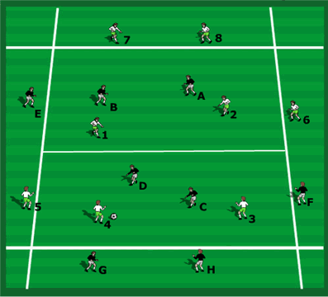
Players must pass the ball to their target players to score. To score again they have to work the ball back into their own half of the field to be able to return.
Target players have two touches as do side players.
COACHING POINTS:
Creating Space by running off the ball to receive or to help a teammate receive.
Quality of Passing; long and short to targets and to teammates.
Support play: working angles and distances incorporating switching play using the side players.
Receiving and Turning in tight situations and dribbling in 1 v 1 situations.
Quick decision making is required in this session because the numbers are small, the area tight and the transitions rapid.
Develop:
No restriction on touches then 3, 2 or 1 touch, but only if it is on to do one touch.
All outside and target players have one touch only where possible
Switch with target players as they receive the ball.
Switch with outside players
Here is an example of the transition and movement off the ball to make it happen.
(2) passes to target player (8) who brings the ball back into the playing area.
(3) makes a run into the other half of the field on the blind side of (C) to receive the next pass. They need to get the ball into that half to be able to score.
(1) makes a forward run into space to receive the next pass off (3) and passes to target player (7) who can start the play again.
(1) switches with (7) and becomes a target player for the next phase of play.

Elements of play the target game teaches
A) Attacking as a Team and as Individuals.
Creating Space by running off the ball to receive or to help a teammate receive.
Developing quick support play working angles and distances incorporating switching play using the side players.
Passing long and short to targets and to teammates.
Receiving and turning in tight situations and dribbling in 1 v 1 situation’s.
Lots of touches on the ball for the players in this practice.
Quick decision making is required in this session because the numbers are small, the area tight and the transitions rapid.
B) Defending as a Team and as Individuals.
Pressurizing players on the ball to regain possession.
Supporting pressuring players and tracking runners off the ball.
High pressure to regain possession in the attacking half to be able to go straight to the target to score.
C) Transitions from defense to attack and attack to defense, quick decision making and improved concentration as the switch occurs. Interchanges of positions between inside players, targets and side support players
D) As a coach you can work in this session how to defend properly as individuals and a team or how to attack properly as individuals and a team.
Progressions
No restriction on touches then three, two or one touch but only if it is on to do so.
Introduce neutral player so a 5 v 4 overload in the middle if possession isn’t kept easily.
Interchanges of players outside to in, inside to out.
Have one teammate at each end so you are attacking both ends but once you have passed to one target you keep possession and must try to get to the other target. You can’t go back unless the opposition win the ball and then you get it back, only then can you go back to the same target.
To lessen the workload and keep everyone involved have players switch with targets and outside players when they pass to them.
The team can only score if they get an overlap, crossover or 1 – 2 in during the buildup.
No talking so players have to rely on their own vision to play.
Players move into the target zone to receive (timing of run and pass) so we don’t play with actual targets, different players can then become the target player.
Man – Marking – Have the players man mark so they must track a player when they haven’t the ball and they must lose their marker when they have the ball.
To improve the speed of thought reward a successful one touch pass with a goal or point. To score a goal by passing to the target player now reward this with three goals or 3 points.
The team in possession can pass back to the opponents target players to help keep possession of the ball. Liken this to passing back to the keeper in

The 3 Team Transition Game for Attacking Players In and Around the Box - Training Center Exclusive
Three teams the outside team works with the inside attacking team. Great to teach both defending and attacking play. Teaches the mentality of transitional change. Developing Quick Play in and around the box. As soon as the team lose possession they must try to defend on the offside line and beyond, thus immediately pushing opponents away from the goal. Using the set up through the “numbers” to suit how we set our teams up.
1. Three teams the outside team works with the inside attacking team. Great to teach both defending and attacking play.
2. First team to score 2 goals stays on; the losing team goes off
3. Keep the score for number of wins per team
4. Transition game: Defending team wins the ball, they must pass to the outside team to then attack.
5. Teaches the mentality of transitional change.
6. Developing Quick Play in and around the box
7. As soon as the team lose possession they must try to defend on the offside line and beyond, thus immediately pushing opponents away from the goal
8. Using the set up through the “numbers” to suit how we set our teams up

Three team game: The Set Up
Constant Transitioning from attacking to defending as possession changes

Attacking Play
Quick break using the overlapping wingback (3)

Crossing behind the defense
Defenders recover, attackers pressure, (3) drives the ball behind the recovering defenders

Striker (9) moves AWAY from the ball: The Crespo
(9) Off the shoulder of (5) to receive Facing forward. Short and sharp movements

Check away and back across: The Crespo
(9) Off the shoulder of (5) who follows the run. (9) checks back into the space he created

Subtle movements by the striker to get free
(9) Checks back into space to receive to feet and side on to attack (5) 1 v 1

Opposite Run by (9): The Vialli Check
(9) Checks back into space to receive. to feet (5) stays tight, (9) spins back in
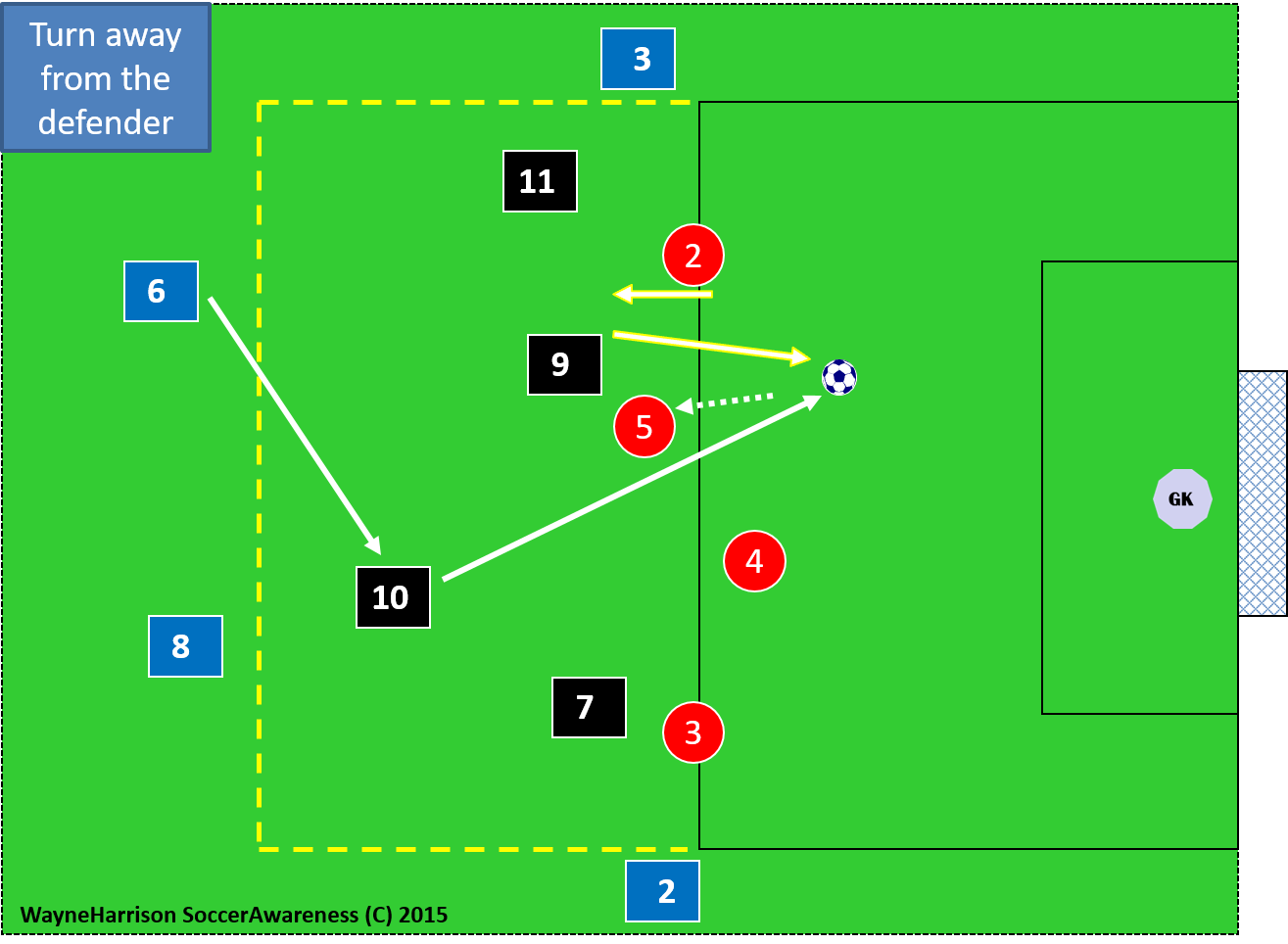
Opposite Run by (9): Del Piero Spin Away
(9) Checks back into space to receive. to feet (5) stays tight, (9) spins away and back in

Short to create space behind for another player
(9) Checks back into space to receive. to feet (5) stays tight, (11) cuts inside

Check to and back: The Vialli Check
(4) Tucks in to close the space as (5) gets tight. (9) reads the pass between (4) and (3)

Combination and Link Play
Round the corner pass from (9). (7) times the run between (3) and (4) to stay onside

1 v 1’s in and around the penalty box
Try to create 1 v 1 s for players to run at and commit opponents

Or creating give and go’s: short and sharp
The old 1- 2 is one of the best (and simplest) moves ever. Timing of pass and run vital

An Example: Creating THIRD MAN runs
(7) And (11) provide two options in behind the opponents back four
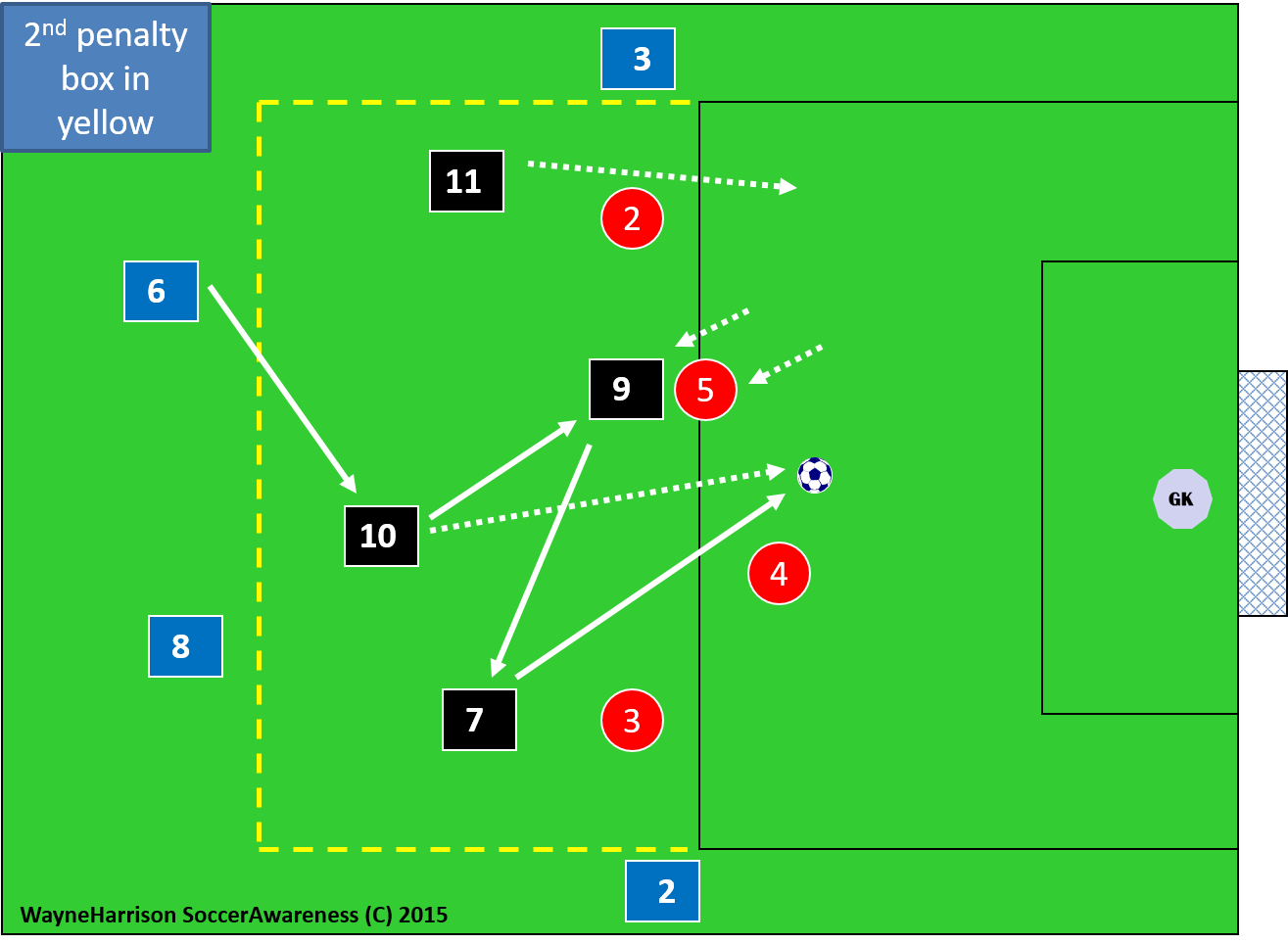
Creating THIRD MAN runs: another idea
(10) Starts the move and finishes it.

Blindside THIRD MAN runs
Players watch the ball go to (11) and maybe don’t see the run by (10) or (7)?

Keeper saves the ball and distributes quickly
Defenders now have the ball and play out to transition back

Now defenders are attackers
Defenders now have the ball and play out to transition back

Defenders win the ball and now Transition
A bad pass by (6). Defenders must pass to the outside and they then become the attackers

Transition Defending to Attacking
Good to teach the front four how to defend effectively

Compare to Pressing in the Attacking Third
Now (9) presses the ball like it is in the attacking third, all work together.

Defending Principles taught also
Attacking team give it away, defending team pass it out and get into position to attack

Defending Principles taught also
As the attacking team transition back, the defending team MUST push up also

Defending Principles taught also
Exaggerated; but Immediately the defending team must push up and leave opponents offside.

Quick Transition Directional Play Promoting Passing and Movement Off the Ball
This session improves quick decision making, tight control because the spaces are small to play in, and thinking in advance due to the switch in direction of the play. You can also work on the defending players.
The following session is an excerpt from “Soccer Awareness Coaching Curriculums presented by Game Sizes: 4 v 4, 7 v 7, 9 v 9 through to 11 v 11”
This eBook covers up to 14 weeks of training for each game size presented as one session per week. All sessions have small sided games scrimmage set ups as close as we can get it to finish to reflect the theme of the session
As the program moves from 4 v 4 through to 11 v 11 the focus changes from individual teachings at 4 v 4, to small sided situations at 7 v 7, to Phases of play and tactical needs at 9 v 9; through to team tactical development at 11 v 11. 11 v 11 focuses on advanced training ideas to teach the “team”.
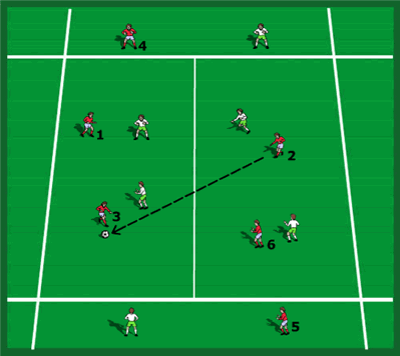
Quick continuous attacking play which is good for anaerobic fitness. Here the players are breaking one way passing to an outside player and switching positions, inside player out, outside player in then attack the other side of the zone.
Coaching Points:
Technical ability on the ball in 1 v 1 situations.
Quick Transition in attack - As the transition between players happens for example (3) changes with (5), the numbers team must get the ball to (4) as quickly as possible.
Observe the movement of (1), (2) and (6) in terms of their support positions as the directional change takes place, they must move in anticipation to find space to help the player on the ball as the switch occurs.
Observe also, as the change occurs, the positions of the defending team; has the decision been made quickly enough who presses the ball. Are the other defensive players supporting and covering and especially tracking runners off the ball. The coach must learn to look away from the ball and observe what may happen next before it happens.
This session improves quick decision making, tight control because the spaces are small to play in, and thinking in advance due to the switch in direction of the play. You can also work on the defending players.

Here (3) passes to (5) and (3) leaves the area. As the ball is traveling to (5), (1), (2) and (6) must get into a position to help (5) as early as possible so in theory, (5) can make a one touch pass to any or all of them. Thus (5) already has three options of a pass.
Their movement is OFF THE BALL and away from their markers.
Of course the defenders will move to compensate but for the sake of what I am trying to show it is easier to get the point across by showing the movements of the attacking team only.
The attacking players in the actual practice may get free like this anyway if they time it correctly.

The attacking players each being free to help (5) by being open for a pass.
(5) May elect to run with the ball but at least three are three options available for a pass if needed.
(5) May even elect to play a long pass straight to (4) on the other side of the field if the pressure from the closest defender is not fast enough. You may then ask the closest player (in this case player 2), not necessarily the passing player (5) to be the switching player instead if (5) passes it directly to (4).
You could even then work on defending in this game though focus on defending totally in the session or attacking totally in the session it is better not to try to do both as it can be confusing for the players.
Progression:
If a player beats an opponent in a 1 v 1 situation the team gets an extra point or goal each time.
Play one and two touch; reward each successful one touch pass with a goal to encourage the players to play quickly.
Competitive: Ensure you keep the score and have a finishing score to achieve as this keeps the players focused and motivated to win.
We produced the eBook "Tactical Thoughts on the Development of the 4 v 4, 7 v 7 and 9 v 9 Game Sizes" covering information on team shape and development. We now add this eBook to provide Curriculums in each game size to support the tactical games eBook.
What this eBook offers you:
Its all done here for you, paying attention to the ages of the players and the depth of teaching suitable to them.
As the program moves from 4 v 4 through to 11 v 11 the focus changes from individual teachings at 4 v 4, to small sided situations at 7 v 7, to Phases of play and tactical needs at 9 v 9; through to team tactical development at 11 v 11.
11 v 11 focuses on advanced training ideas to teach the “team”.
This eBook covers up to 14 weeks of training for each game size presented as one session per week.
All sessions have small sided games scrimmage set ups as close as we can get it to finish to reflect the theme of the session.