Welcome to the Soccer Awareness Coaches Corner. Browse through soccer drills, small sided games, tactical thoughts, full sessions and a variety of resources. Posts marked “Training Center Exclusive” are for members only.

Breakaway Game
In this game we are working on finishing, dribbling and breakaways. This is a great activity to work on both attacker and goalkeeper skills.
Finishing, dribbling, breakaways
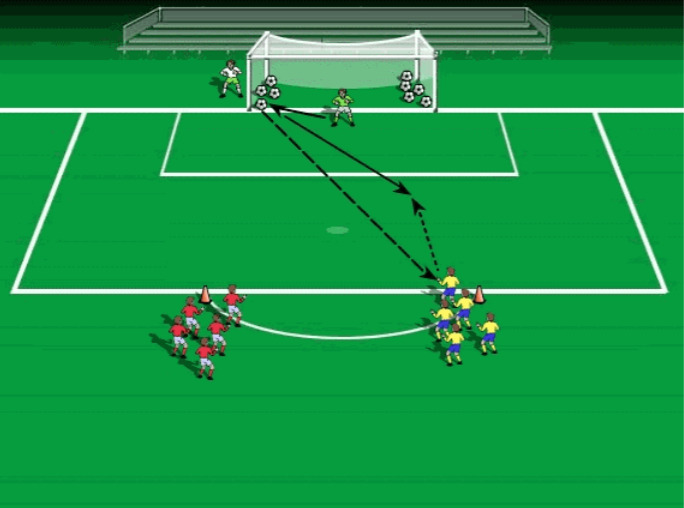
Use the penalty area. The balls are placed in the side of the net and easily accessible for the goalkeepers. All players are at the top of box on either side.
The goalkeeper starts the exercise by distributing the ball to the first person in line at the top of the box.
The attacker must control the ball and immediately breakaway to goal.
As soon as the ball has touched the attacker for the first time, the goalkeeper can leave his/her goal line and close down the shooter.
The attacker has five seconds to score.
The goalkeeper allowing the fewest amounts of goals wins. Keep track of the goals.
The team or individual with the most goals wins. Alternate the goalkeepers every time.

Progression:
The goalkeeper must find the attackers chest.
The attacker has three seconds to score.
Coaching Points:
The goalkeeper must react to an errant touch by the attacker.
The attacker’s first touch must be out at a 45 degree angle away from the body.
If the goalkeeper’s feet are moving, shoot quickly.

This drill comes from the Soccer Awareness Youth Coaches Guide!
A Complete 6 to 10 Year Old Developmental Coaching and Training Program. More than 750 pages of session, drills, theory and more to get you started or take your team to the next level.
This program is perfect for youth coaches wanting practices to start their soccer coaching education and it is also for those more advanced and experienced coaches wanting to train their players as best they can at these wonderful open minded ages for development and education of both the mind and body. Our plan is to help all coaches at whatever level of experience they are at.

Ball Control and Dribbling Skills Ideas
Dribbling is a ball skill that's crucial in soccer. The best soccer players in the world can control the ball when sprinting at full speed and avoiding defenders. Better dribbling skills allows players to create space and time and therefore better control the ball and make plays. Here are two drills you can add to your practices to improve your teams dribbling skills.
The following two drills come from eBook 27: Dribbling Technique and Skill for U6 to U9. This eBook includes drills and teaches technique that you can use in practice to help your team perfect their dribbling. You will learn different techniques to control the ball, specific dribbling moves, awareness dribbling work, dribbling for possession and more than 50 pages of drills that you can use with your team.
Wayne Harrison has put together this collection of dribbling drills from his wealth of knowledge at the highest levels of the game both as a professional player and professional coach. Find Out More
He Says She Says

Emphasis: Ball control and motor skills
Set-up: Use the penalty box or the center circle. Grid size depends on the number of players. Each player has a ball.
Objective: The players must follow the instruction of the coach. For example, if the coach shouts “touch the ball quickly side to side”, then the players must do so. Complete 10 commands successfully and then stretch for a minute. Repeat using different commands.
Progression:
Tap the top of the ball with the bottoms of your feet, alternating feet each time.
Jump over the ball.
Hop around the ball.
Skip around the ball.
Toss the ball up, hit it with your head, and catch it.
Use the bottom of your foot and move it in a circle.
Kick the ball in the air, turn, and catch it.
Coaching Points:
Get the touches right.
Don’t run into anyone.
Indianapolis 500

Emphasis: Dribbling, ball control
Set-up: Set up a 15x20 yard grid (race track). Place all of your players in the grid with a ball.
Objective: The players must not crash into the cones (rails). If the players (collide) with each other or the cones (rails), they must go outside the grid, and do fast footwork with the ball. For example; toe touches on the ball, quick passes side to side, or quick turns with the left and right foot. The players (cars) must obey the coaches (race director) shout. “Shift gears”-change directions, “red flag”-stop the ball, “blue flag”-stop the ball with the knee, “yellow flag”-dribble slower, and “green flag”-accelerate to top speed.
Progression:
Make the grid smaller and more congested.
Players must only use the left foot only.
Coaching Points:
Keep the ball close to your body.
Concentrate on change of direction away from pressure (other cars).



Three Team Awareness Game with Measured Outcomes
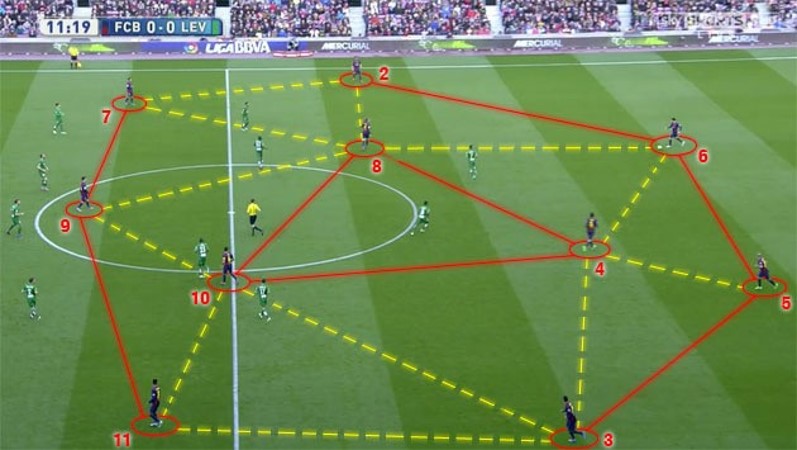
With these drills our players are developing awareness of where the player they receive from is and where the player they pass to is. Because of this players begin to anticipate the pass to them and where it is coming from. Also they must look to where it is going to (where is the player they are passing to?). We are trying to create a situation where players are looking two moves ahead not just one.
Non – Competitive Awareness Numbers “Game” With Teams: Passing in Sequence
Divide the players up into three teams

30 x 30
Using 3 teams. Within each numbered team each player is numbered off. Teams (1) and (2) work together (with two balls) and team (3) works alone (with one ball). Players must pass in sequence i.e. with teams (1) and (2) working together 1 passes to 2; 2 passes to 3; 3 to 4 and so on up to 8 who passes to 1 and we begin again whilst team (3) players pass 1 to 4.
Awareness of: where the player you receive from is and where the player you pass to is. Because of this players begin to anticipate the pass to them and where it is coming from. Also they must look to where it is going to (where is the player they are passing to?). We are trying to create a situation where players are looking two moves ahead not just one.
For instance as (1) is about to pass to (2), (3) should be looking to support (2) for the next pass already, looking two moves ahead before the ball leaves (1).
Peripheral Vision Development results from this.
Develop: Reduce the number of touches players are allowed each time they receive a pass, all in free play to begin, then three touch, then two touch then one touch if it is on to do so. This speeds up the decision making process and forces them to look earlier as to where they are passing to.
Semi – Competitive Awareness Numbers Game: Passing in Sequence


Coaching Points:
There are many things that the player needs to process before they even touch the ball involved in this. The breakdown is:
Good Footwork to receive the ball; which in turn helps the first touch
Taking a look around for all options to increase their peripheral vision
An open body stance to be able to change the direction of play if needed
Communication from the player about to receive the ball to teammates; and from teammates to that same player to help him or her recognize the options available
Then the first touch occurs.
An Open body stance is needed to allow a yard or more extra space away from defenders by letting the ball run across the body into preconceived space.
Looking before receiving to know in advance of the receiving pass; where the defending players are, where the space is, where team mates are free to receive a pass, how many options there are to move the ball on.
Movement OFF the ball is a priority both to receive it and after passing it.

The Three Zone Directional Game - Training Center Exclusive
This game is based on possessing the ball and the movement off it.
We have several progressions we can use to challenge the players these include:
A simple Warm up to get the idea going
Playing through the thirds with targets
Playing through the thirds without targets
Players must stay in their own thirds so we have 3 combination games going at once
We can add free players therefore creating overload situations
More!
*Membership Required
This game is based on possessing the ball and the movement off it.
We have several progressions we can use to challenge the players these include:
A simple Warm up to get the idea going
Playing through the thirds with targets
Playing through the thirds without targets
Players must stay in their own thirds so we have 3 combination games going at once (e.g. 3 v 3, 2 v 2 and 3 v 3 per zone or whatever numbers of players you have).
We can add free players therefore creating overload situations to make it easier for success competitively and to build confidence initially.
No free players to increase the pressure and the challenge.
Players can rotate between zones now. This is more game related in what we want to teach with players have freedom to interchange as long as they are covered by a team mate.
Add a condition to help improve / focus on body position and footwork: If a player faces backwards when receiving the ball they MUST pass that ball backwards and with only one touch allowed.
Man for man marking; 1 v 1s all over the field and in all three zones. Players in possession can rotate and move around their immediate marker has to follow them.
Touch restriction: Unlimited, then 3 then 2 then 1 touch if on to do so.
All through remind players that they MUST scan the field, must check their shoulders for options; to the side or behind them and not just see in front of them.
Use the yes and no check system to highlight for each player if they looked AWAY from the ball before receiving it.
Can play a longer pass from one end zone to another and missing out the middle third if that’s the best option.
Remember Xavi: In 90 Minutes looked AWAY from the ball 841 times. Amazing.
Joke about only needing half a touch to emphasize the importance of this mental skill.
Add goals at each end include keepers (who should have been in the game anyway for their footwork skills) and make it a game situation whatever the numbers are.
3 Zone Game: Playing Through the Thirds with Targets

4 ball warm up. Three zones, 3 v 3, 2 v 2 and 3 v 3.Players are passing and maintaining possession. Condition it to 1 or 2 touches on the ball to challenge the players. Players stay in their own zones initially. Play to the targets.
3 Zone Game: Playing Through the Thirds Without Targets

4 ball warm up. Three zones, 3 v 3, 2 v 2 and 3 v 3.Players are passing and maintaining possession. Condition it to 1 or 2 touches on the ball to challenge the players. Players stay in their own zones initially.
3 Zone Game: Playing Through the Thirds

Each end zone can be a defensive third or attacking third zone depending on where the ball is. Here for example (G) passes out of the defensive third to the middle third to (C) to the attacking third to (B). Now going the other way the end zones are reversed.
3 Zone Game: Making it Competitive

Now we have three zones each with their own combination play battles. 3 v 3, 2 v 2 and 3 v 3 but add two or three free players to help the game flow initially.
3 Zone Game: Making it Competitive with Targets

Now we have three zones each with their own combination play battles. 3 v 3, 2 v 2 and 3 v 3 but add two or three free players to help the game flow initially. Blues play to the blue target and reds to the red target, each team can use the other target as support. You can keep possession and work the ball back through the middle to the defending third after you reach your own target as the game is about maintaining possession and movement off the ball. You can rotate the targets the passer becoming the new target.
3 Zone Game: Making it Competitive: Stay in Own Zones

Only the free players can move between zones so they create overload situations in each zone, could be a 4 v 3 or a 5 v 3 for example.
3 Zone Game: Making it Competitive: Create Overloads

Only the free players can move between zones so they create overload situations in each zone, could be a 4 v 3 or a 5 v 3 for example. Here we have a 4v3, 3v2 and a 4v3.

Only the free players can move between zones here two move to the middle to create a 4 v 2 overload. Looking to move the ball from one end to the other so its a directional game similar to the actual game itself. Whoever is in possession must work to find the best open spaces in advance of the ball.
3 Zone Game: Making it Competitive: Rotation Between Zones

Now all players can move between the 3 zones but we want to maintain the balance in each. So one player moves from the defending third to the middle third a middle third player must move to the defending third. So within our set framework players can interchange positions and also cover for each other and again emulating the actual game situation we want to teach with players having the freedom to change positions and move around the field. Defenders can track them or not.
3 Zone Game: Making it Competitive: Rotation Between Zones and Man for Man Marking

Now we match up players to play 1 v 1 against each other within the game situation. Now all players can move between the 3 zones. The team in possession dictates the movements off the ball, the team without possession have to track their immediate opponents. If they are heavily marked the free players become a greater source of support.
3 Zone Game: Making it Competitive: Conditioning to Encourage Correct Footwork and Body Position

Now if a player receives the ball facing fully backwards they can only play 1 touch and it has to be a pass backwards also. (1) is marked by (C) and has their back to the way we want to go so must pass back, here to (3).
3 Zone Game: Making it Competitive: Conditioning to Encourage Correct Footwork and Body Position

Due to the condition players should begin to think about preparing their bodies to receive and be able to play and SEE forward. And therefore increase their immediate options. (1) here opens up their body position, is light on their feet; and is facing either sideways or forwards but is now in a position to pass forward and not use their body position and feet preparationto narrow down their options.
3 Zone Game: Making it Competitive with Equal Numbers for a more Pressurized Game

Now no free players so the game is much more competitive. Only move to this when you know you can have success. Here we show the players in possession, the blue team moving OFF the ball into new spaces to get free to receive. Players in the other grids are already on the move but must time it right and not do it too early or too late.
3 Zone Game: Making it Competitive Playing from the Defensive Third Directly to the Attacking Third

There is nothing wrong with a good quality long ball if that's the best option at that particular moment. (8) can play it into open space with the right weight and accuracy to move (1) to meet it.
3 Zone Game: Making it Competitive with Equal Numbers for a More Pressurized Game: What not to do

This will happen so check it if it does and address the problem. Players stand still and wait at the edge of their zone for the ball to come. They have no space to work in and are easily marked by the defenders. This isn’t game realistic at all but it will occur due to the set up and them waiting for the ball to transfer from the defending to middle thirds.
3 Zone Game: Making it Competitive with Equal Numbers for a More Pressurized Game: Restrict the Number of Touches on the Ball

Can be with man marking or without. Now we arrive at the moment we want to happen on the field where awareness training kicks in, players scan the field for options IN ADVANCE of the ball. Everything we have practiced up to this point should include a constant reminder of LOOKING AWAY from the ball. So go free and unlimited touches first, and build to 3 to 2 to 1 touch if its on to do so. At 1 touch add free players to help it work if needed.




Individual Striker Movements Off the Shoulder Part 4 - Exercise to Practice the Opposite Move
Striker (E) comes short and shows for the ball asking for a pass from (D). Defender (F) follows. Midfielder (D) passes to (C), (D) then passes over the top into (E)’s path as he / she spins. Defender must play passively. To continue the work once player (E) receives the ball they must beat (F) back to the touchline. Players (C) and (D) go to the middle and the next two take their place. As the pass is going from (D) to (C) the striker shouts the code word and spins to receive the pass as player (C) is about to pass it. The shout must be early to (C) to make the pass at the exact same time (E) is spinning to receive it.
This is part 4 of 4 on our Individual Striker Movements Off the Shoulder Series.
Exercise to Practice the Opposite Move

- Striker (E) comes short and shows for the ball asking for a pass from (D). Defender (F) follows.
- Midfielder (D) passes to (C), (D) then passes over the top into (E)’s path as he / she spins.
- Defender must play passively. To continue the work once player (E) receives the ball they must beat (F) back to the touchline. Players (C) and (D) go to the middle and the next two take their place.
- As the pass is going from (D) to (C) the striker shouts the code word and spins to receive the pass as player (C) is about to pass it. The shout must be early to (C) to make the pass at the exact same time (E) is spinning to receive it.
- Develop – The player receiving the pass can get it “short or long”, to keep the defender guessing.
- Short, when the code word is not used but the player could use any other word to confuse. Long, with the actual code word used. Combine with the passer to beat the defender.

- Striker (E) comes short and shows for the ball asking for a pass. Defender (F) follows.
- Midfielder (C) passes to (D), (D) then passes over the top into (E)’s path as he / she spins.
- Defender must play passively. To continue the work once player (E) receives the ball they must beat (F) back to the touchline. Players (C) and (D) go to the middle and the next two take their place.
- As the pass is going from (D) to (C) the striker shouts the code word and spins to receive the pass as player (C) is about to pass it. The shout must be early to (C) to make the pass at the exact same time (E) is spinning to receive it.
- Develop – The player receiving the pass can get it “short or long”, to keep the defender guessing. If short, combine with the passer to beat the defender.
- This is the “Vialli Move”.
Working Opposites with Movement of Strikers

- Strikers must recognize when the man on the ball has TIME to play the ball forward. Strikers move towards the ball dragging the man marking defenders close to them.
- As the player checks toward the passer as if to receive a pass and is marked tightly by the defender, a sharp spin is made to receive a long pass behind (into the space created by coming short) rather than the short one the striker seemed to be asking for. A Sharp turn / spin into the defender and across the shoulder is the best move rather than the old arc run into space. With the old arc run this is easily tracked by the defender as there is time to see the ball and the player.
- When the player has time on the ball to pass expect lots of movement at pace e.g. short to go long. Midfield player can pass down the side of the striker. When there’s no time on the ball i.e. they must pass quickly, expect players to stay in their positions to provide options. This means if they go short to receive they get the ball to feet from the first run because there is no time to make the second run as the player on the ball has to release it quickly.
Working Opposites Checking Back to Receive

- The midfield players need to know the strikers are playing opposites. This time the strikers are moving away to come back. Again there is time on the ball for the midfield player and the opposite movement comes into effect (both working off the second run), but if no time the striker knows it will be played first time into the first run.
- The opposite movement is if the striker shows to receive to feet, he / she is going to spin away and receive in space in front of them in the form of a through ball, if he / she runs away, then expect a check back to feet.
- This is especially effective when the strikers are not too close together so there’s lots of space to work in. To make the movement clearer the strikers can have a code word to call as a signal so the player on the ball knows what is happening. They call it as early as possible.
No Time On the Ball to Wait for the Second Run

- There is no time on the ball and the passer has to release the ball quickly due to quick pressure on the ball from (C).
- In this case the striker must recognize this and act accordingly and expect a pass from their first run, in this case with (10) it can be a run inviting a ball to be played down the side into the channel for the striker to run on to. In the case of (9) it is a pass to feet coming short to receive. The pass can be made from wide areas too with the same conditions passing off the first run or passing off the second run depending on the time on the ball of the passer or if the striker has given the code word signal.
- In a game the team could be prepared to play on the basis that they always make the pass off the first run unless they get a call from the striker using the code word to implement the opposite movement. It isn’t always possible in split second situations to recognize how much time a player has on the ball so it may be best just to work the movement off a call.

- Receiving from a wide position on the field the same principles apply receiving off the first pass, as above (10) down the side to space to run on to and (9) to feet. Here the passer must release the pass early (because of pressure on the ball) or they have not received the code word signal to implement the opposite move.
- In a game situation for the first thirty minutes it could be a game plan where the strikers always work off a pass from the first run and get the defenders conditioned into thinking that is always the case saving the decisive moment later in the game where the code word signal is called and they work the opposite move receiving from the second run. It may be they only have to do it once in a game and it results in a goal (due to the defenders being unprepared for the opposite movement) giving the striker a vital second or fractions of a second thus gaining a couple of yards on the defender in a vital area of the field to receive a pass and score a goal.

Italian Pressing and Conditioning Play Part 1: Pressing from the Back and Condensing Play
Pressing from the Back and Condensing Play. Defenders drop off slower than attackers to allow them to get close and to delay their forward momentum. The defenders attack the ball the moment the furthest attacker is along the defensive line of the last defender. They move together to the ball, in this case treble- teaming the man on the ball.
This is part 1 of a four part series on Italian Pressing and Conditioning Play
Pressing from the Back and Condensing Play

- Defenders drop off slower than attackers to allow them to get close and to delay their forward momentum.
- The defenders attack the ball the moment the furthest attacker is along the defensive line of the last defender.
- They move together to the ball, in this case treble- teaming the man on the ball.

- Here the strikers are along the line of the last defender and that is the instance the three defenders step and leave them offside and press the ball collectively.
- Use a command call, the best player to do it is the last defender who has to have good awareness of the positions of the other two opponent’s players as well as the player on the ball.
- The Command can be STEP, a short and sweet command that has to be instantly adhered to.
- Then you are relying on the officials seeing this and getting the decision right!! Good luck with that.

- (A) and (C) are offside if they receive the ball.
- (B) has 3 players challenging. Timing of the movement is crucial, all players attacking the ball at the same time.
- You need good talkers to do this.
- Slowing the opponent’s forward movement helps the recovering defensive players get back to help too; such as midfield players recovering back.
- Defenders must make sure the player on the ball does not get past them. Keeper acts as sweeper if the trap fails.
Part 2 Coming Soon
This eBook includes drills and teaches technique that you can use in practice to help your team perfect their dribbling. You will learn different techniques to control the ball, specific dribbling moves, awareness dribbling work, dribbling for possession and more than 50 pages of drills that you can use with your team.
Buy a Printed Copy on Amazon