Welcome to the Soccer Awareness Coaches Corner. Browse through soccer drills, small sided games, tactical thoughts, full sessions and a variety of resources. Posts marked “Training Center Exclusive” are for members only.

Teaching Players to Position Off the Ball to Face Forward to Receive It
Often players position to receive the ball with their back to play. These session plans show some ideas on how to position and instead "Face Forward" or at least Half Turned or three quarters turned rather than positioning square and facing back.
Often players position to receive the ball with their back to play.
These session plans show some ideas on how to position and instead "Face Forward" or at least Half Turned or three quarters turned rather than positioning square and facing back.
Simple movements can create more space for a player to then be at an advantage in their 1 v 1's against opponents all over the field of play. It can be the difference between keeping the ball and losing it. Much is done to creating the correct Fee preparation and Body positions.
We start with Central Strikers. Central strikers 9 times out of 10 position face backwards against a center back. This is fact, watch any youth striker and you will see this. It's still ok to do this but there are better ways to affect the center back. Rarely do you see a central striker come off the shoulder of a defender and FACE Forward.
This presentation shows you how to do this in various ways. It's very simple movement and very effective movement and it causes all sorts of problems for center backs. There is more depth and detail to this but this is a starting point to initially learn these vital movements. Also encourage players to face FORWARD or at the very least half or three quarters turned to see what's behind and around them before receiving and so their momentum on receiving the ball is then forward not back.
Sign up for our free newsletter below to download this 26 page presentation for free instantly.
This presentation can also be found along with more than 500 other presentations, drills, videos and more in the Soccer Awareness Training Center.
Presentation Preview
A simple exercise to show how players often position
This is the "Start Position" of the session. Everyone is marked.

Have each offensive player in black mark a defending opponent, or visa-versa. Sounds daft when we have possession of the ball; but this is what often occurs with poor positioning. This is a very exaggerated situation but is done to show how not to position off the ball.
Players must always SCAN the field in every position to find open spaces to move into; and free themselves of being marked by an opponent. They must also try to position so they are facing forward or at the very least Half Turned.



Distribution from the Keeper and Playing Out from the Back Using the 3-1-3-3 - Training Center Exclusive
Here are 9 ways to distribute from the keeper and play out from the back. We owe it to the players to teach them this as Young as is possible.
I work on this initially practicing all ways to get out. Have opponents only intercepting passes to begin. Then let it go free. When opponents win it back we work on the defending team condensing and defending correctly.
If three or four ways to develop play are done very frequently then it becomes a subconscious decision to move into position so no decision making required as such.
I am a real purist at heart so this would be how I want my teams to play from the back. Ok its risky sometimes but to me we have to try it. We have to defeat the long ball from the keeper way of playing that to me is completely wrong to play. Using this method, what are we teaching the players? Boot it and hope you win the 2nd ball? Bad, sad and it makes me mad !!
We owe it to the players to teach them this as Young as is possible. So here we develop play from the back. I work on this initially practicing all ways to get out.
Have opponents only intercepting passes to begin. Then let it go free.
When opponents win it back we work on the defending team condensing and defending correctly.
So certain plays are recognized consciously first of all with particular CUES offering identification of these.
If three or four ways to develop play are done very frequently then it becomes a subconscious decision to move into position so no decision making required as such.
This is Barcelona: We are using different numbers but the principles are the same. At any one time this can be a 3-1-3-3; it looks more like a 3-3-1-3 here

Basically we do it with (4), (5) and (6) as the first three, (8) is the single player, (2), (3) and (10) the next line of three and finally (7), (9) and (11) as the front three. But players rotate within this system to create a distinctive angled possession STYLE within the system / formation.
Distribution from the keeper and Playing from the back in a 3-1-3-3
Perhaps use cones instead of actual players to practice to make it work initially and to gain confidence (better still use Mannequins). Attacking team work the ball to the coach and then work it back to the keeper, back and forth.

Distribution from the keeper and Playing from the back in a 3-1-3-3
Our starting position, the team is in defensive shape and ready to attack. A 7 v 4 makes it easy to get out, but decrease the number of opponents if necessary to gain success initially; or increase if too easy.

How to coach it: Getting the ball to the Coach (or use small goals if you prefer)
Our team building from the back get wide and long. We maintain possession passing up and down and can go back to the keeper and constantly start again; or give it to the coach.

The coach can give it to the attacking red team
Coach gives it to the attacking red team and the defending team (your team) must get back to defensive shape asap. Add more players if this is too easy to defend against.

The coach can give it back to the keeper to start again
Coach can pass it to the keeper, your team resorts back to defensive shape as the ball travels and then starts to build again with the ball

1. Distribution from the keeper using one attacking wing fullback
We attack down one side and we slide across with the back three to cover the spaces behind

2. Distribution through Both center backs or (6)
A simple starting position on distribution from the back using only those players in the immediate vacinity. A 3 v 2 at the back in our favor.

3. Distribution through Number (6) in a wide area
Now (6) breaks wide to receive the ball and escape being marked in the middle and switches with (4) and perhaps opponent (9) goes with (4). The same can happen with (6) breaking out to the right also replacing (5) who moves centrally.

4. Distribution from the keeper: One centre back breaks wide
(4) Stays tight, (6) stays central, (5) goes wide, (2) pushes on and we get out down one side. Opponents (9) and (10) stop our (6) and (4), (5) gets free to play out. Only 2 defending now so risky against a counter attack.

OR, (3) stays tight too (4) moves central, (6) takes (5)s place at the back, (5) goes wide, (2) pushes on and we get out down one side. Opponents (9) and (10) stop our (6) and (4), (5) gets free to play out. (2) becomes (7), (5) becomes (2). Three defending now.

5. Distribution from the keeper thru wingbacks
They push 3 up we get out through our wingbacks. Have opponents make different choices to force the keeper to make relevant decisions in training.

Distribution from the keeper through Both wing backs
We can start to add players and build the session up. Here we close off one side so the keeper has to recognize he cant go to (3) but can go to (2).

6. Distribution from the keeper thru central midfield rotation of (6) and (8)
(6) Clears the space and takes the opponents (8) with him and our (8) drops in free to start the attack. Can also be with (6) and (10).

7. Distribution through Both wing backs dropping back
Centre backs both push out quickly,. And they are tracked by the two strikers. This releases spaces behind them. Both wing backs drop back into those spaces to receive the ball.

8. Distribution through centerbacks getting free
Centre backs both push out quickly,. Opponent strikers press the wing backs and centre backs get free so can bring the ball out and attack. Wing backs fill their positions by rotation. (2) and (3) become centre backs and tuck in either side of (6). Also (6) and (8) tried to rotate to get out.

How it may look if we lose the ball and have to recover
We tried (6) and (8) rotation, also center backs and wingbacks rotated, then we lost the ball and this is how we recover with players in different positions but in the same defensive framework.

Distribution from the keeper and Playing from the back 11 v 11
Now in an 11 v 11. Our normal way to get out from the back. We should always try this initially if it is on to do so. Try to get out thru (4), (5) or (6).

Distribution from the keeper 11 v 11
Another way to get out thru one center back and one wingback and even (8). (6) fills (5)s position (4) fills (6)s and (3) fills (4)s

Another way to get out thru one center back (5) and (7). Wingback (2) tucks inside and may take opponents 11 with them to clear the pass for (7). A nice area to play into circled also.

They go 3 v 3 against us to stop us playing out of the back so we try to get out through (2) and (3). Otherwise we have to push up, condense and kick it long.

This takes lots of practice with the keepers to make this pass happen consistently.
They go 3 v 3 against us so we try to get out through (2) and (3). Otherwise we have to push up, condense and kick it long. They “may” see what we are doing and push 7 and 11 onto our wingbacks (2) and (3).

They push two players onto our wingbacks (2) and (3)
This outlet is now stopped.
So we have to change our team shape from “wide and long” to “short and tight” getting ready for the long kick from the keeper.

9. They have pushed onto our Wingbacks so this outlet is stopped; we have to go long as a last resort
This can still be EFFECTIVE: Now we condense as a team “short and tight”. Our (10) is good in the air so we hit him and we have a lot of players around him to win the 2nd ball. Of course opponents will readjust also. Its cat and mouse.

This can still be EFFECTIVE: Now we condense as a team “short and tight”. Our (10) is good in the air so we hit him and we have a lot of players around him to win the 2nd ball. Of course opponents will readjust also. Its cat and mouse.

We leave their 3 strikers offside.
Players can gamble for the flick on from (10). Players position behind, in front and alongside (10) so wherever the 2nd ball goes we have players to pick it up. WE ABSOLUTELY MUST get better at this. Obviously opponents will position better than this defensively; but you get the point.


Soccer Awareness: Basic Principles of Development (One Touch Play)
Linking foot preparation, body position and mental preparation to the technique involved in making a one touch pass leads us to a discussion on one touch play and its benefits.
One touch play teaches the value of being able to take your eye off the ball when keeping your eye on the ball can be a disadvantage.
To make this work, players need to have good teamwork and positional sense and therefore must work hard for each other.
This article is the intro to Wayne’s eBook 16: Soccer Awareness “One Touch” Training Developing its Relationship with Movement Off the Ball. Get the full book.
The Importance of Teaching One Touch Play: Improving One Touch Play
Maintaining an Awareness of What Is In Advance and Beyond the Ball
Linking foot preparation, body position and mental preparation to the technique involved in making a one touch pass leads us to a discussion on one touch play and its benefits.
One touch play teaches the value of being able to take your eye off the ball when keeping your eye on the ball can be a disadvantage.
To make this work, players need to have good teamwork and positional sense and therefore must work hard for each other.
A Gradual Training Introduction: Training the Psyche of the Players through One Touch Play
Introduce the training in a gradual way; don’t jump straight into a scrimmage. Set it up so it is easy to do initially. For example, one touch passing in two’s. Here, no great amount of awareness is needed because they are facing each other, but they must look into each other’s eyes and not at the ball. This is teaching them to get their heads up, and is the first most basic stage. It is also working on the pace and direction of the pass, getting foot sensitivity started in terms of that first touch on the ball that is now in effect a pass.
Then move to groups of three where a little more peripheral vision is needed. Then ask them to pass and move in a small area.
Next, add more players so there are more passing options and more awareness is needed. Now introduce the Numbers Game, passing in sequence; this really starts to introduce the awareness concept, but with one touch only.
Communication: Good communication is a must, so have players talk to each other, passing messages on to help each other all of the time.
Also, have them do this without any verbal communication as they then have to rely on themselves alone and in games. Unfortunately as much as we try, this very often happens anyway.
So do this WITH communication and WITHOUT communication. Even compare the two, some may get so good at this they can work it out for themselves most of the time as their peripheral vision improves.
So practice one touch with your team, then play games / scrimmages with your team and insist on it being ONE TOUCH ONLY.
There will be times when 2 touches are needed but do not allow it. Force the error if need be by insisting on one touch only.
Example: A player does not get his feet ready to receive and as a result does not make correct contact with the ball and possession is lost. Everyone can see that his feet were the problem, especially the player involved, and this will register in his mind for the next time.
Example: The ball is passed too heavily and quickly (pace and timing of the pass is wrong) and the receiver needs a touch to control the pass initially and then make a 2nd touch pass to keep possession. That is the passer’s fault, not the receiver’s; and they will learn that from this single pass. It is likely that a one touch play at this moment will not work, which is fine, because this will help them learn why it didn’t work for the next time.
Example: No teammates move to give the player receiving the ball an option to pass it one touch.
This is the fault of the player or players off the ball and not the receiving player, but you must insist it is passed one touch still so they pass it into the space the player should have moved into. Again, this will probably result in giving the ball away, but they will learn from that.
The players will recognize if possession was lost because there was not enough support off the ball, the pass was too heavy, or if it was the fault of the player’s first touch if there were options off the ball.
When you first do it, particularly in a competitive scrimmage situation whether within your own team training or against another team, you may find it is incredibly ugly play; the players will more than likely really struggle with it (or maybe not, they may surprise you).
And it may be ugly for quite a while; but just let it go.
Do not be disheartened and don’t let your players get discouraged. And do not coach, just let them play and work it out for themselves. Tell them you expect it to go wrong more than go right to relax them about it...
They will find with practice that they need to adjust the weight of the pass to help the next player, so foot sensitivity in passing will improve.
They will learn this through their own trial and error, not necessarily just what you tell them.
Get eBook 16: Soccer Awareness “One Touch” Training Developing its Relationship with Movement Off the Ball. This 103 page eBook explores one touch training and movement off the ball and includes 90 pages of drills that you can do with your team. Table of contents is below.
One Touch Training: Teaches the player WHEN to play one touch; and when NOT to play one touch. We are teaching players to have a ONE TOUCH MENTALITY. A One touch mentality teaches players to recognize the best options; and therefore make the best DECISIONS; BEFORE and in ADVANCE of receiving the ball.
Movement OFF the ball: This mentality conditions the mind of players OFF the ball to position and move to help the player who is receiving the ball. This means we want players to always; at every moment; THINK: “I only have One touch”; therefore this will force players to always do what I call the “LOOK and THINK” before they receive the ball to see several options and pick out their best option, which may actually be to DRIBBLE!!
When you use these training sessions consistently you will see the development of that relationship between having a ONE TOUCH mentality and Movement OFF the ball.
So in a nutshell:
LOOK (before receiving the ball);
MOVE (find space off the ball based on positioning of teammates and opponents):
THINK (what is my best option?):
EXECUTE (the Decision; or the SKILL Factor).

The Three Team Awareness One Touch Game
Working with three teams (numbers depends on how many players you have, e.g. it can be 4 v 4 + 4 or 5 v 5 + 5 etc). Teams (1) and (2) work together to keep the ball from team (3). If team (3) regains possession the team who gave it away becomes the defenders. The defenders reward is they keep the ball and link with the other team.
The following clinic is part of the New "Soccer Awareness Age Group Specific Awareness Developmental Training" eBook from Soccer Awareness! Click here to preview the full table of contents!
Working with three teams (numbers depends on how many players you have, e.g. it can be 4 v 4 + 4 or 5 v 5 + 5 etc). Teams (1) and (2) work together to keep the ball from team (3). If team (3) regains possession the team who gave it away becomes the defenders. The defenders reward is they keep the ball and link with the other team.

Rules: Once possession is gained, to establish who gave the ball away the player who gave the ball away calls the color of his team and then everyone knows they are now defending and the game continues without a stoppage.
With younger players it may be best to do this (because the ball may be given away a lot more for one thing); whoever won the ball puts his or her foot on the ball to stop play and the coach can call out the team who gave it away. Play begins again working on transitions.
Develop: Increase difficulty for attackers by
Reducing the zone size.
Decreasing the number of touches on the ball of each player.
Conditioning the passing to be only to the other attacking team’s players e.g. (1) only passes to (2) and vice versa, therefore only half the numbers of passes are available per player.
Using two balls so that as they pass one ball they are now increasing their awareness and vision by looking for the other ball coming.
Players take off their pinnies so they really have to look and can’t rely on color identification.
No talking or pointing, so players have to rely on their own vision.
Prohibiting verbal communication
ULTIMATELY PLAY ONE TOUCH

Three Team Possession Game
Three teams, two teams work together, one defends, creates an overload situation in attack, for example 15 players, three teams of 5, a 10 v 5 game.
Possession changes as one of the two team’s players gives the ball away to the defending team then they become the next defending team this is a good transition game also from attack to defense and defense to attack. This game can be in an area of 40 x 40 yards for example and the challenge to the players can also be to move inside to outside (outside being just inside the touchline) and outside to inside to ensure they avoid standing in one area. Plus it takes greater vision or awareness inside the area; where they need to look around and open their stance up to potentially change the direction of play; than on the outside where they can see everything easily.
Encourage players who play centrally on the team to get in the middle of the area and dictate the play, be the pivot for the team, the player who transfers the ball from one side to the other, the link player, this can be one, two or even three players at a time, but they can rotate between themselves too.
Equal numbered teams in a possession keep away game; this would be the next progression from the overload game being a more difficult challenge of the players. Same principles and ideas as above apply.
Transition games: In two halves, creating overloads in each half as each team gains possession. Team A have to get the ball in one half and play a 7 v 3 for example, team B have to win it back with the 3 defenders and get it back to the other half and have a 7 v 3 in their favor, and so on.

Breakaway Game
In this game we are working on finishing, dribbling and breakaways. This is a great activity to work on both attacker and goalkeeper skills.
Finishing, dribbling, breakaways
Use the penalty area. The balls are placed in the side of the net and easily accessible for the goalkeepers. All players are at the top of box on either side.
The goalkeeper starts the exercise by distributing the ball to the first person in line at the top of the box.
The attacker must control the ball and immediately breakaway to goal.
As soon as the ball has touched the attacker for the first time, the goalkeeper can leave his/her goal line and close down the shooter.
The attacker has five seconds to score.
The goalkeeper allowing the fewest amounts of goals wins. Keep track of the goals.
The team or individual with the most goals wins. Alternate the goalkeepers every time.

Progression:
The goalkeeper must find the attackers chest.
The attacker has three seconds to score.
Coaching Points:
The goalkeeper must react to an errant touch by the attacker.
The attacker’s first touch must be out at a 45 degree angle away from the body.
If the goalkeeper’s feet are moving, shoot quickly.

This drill comes from the Soccer Awareness Youth Coaches Guide!
A Complete 6 to 10 Year Old Developmental Coaching and Training Program. More than 750 pages of session, drills, theory and more to get you started or take your team to the next level.
This program is perfect for youth coaches wanting practices to start their soccer coaching education and it is also for those more advanced and experienced coaches wanting to train their players as best they can at these wonderful open minded ages for development and education of both the mind and body. Our plan is to help all coaches at whatever level of experience they are at.

9 v 9 Animation of Team Development using One Word Commands
Just a one-word signal can organize a defense, so everyone on the team knows what to do and reacts together as a unit. Also midfield players close by can react off the call too as can strikers. These One-word calls ensure everyone will know quickly and effectively what they should do as a unit and as a team. Hence the back players (and the keeper) can organize their movement as a unit (and therefore influence those in front of them) from Five VERY simple one-word commands. The momentum is triggered from the back and runs forward through the team to the strikers. We must have a very vocal and confident leader at the back organizing this and making the decisions.

Improving Shooting On Goal Using Simple Shooting Ideas
Here are 3 simple drills to help your players develop good technique for shooting at goal.
Developing Good Technique For Shooting At Goal
Warm Up As always with a ball each and stretching
1) In two’s shooting through the coned empty goals to each other. We are looking for accuracy and a good technique. Have the players count the number of goals they score. Have a few rounds adding up scores each time.
2) If you have the upright cones have them shooting to knock over the cones. Do it alternately per player each side and count which team knocks the most cones over (competitive). Ensure players are all organized properly behind an end line so they all shoot from the same distance.

3) Simple shooting practice. Players are in two’s 10 to 20 yards apart, distance depending on the age group you are working with. Each has a goal to defend and they have to score past each other. Keep it to two or three touches per shot. Focus on the technique of striking the ball and explain and demonstrate this to the players.

Develop: Have the players shoot with their stronger foot for a time then have them practice shooting with their weaker foot for a time.
Conditions: Work on side foot shooting, instep shooting, swerving the ball with the inside and outside of the foot etc.
Competitive: After two minutes of shooting have the winners play each other and the losers play each other.
Develop: Have two v two games so some passing and shooting is developed; encourage a one touch shot from a well weighted pass from their teammates.


Combination Plays and Finishing Session
Development of the mental side of the game in terms of the Awareness program, i.e. seeing situations quickly and acting upon them is very important to the player to help him or her have success by scoring goals. The shorter and sharper the practice then the less time the players have to make the correct decisions to be successful, the more important it is to train them to be able to cope with these pressure situations.
The following session is from the Soccer Awareness eBook "Tactical Thoughts on the Development of the 4 v 4, 7 v 7 and 9 v 9 Game Sizes" covering information on team shape and development. As the program moves from 4 v 4 through to 11 v 11 the focus changes from individual teachings at 4 v 4, to small sided situations at 7 v 7, to Phases of play and tactical needs at 9 v 9; through to team tactical development at 11 v 11. Find out more here
Constant Transitioning from attacking to defending as possession changes
Three teams the outside team works with the inside attacking team. Great to teach both defending and attacking play.
First team to score 2 goals stays on; the losing team goes off
Keep the score for number of wins per team
Transition game: Defending team wins the ball, they must pass to the outside team to then attack.
Teaches the mentality of transitional change.
Developing Quick Play in and around the box
As soon as the team lose possession they must try to defend on the offside line and beyond, thus immediately pushing opponents away from the goal
Using the set up through the “numbers” to suit how we set our teams up
Develop the idea through the 4-2-3-1 set up as shown

Attacking Play
Quick break using the overlapping wingback (3)

Crossing behind the defense
Defenders recover, attackers pressure, (3) drives the ball behind the recovering defenders

Striker (9) moves AWAY from the ball: The Crespo
(9) Off the shoulder of (5) to receive Facing forward. Short and sharp movements

Check away and back across: The Crespo
(9) Off the shoulder of (5) who follows the run. (9) checks back into the space he created

Subtle movements by the striker to get free
(9) Checks back into space to receive to feet and side on to attack (5) 1 v 1
Combination and Link Play
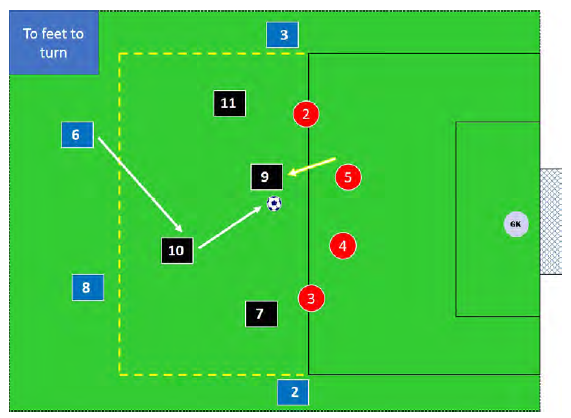
Round the corner pass from (9). (7) times the run between (3) and (4) to stay onside

Keeper saves the ball and distributes quickly
Defenders now have the ball and play out to transition back

Now defenders are attackers
Defenders now have the ball and play out to transition back

Defenders win the ball and now Transition
A bad pass by (6). Defenders must pass to the outside and they then become the attackers

Transition Defending to Attacking
Good to teach the front four how to defend effectively

A Shooting Game with big goals
Two large goals to shoot at to encourage success by scoring goals. Shorter field so lots of shots on goal because players are nearly always in shooting positions. Initially have the two team / two balls set up so no opposition to enable players working both ways to get lots of shots in. Once a team has worked a position to shoot and has done so that team’s keeper sets up another attack.
Progress it to the competitive even sided game.
Coaching Points:
Quick shooting.
Rebounds.
Transitions.
Quick break counter attack.
Players must be particularly aware of where teammates are, where the opposition are, the keepers position because the space to work in is small and the time they have on the ball is short.
Hence development of the mental side of the game in terms of the Awareness program, i.e. seeing situations quickly and acting upon them is very important to the player to help him or her have success by scoring goals. The shorter and sharper the practice then the less time the players have to make the correct decisions to be successful, the more important it is to train them to be able to cope with these pressure situations.


Improving Awareness In First And Second Touch Development - Training Center Exclusive
In this session, we are ensuring there is timing between the players in terms of the pass and the run to receive. We are doing simple passing in two’s back and forth, first two touch, then one touch where possible. Ask the players to look into “each other’s eyes” as they pass and NOT at the ball to see if they can keep possession between them. This will be difficult at first but it helps to teach them to look up and not down at the ball. during games and hence helping their “Awareness” development as players.
*Membership Required
Passing In Two’s
Simple passing in two’s back and forth, first two touch, then one touch where possible. Coach can dictate the distance between them.
Ask the players to look into “each other’s eyes” as they pass and NOT at the ball to see if they can keep possession between them.
This will be difficult at first but it helps to teach them to look up and not down at the ball. during games and hence helping their “Awareness” development as players..
They should be able to see their ball in the “peripheral vision”.
Using both feet to pass the ball.
Competitive: Count how many passes they can get in between them during a given time.

1st And 2nd Touches On The Ball In Teams Of Two
Ensure there is timing between the players in terms of the pass and the run to receive.
a) Two touch passing. Practice using both feet.
b) Side of foot passing getting a rhythm going one touch to control then a second touch to pass back. Then the passer is moving in to meet the ball and pass, and then out after passing the ball. Get a rhythm moving in and out, don’t stand still.
c) One touch side of foot passing, moving in to meet the ball, one touch pass and then back again. Weight and Accuracy MUST be good now to allow the team mate to pass back with one touch.
d) Decision Making: Player passing points their arm to one side the player receiving has to pass to the other side.
e) Two footed Control and Pass: Inside and Inside receive the ball with the inside of the right foot, move the ball first touch and inside and off line to yourself, then a second pass with the inside of the left foot. Do left foot first touch also.
f) One footed Control and Pass: Inside and outside of the foot passing using the same foot. Move the ball inside and off line with the inside of the right foot and pass with the outside of the right foot. Repeat with the left foot.
g) One footed Control and Pass: Outside and inside of the foot passing using the same foot. Move the ball outside and off line with the outside of the right foot and pass with the inside of the right foot. Repeat with the left foot.
h) Feinting and Receiving: Fake to kick the ball one way and go the other. Perform this action with the various moves discussed previously.
i) Receiving and controlling the ball: Three touches on the ball. First movement is forward to receive the pass, first touch on the ball is forward again, second touch is to the side, and then third touch is the forward pass back to the team mate.
j) Pointing: Introduce pointing again, passer points one way, receiver fakes that way and passes to themselves the other way then passes to their teammate.
k) Competition and Pressure. Count the number of passes in a given time and see which pair does the best. Look for a balance between control and speed of passing. Do this for all the different progressions as a finishing point for each one so they need to do it under pressure.

Place a cone in front of each player as a target object to play around. This also helps the player receiving the ball to judge their first touch and how far it needs to go across the field before they pass the ball forward again, with their second touch, to their teammate.
Player (1) pass the ball down the side of the cone to player (2) who must move the ball on their first touch to themselves and to the other side of it, then pass the ball back on their second touch. Player (1) then repeats the process.
Try to make the first touch to themselves a short, tight distance with the ball under control for the second touch which is the pass back down the other side of the cone. Keep this continuous rhythm going but you can dictate which part of the foot you can do this with as previously highlighted, inside to outside, outside to inside, inside to inside and transferring feet and so on.
Work the ball also from left to right so players practice moving the ball both ways not just one way.
Competitive: How many successful passes can the pairs of players make in a given time using the required techniques?

Now use the cone as a target to get in front of. As the ball is passed the player receiving must get in front of the cone to receive the pass, perform the movement required and pass back then move back behind the cone again.
This forces the player to move towards the ball as they receive it. This is an important movement because players often wait for the ball to come to them in a game and an opponent steps in front of them to steal it before it gets to them.
The movements are continuously back and forward, in front of the cone, receive the pass, move across with one touch, pass again with a second touch then behind the cone moving backwards and back across to receive again. Have the players develop a rhythm to this to get the best out of this practice.
Increase the distance between the players so they do not get too close to each other when both have moved in front of the cones to both pass the ball and receive the ball.
Competitive: How many successful passes can the pairs of players make in a given time using the required techniques?


Develop: As above have the players now make a first touch pass to themselves to the side then a diagonal second touch pass back across the field to their teammate.
Now have the players come in front of the cone to receive the pass as before forcing them to come and meet the pass. (1) Passes the ball from in front of the cone, then drops back, moves across to receive the diagonal pass back and move forward again to receive and so on.


Game Day Warm-up (ONE Touch Layoff)
In this warm-up, players pass, receive and move off the ball at GAME speed. We are getting them mentally and physically prepared for the speed of the game.
The following drill comes from the Soccer Awareness Training Center! Find out how you can access more than 600 drills, training sessions, videos and more.
Area: 15 x 15
Routine: A well weighted pass to the center cone; where a player is waiting to layoff a pass and back pedal out of the way to create a new passing lane for the player standing on the cone opposite of where the play originated.
A third player receives and dribbles at full speed back to the line. Player sprint and follow their pass and be ready for the next pass.
Coaching Points:
Mental and physical preparation for the game
Players pass, receive and move off the ball at GAME speed
Quality of the pass: weight, timing, angle; accuracy
Intensity at every stage to be prepared for the game

Players move to the cones to receive the pass. Moving left to right the player must position so they receive the ball with the OUTSIDE / OPPOSITE foot. This opens their body position up to be able to either pass back or in a different direction very easily and very quickly because they are already balanced and ready.
Future Collaboration with the English Football Association
We are excited and honored to be invited by the professional English FA to add my work to their Professional Player Insight Group. Paul Holder, a legendary figure in youth development at the English Football Association, has reached out to invite Soccer Awareness to be part of the English F.A.’s player development program. Exciting times ahead for Soccer Awareness. Read his message below:
Wayne,
The English FA is continuing to develop world class experiences for Coaches and teachers across the game and for all ages and stages.
We have put together a “player development insights group” which is focusing on developing resources and best practice that would help coaches understand those big issues in any players’ ‘journey’ from their first touch of a football to a world cup final.
We are looking closely at ‘skill development’ and what constitutes ‘skillful play’, how coaches in the first instance recognise it and then how to coach, develop and maintain it.
What it looks like for an individual, a small group and how it would impact on team performance. The rationale behind it all is that if the individual skills and tactics are weak, the unit (small group) will stutter and so, the team will eventually fail.
All that great work you have done over the years , particularly on the importance of ‘awareness’ ‘fits perfectly’ with our aims and objectives.
The group is impacting on courses, CPD (Coach Professional Development) events and on clubs coaching programmes and coaching philosophies.
We work mainly to serve the professional game but it is a ‘whole game message, which is going out to grassroots as well.
It would be great if we could tap into your knowledge, experience and expertise in these areas.
This would mean us forming a real collaboration which would benefit all of us. It would mean sharing ideas, best practice and of course, futures trends, all of which we would filter out to the game in a variety of mediums.
The details of how it would work, we can deal with later.
Let me know your thoughts.
Best wishes;
Paul Holder
Professional Game Team – The English FA

Defensive Pressing to Push Up Without Touching the Ball with a Back Three
This is a great session to teach the players and shows how they can push opponents back even when THE OPPONENTS have the ball.
We will try to push them back without even touching the ball ourselves. We start on the edge of our box we try to get our back three up to the half way line. Set Conditions will help us do this to start the process off.
Conditions:
Defending team cannot tackle.
Defending team CAN intercept a pass.
Attacking team must play 1 or 2 touches due to the fact defenders cannot tackle so opponents cant dribble 1 v 1.
Coaching Points:
Defenders press the ball as quickly as possible.
Try to stop the forward pass, try to force a pass across the field or backwards.
Defenders must recognize every opportunity to push up no matter how small a distance it may be.
Sometimes its 5 yards up 3 yards back for example depending on the position of ball and if there is pressure on it.
Try to intercept the pass and gain possession.
Download this free 20 page session by joining our mailing list below

Awareness One Touch Theme Developmental Training: Incorporating Movement Off the Ball
Players are generally all very good at playing using many touches; that is; dribbles, turns and running with the ball, that is more technical training / playing.
But often not so good at one touch quick thinking and quick decision making training, that is more skill training / playing.
Hence why we must increasingly do this training with them.
This article is the intro to Wayne’s eBook 16: Soccer Awareness “One Touch” Training Developing its Relationship with Movement Off the Ball. This 103 page eBook explores one touch training and movement off the ball and includes 90 pages of drills that you can do with your team. Get the full book.

One Touch Training: Teaches the player WHEN to play one touch; and when NOT to play one touch. We are teaching players to have a ONE TOUCH MENTALITY. A One touch mentality teaches players to recognize the best options; and therefore make the best DECISIONS; BEFORE and in ADVANCE of receiving the ball.
Movement OFF the ball: This mentality conditions the mind of players OFF the ball to position and move to help the player who is receiving the ball. This means we want players to always; at every moment; THINK: “I only have One touch”; therefore this will force players to always do what I call the “LOOK and THINK” before they receive the ball to see several options and pick out their best option, which may actually be to DRIBBLE!!
When you use these training sessions consistently you will see the development of that relationship between having a ONE TOUCH mentality and Movement OFF the ball.
So in a nutshell:
LOOK (before receiving the ball);
MOVE (find space off the ball based on positioning of teammates and opponents):
THINK (what is my best option?):
EXECUTE (the Decision; or the SKILL Factor).
Introduction:
Players are generally all very good at playing using many touches; that is; dribbles, turns and running with the ball, that is more technical training / playing.
But often not so good at one touch quick thinking and quick decision making training, that is more skill training / playing.
Hence why we must increasingly do this training with them.
For the ONE TOUCH AWARENESS training game with three teams that I want everyone to do each training session for 10 minutes; to ensure we improve the players quick thinking and decision making, as well as their awareness of how to get free OFF THE BALL, here are some more ideas with the same theme so you do not have to do the same game every training session.
This will also ensure the players do not get bored with the repetition of it all.
Really try to have the players play one touch but depending on their developmental level perhaps start with two touches for them to gain early success and to increase their confidence.
But, As Soon As You Can; Play One Touch Only
Please ensure you do this every session as it is imperative we work on this theme with them.
Coaches choose which session they use each training session please, there are many choices to go at for you.
Shown below are many variations of the theme but the simplest theme to use is focusing on:
“ONE TOUCH PASSING AND MOVING OFF THE BALL”
Many may struggle with this but in time and with patience and practice you will be amazed how much improvement comes in quick decision making using this game. As each player only has one touch to pass the ball this should improve players movement off the ball to support due to this as they know the player receiving needs immediate help and as many options as possible. The two aspects of play go hand in hand, one touch play and movement off the ball.
Players in 90 minutes touch the ball themselves, depending on their position, perhaps 3 to 6 minutes, so what do they do in the other 84 to 87 minutes?
They must understand how best to move OFF THE BALL in that time span to help their teammates.
Hence why the focus and teaching of Movement OFF the ball is so vital and important in the greater scheme of things in the game.

A Crossing Phase of Play Including an Overlap
We are looking to get the ball wide in this phase of play so overlap work comes in. Primarily working with wide players and how they create positions to cross the ball from. For your preparation you can play against a back four or a back three depending on what the opposition play like (better to plan for both).
Introduce this and the crossing and finishing game following this when you think the players are ready to follow and understand it fully.
Start with the overload situation to help gain success and breed confidence in the players. If defenders win the ball they pass to the targets and the play starts again.
We are looking to get the ball wide in this phase of play so overlap work comes in. Primarily working with wide players and how they create positions to cross the ball from. For your preparation you can play against a back four or a back three depending on what the opposition play like (better to plan for both).
Coaching Points of an Overlap:
1. Does the player need support behind or in front?
2. Create Space – Move inside with the ball to open it up outside.
3. Communicate – Support player can call “hold” to gain time to get into position
4. Timing of the Run – Go wide (angle and distance).
5. Player on the ball passes or uses the run as a decoy to come inside and attack.

The end product of the attacking movement.
I have left the defenders out to be able to show more easily where the attacking players need to finish up, (obviously they will track the players back towards their own goal). (9) And (10) may switch positions as to where they attack and do a crossover between them.
We have players attacking: the near post (10), the far post (9), beyond the far post for anything over hit from the crosser (11), around the edge of the box and in the center for the pull back (8), (3) and (7) in anticipation areas around the box also and (6) naturally moves forward to maintain the shape of the attack and fill spaces in behind (8).
The cross arrives at the far post area for (10) to try and score.


Small Sided Third Man Run Games - Training Center Exclusive
Some of the best forward runs in soccer are deemed “third man runs” often made from a position that is blindside of the opponents. The third man run player can start the passing sequence; or not, but invariably they are on the end of a forward pass often beyond the back four of the opponents.
The set up in the first game is as it would be in the attacking shape of a 4-2-3-1, so you can take this small sided game to represent the 11 v 11 in a particular area of the field making the same types of plays. You can also use this for any team shape set up you might use in an 8 v 8 or 11 v 11. If you play with two striker s then play 7 v 7 and two up front for example or even change the shape behind.
*Membership Required
The set up is as it would be in the attacking shape of a 4-2-3-1, so you can take this small sided game to represent the 11 v 11 in a particular area of the field making the same types of plays.
You can also use this for any team shape set up you might use in an 8 v 8 or 11 v 11. If you play with two striker s then play 7 v 7 and two up front for example or even change the shape behind.
To begin to help provide a guide / signal for when to make the 3rd man run we have a CONDITIONED RULE: Every time the ball is passed BACKWARDS, another player must run forward and beyond the ball.
That would be the forward third man run we are encouraging; and the player receiving the back pass needs to see that run and make that pass.

Coaching Points:
Identifying the conditioned moment (a back pass) to make the run
Identifying the conditioned moment to make the pass
Timing; angle and weight of the pass off a previous pass back
Timing and angle of the run to receive the through ball
Encouraging more than one player making a forward run to increase the options
Scoring: To score the player has to receive the pass as he or she is over the end line within the end zone. Equate the first line on the end zone as the back four of the opponents so you are timing the run to beat the back four (or beat their offside with a run from deep).
Timing: Going too early with the run and they receive the pass in an offside position. Weight of pass is so important here also.
The ball is passed forward first, as soon as it is passed back that is the signal for a player; or players; to make forward runs beyond the ball and beyond the furthest forward player; if possible. Here (11) is the receiving player.

The third man run passing sequence can also be started and end with the same player such as here with (11) who plays forward to (9) who drops the ball back to (7) who plays the forward pass to (11) making the blindside run.

Here a run from a deeper position by (8). The ball goes back to (10) which is the signal for a forward run, and (8) makes the run into the space that (7) has created by coming inside and bringing the defender inside also. (8) Did not get beyond (9) initially but we still got the third man run in.

Here two players make third man runs beyond the ball so (7) has two options of a pass. This is even better.
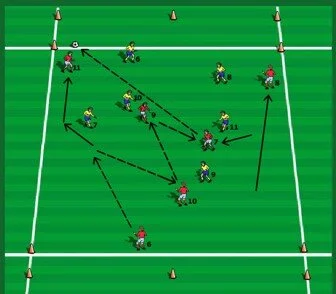
1. The ball is played back to (10) off (11) who makes a forward run. When it was passed back (8) started the third man run. Because it was from very deep he had time to run a distance to meet the pass without being offside so there was time to pass to (9) and for (9) to receive and turn and pass the ball in.
2. Again timing is the essence of all this for it to work.
3. Being wide, (8) is in a great observational position and can watch the play as it builds up; and be able to make the right run at the right time.
Development:
1. Have a goal instead of an end zone so the outside end line is still the offside line representing the back four; but now you can finish on goal.
2. Initially have it where defenders cannot track the player once they are beyond the end line so they have a free run on goal to gain confidence in finishing without pressure.
3. Then allow defenders to track the run and tackle so increasing the pressure on the finisher.
4. Good for finishing one v one also with defenders tracking the player to pressure them.

Include goals as an end product
1. The inside thick end line represents the back four position of the opponents. We need to build the attack and once the ball is played back another player; or players; makes the third man run off the ball, in this case (8) and (11).
2. Set up like this you can have two teams working on the same theme.
3. If you want to relate it to playing against a back four you can bring your own back four in and set it up as such; as I have shown in the Phase of Play next.

Phase of play: focusing on movement and third man runs beyond the ball
You can Include the pass back condition to help the players identify the right movement to make the 3rd man forward run until they can do it without this condition.
1. Defending team win it they pass the ball into the small goals and we start again. You can keep score to keep it competitive. (7) Is a good option as he or she comes inside from the blind side of (3) who may be ball watching and see their run too late.
2. Here as the ball is played into (9); (10) and (7) start to make forward runs to offer two options behind the back four to pass into; and (11) plays the diagonal through ball to (7).
3. (8) Fills the space behind left by (10) and it could easily be a lay off from (9) to (8) to play the forward pass also.
4. DEVELOP: Bring in both fullbacks attacking so we add even more options of third man runs, especially when the wide players (7) and (11) cut inside to clear the space outside.

1. (11) has two options of a forward pass, choosing (10) in this case over (7).
2. In this case a ball over the top of the defense would be a great pass too; especially if the defense is focusing on the ball. For example (7) comes from the blind side of (3) as in the previous diagram. It could be a flatter run if it helps the timing.

1. It is easier for the third man run player to see the ball when it is coming towards them at an angle, such as in this diagram above (with the run of (7) here). (7) CAN SEE THE FULL BUILD UP HERE AND IT WILL HELP HIS OR HER TIMING.
2. If directly from behind the run (in 10’s case) then it is much harder to see when and where the pass is being made to get the timing and angle of the run correct, though it can still work with players with good awareness and peripheral vision..
FINALLY: Take out the condition of the run coming off another player passing the ball back. Now players must work it out for themselves when and where they make the runs beyond the opponents back four.
DEVELOPMENT: It also does not necessarily have to be from a back pass anymore, that was just a condition put in to ensure the runs were made initially in the practice. Players can still make third man runs off forward passes.

Here is an example of such a play. (9) Plays it forward to (7), (10) has already set off on the forward run to receive into the space created by (9) coming short to receive and dragging center back (4) to the ball also.
REMEMBER; all these diagrams are set up to show the attacking TEAM HAVING SUCCESS. It won’t be as easy in actual play but our aim / goal here is to develop a training plan to make it successful initially; and to give the players confidence in the execution of the idea.
In reality the fullback (2) should tuck in to fill the space as (4) goes short, leaving (11) free but he is not the danger, (10) is.
And / Or perhaps a midfield defending player (maybe (6) for example) will track (10)’s run to make it more difficult to have success but you will add that into the session after initial success; to really test the players. This third man run concept is particularly good when teams defend high against you so there is lots of space to run into behind the back four

54 Pages
We want to stay with our own game plan as closely as possible; based on what we practice and to keep it simple for us; as we dictate to our opponents; and we impose OUR WAY on them.
But there will be many occasions where we must change the system of play and we may have to adjust to suit the opponents.
Here are some ideas for you to consider for your team starting with the 13313 and 14231 systems of play.