
Developing Play with a Defending Back Four
/ Wayne Harrison
- The session is designed to show how to work on team shape building up from a back four only. Side cones are 25 to 30 yards apart as are the defenders and the coach. The coach moves with the ball and the defenders mirror the movement maintaining the distances between them.
- You can use the signal words UP, OUT, HOLD, DROP, and SLIDE, to determine the movement. Eventually we need to work up to an 11 v 11 situation showing how to work a team as individuals, as units and ultimately a team.

- Here the coach moves to the outside and the whole back four adjust their positions across the field (slide) to compensate for this movement, (2) being the player to apply immediate pressure on the ball.
- Re-emphasize the idea that the players are tied as links in a chain and so have to move together as links of a unit or even tie them up so they feel how it is when they move together. Coach moves back up the field the back four condense up also based on the position of the ball.

Teaching players to develop a "one touch mentality" in their game, to train the MIND.
To play in "Anticipation" of the ball; both on and off it by Scanning the field constantly to make earlier, faster and more successful decisions in the game.
How do we do this? Here are some sessions to use to help develop this ability.

45 Pages
Using the 1-3-3-1-3 system of play for this, we show how your players can find free spaces between opponents with inverted runs from outside to in. Including how to create freedom of movement within the team framework.

This 295 page ebook includes 17 game situational clinics focused on tactical play and target games. To achieve the given theme successfully, many of the situational games have set conditions to them to force the theme to happen consistently and to maintain the focus of it. As we will explain, a big part of teaching in ALL these games is developing a One Touch Mentality in each players brain. So the “general” theme around all of them will be establishing this thinking process no matter the “specific” theme being taught.
This book is also available to Elite and Premium Members in the Soccer Awareness Training Center. Access Here.

We produced the eBook "Tactical Thoughts on the Development of the 4 v 4, 7 v 7 and 9 v 9 Game Sizes" covering information on team shape and development. We now add this eBook to provide Curriculums in each game size to support the tactical games eBook.
What this eBook offers you:
Its all done here for you, paying attention to the ages of the players and the depth of teaching suitable to them.
As the program moves from 4 v 4 through to 11 v 11 the focus changes from individual teachings at 4 v 4, to small sided situations at 7 v 7, to Phases of play and tactical needs at 9 v 9; through to team tactical development at 11 v 11.
11 v 11 focuses on advanced training ideas to teach the “team”.
This eBook covers up to 14 weeks of training for each game size presented as one session per week.
All sessions have small sided games scrimmage set ups as close as we can get it to finish to reflect the theme of the session.

This eBook shows how these different size games can be taught and also shows different systems of play that might be useful to you.
The idea I am trying to cultivate is to find a pattern of development that goes from 4 v 4 to 7 v 7 all the way through 9 v 9 to 11 v 11 that educates the players VERY EARLY on how to ultimately play the 11 v 11, a common thread running right through the book.

This ebook contains 50 of the best, fun and developmental coaching sessions for 6 to 10 year olds providing a solid foundation for you to build your players' skills. There are more than 300 pages of specific practices with diagrams, step by step instructions, objectives, coaching points and progressions. Topics covered include: setting up training sessions and small-sided games, awareness, improving touch, dribbling, shooting, passing and much more. Bring out the best in your soccer players with these fun and developmental sessions.

Some of this is thinking outside the box and addressing issues not always covered in this format.

Complete 6 to 10 Year Old Developmental Coaching and Training Program
More than 750 pages of session, drills, theory and more to get you started or take your team to the next level.
This program is perfect for youth coaches wanting practices to start their soccer coaching education and it is also for those more advanced and experienced coaches wanting to train their players as best they can at these wonderful open minded ages for development and education of both the mind and body. Our plan is to help all coaches at whatever level of experience they are at.
This book aims to provide the best educational information possible for all coaches of players from 6 to 10 years old in terms of the Technical, Tactical, Skill, Psychological and Physical attributes players need at these ages and then bring it all together in a team concept. As the age group raises so does the type of training required.
Limited Time: Get a free copy of Best of Soccer Awareness ($12.95 value) with your purchase
Give the gift of coaching education to a colleague or family member with a Soccer Awareness Gift Card!
Purchasing this digital gift card creates a unique code. The gift card recipient can enter this code at checkout to subtract the gift card value from their eBook order total.
Introduce Attacking Opponents

- Players with the ball pass it across in front of the defenders. Defenders adjust their positions to mirror this movement. This is working on marking zones and marking players and distinguishing between the two depending on where the ball is.
- Pass across to the next player and hold the ball there, check the defenders positions, then move the ball again.
- Use the side cones as guides to distancing between units as they are introduced.
- The ball has been passed inside and the defenders adjust closing down the player on the ball and closing down the spaces around the ball.
- This is continued using all the players sometimes missing a player out with a pass so it goes across two players to test the defenders and how they adjust. Once they have grasped this concept you can move the players to the next progression. In the next phase of the session have extra balls ready in the center circle to keep the flow of the session going.

- The coach now has players to pass the ball to (opponents).These players initially must be in static positions to check the set up. You can us a rope to tie the four defenders together to get the idea of moving as a unit. Players maintain an open stance so they can see opponents as well as the ball. When the ball is at (C) or (D) the back four take positions with regard to (A) and (B) and do not get drawn to the ball. Defending team can win back the ball only with interceptions of passes not with tackles to allow us to look at the shape they achieve.
- Here we see how the back four should look once the ball has been passed wide and defender (2) has closed the ball down.
- Notice the back four is NOT flat but like angled links between each player with the central defender (5) the deepest player. This player can effectively be called the sweeper. When the ball is at (B) on the other side, (4) becomes the sweeper.
- The second center back is the deepest player and the two center backs share this responsibility depending on which side of the field the ball is positioned.

Often players position to receive the ball with their back to play. These session plans show some ideas on how to position and instead "Face Forward" or at least Half Turned or three quarters turned rather than positioning square and facing back.
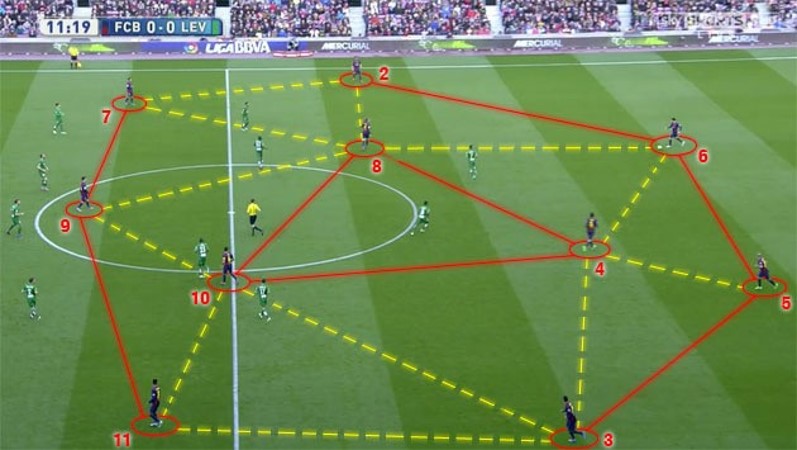
Here are 9 ways to distribute from the keeper and play out from the back. We owe it to the players to teach them this as Young as is possible.
I work on this initially practicing all ways to get out. Have opponents only intercepting passes to begin. Then let it go free. When opponents win it back we work on the defending team condensing and defending correctly.
If three or four ways to develop play are done very frequently then it becomes a subconscious decision to move into position so no decision making required as such.
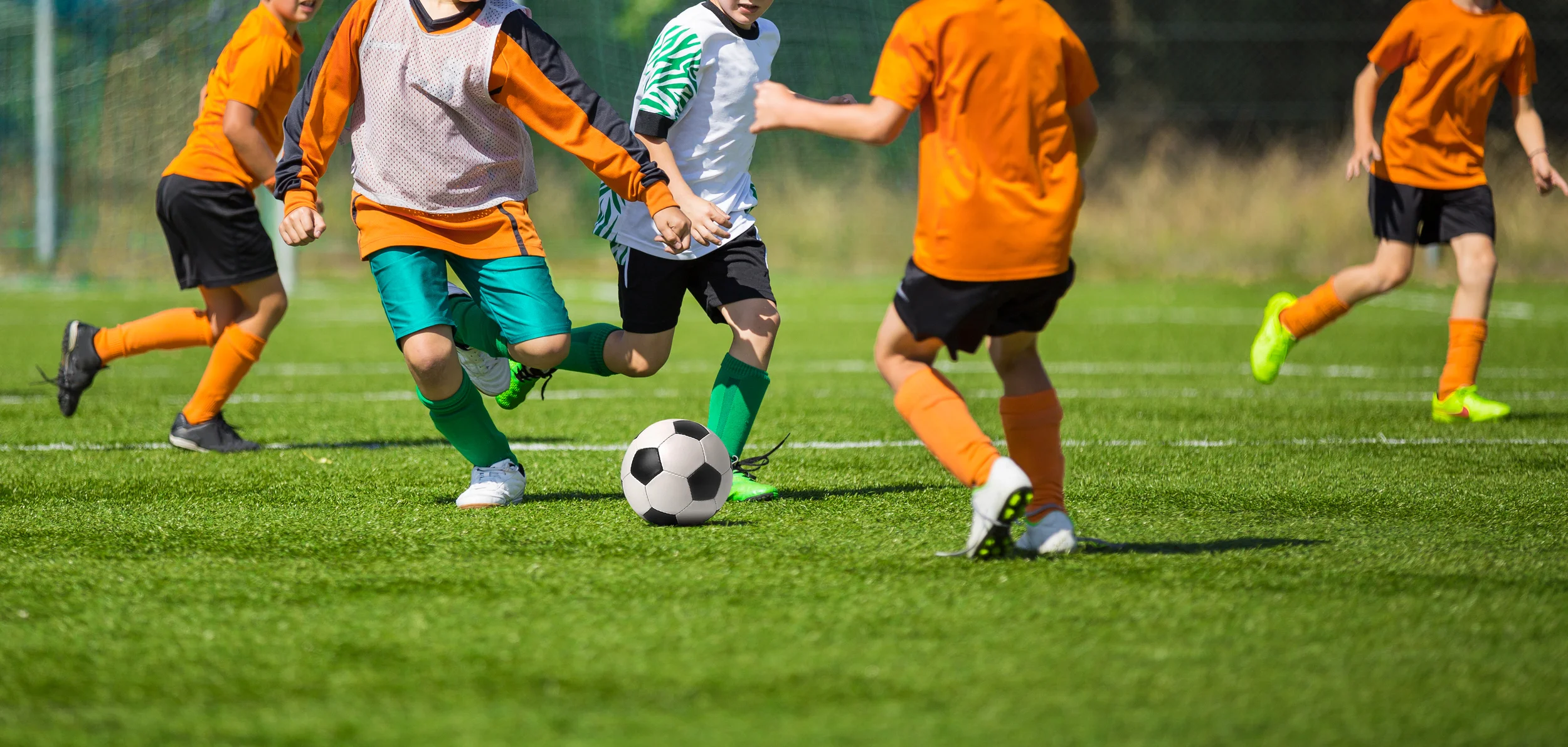
Linking foot preparation, body position and mental preparation to the technique involved in making a one touch pass leads us to a discussion on one touch play and its benefits.
One touch play teaches the value of being able to take your eye off the ball when keeping your eye on the ball can be a disadvantage.
To make this work, players need to have good teamwork and positional sense and therefore must work hard for each other.

Working with three teams (numbers depends on how many players you have, e.g. it can be 4 v 4 + 4 or 5 v 5 + 5 etc). Teams (1) and (2) work together to keep the ball from team (3). If team (3) regains possession the team who gave it away becomes the defenders. The defenders reward is they keep the ball and link with the other team.
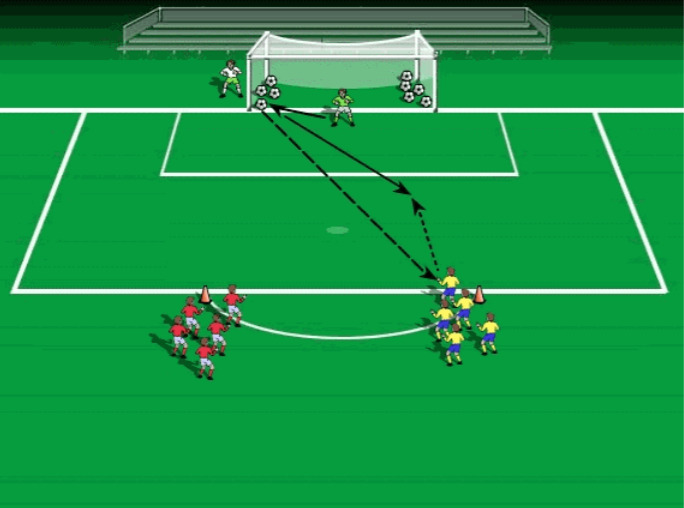
In this game we are working on finishing, dribbling and breakaways. This is a great activity to work on both attacker and goalkeeper skills.

Just a one-word signal can organize a defense, so everyone on the team knows what to do and reacts together as a unit. Also midfield players close by can react off the call too as can strikers. These One-word calls ensure everyone will know quickly and effectively what they should do as a unit and as a team. Hence the back players (and the keeper) can organize their movement as a unit (and therefore influence those in front of them) from Five VERY simple one-word commands. The momentum is triggered from the back and runs forward through the team to the strikers. We must have a very vocal and confident leader at the back organizing this and making the decisions.

Here are 3 simple drills to help your players develop good technique for shooting at goal.

Development of the mental side of the game in terms of the Awareness program, i.e. seeing situations quickly and acting upon them is very important to the player to help him or her have success by scoring goals. The shorter and sharper the practice then the less time the players have to make the correct decisions to be successful, the more important it is to train them to be able to cope with these pressure situations.

In this session, we are ensuring there is timing between the players in terms of the pass and the run to receive. We are doing simple passing in two’s back and forth, first two touch, then one touch where possible. Ask the players to look into “each other’s eyes” as they pass and NOT at the ball to see if they can keep possession between them. This will be difficult at first but it helps to teach them to look up and not down at the ball. during games and hence helping their “Awareness” development as players.
*Membership Required

In this warm-up, players pass, receive and move off the ball at GAME speed. We are getting them mentally and physically prepared for the speed of the game.
54 Pages
We want to stay with our own game plan as closely as possible; based on what we practice and to keep it simple for us; as we dictate to our opponents; and we impose OUR WAY on them.
But there will be many occasions where we must change the system of play and we may have to adjust to suit the opponents.
Here are some ideas for you to consider for your team starting with the 13313 and 14231 systems of play.