
Rotating Shadow Strikers and Teammates In and Around Zone 14 - Training Center Exclusive
/ Wayne Harrison
Just a one-word signal can organize a defense, so everyone on the team knows what to do and reacts together as a unit. Also midfield players close by can react off the call too as can strikers. These One-word calls ensure everyone will know quickly and effectively what they should do as a unit and as a team. Hence the back players (and the keeper) can organize their movement as a unit (and therefore influence those in front of them) from Five VERY simple one-word commands. The momentum is triggered from the back and runs forward through the team to the strikers. We must have a very vocal and confident leader at the back organizing this and making the decisions.

Some of the best forward runs in soccer are deemed “third man runs” often made from a position that is blindside of the opponents. The third man run player can start the passing sequence; or not, but invariably they are on the end of a forward pass often beyond the back four of the opponents.
The set up in the first game is as it would be in the attacking shape of a 4-2-3-1, so you can take this small sided game to represent the 11 v 11 in a particular area of the field making the same types of plays. You can also use this for any team shape set up you might use in an 8 v 8 or 11 v 11. If you play with two striker s then play 7 v 7 and two up front for example or even change the shape behind.
*Membership Required
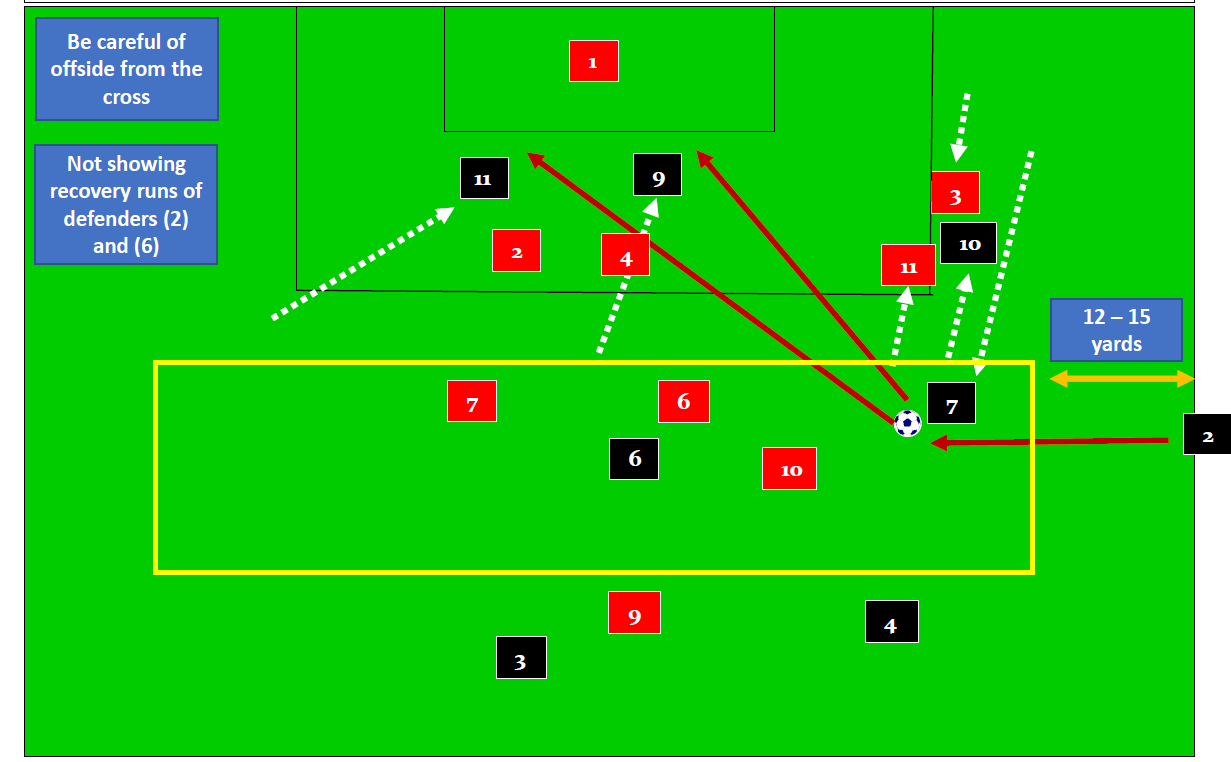
The best way to win the ball from a throw in; more often than not ; is for the opponents to throw it in. The best way to lose the ball from throw ins; more often than not ; is for US to throw the ball in. It sounds “back to front” but watch and see. Therefore, its very important to have pre meditated plans for throw ins, as must as for corners, free kicks wide and central or long, and how to defend from these set plays too.
This is a basic crossover move. The person who receives the throw to cross the ball starts their run second. (7) and (10) line up with (2). They look to cross over . All other players stay out of the immediate area.
This article is available for Training Center Members Only. Get more information about joining here.

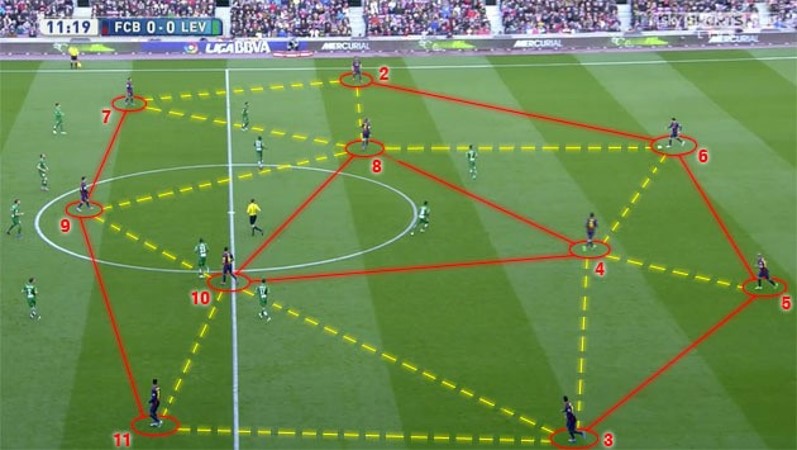
A rondo can be applied on certain parts of the field of play that apply to the game. This exercise is based on the positioning of the players around Zone 14 (the zone in front of the opponents back 3 or 4 and their midfield).
Here we start the exercise off as a typical rondo and develop the idea to take it into the game situation. This example can be the shape within a 4-2-3-1 system of play. I have used this same set up many times in training to bring the ideas out in actual games with my U14 team. Certain moves become almost automatic as each player mentally knows what the other will do; before they do it. Especially good when teams defend deep against you and you have to open them up with imaginative movements OFF the ball. I love this session.
*Membership Required

This game and its many progressions are designed to get the most out of the thinking processes of the players. Many mental challenges to overcome and learn from. In the game players must develop the ability to be calm under pressure, to be confident to receive the ball in tight spaces and to have the confidence of teammates to give the ball to you under pressure. Players need to develop their ability to look ahead of the ball even more, to assess options and make decisions even faster because the time on the ball is even more restricted than usual.
This article is available for Training Center Members Only. Get more information about joining here.

Teams may work out that we are good at playing penetrating passes and making great runs in behind them so the way to try to stop this is to defend deep. If they defend deep we need a tactical solution to counter this. This presentation gives you ideas on how to do this and play initially IN-FRONT of the opponents back four.

This is just A WAY to play 7 v 7, there are various other ways to do it. Just a one-word signal can organize a defense, so everyone on the team knows what to do and reacts together as a unit. Also midfield players close by can react off the call too as can strikers. These One-word calls ensure everyone will know quickly and effectively what they should do as a unit and as a team. We must have a very vocal and confident leader at the back organizing this and making the decisions.
This article is available for Training Center Members Only. Get more information about joining here.

This is a very simple way to show how the team movement works. The main theme is movement OFF and often AWAY from the ball. Players position OFF the ball based on: The best spaces, the opponent's positions, their own teammates positions, the position of the ball. These are ALL EXAMPLES of what “might / could” happen. Players can interchange positions as we develop the play. We offer great dynamics and fluidity to the players to allow them to express themselves on the field.
With this we can show the discipline also involved when we lose the ball and we recover back or press high. Teams will develop their style of play within these frameworks, it will never be as picture perfect as this due to the nature of the game, it is more just a guiding framework. How we do it per team it can be determined by the level of play.
This article is available for Training Center Members Only. Get more information about joining here.

This is a very simple way to show how the team movement works. The main theme is movement OFF and often AWAY from the ball. Players position OFF the ball based on: The best spaces, the opponent's positions, their own teammates positions, the position of the ball. These are ALL EXAMPLES of what “might / could” happen. Players can interchange positions as we develop the play. This is an introduction to this presentation.



Here are 9 ways to distribute from the keeper and play out from the back. We owe it to the players to teach them this as Young as is possible.
I work on this initially practicing all ways to get out. Have opponents only intercepting passes to begin. Then let it go free. When opponents win it back we work on the defending team condensing and defending correctly.
If three or four ways to develop play are done very frequently then it becomes a subconscious decision to move into position so no decision making required as such.
Subscribe to the Soccer Awareness Training Center to get access to all premium Training Center Exclusive articles.