Welcome to the Soccer Awareness Coaches Corner. Browse through soccer drills, small sided games, tactical thoughts, full sessions and a variety of resources. Posts marked “Training Center Exclusive” are for members only.

7 v 7 Animation of Team Development Using One Word Commands - Training Center Exclusive
This is just A WAY to play 7 v 7, there are various other ways to do it. Just a one-word signal can organize a defense, so everyone on the team knows what to do and reacts together as a unit. Also midfield players close by can react off the call too as can strikers. These One-word calls ensure everyone will know quickly and effectively what they should do as a unit and as a team. We must have a very vocal and confident leader at the back organizing this and making the decisions.
This article is available for Training Center Members Only. Get more information about joining here.
This is just A WAY to play 7 v 7, there are various other ways to do it. 1Just a one-word signal can organize a defense, so everyone on the team knows what to do and reacts together as a unit. Also midfield players close by can react off the call too as can strikers. These One-word calls ensure everyone will know quickly and effectively what they should do as a unit and as a team. Hence the back players (and the keeper) can organize their movement as a unit (and therefore influence those in front of them) from Four VERY simple one-word commands. The momentum is triggered from the back and runs forward through the team to the strikers. We must have a very vocal and confident leader at the back organizing this and making the decisions.

5 Phases of Play for 1-3-2-1 and 7 v 7 Game Sizes
This is a very simple way to show how the team movement works. Players can interchange positions as we develop the play. We offer great dynamics and fluidity to the players to allow them to express themselves on the field. With this we can show the discipline also involved when we lose the ball and we recover back. We are teaching players to find the best spaces possible in attack and we can use triangles and diamonds to highlight them here..
This is a very simple way to show how the team movement works. Players can interchange positions as we develop the play. We offer great dynamics and fluidity to the players to allow them to express themselves on the field. With this we can show the discipline also involved when we lose the ball and we recover back. Teams will develop their style of play within these frameworks, it will never be as picture perfect as this due to the nature of the game, it is more a guide. We are teaching players to find the best spaces possible in attack and we can use triangles and diamonds to highlight them here..

1-3-2-1: Patterns of Play at 7 v 7
The following presentation is designed to simplify the potential Patterns of Play of players at 7 v 7. Eventually we will show several movements but we need to build up to these slowly and with patience. Patterns of Play are designed to be practiced to help players identify common situations in the game itself.
The following drill is part of Soccer Awareness New eBook: Tactical Thoughts on the Development of the New 4 v 4, 7 v 7 and 9 v 9 Game Sizes.

This eBook shows how these different size games can be taught and also shows different systems of play that might be useful to you. Run with them as you may and of course come up with your own solutions too as that is what coaching is all about. I have introduced the use of RONDOS to initially aid the development of players for the game situation.
The idea I am trying to cultivate is to find a pattern of development that goes from 4 v 4 to 7 v 7 all the way through 9 v 9 to 11 v 11 that educates the players VERY EARLY on how to ultimately play the 11 v 11, a common thread running right through the book. Click Here to Preview The Book
This book can also be found as part of the Elite Soccer Awareness Training Center Plan.
Taking simple tactical ideas created on the training field to the game situation. We teach certain movements in training; players take ownership of them in the game situation.
The following presentation is designed to simplify the potential Patterns of Play of players at 7 v 7. We show 3 different systems of play. Eventually we will show several movements but we need to build up to these slowly and with patience.
Patterns of Play are designed to be practiced to help players identify common situations in the game itself. When these situations occur the players involved will think about the movements within a pattern of play (that they practiced in training) and will re-enact them in the game. Our goal is to make this an unconscious decision where the players don’t even have to think about it; they just do it naturally / instinctively.
Players in our Defensive 3-2-1 Shadow Phase of Play
Using Cones as reference points for team shape defensively then team shape offensively. This is the team shape start position of a 3-2-1.

The Initial Attacking Shadow Phase of Play
Zone 14 is the area between the opponents back players and their midfield.

The Full Attacking System of Play
This is the attacking team shape now a 1-2-2-1. The attacking team shape we change to when we are chasing a game; perhaps losing 1-0 and wanting to be more positive in attack. So this now would be the start position.

Slightly Safer Way to Play
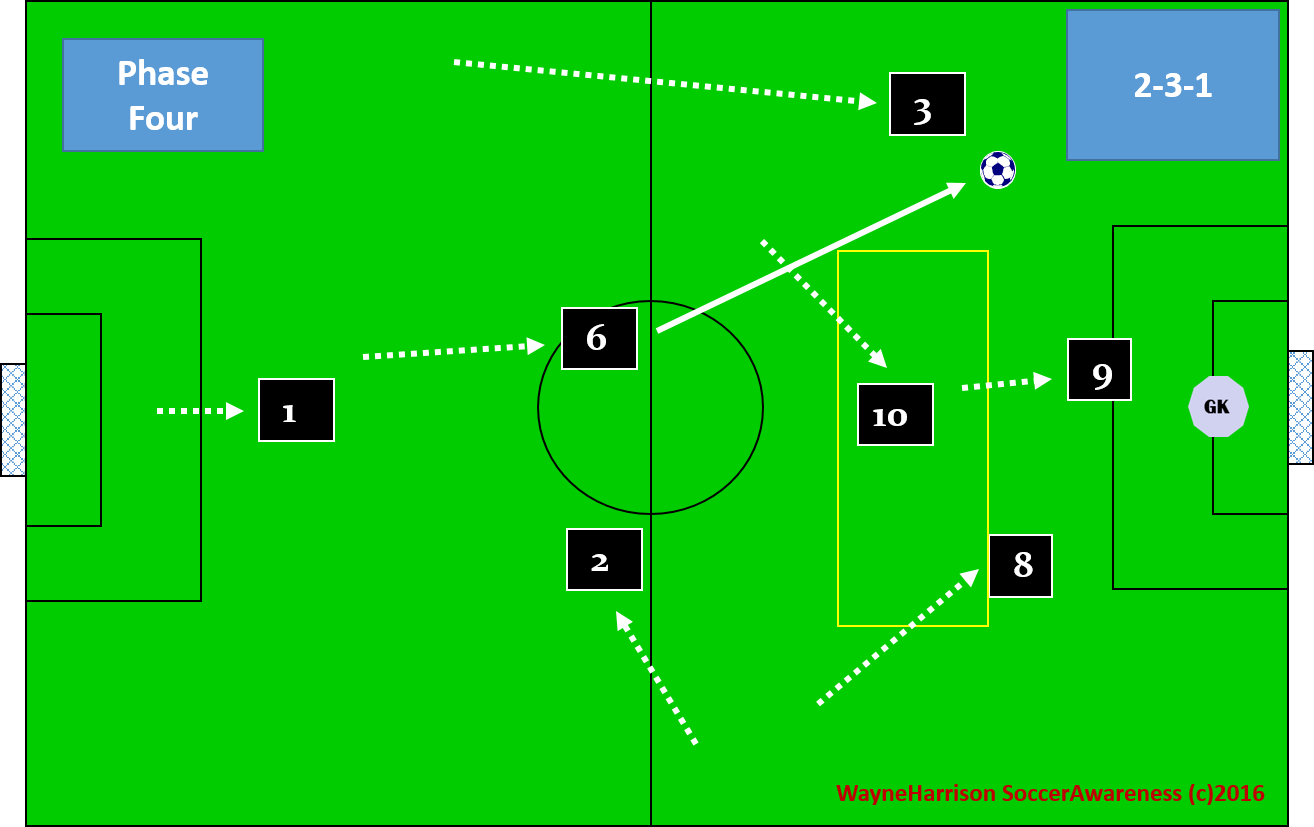
This is the attacking team shape now a 2-3-1. The attacking team shape We push one wingback / FB forward only and keep safe at the back should the opponents win the ball and counter attack.

Team and Unit Patterns of Play
The previous diagrams show simple and distinctive patterns of play for the team to follow; from a basic defending shape; to a basic attacking shape. The Third diagram shows a more advanced pattern of play for the attacking phase.
Next diagram we have a very simple “unit” pattern of play involving our 2 wide players working together and creating space for each other on one side of the field. (3) knows when (10) cuts inside that is the “cue” for (3) to overlap; call it a “condition” if you like. Likewise with (2) and (8) on the other side. This encourages / conditions our Fullbacks (2) and (3) to attack. This is a “two player rotation.”
This is the attacking team shape now a 2-3-1. The attacking team shape We push one wingback / FB forward (3) on only and keep safe at the back should the opponents win the ball and counter attack.
Get more like this including Small Sided 4 v 4 Attacking Games, Patterns of Play at 7 v 7, Team Shape Development in 9 v 9 and lots more in Soccer Awareness eBook: Tactical Thoughts on the Development of the New 4 v 4, 7 v 7 and 9 v 9 Game Sizes.



54 Pages
We want to stay with our own game plan as closely as possible; based on what we practice and to keep it simple for us; as we dictate to our opponents; and we impose OUR WAY on them.
But there will be many occasions where we must change the system of play and we may have to adjust to suit the opponents.
Here are some ideas for you to consider for your team starting with the 13313 and 14231 systems of play.