
Welcome to the Soccer Awareness Coaches Corner. Browse through soccer drills, small sided games, tactical thoughts, full sessions and a variety of resources. Posts marked “Training Center Exclusive” are for members only.

Developing Play from the Back with Right Center Back (5)
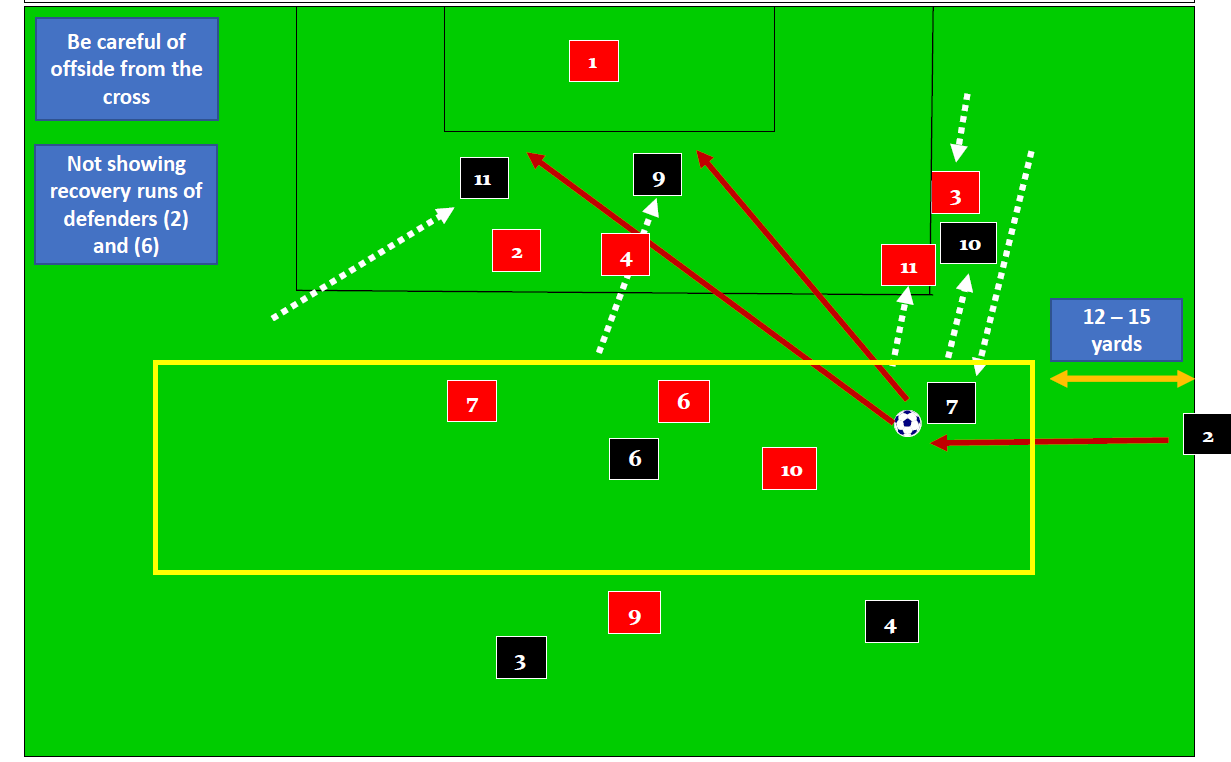
Showing how we can attack from the back through the right center back (5). The same can happen with our left center back. This is not an expected play so it can catch opponents out if we develop this idea.
We start with our attacking team shape of Phase 2 of the 5 phases. I am showing potential options of attack we can use and develop knowing we are covered behind so whichever center back gets forward they are confident they are covered. Here opponents play 4-4-2 then 4-3-3.
This is the attacking team shape (attacking “start position”) for a 3-3-1-3. Zone 14 is the area between the opponents back three or four and their midfield.. Here we develop play through (5). (2) and (7) go touchline wide to open up space inside / OR receive the pass wide. (5) has options, Pass wide, pass inside or run forward with the ball.

(5) attacks the open spaces created by teammates in front of him
Space clears for (5) to push up and attack. (8) clears the space inside by taking defender (F) away. (10) makes a
diagonal run into space to get free of (E). Either (2) or (8) drops in to fill in for (5) so (5) knows he is covered behind
so he has FREEDOM TO ATTACK.

Right center back (5) attacks from the back
(5) can feed (10) play inside defender (J) for (7), can play the diagonal pass to (9) who is off the shoulder of (H), the
long switch to (11), or continue his run and play combinations with his players around him. (2) covers for (5).
Opposite left center back (4) tucks inside once (5) has started to attack.

Combinations as (5) advances up the field
(C) presses (5), and (5) can now play a give and go with (10) or even (7). But here, (7) stays wide to keep defender (J)
wide. If defender (J) marks inside then (5) can play with (7) wide and continue you his run into the attacking third.

Striker (9) makes the blind side channel run
(9) Makes the diagonal run and (5) plays him in. (5) can advance into the box or be on the edge of it for any potential
clearances.


Combinations as (5) advances up the field
Defender (J) marks inside so now (7) is free. (5) attacks and plays to (7) who is free due to positioning on the
touchline, and (5) can still continue into the attack knowing he is covered behind. Now we have a 2 v 1 against defender left back (J).

Not showing the dropping back of defenders just to show how we can develop this this shows how we can attack
with a right center back from back to front but still be covered at the back. If it breaks down (5) just drop backs into
(2)s position. Now a shot or cross is available to (5).

We lose it but it’s just a small adjustment to recover back
Simple adjustment if the move doesn’t work so nothing is lost with allowing this freedom of movement forward.
The good part is this type of attacking movement is NOT EXPECTED by opponents.

Opponents play 4-3-3 / 4-5-1
This is the attacking team shape (attacking “start position”) for a 3-3-1-3. Zone 14 is the area between the opponents back
three or four and their midfield.. Here we develop play through (5). (2) and (7) go touchline wide to open up space inside /
OR receive the pass wide. (5) has options, Pass wide, pass inside or run forward with the ball.




A “Comfort Zone” Developing Width in Play in a 9 v 9
Objective: To Encourage Players To Use Width And Offer An Area To Play Without Pressure
The following is part of Soccer Awareness eBook: Tactical Thoughts on the Development of the New 4 v 4, 7 v 7 and 9 v 9 Game Sizes.
This eBook shows how these different size games can be taught and also shows different systems of play that might be useful to you.
The idea I am trying to cultivate is to find a pattern of development that goes from 4 v 4 to 7 v 7 all the way through 9 v 9 to 11 v 11 that educates the players VERY EARLY on how to ultimately play the 11 v 11, a common thread running right through the book. Click Here to Buy the Book
OBJECTIVE: TO ENCOURAGE PLAYERS TO USE WIDTH AND OFFER AN AREA TO PLAY WITHOUT PRESSURE
Theme: Developing Width in attack
A perfect Introduction to this idea so players are free to receive in wide areas. If a player breaks wide into the outside channel on either side of the field and is in possession of the ball this player cannot be tackled. Defenders are not allowed into the channel.
The players on the team in possession of the ball can run the ball into the channel or have it passed to them into the channel. Allow only 4 seconds in the free wide area.
This condition plants the seed in the mind of the players to immediately play with width when in possession. Numbers for this game can be 4 v 4 and upwards. Our offensive team shape to begin. Four players give us width in attack.
Develop: The wide areas can be used to practice certain moves the players have been taught, especially at the younger ages where they need to be able to practice them without pressure. This allows for them playing in a game but also doing the move without pressure.
Coaching Points:
Create space wide when in possession of the ball
Building play from the back
Using width to attack
Developing Overlap runs
Development of the Theme
Build the theme up very simply to ensure immediate understanding and success.
No opposition at first so 9 v 0.
Small numbers (e.g. 9 v 3): Passive opposition (jockey the player only)
Small numbers (e.g. 9 v 5): Passive opposition (Can only Intercept the passes not tackle
9 v 9 but again passive opposition
9 v 9 full game with wide FREE ZONES for the team you are training.
When you feel the players are ready have a full blown 9 v 9 game and have it for both teams at the same time going both ways.
Ensure all players on your roster are involved in the attacking team theme development initially so everyone benefits and understands what you are teaching and why you are teaching it.
To Encourage players to use width and play without pressure

This is the basic set up of the attacking shape of a 9 v 9 in the 3-3-1-1 formation. Emphasis is on the theme of exploiting the wide areas of the field by setting the free zone “Condition.”
A Small number of defenders added

Bring a small number of defenders in as passive opposition who can only Intercept not tackle. So we have here a 9 v 5 set up.
Get the rest of this session and more in the Soccer Awareness eBook: Tactical Thoughts on the Development of the New 4 v 4, 7 v 7 and 9 v 9 Game


Developing Play with a Defending Back Four
The session is designed to show how to work on team shape building up from a back four only. Side cones are 25 to 30 yards apart as are the defenders and the coach. The coach moves with the ball and the defenders mirror the movement maintaining the distances between them.

- The session is designed to show how to work on team shape building up from a back four only. Side cones are 25 to 30 yards apart as are the defenders and the coach. The coach moves with the ball and the defenders mirror the movement maintaining the distances between them.
- You can use the signal words UP, OUT, HOLD, DROP, and SLIDE, to determine the movement. Eventually we need to work up to an 11 v 11 situation showing how to work a team as individuals, as units and ultimately a team.

- Here the coach moves to the outside and the whole back four adjust their positions across the field (slide) to compensate for this movement, (2) being the player to apply immediate pressure on the ball.
- Re-emphasize the idea that the players are tied as links in a chain and so have to move together as links of a unit or even tie them up so they feel how it is when they move together. Coach moves back up the field the back four condense up also based on the position of the ball.



Introduce Attacking Opponents

- Players with the ball pass it across in front of the defenders. Defenders adjust their positions to mirror this movement. This is working on marking zones and marking players and distinguishing between the two depending on where the ball is.
- Pass across to the next player and hold the ball there, check the defenders positions, then move the ball again.
- Use the side cones as guides to distancing between units as they are introduced.
- The ball has been passed inside and the defenders adjust closing down the player on the ball and closing down the spaces around the ball.
- This is continued using all the players sometimes missing a player out with a pass so it goes across two players to test the defenders and how they adjust. Once they have grasped this concept you can move the players to the next progression. In the next phase of the session have extra balls ready in the center circle to keep the flow of the session going.

- The coach now has players to pass the ball to (opponents).These players initially must be in static positions to check the set up. You can us a rope to tie the four defenders together to get the idea of moving as a unit. Players maintain an open stance so they can see opponents as well as the ball. When the ball is at (C) or (D) the back four take positions with regard to (A) and (B) and do not get drawn to the ball. Defending team can win back the ball only with interceptions of passes not with tackles to allow us to look at the shape they achieve.
- Here we see how the back four should look once the ball has been passed wide and defender (2) has closed the ball down.
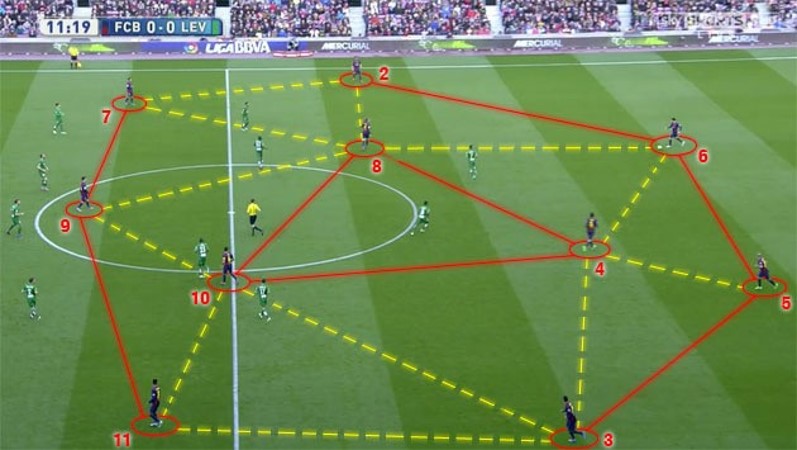
- Notice the back four is NOT flat but like angled links between each player with the central defender (5) the deepest player. This player can effectively be called the sweeper. When the ball is at (B) on the other side, (4) becomes the sweeper.
- The second center back is the deepest player and the two center backs share this responsibility depending on which side of the field the ball is positioned.

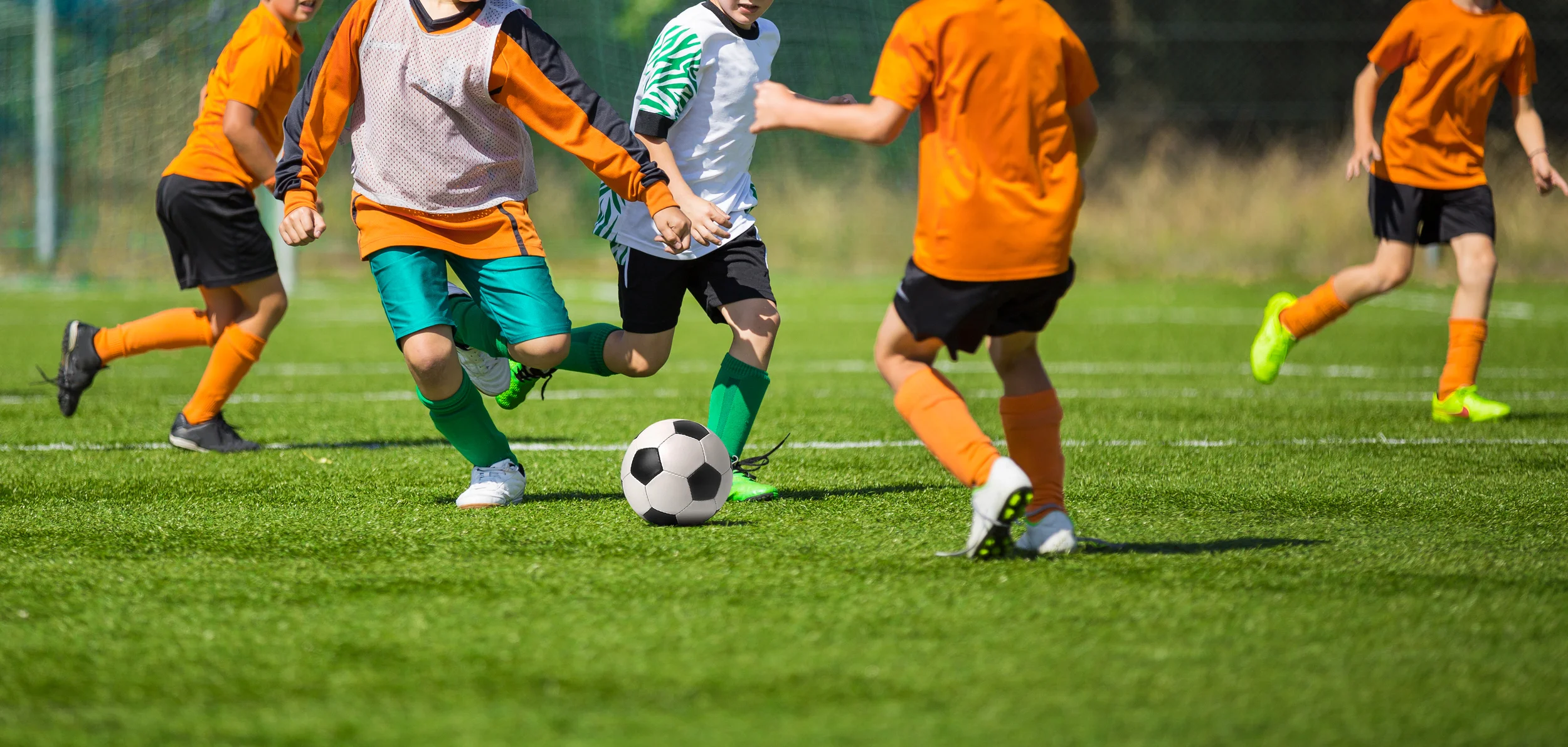

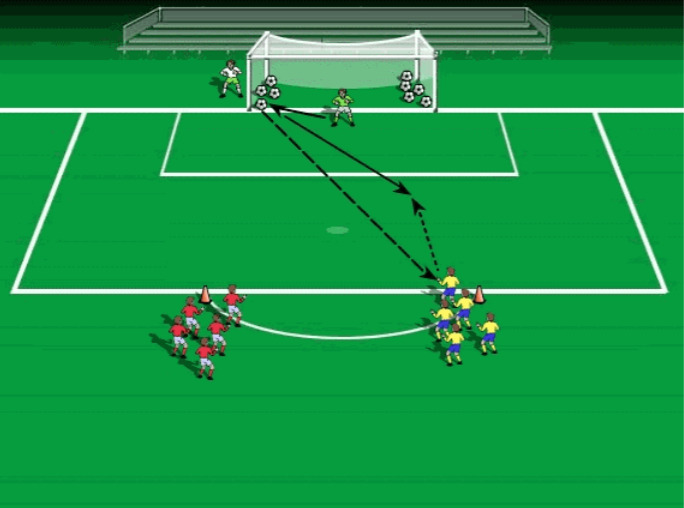


Here are 9 ways to distribute from the keeper and play out from the back. We owe it to the players to teach them this as Young as is possible.
I work on this initially practicing all ways to get out. Have opponents only intercepting passes to begin. Then let it go free. When opponents win it back we work on the defending team condensing and defending correctly.
If three or four ways to develop play are done very frequently then it becomes a subconscious decision to move into position so no decision making required as such.
Subscribe to the Soccer Awareness Training Center to get access to all premium Training Center Exclusive articles.