Welcome to the Soccer Awareness Coaches Corner. Browse through soccer drills, small sided games, tactical thoughts, full sessions and a variety of resources. Posts marked “Training Center Exclusive” are for members only.

Small Sided Third Man Run Games - Training Center Exclusive
Some of the best forward runs in soccer are deemed “third man runs” often made from a position that is blindside of the opponents. The third man run player can start the passing sequence; or not, but invariably they are on the end of a forward pass often beyond the back four of the opponents.
The set up in the first game is as it would be in the attacking shape of a 4-2-3-1, so you can take this small sided game to represent the 11 v 11 in a particular area of the field making the same types of plays. You can also use this for any team shape set up you might use in an 8 v 8 or 11 v 11. If you play with two striker s then play 7 v 7 and two up front for example or even change the shape behind.
*Membership Required
The set up is as it would be in the attacking shape of a 4-2-3-1, so you can take this small sided game to represent the 11 v 11 in a particular area of the field making the same types of plays.
You can also use this for any team shape set up you might use in an 8 v 8 or 11 v 11. If you play with two striker s then play 7 v 7 and two up front for example or even change the shape behind.
To begin to help provide a guide / signal for when to make the 3rd man run we have a CONDITIONED RULE: Every time the ball is passed BACKWARDS, another player must run forward and beyond the ball.
That would be the forward third man run we are encouraging; and the player receiving the back pass needs to see that run and make that pass.

Coaching Points:
Identifying the conditioned moment (a back pass) to make the run
Identifying the conditioned moment to make the pass
Timing; angle and weight of the pass off a previous pass back
Timing and angle of the run to receive the through ball
Encouraging more than one player making a forward run to increase the options
Scoring: To score the player has to receive the pass as he or she is over the end line within the end zone. Equate the first line on the end zone as the back four of the opponents so you are timing the run to beat the back four (or beat their offside with a run from deep).
Timing: Going too early with the run and they receive the pass in an offside position. Weight of pass is so important here also.
The ball is passed forward first, as soon as it is passed back that is the signal for a player; or players; to make forward runs beyond the ball and beyond the furthest forward player; if possible. Here (11) is the receiving player.

The third man run passing sequence can also be started and end with the same player such as here with (11) who plays forward to (9) who drops the ball back to (7) who plays the forward pass to (11) making the blindside run.

Here a run from a deeper position by (8). The ball goes back to (10) which is the signal for a forward run, and (8) makes the run into the space that (7) has created by coming inside and bringing the defender inside also. (8) Did not get beyond (9) initially but we still got the third man run in.

Here two players make third man runs beyond the ball so (7) has two options of a pass. This is even better.

1. The ball is played back to (10) off (11) who makes a forward run. When it was passed back (8) started the third man run. Because it was from very deep he had time to run a distance to meet the pass without being offside so there was time to pass to (9) and for (9) to receive and turn and pass the ball in.
2. Again timing is the essence of all this for it to work.
3. Being wide, (8) is in a great observational position and can watch the play as it builds up; and be able to make the right run at the right time.
Development:
1. Have a goal instead of an end zone so the outside end line is still the offside line representing the back four; but now you can finish on goal.
2. Initially have it where defenders cannot track the player once they are beyond the end line so they have a free run on goal to gain confidence in finishing without pressure.
3. Then allow defenders to track the run and tackle so increasing the pressure on the finisher.
4. Good for finishing one v one also with defenders tracking the player to pressure them.

Include goals as an end product
1. The inside thick end line represents the back four position of the opponents. We need to build the attack and once the ball is played back another player; or players; makes the third man run off the ball, in this case (8) and (11).
2. Set up like this you can have two teams working on the same theme.
3. If you want to relate it to playing against a back four you can bring your own back four in and set it up as such; as I have shown in the Phase of Play next.

Phase of play: focusing on movement and third man runs beyond the ball
You can Include the pass back condition to help the players identify the right movement to make the 3rd man forward run until they can do it without this condition.
1. Defending team win it they pass the ball into the small goals and we start again. You can keep score to keep it competitive. (7) Is a good option as he or she comes inside from the blind side of (3) who may be ball watching and see their run too late.
2. Here as the ball is played into (9); (10) and (7) start to make forward runs to offer two options behind the back four to pass into; and (11) plays the diagonal through ball to (7).
3. (8) Fills the space behind left by (10) and it could easily be a lay off from (9) to (8) to play the forward pass also.
4. DEVELOP: Bring in both fullbacks attacking so we add even more options of third man runs, especially when the wide players (7) and (11) cut inside to clear the space outside.

1. (11) has two options of a forward pass, choosing (10) in this case over (7).
2. In this case a ball over the top of the defense would be a great pass too; especially if the defense is focusing on the ball. For example (7) comes from the blind side of (3) as in the previous diagram. It could be a flatter run if it helps the timing.

1. It is easier for the third man run player to see the ball when it is coming towards them at an angle, such as in this diagram above (with the run of (7) here). (7) CAN SEE THE FULL BUILD UP HERE AND IT WILL HELP HIS OR HER TIMING.
2. If directly from behind the run (in 10’s case) then it is much harder to see when and where the pass is being made to get the timing and angle of the run correct, though it can still work with players with good awareness and peripheral vision..
FINALLY: Take out the condition of the run coming off another player passing the ball back. Now players must work it out for themselves when and where they make the runs beyond the opponents back four.
DEVELOPMENT: It also does not necessarily have to be from a back pass anymore, that was just a condition put in to ensure the runs were made initially in the practice. Players can still make third man runs off forward passes.

Here is an example of such a play. (9) Plays it forward to (7), (10) has already set off on the forward run to receive into the space created by (9) coming short to receive and dragging center back (4) to the ball also.
REMEMBER; all these diagrams are set up to show the attacking TEAM HAVING SUCCESS. It won’t be as easy in actual play but our aim / goal here is to develop a training plan to make it successful initially; and to give the players confidence in the execution of the idea.
In reality the fullback (2) should tuck in to fill the space as (4) goes short, leaving (11) free but he is not the danger, (10) is.
And / Or perhaps a midfield defending player (maybe (6) for example) will track (10)’s run to make it more difficult to have success but you will add that into the session after initial success; to really test the players. This third man run concept is particularly good when teams defend high against you so there is lots of space to run into behind the back four


Quick Pressing Game
This game is an excellent example of how a small change to the structure of a standard game changes the game to allow a specific skill or topic you want to work on. You don’t need to say anything; the explanation is in the game.
This game is an excellent example of how a small change to the structure of a standard game changes the game to allow a specific skill or topic you want to work on. You don’t need to say anything; the explanation is in the game.
Organization:
Age Group U10s to adults
Pitch sizes 30/40 x 20– or at the discretion of the coach
Number of teams – 2
Team sizes 4-6 players
Bibs optional
Goals – full size adult goals or made with cones

Progression: This is a standard small sided game but with big goals and no keepers. Players can score from anywhere on the pitch. It is very easy to score a goal in this game, so players quickly understand they have to put pressure on the ball and not allow players to shoot. They must close quickly. Players need to concentrate as a poor defensive position will ultimately lead to conceding a goal. Alternatively you can add a keeper in each goal and the players have to JUST pass the ball to the opposing keeper to score.



Diagonal Runs Without the Ball in a 6 v 6 Game
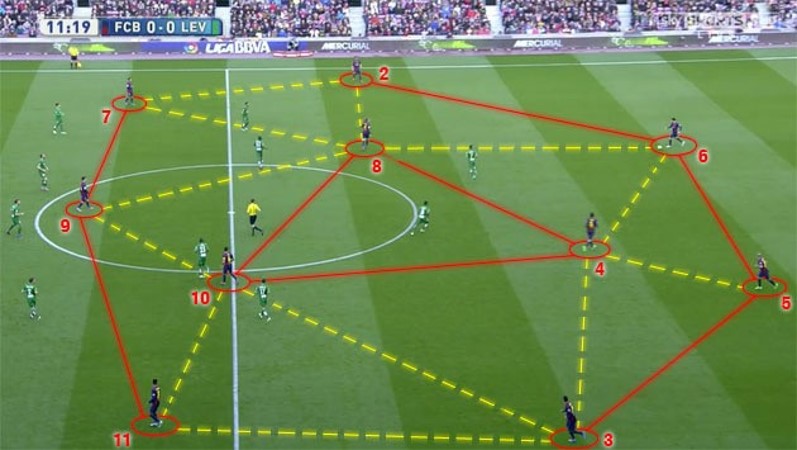
The theme is making diagonal runs with or without the ball to receive or create space for a teammate. When it is a forward diagonal run the player making it must avoid running offside in a game situation.
The following comes from Soccer Awareness eBook 12: 16 Team Shape Games. Soccer shape teaches players how to defend and attack as a team. No matter what formation you choose to play, Team Shape is a vital component to how successful your team will play on the weekend. In this book we will look at various options based on age groups for the size of the games. Get the book here.
The theme here is making diagonal runs with or without the ball to receive or create space for a teammate. When it is a forward diagonal run the player making it must avoid running offside in a game situation.

Coaching Points:
Creating Space.
Decision – when and where to pass into the receiver.
Technique – Quality of pass particularly the weight, accuracy and timing.
Angle and Timing of the Diagonal Runs both to create space and to receive the ball.
Support Positions of the players.
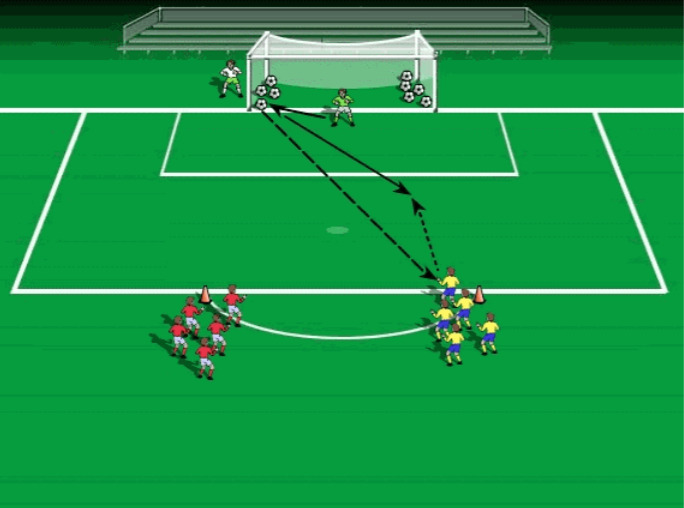
In the above example (2) is on the ball to pass it forward. (6) Makes a diagonal run away from the center taking man marking (B) with them. (4) Also makes a diagonally opposite run away from the central area taking (C) away also. This leaves space for (5) to come short with another diagonal run to receive the pass. As in receiving and turning (5) may have run (A) off to check back if time was available to do so thus creating more time and space on the ball.
Another way to create space for (5) coming short to receive would be for (6) to make a run towards (5) and cut across the path of (5)’s marker (A) to hold up their run.


eBook Download: Fast Transition 3 v 3 Plus Keeper Game and Developments - Training Center Exclusive
This is a dynamic small-sided game that players love to do and at the same can be done to help educate them in many important areas of the game. We build the numbers up as we go to include more detailed information on particular plays they can learn. Quick play, fast decisions, quick transitions, tactical rotation and combination plays and use of imagination in tight areas finishing with many shots on goal; we get it all in this game.
*Membership Required
Below is a preview of the 29 page eBook.
Soccer Awareness Training Center Members >> Download the full eBook Here
This is a dynamic small-sided game that players love to do and at the same can be done to help educate them in many important areas of the game. We build the numbers up as we go to include more detailed information on particular plays they can learn. Quick play, fast decisions, quick transitions, tactical rotation and combination plays and use of imagination in tight areas finishing with many shots on goal; we get it all in this game. Enjoy.
Coaching Points:
Teaching the thinking process of awareness and peripheral vision
Quick Play: One and two touch
Combination Plays; overlaps, give and goes, diagonal runs
Rotations of players, tactical positional changes
Changes in tempo; learning when to slow the game down / speed it up
Very fast Transitions of play based on a possession change
Mental transitions in changes of possession
Shooting and scoring goals
An Immense amount of touches on the ball for every player
At some point bring the offside rule in, you decide when its it’s the right time.
You can ensure the right players form the attacking and defending team shape per your actual team set up. So have a back three / four work together or a front four for example. So a SSG becomes a function.
Count the score to keep it competitive for example the first team to score 5 goals wins. Players love this game its dynamic and a lot of fun too.
Ensure the coach identifies coaching moments and educates the players at every opportunity asking THEM to solve the problem; or create their own solutions.
Fast Transition 3 v 3 Plus Keeper Game

Coach says go. (4) and (C) race to the cone and coach shouts one team or the other to have possession (it could be the winner of the race). Two players join them to make a 3 v 3 but the keeper can be a keeper sweeper too.

Letters team get the ball. It is played to the central player to begin the 3 v 3 or 4 v 4 with the keepers. Play one game for an amount of time (can be 1 minute) then start again with the next players.
Soccer Awareness Training Center Members >> Download the full eBook Here

Running With The Ball In A Small-Sided Game
Small sided game with the emphasis on running with the ball.
Small sided game with the emphasis on running with the ball.
To score the player on the ball has to run the ball into the marked area. Here (1) runs the ball in chased by (C) then must look to pass to another player and attack the opposite way.
Once the team has scored they have to then keep possession and can attack the other end zone.
Coaching Points:
Run with the ball whenever possible
First touches to be forward.
Keep the ball moving
If you can’t run with the ball look for a give and go and then run again
Have the positive attitude to run at them to score.
Build an overload into the game if necessary with an extra floating player if it is too difficult to get free with equal numbers making it a 4 v 3 in favor of the attacking team always.


Quick Transition 2 v 2 Rondos
This is a 2 v 2 game going to 4 goals. The team who scores stays on and must quickly defend the 2 new players coming in (one from each goal that the opposition defends).
The following drill comes from the New Soccer Awareness eBook Developing Players with Rondos Using the Soccer Awareness Philosophy. This 222 page eBook explores the use of rondos in youth soccer. Rondos are a great way to prepare players for the game situations and especially the fast decision making needed within the game. Preview The Book
This is a 2 v 2 game going to 4 goals. The team who scores stays on and must quickly defend the 2 new players coming in (one from each goal that the opposition defends).
Instant transition with the same ball that the opponents scored with, here (3) and (4) are positioned to immediately bring the ball the opponents’ may score with out to attack. The other two players (1) and (2) must get off the field ASAP.
Introduce a target player (can be coaches or players). Now it can be a 3 v 2 effectively.
Players can use the target to play give and goes with each other or with their immediate teammates.
Liken passing into the goal as a midfielder passing into a striker so they get the ball in there as quickly as possible or a defender into a midfielder.
The 1st thought of the player on the ball has to be “Can I score?”
The 1st thought of the 1st defender is can I stop them scoring, win possession immediately, and score myself.
First team to 10 goals wins, keeping the competitive element.
If the ball goes out of play the coach can provide another one to keep things going quickly.
Coaching Points Attacking:
Quick Break and counter attack
Switching the point of attack if another goal is more open
Quick one and two touch passing
Positioning to open up passing lanes and getting between defenders to pass the ball in early
Creating 2 v 1 situations from a 2 v 2 set up and setting up a give and go.
Coaching Points Defending:
Instant pressure as possession changes (transition after scoring going from being an attacker to being a defender)
Regaining possession at the front with a scoring reward
Getting in front of the passing lanes to prevent the quick pass into the goal.
Working together with pressure and support, the support player supporting the first defender, stepping across and covering the passing lane to the second goal and also keeping an eye on the 2nd attacker.
Transition Coaching Points:
Immediately the team that has been in possession of the ball and has scored then they must switch on mentally to being defenders and high pressuring the new attacking team to try to win the ball back and score again.
Area: 15 x 10

A 2 v 2 game going to 2 goals. The team who scores stays on and must quickly defend the 2 new players coming in (one from each goal that the opposition defends).
Offside half way line. Instant transition with the same ball that the opponents scored with.
Players can use the target to play give and goes with each other or with their immediate teammates.

Use the players in the goals to support. They have 1 or 2 touches only so they must play quickly.
Now it is essentially a 3 v 2. For the inside players start with unlimited touches then as they are successful decrease the number to test their peripheral vision and awareness on and off the ball.
Always increasing the challenge each point of success is reached.
Now develop by allowing the balls to transfer

This will really test the players imagination and awareness on and off the ball. In one instant (3) and (4) are defending, in the next they are attacking. Likewise for the letters team.
Here we show how the mental transition works with each team suddenly changing their positions defensively to deal with the change.
Get much more like this in the New Soccer Awareness eBook Developing Players with Rondos Using the Soccer Awareness Philosophy. This 222 page eBook explores the use of rondos in youth soccer. Rondos are a great way to prepare players for the game situations and especially the fast decision making needed within the game. Preview The Book


Small-Sided Passing Support And Combination Work Game
Using two wide positioned goals for each team to attack. This is designed to encourage players to spread out when they attack and switch play; changing direction if one route is blocked. Looking for quick transition and movement off the ball to create space but attacking the space when it is on to do so. The first thought of the player on the ball should still be “Can I run or pass the ball forward.”
The following drill comes from the Soccer Awareness Training Center. Soccer Awareness Training Center provides unlimited access to Wayne Harrison's Soccer Awareness systems, training sessions, drills and more. Wayne's system helps develop world class youth soccer players and teams in a systematic and imaginative manner that guarantees performance at the highest level of competition. Whether you’re a beginning coach who needs help getting started or someone who wants to add some variety to their training sessions, the Soccer Awareness Training Center offers a wide variety of drills to choose from. Join Today
To score players can pass through the goal or dribble through it. The ball stays in play and movement off the ball to support the player in it to score becomes more important.

Using two wide positioned goals for each team to attack. This is designed to encourage players to spread out when they attack and switch play; changing direction if one route is blocked. Looking for quick transition and movement off the ball to create space but attacking the space when it is on to do so. The first thought of the player on the ball should still be “Can I run or pass the ball forward.”
Coaching Points:
Creating Space – for yourself and your teammates.
Decision – When, Where and How to pass the ball.
Technique – The Quality of the pass (Accuracy, Weight, Angle).
Support Positions of teammates (Angle, Distance and Communication). Supporting in front and behind
Switching Play using width in attack, drawing defenders to one side of the field then switching the play quickly to attack the other open side to score. Here the ball is played to (3) from (1), the defending team is drawn towards defending their right side goal. The attacking team stay spread out and this situation shows how a pass back to (1) then quickly across to (2) can open up an attack to the other left side goal.



How We Set Our Teams Up At 8 v 8
This is a recommended set-up to relate the field positions of the 8 v 8 players in the 3-3-1 to the 4-2-3-1 formation for the 11 v 11.
The following is an excerpt from The Ultimate Youth Coaches Training Guide; A Complete 6 to 10 Year Old Developmental Coaching and Training Program.
This program is perfect for youth coaches wanting practices to start their soccer coaching education and it is also for those more advanced and experienced coaches wanting to train their players as best they can at these wonderful open minded ages for development and education of both the mind and body. Our plan is to help all coaches at whatever level of experience they are at. Find Out More
To relate the field positions of the 8 v 8 players in the 3-3-1 to the 4-2-3-1 formation for the 11 v 11 we do the following:
We do not include center backs 4 or 5.
Number 10 in 8 v 8 can be represented as EITHER a number 8 or a number 10 in 11 v 11.
Both types of player work for this.
The rest of the players mirror the positions of the same numbered players in 11 v 11 that being: the keeper 1, fullbacks / wing backs 2 and 3.
Central defensive midfielder 6 (who can play center back or center midfield)
7 being wide right (midfielder / winger / wide striker),
11 wide left (midfielder / winger / wide striker) and
9 is the central striker.
So using this method, we are creating really consistent and relevant developmental training that can be easily transferred from the 8 v 8 model to the 11 v 11 model.
This means the movements and types of plays technically and tactically we want to teach at U11 and 11 v 11 are already being established at U7, U8; U9 and U10
Using Cones as reference points for team shape defensively then team shape offensively. This is the team shape start.

Attacking shape is now a 3-1-3. Zone 14 is the area between the opponents.


The 6 Second Transition Game
Teams are at their most vulnerable in terms of losing the ball, in the first few seconds after gaining possession. It is this transition period that we are looking at, both in terms of winning the ball back quickly and then keeping it. The key is the first six seconds after losing the ball. In this game when a team loses possession they have 6 seconds to win the ball back (the coach counts this out).
The following drill comes from the Soccer Awareness Training Center. Soccer Awareness Training Center provides unlimited access to Wayne Harrison's Soccer Awareness systems, training sessions, drills and more. Wayne's system helps develop world class youth soccer players and teams in a systematic and imaginative manner that guarantees performance at the highest level of competition. Whether you’re a beginning coach who needs help getting started or someone who wants to add some variety to their training sessions, the Soccer Awareness Training Center offers a wide variety of drills to choose from. Join Today

Organization:
Age Group U12s to adults
Pitch sizes 30/40 x 20 – or at the discretion of the coach
Number of teams – 2
Team sizes – 4-6
Bibs optional
Goals – 5 a side or mini soccer goals

Teams are at their most vulnerable in terms of losing the ball, in the first few seconds after gaining possession. It is this transition period that we are looking at, both in terms of winning the ball back quickly and then keeping it. The key is the first six seconds after losing the ball. This period is when the opposition has not yet switched from defensive to possession mode. The other key period is those six seconds after you have won the ball back and the need to maintain possession during that critical period when your team is changing shape and finding space (going wide and deep).
Progression: In this game when a team loses possession they have 6 seconds to win the ball back (the coach counts this out).
If they win it back in that time they are awarded a point (a goal). The idea is to double team and work frantically to get the ball back in the allotted time frame. If they fail to achieve this they must then go to the center and make sure they close all the gaps and limit the space for the opposition. If they do win the ball back within 6 seconds, if they are high up the pitch they must look for an immediate goal scoring opportunity. If they are in a more crowded midfield area they must look for an ‘outman’ who can get hold of the ball and maintain possession through the crucial 6 second period. This may well be a sideways pass or a backwards pass to a player in plenty of space. In the excellent book by Patrick Barclay, ‘Mourinho, Anatomy of a Winner’, Jose talks about doing a lot of work on ‘keep ball’. This was based on Mourinho’s theory of possession for possession’s sake. All teams need rest periods, and it is much better to do this when your team has possession. Other than the 6 second condition the rest of the game is a standard small sided game. Goals can also be scored in the normal way.

Three Team Awareness Game with Measured Outcomes
With these drills our players are developing awareness of where the player they receive from is and where the player they pass to is. Because of this players begin to anticipate the pass to them and where it is coming from. Also they must look to where it is going to (where is the player they are passing to?). We are trying to create a situation where players are looking two moves ahead not just one.
Non – Competitive Awareness Numbers “Game” With Teams: Passing in Sequence
Divide the players up into three teams

30 x 30
Using 3 teams. Within each numbered team each player is numbered off. Teams (1) and (2) work together (with two balls) and team (3) works alone (with one ball). Players must pass in sequence i.e. with teams (1) and (2) working together 1 passes to 2; 2 passes to 3; 3 to 4 and so on up to 8 who passes to 1 and we begin again whilst team (3) players pass 1 to 4.
Awareness of: where the player you receive from is and where the player you pass to is. Because of this players begin to anticipate the pass to them and where it is coming from. Also they must look to where it is going to (where is the player they are passing to?). We are trying to create a situation where players are looking two moves ahead not just one.
For instance as (1) is about to pass to (2), (3) should be looking to support (2) for the next pass already, looking two moves ahead before the ball leaves (1).
Peripheral Vision Development results from this.
Develop: Reduce the number of touches players are allowed each time they receive a pass, all in free play to begin, then three touch, then two touch then one touch if it is on to do so. This speeds up the decision making process and forces them to look earlier as to where they are passing to.
Semi – Competitive Awareness Numbers Game: Passing in Sequence


Coaching Points:
There are many things that the player needs to process before they even touch the ball involved in this. The breakdown is:
Good Footwork to receive the ball; which in turn helps the first touch
Taking a look around for all options to increase their peripheral vision
An open body stance to be able to change the direction of play if needed
Communication from the player about to receive the ball to teammates; and from teammates to that same player to help him or her recognize the options available
Then the first touch occurs.
An Open body stance is needed to allow a yard or more extra space away from defenders by letting the ball run across the body into preconceived space.
Looking before receiving to know in advance of the receiving pass; where the defending players are, where the space is, where team mates are free to receive a pass, how many options there are to move the ball on.
Movement OFF the ball is a priority both to receive it and after passing it.

The Roles and Responsibilities of Each Player in the 7 v 7
Here we are looking at players 1, 2, 3, 6, 8, 9 and 10 of the 11 v 11 and we will look at them in this particular formation of 1-3-2-1.
The following is a preview of Soccer Awareness eBook: Tactical Thoughts on the Development of the New 4 v 4, 7 v 7 and 9 v 9 Game Sizes.
This 407 page eBook shows how these different size games can be taught and also shows different systems of play that might be useful to you. Run with them as you may and of course come up with your own solutions too as that is what coaching is all about. I have introduced the use of RONDOS to initially aid the development of players for the game situation. Click Here to Buy the Book
Here we are looking at players 1, 2, 3, 6, 8, 9 and 10 of the 11 v 11 and we will look at them in this particular formation of 1-3-2-1 but will show other variable formations too.
(2) And (3) can take on the characteristics of (7) and (11) in attack. We want them to get up and down the field as our wide outlets..
(6) Can be compared to center backs (4) and (5) in their roles though in a more attacking minded way in the way I believe we can play. (6) is also playing a more characteristic Number (6) role as in the 11 v 11 team.
(8) Is like a link midfield player and (10) is the shadow striker in behind (9) the central striker.
In this set up the shadow striker has perhaps slightly more defensive duties than the shadow striker in an 11 v 11 due to the lower number of players on the team.
Defensive positioning is more beside (8) than in front of (8) as it would be in the 11 v 11.
(9) Plays the traditional striker role.
Players in Our Defensive 3-2-1 Set Up

Using Cones as reference points for team shape defensively then team shape offensively. This is the team shape start position of a 3-2-1.
Players in Our Attacking 3-2-1 Set Up
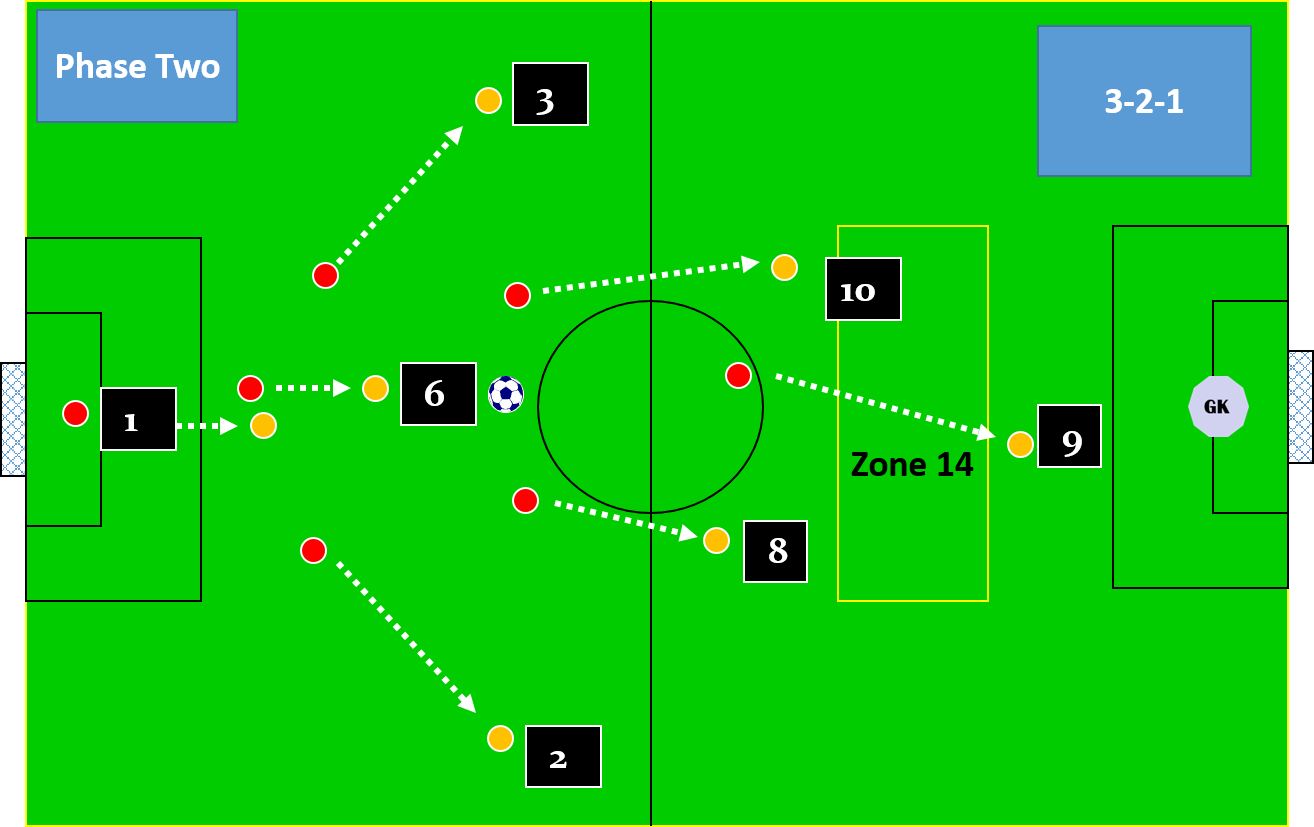
Zone 14 is the area between the opponents back players and their midfield.
The Role of the Keeper
With the ball / without the ball
Technical
Tactical
Psychological
Physical
Skill
Technical Qualities: With the ball
Speed and quality of distribution
Pass, kick, without hands and excellent on the floor technique.
Technique of releasing the ball with the feet and hands - distance (short, middle and long) with speed and direction
Tactical: With the ball
Speed - with ball TO START ATTACKS
Positioning - in a position to receive the back pass.
Choice - playing in depth - retaining possession of the ball
Without the ball:
Positioning: depending on where the ball is and who has it
Communication - with their peers and with respect to the opponents
Control of ways to defend - the goal - area (at the sides, in front of the back four and behind the back four)
Psychological:
The “Will” to avoid goals against
Disciplined and responsible
Stable / consistent performances - avoiding risk
A Leader and organizer
Highly Vocal Communication Skills - with defenders (especially) - with the midfielders - with the forwards (Can see the WHOLE FIELD)
Physical Attributes:
Speed over short and middle distances
QUICK Reactions (not anticipation)
Vertical Force - strong jumping ability - to attack the ball AT ITS HIGHEST POINT
Duel - in the air - power in the 1 to 1; so a strong body
Skill:
All about Decision Making and developing the mind of the player. The “Skill Factor: is perhaps THE most important component to develop in a player.
Everything they do relates to this in terms of assessing options and what the right course of action to take both on and off the ball.
Get the rest of this article and more in the Soccer Awareness eBook: Tactical Thoughts on the Development of the New 4 v 4, 7 v 7 and 9 v 9 Game

4 v 4 Shooting Game With Keepers
In this game, players must be particularly aware of where teammates are, where the opposition are, the keepers position because the space to work in is small and the time they have on the ball is short. Hence development of the mental side of the game in terms of the Awareness program, i.e. seeing situations quickly and acting upon them is very important to the player to help him or her have success by scoring goals.
The following drill comes from the Soccer Awareness Training Center. Soccer Awareness Training Center provides unlimited access to Wayne Harrison's Soccer Awareness systems, training sessions, drills and more. Wayne's system helps develop world class youth soccer players and teams in a systematic and imaginative manner that guarantees performance at the highest level of competition. Whether you’re a beginning coach who needs help getting started or someone who wants to add some variety to their training sessions, the Soccer Awareness Training Center offers a wide variety of drills to choose from. Join Today
Two large goals to shoot at to encourage success by scoring goals. Shorter field so lots of shots on goal because players are nearly always in shooting positions. Initially have the two team / two balls set up so no opposition to enable players working both ways to get lots of shots in. Once a team has worked a position to shoot and has done so that team’s keeper sets up another attack.

Progress it to the competitive even sided game.
Coaching Points:
Quick shooting.
Rebounds.
Transitions.
Quick break counter attack.
Players must be particularly aware of where teammates are, where the opposition are, the keepers position because the space to work in is small and the time they have on the ball is short.
Hence development of the mental side of the game in terms of the Awareness program, i.e. seeing situations quickly and acting upon them is very important to the player to help him or her have success by scoring goals. The shorter and sharper the practice then the less time the players have to make the correct decisions to be successful, the more important it is to train them to be able to cope with these pressure situations.

Five Gates Dribbling Activity
In this drill, players score by dribbling over the opponents’ end line or by dribbling through any of the five gates located in the playing area. Players can only leave their third of the field by dribbling forward.
Work on your team’s dribbling with this drill from the Soccer Awareness Training Center.
55 x 44 yard area organized as shown. Three areas are created using flags. Five gates are created using cones as shown. An 8v8 is organized in the playing area with both teams arranged in a 3:3:2 formation.
15 minutes - Both teams compete for possession of the ball. Players are positioned in each of the thirds of the field as shown.
Players score by dribbling over the opponents’ end line or by dribbling through any of the five gates located in the playing area.
Players can only leave their third of the field by dribbling forward.
Diagram illustrates player (A) receiving a pass, beating his marker and dribbling into the next third of the field.
Coaching Points:
Encourage dribbling in all areas.
Spread out side-to-side and end-to-end.
Spread immediately when goalkeeper receives the ball.
Attack at pace.
Create 1v1 situations by moving away from the player in possession.
Cool Down: 5-10 minutes light jogging and stretching.
NOTE: Depending on the ability of the players it may be advisable to take more than 5 minutes to move through each exercise phase.
Get many more dribbling drills, small-sided games and much more in the Soccer Awareness Training Center!

A “Comfort Zone” Developing Width in Play in a 9 v 9
Objective: To Encourage Players To Use Width And Offer An Area To Play Without Pressure
The following is part of Soccer Awareness eBook: Tactical Thoughts on the Development of the New 4 v 4, 7 v 7 and 9 v 9 Game Sizes.
This eBook shows how these different size games can be taught and also shows different systems of play that might be useful to you.
The idea I am trying to cultivate is to find a pattern of development that goes from 4 v 4 to 7 v 7 all the way through 9 v 9 to 11 v 11 that educates the players VERY EARLY on how to ultimately play the 11 v 11, a common thread running right through the book. Click Here to Buy the Book
OBJECTIVE: TO ENCOURAGE PLAYERS TO USE WIDTH AND OFFER AN AREA TO PLAY WITHOUT PRESSURE
Theme: Developing Width in attack
A perfect Introduction to this idea so players are free to receive in wide areas. If a player breaks wide into the outside channel on either side of the field and is in possession of the ball this player cannot be tackled. Defenders are not allowed into the channel.
The players on the team in possession of the ball can run the ball into the channel or have it passed to them into the channel. Allow only 4 seconds in the free wide area.
This condition plants the seed in the mind of the players to immediately play with width when in possession. Numbers for this game can be 4 v 4 and upwards. Our offensive team shape to begin. Four players give us width in attack.
Develop: The wide areas can be used to practice certain moves the players have been taught, especially at the younger ages where they need to be able to practice them without pressure. This allows for them playing in a game but also doing the move without pressure.
Coaching Points:
Create space wide when in possession of the ball
Building play from the back
Using width to attack
Developing Overlap runs
Development of the Theme
Build the theme up very simply to ensure immediate understanding and success.
No opposition at first so 9 v 0.
Small numbers (e.g. 9 v 3): Passive opposition (jockey the player only)
Small numbers (e.g. 9 v 5): Passive opposition (Can only Intercept the passes not tackle
9 v 9 but again passive opposition
9 v 9 full game with wide FREE ZONES for the team you are training.
When you feel the players are ready have a full blown 9 v 9 game and have it for both teams at the same time going both ways.
Ensure all players on your roster are involved in the attacking team theme development initially so everyone benefits and understands what you are teaching and why you are teaching it.
To Encourage players to use width and play without pressure

This is the basic set up of the attacking shape of a 9 v 9 in the 3-3-1-1 formation. Emphasis is on the theme of exploiting the wide areas of the field by setting the free zone “Condition.”
A Small number of defenders added

Bring a small number of defenders in as passive opposition who can only Intercept not tackle. So we have here a 9 v 5 set up.
Get the rest of this session and more in the Soccer Awareness eBook: Tactical Thoughts on the Development of the New 4 v 4, 7 v 7 and 9 v 9 Game

The Arsenal Game
This game was based on how you would structure a small sided game in the style that the present Arsenal side would play. Their play is made up of lots of quick short passing with plenty of movement off the ball. They use give and goes a lot (wall passes) which I have highlighted in the game.

The following drill is part of Soccer Awareness New eBook: Tactical Thoughts on the Development of the 4 v 4, 7 v 7 and 9 v 9 Game Sizes.
This eBook shows how these different size games can be taught and also shows different systems of play that might be useful to you. Run with them as you may and of course come up with your own solutions too as that is what coaching is all about. I have introduced the use of RONDOS to initially aid the development of players for the game situation. Click Here to Preview The Book
This game was based on how you would structure a small sided game in the style that the present Arsenal side would play. Their play is made up of lots of quick short passing with plenty of movement off the ball. They use give and goes a lot (wall passes) which I have highlighted in the game.

Organization:
Pitch size –40 x 20 or at the discretion of the coach, but basically a standard 4 v 4 pitch
Number of teams –3
Team sizes 4 players
Bibs optional
Goals –5 a side or mini soccer goals
Progression:
I play this game as a 4 v 4 with keepers. I also have four additional players, two on each side (who are neutral and play with the team in possession). The game is a standard 4 v 4 game, except that the neutral players on each side can be used. The neutral players have one touch only (younger players and less technical players may require two touches) and play with the team that have possession. They take any throw-ins or kick-ins from their side. Having the neutral players encourages plenty of give and goes. The players should also be encouraged to play at a fast tempo. Change the four neutral players (one team) with one of the teams on the pitch every few minutes.
Play with 1 v 1s in each zone so players must stay there OR they can move around but must maintain 1 v 1 in each zone.
Can add a neutral player who can create a 2 v 1 overload in each zone.
Play two touches / play ONE TOUCH.
Often players position to receive the ball with their back to play. These session plans show some ideas on how to position and instead "Face Forward" or at least Half Turned or three quarters turned rather than positioning square and facing back.