Welcome to the Soccer Awareness Coaches Corner. Browse through soccer drills, small sided games, tactical thoughts, full sessions and a variety of resources. Posts marked “Training Center Exclusive” are for members only.

Soccer Awareness: Basic Principles of Development (One Touch Play)
Linking foot preparation, body position and mental preparation to the technique involved in making a one touch pass leads us to a discussion on one touch play and its benefits.
One touch play teaches the value of being able to take your eye off the ball when keeping your eye on the ball can be a disadvantage.
To make this work, players need to have good teamwork and positional sense and therefore must work hard for each other.
This article is the intro to Wayne’s eBook 16: Soccer Awareness “One Touch” Training Developing its Relationship with Movement Off the Ball. Get the full book.
The Importance of Teaching One Touch Play: Improving One Touch Play
Maintaining an Awareness of What Is In Advance and Beyond the Ball
Linking foot preparation, body position and mental preparation to the technique involved in making a one touch pass leads us to a discussion on one touch play and its benefits.
One touch play teaches the value of being able to take your eye off the ball when keeping your eye on the ball can be a disadvantage.
To make this work, players need to have good teamwork and positional sense and therefore must work hard for each other.
A Gradual Training Introduction: Training the Psyche of the Players through One Touch Play
Introduce the training in a gradual way; don’t jump straight into a scrimmage. Set it up so it is easy to do initially. For example, one touch passing in two’s. Here, no great amount of awareness is needed because they are facing each other, but they must look into each other’s eyes and not at the ball. This is teaching them to get their heads up, and is the first most basic stage. It is also working on the pace and direction of the pass, getting foot sensitivity started in terms of that first touch on the ball that is now in effect a pass.
Then move to groups of three where a little more peripheral vision is needed. Then ask them to pass and move in a small area.
Next, add more players so there are more passing options and more awareness is needed. Now introduce the Numbers Game, passing in sequence; this really starts to introduce the awareness concept, but with one touch only.
Communication: Good communication is a must, so have players talk to each other, passing messages on to help each other all of the time.
Also, have them do this without any verbal communication as they then have to rely on themselves alone and in games. Unfortunately as much as we try, this very often happens anyway.
So do this WITH communication and WITHOUT communication. Even compare the two, some may get so good at this they can work it out for themselves most of the time as their peripheral vision improves.
So practice one touch with your team, then play games / scrimmages with your team and insist on it being ONE TOUCH ONLY.
There will be times when 2 touches are needed but do not allow it. Force the error if need be by insisting on one touch only.
Example: A player does not get his feet ready to receive and as a result does not make correct contact with the ball and possession is lost. Everyone can see that his feet were the problem, especially the player involved, and this will register in his mind for the next time.
Example: The ball is passed too heavily and quickly (pace and timing of the pass is wrong) and the receiver needs a touch to control the pass initially and then make a 2nd touch pass to keep possession. That is the passer’s fault, not the receiver’s; and they will learn that from this single pass. It is likely that a one touch play at this moment will not work, which is fine, because this will help them learn why it didn’t work for the next time.
Example: No teammates move to give the player receiving the ball an option to pass it one touch.
This is the fault of the player or players off the ball and not the receiving player, but you must insist it is passed one touch still so they pass it into the space the player should have moved into. Again, this will probably result in giving the ball away, but they will learn from that.
The players will recognize if possession was lost because there was not enough support off the ball, the pass was too heavy, or if it was the fault of the player’s first touch if there were options off the ball.
When you first do it, particularly in a competitive scrimmage situation whether within your own team training or against another team, you may find it is incredibly ugly play; the players will more than likely really struggle with it (or maybe not, they may surprise you).
And it may be ugly for quite a while; but just let it go.
Do not be disheartened and don’t let your players get discouraged. And do not coach, just let them play and work it out for themselves. Tell them you expect it to go wrong more than go right to relax them about it...
They will find with practice that they need to adjust the weight of the pass to help the next player, so foot sensitivity in passing will improve.
They will learn this through their own trial and error, not necessarily just what you tell them.
Get eBook 16: Soccer Awareness “One Touch” Training Developing its Relationship with Movement Off the Ball. This 103 page eBook explores one touch training and movement off the ball and includes 90 pages of drills that you can do with your team. Table of contents is below.
One Touch Training: Teaches the player WHEN to play one touch; and when NOT to play one touch. We are teaching players to have a ONE TOUCH MENTALITY. A One touch mentality teaches players to recognize the best options; and therefore make the best DECISIONS; BEFORE and in ADVANCE of receiving the ball.
Movement OFF the ball: This mentality conditions the mind of players OFF the ball to position and move to help the player who is receiving the ball. This means we want players to always; at every moment; THINK: “I only have One touch”; therefore this will force players to always do what I call the “LOOK and THINK” before they receive the ball to see several options and pick out their best option, which may actually be to DRIBBLE!!
When you use these training sessions consistently you will see the development of that relationship between having a ONE TOUCH mentality and Movement OFF the ball.
So in a nutshell:
LOOK (before receiving the ball);
MOVE (find space off the ball based on positioning of teammates and opponents):
THINK (what is my best option?):
EXECUTE (the Decision; or the SKILL Factor).



Awareness One Touch Theme Developmental Training: Incorporating Movement Off the Ball
Players are generally all very good at playing using many touches; that is; dribbles, turns and running with the ball, that is more technical training / playing.
But often not so good at one touch quick thinking and quick decision making training, that is more skill training / playing.
Hence why we must increasingly do this training with them.
This article is the intro to Wayne’s eBook 16: Soccer Awareness “One Touch” Training Developing its Relationship with Movement Off the Ball. This 103 page eBook explores one touch training and movement off the ball and includes 90 pages of drills that you can do with your team. Get the full book.

One Touch Training: Teaches the player WHEN to play one touch; and when NOT to play one touch. We are teaching players to have a ONE TOUCH MENTALITY. A One touch mentality teaches players to recognize the best options; and therefore make the best DECISIONS; BEFORE and in ADVANCE of receiving the ball.
Movement OFF the ball: This mentality conditions the mind of players OFF the ball to position and move to help the player who is receiving the ball. This means we want players to always; at every moment; THINK: “I only have One touch”; therefore this will force players to always do what I call the “LOOK and THINK” before they receive the ball to see several options and pick out their best option, which may actually be to DRIBBLE!!
When you use these training sessions consistently you will see the development of that relationship between having a ONE TOUCH mentality and Movement OFF the ball.
So in a nutshell:
LOOK (before receiving the ball);
MOVE (find space off the ball based on positioning of teammates and opponents):
THINK (what is my best option?):
EXECUTE (the Decision; or the SKILL Factor).
Introduction:
Players are generally all very good at playing using many touches; that is; dribbles, turns and running with the ball, that is more technical training / playing.
But often not so good at one touch quick thinking and quick decision making training, that is more skill training / playing.
Hence why we must increasingly do this training with them.
For the ONE TOUCH AWARENESS training game with three teams that I want everyone to do each training session for 10 minutes; to ensure we improve the players quick thinking and decision making, as well as their awareness of how to get free OFF THE BALL, here are some more ideas with the same theme so you do not have to do the same game every training session.
This will also ensure the players do not get bored with the repetition of it all.
Really try to have the players play one touch but depending on their developmental level perhaps start with two touches for them to gain early success and to increase their confidence.
But, As Soon As You Can; Play One Touch Only
Please ensure you do this every session as it is imperative we work on this theme with them.
Coaches choose which session they use each training session please, there are many choices to go at for you.
Shown below are many variations of the theme but the simplest theme to use is focusing on:
“ONE TOUCH PASSING AND MOVING OFF THE BALL”
Many may struggle with this but in time and with patience and practice you will be amazed how much improvement comes in quick decision making using this game. As each player only has one touch to pass the ball this should improve players movement off the ball to support due to this as they know the player receiving needs immediate help and as many options as possible. The two aspects of play go hand in hand, one touch play and movement off the ball.
Players in 90 minutes touch the ball themselves, depending on their position, perhaps 3 to 6 minutes, so what do they do in the other 84 to 87 minutes?
They must understand how best to move OFF THE BALL in that time span to help their teammates.
Hence why the focus and teaching of Movement OFF the ball is so vital and important in the greater scheme of things in the game.

Passing Game for Spatial Awareness Development
Players have the ball at their feet for approximately 5 minutes out of 90. What do they do the rest of the 85 minutes? They must learn to move off the ball and to move into open passing lanes to be open at all times to help the player on the ball or the next player on the ball. Here is a great session to teach this.
We can use many upright cones to represent opponents rather than mannequins. We set the cones up in triangles and diamonds. We ask players to position between the cones in the best space available. Try to balance their position to find the best space in the middle of the triangle or diamond of cones (opponents). Players beyond the ball try to position in triangles and diamonds of support also.
The following is an excerpt from Soccer Awareness eBook 16: Soccer Awareness “One Touch” Training: Developing its Relationship with Movement Off the Ball.
This 103 page eBook explores one touch training and movement off the ball and includes 90 pages of drills that you can do with your team.
Passing Game with Cones for Spatial Awareness Development using Mannequins or Cones in Training for Movement Off the Ball
Players have the ball at their feet for approximately 5 minutes out of 90. What do they do the rest of the 85 minutes? They must learn to move off the ball and to move into open passing lanes to be open at all times to help the player on the ball or the next player on the ball. Here is a great session to teach this.
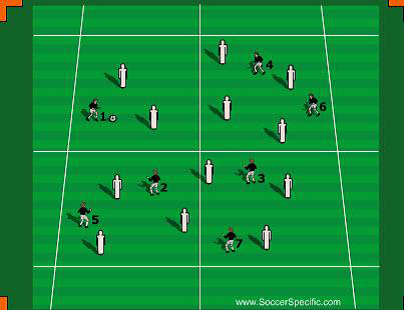
Getting into passing lanes to help each other
We can use many upright cones to represent opponents rather than mannequins. We set the cones up in triangles and diamonds. We ask players to position between the cones in the best space available.
Try to balance their position to find the best space in the middle of the triangle or diamond of cones (opponents). Players beyond the ball try to position in triangles and diamonds of support also.
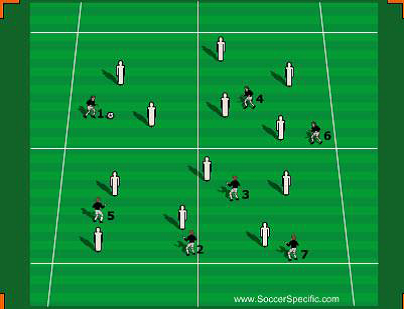
OBJECTIVE: To improve movement off the ball by providing mannequins to act as opponents to fill important space
A non-directional training practice
Mannequins represent opponents on the field. They fill important spaces so the players need to pass and move around and between them. This ensures players move off the ball to help the player on the ball have as many options as possible for a pass. The goal of the players is to find as much space as they can between the mannequins to give themselves as much space as possible to play in.
Every now and again stop the practice and see where the players are positioned. Are they in free space? Are they too close to a mannequin and hence in a game situation not available for a pass? If they are then ASK THE PLAYERS to SHOW you a better position to be in.
Possible problems here are the positioning of players behind opponents so the player on the ball cannot see them to pass to.
Develop:
Restrict the number of touches on the ball to 3 touches, two touches then one touch; if it is on to do so. To enable one touch to be possible movement off the ball has to be intelligent, fast and into space to help the passer play one touch. Thinking AHEAD of the ball arriving is paramount here otherwise one touch play cannot be performed successfully. Try to think two moves ahead. Movement OFF the ball by others is paramount here also otherwise the person receiving the pass will not be able to play one touch successfully.
Play the Numbers Game: 1 passing to 2, 2 to 3, 3 to 4 and so on. Increase the number of balls being used.
Two teams playing in the same area with a ball each. Now players need to avoid the other team AND the mannequins to find space to receive the pass.
Coaching Points:
Thinking and looking before receiving of the receiving player so they have assessed their options before receiving and in advance of the ball
Ability to play ONE touch if possible for speed of play
Movement OFF the ball of teammates to help the player on the ball
Movement INTO spaces between and around the mannequins to enable this to happen using the mannequins as guides.
Thinking TWO moves ahead to support.
Playing in triangles of support offering several options for the player on the ball in many directions.
An exaggerated situation but this shows what happens when players do not move to space to help the player on the ball; and do not open up the angle for a pass, instead standing behind an opponent and not being free to receive. How many times do you see this?
To defeat this problem; the player on the ball can pass to a space hoping that this will force the receiver to move to that space to receive the ball. Then the weight; timing and accuracy of the pass has to be particularly good; but this is not ideal.
Whilst players can still be successful with later movement off the ball of supporting players; if the player on the ball hastime on it to take more touches; it is always better to provide options of a pass as early as possible to increase speed of play and give opponents less time to work out their movements.
Working in threes
Here showing possible passing routes with each group of three players also showing how they get free and into as much space as possible, based on the positions of the mannequins who act as opponents filling spaces.
Different colors to pass to in order to develop color coordination.

Game situation
Have players passing in two teams to begin as a warm up, with a ball each team, then two and three balls each team. Then they pass to opposite colors only.
Now play a 6 v 6 (or any number you like) and make it a possession game. Mannequins make it more difficult by filling spaces so players have to play around them as well as their opponents. This should improve them playing in tight situations.
Use a 2 player overload if required initially until they get really good; then make it equal numbers each team, you dictate this based on the ability of your players. Of course change the numbers of touches on the ball decreasing the number as they become proficient to increase the difficulty.

The focus is again passing and movement off the ball to receive with as many players as possible offering an option of a pass for the player on the ball.
Here we show potential positioning of players in the biggest spaces they can find between the mannequins.
More space means more time to play on the ball so the player has the choice to play quickly or not; also depending on the individual situation presented; and often dictated to by the support positions of his teammates.
Develop: Have two teams playing through each other avoiding each other and also avoiding the mannequins. This is now a big challenge to each player on the field where there will be less space to play in and their peripheral vision will really be tested to its fullest.
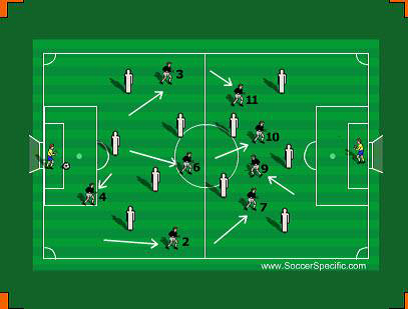
Game Situation
Try an overload first of all maybe a 9 v 4 building it up to a full game. This is a big challenge meaning fewer spaces to play in and forcing more movement off the ball to support each other.

Here is a great video of FC Barcelona YouTube showing how this works.
Get more like this in Soccer Awareness eBook 16: Soccer Awareness “One Touch” Training: Developing its Relationship with Movement Off the Ball.
This 103 page eBook explores one touch training and movement off the ball and includes 90 pages of drills that you can do with your team.

Youth Soccer Training & Development: Myelin & Training - The Scientific Concept in Skill Development
In this article, I explain the scientific background to the Soccer Awareness training method. A previous article introduced Awareness Training and explained how it helps players develop skills more rapidly than traditional training methods. In this article I want to explain the scientific background to Awareness Training and how the approach speeds up and improves decision making and the thought processes in soccer.
In this article, I explain the scientific background to the Soccer Awareness training method. A previous article introduced Awareness Training and explained how it helps players develop skills more rapidly than traditional training methods. In this article I want to explain the scientific background to Awareness Training and how the approach speeds up and improves decision making and the thought processes in soccer.
In my experience, there are three key ingredients for successful skill acquisition and development. They are:
Deep Practice
Ignition, and
Master Coaching
These three elements work together within your brain to create myelin. Myelin is the neural substance that adds vast amounts of speed and accuracy to your movement, thoughts and decisions.
What is Myelin and why is it important to skill development?
Inside the brain information is transmitted through neurons. Human skill is created by chains of nerve fibers carrying a tiny electrical impulse from the brain to the body through these neurons. Myelin is the insulation that wraps around the nerve fibers in our brains and increases signal strength, speed and accuracy. Myelin is produced by a person thinking about and analyzing skill situations themselves.
All human skills are created by linking the nerve fibers in your brain that send signals to your muscles. Myelin plays an important role by serving as an insulator for these nerve fibers. According to the U.S. National Library of Medicine and the National Institutes of Health, “The purpose of the myelin sheath is to allow impulses to transmit quickly and efficiently along the nerve cells” (NLM/NIH: MedlinePlus).
It has been shown that the more insulation – or more myelin – wrapped around those fibers, the stronger and faster the signal becomes as fewer of these electrical impulses leak out. Therefore, skill can now be redefined as “myelin insulation that wraps neural circuits and grows according to certain signals.” The two – skill development and myelin – are married together.
Myelin acts like an elastic band around the nerve fibers squeezing them and forcing the signal through faster. In football (soccer), with each repetition, myelin responds by wrapping layers around the nerve fibers, speeding up and improving decision making and thought processes. With each additional layer of myelin added, the player increases the ability to process the football specific skill required.
Everyone has myelin and everyone can improve themselves through its production. The more myelin produced; the thicker the sheath, the faster the message; the quicker thinking the player becomes.
How do the “three ingredients” work to help create myelin and improve performance?
Deep Practice
For his book Talent Code, Daniel Coyle searched out what he calls “hotbeds of talent” around the world, including a soccer field in São Paolo, Brazil. Through his research, he developed a theory of what he calls “Deep Practice” that helps produce amazing success. This means “training on the edge of your capabilities.” Training in this dynamic capacity leads to mistakes being made, which increases the speed of skill acquisition. Players learn through making errors/mistakes and then correcting them. This method produces results 10 times faster than regular practice.
As deep practice is occurring, the player is wrapping even more myelin around each circuit and increasing skill. Simply put: mistakes lead to better skill acquisition. Deep practice is most important for players 6 to 12 years old. Their spatial awareness and ability to understand tactical concepts is still developing and at its height, and they have an unlimited capacity to acquire and develop new motor skills.
Simply put: mistakes lead to better skill acquisition.
Repetition of themes in small sided games is crucial, and especially in the “sweet spot” on the edge of the comfort zone that produces errors but also teaches skills. This is where futsal comes in to play.
As Coyle explains in Talent Code, “Most Brazilian players learn their skills through futsal, the ssg equivalent of soccer. Futsal uses a half size and much heavier ball that doesn’t bounce; that promotes touch, technical and skill development. Sharp passing is paramount to have success. Futsal compresses essential skills into a small box, puts players into the ‘deep practice zone,’ making and correcting errors, constantly generating solutions to vivid problems. Players touching the ball 600% more often learn far faster, without realizing it, than they would in the vast expanse of the outdoor game.”
Deep practice needs to be on the edge of the players comfort zones, and maintained in game-related skill-developing situations.
Building myelin takes time, and putting ourselves in a position to fail actually helps fix our mistakes. Failing “better” and continuing this process until we accomplish the task is one of the quickest and most efficient ways to build myelin. We talk about letting players make their own decisions, allowing them to think for themselves – to problem solve; to self-correct. Myelin production does just that.
This learning process can boost the brain’s efficiency by increasing the speed with which a signal travels down the nerve fibers by up to 100 times. So think about it: if self-correcting could make signal transport over 100 times faster, why would you not want to help build this into a player’s mentality? By commanding the players, by telling them what to do, you are actually restricting this process from taking place.
Therefore, your players will actually think and react and make decisions more slowly and less efficiently because of this command style of coaching. Unfortunately, some coaches are still stuck in this old methodology of command coaching and it has to change. It doesn’t work.
What does this mean in terms of learning behavior?
Players should be encouraged to solve problems on their own, and not be told everything by the coach so they don’t have to think for themselves. By working through their own mistakes in practice, players train their minds to work faster and more efficiently.This is a scientifically proven fact. This will not happen if you continue to pursue the command style of coaching, where it is all about the coach and not about the player.
This is why we need to start this process at the youngest ages possible. There is a big responsibility to ensure that coaches for the youngest age groups begin this process of allowing the players self-correction, and at the most: only guide them to the right decisions.

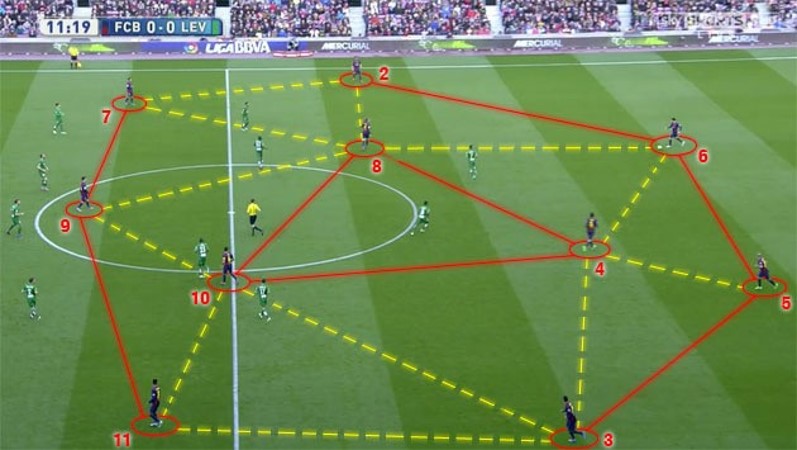
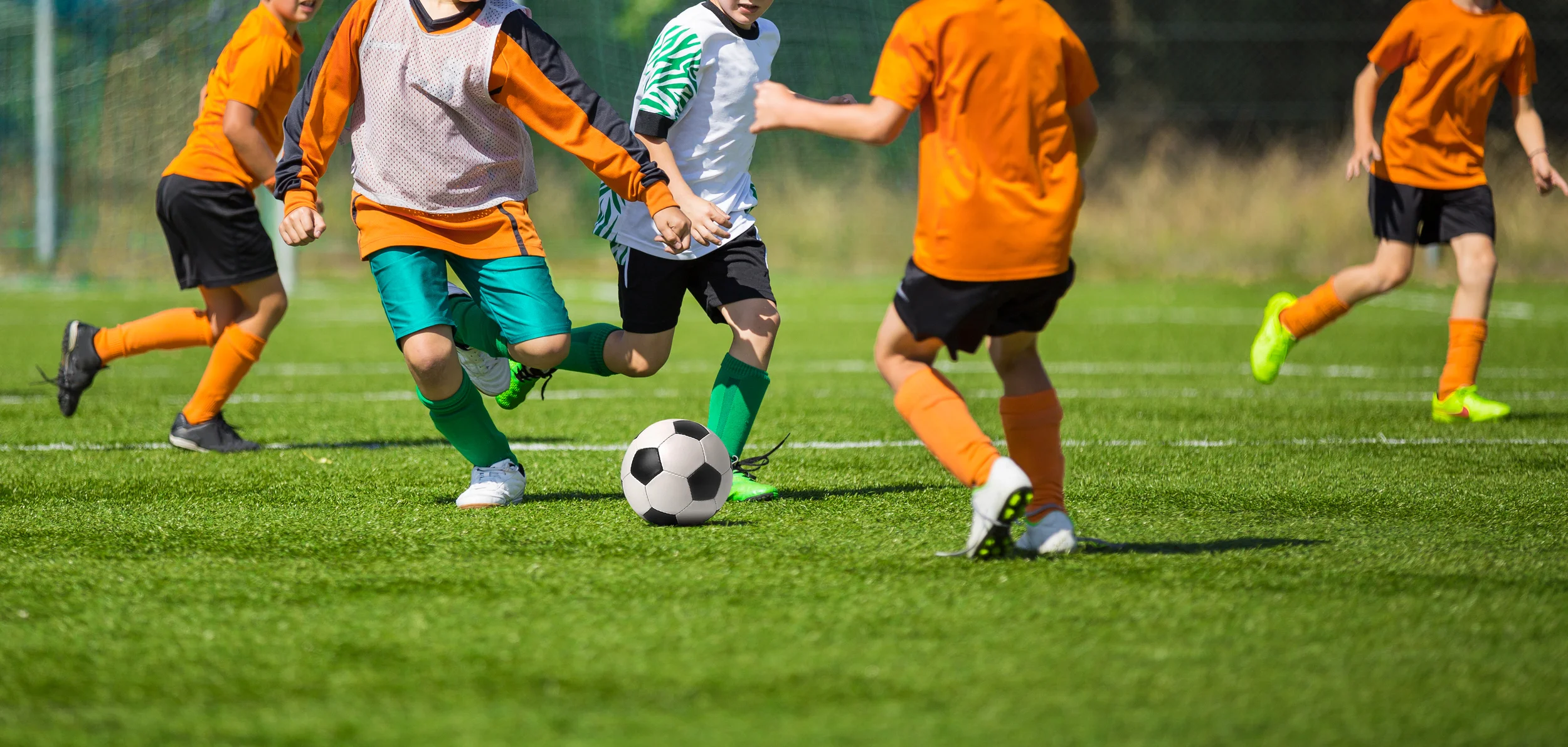



The secret is to develop specific practice to increase the layers of myelin to add more skill and speed. The thicker the myelin gets, the better it insulates and the faster and more accurate our movements and thoughts become.
What is specific practice? An example would be practicing the same theme over and over, initially as a technique and then as a skill. This could be one-touch passing, first in isolation as a technique and second in a game situation as a skill (when and where to pass).
They say that for a person to become an expert at something they need to do a minimum of 10,000 hours of practice. This means that deep practice times 10,000 hours should produce world-class skills. This is the ten year/ten thousand hours rule. There are no guarantees for this, of course, but this is the kind of minimum effort required to achieve these results.
Simply put, the rules of deep practice are: try again, fail again; try better, fail better; keep trying, succeed. In other words, coaches need to allow players to fail/make mistakes and learn from them in practice.
Ignition
Deep practice is a cool conscious act; ignition is a hot, mysterious burst – an awakening.
Ignition is the motivational fuel that generates the energy, passion and commitment of a person from within to perform deep practice. It is intrinsic motivation where the athlete has a self-willed drive to succeed. This is the catalyst, and it represents a huge level of commitment that can be borne out of a player’s deepest, often unconscious, desires to succeed.
A person’s motivation is not just intrinsic; it can also be ignited by an event in the outside world, such as being inspired to play for your country after watching the skills of the World Cup Champions. In a famous example, Roger Bannister broke the seemingly-impossible four-minute mile in 1954. This ignited everyone’s belief to go for it, and within three years, seventeen athletes had broken what was previously considered a physiologically impossible feat.
An athlete can also be ignited or inspired beyond the intrinsic by Master Coaches.
Master Coaches
Master Coaches are the final piece in the “jigsaw of success,” and can have an immense amount of positive influence on the player. These coaches create a learning environment where the players are actively engaged and are led by guided discovery methods of coaching. Training should be player centered not coach centered, where coaches only need to step in at the appropriate moments to make corrections.
Real master coaches are like farmers; they are deliberate cultivators of myelin. They are talent whisperers, and can be the difference between success and failure for athletes.
The drawbacks of poor training at young ages: Myelin does not unwrap, it only wraps. And somyelin is the reason bad habits can be difficult to break in older players. This is why developmental training is so important, where skill development is the focus. We must help players develop good habits that stay with them, because the bad habits equally stay with them if developed at a young age. The ages of 6 to 12 are the most important in the training of players and can affect their success in the future.
In summary
The game of soccer is dynamic; situations change and new decisions have to be made every second. Players are continuously making and correcting errors and constantly generating solutions to ongoing problems. To be successful, players must be skilled at decision making, and to be skilled they need to be properly trained.
This training occurs in deep practice. The more you practice “on the edge,” the more decision making situations you find yourself in. The more decision making situations you are in, the more thought it takes to solve them. The more this all happens, the more myelin is grown, the faster the body and brain processes situations and the better the decisions are made.
So, to recap; myelin is the insulation that wraps these nerve fibers and increases signal strength, speed, and accuracy. The more we fire a particular skill circuit (it could be when and where to pass, for example), the more myelin is produced to activate and stimulate that circuit and the stronger, faster and more fluent our movements and thoughts become.
The three key ingredients for skill acquisition and development are Deep Practice (with specific practice), Ignition and Master coaching. These are required to help build the myelin wrap, which helps to speed up, strengthen and improve the accuracy of decision making. All three must be present to facilitate the maximum growth of myelin production and subsequent skill development.
In simple terms
The more Myelin the person produces the faster, stronger and more accurate the messages are from the brain.
Deep Practice ensures myelin is produced.
Ignition is the process that serves as the motivation for deep practice. Ignition supplies the energy, and deep practice translates that energy over time into forward progress (increasing the wraps of myelin). Ignition is caused by the inside energy of the person (desire, self-belief) and the outside energy of the coach or outside events. Words are the signal most used to trigger ignition.
Master Coaches use the words that trigger ignition, which in turn motivates the deep practice that produces the myelin that speeds up and strengthens the decision making signals in the brain of the player. So, the types of words used can influence the player greatly. Negative words can have as much bad influence; as positive words have good influence. Coaches should take note of this important statement.
So, working backwards, the formula is: Master coaching creates Ignition, which encourages Deep Practice. Deep Practice – and especially specific practice – enhances myelin production, which produces improvements in accuracy and speed of decision making.
In conclusion
My method of coaching is, as you see, all about inspiring the players to think and make decisions for themselves. We need to encourage them to self-determine “where, when, how and why” they need to play a particular way or make a particular decision in a particular situation.
It is encouraging, to say the least, that I have discovered this wonderful work – Talent Code by Daniel Coyle – which supports my work. This book proves scientifically that the way to develop players is to empower them and to give them the reins of thought.
The key is becoming a Master Coach. The Master Coach guides players and steers their path towards greatness. He applies his knowledge and experience to use the “less is more” approach in the right contexts of development. In a way he, is showing them without showing them, guiding them to the light at the end of the tunnel – without showing it directly – until the players themselves find and see it and go through it.
So please, let the players learn for themselves. With guided deep practice and appropriate ignition by master coaches, over time players will develop far better than coaches commanding and demanding and not allowing players to think for themselves.

Quick Transition 2 v 2 Rondos
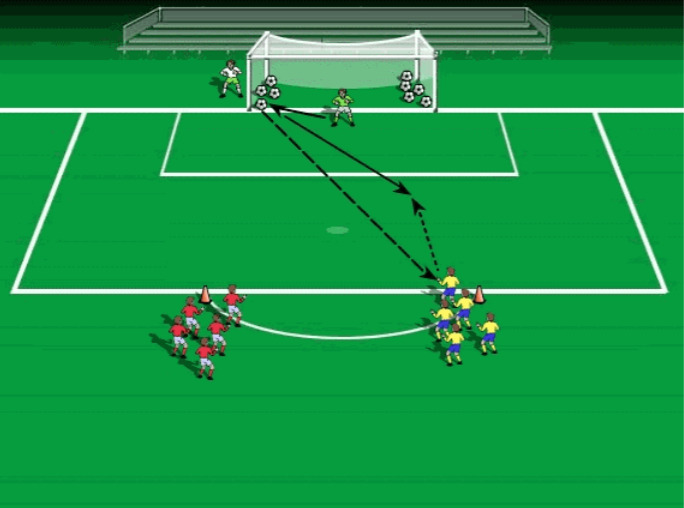
This is a 2 v 2 game going to 4 goals. The team who scores stays on and must quickly defend the 2 new players coming in (one from each goal that the opposition defends).
The following drill comes from the New Soccer Awareness eBook Developing Players with Rondos Using the Soccer Awareness Philosophy. This 222 page eBook explores the use of rondos in youth soccer. Rondos are a great way to prepare players for the game situations and especially the fast decision making needed within the game. Preview The Book
This is a 2 v 2 game going to 4 goals. The team who scores stays on and must quickly defend the 2 new players coming in (one from each goal that the opposition defends).
Instant transition with the same ball that the opponents scored with, here (3) and (4) are positioned to immediately bring the ball the opponents’ may score with out to attack. The other two players (1) and (2) must get off the field ASAP.
Introduce a target player (can be coaches or players). Now it can be a 3 v 2 effectively.
Players can use the target to play give and goes with each other or with their immediate teammates.
Liken passing into the goal as a midfielder passing into a striker so they get the ball in there as quickly as possible or a defender into a midfielder.
The 1st thought of the player on the ball has to be “Can I score?”
The 1st thought of the 1st defender is can I stop them scoring, win possession immediately, and score myself.
First team to 10 goals wins, keeping the competitive element.
If the ball goes out of play the coach can provide another one to keep things going quickly.
Coaching Points Attacking:
Quick Break and counter attack
Switching the point of attack if another goal is more open
Quick one and two touch passing
Positioning to open up passing lanes and getting between defenders to pass the ball in early
Creating 2 v 1 situations from a 2 v 2 set up and setting up a give and go.
Coaching Points Defending:
Instant pressure as possession changes (transition after scoring going from being an attacker to being a defender)
Regaining possession at the front with a scoring reward
Getting in front of the passing lanes to prevent the quick pass into the goal.
Working together with pressure and support, the support player supporting the first defender, stepping across and covering the passing lane to the second goal and also keeping an eye on the 2nd attacker.
Transition Coaching Points:
Immediately the team that has been in possession of the ball and has scored then they must switch on mentally to being defenders and high pressuring the new attacking team to try to win the ball back and score again.
Area: 15 x 10
A 2 v 2 game going to 2 goals. The team who scores stays on and must quickly defend the 2 new players coming in (one from each goal that the opposition defends).
Offside half way line. Instant transition with the same ball that the opponents scored with.
Players can use the target to play give and goes with each other or with their immediate teammates.

Use the players in the goals to support. They have 1 or 2 touches only so they must play quickly.
Now it is essentially a 3 v 2. For the inside players start with unlimited touches then as they are successful decrease the number to test their peripheral vision and awareness on and off the ball.
Always increasing the challenge each point of success is reached.
Now develop by allowing the balls to transfer

This will really test the players imagination and awareness on and off the ball. In one instant (3) and (4) are defending, in the next they are attacking. Likewise for the letters team.
Here we show how the mental transition works with each team suddenly changing their positions defensively to deal with the change.
Get much more like this in the New Soccer Awareness eBook Developing Players with Rondos Using the Soccer Awareness Philosophy. This 222 page eBook explores the use of rondos in youth soccer. Rondos are a great way to prepare players for the game situations and especially the fast decision making needed within the game. Preview The Book


How to Teach Freedom of Movement for the 4-2-3-1
Attacking and Defensive Positioning; and Covering for Each Other in Brief
To play such a fluid and imaginative style of play as we do; where players are offered such freedom offensively all over the field; there is always a "weakness" to this we need to address. In this case we look at the defensive consequences for which we need to cover and correct.
Attacking and Defensive Positioning; and Covering for Each Other in Brief
To play such a fluid and imaginative style of play as we do; where players are offered such freedom offensively all over the field; there is always a "weakness" to this we need to address. In this case we look at the defensive consequences for which we need to cover and correct. Full version is 39 pages.
Defensive Adjustment and Organization
The potential weakness in this system and STYLE of play is the defensive adjustments needed to ensure our fluidity of attacking movement doesn’t cost us when we lose possession of the ball.
This presentation shows how we can make sure; defensively; we are disciplined and solid by teaching the players where to immediately press; where and when to recover; and how to fill in and cover for each other immediately the ball is lost.
Therefore we transition (in MIND and BODY) from incredible freedom of attacking momentum; which brings imagination, interchanges and rotations, to the opposite; intense, concentrated and positionally disciplined defense.
This is a simple way to show how we can make sure the team is well organized to allow the attacking freedom to take place; knowing we can cover ourselves if we lose the ball.
Interchanging Positions in Attack and what it means. We attack with freedom and rotation of positions knowing we are covered by team mates.

So now, as close as possible to identify the change; Nine is 10, Eleven is 9, Eight is 6, Six is 8, Ten is 11; and so on. Three is in an Inside Left position, Two is in an Inside Right position. A six player attack.
Our Players have attacked and interchanged positions in the attack but we have lost the ball. They get the ball out and keep possession; we have to press and also recover at the same time.
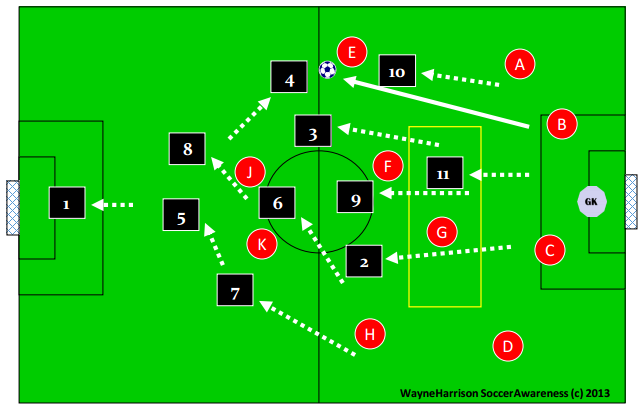
Now we must press thru (4) who MUST delay (E), and the rest of the team can then get compact behind; alongside and in front of the opponents. (3) and (10) can recover to the press also.
In theory our players are out of position but are they? It depends how you teach them; how we press and recover and who does what, where and why.
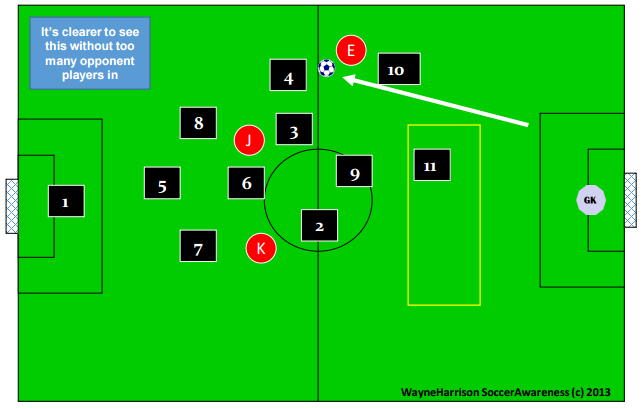
Changes: Our Center back (4) is now a left fullback 3; our linking midfielder (8) is a center back 4; our left back (3) is a center midfielder 8, our striker (9) is a number 10; our attacking midfielder (10) is in the wide left position 11; our wide left (11) is in the (9) position and (2) is in 7s position and (7) is in 2s position.
Changes in Previous Diagrams:
To recap on the previous defensive recovery set up which was our offensive set up initially:
Our Center back (4) is now a left fullback 3;
Our linking midfielder (8) is a center back 4;
Our left back (3) is a center midfielder 8,
Our striker (9) is now a number 10;
Our attacking midfielder (10) is in the wide left position 11;
Our wide left striker (11) is in the (9) central striker position;
Our right fullback (2) is in 7s wide striker position;
Our wide right striker (7) is in right fullback 2s position.
How we press and recover and who does what, where and why and rotation back into original positions and defensive set up.

The Ball goes out of play, for example, the players then rotate back into their own positions; or any part of the game they have time to do this they must try to work back into their own positions. We then start again to win back the ball and continue the freedom futbol method of playing.

A Square Passing Rondo Introducing Brain Centered Awareness Training
The goal of this exercise is to help program movements into our players while also helping them develop proper habits to read the game and play in a creative manner.
Groups of 4 players with one ball. Place extra balls either in the grid or nearby to keep the exercise flowing in the event of mistakes.
The Square should be approximately 15×15 yards. There should be three discs at each corner of the square (as pictured).
The Goal of this exercise is to help program movements into our players while also helping them develop proper habits to read the game and play in a creative manner.
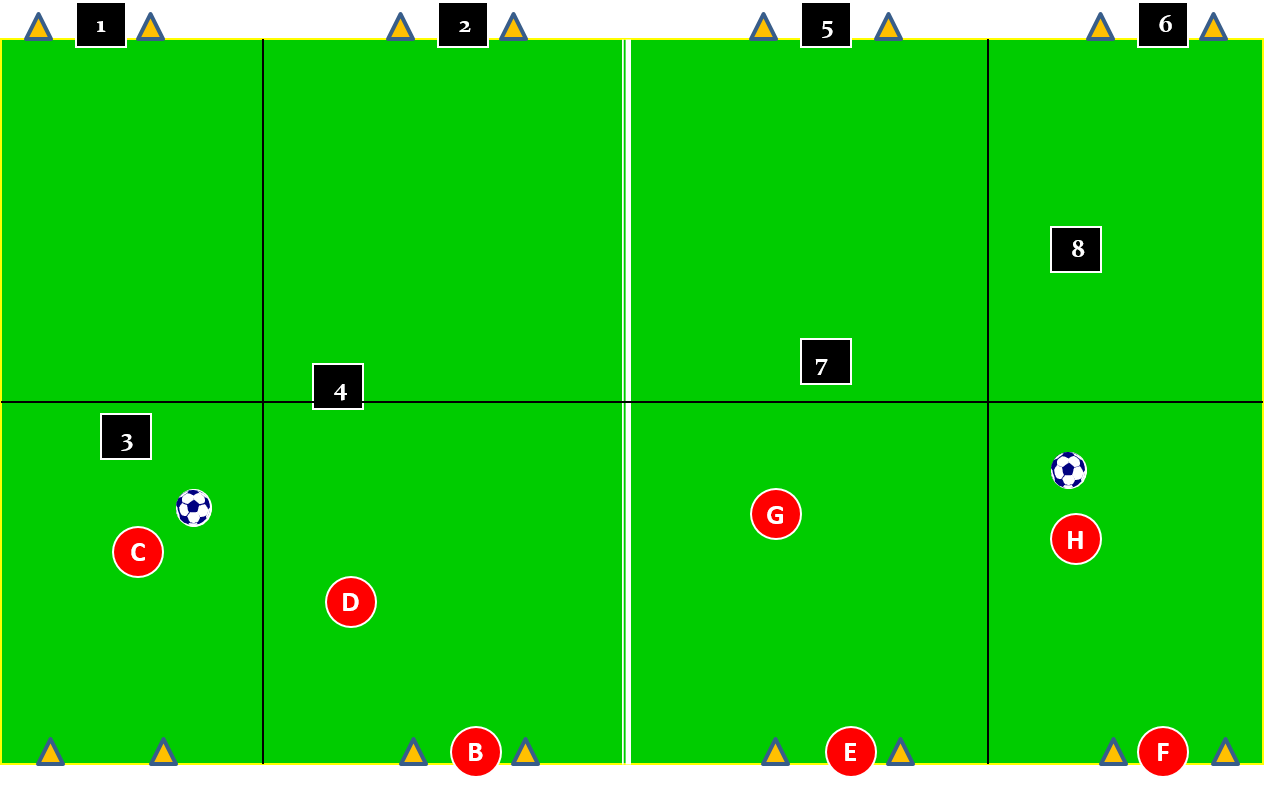
Focus: Players should start on the furthest disc from the player they’ll be receiving the ball from.
1st Movement: When player B takes his/her first touch “prepares the ball”, player C should break off the disc “separate from the defender” and show into the space to receive a pass from B. Player D should now be prepared to separate from the defender on player C’s preparation touch. Exercise continues.
Coaching Points:
Crisp Passing
Explosive Separation from defender
Head on a swivel- Can we take a look at where we want to play next as the ball is traveling?
Clean 1st touch

This is an outstanding warm-up to help program players with a proper skill set to meet the demands of the modern game, movement off the ball, timing of runs, crisp passing, taking a look!, but for the exercise to truly be effective, the coach MUST demand that all the movements & requirements of the exercise are carried out at game speed. Coaching Demand: If you let your players get away with things that wouldn’t work in the game during training, what is the point of training?
Add Central Midfield Support Players

Now we have give and goes or 1-2s with each of the four players. Two midfield players rotate in and out and take turns in supporting the outside player. If you only have 5 players use one midfield player only.
If you like this, get much more like it in one of our new ebooks:

Developing Players with Rondos Using the Soccer Awareness Philosophy
This 222 page eBook explores the use of rondos in youth soccer. Rondos are a great way to prepare players for the game situations and especially the fast decision making needed within the game. I have included as a way to work into these game situations many Rondo ideas that I feel are great foundation builders for players learning to combine and play together. I have stayed with simplistic ideas that all levels of players can try and be successful at. It is up to each coach to work out how to make it work for their players. Get It Here

Tactical Thoughts on the Development of the New 4 v 4, 7 v 7 and 9 v 9 Game Sizes
This 407 page eBook shows how these different size games can be taught and also shows different systems of play that might be useful to you.
Run with them as you may and of course come up with your own solutions too as that is what coaching is all about. I have introduced the use of RONDOS to initially aid the development of players for the game situation. Get It Here

Testing Players Awareness
Coaches are trying to develop the concept of the player recognizing options before receiving the ball. This exercise is a very simple idea and tests the players to see if they looked over their shoulder away from the ball or not before they receive the pass.
The following drill comes from Best of Soccer Awareness. This 80 page eBook contains 24 of the best sessions from UEFA Professional “A" License Coach Wayne Harrison's Soccer Awareness method.
To develop the Soccer Awareness concept its important to take the process from structured training sessions into free flowing game situational set ups so the players are developing their thinking skills under pressure. We offer various game situational small sided situations here to test this. We hope you enjoy this eBook.
This book is also available as part of the Premium and Elite Plans in the Soccer Awareness Training Center. Find Out More
Coaches are trying to develop the concept of the player recognizing options before receiving the ball. This exercise is a very simple idea and tests the players to see if they looked over their shoulder away from the ball or not before they receive the pass.
The opposite outside player from the ball can decide to close down the middle player or stay away (in this case player 3). If they close down then the middle player must pass the ball back to the player who passed it to them, player 2. If not closed down then they receive and turn and pass to player 3 (below).


Coaching Points:
Look over shoulder before receiving (where you are passing to).
Body Stance – half turned (can see behind).
Support at an angle.
Save a touch – let weight of ball determine this- let it run across the body and move one touch.
Develop - Opposite player stays or closes the middle player down.
If closed down, middle player passes back to same.
If not closed the middle player turns and passes to opposite player.
Go through each progression in the order it is presented here, do one at a time and have each player practice it in the middle at every stage of the progressions.
If the player in the middle (2) turns and looks to pass to player 3 when player 3 has closed them down; this is an indication that player 2 in the middle did not look before receiving, to see where player 3 was. This will likely happen with some players.
Initially and before we set the conditions players will pass from 1 to 2 to 3 and not always look behind them before receiving, after making the reference to this and changing the idea having players close or not close down, you will see the middle player looking over their shoulder as the ball is being passed to them to see if they are closed down or not.
The difference is obvious when you put the conditions in and is a great help in developing awareness in players.


Directional Awareness Four Team Passing Game - Training Center Exclusive
Objective: Awareness of Teammates and Opponents Positioning on the Field in Advance of Receiving the Ball
We are working on: When and where to pass, Looking before receiving, Awareness of player positions before receiving the ball, Awareness of options on the ball before receiving it, Awareness of Opponents positions before receiving the pass and Maintaining possession of the ball
*Membership Required
Objective:
Awareness of Teammates and Opponents Positioning on the Field in Advance of Receiving the Ball
Coaching Points:
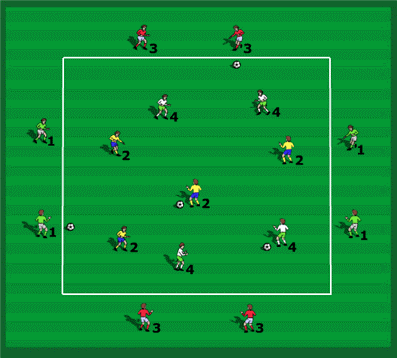
When and where to pass (timing, accuracy, weight)
Looking before receiving
Awareness of player positions before receiving the ball
Awareness of options on the ball before receiving it
Awareness of Opponents positions before receiving the pass
Maintaining possession of the ball
Rules:
Warm Up:
Two balls per inside team (or more). (2)’s pass to (1)’s and (4)’s pass to (3)’s. The two groups work across each other. Four teams working but in pairs.
Directional session now working across each other, needing to know where their teammates are but also where the other numbered players are in the middle. This improves awareness and the peripheral vision of the players.
A good lead in to everyone being free in the area and passing and moving later.
Players need to look before they receive, see what the options are in advance of the ball.
Progressions:
Passing in straight and / or angled lines
Running in straight and / or angled lines
Mixing the two up
Players pass to the end players only, to begin transferring the ball from one side to the other. If both players on the other side have balls at their feet then liken it in a game to the strikers being marked and you have pressure on the ball preventing a forward pass so you have to go back to where you came from, either to the other player you did not receive the pass from or back to the same player.
Passing inside the area to team mates in the buildup not just to the outside players.
Introduce give and go’s with outside players (players then keep the same ball throughout a set time period)
Switching positions with the outside
Passing inside the area first then outside
Outside players can pass to each other on the same side the ball moving and keep the inside players alert as to where the ball is.
Outside players switch positions with and without a ball, if without the ball then they are now moving targets as it would be in a game.
All players communicate with each other to help make each movement and pass successful (above as (4) receives the pass, (3) calls to let him know they are free to receive the next pass.
Ask inside and outside players to pass to space to move players into better positions to receive the pass.
Liken To Working Through The Thirds Of The Field (Defender To Midfielder To Striker And Back)

Above; (2) passes to space to move outside player (1) to receive. (3) Passes to space to move (4) into the path of the pass. (4) And (1) respectively can help (2) and (3) by pointing to where they want the ball if they identify the space to pass it to first.
Where is the space to take my next touch (if it open it could be towards the player they are about to pass to), or can I pass it one touch to (3) on the other side?
Already as this pass is coming in to (3) another (4) player is looking to support the next pass going back.

Competitive: The Game Situation
One ball only. Now we take the session into a game. (2)’s play against (4)’s. It is a 4 v 4 game.
(2) work with (1)’s on the outside and score by completing a pass to the outside players. They then have to get the ball to the other side to score again. (4)’s work with the (3)’s on the outside so teams play in opposite directions. Play to 10 goals then rotate the players so the (1)’s play against the (3)’s. Rotate the teams so the (1)’s play against the (2)’s and the (3)’s against the (4)’s. Here the number (4) team have scored one goal at one end then switched the play to the other end by quick accurate passing to score another goal.
The set up is designed to make it easier to maintain possession because they are going both ways and it is much more difficult to defend against. Players who give the ball away cheaply get punished because of this as it may be a while before they can win it back due to the set up so everyone has to stay focused.

Outside player’s one touch, inside players two or three touch restriction. This forces players to use their awareness to be successful. Outside player has only one touch so as the ball is traveling to them the inside players know this and need to get in position to support early. Player passing to the outside player knows they only have one touch so the weight of the pass must be right.
Progression: To score the player passing to the outside player cannot be the player to receive it back immediately. If they do they maintain possession but it is not a goal. This means at least one other player MUST get into a support position to help the outside players pass (and score a goal).
Progression: the first outside player receiving has to pass to the second outside player, then the inside players have to position and work an angle of support off of the 2nd player.


Off the Shoulder Movement and How to Combat It
(3) Watches the ball and allows the wide player (B) to get beyond him. A ball in behind always beats him. Centrally the centre back (4) does the same, he watches the ball and the striker comes off his shoulder and he gets caught with the ball in behind him. This will cost us in unless we work on it with the team.
This often goes wrong. Here’s how you can fix it.
The following is an excerpt from Soccer Awareness eBook 18: Identifying and Solving Common Game Situation Problems in the Training Environment.
This 38 page eBook shows a different way to look at the game, rather than highlighting what we need to do well, it shows what often goes wrong and how to fix it.
These are many very simple situations I have found that happen in many games.
How many of these problems do YOU experience with your team?
Off the Shoulder Movement and How to Combat It
(3) Watches the ball and allows the wide player (B) to get beyond him. A ball in behind always beats him.
Centrally the centre back (4) does the same, he watches the ball and the striker comes off his shoulder and he gets caught with the ball in behind him.
This will cost us in unless we work on it with the team.

Here striker (A) comes off the shoulder of (4) who stays central and the ball in played into the space beyond and behind him.
Likewise wide player (B) makes the same movement with the same end result.

This is the end product where we can get caught.
To counter this center back (4) or fullback (3) should drop off inside the space the ball is going to be played into.
Alternatively the whole back four can press up and leave them offside but this is risky if there is no pressure on the ball being delivered.

Get more like this in Soccer Awareness eBook 18: Identifying and Solving Common Game Situation Problems in the Training Environment.
This 38 page eBook shows a different way to look at the game, rather than highlighting what we need to do well, it shows what often goes wrong and how to fix it.

Developing Attacking Play in the Opponents Defending Third
The attacking team has the ball. This is the start position of the game situation.
The idea is to have this phase, being the attacking one, and working on various ideas of movement, rotation and interchange to try to score.
You can focus on this until success is achieved from an attacking point of view.

The following is the beginning of Soccer Awareness eBook 31: Developing the Four Phases of the Game.
The game is really all about 4 Phases of Play. It can be divided up further into sub phases but the essence of the game are these 4. This eBook is what one of my main training sessions is based on. We actually train very often with this precise game situational model as it totally mirrors what I expect my team to do in the actual games. In doing so, we practice the same ideas over and over until they become AUTOMATIC when it matters.
The attacking team has the ball. This is the start position of the game situation.
The idea is to have this phase, being the attacking one, and working on various ideas of movement, rotation and interchange to try to score.
You can focus on this until success is achieved from an attacking point of view.
The starting point of the session: attacking team shape in a “Phase of Play”

Starting position of the attacking team. We can begin with an overload to get things moving positively in an attacking sense by not including (7) and (11) on the defending team. 16 players.
Attacking team shape in a Phase of Play: Using the full width of the field

To begin, our advantage is in wide areas where we have 2 v 1s on each side of the field. Draw defending fullbacks a Little wider in the process.
Wide attackers (7) and (11) cut inside to attack the inside áreas of the field


(7) And (11) cut inside to support (9) and draw defenders in to créate space wide for (2) and (3) to attack in.
(8) and (10) pull away from their markers to get free. Here we must attack through the wide areas of the field.
Defending fullbacks stay wide
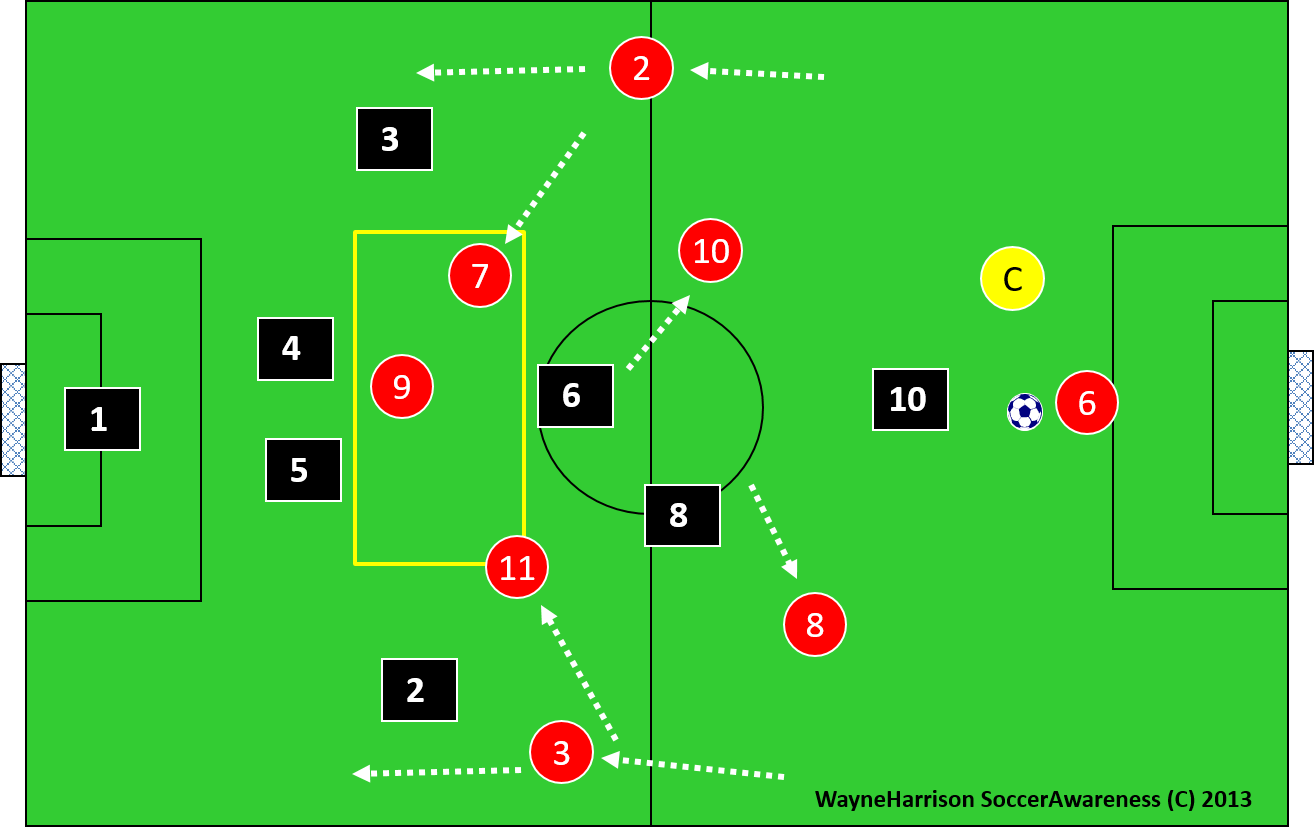
Defenders (2) and (3) are distracted by the runs of the attacking (2) and (3). Now (7) and (11) overload the central área in front of the two center backs. This is the área we must attack now.
Attacking wingbacks cut inside

Defenders (2) and (3) are distracted by the runs of the attacking (7) and (1). Now (2) and (3) overload the central área in front of the two center backs. This is the área we must attack now, this is a less predictable movement by the attacking team.
Movement OFF the shoulder of defender (4)

Striker (9) moves off the shoulder of defender (4) in the build up to get free for a pass into the open channel from (3).
Attacking wingback (2) cuts inside to score

(9) Drags defender (4) short thinking he is receiving to feet and (2) exploits the space left in behind defender (4). This kind of move is a rarity because not many teams teach wingbacks to get into central shooting areas like this.
Get the rest of this session and more like it in Soccer Awareness eBook 31: Developing the Four Phases of the Game

Quick Transition Directional Play Promoting Passing and Movement Off the Ball
This session improves quick decision making, tight control because the spaces are small to play in, and thinking in advance due to the switch in direction of the play. You can also work on the defending players.
The following session is an excerpt from “Soccer Awareness Coaching Curriculums presented by Game Sizes: 4 v 4, 7 v 7, 9 v 9 through to 11 v 11”
This eBook covers up to 14 weeks of training for each game size presented as one session per week. All sessions have small sided games scrimmage set ups as close as we can get it to finish to reflect the theme of the session
As the program moves from 4 v 4 through to 11 v 11 the focus changes from individual teachings at 4 v 4, to small sided situations at 7 v 7, to Phases of play and tactical needs at 9 v 9; through to team tactical development at 11 v 11. 11 v 11 focuses on advanced training ideas to teach the “team”.
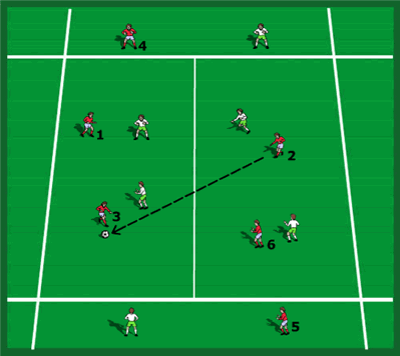
Quick continuous attacking play which is good for anaerobic fitness. Here the players are breaking one way passing to an outside player and switching positions, inside player out, outside player in then attack the other side of the zone.
Coaching Points:
Technical ability on the ball in 1 v 1 situations.
Quick Transition in attack - As the transition between players happens for example (3) changes with (5), the numbers team must get the ball to (4) as quickly as possible.
Observe the movement of (1), (2) and (6) in terms of their support positions as the directional change takes place, they must move in anticipation to find space to help the player on the ball as the switch occurs.
Observe also, as the change occurs, the positions of the defending team; has the decision been made quickly enough who presses the ball. Are the other defensive players supporting and covering and especially tracking runners off the ball. The coach must learn to look away from the ball and observe what may happen next before it happens.
This session improves quick decision making, tight control because the spaces are small to play in, and thinking in advance due to the switch in direction of the play. You can also work on the defending players.

Here (3) passes to (5) and (3) leaves the area. As the ball is traveling to (5), (1), (2) and (6) must get into a position to help (5) as early as possible so in theory, (5) can make a one touch pass to any or all of them. Thus (5) already has three options of a pass.
Their movement is OFF THE BALL and away from their markers.
Of course the defenders will move to compensate but for the sake of what I am trying to show it is easier to get the point across by showing the movements of the attacking team only.
The attacking players in the actual practice may get free like this anyway if they time it correctly.

The attacking players each being free to help (5) by being open for a pass.
(5) May elect to run with the ball but at least three are three options available for a pass if needed.
(5) May even elect to play a long pass straight to (4) on the other side of the field if the pressure from the closest defender is not fast enough. You may then ask the closest player (in this case player 2), not necessarily the passing player (5) to be the switching player instead if (5) passes it directly to (4).
You could even then work on defending in this game though focus on defending totally in the session or attacking totally in the session it is better not to try to do both as it can be confusing for the players.
Progression:
If a player beats an opponent in a 1 v 1 situation the team gets an extra point or goal each time.
Play one and two touch; reward each successful one touch pass with a goal to encourage the players to play quickly.
Competitive: Ensure you keep the score and have a finishing score to achieve as this keeps the players focused and motivated to win.


Academy Level: A Fun Awareness Warm-up for Improving Peripheral Vision
Use this warm up to work on awareness of where other players are (in this case all the other players are defenders trying to win possession of your ball) whilst maintaining possession of the ball ensuring players are looking around away from their own ball.
The following comes from the Soccer Awareness 12 Week Academy Level Training Plan!
Do you want to get to the next level in your team's soccer development? If so check out this specialized coaching and training program by our Founder, Wayne Harrison, is designed to cover: Technique; Skill; Physical; Tactical and Psychological / Mental Developmental Training.
Each player has a ball to play with. They must protect their own soccer ball but at the same time try to kick someone else’s ball out the area. When your ball is kicked out you cannot kick anyone else’s ball out. You can vary the game by allowing them chances, maybe up to three each before they are ultimately out of the game. When they are out have them juggle the ball to keep practicing skills.

Play until the last player is left with their own ball still and everyone else’s ball has been kicked out. This player is the winner. Variations can be you have three areas of play they can work in. They start in one then if they are kicked out they go to the next and so on, this way they get two chances but also you can have two winners in each group with an overall winner at the end. Or you can just decrease the area they are playing in to make it harder as there is less space to work in.
Coaching Points:
- Skills practice including Dribbling and Turning,
- Shielding,
- Tackling,
- Awareness of where other players are (in this case all the other players are defenders trying to win possession of your ball) whilst maintaining possession of the ball ensuring players are looking around away from their own ball,
- Anaerobic Fitness work. These are practices that are fun but ensure relevant skills are practiced by the players.
This is a session that is fun but ensures relevant skills are practiced by the players.
Kick Out Game
There are 12 players in this session, 9 with a ball, 3 without. The 3 without have to try and win a ball off a player with a ball and kick it out the area. If a player has their soccer ball kicked out then they can join in with the other players helping them keep possession by passing and support play.

To make this competitive rotate the players so different groups of 4 work together, time each group to see who does the best.
To decrease the time it takes if the defenders can win a ball and pass it to the coach (who is constantly moving around outside the area) for example 3 times out of the 9 balls won, then the clock stops. This represents winning the ball and keeping possession in a game rather than kicking it out of play and losing possession again in a game. It may be the first 3 balls the defenders win.
Then have it where they need to get all the balls to the coach, a bigger more relevant challenge and have the coach moving around the area.
The session develops from an individual 1 v 1 attacking / defending work out to a passing and support situation. You can work on the defenders by encouraging them to work as a team, maybe in 2’s for instance to have a better chance of winning the soccer balls. The defenders can pass the ball around between themselves until one can find the coach with a pass. Attackers during this time can try to win it back before it goes out the area.


Competitive Directional Three Team Awareness Game Introducing Goals As Targets
Here is an interesting way to work on awareness training and passing, movement off the ball, fitness and looking for the penetrating pass. Add triangular goals to score through, this means the game continues after a goal is scored as the ball must be received and possession maintained by another player on the other side of the triangle to count as a goal. This ensures continuous play.

The following post if an excerpt from the One Touch Training Section in the Soccer Awareness Training Center. Soccer Awareness Training Center provides unlimited access to Wayne Harrison's Soccer Awareness systems, training sessions, drills and more. Wayne's system helps develop world class youth soccer players and teams in a systematic and imaginative manner that guarantees performance at the highest level of competition. Whether you’re a beginning coach who needs help getting started or someone who wants to add some variety to their training sessions, the Soccer Awareness Training Center offers a wide variety of drills to choose from. Join Today
- Here is an interesting way to work on awareness training and passing, movement off the ball, fitness and looking for the penetrating pass. Add triangular goals to score through, this means the game continues after a goal is scored as the ball must be received and possession maintained by another player on the other side of the triangle to count as a goal. This ensures continuous play.
- It is a more directional method of playing and more specific to the game in general. The defenders are NOT allowed inside the triangle so they must be constantly working their way around the triangle trying to cut off the penetrating passes.
- Team (3) defends teams (1) and (2) work together. The combined attacking teams can attack both goals alternatively. Attacking both goals encourages “Switching the Field”.
- Ultimately reduce the game to two equal number teams for the greatest challenge and begin with as many touches as possible reducing the number of touches each is allowed as they improve and are able to keep possession effectively. Reducing the number of touches allowed inevitably increases their awareness and forces them to look for options earlier and improves and speeds up their decision making. This should result in them keeping possession more effectively.

Measuring / Assessing Performance
When training; as a method of self-assessment or measurement (or as close as one can get without an entirely objective process); I like to ask players to count; just for themselves; how many times they each give the ball away in a given timed period. I ask them to add them up to a final number and then think about what happened in each situation and if there was a certain aspect of their play that was causing them to give the ball away.
Hence whilst they are working on playing as a team player they are also at the same time focusing on themselves as individual players and assessing their own efficiency.
Therefore, they had to think about what the reasons were for giving possession of the ball away and if one stood out then that would be the most likely skill they needed to work on to become a better player, and thus not give possession way to the same extent, as they develop more as a player.
Examples could be:
- Poor footwork, the feet are not ready to receive the ball (a very common one, perhaps the most common one), so they are getting it wrong even before they touch the ball and this leads on to a poor first touch.
- Next perhaps then a poor first touch (that perhaps was caused by the poor footwork in the first place), or
- Not looking before receiving and knowing options in advance of the ball and thus getting caught in possession unnecessarily (this is in the mind, not thinking quickly enough), because they did not see the defender coming in to close them down or did not see their next options quickly enough, or
- Poor body position (closed stance) so their directional options for the next decision are limited (they may still maintain possession by going back to the player whom they face but they will miss out on better options if they opened their stance up and looked).
- For players off the ball to help the player receiving the pass it needed good communication from them (but I told the player receiving to not expect this often and that they needed to rely on their own awareness by looking for themselves, this is a fact of life with soccer and communication because players do not talk enough to help each other)
- They also needed to make movement into space to help the player receiving the ball to thus aid their next decision.
So a two-way support mechanism; the player receiving scans the options themselves, as the ball is arriving; players off the ball move to; create several options preferably for the player receiving; for his or her next pass or phase of play.
Reward System
Having done this, I then encourage their quick thinking using one touch play by asking them to add up the number of times they made a successful one touch pass during the time period, and that they could then deduct a mistake or giveaway from their score. This was a form of a rewards system I use.
Use this with free play, as many touches as they like and one touch reward, or three touches and a one touch reward, then two touches and a one touch reward (the most difficult of these). I call this lose a life and gain a life (or you can call it positive or negative point scores if you like); as they add up their score in their heads as they proceed.
It was important they did not get obsessed with passing one touch just to get one life (or point) back as not every situation warrants or needs a one touch pass and they may lose a life because of it, making a bad decision. Of course this is not an entirely objective measurement but it can be an indicator to them of the things they are good at and the things they need to improve upon.
If players mentally focus and use this idea they can identify for themselves their strengths and weaknesses and therefore have a somewhat objective idea of what they need to work on to improve themselves. You can apply this method of self-assessment to many game set ups and situations in training.
Age Related
For younger players meaning 6 to 9 year olds in general terms; it is best to introduce these ideas in a non-pressurized situation, where they are likely to give up the ball at times without pressure anyway; and you can analyze this with them.
Without pressure means the focus could be on foot work as much as anything which is the best place to start to help them; as many of the reasons the ball is given up in this is due to excessive pressure. No pressure narrows the field of possibility for error.
Choosing Options
Guard against them just passing the easy pass for the sake of, challenge them to really look to see all the options and try to choose the one that hurts the opponents’ the most, there may be a simple 4-yard pass that won’t affect the defenders, but there may be a one touch switching play pass to the other side of the field that will hurt them more, as we have a free player there and the change in play will be more effective than the easy pass.
You the coach can observe players and see those who attempt to take the right choices (being the most difficult sometimes but if successful causing the most damage to the opponents).
You may get a player, who takes every easy option and gets a good score, and never takes chances, well he or she is good for maintaining possession of the ball (and that is good in itself) but won’t unlock the door for the team with a telling but perhaps risky decision; as they didn’t test themselves, this is where your observation will come into the equation.
It can be a balancing act between making the right choice (perhaps a more difficult one), making the easy choice; and mixing them up, as sometimes only the easy pass is on anyway.
This is why it is not a totally objective process, it can’t be in such a dynamic game as this, but also where the subjectivity of the coach’s experience comes into play when assessing players with this system in mind.
Playing Percentages and Performing in Safety and Risk Areas
You can also apply logic to the decision made by players when you look at the safety and risk areas that players are in. You would encourage the easy option in the defending third of the field; as if the ball is lost there through a risky play then the opponents may score.
You would encourage the riskier but potentially damaging option against the opponents in the attacking third of the field because if possession is lost there then we can still recover the ball quickly and not be too open to a damaging attack against us.
But if it is successful this riskier option may lead to a goal that the easy option might not have. Yes, it would be a higher percentage chance of keeping possession with the easy option, but the rewards are greater if using the lower percentage option.
Example: In the attacking third we have two options; an easy pass that has a 9 out of 10 (90%) chance of success but it doesn’t penetrate the opponents defense, or a difficult pass between defenders that penetrates and puts the striker in a position to score but has a maybe 3 out of ten (30%) chance of being successful because of the limited space to pass it into and the number of defenders between the passing player and the striker receiving your pass. Which does the player take? Fear of failure would suggest the easy one, taking the chance would be the difficult one; but it may result in a goal. The player has to decide was the difficult option the best one to take? Maybe it was the best option at that moment even though its percentage of success was low.
Hence the higher percentage option with the most chance of maintaining possession is not necessarily the best option to take; it can depend on the individual situation at any given moment in time; and also on which part of the field it is happening.
The better the player, the more often they will make the right decision, using both the easy and more difficult options that present themselves all the time in the game.
Conditioning Games in Training
Free Play, Two Touches and One Touch Play
Conditioning the game situation in training can help identify what players are good at in these continuums. Playing a game with each player able to have an unlimited number of touches allows them to “get out of jail” as I call it, meaning get out of trouble and keep possession; even if their decision was not the best option to take at that particular moment. As an example; perhaps they did not look early to scan their options as the ball was coming to them (as in the best continuums) so they missed the opportunity for the one touch pass (which at that moment was the best option available) but their dribbling skills allowed them to still maintain possession of the ball.
Making the game a two touch maximum each time they receive the ball starts to focus their minds in quick thinking and quick decisions thereof; and does not allow them to get out of trouble (get out of jail should their decision making be poor) with lots of touches.
Rotating between games of two touches and free play all in (as many touches as they like); but including the one touch successful pass option in both; is a good way to focus their minds on the job in hand and understand the options they have available to be successful.
Players could for example be minus 6 meaning they are more successful, or positive 6 meaning they gave the ball away more; as they add one when they give it away and take one away when they perform the reward theme successfully.
Examples of good games to play for this are such as:
Three Team Possession Game: Three teams, two teams work together, one defends, creates an overload situation in attack, for example 15 players, three teams of 5, a 10 v 5 game. Possession changes as one of the two team’s players gives the ball away to the defending team then they become the next defending team this is a good transition game also from attack to defense and defense to attack. This game can be in an area of 40 x 40 yards for example and the challenge to the players can also be to move inside to outside (outside being just inside the touchline) and outside to inside to ensure they avoid standing in one area. Plus, it takes greater vision or awareness inside the area; where they need to look around and open their stance up to potentially change the direction of play; than on the outside where they can see everything easily.
Encourage players who play centrally on the team to get in the middle of the area and dictate the play, be the pivot for the team, the player who transfers the ball from one side to the other, the link player, this can be one, two or even three players at a time, but they can rotate between themselves too.
Equal numbered teams in a possession keep away game: this would be the next progression from the overload game being a more difficult challenge of the players. Same principles and ideas as above apply.
Transition games: In two halves, creating overloads in each half as each team gains possession. Team A have to get the ball in one half and play a 7 v 3 for example, team B have to win it back with the 3 defenders and get it back to the other half and have a 7 v 3 in their favor, and so on.
Themes of Play
You can work on different THEMES in these possession games based on how you reward the players; for example, each of the situations below constitutes a different reward mechanism to adhere to:
Quick thinking / Quick Passing: One touch successful passing; this improves quick thinking, early identification of options, in advance of the ball, quick passing.
Switching the Play or point of attack: Playing in thirds and being able to pass from one outside third to the other outside third successfully across the middle third can create a switching the play reward.
Defending 1 v 1: For a defending team, the individual winning possession and keeping it can be a reward, so they get a life / point for that.
Success in a 1 v 1 dribbling situation, beating a player with a dribble and maintaining possession. You can use this in free play all in games where players have unlimited touches each time they receive the ball.
Several themes in one can also be used; just playing the game or scrimmage you can incorporate all of these into the equation and ask the players to process in their minds all the ideas as to where they go right and where they need to improve.

Awareness “Look, Think and Decide” Challenges with Players in 2s and 3s
These simple ideas are designed to get (forces) players to look away from the ball but at the same time be able to control and pass the ball accurately when it comes. It can be 1 touch or 2 touches. This prevents them from just being focused on the ball as it is arriving and therefore not being aware of their immediate options.
You can do this as a nice warm up to get the players minds working.
These simple ideas are designed to get (forces) players to look away from the ball but at the same time be able to control and pass the ball accurately when it comes. It can be 1 touch or 2 touches. This prevents them from just being focused on the ball as it is arriving and therefore not being aware of their immediate options.
Its all mental training and if you do it quickly then the players have to be constantly looking and thinking BEFORE receiving the ball and making successful decisions and accurate passes. Players are required to look AWAY from the ball to see the signal and then make a decision. They can often see the ball in their Peripheral vision anyway as they look away from it.
Increase the challenges as you see fit, reducing the number of touches, by reducing the amount of space between players. Even ask the signaling player to make the signal as late as possible but still giving the players split second time and a chance to see, decide and perform the correct action before receiving the ball.
Try to get a good rhythm going with the signaling and decision making and passing and moving; so we have constant play with no interruptions and the thinking process is constantly tested.
Awareness Challenges with Players in 2s
(C) Offers 4 challenges: right hand up, left hand up, no hands up, and both hands up.
Players must look away from the ball to see what decision (C) has made and then call out what (C) has done. At the same time one touch passing accuracy should be maintained. You can introduce 2 touch passing with certain footwork challenges also. Start at a distance and reduce it, say 10 years apart to start. This is a very easy introduction to the look; think and decide.

Once they get good at this decrease the distance between the two players so less time to think and anticipate and decision make. Now maybe 5 yards apart. Rotate the players so everyone is involved in the thinking processes developed. Make it competitive and each player counts how many times they made the wrong decision and hence the wrong pass; perhaps because they forgot to look away from the ball in the first place and just focused on the ball as happens VERY often in the game itself.
Awareness Challenges with Players in 3s
(C) Offers 4 challenges: right hand up, left hand up, no hands up, and both hands up. (A) Point right, moves left. (C) turn left; in the hand direction and passes right). (A) moves to the left cone to receive the pass.
Now (C) must receive the ball and work between the two players (A) and (B). Before (C) receives the pass off (B), (C) must look “behind” to see what (A) is signaling. Same ideas; right hand up, left hand up, both hands up (pass back), no hands up (Receive and Turn). If the right hand is up then (C) receives and turns to the right and passes to the left, so the turn is in the direction of the hand; but diagonally opposite with the pass. Here (A) holds the right hand up and moves left.

(A) Brings the ball back with one touch to the middle cone and we start again.
Now (B) must decide where (C) plays the ball by performing the hand signals. Both hands up and (C) must pass the ball back to (A), no hands up (C) must receive and turn and pass to the middle cone to (B). Here (B) has both hands up so must pass back to (A) at the middle cone.

Make it two touches but the middle player now must move side to side and turn their body to receive the ball going the opposite way.
Here (C) comes off at an angle to (A) and (B) getting side-on to have better peripheral vision. As (C ) is moving he or she must be looking at (B) to see what signal they have made to then decide what pass they make. (B) obviously put up the left hand so moves to the right. (C) receives and turns to the outside or left and passes to (B)s left.

As in the 2s idea have it competitive and players count how many decisions they got wrong to test against themselves and also against each other.
(B)'s first touch is back to the middle cone and 2nd touch is a pass to (C) who has switched positions in the mean time. As all this is happening (A) has signaled with NO hands up so (C) must receive and turn and pass to (A) at the middle cone as shown. Now (C) can turn inside or outside. Next, (A) waits until (C) is in position on the other side to then pass the ball.

54 Pages
We want to stay with our own game plan as closely as possible; based on what we practice and to keep it simple for us; as we dictate to our opponents; and we impose OUR WAY on them.
But there will be many occasions where we must change the system of play and we may have to adjust to suit the opponents.
Here are some ideas for you to consider for your team starting with the 13313 and 14231 systems of play.