Welcome to the Soccer Awareness Coaches Corner. Browse through soccer drills, small sided games, tactical thoughts, full sessions and a variety of resources. Posts marked “Training Center Exclusive” are for members only.

The Three Zone Directional Game - Training Center Exclusive
This game is based on possessing the ball and the movement off it.
We have several progressions we can use to challenge the players these include:
A simple Warm up to get the idea going
Playing through the thirds with targets
Playing through the thirds without targets
Players must stay in their own thirds so we have 3 combination games going at once
We can add free players therefore creating overload situations
More!
*Membership Required
This game is based on possessing the ball and the movement off it.
We have several progressions we can use to challenge the players these include:
A simple Warm up to get the idea going
Playing through the thirds with targets
Playing through the thirds without targets
Players must stay in their own thirds so we have 3 combination games going at once (e.g. 3 v 3, 2 v 2 and 3 v 3 per zone or whatever numbers of players you have).
We can add free players therefore creating overload situations to make it easier for success competitively and to build confidence initially.
No free players to increase the pressure and the challenge.
Players can rotate between zones now. This is more game related in what we want to teach with players have freedom to interchange as long as they are covered by a team mate.
Add a condition to help improve / focus on body position and footwork: If a player faces backwards when receiving the ball they MUST pass that ball backwards and with only one touch allowed.
Man for man marking; 1 v 1s all over the field and in all three zones. Players in possession can rotate and move around their immediate marker has to follow them.
Touch restriction: Unlimited, then 3 then 2 then 1 touch if on to do so.
All through remind players that they MUST scan the field, must check their shoulders for options; to the side or behind them and not just see in front of them.
Use the yes and no check system to highlight for each player if they looked AWAY from the ball before receiving it.
Can play a longer pass from one end zone to another and missing out the middle third if that’s the best option.
Remember Xavi: In 90 Minutes looked AWAY from the ball 841 times. Amazing.
Joke about only needing half a touch to emphasize the importance of this mental skill.
Add goals at each end include keepers (who should have been in the game anyway for their footwork skills) and make it a game situation whatever the numbers are.
3 Zone Game: Playing Through the Thirds with Targets

4 ball warm up. Three zones, 3 v 3, 2 v 2 and 3 v 3.Players are passing and maintaining possession. Condition it to 1 or 2 touches on the ball to challenge the players. Players stay in their own zones initially. Play to the targets.
3 Zone Game: Playing Through the Thirds Without Targets

4 ball warm up. Three zones, 3 v 3, 2 v 2 and 3 v 3.Players are passing and maintaining possession. Condition it to 1 or 2 touches on the ball to challenge the players. Players stay in their own zones initially.
3 Zone Game: Playing Through the Thirds

Each end zone can be a defensive third or attacking third zone depending on where the ball is. Here for example (G) passes out of the defensive third to the middle third to (C) to the attacking third to (B). Now going the other way the end zones are reversed.
3 Zone Game: Making it Competitive

Now we have three zones each with their own combination play battles. 3 v 3, 2 v 2 and 3 v 3 but add two or three free players to help the game flow initially.
3 Zone Game: Making it Competitive with Targets

Now we have three zones each with their own combination play battles. 3 v 3, 2 v 2 and 3 v 3 but add two or three free players to help the game flow initially. Blues play to the blue target and reds to the red target, each team can use the other target as support. You can keep possession and work the ball back through the middle to the defending third after you reach your own target as the game is about maintaining possession and movement off the ball. You can rotate the targets the passer becoming the new target.
3 Zone Game: Making it Competitive: Stay in Own Zones

Only the free players can move between zones so they create overload situations in each zone, could be a 4 v 3 or a 5 v 3 for example.
3 Zone Game: Making it Competitive: Create Overloads

Only the free players can move between zones so they create overload situations in each zone, could be a 4 v 3 or a 5 v 3 for example. Here we have a 4v3, 3v2 and a 4v3.

Only the free players can move between zones here two move to the middle to create a 4 v 2 overload. Looking to move the ball from one end to the other so its a directional game similar to the actual game itself. Whoever is in possession must work to find the best open spaces in advance of the ball.
3 Zone Game: Making it Competitive: Rotation Between Zones

Now all players can move between the 3 zones but we want to maintain the balance in each. So one player moves from the defending third to the middle third a middle third player must move to the defending third. So within our set framework players can interchange positions and also cover for each other and again emulating the actual game situation we want to teach with players having the freedom to change positions and move around the field. Defenders can track them or not.
3 Zone Game: Making it Competitive: Rotation Between Zones and Man for Man Marking

Now we match up players to play 1 v 1 against each other within the game situation. Now all players can move between the 3 zones. The team in possession dictates the movements off the ball, the team without possession have to track their immediate opponents. If they are heavily marked the free players become a greater source of support.
3 Zone Game: Making it Competitive: Conditioning to Encourage Correct Footwork and Body Position

Now if a player receives the ball facing fully backwards they can only play 1 touch and it has to be a pass backwards also. (1) is marked by (C) and has their back to the way we want to go so must pass back, here to (3).


3 Zone Game: Making it Competitive: Conditioning to Encourage Correct Footwork and Body Position

Due to the condition players should begin to think about preparing their bodies to receive and be able to play and SEE forward. And therefore increase their immediate options. (1) here opens up their body position, is light on their feet; and is facing either sideways or forwards but is now in a position to pass forward and not use their body position and feet preparationto narrow down their options.
3 Zone Game: Making it Competitive with Equal Numbers for a more Pressurized Game

Now no free players so the game is much more competitive. Only move to this when you know you can have success. Here we show the players in possession, the blue team moving OFF the ball into new spaces to get free to receive. Players in the other grids are already on the move but must time it right and not do it too early or too late.
3 Zone Game: Making it Competitive Playing from the Defensive Third Directly to the Attacking Third

There is nothing wrong with a good quality long ball if that's the best option at that particular moment. (8) can play it into open space with the right weight and accuracy to move (1) to meet it.
3 Zone Game: Making it Competitive with Equal Numbers for a More Pressurized Game: What not to do

This will happen so check it if it does and address the problem. Players stand still and wait at the edge of their zone for the ball to come. They have no space to work in and are easily marked by the defenders. This isn’t game realistic at all but it will occur due to the set up and them waiting for the ball to transfer from the defending to middle thirds.
3 Zone Game: Making it Competitive with Equal Numbers for a More Pressurized Game: Restrict the Number of Touches on the Ball

Can be with man marking or without. Now we arrive at the moment we want to happen on the field where awareness training kicks in, players scan the field for options IN ADVANCE of the ball. Everything we have practiced up to this point should include a constant reminder of LOOKING AWAY from the ball. So go free and unlimited touches first, and build to 3 to 2 to 1 touch if its on to do so. At 1 touch add free players to help it work if needed.


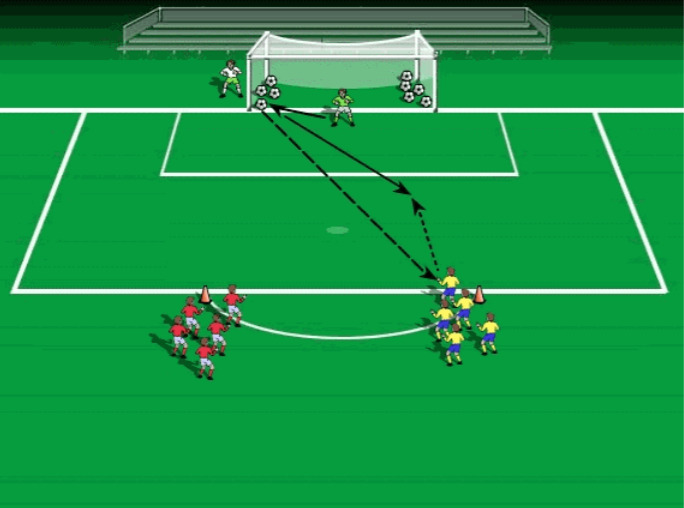


Developing Attacking Play in the Opponents Defending Third
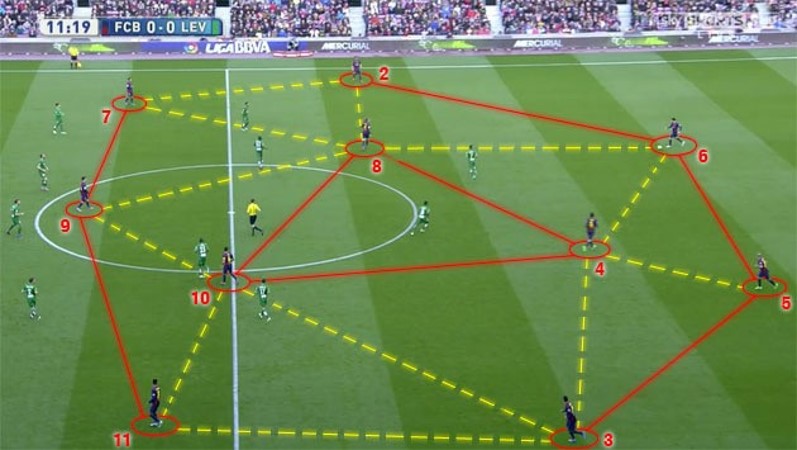
The attacking team has the ball. This is the start position of the game situation.
The idea is to have this phase, being the attacking one, and working on various ideas of movement, rotation and interchange to try to score.
You can focus on this until success is achieved from an attacking point of view.

The following is the beginning of Soccer Awareness eBook 31: Developing the Four Phases of the Game.
The game is really all about 4 Phases of Play. It can be divided up further into sub phases but the essence of the game are these 4. This eBook is what one of my main training sessions is based on. We actually train very often with this precise game situational model as it totally mirrors what I expect my team to do in the actual games. In doing so, we practice the same ideas over and over until they become AUTOMATIC when it matters.
The attacking team has the ball. This is the start position of the game situation.
The idea is to have this phase, being the attacking one, and working on various ideas of movement, rotation and interchange to try to score.
You can focus on this until success is achieved from an attacking point of view.
The starting point of the session: attacking team shape in a “Phase of Play”

Starting position of the attacking team. We can begin with an overload to get things moving positively in an attacking sense by not including (7) and (11) on the defending team. 16 players.
Attacking team shape in a Phase of Play: Using the full width of the field

To begin, our advantage is in wide areas where we have 2 v 1s on each side of the field. Draw defending fullbacks a Little wider in the process.
Wide attackers (7) and (11) cut inside to attack the inside áreas of the field


(7) And (11) cut inside to support (9) and draw defenders in to créate space wide for (2) and (3) to attack in.
(8) and (10) pull away from their markers to get free. Here we must attack through the wide areas of the field.
Defending fullbacks stay wide

Defenders (2) and (3) are distracted by the runs of the attacking (2) and (3). Now (7) and (11) overload the central área in front of the two center backs. This is the área we must attack now.
Attacking wingbacks cut inside

Defenders (2) and (3) are distracted by the runs of the attacking (7) and (1). Now (2) and (3) overload the central área in front of the two center backs. This is the área we must attack now, this is a less predictable movement by the attacking team.
Movement OFF the shoulder of defender (4)

Striker (9) moves off the shoulder of defender (4) in the build up to get free for a pass into the open channel from (3).
Attacking wingback (2) cuts inside to score

(9) Drags defender (4) short thinking he is receiving to feet and (2) exploits the space left in behind defender (4). This kind of move is a rarity because not many teams teach wingbacks to get into central shooting areas like this.
Get the rest of this session and more like it in Soccer Awareness eBook 31: Developing the Four Phases of the Game

A “Comfort Zone” Developing Width in Play in a 9 v 9
Objective: To Encourage Players To Use Width And Offer An Area To Play Without Pressure
The following is part of Soccer Awareness eBook: Tactical Thoughts on the Development of the New 4 v 4, 7 v 7 and 9 v 9 Game Sizes.
This eBook shows how these different size games can be taught and also shows different systems of play that might be useful to you.
The idea I am trying to cultivate is to find a pattern of development that goes from 4 v 4 to 7 v 7 all the way through 9 v 9 to 11 v 11 that educates the players VERY EARLY on how to ultimately play the 11 v 11, a common thread running right through the book. Click Here to Buy the Book
OBJECTIVE: TO ENCOURAGE PLAYERS TO USE WIDTH AND OFFER AN AREA TO PLAY WITHOUT PRESSURE
Theme: Developing Width in attack
A perfect Introduction to this idea so players are free to receive in wide areas. If a player breaks wide into the outside channel on either side of the field and is in possession of the ball this player cannot be tackled. Defenders are not allowed into the channel.
The players on the team in possession of the ball can run the ball into the channel or have it passed to them into the channel. Allow only 4 seconds in the free wide area.
This condition plants the seed in the mind of the players to immediately play with width when in possession. Numbers for this game can be 4 v 4 and upwards. Our offensive team shape to begin. Four players give us width in attack.
Develop: The wide areas can be used to practice certain moves the players have been taught, especially at the younger ages where they need to be able to practice them without pressure. This allows for them playing in a game but also doing the move without pressure.
Coaching Points:
Create space wide when in possession of the ball
Building play from the back
Using width to attack
Developing Overlap runs
Development of the Theme
Build the theme up very simply to ensure immediate understanding and success.
No opposition at first so 9 v 0.
Small numbers (e.g. 9 v 3): Passive opposition (jockey the player only)
Small numbers (e.g. 9 v 5): Passive opposition (Can only Intercept the passes not tackle
9 v 9 but again passive opposition
9 v 9 full game with wide FREE ZONES for the team you are training.
When you feel the players are ready have a full blown 9 v 9 game and have it for both teams at the same time going both ways.
Ensure all players on your roster are involved in the attacking team theme development initially so everyone benefits and understands what you are teaching and why you are teaching it.
To Encourage players to use width and play without pressure

This is the basic set up of the attacking shape of a 9 v 9 in the 3-3-1-1 formation. Emphasis is on the theme of exploiting the wide areas of the field by setting the free zone “Condition.”
A Small number of defenders added

Bring a small number of defenders in as passive opposition who can only Intercept not tackle. So we have here a 9 v 5 set up.
Get the rest of this session and more in the Soccer Awareness eBook: Tactical Thoughts on the Development of the New 4 v 4, 7 v 7 and 9 v 9 Game


Small Sided 4 v 4 Defending Games
One way to teach the basic tactical game of the 4 v 4 is to offer many different ideas on actual game situation that focus on certain themes. This is what the following presentations does. You cannot do better than put players into game situations to learn the game, we just take it one stage further by what we present here. We begin by teaching defending principles in a 4 v 4 game situation so several thoughts on different set ups to teach it individually and collectively as team players.
The following drill is part of Soccer Awareness eBook: Tactical Thoughts on the Development of the New 4 v 4, 7 v 7 and 9 v 9 Game Sizes.
This 407 page eBook shows how these different size games can be taught and also shows different systems of play that might be useful to you.
Run with them as you may and of course come up with your own solutions too as that is what coaching is all about. I have introduced the use of RONDOS to initially aid the development of players for the game situation. Click Here to Preview The Book
The USSF now have made it mandatory for 4 v 4 games to be played at the younger ages. This is a GREAT MOVE and long overdue.
This is what US Youth Soccer states:
Here are some of the reasons why we believe, as soccer coaches, administrators and parents must guarantee that our young soccer players play small-sided games:

Because we want our young soccer players to touch the soccer ball more often and become more skillful with it! (Individual technical development)
Because we want our young soccer players to make more, less-complicated decisions during the game! (Tactical development)
Because we want our young soccer players to be more physically efficient in the field space they are playing in! (Reduced field size)
Because we want our young soccer players to have more individual teaching time with the coach! Fewer players on the field and fewer players on the team will guarantee this! (Need to feel worthy and need to feel important)
Because we want our young soccer players to have more, involved playing time in the game! (More opportunity to solve problems that only the game presents)
Because we want our young soccer players to have more opportunity to play on both sides of the ball! (More exposure to attacking and defending situations)
Because we want our young soccer players to have more opportunities to score goals! (Pure excitement)
Because we want to include children of all temperaments, assertive to shy, to have more opportunities to interact with others and the game! (Socialization)
These are the reasons why we adults must foster "Small-Sided Games" in our youth soccer programs. The "Small-Sided" environment is a developmentally appropriate environment for our young soccer players. It’s a FUN environment that focuses on the young soccer player.
All makes total common sense.
One way to teach the basic tactical game of the 4 v 4 is to offer many different ideas on actual game situation that focus on certain themes. This is what the following presentations do.
You cannot do better than put players into game situations to learn the game, we just take it one stage further by what we present here.
We begin by teaching defending principles in a 4 v 4 game situation so several thoughts on different set ups to teach it individually and collectively as team players.
4 v 4 a Basic Diamond Shape for Defending
The main idea here is for the defending team to condense the area the ball can be played into the defending team become a diamond within the opponents attacking diamond. (4) Forces (A) one way and the rest of the team adjust their positions off this. (3) Protects the space inside but can close down (C) if the ball is passed, (2) and (1) is the same scenario and this results in the diamond being shorter and tighter.
As the opponents move the defending team must move to compensate. Also if any pass is played behind (1), (2) or (3) they should be first to the ball.

Coaching Points:
Pressure – 1 v 1 defending to win the ball, delay or force a bad pass.
Support – position of immediate teammate (angle, distance and communication).
Cover – positions of teammates beyond the supporting player.
Recovering and Tracking should the ball go past our position, recovery run to goal side of the ball and tracking the run of a player.
Double-Teaming – (A) passes to (C), (3) closes (C) down from in front, (4) follows along the path of the ball to close down from behind or slightly to the side. (4) Closes in such a way as to obstruct a bass back to (A).
Regaining Possession and creating Compactness from the back (pushing up as a unit).
The objectives of defending are to disrupt the other teams build up, make play predictable, prevent forward passes and ultimately regain possession of the ball.
Techniques include – pressuring, marking, tackling and winning the ball.
Get more like this including Small Sided 4 v 4 Attacking Games, Patterns of Play at 7 v 7, Team Shape Development in 9 v 9 and lots more in Soccer Awareness eBook: Tactical Thoughts on the Development of the New 4 v 4, 7 v 7 and 9 v 9 Game Sizes.

Developing Play with a Defending Back Four
The session is designed to show how to work on team shape building up from a back four only. Side cones are 25 to 30 yards apart as are the defenders and the coach. The coach moves with the ball and the defenders mirror the movement maintaining the distances between them.

- The session is designed to show how to work on team shape building up from a back four only. Side cones are 25 to 30 yards apart as are the defenders and the coach. The coach moves with the ball and the defenders mirror the movement maintaining the distances between them.
- You can use the signal words UP, OUT, HOLD, DROP, and SLIDE, to determine the movement. Eventually we need to work up to an 11 v 11 situation showing how to work a team as individuals, as units and ultimately a team.

- Here the coach moves to the outside and the whole back four adjust their positions across the field (slide) to compensate for this movement, (2) being the player to apply immediate pressure on the ball.
- Re-emphasize the idea that the players are tied as links in a chain and so have to move together as links of a unit or even tie them up so they feel how it is when they move together. Coach moves back up the field the back four condense up also based on the position of the ball.
Introduce Attacking Opponents

- Players with the ball pass it across in front of the defenders. Defenders adjust their positions to mirror this movement. This is working on marking zones and marking players and distinguishing between the two depending on where the ball is.
- Pass across to the next player and hold the ball there, check the defenders positions, then move the ball again.
- Use the side cones as guides to distancing between units as they are introduced.
- The ball has been passed inside and the defenders adjust closing down the player on the ball and closing down the spaces around the ball.
- This is continued using all the players sometimes missing a player out with a pass so it goes across two players to test the defenders and how they adjust. Once they have grasped this concept you can move the players to the next progression. In the next phase of the session have extra balls ready in the center circle to keep the flow of the session going.

- The coach now has players to pass the ball to (opponents).These players initially must be in static positions to check the set up. You can us a rope to tie the four defenders together to get the idea of moving as a unit. Players maintain an open stance so they can see opponents as well as the ball. When the ball is at (C) or (D) the back four take positions with regard to (A) and (B) and do not get drawn to the ball. Defending team can win back the ball only with interceptions of passes not with tackles to allow us to look at the shape they achieve.
- Here we see how the back four should look once the ball has been passed wide and defender (2) has closed the ball down.
- Notice the back four is NOT flat but like angled links between each player with the central defender (5) the deepest player. This player can effectively be called the sweeper. When the ball is at (B) on the other side, (4) becomes the sweeper.
- The second center back is the deepest player and the two center backs share this responsibility depending on which side of the field the ball is positioned.

The Conscious and Sub-Conscious Mind and Myelin Production in the Development of Soccer Players
The more you practice, the more you know how to do something better. However, if you believe, for even one second, that a habit cannot be undone, you are right! There is no way of undoing what you have learnt – so you might ask then, how do we get rid of a habit?
The answer is putting in more practice to learn something else than you did into learning the habit you are trying to undo. It's just that simple!
Every soccer player, like every human being, has two distinct parts of the mind whose primary role is thought and recollection: the conscious state and the sub-conscious state. As the names suggest, when you are completely aware of what you are doing, you are letting your conscious state guide you through the process.
On the other hand, when you react instinctively, or automatically even, your actions are being controlled by your sub-conscious mind. This isn't just true for football, by the way! Even when you are driving or cooking or swimming both these aspects come into the picture.
Our natural tendency is to think that we are how we think! We tend to define ourselves by our conscious mind or thoughts, which is not completely accurate. When it comes to making a decision after thinking about it, the conscious mind is the king. However, everything that we do, using our conscious mind, only helps create a belief system or habit for our sub-conscious mind.
What does that mean? It means that as we keep making a particular kind of decision, based on a particular kind of thought process, we convince our mind about our thinking patterns, which slowly becomes a habit for us.
To quote a simple example – say you are asked to pick your favorite color between Red & Green, and you choose Green. If this question is repeatedly asked to you, over and over again, there will come a point in time when you won't even need to think about the answer – you will just choose "Green" without blinking. It might even get to the point where you will speak out the answer even before the question is completed or earlier still.
Basically, what you are doing is training your mind to handle that situation in a way where you know exactly what you are going to do.
Being asked the same thing, over and over again, is just a way of reinforcing that idea into your sub-conscious mind. The decision, originally, was being made by the conscious segment of your mind. However, over time that role was slowly and gradually handed over to the sub-conscious mind, which made it instinctive.
That is the exact same reason why you can apply the brakes quickly, when the car in front of you suddenly comes to a halt. That is also why you know how to instantly use a spoon or even how to tie your shoe-laces.
MAKING HABITS
There is a gross misunderstanding about forming habits and breaking them. The general belief is that once a habit has been formed, it cannot be broken or is very hard to break. In actuality, it's all about chemicals in our brain!
When you do something, anything, you trigger chemical reactions that produce something called Myelin. This myelin forms a cover around your brain's neuron.
That is the beginning of the formation of a habit. Every time you do that same thing again, your brain adds another layer of myelin to the existing layer – which makes it thicker.
The thicker the myelin, the stronger the habit! The stronger the habit, the more instinctive you are! That means exactly what you already know –"practice makes perfect"! (Well, permanent more like.)
The more you practice, the more you know how to do something better. However, if you believe, for even one second, that a habit cannot be undone, you are right! There is no way of undoing what you have learnt – so you might ask then, how do we get rid of a habit?
The answer is putting in more practice to learn something else than you did into learning the habit you are trying to undo. It's just that simple!
HENCE WHY THE YOUNGER WE GET PLAYERS TO OUR TRAINING THE BETTER WITH FEWER BAD HABITS TO BREAK / CHANGE.
If you put in enough hours, more than what you have done before, you will put on more and more myelin on your neurons for a second habit and your second habit will become stronger, pushing the first behind in the pecking order.
Basically, your habits are instilled in your sub-conscious mind, allowing your body to respond to environmental triggers a particular kind of reaction, instinctively. Get the right kind of triggers for your mind and you will have the right kind of Myelin layers forming in the right place and the reaction becomes ANTICIPATION..
When you arrive at Barcelona the first thing they teach is LOOK and THINK; LOOK and THINK; LOOK and THINK.
When you see Xavi Hernandez of Barcelona threading an inch-perfect pass through 4-opposition players, finding a team-mate, commentators & fans call it vision.
However, what they don't realise is that the reason a player can pick out a pass like that is because they have practiced it, studied it, run through that same routine over and over and over again, in practice!
What is the purpose of a training session in soccer? It is to prepare for the team you are about to face over the weekend. You play the reserve line-up or break up your squad, and play one team like the opposition plays, and build your strategies by employing solutions to the problems they will pose.
You run those plays/situations over and over again; make your players watch videos, and constantly reinforce these ideas until your players are able to recognize and react instinctively.
So, when they face their opposition on the pitch, it's all about reacting instinctively and allowing the training to lead each individual through.
The game is so fast, it is almost impossible to stop the ball, look up and think about what you are going to do, assess your options and then make a decision. Instead, training helps your players understand patterns of play, patterns of runs and patterns of passes that they should make or expect. OUR Training focused almost conditions the LOOK and THINK.
What is the Look and Think?
The Continuums “Look and Think” Model of Development
Word Association combining thought and deed
“Look and Think” MUST come first before everything else; decisionmaking in advance of the ball.
- LOOK / OBSERVE / THINK (ALWAYS BEFORE receiving the ball; assessing all options in “Anticipation” not as a Reaction)
- SKILL: THE DECISION (How, why; when and where of Technique; plus its success or not; and why?)
- FOOT PREPARATION (flat footed, off balance?)
- BODY POSITION (open or closed?)
- COMMUNICATION (Verbal and visual)
- CONTROL (If not a one touch pass on, the 1sttouch control)
- TECHNIQUE (the pass, the run, the dribble, the turn, the shot; etc)
- TACTICAL MOBILITY (Movement off the ball, finding space; 90% of the game)
- MENTAL and PHYSICAL TRANSITION (Possession changes, Player tunes in immediately?)
Relating Word Association with Actions to identify the Strengths and Areas of Improvement needed in players. Focusing particularly on teaching a ONE TOUCH MENTALITY.
1. Most players will mentally prepare to make a decision AFTER receiving the ball; we teach them to mentally prepare to make decisions BEFORE they receive the ball. This saves them time and space and can be the difference between maintaining possession and losing the ball. As the game gets faster, so is the need for players to master this VITAL innate ability.
2. One Touch Development: We ask Players at our training to THINK with a “One Touch Mentality”, like every time the ball is coming to them they imagine they only have one touch to play the ball with.
This will literally FORCE them to LOOK around and THINK of their options before receiving the ball
On deciding the best option thru a “one touch thought process” It could result in a pass, a dribble, a receive and turn and run; a run with the ball, a one touch pass, a short pass, a long pass;, few touches, many touches on the ball as the next option; anything at all. The secret is they enabled themselves to save time and space; to play really “quickly”; or even playmore “slowly”; based on the “Tempo of the Game” needed at that moment.
3. In the Zone: Training your mind as well as your body
Being in the zone generally means being in a state in which your mind and body are working in harmony. You're calm yet energized, challenged yet confident, focused yet instinctive.
4. Mental training: Keep your focus
Training your mind is an important step toward getting in the zone. Aspects of mental training for sports include increasing concentration and focus, controlling emotions, trying to feel relaxed but energized, being calm and positive, and aiming to feel challenged and confident.
Soccer is played in the mind and preparing the mind for the game is an extremely scientific and sequential process.By breaking things down, sequentially arranging and explaining them, and through incredible amounts of repetition, you create a team that knows exactly what team-mates are up to and what they need to do next.
Hence why playing a specific system and STYLE of play consistently is so important. The sub-conscious mind is the most important weapon on the soccer pitch. It gives you the speed of thought you need to survive and excel. The more natural you are at reading a situation and picking up cues, the better you will be at soccer.
The more you train, the better you will be able to visualize everything and the better you can visualize, the more trained your subconscious mind will be. You will then be a step ahead of everyone else. You will hit those perfect passes or strike the top-corner nearly every time till it comes to a point where making split-second decisions will come naturally to you, and also look magical !
THIS is EXACTLY what we will teach your child where their game will become “automatic” but it takes a lot of time and training, it’s a marathon not a sprint. Most players play CONSCIOUSLY because they haven’t been trained to play beyond that thought process; many are at the stage where they still don’t decision make a head of the ball.. Our training teaches them to think both SUBCONSCIOUSLY and in advance of the ball.
The Conscious and Sub Conscious Mind and Myelin Production
The process is:
a) Playing Consciously and making decisions but not before receiving the ball, and then;
b) Playing consciously and making decisions before receiving the ball, and then;
c) Playing subconsciously and the decision is already made without thinking.
When a player is consistently acting and performing at stage c) then that player sees the field in slow motion, is relaxed, everything comes easy (as long as they put the work rate in); and off the ball they have intensity and desire.
And the more the players trains in the right way the better they will become, it doesn’t suddenly happen and its done, it is a constant work in progress to maintain this level of thought and action.
The players who think they have it made and don’t need to work as hard anymore invariably fail.
A BALANCE BETWEEN RELAXATION ON THE BALL AND INTENSITY OFF THE BALL IS THE GOAL

Individual Striker Movements Off the Shoulder Part 4 - Exercise to Practice the Opposite Move
Striker (E) comes short and shows for the ball asking for a pass from (D). Defender (F) follows. Midfielder (D) passes to (C), (D) then passes over the top into (E)’s path as he / she spins. Defender must play passively. To continue the work once player (E) receives the ball they must beat (F) back to the touchline. Players (C) and (D) go to the middle and the next two take their place. As the pass is going from (D) to (C) the striker shouts the code word and spins to receive the pass as player (C) is about to pass it. The shout must be early to (C) to make the pass at the exact same time (E) is spinning to receive it.
This is part 4 of 4 on our Individual Striker Movements Off the Shoulder Series.
Exercise to Practice the Opposite Move

- Striker (E) comes short and shows for the ball asking for a pass from (D). Defender (F) follows.
- Midfielder (D) passes to (C), (D) then passes over the top into (E)’s path as he / she spins.
- Defender must play passively. To continue the work once player (E) receives the ball they must beat (F) back to the touchline. Players (C) and (D) go to the middle and the next two take their place.
- As the pass is going from (D) to (C) the striker shouts the code word and spins to receive the pass as player (C) is about to pass it. The shout must be early to (C) to make the pass at the exact same time (E) is spinning to receive it.
- Develop – The player receiving the pass can get it “short or long”, to keep the defender guessing.
- Short, when the code word is not used but the player could use any other word to confuse. Long, with the actual code word used. Combine with the passer to beat the defender.

- Striker (E) comes short and shows for the ball asking for a pass. Defender (F) follows.
- Midfielder (C) passes to (D), (D) then passes over the top into (E)’s path as he / she spins.
- Defender must play passively. To continue the work once player (E) receives the ball they must beat (F) back to the touchline. Players (C) and (D) go to the middle and the next two take their place.
- As the pass is going from (D) to (C) the striker shouts the code word and spins to receive the pass as player (C) is about to pass it. The shout must be early to (C) to make the pass at the exact same time (E) is spinning to receive it.
- Develop – The player receiving the pass can get it “short or long”, to keep the defender guessing. If short, combine with the passer to beat the defender.
- This is the “Vialli Move”.
Working Opposites with Movement of Strikers

- Strikers must recognize when the man on the ball has TIME to play the ball forward. Strikers move towards the ball dragging the man marking defenders close to them.
- As the player checks toward the passer as if to receive a pass and is marked tightly by the defender, a sharp spin is made to receive a long pass behind (into the space created by coming short) rather than the short one the striker seemed to be asking for. A Sharp turn / spin into the defender and across the shoulder is the best move rather than the old arc run into space. With the old arc run this is easily tracked by the defender as there is time to see the ball and the player.
- When the player has time on the ball to pass expect lots of movement at pace e.g. short to go long. Midfield player can pass down the side of the striker. When there’s no time on the ball i.e. they must pass quickly, expect players to stay in their positions to provide options. This means if they go short to receive they get the ball to feet from the first run because there is no time to make the second run as the player on the ball has to release it quickly.
Working Opposites Checking Back to Receive

- The midfield players need to know the strikers are playing opposites. This time the strikers are moving away to come back. Again there is time on the ball for the midfield player and the opposite movement comes into effect (both working off the second run), but if no time the striker knows it will be played first time into the first run.
- The opposite movement is if the striker shows to receive to feet, he / she is going to spin away and receive in space in front of them in the form of a through ball, if he / she runs away, then expect a check back to feet.
- This is especially effective when the strikers are not too close together so there’s lots of space to work in. To make the movement clearer the strikers can have a code word to call as a signal so the player on the ball knows what is happening. They call it as early as possible.
No Time On the Ball to Wait for the Second Run

- There is no time on the ball and the passer has to release the ball quickly due to quick pressure on the ball from (C).
- In this case the striker must recognize this and act accordingly and expect a pass from their first run, in this case with (10) it can be a run inviting a ball to be played down the side into the channel for the striker to run on to. In the case of (9) it is a pass to feet coming short to receive. The pass can be made from wide areas too with the same conditions passing off the first run or passing off the second run depending on the time on the ball of the passer or if the striker has given the code word signal.
- In a game the team could be prepared to play on the basis that they always make the pass off the first run unless they get a call from the striker using the code word to implement the opposite movement. It isn’t always possible in split second situations to recognize how much time a player has on the ball so it may be best just to work the movement off a call.

- Receiving from a wide position on the field the same principles apply receiving off the first pass, as above (10) down the side to space to run on to and (9) to feet. Here the passer must release the pass early (because of pressure on the ball) or they have not received the code word signal to implement the opposite move.
- In a game situation for the first thirty minutes it could be a game plan where the strikers always work off a pass from the first run and get the defenders conditioned into thinking that is always the case saving the decisive moment later in the game where the code word signal is called and they work the opposite move receiving from the second run. It may be they only have to do it once in a game and it results in a goal (due to the defenders being unprepared for the opposite movement) giving the striker a vital second or fractions of a second thus gaining a couple of yards on the defender in a vital area of the field to receive a pass and score a goal.

Soccer Awareness Philosophy of Team Play
#1 - Keep Possession - If players chase for the ball a long time they get frustrated, get tired and commit fouls. So keep possession and force this upon them
- Keep Possession - If players chase for the ball a long time they get frustrated, get tired and commit fouls. So keep possession and force this upon them
- Develop Play from the back - When it is on to do so to help maintain possession of the ball and not rely on a 2nd ball pick up
- Pass and Move - Movement off the ball is a major part of our team development
- Form triangles and diamonds of support all over the field - Creating open body stances and increasing peripheral awareness
- Inter-Change Positions - Offensively and defensively cover for each other
- Create space for your teammates; not just for yourself - Unselfish team play; Play for the TEAM
- Attacking Fullbacks using Width in Attack - Offense is the best form of defense
- Keep a very high line defensively - Squeeze opponents into their own half of the field
- Pressure opponent’s high up the field - Winning the ball back 30 yards from the opponent’s goal is better than 80 yards away
- Counter Attacking and Quick Breakaway - Developing different ways to counter attack
- You need skilful players to make this all work - We have the raw material so let’s develop them

Hi Coach,
We are excited to provide you with one of our popular soccer coaching ebooks today...
In this Soccer Coaching Ebook you will Learn The SECRETS To Coaching Decision Making And Awareness From Pro Academy Coach Wayne Harrison!
Learn the "Look and Think" Model Of Player Development which will get ever player on your team to think and act several steps ahead of play and think fast!
Click here to download the popular Coaching Soccer Awareness E-Book FREE!
Problems to Solve
- How to get FREE AND FIND SPACE TO RECEIVE the ball and to maintain possession of the ball
- How do we do this?
- Using the Thinking Process
- Players must learn to think AHEAD of the ball, to think two moves ahead in their mind.
- So; Observation of own players positioning / Opponents positioning / SPACE available / where the ball is in relation to all these factors.
- All done BEFORE RECEIVING THE BALL.
- Saving time doing this; Increasing time and space to play in by doing this.
- Also; POSITIONING OFF THE BALL
- Positioning to find SPACE based on their own team mates and the opponents positioning; the position of the ball; and based on these factors: FINDING THE BEST SPACES AVAILABLE.
- Doing all of the above means: we can be successful using fewer touches on the ball.
- Doing all of the above will SAVE a touch or two on the ball; and by doing so:
- Players will: PLAY MORE QUICKLY, THINK MORE QUICKLY, MOVE MORE QUICKLY.

Italian Pressing and Conditioning Play Part 4: Basic Examples of the One Word Command Calls and When to Use Them
How to use the following call in pressing and conditioning play: Up and Hold Calls, Out Call, Drop Call and Slide Call
This is part 4 of a four part series on Italian Pressing and Conditioning Play.
Get Part 1: Pressing from the Back and Condensing Play
Get Part 2: Pressing with a Back Four and Defensive Midfielder
Up and Hold Calls

- Using two examples here, one with the opponent facing forward with the ball, (F); the other with the opponent facing back with the ball, (E).
- At (F) where the player is facing forward but is pressed well by (6); if the pressure prevents a forward pass we can edge up still using the UP word. This is braver than HOLD. All the above applies for HOLD also for instance if a striker runs forward and the ball can’t be passed forward as in the above examples then let them run offside and hold the back line.
- At (E) in this situation the UP call can be used. (E) Can’t play it forward due to immediate pressure by (8) and it allows the back players to edge up and condense the space and make the opposition strikers work back. Whether (F) passes back or not, whilst the ball can’t be passes forward we can edge up.
- Here we can see where the players position after pushing up. The opponent’s strikers are left well offside and the whole team has moved forward (I have left 4 players in there to emphasize it even more). This puts pressure on the player on the ball in terms of our immediate pressing player but also as a team we are closer to the opponents to help prevent them from receiving the ball or at least be closer to pressure them again wherever the ball is passed.
- If the opponent on the ball is pressured and is facing back towards their own goal then this is a low risk movement. The team can push up also if the opponent is facing forward and the pressing player stops the forward pass but it is more risky and relies on everyone being confident in the pressing player doing his / her job successfully. This player doesn’t have to win possession just prevent the forward pass and if possible force the player on the ball to pass back or at least to the side and not forward.

Hi Coach,
We are excited to provide you with one of our popular soccer coaching ebooks today...
In this Soccer Coaching Ebook you will Learn The SECRETS To Coaching Decision Making And Awareness From Pro Academy Coach Wayne Harrison!
Learn the "Look and Think" Model Of Player Development which will get ever player on your team to think and act several steps ahead of play and think fast!
Click here to download the popular Coaching Soccer Awareness E-Book FREE!
Out Call


- We have cleared it long to the coach (acting as our striker) and everyone sprints out.
- OUT – We have cleared it long and sprint out as quickly as possible leaving opponents offside (we can have kept possession or opponents may get it, we still have time to get out).
- Players must work forward as a team and push up to the half way line if possible. If the opponents win the ball in their defensive third (our attacking third) then by our back players pushing up they in turn force the midfield up who push the strikers up so the team is in a better position to regain possession.
- This is the best position to regain the ball as the strikers are the first line of defense and if they win it in these areas we have a chance to get an immediate strike on goal.
- If the team doesn’t push out so quickly then the whole team’s position suffers. The strikers may try to close down the ball but they lack support as the team is so spread out, this makes it more difficult to win the ball back effectively using a full team press starting with the back four.

This shows four players clearly offside as the back four have pushed up and the team is then condensed up from the back.
Drop Call

- The above example shows there is no pressure (NP) and (G) can pass the ball forward early if need be. Strikers (B) and (C) can even time their runs back or across and forward to stay on side as they have time to do so. Generally a defender will have to track the player’s runs in this situation so the call DROP will be used.
- Just a one word signal can organize a back four defense so everyone knows what to do and reacts together as a unit. Also midfield players close by can react off the call too.
- One word calls ensure everyone will know quickly and effectively what they should do as a unit and as a team.
- Hence the back players can organize their movement as a unit (and therefore influence those in front of them) from five, one word commands. Midfielders (6) and (8) also drop back (though not shown here).
- The whole team drops off. Here the defenders have tracked back to stay between the goal and the opponents strikers particularly the one with possession of the ball. If they hadn’t dropped off then the ball would have been played in behind them and the striker would have had a free run at goal in possession of the ball.
- This can be dangerous if the team defends high up the field and the ball is played behind them as there is a lot of space for the ball to be played into.
- The team can step up and try to play offside even when the opponents have the ball with no pressure to stop the forward pass but the timing here is crucial and is not to be recommended. Between bad timing by the players moving up too late and split second decisions by officials this is a very difficult decision to make.
Slide Call

Moving across the field, don’t take it literally at 90 degrees it could be diagonally in a game (45 above). The furthest players away from the ball are still aware of their immediate opponents but marking in advance of the ball (space). Here (F) passes to (D) and the back four slide over with player (3) applying immediate pressure on the ball.
The midfield two (6) and (8) will turn and also slide over (though not shown here).

Italian Pressing and Conditioning Play Part 1: Pressing from the Back and Condensing Play
Pressing from the Back and Condensing Play. Defenders drop off slower than attackers to allow them to get close and to delay their forward momentum. The defenders attack the ball the moment the furthest attacker is along the defensive line of the last defender. They move together to the ball, in this case treble- teaming the man on the ball.
This is part 1 of a four part series on Italian Pressing and Conditioning Play
Pressing from the Back and Condensing Play

- Defenders drop off slower than attackers to allow them to get close and to delay their forward momentum.
- The defenders attack the ball the moment the furthest attacker is along the defensive line of the last defender.
- They move together to the ball, in this case treble- teaming the man on the ball.

- Here the strikers are along the line of the last defender and that is the instance the three defenders step and leave them offside and press the ball collectively.
- Use a command call, the best player to do it is the last defender who has to have good awareness of the positions of the other two opponent’s players as well as the player on the ball.
- The Command can be STEP, a short and sweet command that has to be instantly adhered to.
- Then you are relying on the officials seeing this and getting the decision right!! Good luck with that.

- (A) and (C) are offside if they receive the ball.
- (B) has 3 players challenging. Timing of the movement is crucial, all players attacking the ball at the same time.
- You need good talkers to do this.
- Slowing the opponent’s forward movement helps the recovering defensive players get back to help too; such as midfield players recovering back.
- Defenders must make sure the player on the ball does not get past them. Keeper acts as sweeper if the trap fails.
Part 2 Coming Soon

How Our Teams Play at 11 v 11 in the Tiffiny League
Here is a chance for all our players to watch and understand how we will be playing in the Tiffiny league.
This system of play is based on my 14th published and latest Book: "Coaching The FLEX: 1-3-3-1-3" its a very free and open way to play where players are allowed and encouraged to change positions on the field as long as they cover for each other.
Here is a chance for all our players to watch and understand how we will be playing in the Tiffiny League.
This system of play is based on my 14th published and latest Book: "Coaching The FLEX: 1-3-3-1-3" its a very free and open way to play where players are allowed and encouraged to change positions on the field as long as they cover for each other.
Thanks to TouchTight for putting this together for everyone!

Six Goal Game
This is another multi goal game to consider. Promote quick play with fast penetrating forward runs beyond the ball (3rd man runs).
The following game is an excerpt from Soccer Awareness eBook 4: Attacking and Defending Games: Challenging the Mindset and Mental Transition of the Players.
This is another multi goal game to consider. Promote quick play with fast penetrating forward runs beyond the ball (3rd man runs).

Set-up: Grid size - 30 yards long x full width of the field. Six mini goals are created using cones and flags. Divide the players up into two equal teams. Have an additional team ready to come on after 4 minutes has elapsed to replace the losing team. Each goal should be 5 to 7 yards apart. A supply of balls is placed in the back of each gridded end zone. Depending on what system of play you are currently employing would determine how many midfielders you would start with. The end zone behind each goal should be 5 to 7 yards deep.
Objective: This exercise teaches players to time their runs as well as the importance of possession in the middle 1/3rd and final 1/3rd of the field. Both teams compete for the ball and try to score off the dribble or pass for the first 5 minutes. In the above diagram, player (1) passes to player (2) who finds player (3) making a perfectly timed run in behind the defense. The goals act as a natural offside line. Players may not be waiting behind the goals or it becomes the opponent’s ball. The defending team may not chase the attacking players into the end zone. Players need to work for each other creating space. Emphasis may be shifted toward the defending side of the ball verses the attacking side. In that case the emphasis is put on communication, pressure on the ball, immediate support cutting out all paths leading to the goal.
Progression:
- Put in the restriction you may only score off of a pass that has penetrated the goal and has been collected on the other side of the goal.
- RULE: WHEN A PLAYER PASSES THE BALL BACK ANOTHER PLAYER MUST IMMEDIATELY RUN FORWARD.
- As play becomes easy add restrictions, before you can go to goal it must come off of a 1 TOUCH pass, a 3rd man combination, a double pass, an overlap, a spin move or a give and go.
- The final phase would be to allow the team who has successfully scored to turn and now attack the opposite 3 goals.
Coaching Points:
- QUICK PLAY WITH FAST PENETRATING FORWARD RUNS BEYOND THE BALL.
- Vision.
- Having good field awareness and vision around you is all important but one must be able to connect their pass to be successful in this exercise.
- Mobility on both sides of the ball.
- Possession - Don’t give it away or you will have to defend 3 goals.
- Communication both sides of the ball.
- Be precise with your passes.
- Support on both sides of the ball.

3 v 3 Possession Game
The game is played in a 3v3 format. Players try to maintain possession of the ball by constant passing and moving. 1 point is awarded for 5 successful passes. Play for a designated number of goals or for a predetermined time.

The following is an excerpt from Soccer Awareness eBook 3: 33 Passing And Receiving Practices For U6 To U10.
If players can't pass and receive the ball in soccer, they will not be successful. The coach of youth players should emphasize technical training while also having a basic understanding of correct technical execution. This can be accomplished using a variety of conditioned games to teach techniques in a way that provides plenty of repetition. This book contains 33 passing and receiving drills that you can implement with your team.
Emphasis: Passing and Receiving
Set-up: 20 x 20 yard grid. Six players per grid with one ball per group. Repeat set-up to
accommodate entire team. Two sets of colored bibs.
Objective: The game is played in a 3v3 format. Players try to maintain possession of the ball by constant passing and moving. 1 point is awarded for 5 successful passes. Play for a designated number of goals or for a predetermined time.

Progression: Play 2-touch
Coaching Points:
- Constant movement.
- Communication is vital.
- Angles of support to receive ball.
- Pass must have appropriate weight to ensure that teammate can deal with it.

Example Soccer Awareness Training Session
All training is match specific. Our work is based upon developing a balance between ball handling and functional running and sprinting in combination with jumping, stopping and turning.
Quick feet, changing stride length exercises will be particularly important.
Repetition of the exercises is important throughout the season on a weekly basis to develop good and correct habits regarding co-ordination, comfort in running, awareness of the efficient use of arms and legs in running and the synchronization of limbs.
- Footwork and coordination movements for balance and changing direction,
- Dribbling techniques are practiced & reinforced every time,
- Rondos to teach positioning, footwork and foot preparation and body stance as well as improve and speed up decision making
- Developing the thinking process through specific “training the mind” exercises,
- 1 v 1s plus 1 possession games with support and building them up in numbers to 2 v 2 plus 1 and so on using and transitioning with outside players to develop rotational patterns of play;
- Finishing Techniques focusing on “Movements to get free” and shooting in both the corners of the goal;
- A small sided game situation bringing it all together based on a particular theme (so many different game situations taught) which is vital for the players to end on.
- Examples of SSG’s; One touch development; Movement off and “away” from the ball; Switching the point of attack; Zonal defending; High pressure games to speed up decision making; Shooting and Finishing games; Transition games highlighting the importance of when “possession changes” and what players need to do; Pressing games to improve immediate defending principles and so on.
Download the rest of the example session and all that can be taught (PDF)
Defending in Wide Areas Against a Counter Attack
Positioning at the back when losing the ball
Both wing backs attacking. We lose the ball, the most vulnerable place for us is now the wide area as shown. We mark “goal-side” and leave the wide area open.
Positioning at the back when losing the ball

Both wing backs attacking. We lose the ball, the most vulnerable place for us is now the wide area as shown. We mark “goal-side” and leave the wide area open.
We are exposed with a 1 v 1 wide

If (J) is fast we are in big trouble now as he attacks defender (4) in a 1 v 1. He could run inside to goal or into a crossing position. Next slide shows how we can prevent this before it happens.
What Should Happen

This is what should happen; (4) moves channel side of (J) and with depth to fill the space and prevent the pass. (6) drops in to cover or (5) if closer can do it. This may delay the forward momentum of (A) and allow recovery runs.
What Should Happen

Here (5) adds cover to (4) if needed, and (6) drops back to cover (K)s run. If (A) passes to (J)’s feet then (4) has time to close (J) down and control the situation with (J) with their back to goal. Other players will try to recover back or (3) and (11) can press and stop the delivery if close enough.
54 Pages
We want to stay with our own game plan as closely as possible; based on what we practice and to keep it simple for us; as we dictate to our opponents; and we impose OUR WAY on them.
But there will be many occasions where we must change the system of play and we may have to adjust to suit the opponents.
Here are some ideas for you to consider for your team starting with the 13313 and 14231 systems of play.