
Welcome to the Soccer Awareness Coaches Corner. Browse through soccer drills, small sided games, tactical thoughts, full sessions and a variety of resources. Posts marked “Training Center Exclusive” are for members only.

3 Best Striker Movements to Get Free - Training Center Exclusive
This is a very good but also a very simple exercise to practice the opposite move.
Strikers usually stand with their back to defenders waiting for the ball, so the defender is in charge, this way a very small movement means they end up facing forward and are then at an advantage.
I believe this is a good way of simplifying movements by the striker in this position and giving them a framework to play from, they may develop their own variations of these three moves but it is a good planning tool to use in training so the players making the delivery at least have an idea what the striker may attempt in terms of his or her movement based on the position of the defender.
*Membership Required
Working Opposites With Movement Of Strikers
A very good but also a very simple exercise to practice the opposite move
Striker (E) comes short and shows for the ball asking for a pass. Defender (F) follows.
Midfielder (C) passes to (D), (D) then passes over the top into (E)’s path as he / she spins.
Defender must play passively. To continue the work once player (E) receives the ball they must beat (F) back to the touchline. Players (C) and (D) go to the middle and the next two take their place.
As the pass is going from (D) to (C) the striker shouts the code word and spins to receive the pass as player (C) is about to pass it. The shout must be early to (C) to make the pass at the exact same time (E) is spinning to receive it.
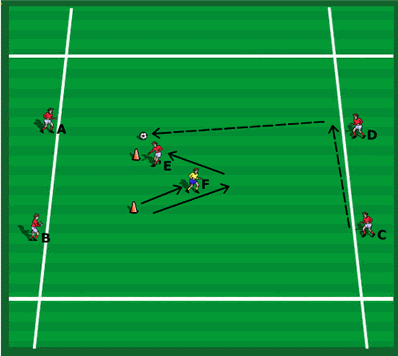

Develop – The player receiving the pass can get it “short or long”, to keep the defender guessing. If short, combine with the passer to beat the defender.
This is the “Vialli Move”.
Practice it also where (C) receives a pass from (E), has time on the ball, and can take two touches (liken to a game situation) and that player makes the next pass off the opposite move into the space behind the striker (E).
Alternatively (E) has possession, comes short and passes to (C), at the same time as passing (E) shouts the code word and (C) can make a one touch pass in behind, knowing (E) will spin and turn back due to the code word being called. If it isn’t called it can be passed to (E)”s feet or may be passed off to (D).
So, different set ups can be used here, sometimes the ball starts with (E) with a pass layoff, sometimes with (C) with it being passed to (D) and the timing needed and practiced thereof of the runs and passes based on the code word being called (or not).
So, options can be:
The start position is (C) passes to (D), and (E) times their run off that pass and uses the code word and receives a pass in behind them into space.
(C) passes to (D) again as the start position, and (E) times their run off that pass and doesn’t use the code word so gets it feet. Can pass back, check back to the cone to start again.
A different start position where (E) has the ball and passes to (C) and goes short; no code word so gets it to feet or the ball is passed to (D).
Now (E) has the ball again as the start position and passes to (C) and goes short; uses the code word as the pass goes to (C) who immediately passes the ball ONE TOUCH in behind and into space for the spin turn from (E). Lots of different ideas can be used here. Introduce a goal to finish in.
Individual Striker Movements
Strikers usually stand with their back to defenders waiting for the ball, so the defender is in charge, this way a very small movement means they end up facing forward and are then at an advantage.
The movement of the striker, the three ideas, working opposites on the first two.
Short to go long, (opposite run)
Long to come short, (opposite run)
Off the shoulder of the defender. Player A makes a diagonal run away to invite a ball “off / over the shoulder” of the marking defender.
On (1) the striker takes the defender towards the ball to create space behind, either for themselves or a team mate.
On (2) the striker takes the defender away to create space in front and short to check back into for themselves or a team mate.
On (3) Here the striker runs away and invites a ball off or over the shoulder of the defender, in this situation the striker is off the right shoulder of the defender.
The ball may be delivered off (outside) the right shoulder of the defender so it goes wider, or (inside) the left shoulder of the defender so the striker cuts inside the defender either in front or behind them, or moves towards the ball and receives to feet.

“Off The Shoulder” Has Three Further Movements To Consider
So; the striker (10) in this position has three ideas for moves; each of which help the striker to end up in a position where they are facing FORWARD:

A) Away from the defender then back across the defender either in front of them or behind them for the delivery inside the defender. If the defender checks away with the striker, then the striker checks back inside to their right; the defenders left (especially as the defender in this case plants their right foot down and is slightly off balance going to their right; the strikers left) always facing forward.
If not checked by the defender then the striker attacks behind the defender for the diagonal pass inside the defenders start position (on the ground or in the air).
B) Moving and staying off the shoulder for the delivery outside the defender to attack, the player on the ball plays a diagonal pass over the inside shoulder of the defender into the path of the striker facing forward.
The striker by making this move opens up the angle for the pass and gets in line still with the defender so as not to be offside but again facing forward, ready to attack the pass in front of them.
C) Going short to the ball to receive the delivery to feet after first moving not towards but away from the defending player and the ball, and ending up facing forward.
In this case the defender “should” drop off to cover themselves so the striker can’t make a run behind them, but this is the cue for the striker to check to the ball from a wider angle and more open body stance so they receive the ball at their feet; but facing forward with space to run at the defender; not with their back to goal and with their back to the defender. The first movement helps this space be created.
The defender starts in the same position as the striker though it isn’t shown here.
I believe this is a good way of simplifying movements by the striker in this position and giving them a framework to play from, they may develop their own variations of these three moves but it is a good planning tool to use in training so the players making the delivery at least have an idea what the striker may attempt in terms of his or her movement based on the position of the defender.

Free eBook: Teaching Strikers Receiving the Ball to Feet with Their Backs to Goal
All start positions should be with the idea of getting the ball into the strikers’ feet to receive it with their back to goal; and then developing the play from there. Emphasize the striker getting across the defender if the defender tries to get in front of them to intercept the pass to them, and using their body to block them off. This can be a big problem for a striker if they are not aware of where the defender marking them is. Secondary movements and developments will result from there. Using the three R’s to teach this; Review, rehearse and restart.
Below is a preview of Soccer Awareness eBook 14: "Teaching Strikers Receiving the Ball to Feet with Their Backs to Goal and Introducing Quick Play in and Around the Box"
Scroll to the bottom of the page to download this ebook for free!
All start positions should be with the idea of getting the ball into the strikers’ feet to receive it with their back to goal; and then developing the play from there.
Emphasize the striker getting across the defender if the defender tries to get in front of them to intercept the pass to them, and using their body to block them off.
This can be a big problem for a striker if they are not aware of where the defender marking them is.
Secondary movements and developments will result from there.
Using the three R’s to teach this; Review, rehearse and restart.
Warm Up:

In 4’s, receiving and turning or passing back and playing forward, first thought is can I turn and beat the defender and pass to the target, otherwise the passing player gets the ball back and plays it forward to the target, so the striker then acts as a rebound player.
Strikers must be strong to keep the ball at their feet doing this and back into the defender in the process.
The striker can do this side on to the defender too (to help their peripheral vision for seeing opponents and their own teammates), and protecting the ball with their body using the opposite foot to maintain possession. Once the ball is at the other side the defending players become attackers and have to do the same back.
Teach receiving both with the inside and the outside of the feet. Strikers can drop their shoulders one way and move the other as a feint to fool the defender.
If there is no space behind for a player to pass into them then strikers need to get the ball to feet and be able to work from there.
Coaching Points:
Using the body to hold the defender off, so the striker initially backs into the defender
Communication between the passer and receiver as to where the receiver wants the ball (using verbal or visual cues)
A good first touch (perhaps turning with the ball on the first touch)
Receiving and turning beating the defender 1 v 1 to shoot on goal, using the defenders body as a pivot
If the striker can’t turn then try to work a combination with the 2nd striker and act as a rebound player
Lay the ball off to a midfield player to develop the secondary phase of play from there
Get a finish on goal




Developing the Striker and Shadow Striker Using 6 Players
This exercise is great for the thinking processes and fast decision making on and off the ball and rotations between players. Can call this the striker (9) and Shadow Striker (10) also working off each other. But it can apply to players in other parts of the field supporting each other.
The following is part of a presentation on Developing the Striker and Shadow Striker Using 6 Players that can be found in the Striker Movement Section of the Soccer Awareness Training Center. Soccer Awareness Training Center provides unlimited access to Wayne Harrison's Soccer Awareness systems, training sessions, drills and more. Wayne's system helps develop world class youth soccer players and teams in a systematic and imaginative manner that guarantees performance at the highest level of competition. Whether you’re a beginning coach who needs help getting started or someone who wants to add some variety to their training sessions, the Soccer Awareness Training Center offers a wide variety of drills to choose from. Join Today
This exercise is great for the thinking processes and fast decision making on and off the ball and rotations between players. Can call this the striker (9) and Shadow Striker (10) also working off each other. But it can apply to players in other parts of the field supporting each other. THE PLAYERS IN THE MIDDLE MUST ALWAYS SCAN BEHIND THEM WITH A LOOK OVER THE SHOULDER BEFORE RECEIVING THE BALL.
Technical Coaching points:
Support angle / distance of the two middle players (not in straight lines)
Receiving skills of the two middle players (TIGHT first touch is vital)
Passes into and from the two middle players (weight, timing and accuracy)
Awareness of the two middle players (scanning openings)
Combination plays of the two middle players (give and go’s a favorite)
The TIMING of movements and PASSES are vital and must be in synch
Progression: Servers can change sides before receiving a pass from the middle players.
Liken the thirds to the attacking third, middle third and defensive third so the shadow striker is dropping back from the attacking third to the middle third to receive the ball. You could liken this to a midfield player dropping short to receive from the back players also.
This is a great all round clinic for many skills being trained including: Passing and the weight and angle of the pass, Movement off the ball, Creating and finding space, supporting positions particularly angled support; decision making without pressure to begin, transition, and ultimately Awareness on and off the ball. Both middle players must touch the ball before it is transferred to the other side.
The two middle players must be aware of each others positions. Must never be in the same half of the field to ensure one goes short and one long. Working on receiving skills and release skills.
Avoid supporting in a straight line, working angles off each other to support.
Play the ball into striker (9) who then lays it off for the shadow striker (10), instead of it going to the shadow striker first then the point striker. The difference is, to the shadow striker first, this player has to receive and turn and pass, into the point striker then it is all passing the way you are facing. 10 x 10 yard grid or larger if necessary.
Supporting at angles to each other for greater Peripheral Vision
The Basic set up. (1) passes to (2) who passes (3) who passes back to (4) who passes to (5) who passes to (6). (3) and (4) MUST be at angles to each other. All passes are angled. We have 4 zones that players use to find their positions in. 10 x 10 yard grid.

Showing the passing sequence and the movements of (3) and (4). Once the ball gets to (6) (1) and (2) have switched with (3) and (4) and gotten in position to receive and work off each other. 10 x 10 yard grid.

As the ball travels the players are switching. The pass from (5) to (6) takes time and allows time for the switch. 10 x 10 yard grid.

As the ball travels the players are switching. The pass from (5) to (6) takes time and allows time for the switch. Now (1) is in position to receive from (6) and (2) is in position to receive from (1). 10 x 10 yard grid.

As the ball travels the players are switching. The pass from (5) to (6) takes time and allows time for the switch. Now (1) is in position to receive from (6) and (2) is in position to receive from (1). 10 x 10 yard grid.

Striker Movements Section Preview

Soccer Awareness Training Center provides unlimited access to Wayne Harrison's Soccer Awareness systems, training sessions, drills and more. Wayne's system helps develop world class youth soccer players and teams in a systematic and imaginative manner that guarantees performance at the highest level of competition. Join Now

Finishing Techniques From Wide Strikers
Work on finishing technique from wide strikers with this drill from Soccer Awareness Training Center. You can use this session as young as U8 in my opinion obviously simplifying it for the younger players.
The following drill comes from the Striker Movements section of the Soccer Awareness Training Center. Soccer Awareness Training Center provides unlimited access to Wayne Harrison's Soccer Awareness systems, training sessions, drills and more. Wayne's system helps develop world class youth soccer players and teams in a systematic and imaginative manner that guarantees performance at the highest level of competition. Whether you’re a beginning coach who needs help getting started or someone who wants to add some variety to their training sessions, the Soccer Awareness Training Center offers a wide variety of drills to choose from. Join Today
A simple set up to practice movement off the ball. (A) and (B) pass the ball back and forth, on the third pass the movement begins and (A) makes the desired pass.
Do BOTH sides so players get to finish both sides with both feet. Or the Striker can use a code word for when the pass is made. “Code Word” can be anything you like. You can create new ideas yourself and using this set up means it is easy to recreate.
Sequence is (S) shoots, then (D) becomes (S) and (A) becomes (D) and (S) becomes (B) and we rotate through each player so everyone gets the chance to finish on goal. Or you may have more players to keep the momentum going.
You can use this session as young as U8 in my opinion obviously simplifying it for the younger players.

Start position inside. Movement outside to take the defender wide. If the defender does not follow then get it to feet to run at him 1 v 1. If he does follow then perform an OPPOSITE run, outside to inside. (7) coming inside on stronger left foot to shoot.
Get more like this in the Striker Movements section of the Soccer Awareness Training Center. Not a member? Try for one week free!

Individual Striker Movements Off the Shoulder Part 3
Striker moves “OFF THE SHOULDER” of the defender. Only a matter of a few yards can open up wonderful space and attacking opportunities.
This is part 3 of 4 on our Individual Striker Movements Off the Shoulder Series.
We are excited to provide you with one of our popular soccer coaching ebooks today... Learn the "Look and Think" Model Of Player Development which will get ever player on your team to think and act several steps ahead of play and think fast! Click here to download the popular Coaching Soccer Awareness E-Book FREE!

Striker moves “OFF THE SHOULDER” of the defender. Only a matter of a few yards can open up wonderful space and attacking opportunities.
In this case moving off the shoulder of the defender means there is a space in behind the defender that the player on the ball can deliver to (that was previously difficult to see and / or deliver into). If the defender does not adjust their position then this is a great chance to receive and attack the goal.
Striker is now:
- Facing forward, and off at an angle, not having to turn and run forward (saves time and puts the defender at a disadvantage).
- Can see the ball, the goal and the defender at the same time.
- Striker can even take their position off the sweeper (in terms of being offside) if the opposition employs one, so they are almost in advance but also wide of the marking defender. This position (off the shoulder) is very difficult to defend against.
- If not facing forward at least in a side – on position so they can see forward and not have their back to the defender.
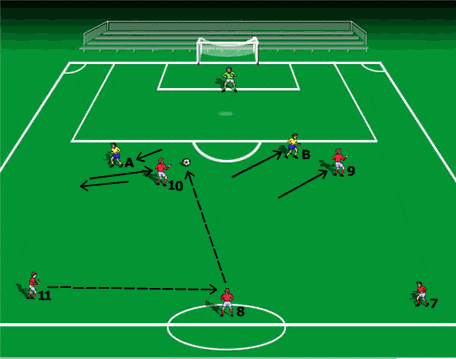
Striker moves “OFF THE SHOULDER” of the defender.
The defender comes with the striker and closes them down. Now the timing of the pass and timing of the run come into play. Striker then checks back inside into the space the defender has vacated and attacks inside and across in front of them. Striker (9) can run off the other center back (B) to create the space inside also. The player on the ball plays it inside the center back.
Also try to time it where as the defender in this case, plants their right foot down (and be flat footed even) so are leaning forward and towards the striker, that is the time to check back inside and across them. The defender is likely to be most off balance at this time, and that is the time to take advantage as they have to spring back on themselves and adjust their feet. It may give a valuable yard or two to the striker which can be the difference between a goal and not a goal.

Striker moves “OFF THE SHOULDER” of the defender.
Same as the previous diagram where the defender closes the striker down but this time the striker makes a run outside and behind the defender rather than inside and across them. Timing of this is important for being on side.
Timing the movement also as previously, when the defender is in an off balanced stance making it more difficult to check back in one movement and cover the strikers run.

Individual Striker Movements Off the Shoulder Part 1
Here the striker runs away and invites a ball off or over the shoulder of the defender, in this situation the striker is off the right shoulder of the defender. The ball may be delivered off (outside) the right shoulder of the defender so it goes wider, or (inside) the left shoulder of the defender so the striker cuts inside the defender either in front or behind them, or moves towards the ball and receives to feet.
This is part 1 of 4 on our Individual Striker Movements Off the Shoulder Series.
We are excited to provide you with one of our popular soccer coaching ebooks today... Learn the "Look and Think" Model Of Player Development which will get ever player on your team to think and act several steps ahead of play and think fast! Click here to download the popular Coaching Soccer Awareness E-Book FREE!

The movement of the striker, the three ideas, working opposites on the first two.
- Short to go long, (opposite run)
- Long to come short, opposite run)
- Off the shoulder of the defender.

Player A makes a diagonal run away to invite a ball “off / over the shoulder” of the marking defender.
On 1) the striker takes the defender towards the ball to create space behind, either for themselves or a team mate.
On 2) the striker takes the defender away to create space in front and short to check back into for themselves or a team mate.
On 3) Here the striker runs away and invites a ball off or over the shoulder of the defender, in this situation the striker is off the right shoulder of the defender. The ball may be delivered off (outside) the right shoulder of the defender so it goes wider, or (inside) the left shoulder of the defender so the striker cuts inside the defender either in front or behind them, or moves towards the ball and receives to feet.
“Off The Shoulder” Has Three Further Movements To Consider
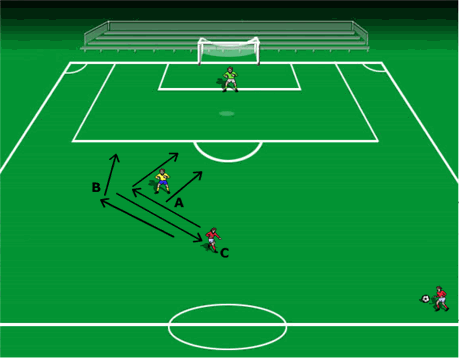
Carrying this idea on the striker in this position has three ideas for moves each of which help the striker to end up in a position where they are facing FORWARD:

- Away from the defender then back across the defender either in front of them or behind them for the delivery inside the defender. If the defender checks away with the striker, then the striker checks back inside to their right; the defenders left (especially as the defender in this case plants their right foot down and are slightly off balance going to their right; the strikers left) always facing forward. If not checked by the defender then the striker attacks behind the defender for the diagonal pass inside the defenders start position.
- Moving and staying off the shoulder for the delivery outside the defender to attack, the player on the ball plays a diagonal pass over the shoulder of the defender into the path of the striker facing forward. The striker by making this move opens up the angle for the pass and gets in line still with the defender so as not to be offside but again facing forward, ready to attack the pass in front of them.
- Going short to the ball to receive the delivery to feet after first moving not towards but away from the defending player and the ball, and ending up facing forward.
- In this case the defender “should” drop off to cover themselves so the striker can’t make a run behind them, but this is the cue for the striker to check to the ball from a wider angle and more open body stance so they receive the ball at their feet; but facing forward with space to run at the defender; not with their back to goal and with their back to the defender. The first movement helps this space be created.
The defender starts in the same position as the striker though it isn’t shown here.
I believe this is a good way of simplifying movements by the striker in this position and giving them a framework to play from, they may develop their own variations of these three moves but it is a good planning tool to use in training so the players making the delivery at least have an idea what the striker may attempt in terms of his or her movement based on the position of the defender.

Finishing In and Around the Box with the 4-2-3-1 Diamond Attacking Set-Up
Striker movement is one of the greatest and most difficult ARTS to master. The situation is constantly changing and the striker is constantly moving to create space for him or herself but also for teammates. Small-sided games are important in the development of younger players through increased touches with the ball and more experience with basic tactical challenges.
The following session is an excerpt from Soccer Awareness eBook 8: Small-Sided Games for Strikers. This 54 page eBook combines striker training with small-sided games into eight full training sessions, each with coaching points, multiple progressions and developments.
Striker movement is one of the greatest and most difficult ARTS to master. The situation is constantly changing and the striker is constantly moving to create space for him or herself but also for teammates. Small-sided games are important in the development of younger players through increased touches with the ball and more experience with basic tactical challenges.
- Use the players on the team in their specific positions at all times, you could have two sets of 3 and 3 as attackers so they learn to switch on to defend also; like defending from the front. A 3 v 3 + 1 attacking and defending game.
- Emphasize the diamond set up as in the attacking phase of the 4-2-3-1 is between the opponents back players and their midfield to gain an overload advantage.
- Good for teaching strikers how to switch on immediately from at-tacking to defending so have 6 attacking players in there unless you want to work on defending so have the relevant defenders in place.
- Build up can be slower using the outside players until the right moment appears then it has to be as fast as possible with quick combinations plays by the attacking team.
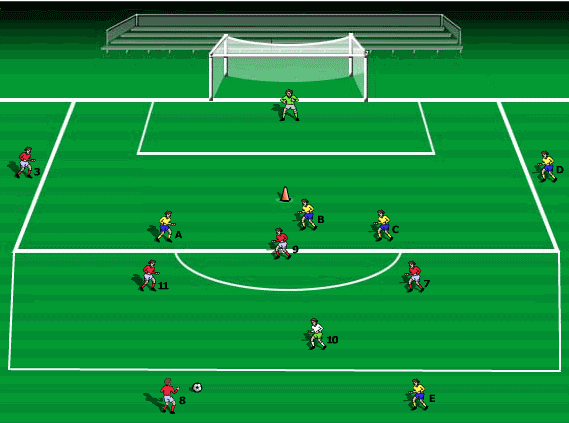
- This is a Functional practice, a 3 v 3 + 1 with support players involving Receiving, Turning, Dribbling and Shooting. First priority of the striker is “Can I shoot?” Composure in the box is the key factor, defenders don’t want to concede a penalty so strikers have more time than they realize.
- No conditions to start but support players stay outside the box. Defenders win the ball they play to the coach or just clear it to outside players. Start again with a new ball to the strikers. Strikers try to receive the ball at an angle so they are half turned and facing the goal so they can get a quick shot in. Others take up positions off this for rebounds etc.
- Outside players can be passing a ball around between each other to keep active and when the play is finished inside the box whoever is on the second ball passes it in to restart.
- Looking for quick shots, working off rebounds, combination work, 1 – 2’s, quick movement to create space, support play
- Use the cone for an offside line likening to the deepest defender so inside attacking players can time their runs off it.
- So one team attacks the other defends. How many goals can the attacking team score in 5 minutes?
- If the defending team win the ball they pass to their own players on the outside (same as winning and keeping possession in a game) who then give the ball to an outside attacking player and the sequence begins again.
- Rotate the teams and each team gets a chance to attack for 5 minutes. Add up all the goals scored for either side in the 20 minutes for a combined winning team. Alternatively have two goals at opposite ends so it is more like a game situation.
- Rotate the players within each team.
Coaching Points In Shooting And Finishing
Make it a competition between two teams. Each team has 15 at-tempts at goal, see who can score the most goals. Attacking team continue each attempt until the ball is out of play or a goal is scored or the opponents win possession. Rotate the defenders to keep them fresh. Here the coach passes to (8) who lays it off for (9) who shoots and scores. (8) And (10) follow the shot in for any rebounds.
Coaching Points in Shooting:
- Positive Attitude to shoot, quick shooting. Every opportunity try to get a shot in.
- Receive on the Half Turn if possible (create space for yourself), take the chance
- Accuracy and Power (accuracy first). Be composed
- Shooting High or Low (low best because it’s more difficult for the keeper)
- Selection of Shot (driven, chip, side foot, swerve etc). You can use defenders to shoot around for placement. Check keepers position (if time!)
- Near Post or Far Post (can depend on keepers position, also if you shot and miss at the near post the ball is out of play, if shooting at the far post and it’s missing, the keeper may palm it to a striker following up, a striker may intercept it on its way and score, (it may hit a defender and go in off them)
- Rebounds (follow all shots in)
Get this full training session including multiple progressions, attacking from crosses, making transitions and switching positions, a 3 v 3 attacking and defending transition game and more small-sided games for strikers in Soccer Awareness eBook 8: Small-Sided Games for Strikers.
This full training session is also available in the Soccer Awareness Training Center. The Soccer Awareness Training Center powered by Edufii is the ultimate youth soccer coaches learning platform. Join Our Team
54 Pages
We want to stay with our own game plan as closely as possible; based on what we practice and to keep it simple for us; as we dictate to our opponents; and we impose OUR WAY on them.
But there will be many occasions where we must change the system of play and we may have to adjust to suit the opponents.
Here are some ideas for you to consider for your team starting with the 13313 and 14231 systems of play.