Welcome to the Soccer Awareness Coaches Corner. Browse through soccer drills, small sided games, tactical thoughts, full sessions and a variety of resources. Posts marked “Training Center Exclusive” are for members only.

Off the Shoulder Movement and How to Combat It
(3) Watches the ball and allows the wide player (B) to get beyond him. A ball in behind always beats him. Centrally the centre back (4) does the same, he watches the ball and the striker comes off his shoulder and he gets caught with the ball in behind him. This will cost us in unless we work on it with the team.
This often goes wrong. Here’s how you can fix it.
The following is an excerpt from Soccer Awareness eBook 18: Identifying and Solving Common Game Situation Problems in the Training Environment.
This 38 page eBook shows a different way to look at the game, rather than highlighting what we need to do well, it shows what often goes wrong and how to fix it.
These are many very simple situations I have found that happen in many games.
How many of these problems do YOU experience with your team?
Off the Shoulder Movement and How to Combat It
(3) Watches the ball and allows the wide player (B) to get beyond him. A ball in behind always beats him.
Centrally the centre back (4) does the same, he watches the ball and the striker comes off his shoulder and he gets caught with the ball in behind him.
This will cost us in unless we work on it with the team.

Here striker (A) comes off the shoulder of (4) who stays central and the ball in played into the space beyond and behind him.
Likewise wide player (B) makes the same movement with the same end result.

This is the end product where we can get caught.
To counter this center back (4) or fullback (3) should drop off inside the space the ball is going to be played into.
Alternatively the whole back four can press up and leave them offside but this is risky if there is no pressure on the ball being delivered.

Get more like this in Soccer Awareness eBook 18: Identifying and Solving Common Game Situation Problems in the Training Environment.
This 38 page eBook shows a different way to look at the game, rather than highlighting what we need to do well, it shows what often goes wrong and how to fix it.



Quick Break Transition 2 v 2 Game
A 2 v 2 game going to 4 goals. The team who scores stays on and must quickly defend the 2 new players coming in. We are working on Quick break and counter attack, Quick one and two touch passing and Positioning to open up passing lanes and getting between defenders to pass the ball in early.
The following session is an excerpt from “Soccer Awareness Coaching Curriculums presented by Game Sizes: 4 v 4, 7 v 7, 9 v 9 through to 11 v 11”
This eBook covers up to 14 weeks of training for each game size presented as one session per week. All sessions have small sided games scrimmage set ups as close as we can get it to finish to reflect the theme of the session As the program moves from 4 v 4 through to 11 v 11 the focus changes from individual teachings at 4 v 4, to small sided situations at 7 v 7, to Phases of play and tactical needs at 9 v 9; through to team tactical development at 11 v 11. 11 v 11 focuses on advanced training ideas to teach the “team”.
1. A 2 v 2 game going to 4 goals. The team who scores stays on and must quickly defend the 2 new players coming in (one from each goal that the opposition defends).
Instant transition with the same ball that the opponents scored with, here (3) and (4) are positioned to immediately bring the ball the opponents’ may score with out to attack. The other two players (1) and (2) must get off the field ASAP.
The 1st thought of the player on the ball has to be “Can I score?”
The 1st thought of the 1st defender is can I stop them scoring, win possession immediately, and score myself. First team to 10 goals wins, keeping the competitive element.

Coaching Points Attacking:
Quick break and counter attack
Switching the point of attack if another goal is more open
Quick one and two touch passing
Positioning to open up passing lanes and getting between defenders to pass the ball in early
Creating 2 v 1 situations from a 2 v 2 set up and setting up a give and go.
Coaching Points Defending:

Instant pressure as possession changes (transition after scoring going from being an attacker to being a defender)
Regaining possession at the front with a scoring reward
Getting in front of the passing lanes to prevent the quick pass into the goal.
Working together with pressure and support, the support player supporting the first defender, stepping across and covering the passing lane to the second goal and also keeping an eye on the 2nd attacker.
Transition Coaching Points:
Immediately the team that has been in possession of the ball and has scored then they must switch on mentally to become defenders and high pressure the new attacking team to try to win the ball back.
Develop:

Allow back passes to the players in their own goal so they can support the two (or three) attacking players on the ball.
Allow them only one touch so they have to pass it quickly, make a quick decision and players receiving all need to get open to help them.
Vary the number of touches on the ball depending on the age and level of the players and their ability to perform.
Quick transition 3 against 3
Do the same set up but with three goals either side of the field and 3 v 3 games.
It offers more options of passes in the field of play and starts to get the players thinking about triangular support or diamond support if the ball is with a supporting player off the field. A diamond set up.


The Three Zone Directional Game - Training Center Exclusive
This game is based on possessing the ball and the movement off it.
We have several progressions we can use to challenge the players these include:
A simple Warm up to get the idea going
Playing through the thirds with targets
Playing through the thirds without targets
Players must stay in their own thirds so we have 3 combination games going at once
We can add free players therefore creating overload situations
More!
*Membership Required
This game is based on possessing the ball and the movement off it.
We have several progressions we can use to challenge the players these include:
A simple Warm up to get the idea going
Playing through the thirds with targets
Playing through the thirds without targets
Players must stay in their own thirds so we have 3 combination games going at once (e.g. 3 v 3, 2 v 2 and 3 v 3 per zone or whatever numbers of players you have).
We can add free players therefore creating overload situations to make it easier for success competitively and to build confidence initially.
No free players to increase the pressure and the challenge.
Players can rotate between zones now. This is more game related in what we want to teach with players have freedom to interchange as long as they are covered by a team mate.
Add a condition to help improve / focus on body position and footwork: If a player faces backwards when receiving the ball they MUST pass that ball backwards and with only one touch allowed.
Man for man marking; 1 v 1s all over the field and in all three zones. Players in possession can rotate and move around their immediate marker has to follow them.
Touch restriction: Unlimited, then 3 then 2 then 1 touch if on to do so.
All through remind players that they MUST scan the field, must check their shoulders for options; to the side or behind them and not just see in front of them.
Use the yes and no check system to highlight for each player if they looked AWAY from the ball before receiving it.
Can play a longer pass from one end zone to another and missing out the middle third if that’s the best option.
Remember Xavi: In 90 Minutes looked AWAY from the ball 841 times. Amazing.
Joke about only needing half a touch to emphasize the importance of this mental skill.
Add goals at each end include keepers (who should have been in the game anyway for their footwork skills) and make it a game situation whatever the numbers are.
3 Zone Game: Playing Through the Thirds with Targets

4 ball warm up. Three zones, 3 v 3, 2 v 2 and 3 v 3.Players are passing and maintaining possession. Condition it to 1 or 2 touches on the ball to challenge the players. Players stay in their own zones initially. Play to the targets.
3 Zone Game: Playing Through the Thirds Without Targets

4 ball warm up. Three zones, 3 v 3, 2 v 2 and 3 v 3.Players are passing and maintaining possession. Condition it to 1 or 2 touches on the ball to challenge the players. Players stay in their own zones initially.
3 Zone Game: Playing Through the Thirds

Each end zone can be a defensive third or attacking third zone depending on where the ball is. Here for example (G) passes out of the defensive third to the middle third to (C) to the attacking third to (B). Now going the other way the end zones are reversed.
3 Zone Game: Making it Competitive

Now we have three zones each with their own combination play battles. 3 v 3, 2 v 2 and 3 v 3 but add two or three free players to help the game flow initially.
3 Zone Game: Making it Competitive with Targets

Now we have three zones each with their own combination play battles. 3 v 3, 2 v 2 and 3 v 3 but add two or three free players to help the game flow initially. Blues play to the blue target and reds to the red target, each team can use the other target as support. You can keep possession and work the ball back through the middle to the defending third after you reach your own target as the game is about maintaining possession and movement off the ball. You can rotate the targets the passer becoming the new target.
3 Zone Game: Making it Competitive: Stay in Own Zones

Only the free players can move between zones so they create overload situations in each zone, could be a 4 v 3 or a 5 v 3 for example.
3 Zone Game: Making it Competitive: Create Overloads

Only the free players can move between zones so they create overload situations in each zone, could be a 4 v 3 or a 5 v 3 for example. Here we have a 4v3, 3v2 and a 4v3.

Only the free players can move between zones here two move to the middle to create a 4 v 2 overload. Looking to move the ball from one end to the other so its a directional game similar to the actual game itself. Whoever is in possession must work to find the best open spaces in advance of the ball.
3 Zone Game: Making it Competitive: Rotation Between Zones

Now all players can move between the 3 zones but we want to maintain the balance in each. So one player moves from the defending third to the middle third a middle third player must move to the defending third. So within our set framework players can interchange positions and also cover for each other and again emulating the actual game situation we want to teach with players having the freedom to change positions and move around the field. Defenders can track them or not.
3 Zone Game: Making it Competitive: Rotation Between Zones and Man for Man Marking

Now we match up players to play 1 v 1 against each other within the game situation. Now all players can move between the 3 zones. The team in possession dictates the movements off the ball, the team without possession have to track their immediate opponents. If they are heavily marked the free players become a greater source of support.
3 Zone Game: Making it Competitive: Conditioning to Encourage Correct Footwork and Body Position

Now if a player receives the ball facing fully backwards they can only play 1 touch and it has to be a pass backwards also. (1) is marked by (C) and has their back to the way we want to go so must pass back, here to (3).
3 Zone Game: Making it Competitive: Conditioning to Encourage Correct Footwork and Body Position

Due to the condition players should begin to think about preparing their bodies to receive and be able to play and SEE forward. And therefore increase their immediate options. (1) here opens up their body position, is light on their feet; and is facing either sideways or forwards but is now in a position to pass forward and not use their body position and feet preparationto narrow down their options.
3 Zone Game: Making it Competitive with Equal Numbers for a more Pressurized Game

Now no free players so the game is much more competitive. Only move to this when you know you can have success. Here we show the players in possession, the blue team moving OFF the ball into new spaces to get free to receive. Players in the other grids are already on the move but must time it right and not do it too early or too late.
3 Zone Game: Making it Competitive Playing from the Defensive Third Directly to the Attacking Third

There is nothing wrong with a good quality long ball if that's the best option at that particular moment. (8) can play it into open space with the right weight and accuracy to move (1) to meet it.
3 Zone Game: Making it Competitive with Equal Numbers for a More Pressurized Game: What not to do

This will happen so check it if it does and address the problem. Players stand still and wait at the edge of their zone for the ball to come. They have no space to work in and are easily marked by the defenders. This isn’t game realistic at all but it will occur due to the set up and them waiting for the ball to transfer from the defending to middle thirds.
3 Zone Game: Making it Competitive with Equal Numbers for a More Pressurized Game: Restrict the Number of Touches on the Ball

Can be with man marking or without. Now we arrive at the moment we want to happen on the field where awareness training kicks in, players scan the field for options IN ADVANCE of the ball. Everything we have practiced up to this point should include a constant reminder of LOOKING AWAY from the ball. So go free and unlimited touches first, and build to 3 to 2 to 1 touch if its on to do so. At 1 touch add free players to help it work if needed.




Finishing In and Around the Box with the 4-2-3-1 Diamond Attacking Set-Up
Striker movement is one of the greatest and most difficult ARTS to master. The situation is constantly changing and the striker is constantly moving to create space for him or herself but also for teammates. Small-sided games are important in the development of younger players through increased touches with the ball and more experience with basic tactical challenges.
The following session is an excerpt from Soccer Awareness eBook 8: Small-Sided Games for Strikers. This 54 page eBook combines striker training with small-sided games into eight full training sessions, each with coaching points, multiple progressions and developments.
Striker movement is one of the greatest and most difficult ARTS to master. The situation is constantly changing and the striker is constantly moving to create space for him or herself but also for teammates. Small-sided games are important in the development of younger players through increased touches with the ball and more experience with basic tactical challenges.
- Use the players on the team in their specific positions at all times, you could have two sets of 3 and 3 as attackers so they learn to switch on to defend also; like defending from the front. A 3 v 3 + 1 attacking and defending game.
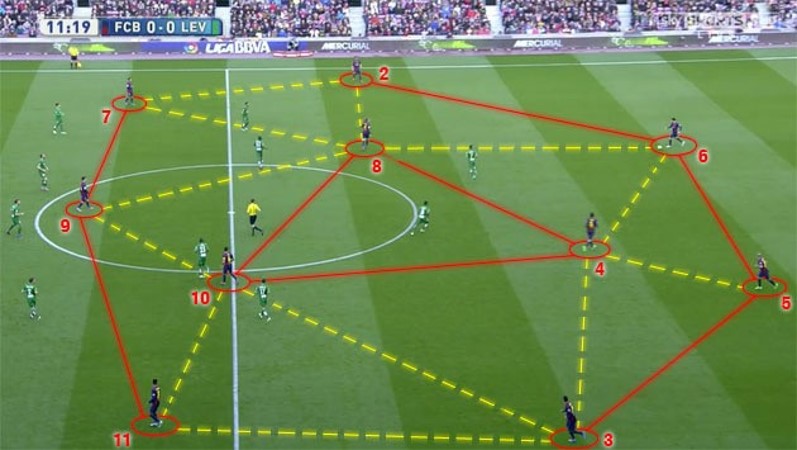
- Emphasize the diamond set up as in the attacking phase of the 4-2-3-1 is between the opponents back players and their midfield to gain an overload advantage.
- Good for teaching strikers how to switch on immediately from at-tacking to defending so have 6 attacking players in there unless you want to work on defending so have the relevant defenders in place.
- Build up can be slower using the outside players until the right moment appears then it has to be as fast as possible with quick combinations plays by the attacking team.

- This is a Functional practice, a 3 v 3 + 1 with support players involving Receiving, Turning, Dribbling and Shooting. First priority of the striker is “Can I shoot?” Composure in the box is the key factor, defenders don’t want to concede a penalty so strikers have more time than they realize.
- No conditions to start but support players stay outside the box. Defenders win the ball they play to the coach or just clear it to outside players. Start again with a new ball to the strikers. Strikers try to receive the ball at an angle so they are half turned and facing the goal so they can get a quick shot in. Others take up positions off this for rebounds etc.
- Outside players can be passing a ball around between each other to keep active and when the play is finished inside the box whoever is on the second ball passes it in to restart.
- Looking for quick shots, working off rebounds, combination work, 1 – 2’s, quick movement to create space, support play
- Use the cone for an offside line likening to the deepest defender so inside attacking players can time their runs off it.
- So one team attacks the other defends. How many goals can the attacking team score in 5 minutes?
- If the defending team win the ball they pass to their own players on the outside (same as winning and keeping possession in a game) who then give the ball to an outside attacking player and the sequence begins again.
- Rotate the teams and each team gets a chance to attack for 5 minutes. Add up all the goals scored for either side in the 20 minutes for a combined winning team. Alternatively have two goals at opposite ends so it is more like a game situation.
- Rotate the players within each team.
Coaching Points In Shooting And Finishing
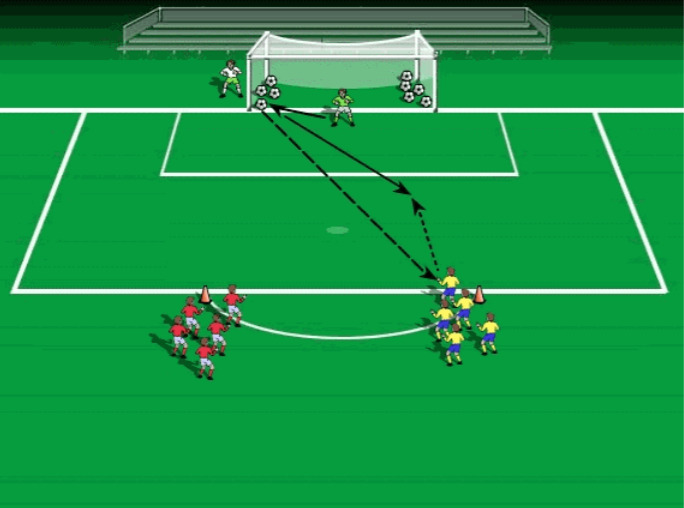
Make it a competition between two teams. Each team has 15 at-tempts at goal, see who can score the most goals. Attacking team continue each attempt until the ball is out of play or a goal is scored or the opponents win possession. Rotate the defenders to keep them fresh. Here the coach passes to (8) who lays it off for (9) who shoots and scores. (8) And (10) follow the shot in for any rebounds.
Coaching Points in Shooting:
- Positive Attitude to shoot, quick shooting. Every opportunity try to get a shot in.
- Receive on the Half Turn if possible (create space for yourself), take the chance
- Accuracy and Power (accuracy first). Be composed
- Shooting High or Low (low best because it’s more difficult for the keeper)
- Selection of Shot (driven, chip, side foot, swerve etc). You can use defenders to shoot around for placement. Check keepers position (if time!)
- Near Post or Far Post (can depend on keepers position, also if you shot and miss at the near post the ball is out of play, if shooting at the far post and it’s missing, the keeper may palm it to a striker following up, a striker may intercept it on its way and score, (it may hit a defender and go in off them)
- Rebounds (follow all shots in)
Get this full training session including multiple progressions, attacking from crosses, making transitions and switching positions, a 3 v 3 attacking and defending transition game and more small-sided games for strikers in Soccer Awareness eBook 8: Small-Sided Games for Strikers.
This full training session is also available in the Soccer Awareness Training Center. The Soccer Awareness Training Center powered by Edufii is the ultimate youth soccer coaches learning platform. Join Our Team
54 Pages
We want to stay with our own game plan as closely as possible; based on what we practice and to keep it simple for us; as we dictate to our opponents; and we impose OUR WAY on them.
But there will be many occasions where we must change the system of play and we may have to adjust to suit the opponents.
Here are some ideas for you to consider for your team starting with the 13313 and 14231 systems of play.