Welcome to the Soccer Awareness Coaches Corner. Browse through soccer drills, small sided games, tactical thoughts, full sessions and a variety of resources. Posts marked “Training Center Exclusive” are for members only.

Free eBook: Teaching Strikers Receiving the Ball to Feet with Their Backs to Goal
All start positions should be with the idea of getting the ball into the strikers’ feet to receive it with their back to goal; and then developing the play from there. Emphasize the striker getting across the defender if the defender tries to get in front of them to intercept the pass to them, and using their body to block them off. This can be a big problem for a striker if they are not aware of where the defender marking them is. Secondary movements and developments will result from there. Using the three R’s to teach this; Review, rehearse and restart.
Below is a preview of Soccer Awareness eBook 14: "Teaching Strikers Receiving the Ball to Feet with Their Backs to Goal and Introducing Quick Play in and Around the Box"
Scroll to the bottom of the page to download this ebook for free!
All start positions should be with the idea of getting the ball into the strikers’ feet to receive it with their back to goal; and then developing the play from there.
Emphasize the striker getting across the defender if the defender tries to get in front of them to intercept the pass to them, and using their body to block them off.
This can be a big problem for a striker if they are not aware of where the defender marking them is.
Secondary movements and developments will result from there.
Using the three R’s to teach this; Review, rehearse and restart.
Warm Up:

In 4’s, receiving and turning or passing back and playing forward, first thought is can I turn and beat the defender and pass to the target, otherwise the passing player gets the ball back and plays it forward to the target, so the striker then acts as a rebound player.
Strikers must be strong to keep the ball at their feet doing this and back into the defender in the process.
The striker can do this side on to the defender too (to help their peripheral vision for seeing opponents and their own teammates), and protecting the ball with their body using the opposite foot to maintain possession. Once the ball is at the other side the defending players become attackers and have to do the same back.
Teach receiving both with the inside and the outside of the feet. Strikers can drop their shoulders one way and move the other as a feint to fool the defender.
If there is no space behind for a player to pass into them then strikers need to get the ball to feet and be able to work from there.
Coaching Points:
Using the body to hold the defender off, so the striker initially backs into the defender
Communication between the passer and receiver as to where the receiver wants the ball (using verbal or visual cues)
A good first touch (perhaps turning with the ball on the first touch)
Receiving and turning beating the defender 1 v 1 to shoot on goal, using the defenders body as a pivot
If the striker can’t turn then try to work a combination with the 2nd striker and act as a rebound player
Lay the ball off to a midfield player to develop the secondary phase of play from there
Get a finish on goal



Circle Rondos
Passing and movement warm up for quick looking and thinking. Various movements to develop decision making with several progressions. An Introduction to all the basics of the thinking process and how it relates to decision making and movement.
The following comes from Soccer Awareness eBook "Developing Players with Rondos Using the Soccer Awareness Philosophy"
This 222 page eBook explores the use of rondos in youth soccer. Rondos are a great way to prepare players for the game situations and especially the fast decision making needed within the game. I have included as a way to work into these game situations many Rondo ideas that I feel are great foundation builders for players learning to combine and play together. I have stayed with simplistic ideas that all levels of players can try and be successful at. It is up to each coach to work out how to make it work for their players.
Though the foundation of the basic rondo stays the same; we explore different ways to present it. It can be made easier or more difficult based on the number of touches players are allowed, for example, so it benefits ALL players who practice with them; also the size of area they play within can be manipulated to change the challenge. Preview Here
Passing and movement warm up for quick looking and thinking. Various movements to develop decision making with several progressions. An Introduction to all the basics of the thinking process and how it relates to decision making and movement.
Circle coaching for passing and support
To increase the players awareness instincts ask them to call the name of the player out who they will be passing to, before they receive the ball. This ensures they look to see who is free before they receive the ball so they know in advance who is free to receive.
One ball, (1) runs and passes to (4) and takes their place. (4) Takes the ball, runs and passes to (8) and so on.

Progression: Introduce two, then three, then four balls all going at the same time. “Awareness” of where each player is running is needed here so they don’t collide and where potential free players to receive are “before” you make the run and pass.
Coaching Points:
Good communication between the players.
Quality of the pass (timing, accuracy and weight).
Good first touch by the receiver.
Progression – Passer becomes a passive defender who puts the receiver under pressure. The receiver must move the ball away at an angle from the pressure on their first touch.
Running with the ball
Running with the ball technique:
Head Up – look forward, observing options “before” receiving the ball using the A.I.A. training.
Good first touch out of feet, 2-3 touches maximum, not dribbling.
Run in a straight line, the quickest route.
Running Style, use the front foot to control the ball using the laces.
Decision: Where is the player taking the ball? In this case to (5) but (5) must try to decide as the ball is coming not after he or she has it. Identify who is free early.
Communication: Call the name of the player you are running the ball to.
Get 222 Pages of Developing Players with Rondos Using the Soccer Awareness Philosophy

6 To 7 Years Old Developmental Training Program Overview
Here is an overview of what coaches should be working on in their training with 6-7 year olds. This is the “Fundamental” stage of development. Coaching emphasis is on teaching Technical and Mental development in the correct Environment.
The following is an excerpt from The Ultimate Youth Coaches Training Guide; A Complete 6 to 10 Year Old Developmental Coaching and Training Program.
This program is perfect for youth coaches wanting practices to start their soccer coaching education and it is also for those more advanced and experienced coaches wanting to train their players as best they can at these wonderful open minded ages for development and education of both the mind and body. Our plan is to help all coaches at whatever level of experience they are at. Find Out More
What You Receive:
More than 750 pages of coaches training and practice information and resources to help you become a better coach today
Complete 6 - 10 Year Old Developmental Coaching and Training Program
140+ Training Sessions, 50+ Small Sided Games and more!
Tactical Thoughts on the Development of the New 4 v 4, 7 v 7 and 9 v 9 Game Sizes
Example Curriculum Showing the Progressive Development of a System of Play
Hyperlinked table of contents
Instantly downloadable low resolution version of the guide
Access to password protected page containing high resolution version broken down by section with 24 hours allowing you to quickly access the section that you want
Here is an overview of what coaches should be working on in their training with 6-7 year olds:
This is the “Fundamental” stage of development
“TECHNIQUE / TECHNIQUE / TECHNIQUE”
Coaching emphasis is on teaching Technical and Mental development in the correct Environment.
This is the FUNdamental Stage, meaning making training fun for the players to encourage them to practice more at these young ages, and relaxing their minds.
Training must be initially in a non-competitive environment so the players get a chance to learn to do the technique correctly; and without pressure. Build pressure in when the time is right.
Short term learning practice, high in repetition, specific to the technique required, involving few decisions.
This is the COGNITIVE PHASE of learning theory (planning)
The learner thinks about the task. Movements will not yet be fluid as the player is concentrating on what to do next; and how to do it; so the thinking process is a major part of this.
Awareness training: The Emphasis is on Individual Awareness with lots of touches to teach the players to play with their heads up; particularly during technical development training such as dribbling and turning.
The coach must observe: the player may be slow to learn, compare the player with a skillful one where movement is fluid, effortless requiring no deep thought, it’s almost instinctive.
The coach must be patient and continue to reinforce the relevant techniques until they start to become second nature in a non-competitive situation, and the players then move to the next stage of development.
Some may reach the next stage earlier than others.
In the training sessions emphasis is given to repeating the quality of football movements. These are corrected and repeated until they become a regular part of the player’s package of techniques.
INCLUDE TRAINING WHERE THE PLAYERS HAVE AS MANY TOUCHES ON THE BALL AS IS POSSIBLE IN THE TIME YOU HAVE WITH THEM
Technical Program Needs to Cover:
Ball Mastery – Coerver work – Ball feeling and familiarity
Ability to use both feet – weak foot work
Passing, control – ability to take/cushion the ball with all parts (With movements prior to)
3v1, 4v1, 4v2 for support and making angles
Dribbling, running with the ball
1v1 activities for fun and enjoyment
Heading for fun
Shooting two footed
Games in small groups: 3 v 3; 4 v 4, they want to play; not be Coached – rotate players
Speed – Quickness
Fast footwork with and without the ball
Tag games to develop fast feet and leg strength
Show how to spread out to create space
Play games for ENJOYMENT, encourage them to produce a skill
Get everyone back behind the ball

Sideways on Soccer Using Corridors
4 v 4 game. Players have to pass diagonally forward because of the condition set. This develops the checking and passing habits of players. Players stay in their same corridors or zones. Theme is to have them check off at an angle and sideways on so they can see the opponent, their team mates and the goal behind them.
The following drill is an excerpt from Soccer Awareness eBook 6: Sideways On or Facing Forward Body Shape for Striker Position; The Brazilian Way.
This book includes In-Depth Information on Striker Movement.
Soccer is a sideways on sport -- players will have much more success when they are able to receive the ball at an angle. Being sideways on allows players, in advance of the ball, to be able to see peripherally advancing defenders.
These exercises are excellent for developing this sideways on aspect of receiving and passing the ball. This aspect of play becomes particularly important when one touch soccer is required. Being able to have the body halfway turned enables attacking players to use a couple of maneuvers to get past defenders. Get it Now

Now we have the two groups play together. Start Position is player (1) passes into Player (4). Defender (B) cannot close that player down until they have had their first touch. It is important to keep the start position passive from a defensive perspective.
Rules:
A player can’t pass forward in their own corridor or zone.
A player can pass forward to the other corridor.
A player can pass back in their own corridor.
4 v 4 game. Players have to pass diagonally forward because of the condition set. This develops the checking and passing habits of players. Players stay in their same corridors or zones. Theme is to have them check off at an angle and sideways on so they can see the opponent, their team mates and the goal behind them.
Strikers work together and link up trying to create angles of support between each other, one short, one long etc.
Develop: Increase the number of corridors and players.

Continuing the movement, (3) is side on to receive and can see opponent (A) and see across to teammate (4) and plays a one touch pass into (4)’s path.
(4) moves into the space where the ball is passed and loses the defender (B) and scores with a one touch finish and shot on goal.
Defender (A) closes down (3) and stops the shot at goal for (3). But the side - on stance of (3) allows (3) to see (4) and affects the pass to (4).
If defender (A) had not closed down the shot at goal for (A) then (3)’s best option was to shoot.
Players have to decide what is the best option a shot or a pass; it may be determined by the positioning of the immediate defender.
Back players can attack also.

More passing ideas
Focus is on scoring where they can. Check the defenders position to see if they can shoot, or need to pass instead. Read the space between the striker and the defender when you pass the ball into them.
Passing away from the striker into space in front of them and the defender or to the side of them and not into feet helps the striker move and receive and get away from the defender. The striker can make the movement first and motion to the passer where they want it by pointing also.
Here (3) checks off short and wide to receive a pass and passer (2) passes the ball away from the defender on the inside of the striker so the striker has their body between the ball and the defender but is also side on to o see in front of them.
Here (1) has a forward pass to (4) or a chance to shoot at goal. (4) Could take (B) away to open up the space for a shot also.

A “Comfort Zone” Developing Width in Play in a 9 v 9
Objective: To Encourage Players To Use Width And Offer An Area To Play Without Pressure
The following is part of Soccer Awareness eBook: Tactical Thoughts on the Development of the New 4 v 4, 7 v 7 and 9 v 9 Game Sizes.
This eBook shows how these different size games can be taught and also shows different systems of play that might be useful to you.
The idea I am trying to cultivate is to find a pattern of development that goes from 4 v 4 to 7 v 7 all the way through 9 v 9 to 11 v 11 that educates the players VERY EARLY on how to ultimately play the 11 v 11, a common thread running right through the book. Click Here to Buy the Book
OBJECTIVE: TO ENCOURAGE PLAYERS TO USE WIDTH AND OFFER AN AREA TO PLAY WITHOUT PRESSURE
Theme: Developing Width in attack
A perfect Introduction to this idea so players are free to receive in wide areas. If a player breaks wide into the outside channel on either side of the field and is in possession of the ball this player cannot be tackled. Defenders are not allowed into the channel.
The players on the team in possession of the ball can run the ball into the channel or have it passed to them into the channel. Allow only 4 seconds in the free wide area.
This condition plants the seed in the mind of the players to immediately play with width when in possession. Numbers for this game can be 4 v 4 and upwards. Our offensive team shape to begin. Four players give us width in attack.
Develop: The wide areas can be used to practice certain moves the players have been taught, especially at the younger ages where they need to be able to practice them without pressure. This allows for them playing in a game but also doing the move without pressure.
Coaching Points:
Create space wide when in possession of the ball
Building play from the back
Using width to attack
Developing Overlap runs
Development of the Theme
Build the theme up very simply to ensure immediate understanding and success.
No opposition at first so 9 v 0.
Small numbers (e.g. 9 v 3): Passive opposition (jockey the player only)
Small numbers (e.g. 9 v 5): Passive opposition (Can only Intercept the passes not tackle
9 v 9 but again passive opposition
9 v 9 full game with wide FREE ZONES for the team you are training.
When you feel the players are ready have a full blown 9 v 9 game and have it for both teams at the same time going both ways.
Ensure all players on your roster are involved in the attacking team theme development initially so everyone benefits and understands what you are teaching and why you are teaching it.
To Encourage players to use width and play without pressure
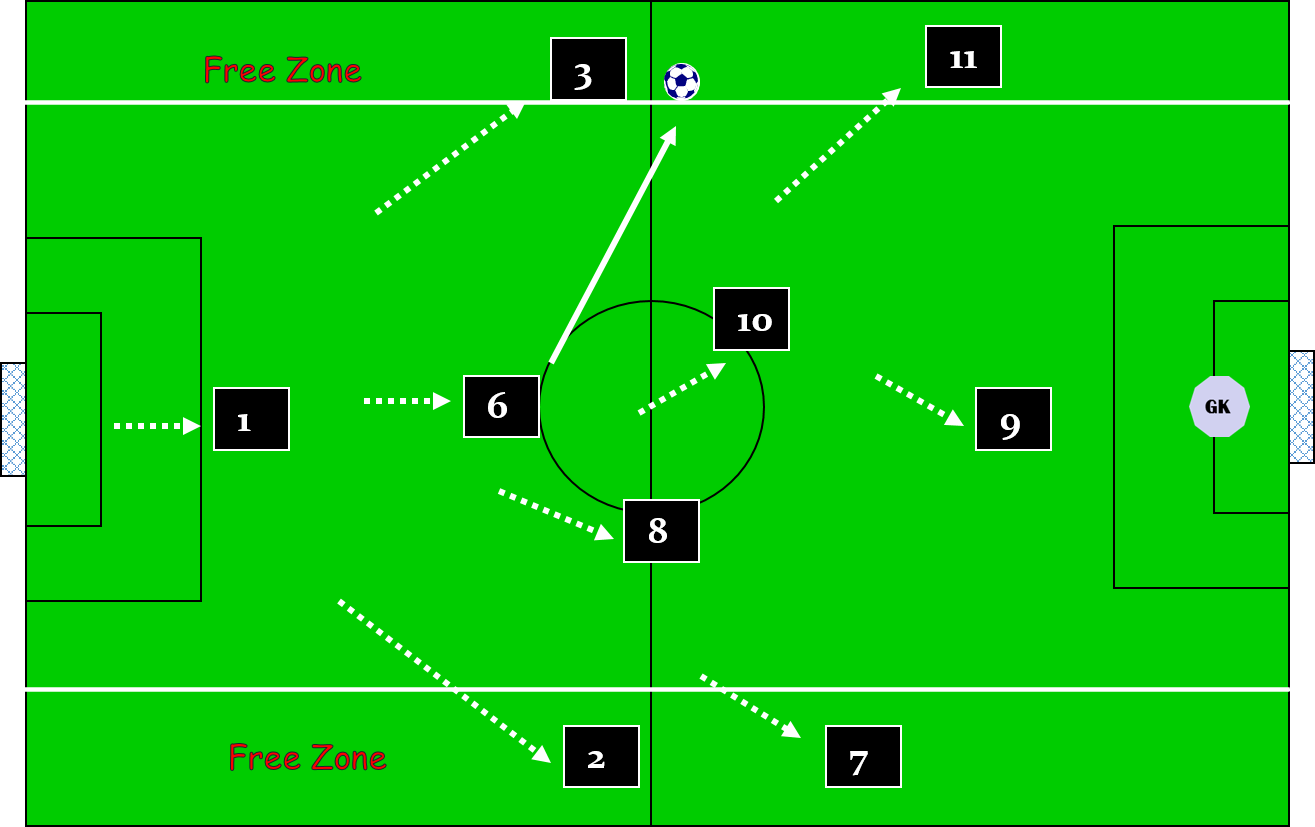
This is the basic set up of the attacking shape of a 9 v 9 in the 3-3-1-1 formation. Emphasis is on the theme of exploiting the wide areas of the field by setting the free zone “Condition.”
A Small number of defenders added
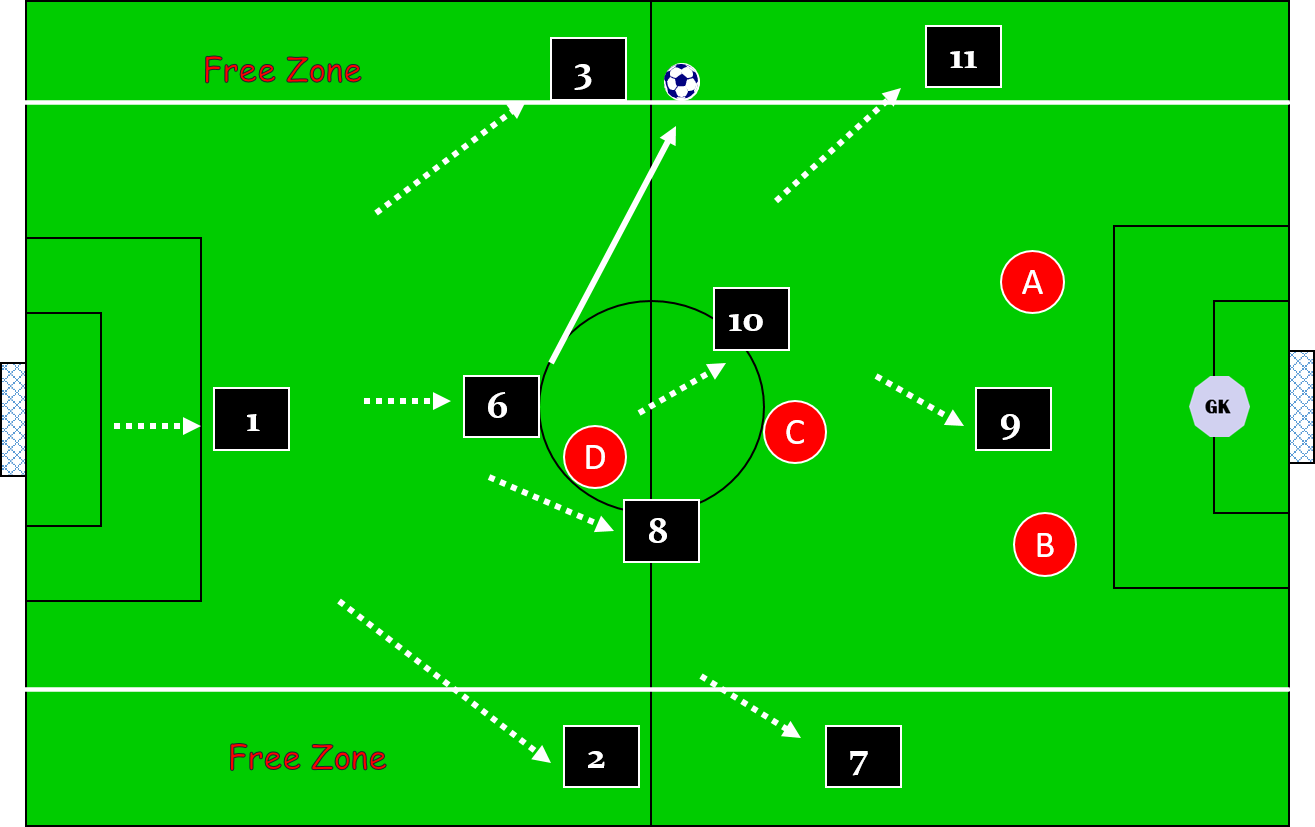
Bring a small number of defenders in as passive opposition who can only Intercept not tackle. So we have here a 9 v 5 set up.
Get the rest of this session and more in the Soccer Awareness eBook: Tactical Thoughts on the Development of the New 4 v 4, 7 v 7 and 9 v 9 Game


The Arsenal Game
This game was based on how you would structure a small sided game in the style that the present Arsenal side would play. Their play is made up of lots of quick short passing with plenty of movement off the ball. They use give and goes a lot (wall passes) which I have highlighted in the game.

The following drill is part of Soccer Awareness New eBook: Tactical Thoughts on the Development of the 4 v 4, 7 v 7 and 9 v 9 Game Sizes.
This eBook shows how these different size games can be taught and also shows different systems of play that might be useful to you. Run with them as you may and of course come up with your own solutions too as that is what coaching is all about. I have introduced the use of RONDOS to initially aid the development of players for the game situation. Click Here to Preview The Book
This game was based on how you would structure a small sided game in the style that the present Arsenal side would play. Their play is made up of lots of quick short passing with plenty of movement off the ball. They use give and goes a lot (wall passes) which I have highlighted in the game.

Organization:
Pitch size –40 x 20 or at the discretion of the coach, but basically a standard 4 v 4 pitch
Number of teams –3
Team sizes 4 players
Bibs optional
Goals –5 a side or mini soccer goals
Progression:
I play this game as a 4 v 4 with keepers. I also have four additional players, two on each side (who are neutral and play with the team in possession). The game is a standard 4 v 4 game, except that the neutral players on each side can be used. The neutral players have one touch only (younger players and less technical players may require two touches) and play with the team that have possession. They take any throw-ins or kick-ins from their side. Having the neutral players encourages plenty of give and goes. The players should also be encouraged to play at a fast tempo. Change the four neutral players (one team) with one of the teams on the pitch every few minutes.
Play with 1 v 1s in each zone so players must stay there OR they can move around but must maintain 1 v 1 in each zone.
Can add a neutral player who can create a 2 v 1 overload in each zone.
Play two touches / play ONE TOUCH.

1-3-2-1: Patterns of Play at 7 v 7
The following presentation is designed to simplify the potential Patterns of Play of players at 7 v 7. Eventually we will show several movements but we need to build up to these slowly and with patience. Patterns of Play are designed to be practiced to help players identify common situations in the game itself.
The following drill is part of Soccer Awareness New eBook: Tactical Thoughts on the Development of the New 4 v 4, 7 v 7 and 9 v 9 Game Sizes.

This eBook shows how these different size games can be taught and also shows different systems of play that might be useful to you. Run with them as you may and of course come up with your own solutions too as that is what coaching is all about. I have introduced the use of RONDOS to initially aid the development of players for the game situation.
The idea I am trying to cultivate is to find a pattern of development that goes from 4 v 4 to 7 v 7 all the way through 9 v 9 to 11 v 11 that educates the players VERY EARLY on how to ultimately play the 11 v 11, a common thread running right through the book. Click Here to Preview The Book
This book can also be found as part of the Elite Soccer Awareness Training Center Plan.
Taking simple tactical ideas created on the training field to the game situation. We teach certain movements in training; players take ownership of them in the game situation.
The following presentation is designed to simplify the potential Patterns of Play of players at 7 v 7. We show 3 different systems of play. Eventually we will show several movements but we need to build up to these slowly and with patience.
Patterns of Play are designed to be practiced to help players identify common situations in the game itself. When these situations occur the players involved will think about the movements within a pattern of play (that they practiced in training) and will re-enact them in the game. Our goal is to make this an unconscious decision where the players don’t even have to think about it; they just do it naturally / instinctively.
Players in our Defensive 3-2-1 Shadow Phase of Play
Using Cones as reference points for team shape defensively then team shape offensively. This is the team shape start position of a 3-2-1.

The Initial Attacking Shadow Phase of Play
Zone 14 is the area between the opponents back players and their midfield.

The Full Attacking System of Play
This is the attacking team shape now a 1-2-2-1. The attacking team shape we change to when we are chasing a game; perhaps losing 1-0 and wanting to be more positive in attack. So this now would be the start position.

Slightly Safer Way to Play
This is the attacking team shape now a 2-3-1. The attacking team shape We push one wingback / FB forward only and keep safe at the back should the opponents win the ball and counter attack.

Team and Unit Patterns of Play
The previous diagrams show simple and distinctive patterns of play for the team to follow; from a basic defending shape; to a basic attacking shape. The Third diagram shows a more advanced pattern of play for the attacking phase.
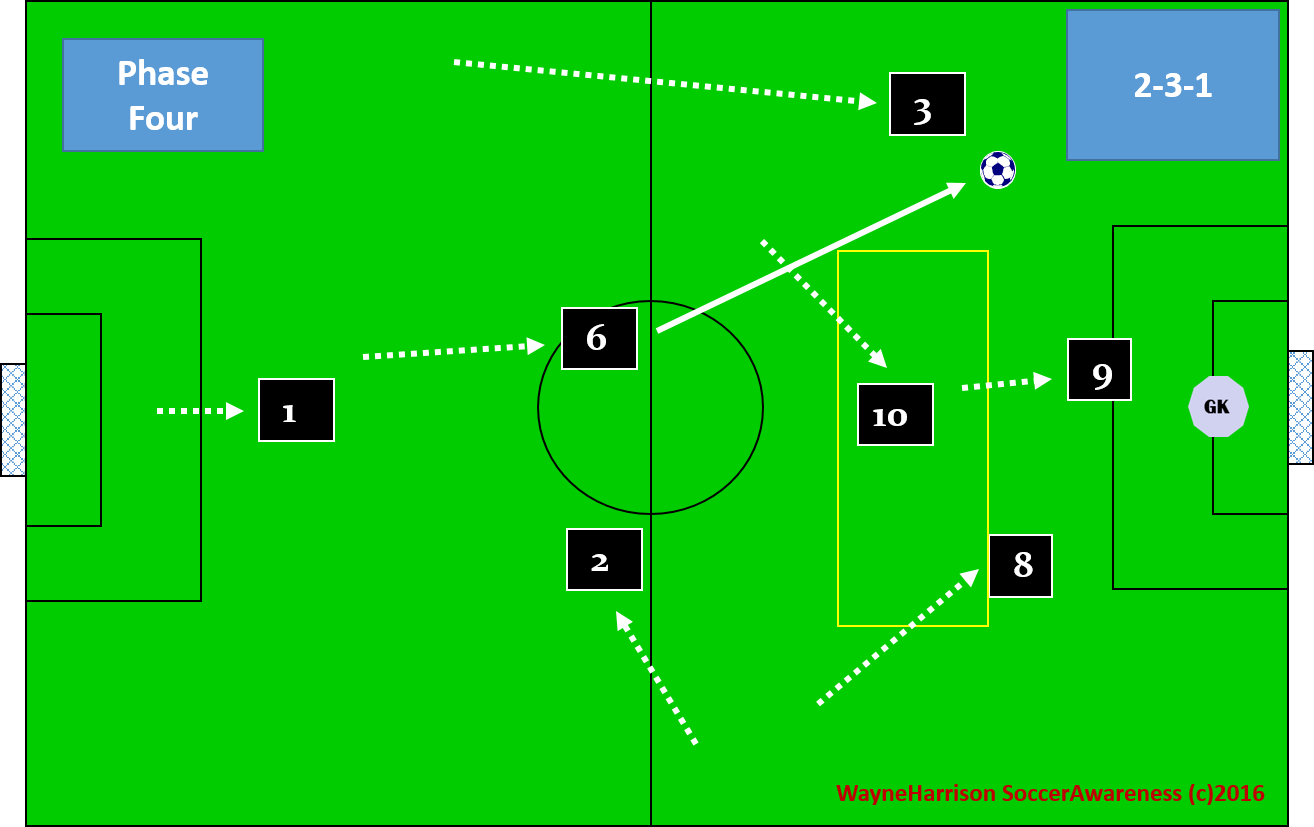
Next diagram we have a very simple “unit” pattern of play involving our 2 wide players working together and creating space for each other on one side of the field. (3) knows when (10) cuts inside that is the “cue” for (3) to overlap; call it a “condition” if you like. Likewise with (2) and (8) on the other side. This encourages / conditions our Fullbacks (2) and (3) to attack. This is a “two player rotation.”
This is the attacking team shape now a 2-3-1. The attacking team shape We push one wingback / FB forward (3) on only and keep safe at the back should the opponents win the ball and counter attack.
Get more like this including Small Sided 4 v 4 Attacking Games, Patterns of Play at 7 v 7, Team Shape Development in 9 v 9 and lots more in Soccer Awareness eBook: Tactical Thoughts on the Development of the New 4 v 4, 7 v 7 and 9 v 9 Game Sizes.

How To Set-up A Small-Sided Game
Small-sided games are less than 11 v 11 and can be any number from 3 v 3 to 9 v 9. The general sizes of a game to establish team coaching themes are usually 6 v 6 or 8 v 8. Here are two examples of set ups for these sizes of games and information on U.S. Soccer's small-sided games standards.
The following is an excerpt from The Ultimate Youth Coaches Training Guide; A Complete 6 to 10 Year Old Developmental Coaching and Training Program.
This program is perfect for youth coaches wanting practices to start their soccer coaching education and it is also for those more advanced and experienced coaches wanting to train their players as best they can at these wonderful open minded ages for development and education of both the mind and body. Our plan is to help all coaches at whatever level of experience they are at. Find Out More
This is a game of less than 11 v 11 that can be any number from 3 v 3 to 9 v 9. The general sizes of a game to establish team coaching themes are usually 6 v 6 or 8 v 8. I have included two examples of set ups for these sizes of games and information on U.S. Soccer's small-sided games standards.
Session Plan
Only coach one team at a time.
Try to work with all the players on the team you are coaching, affecting each performance in a positive way.
Stick to one theme / topic at a time don’t jump from one to another during the session this will only confuse the players.
Divide the field into thirds; defending, middle, attacking third, for easier points of reference (for 6 v 6 and upwards). Cone the thirds of the field off to show the boundaries.
Use specific start positions to get the session going.
Develop your theme using the key coaching points and use them as a base for referral to check you have covered them in the session.
List the key points in the order you perceive them in the process of building the session. For example in defending, pressure on the ball comes before support.
Move from simple to complex as you develop the session, for example in the theme defending from the front, coach individual play within the team concept first (working with one striker), move to coaching a unit of players (it could be the two strikers working together), then extend the numbers (it could be working with the strikers and midfield players then finish with coaching the whole team (strikers, midfielders, defenders, keeper).
This is individual, then unit, then team in this order building up the session from simple to complex in a logical order.
This is just an example to how it can be done in a logical order; it is up to the individual coach to develop his / her own method to suit their own style of coaching.
How to Build a Functional Session
Coach only one set of players.
Work with all the players but work primarily with those players in the specific areas you are trying to affect. On a percentage scale consider 75% of the time with the specific players and 25% of the time with the supporting players on the same team.
Stick to the same theme.
Try to isolate the area of the field and the players who function within that area that you are trying to affect. For example the area to work in with central defenders would be centrally around the edge of the penalty area up to the half way line. For wide midfielders it would be on the wings of the field.
Use start positions to determine how the session begins. Servers can be used to start the session and also double up as targets to play to.
Develop your theme using the key coaching points and use them as a base for referral to check you have covered them in the session.
List the key points in the order you perceive them in the process of building the session.
Work with the individual then the pair or unit building up the number of players you work with at any one time.
Use the functional practice to work with a small number of players in key areas of the field. A functional practice is more specific than a small – sided game, phase play or an 11 v 11 and it isolates the players being coached.
How to Present a Phase Play
Only coach one team at a time.
Try to work with all the players on the team you are coaching, affecting each performance in a positive way.
Stick to one theme / topic at a time don’t jump from one to another during the session this will only confuse the players.
Include key coaching points you want to get into the session and list them with the session plan. Try to cover each point within the session itself.
Use specific start positions to begin the session.
The phase play is attacking one set of goals only with target goals for the opponents you aren’t working with to play to, should they win the ball.
In defending phase plays where you are working with the defending team who protect the only goal, the team that needs to have the ball most of the time is the attacking team as it is the defending team’s job to win it back. Once they win it they should get the ball to a target goal quickly and in as few passes as possible as we are coaching them when they haven’t got the ball not when they have it in their possession. As soon as they have won it and have got it to a target the ball goes back to the attacking team and they begin a new attack. You can condition this by allowing the defending team only so many passes (maybe 5 passes) to get the ball to a target then they lose the ball and a new phase play is set up.
It can be numerous combinations of numbers of players ranging from 4 v 4 to 9 v 9, this can depend on the number of players you have to work with on any given day. Often the best number is a 7 v 7 or with an overload with the team you are working with perhaps to help gain initial success in the session (it could be a 7 v 5). For example in an attacking phase play have 7 attacking players against 4 defending players and a keeper to help the session have the chance be a positive experience for the players you are coaching and the theme to be successful.
Coaching Styles
Command, question and answer and guided discovery are the three methods of coaching to be used preferably the third one; guided discovery being the most used as it gets the players to think for themselves though there are always situations where each style is required to be used. Command is telling and / or showing them what to do (doesn’t leave a lot of room for the players to think for themselves and understand), question and answer is just that; asking them to tell you what they think should happen, guided discovery is asking them to show you they understand a coaching point by moving themselves to the position you require them using their own decisions.
The following is from U.S. Soccer's 2015 Player Development Initiatives Release. Read on USSoccer.com here.
From U.S. Soccer:
The small-sided standards are focused at players from the U-6 to U-12 age groups. The field size is based on age groups, providing a more age appropriate environment that will allow players with a better opportunity to develop heightened soccer intelligence and on-the-ball skills.
The field dimensions and number of players on the pitch will increase in size from 4v4 to 7v7 to 9v9 as players age, up until they reach the U-13 age group and begin to play full 11v11 matches.
| Age | U6 | U7 | U8 | U9 | U10 | U11 | U12 | U13 |
|---|---|---|---|---|---|---|---|---|
| Maximum Field Size (yards) | 30x20 | 30x20 | 30x20 | 47x30 | 47x30 | 75x47 | 75x47 | 112x75 |
| Number of Players | 4v4 | 4v4 | 4v4 | 7v7 | 7v7 | 9v9 | 9v9 | 11v11 |
| GK | No | No | No | Yes | Yes | Yes | Yes | Yes |
| Playing Times (minutes) | 4x8 | 4x8 | 3x15 | 2x25 | 2x25 | 2x30 | 2x30 | 2x35 |
| Break Times (minutes) | 5 | 5 | 5 | 10 | 10 | 10 | 10 | 15 |
| Ball Size | 3 | 3 | 3 | 4 | 4 | 4 | 4 | 5 |
| Goal Size (feet) | 4x6 | 4x6 | 4x6 | 6.5x18.5 | 6.5x18.5 | 6.5x18.5 | 6.5x18.5 | 8x24 |
| Offside | No | No | No | Yes | Yes | Yes | Yes | Yes |
“In general we would like for players to be able to process information faster, and when they are in this environment they are going to learn to do that over a number of years," Ramos said. "When you have young players in an 11v11 game there are only so many involved in any one play at a time. By taking numbers away and playing 4v4, 7v7, and 9v9, you are multiplying their chances on the ball, increasing their touches and making it overall more for them by making them an active participant at all times. Fast forward 10 years and there are thousands of game situations added to a player’s development.”

Small Sided 4 v 4 Defending Games
One way to teach the basic tactical game of the 4 v 4 is to offer many different ideas on actual game situation that focus on certain themes. This is what the following presentations does. You cannot do better than put players into game situations to learn the game, we just take it one stage further by what we present here. We begin by teaching defending principles in a 4 v 4 game situation so several thoughts on different set ups to teach it individually and collectively as team players.
The following drill is part of Soccer Awareness eBook: Tactical Thoughts on the Development of the New 4 v 4, 7 v 7 and 9 v 9 Game Sizes.
This 407 page eBook shows how these different size games can be taught and also shows different systems of play that might be useful to you.
Run with them as you may and of course come up with your own solutions too as that is what coaching is all about. I have introduced the use of RONDOS to initially aid the development of players for the game situation. Click Here to Preview The Book
The USSF now have made it mandatory for 4 v 4 games to be played at the younger ages. This is a GREAT MOVE and long overdue.
This is what US Youth Soccer states:
Here are some of the reasons why we believe, as soccer coaches, administrators and parents must guarantee that our young soccer players play small-sided games:

Because we want our young soccer players to touch the soccer ball more often and become more skillful with it! (Individual technical development)
Because we want our young soccer players to make more, less-complicated decisions during the game! (Tactical development)
Because we want our young soccer players to be more physically efficient in the field space they are playing in! (Reduced field size)
Because we want our young soccer players to have more individual teaching time with the coach! Fewer players on the field and fewer players on the team will guarantee this! (Need to feel worthy and need to feel important)
Because we want our young soccer players to have more, involved playing time in the game! (More opportunity to solve problems that only the game presents)
Because we want our young soccer players to have more opportunity to play on both sides of the ball! (More exposure to attacking and defending situations)
Because we want our young soccer players to have more opportunities to score goals! (Pure excitement)
Because we want to include children of all temperaments, assertive to shy, to have more opportunities to interact with others and the game! (Socialization)
These are the reasons why we adults must foster "Small-Sided Games" in our youth soccer programs. The "Small-Sided" environment is a developmentally appropriate environment for our young soccer players. It’s a FUN environment that focuses on the young soccer player.
All makes total common sense.
One way to teach the basic tactical game of the 4 v 4 is to offer many different ideas on actual game situation that focus on certain themes. This is what the following presentations do.
You cannot do better than put players into game situations to learn the game, we just take it one stage further by what we present here.
We begin by teaching defending principles in a 4 v 4 game situation so several thoughts on different set ups to teach it individually and collectively as team players.
4 v 4 a Basic Diamond Shape for Defending
The main idea here is for the defending team to condense the area the ball can be played into the defending team become a diamond within the opponents attacking diamond. (4) Forces (A) one way and the rest of the team adjust their positions off this. (3) Protects the space inside but can close down (C) if the ball is passed, (2) and (1) is the same scenario and this results in the diamond being shorter and tighter.
As the opponents move the defending team must move to compensate. Also if any pass is played behind (1), (2) or (3) they should be first to the ball.

Coaching Points:
Pressure – 1 v 1 defending to win the ball, delay or force a bad pass.
Support – position of immediate teammate (angle, distance and communication).
Cover – positions of teammates beyond the supporting player.
Recovering and Tracking should the ball go past our position, recovery run to goal side of the ball and tracking the run of a player.
Double-Teaming – (A) passes to (C), (3) closes (C) down from in front, (4) follows along the path of the ball to close down from behind or slightly to the side. (4) Closes in such a way as to obstruct a bass back to (A).
Regaining Possession and creating Compactness from the back (pushing up as a unit).
The objectives of defending are to disrupt the other teams build up, make play predictable, prevent forward passes and ultimately regain possession of the ball.
Techniques include – pressuring, marking, tackling and winning the ball.
Get more like this including Small Sided 4 v 4 Attacking Games, Patterns of Play at 7 v 7, Team Shape Development in 9 v 9 and lots more in Soccer Awareness eBook: Tactical Thoughts on the Development of the New 4 v 4, 7 v 7 and 9 v 9 Game Sizes.

The Roles and Responsibilities of Each Player in 9 v 9
Here we are looking at players 1, 2, 3, 6, 7, 8, 9; 10 and 11 of the 11 v 11 and we will look at them in this particular formation of 1-3-3-1-1. You could of course use different formations at 9 v 9 but I'm basing it on this one because it’s closer to the set up of the 11 v 11 so it transitions easily into it.
The following is a preview of Soccer Awareness eBook: Tactical Thoughts on the Development of the New 4 v 4, 7 v 7 and 9 v 9 Game Sizes.
This 407 page eBook shows how these different size games can be taught and also shows different systems of play that might be useful to you. Run with them as you may and of course come up with your own solutions too as that is what coaching is all about. I have introduced the use of RONDOS to initially aid the development of players for the game situation. Click Here to Buy the Book
Here we are looking at players 1, 2, 3, 6, 7, 8, 9; 10 and 11 of the 11 v 11 and we will look at them in this particular formation of 1-3-3-1-1. You could of course use different formations at 9 v 9 but I'm basing it on this one because it’s closer to the set up of the 11 v 11 so it transitions easily into it. You could argue also of course that it depends which 11 v 11 you use as to how it transitions; which would also be correct. But then if we evaluated every permutation then this book would be a 1000 pages long but I will at least offer two examples with a back 3 and a back 4!
So I am working off the fact this will transition into a 1-3-3-1-3 or a 1-4-2-3-1 because the 1-3-3-1-3 is the attacking shape of the 1-4-2-3-1 anyway (that’s another book of which I have two written to explain each formation also). Now (2) And (3) have (7) and (11) in front of them to help both in defense and in attack. We want them to get up and down the field as our wide outlets and building relationships with each other, (2) two with (7) and (3) with (11).
(6) Can still be compared to center backs (4) and (5) in their roles though in a more attacking minded way in the way I believe we can play. (6) is also STILL playing a more characteristic Number (6) role as in the 11 v 11 team. (8) Is like a link midfield player and (10) is the shadow striker in behind (9) the central striker in a truer sense of the word than at 7 v 7. In this set up the shadow striker has perhaps slightly less defensive duties than the shadow striker in the 7 v 7 did due to the positioning and higher number of players on the team.
Defensive positioning is more in front (8) than beside of (8) as it would be in the 7 v 7. (9) Plays the traditional striker role. We have previously covered the roles of 1, 2, 3, 6, 8, 9, and 10 in the 7 v 7 and their roles are very similar to the 9 v 9 so we will just address the wide players (7) and (11) and some pertinent relationships between players in the 9 v 9.
Team shape from defending to attacking in 3-3-1-1 preparing for a back three at 11 v 11
Defensive shape is at the red triangle cones. Attacking shape at yellow triangle cones.

Team shape attacking in 3-3-1-1 preparing for a back three at 11 v 11
Defensive shape is at the red triangle cones. Attacking shape at yellow triangle cones.
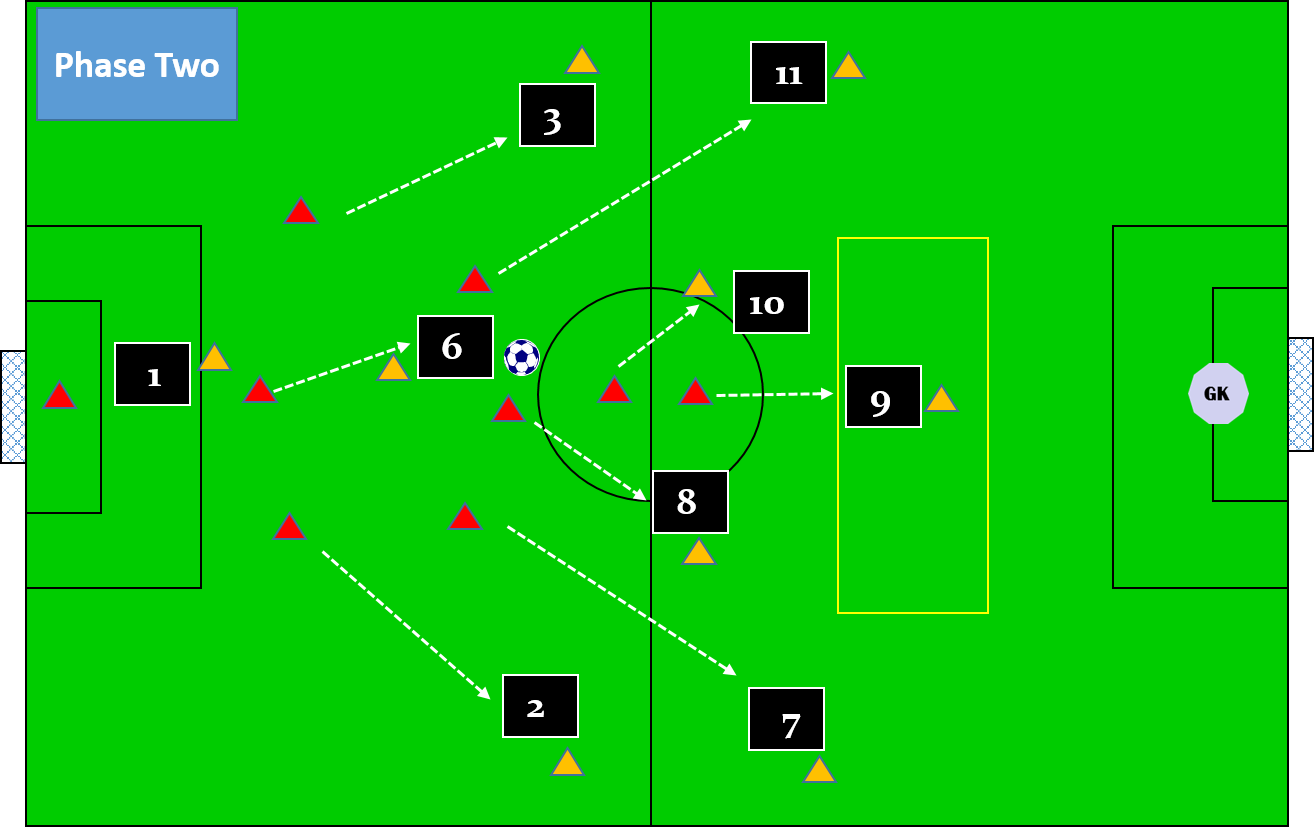
Team shape from defending to attacking in 4-3-1 getting prepared for a back four at 11 v 11
Defensive shape is at the red triangle cones. Attacking shape at yellow triangle cones.
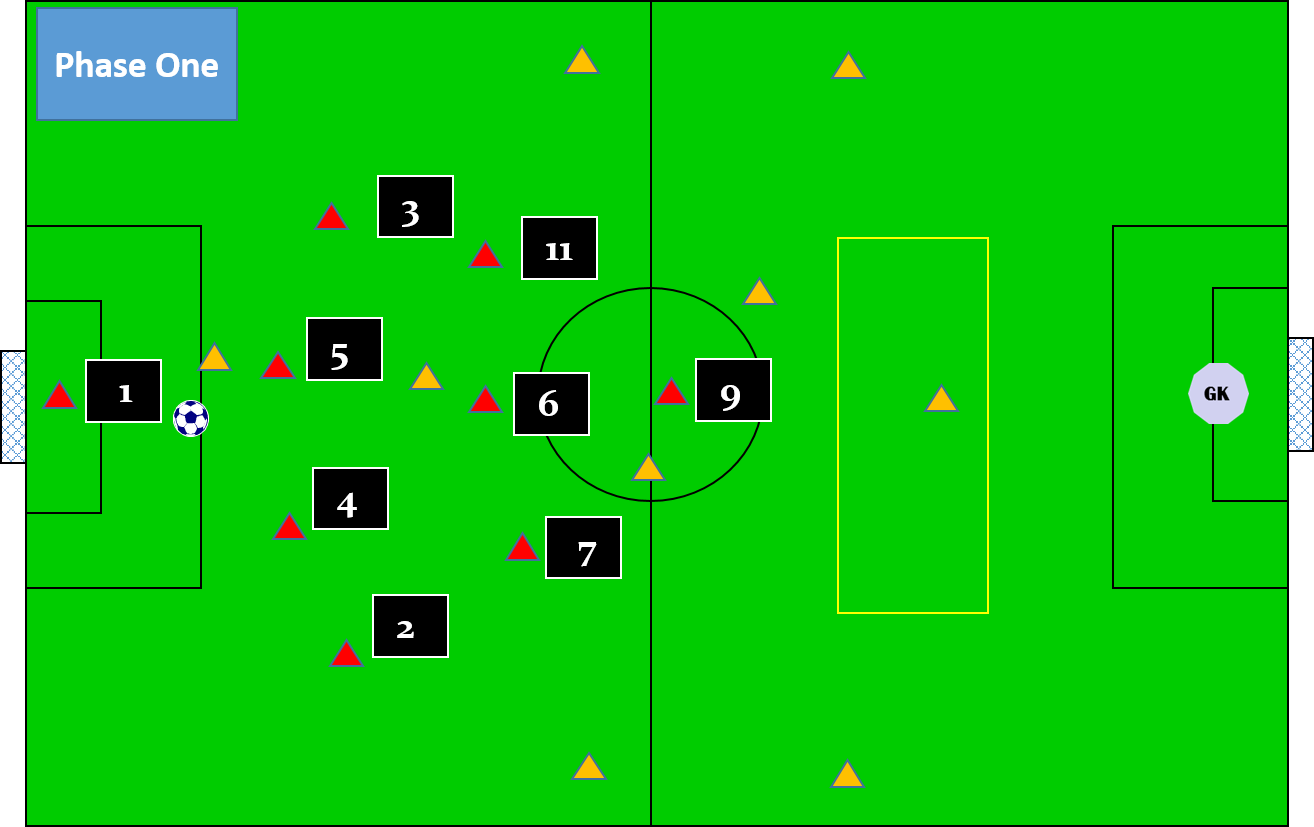
Team shape attacking in 4-3-1 getting prepared for a back four at 11 v 11
Defensive shape is at the red triangle cones. Attacking shape at yellow triangle cones.

The Roles of (7) and (11)
Technical:
- Speed with the ball
- Control of the ball - first control – great first touch
- Crossing Ability – cross with pace: on the ground or by air, with a curve out of the reach of the goalkeeper and between the goalkeeper and defenders. Where to Cross can depend on the position of goalkeeper, defenders and attackers (to the near post, to the far post, the pull back, beyond the far post)
- Also dribbling inside and outside to shoot at goal or to cross
- Passing ability
- Scoring - balls on the floor - balls in the air
Tactical: In Possession
- With ball - speed control with the ball
- Positioning- always in a position to receive, open stance, and facing towards the goal, and as open as possible
- Know how to choose (when and where) - Cross, 1 to 1 dribble; when to pass, when to shoot.
- Understanding of when and where to break outside to inside.
Tactical: Out of Possession
- Orientation: Movement off the ball - to attack - to defend
- Communication - with their peers and with respect to the opponent
- Attitude to close spaces as a team player
- Ability to press and hold the position.
Psychological
- Disciplined and responsible - make the field as large (and deep) as possible
- Orientation. Will work for the team - on offense - on defense: close spaces and prevent deep passes
- Confidence - Create actions for goals - Passing and crossing
Physical
- Speed - in short, medium and long distance - technical in speed (with great coordination)
- Endurance
- Change of pace - be able to play at three different speeds.
- Ability in Passing and Crossing; Dribbling; Shooting ability; Heading Ability.
ATTACKING (55%)
Depending on the way the coach plays the 4-2-3-1 the types of players in these roles may be quite different team to team. A more defensive minded coach may use defensive midfield players here, an attacking coach may choose wingers here which would produce totally different effects with the same system. Or, the coach may pick certain players in these positions based on what the opponents will play like.
A big part of the switch is the role of the wide players. Rather than stay wide (which would hamper the ability of the full-backs to get forward), they narrow and become almost a conventional front three with the lone striker (9). This has the effect of narrowing the opposition defense, as their natural markers (full-backs) follow them into the centre.
Tactical Understanding / Game Intelligence: So, wide players must be comfortable drifting into the centre of the field and coming inside not just being skilled going outside and crossing as is the traditional role of the wide player. Therefore they must be better all round players than the traditional wide player (whether it be a defensive minded or attacking minded player, now it is best if they can be good at both).
Of course, this opens up a huge amount of space on the flanks, which the full-backs can exploit. This presents a further problem for the defending team, as their wide midfield players are suddenly charged with almost a solely defensive job. If the attacking full-backs get to the byline and the defending wide midfielders track them all the way, the defending team will end up with something approaching a flat back six.
Opposites: An added advantage is a right footed player who can play on the left and cut inside and have a good shot, and vice versa. They attack the fullback inside, and they have an advantage from this as they cut inside onto their strongest foot and inside against the fullback’s weakest foot; attacking the left backs right foot; and the right backs left foot.
Shooting and Crossing: having the ability to shoot on goal. Traditional wide players usually are good at crosses and tended to stay wide, the modern wide player has to be better at so many more skills than previous generation’s of players. So; they need the ability to stay wide and cross the ball and the ability to cut inside and shoot at goal.
DEFENDING (45%)
Understanding: Must defend in front of their respective fullback and develop a defensive relationship with them. This player can defensively cover for the fullback attacking. Must have a good tactical understanding to be able to combine with his fullback and know when and where to cover for him; when the fullback breaks forward.
Recovery: Recovery runs are vitally important for this player in this system of play. When recovering they can become a part of a defensive four in midfield.
1 v 1: Must be good at 1 v 1 defending
The relationship between (9) and (10)
ATTACKING:
They must develop a good understanding of movement off the ball to compliment each other. Interchanging of positions can cause much confusion in the opponents defense; and so they have to develop good mutual timing of this movement.
Angled positions off each other will help them in a supporting capacity.
At the same time they will link up together and form a formidable unit of two.
Generally (10) is positioned behind (9) but it can be the reverse at different moments in the game to confuse defenders.
DEFENDING:
They can help each other by pressing as a unit high up the field. Better to work as a pair if it is possible with early pressing of opponents with the reward of winning the ball in an area they can often shoot immediately on goal.
The relationship between (7), (9) and (11)
ATTACKING:
When we attack these three form a three pronged attack. The 1-3-3-1-1 becomes a 1-3-1-1-3 and often the two wide attackers tuck in to support the central striker (9), they may do it at the same time, to form a three; or, depending on which side of the field the ball is on, one will tuck in to form a two pronged attack. These three may interchange to confuse the defenders they are playing against.
They need a good understanding of how to work as a three and also a two, and when to tuck in and when to stay wide.
Barcelona again show this perfectly with the interchanges of Messi, Suarez and Neymar with no real set positions for any of them, they have the freedom to interchange and move around which makes it very difficult for each defender to know who to pick up.
DEFENDING:
The central striker (or whoever is filling that role at the time between the three strikers) must be the first line of defense.
Usually the two wide attacking players drop back to form a midfield three with the central midfielder (8) and tuck back into a 3-3-1-1 defensive team shape.
There again when the time is right they will press as quickly as possible wherever the ball is.

Simple 3 Player Rotational Combination Movements to Teach
Positioning and rotations correctly “off the ball” is vital for team success. Here are Simple 3 Player Rotational Combination Movements that can be taught in training.
The following information is an excerpt from Soccer Awareness eBook 9: How to Develop Spatial Awareness. This 60 page eBook teaches rotational combination movements to teach in 11 v 11.
Positioning and rotations correctly “off the ball” is vital for team success. We begin with a description of the roles of each player and how and where they can move to compliment each other. After establishing the roles and responsibilities of each player, we look at how small movements off the ball can open up spaces for players and create passing lanes.

(9) Short, (10) wide, (7) inside from outside.
So (9) becomes (10), (10) becomes (7); (7) becomes (9).

The set up is for (3), (10) and (11) to work together and move opponents around to free up space for each other.

We hope the defenders react slowly to our movements that are preplanned so they are not aware of what we are going to do which should give us the edge.
(9) can pull away to clear the space for (11) also.
Get more like this in Soccer Awareness eBook 9: How to Develop Spatial Awareness.

2 v 2 To Goal
The coach serves the ball into the penalty area and both teams compete for the ball and try to score. If the team on defense wins possession, they can go to goal as well. If the goalkeeper makes the save or the ball goes outside the penalty area, the play is done.
The following drill is part of Soccer Awareness eBook 7: Seventeen Shooting Practices for U6 to U10. This book can be purchased separately or as part of the Premium Plan in the Soccer Awareness Training Center.
Soccer Awareness Training Center provides unlimited access to Wayne Harrison's Soccer Awareness systems, training sessions, drills and more. Wayne's system helps develop world class youth soccer players and teams in a systematic and imaginative manner that guarantees performance at the highest level of competition. Whether you’re a beginning coach who needs help getting started or someone who wants to add some variety to their training sessions, the Soccer Awareness Training Center offers a wide variety of drills to choose from. Join Today
Emphasis: Finishing, Receiving, Defending, Passing, Goalkeeping
Set-up: Use the penalty area and a regulation size goal. Two teams with two players are inside the penalty area. The coach is standing inside the D with a group of balls, and dictates the service into the box.
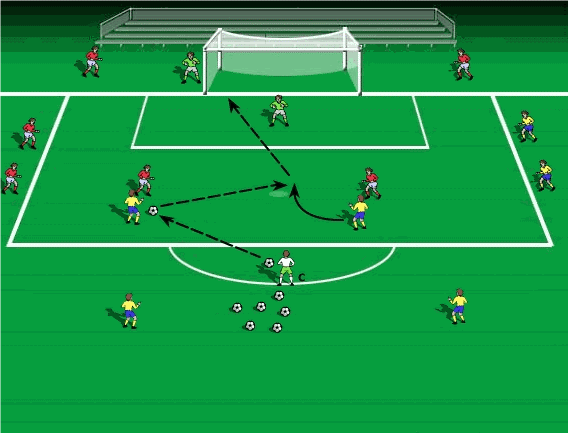
Objective: The coach serves the ball into the penalty area and both teams compete for the ball and try to score. If the team on defense wins possession, they can go to goal as well. If the goalkeeper makes the save or the ball goes outside the penalty area, the play is done. Have the resting teams on the sides of the penalty area keeping the balls re-circulated.
Progression:
- The serves can come from anywhere outside the penalty box. Use the extra players for this.
- A goal must be scored in eight seconds or less.
- Both teams have a two touch maximum.
Coaching Points:
- The players must be willing to work both sides of the ball.
- Receive the ball sideways on.
- Close down the shooter quickly.
Recently Added to the Soccer Awareness Training Center
Attacking and Defending Games Challenging the Mindset and Mental Transition of the Players
Attacking Combination Plays

Small-Sided Games for Strikers
Turning Technique and Skill for 6 to 10 Year Olds
Soccer Awareness Training Center provides unlimited access to Wayne Harrison's Soccer Awareness systems, training sessions, drills and more. Wayne's system helps develop world class youth soccer players and teams in a systematic and imaginative manner that guarantees performance at the highest level of competition. Join Now

Defensive Positioning to Fix in Defensive Team Shape
Teams should have 2 basic shapes, an attacking one and a defensive one; wide and long on offense, short and tight on defense. The differences between each should be significant in terms of spacing between players. A problem that occurs is defensive team shape is not short and tight enough and it allows opponents too much time on the ball.
The following excerpt comes from Soccer Awareness eBook 30: Common Mistakes to Correct at 11 v 11; Identifying and Solving Common Real Game Situation Problems in the Training Environment.
This is a different way to look at the game, rather than highlighting what we need to do well, it shows what often goes wrong and how to fix it. These are many situations I have found happen in top level games. How many of these problems do YOU experience with your team?
Many of the defensive problems as you will see can EASILY be fixed just with good 1 on 1 or unit pressing. Also defensive tactical positioning is covered; as is improvements in our attacking play. A major improvement is needed though in COMMUNICATION at youth level to help fix all errors in most cases. Preview
Defensive Positioning to Fix in Defensive Team Shape
Teams should have 2 basic shapes, an attacking one and a defensive one; wide and long on offense, short and tight on defense. The differences between each should be significant in terms of spacing between players. A problem that occurs is defensive team shape is not short and tight enough and it allows opponents too much time on the ball.
Here is an illustration of defensive positioning to fix. Opponents spread out and our players are FAR TOO WIDE. They mark players not space. This pass is just an example of what we allow that we should stop.

Now, this is how it should set up. All Players tuck in and mark space. Almost inviting (C) to pass to (D) so (7) can press quickly. It may be only 5 to 10 yards of movement but it is vital so we are much more difficult to play through.

Offensive Midfield Player is too Wide
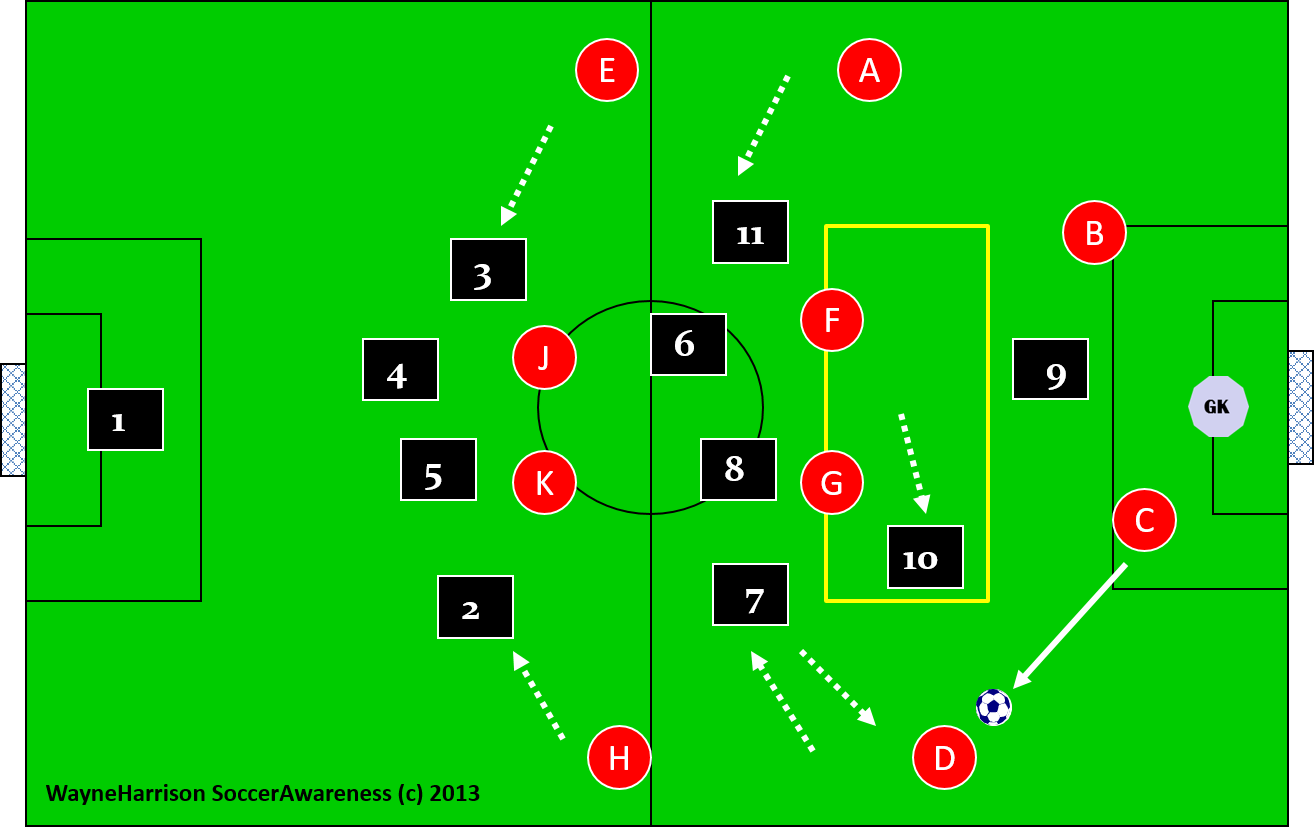
In this example, our opposite midfield player is too wide. This happens too much. We want our players defensively tight close to the ball. This also is a really common one easily fixed. Often fullback (3) does the same as shown.

Here's how it looks when our opposite midfield player tucks in. We want to try to overload the immediate area of the ball, actually condense much more than you might ever imagine. Here a 5 v 3 in our favor. (7) stops the pass to (H).


Four Color Cone Defending Drill
Four cones, red, blue, yellow and white, coach calls different colors players have to adjust side to side to get there quickly. 5 to 6 seconds each pair. Defenders are now shifting quickly and against the movement of the attacker when the attacker decides to shift the ball one way or the other. Only do it for 5 or 6 seconds because in games defenders only stay down there like this for that time period generally. How quickly can they do it?
The following session is an excerpt from Soccer Awareness eBook 19: The Principles of Defending for U8 to U14
Teaching the principles of defending is a vital Art that every coach and player must learn, in theory it is 50% of the game, we cannot score if we cant win the ball in the first place.
This book takes you through simple individual beginnings to more complex unit and team ideas on defending. We address all the important facets of defending such as pressure on the ball and how to tackle or delay, immediate supporting positions, covering positions beyond the support player, the importance of recovery runs to get back goal side of the ball (which many players don't like or want to do), the need for players to track back individual opponents so they do not overload areas against us; and ultimately how we must develop compactness as a team.
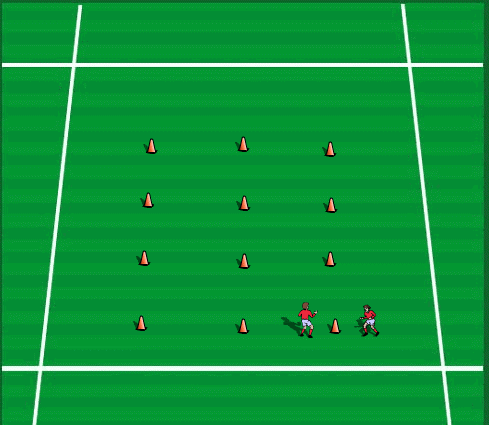
Four cones, red, blue, yellow and white, coach calls different colors players have to adjust side to side to get there quickly. 5 to 6 seconds each pair. Defenders are now shifting quickly and against the movement of the attacker when the attacker decides to shift the ball one way or the other. Only do it for 5 or 6 seconds because in games defenders only stay down there like this for that time period generally. How quickly can they do it?
Change Cone Set Up
Defenders do not just move laterally but they move in different directions such as diagonally and also forwards and backwards. Move the cones so they are at angles to each other. So in pairs and again calling the color, the same routine but a different cone set up so running in different directions and at different angles.
Progression: Open it up so distances are longer.

Do three pairs at once all starting on the same color.
The head forward and the “sitting down” position
Maldini of AC Milan gets into this position with his knees tucked in, like skiers do.
If going to shift to the left; then the right leg does the work, if to right; then the left leg does the work. Getting into this position is physically hard work also.

Longer distance (one outside cone to the other) then can cross legs over and run a couple of strides and on the last two strides do the shifting style side to side. So run a couple of strides first then the feet go side to side as opposed to crossing.

Now side to side to each cone; pressing inside the cone. Have the left foot in line with the left cone, right foot in line with the right cone showing inside.. Check that the feet are right so run at each cone, hold, check, and then go again to the next one. Next show outside so get your right foot just about level with the left cone, your left foot the same with the right cone. You might give half a yard but no more because if you give more the attacker will cut across and inside you. It can be a curved run if you have time.
Showing outside; get the foot, “just about”, level with the ball.
Two Passers positioned at the end of the Balls.
Instructions: On the first run, defenders press each ball and show the ball (the dribbler) to the outside. On the 2nd run the defender shows the ball to the inside. At the end of the run, the defender presses a couple of one touch passes made by the two end players, then goes back to the end of the line to start again.
Coaching Points:
- Speed to the ball is important and "putting on the brakes" just before each ball is key too.
- Do not cross legs in transition.
- "Sit Down" (bend legs) when pressing.
Progression: Now 2 defenders working together press and support.

Instructions: This time the 1st defender has a 2nd defender, a covering player, behind. On the first run, defenders press each ball and show the ball (the dribbler) to the outside. On the 2nd run, the defenders show the ball to the inside. Check the 2nd defenders position each time. Ask the players to show you where they think their support position is.
At the end of the run, the defenders press a couple of one touch passes made by the two end players. In this case they switch over being the pressing player and the covering player.
You can do it two ways, the first defender is always the pressing player, or between each cone they alternate.

3 v 2 To Goal
Use the penalty area and a regulation size goal. Two lines of defenders stand on both sides of the goal. Three lines of attackers stand five yards out from the top of the penalty box. The coach or server stands on the end line, between the 6 and 18, with a group of balls.
The following session is an excerpt from Soccer Awareness eBook 7: 17 Shooting Practices for U6 to U10. Shooting drills are the best way to improve soccer players shooting on goal with power and accuracy. Training shooting soccer drills at an early age will show great improvement in a youth players shot. Shooting drills make player’s shot better through muscle memory, consistency and repetition that make the brain memorize the motion and position of the body so the player can perform these shots during a soccer match. These are 17 of Wayne’s favorite shooting drills for working with U6 to U10 players that are also fun.
Emphasis: Finishing, Receiving, Defending, Passing, Goalkeeping
Set-up: Use the penalty area and a regulation size goal. Two lines of defenders stand on both sides of the goal. Three lines of attackers stand five yards out from the top of the penalty box. The coach or server stands on the end line, between the 6 and 18, with a group of balls.

Objective: The coach serves the ball into the penalty area. The first defender in each line, (2 total), leave the post to meet the three attackers (1 from each line), at the top of the box. The three attackers try to score a goal and the two defenders are trying to prevent the goal from being scored. The play is over when the goalkeeper has possession or the ball travels outside the penalty area.
Progression:
- Two of the three attackers must touch the ball.
- The goal must be scored after an overlapping run is made.
- The attackers have five seconds to score.
Coaching Points:
- Pressure the ball first and cut down the shooters angle.
- Goalkeeper must communicate with the defenders.
- Get the shot off early.
54 Pages
We want to stay with our own game plan as closely as possible; based on what we practice and to keep it simple for us; as we dictate to our opponents; and we impose OUR WAY on them.
But there will be many occasions where we must change the system of play and we may have to adjust to suit the opponents.
Here are some ideas for you to consider for your team starting with the 13313 and 14231 systems of play.