
Join the Soccer Awareness Training Center - 1 WEEK FREE TRIAL

Get Full Access to the Soccer Awareness library of 500+ drills, full training sessions, tactical development, systems of play, video instruction and more!
Whether you’re a beginning coach who needs help getting started or someone who wants to add some variety to their training sessions, the Soccer Awareness Training Center offers a wide variety of drills to choose from. Good coaches will find a variety of ways to teach their players a technique. Using different drills each day or week will keep your practices fresh and exciting - for you, your fellow coaches, and your players. Browse through various size small sided games or drills that target more specific functional team training needs. Each comes with a detailed description and photos to help ensure proper execution.

Just a one-word signal can organize a defense, so everyone on the team knows what to do and reacts together as a unit. Also midfield players close by can react off the call too as can strikers. These One-word calls ensure everyone will know quickly and effectively what they should do as a unit and as a team. Hence the back players (and the keeper) can organize their movement as a unit (and therefore influence those in front of them) from Five VERY simple one-word commands. The momentum is triggered from the back and runs forward through the team to the strikers. We must have a very vocal and confident leader at the back organizing this and making the decisions.

Some of the best forward runs in soccer are deemed “third man runs” often made from a position that is blindside of the opponents. The third man run player can start the passing sequence; or not, but invariably they are on the end of a forward pass often beyond the back four of the opponents.
The set up in the first game is as it would be in the attacking shape of a 4-2-3-1, so you can take this small sided game to represent the 11 v 11 in a particular area of the field making the same types of plays. You can also use this for any team shape set up you might use in an 8 v 8 or 11 v 11. If you play with two striker s then play 7 v 7 and two up front for example or even change the shape behind.
*Membership Required
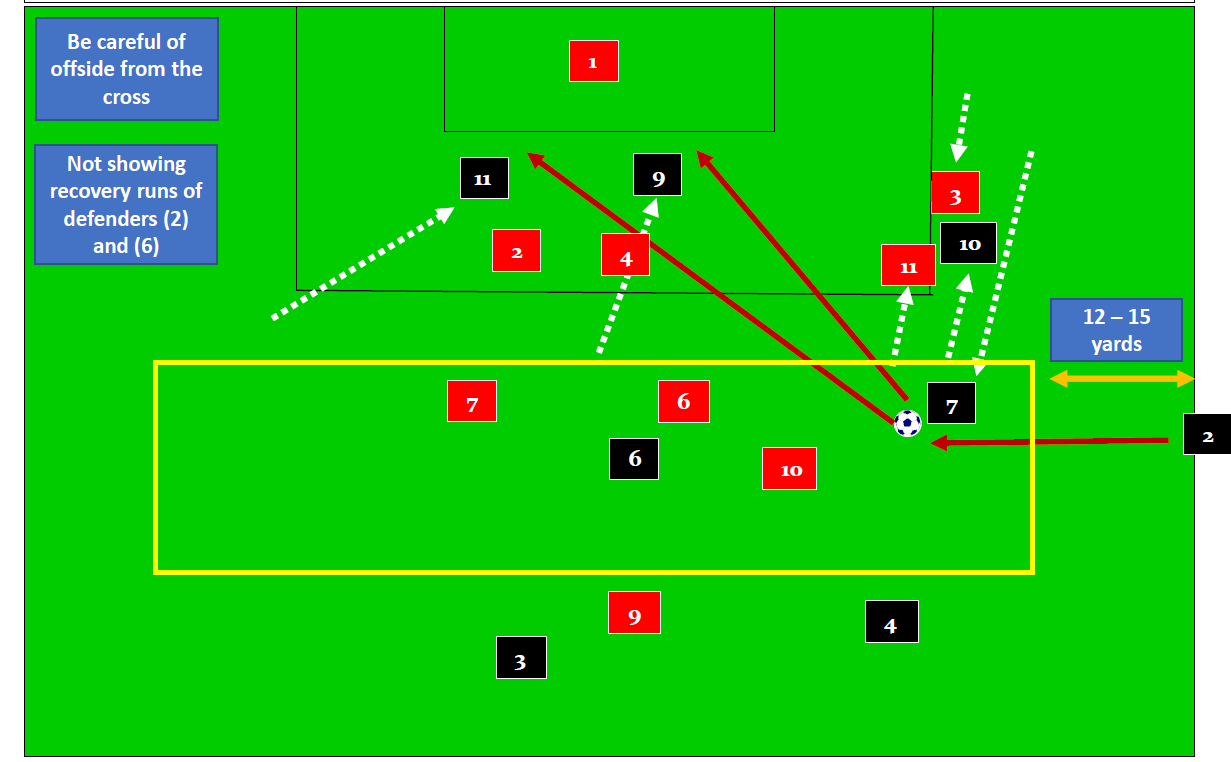
The best way to win the ball from a throw in; more often than not ; is for the opponents to throw it in. The best way to lose the ball from throw ins; more often than not ; is for US to throw the ball in. It sounds “back to front” but watch and see. Therefore, its very important to have pre meditated plans for throw ins, as must as for corners, free kicks wide and central or long, and how to defend from these set plays too.
This is a basic crossover move. The person who receives the throw to cross the ball starts their run second. (7) and (10) line up with (2). They look to cross over . All other players stay out of the immediate area.
This article is available for Training Center Members Only. Get more information about joining here.

A rondo can be applied on certain parts of the field of play that apply to the game. This exercise is based on the positioning of the players around Zone 14 (the zone in front of the opponents back 3 or 4 and their midfield).
Here we start the exercise off as a typical rondo and develop the idea to take it into the game situation. This example can be the shape within a 4-2-3-1 system of play. I have used this same set up many times in training to bring the ideas out in actual games with my U14 team. Certain moves become almost automatic as each player mentally knows what the other will do; before they do it. Especially good when teams defend deep against you and you have to open them up with imaginative movements OFF the ball. I love this session.
*Membership Required

This game and its many progressions are designed to get the most out of the thinking processes of the players. Many mental challenges to overcome and learn from. In the game players must develop the ability to be calm under pressure, to be confident to receive the ball in tight spaces and to have the confidence of teammates to give the ball to you under pressure. Players need to develop their ability to look ahead of the ball even more, to assess options and make decisions even faster because the time on the ball is even more restricted than usual.
This article is available for Training Center Members Only. Get more information about joining here.

Teams may work out that we are good at playing penetrating passes and making great runs in behind them so the way to try to stop this is to defend deep. If they defend deep we need a tactical solution to counter this. This presentation gives you ideas on how to do this and play initially IN-FRONT of the opponents back four.

This is just A WAY to play 7 v 7, there are various other ways to do it. Just a one-word signal can organize a defense, so everyone on the team knows what to do and reacts together as a unit. Also midfield players close by can react off the call too as can strikers. These One-word calls ensure everyone will know quickly and effectively what they should do as a unit and as a team. We must have a very vocal and confident leader at the back organizing this and making the decisions.
This article is available for Training Center Members Only. Get more information about joining here.

This is a very simple way to show how the team movement works. The main theme is movement OFF and often AWAY from the ball. Players position OFF the ball based on: The best spaces, the opponent's positions, their own teammates positions, the position of the ball. These are ALL EXAMPLES of what “might / could” happen. Players can interchange positions as we develop the play. We offer great dynamics and fluidity to the players to allow them to express themselves on the field.
With this we can show the discipline also involved when we lose the ball and we recover back or press high. Teams will develop their style of play within these frameworks, it will never be as picture perfect as this due to the nature of the game, it is more just a guiding framework. How we do it per team it can be determined by the level of play.
This article is available for Training Center Members Only. Get more information about joining here.

This is a very simple way to show how the team movement works. The main theme is movement OFF and often AWAY from the ball. Players position OFF the ball based on: The best spaces, the opponent's positions, their own teammates positions, the position of the ball. These are ALL EXAMPLES of what “might / could” happen. Players can interchange positions as we develop the play. This is an introduction to this presentation.
54 Pages
We want to stay with our own game plan as closely as possible; based on what we practice and to keep it simple for us; as we dictate to our opponents; and we impose OUR WAY on them.
But there will be many occasions where we must change the system of play and we may have to adjust to suit the opponents.
Here are some ideas for you to consider for your team starting with the 13313 and 14231 systems of play.

Teaching players to develop a "one touch mentality" in their game, to train the MIND.
To play in "Anticipation" of the ball; both on and off it by Scanning the field constantly to make earlier, faster and more successful decisions in the game.
How do we do this? Here are some sessions to use to help develop this ability.

45 Pages
Using the 1-3-3-1-3 system of play for this, we show how your players can find free spaces between opponents with inverted runs from outside to in. Including how to create freedom of movement within the team framework.

This 295 page ebook includes 17 game situational clinics focused on tactical play and target games. To achieve the given theme successfully, many of the situational games have set conditions to them to force the theme to happen consistently and to maintain the focus of it. As we will explain, a big part of teaching in ALL these games is developing a One Touch Mentality in each players brain. So the “general” theme around all of them will be establishing this thinking process no matter the “specific” theme being taught.
This book is also available to Elite and Premium Members in the Soccer Awareness Training Center. Access Here.

We produced the eBook "Tactical Thoughts on the Development of the 4 v 4, 7 v 7 and 9 v 9 Game Sizes" covering information on team shape and development. We now add this eBook to provide Curriculums in each game size to support the tactical games eBook.
What this eBook offers you:
Its all done here for you, paying attention to the ages of the players and the depth of teaching suitable to them.
As the program moves from 4 v 4 through to 11 v 11 the focus changes from individual teachings at 4 v 4, to small sided situations at 7 v 7, to Phases of play and tactical needs at 9 v 9; through to team tactical development at 11 v 11.
11 v 11 focuses on advanced training ideas to teach the “team”.
This eBook covers up to 14 weeks of training for each game size presented as one session per week.
All sessions have small sided games scrimmage set ups as close as we can get it to finish to reflect the theme of the session.

This eBook shows how these different size games can be taught and also shows different systems of play that might be useful to you.
The idea I am trying to cultivate is to find a pattern of development that goes from 4 v 4 to 7 v 7 all the way through 9 v 9 to 11 v 11 that educates the players VERY EARLY on how to ultimately play the 11 v 11, a common thread running right through the book.

This ebook contains 50 of the best, fun and developmental coaching sessions for 6 to 10 year olds providing a solid foundation for you to build your players' skills. There are more than 300 pages of specific practices with diagrams, step by step instructions, objectives, coaching points and progressions. Topics covered include: setting up training sessions and small-sided games, awareness, improving touch, dribbling, shooting, passing and much more. Bring out the best in your soccer players with these fun and developmental sessions.

Some of this is thinking outside the box and addressing issues not always covered in this format.

Complete 6 to 10 Year Old Developmental Coaching and Training Program
More than 750 pages of session, drills, theory and more to get you started or take your team to the next level.
This program is perfect for youth coaches wanting practices to start their soccer coaching education and it is also for those more advanced and experienced coaches wanting to train their players as best they can at these wonderful open minded ages for development and education of both the mind and body. Our plan is to help all coaches at whatever level of experience they are at.
This book aims to provide the best educational information possible for all coaches of players from 6 to 10 years old in terms of the Technical, Tactical, Skill, Psychological and Physical attributes players need at these ages and then bring it all together in a team concept. As the age group raises so does the type of training required.
Limited Time: Get a free copy of Best of Soccer Awareness ($12.95 value) with your purchase
Give the gift of coaching education to a colleague or family member with a Soccer Awareness Gift Card!
Purchasing this digital gift card creates a unique code. The gift card recipient can enter this code at checkout to subtract the gift card value from their eBook order total.
“The ultimate goal in coaching is helping each player develop his or her talents and abilities to the fullest. With this in mind, I created the Soccer Awareness philosophy of developmental coaching and training. It simply means training the mind before the body.” – Wayne Harrison
Testimonials

"You think the training process very well…the point after that is the way you put in practice with the players organizing a training session. The way you think and the way you make your exercises is very good.” – Jose Mourinho, Former Head Coach of Chelsea Football Club; now Head Coach of Manchester United
Training

Wayne is available to conduct coach and athlete clinics. The programs are structured with a first Class Curriculum based on Soccer Awareness “Developing the Thinking Player.” Try us and see, Wayne's training has a proven track record at professional level that shows it works.
The “Soccer Awareness” idea originated from what I felt were the most important things to teach players. I looked beyond the technical process as that is easy to implement and wanted to get INSIDE the head of the player.
Thus the “Thinking Process” of a player became my focus, developing ways to teach an awareness of space, time, and movement, but significantly BEFORE the player received the ball. I drew from my own experience as a player knowing if I had more of this great ability I would have been a far better professional player than I was. Read More >


Here are 9 ways to distribute from the keeper and play out from the back. We owe it to the players to teach them this as Young as is possible.
I work on this initially practicing all ways to get out. Have opponents only intercepting passes to begin. Then let it go free. When opponents win it back we work on the defending team condensing and defending correctly.
If three or four ways to develop play are done very frequently then it becomes a subconscious decision to move into position so no decision making required as such.
Subscribe to the Soccer Awareness Training Center to get access to all premium Training Center Exclusive articles.