Welcome to the Soccer Awareness Coaches Corner. Browse through soccer drills, small sided games, tactical thoughts, full sessions and a variety of resources. Posts marked “Training Center Exclusive” are for members only.

How to Play and Teach the 1-4-2-3-1
Here we have a 6 part video series showcasing Wayne Harrison presenting the 1-4-2-3-1 at the NSCAA Annual Convention in front of over 1200 coaches from around the world.. The series begins with developing play out the back to ultimately fashioning attacking and finishing movements off the ball in the attacking third and the 5 phases of play as he creates it. Wayne goes through the thirds of attacking development for you from back to front.
Here we have a 6 part video series showcasing Wayne Harrison presenting the 1-4-2-3-1 at the NSCAA (now United Soccer Coaches) Annual Convention in front of over 1200 coaches from around the world.. The series begins with developing play out the back to ultimately fashioning attacking and finishing movements off the ball in the attacking third and the 5 phases of play as he creates it. Wayne goes through the thirds of attacking development for you from back to front.

How to Teach Freedom of Movement for the 4-2-3-1
Attacking and Defensive Positioning; and Covering for Each Other in Brief
To play such a fluid and imaginative style of play as we do; where players are offered such freedom offensively all over the field; there is always a "weakness" to this we need to address. In this case we look at the defensive consequences for which we need to cover and correct.
Attacking and Defensive Positioning; and Covering for Each Other in Brief
To play such a fluid and imaginative style of play as we do; where players are offered such freedom offensively all over the field; there is always a "weakness" to this we need to address. In this case we look at the defensive consequences for which we need to cover and correct. Full version is 39 pages.
Defensive Adjustment and Organization
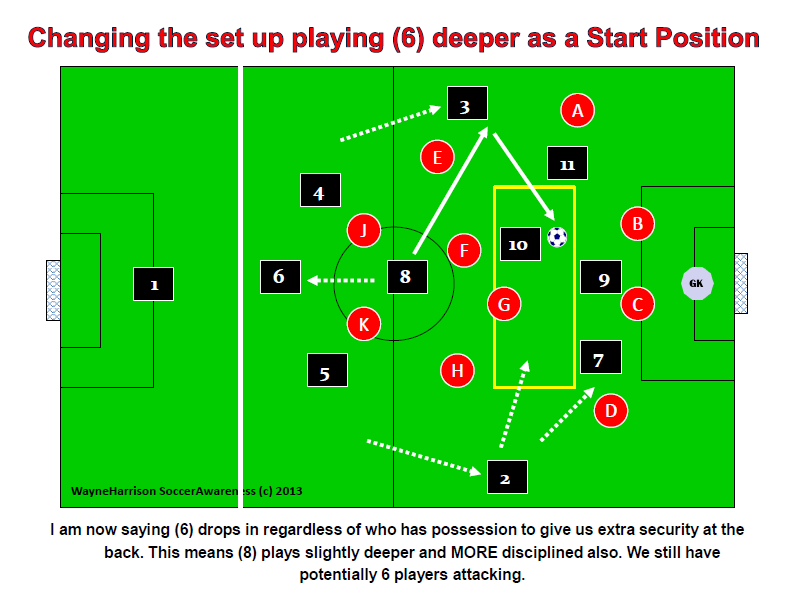
The potential weakness in this system and STYLE of play is the defensive adjustments needed to ensure our fluidity of attacking movement doesn’t cost us when we lose possession of the ball.
This presentation shows how we can make sure; defensively; we are disciplined and solid by teaching the players where to immediately press; where and when to recover; and how to fill in and cover for each other immediately the ball is lost.



Therefore we transition (in MIND and BODY) from incredible freedom of attacking momentum; which brings imagination, interchanges and rotations, to the opposite; intense, concentrated and positionally disciplined defense.
This is a simple way to show how we can make sure the team is well organized to allow the attacking freedom to take place; knowing we can cover ourselves if we lose the ball.
Interchanging Positions in Attack and what it means. We attack with freedom and rotation of positions knowing we are covered by team mates.

So now, as close as possible to identify the change; Nine is 10, Eleven is 9, Eight is 6, Six is 8, Ten is 11; and so on. Three is in an Inside Left position, Two is in an Inside Right position. A six player attack.
Our Players have attacked and interchanged positions in the attack but we have lost the ball. They get the ball out and keep possession; we have to press and also recover at the same time.
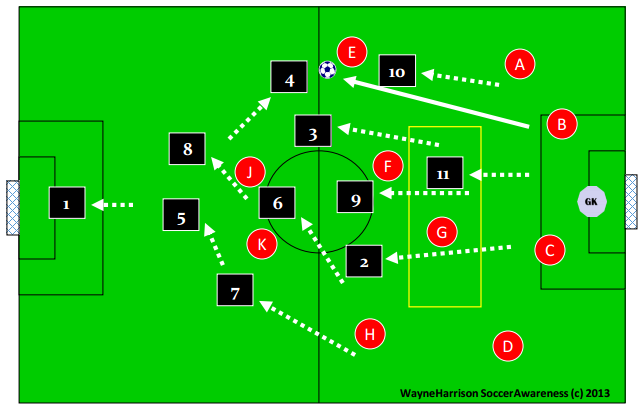
Now we must press thru (4) who MUST delay (E), and the rest of the team can then get compact behind; alongside and in front of the opponents. (3) and (10) can recover to the press also.
In theory our players are out of position but are they? It depends how you teach them; how we press and recover and who does what, where and why.
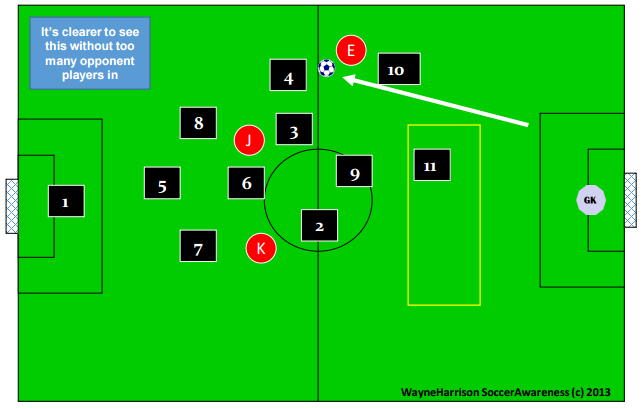
Changes: Our Center back (4) is now a left fullback 3; our linking midfielder (8) is a center back 4; our left back (3) is a center midfielder 8, our striker (9) is a number 10; our attacking midfielder (10) is in the wide left position 11; our wide left (11) is in the (9) position and (2) is in 7s position and (7) is in 2s position.
Changes in Previous Diagrams:
To recap on the previous defensive recovery set up which was our offensive set up initially:
Our Center back (4) is now a left fullback 3;
Our linking midfielder (8) is a center back 4;
Our left back (3) is a center midfielder 8,
Our striker (9) is now a number 10;
Our attacking midfielder (10) is in the wide left position 11;
Our wide left striker (11) is in the (9) central striker position;
Our right fullback (2) is in 7s wide striker position;
Our wide right striker (7) is in right fullback 2s position.
How we press and recover and who does what, where and why and rotation back into original positions and defensive set up.

The Ball goes out of play, for example, the players then rotate back into their own positions; or any part of the game they have time to do this they must try to work back into their own positions. We then start again to win back the ball and continue the freedom futbol method of playing.

A Simple Introduction to The 5 Phases of Play in the 1-4-2-3-1 - Training Center Exclusive
This is a very simple way to show how the team movement works. The system changes as we advance. Players can interchange positions as we develop the play. We offer great dynamics and fluidity to the players to allow them to express themselves on the field. With this we can show the discipline also involved when we lose the ball and recover back.
Teams will develop their style of play within these frameworks, it will never be as picture perfect as this due to the nature of the game. It is more a guide. We teach this from U11 to U18. How we do it per team will be determined by the level of play.
*Membership Required
This is a very simple way to show how the team movement works. The system changes as we advance.
Players can interchange positions as we develop the play.
We offer great dynamics and fluidity to the players to allow them to express themselves on the field.
With this we can show the discipline also involved when we lose the ball and recover back.
Teams will develop their style of play within these frameworks, it will never be as picture perfect as this due to the nature of the game. It is more a guide. We teach this from U11 to U18.
How we do it per team will be determined by the level of play.
The players in our system of play
This is the defending team shape (defending start position) of a 1-4-2-3-1. The positioning of the wing fullbacks defensively is somewhat alien to most set ups in other formations and you have to explain and show in detail to your players how this works and why.

Attacking set up
This is the attacking team shape (attacking “start position”) now essentially a 1-3-3-1-3.
Zone 14 is the area between the opponents back three or four and their midfield.. (6) recovers into the best space centrally that is possible hence I show two positions here as a guide.
We look to exploit Zone 14 between opponents defensive line and their midfield. NB It doesn’t have to be (6) who starts play off every time but for ease of explanation this is how its shown.

Attacking set up showing why Zone 14 is so important
Zone 14 is between the opponents defensive line and midfield line. Sort of no mans land if you like. We must exploit it. Here we show (maybe exaggerated) 3 players in this zone.
We look to exploit Zone 14 between opponents defensive line and their midfield. The question for defenders? Do defenders push out to mark, do midfield players drop back to track? This may cause confusion if done quickly enough.

Inverted runs by wide attackers (7) and (11)
This is the attacking team shape now possibly a 1-2-3-2-3 depending on the moment. This can also be the attacking team shape we change to when we are chasing a game perhaps losing 1-0 and wanting to be more positive in attack. So this now would be the start position.
Center backs (4) and (5) who initially went touchline wide not tuck inside to form a solid back three with (6) to guard against a counter attack should we lose the ball.

Positioning between opponent’s defenders
This is the attacking team shape now possibly a 1-2-3-2-3 depending on the moment. This can also be the attacking team shape we change to when we are chasing a game perhaps losing 1-0 and wanting to be more positive in attack. So this now would be the start position.
Popularly called “Half Spaces” now. Three front players position between opponents and in the spaces as show. (11) Start position must be wide drawing defender (D) wide.

Inverted runs by wing backs (2) and (3)
This is the attacking team shape now possibly a 2-3-2-3 depending on the moment. This can also be the attacking team shape we change to when we are chasing a game perhaps losing 1-0 and wanting to be more positive in attack. So this now would be the start position.
Designed to fool opponents who don’t expect “wing backs” to take up these positions.

Changing of team shape if we lose the ball from this attacking set up
Let’s say we passed the ball forward and lost it on the edge of the opponents penalty area. Immediately both fullbacks tuck inside to offer to fill central spaces and overload the area. (7) presses INSIDE towards (9) and (10).
Leave opponents in wide positions alone and mark the spaces inside. If (A) gets the ball to (B) or (C) by some chance then (2) and (3) have time to adjust and press “as the ball is travelling”. Call it the 6 Second Rule, we try to regain the ball in 6 seconds.

Forcing the ball inside to our strength in numbers
Even in a wide position, based on the pressing player (7) showing the ball inside (blocks the pass to (B); both wing fullbacks tuck inside because the ball is being forced into the central areas.
Take Note: The Ball is in their left touchline area, our right. As a “team” we do not want to be wider than the far post of each goal. This is much more than you likely expect but we are closing all spaces down. This condensing as a team must be IMMEDIATE and FAST.
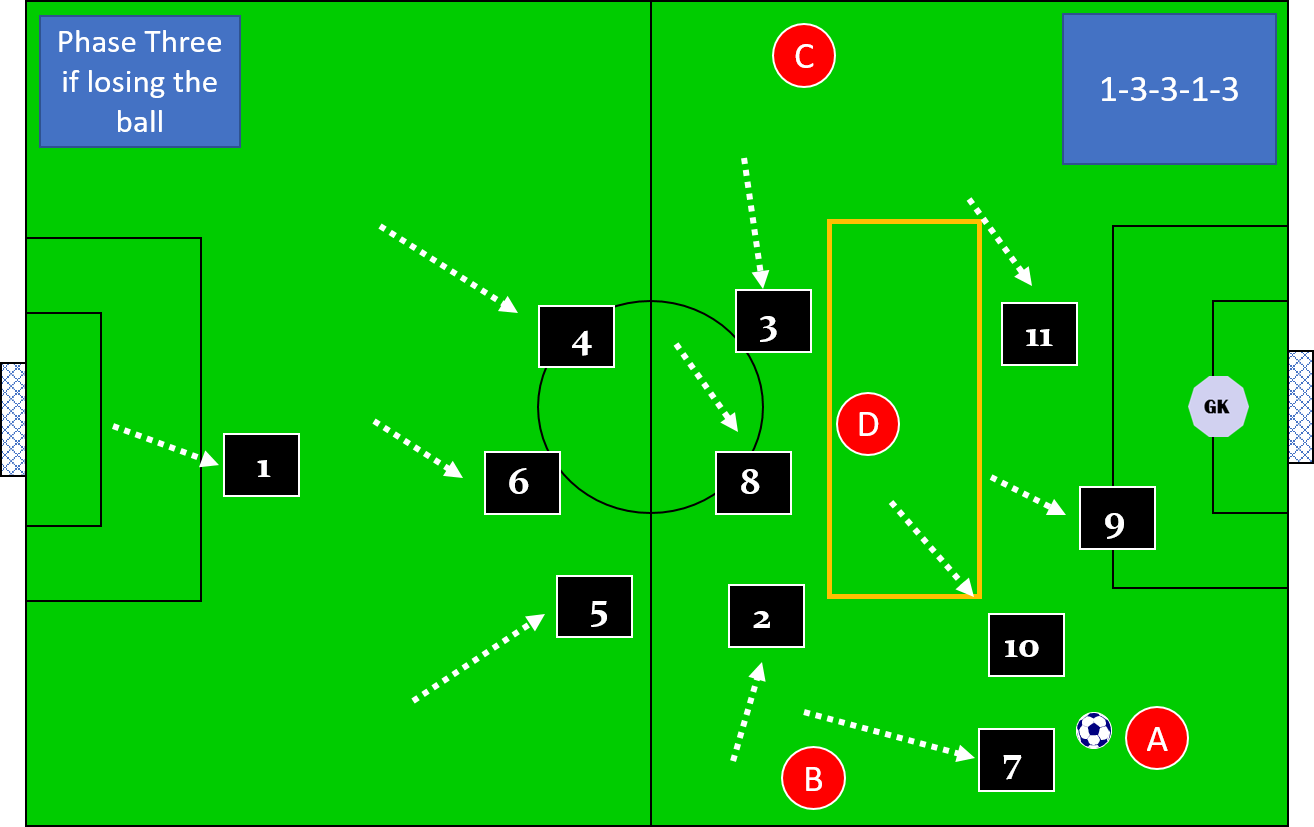
Forcing the ball wide and adjustment of defenders
(7) Cannot get positioned quickly enough to force the ball inside so forces wide and this means some adjustment behind him or her for the right wing fullback and the right centre back especially.
Take Note: The Ball is in the their left touchline area, our right. As a “team” we do not want to be wider than the far post of each goal. This is much more than you likely expect but we are closing all spaces down. This condensing as a team must be IMMEDIATE and FAST.

Interchange and rotation
Movements up front have been effected creating a diamond of support for striker 9 who becomes 10 and so on. These movements will be described in much more detail later.
Freedom of movement for what is essentially a front 6 players attacking. Moving in 2s where players are close so can rotate within the immediate time and space.

Potential interchange movements
Great rotation between players should cause a lot of confusion in the opponents defending set up. We can establish some set routines initially using a situation to set it off (6 gets the ball to feet with time for example). Like a set play in open play to teach the players simply.
Freedom of movement for what is essentially a front 6 players attacking.

A Preferred Phase Five when losing the ball: A Full Team Press
We may press up from the back too leaving opponents offside; should they get a chance of a counter attack. Defenders must decide in a split second which course of action they take.

Defensive team recovery
Defending and recovering from a 1-3-3-1-3 to a 1-5-4-1 or 1-4-2-3-1 (depending on number (6)’s position).
We cant press high and stop the delivery forward so we drop off and get compact.

Movements off the ball into and around the box
(7) attacks far post first them switches to attack the near post. (9) attacking far post at first then switches to attack the near post. (8) positions behind (7) and (9) centrally for the pull back, (10) positions on the edge of the box, (11) for anything hit too long from (2).

Attacking Movements to get in and around the box for the cross
End Product; attacking 4 areas; the near post, the far post and in behind and beyond. 2nd ball clearance (10) is in position and (3) may also shadow around the box.

Crossing into or around the 2nd Six Yard Box
(2) Out of picture delivers the cross. Players are arriving as LATE as possible and as FAST as possible. Four options for (2) and two players shadowing the box.
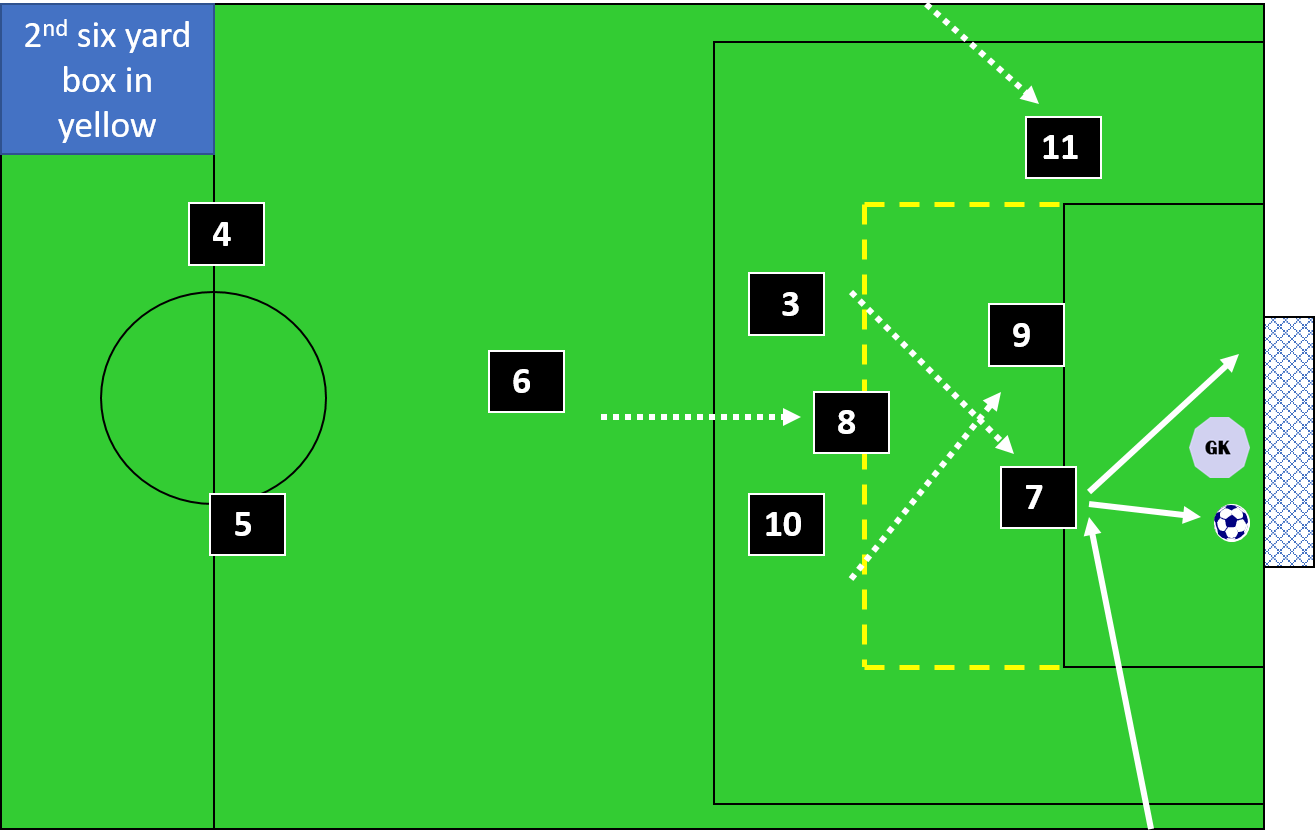
Crossing into or around the 2nd Six Yard Box
(2) Out of picture delivers the cross. (7) and (9) don’t necessarily need to cross-over they can both take defenders AWAY from the crossing area and then cut back.

Three player rotation on the edge of the 2nd Six yard box
(2) Out of picture delivers the cross. The three players have rotated positions trying to free up space for each other. Everyone else are in ideal positions for attacking; second ball clearance; and defending the counter attack

Near post player (7) clearing the SPACE for the Far Post player (9)
Here defender (C) follows (7) and leaves the near post space open for (9) to attack it. This is what we are trying to achieve with the 3 player rotation as someone somewhere may get free. (2) has to pick out the best option or just drive it into the box.

Near Post Player getting FREE for a shot on goal
(2) Out of picture delivers the cross. In closer detail here: (7) getting free dropping off into space in the 2nd six yard box to get a one touch shot on goal
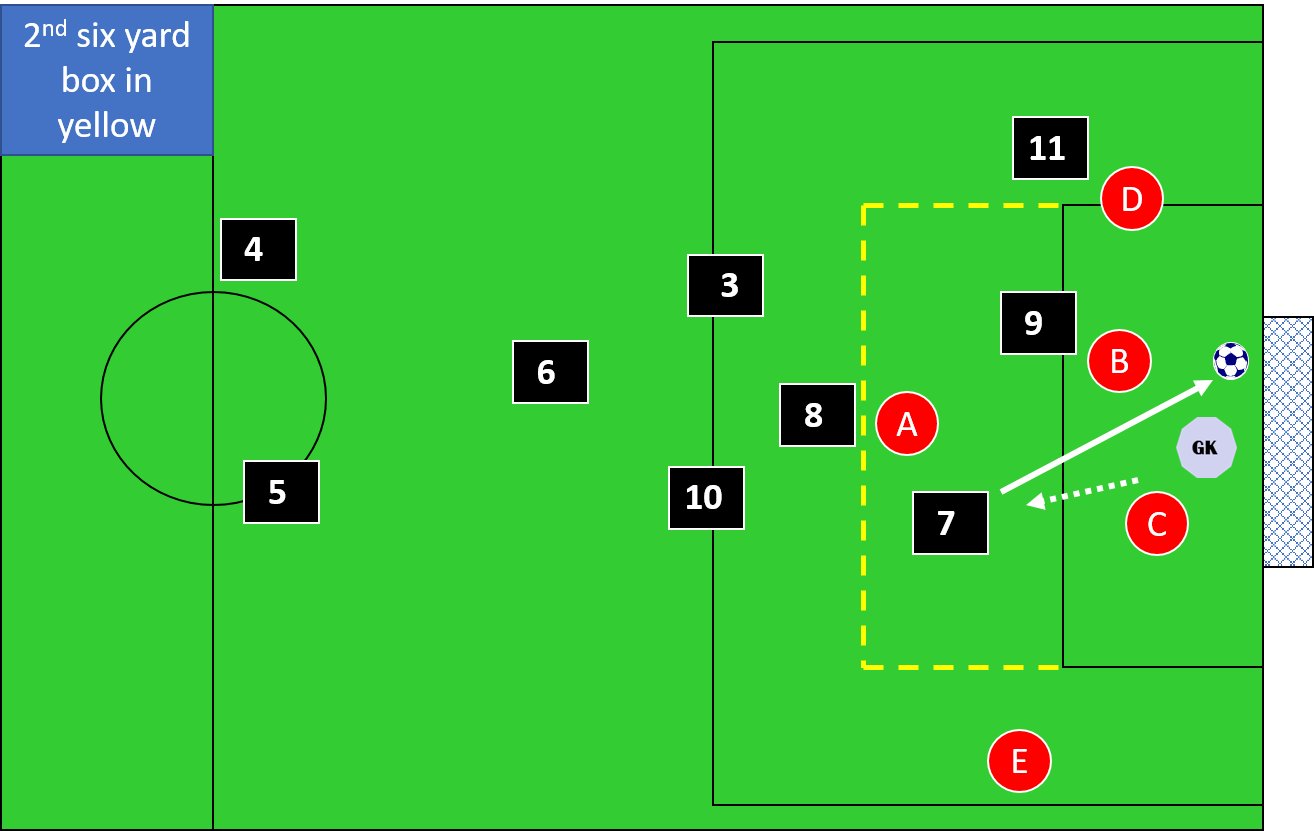
Clearing the Near Post SPACE for the far post player (9)
Leaving out most other defenders to make it clearer how (7) taking defender (C) out of the Near Post SPACE releases (9) making the run from the far post. You hope players man mark for this particular move. (9) gets a run on defender (B).


4-2-3-1 Defensive Pressurizing Game
The game is designed to work on pressurizing the player on the ball, prevent a forward pass and ultimately win the ball. Closest player has to pressure the ball. To score, a player has to make a pass from anywhere into the keepers hands. The ball can be played in the air to the targets hands (to practice quality long distance lofted passes) or on the ground to feet (driven passes). All over the field players must work hard to close people on the ball down quickly.
The following drill is part of a 28 page presentation entitled DEFENDING AS A TEAM IN A 4-2-3-1 that can be found on the recently added 4-2-3-1 System of Play page in the Soccer Awareness Training Center. Soccer Awareness Training Center provides unlimited access to Wayne Harrison's Soccer Awareness systems, training sessions, drills and more. Wayne's system helps develop world class youth soccer players and teams in a systematic and imaginative manner that guarantees performance at the highest level of competition. Whether you’re a beginning coach who needs help getting started or someone who wants to add some variety to their training sessions, the Soccer Awareness Training Center offers a wide variety of drills to choose from. Join Today
The game is designed to work on pressurizing the player on the ball, prevent a forward pass and ultimately win the ball. Closest player has to pressure the ball. To score, a player has to make a pass from anywhere into the keepers hands. The ball can be played in the air to the targets hands (to practice quality long distance lofted passes) or on the ground to feet (driven passes). All over the field players must work hard to close people on the ball down quickly.

Develop –
A) As a reward when a team scores a goal they keep possession so they play to the opposite goal to score. Previously they played to the same goal and the opposition got the ball when they scored.
B) Go to man –marking so in possession players must get free and defenders must work hard to stop them scoring. Show by high pressure as a team how defenders can win the ball back early and close to the opponent’s goal to score. Need to push up from the back to start this.

Coaching Points:
Quick Pressure on the ball
2nd defender supplying close Support for first defender
Deeper Cover from third defender
Recovery runs from players in front of the ball
Regain possession
Here the job of player (G) is to pressure the ball as quickly as possible to win it back. (F) supports across, (G) shows the player on the ball inside towards (F) and between them they try to win the ball back quickly. (E) Offers a balanced covering deeper position behind them.
Players cannot go into the keeper’s area.

Here (6) gets free of defender (D) and chips the ball into the keeper to score a goal. Once this has happened a few times players get the idea they need to work hard to close down quickly opponents on the ball.
This game improves the urgency with which players need to close opponents down as they are so easily punished in this game if they don’t.
New 4-2-3-1 System of Play Presentations in the Soccer Awareness Training Center

Playing The 4-2-3-1 And Changing Systems of Play Depending on the Game Situation
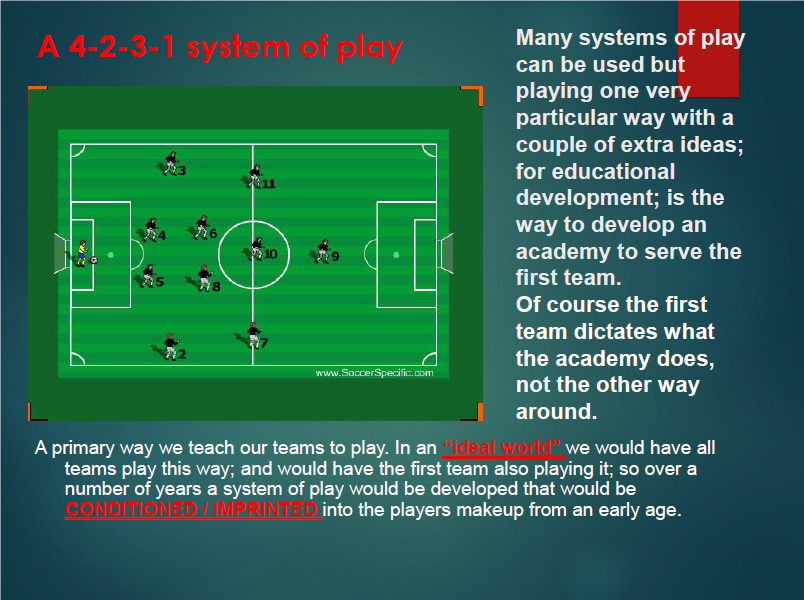
4-2-3-1 System of Play; An 80 Page Guide

Defending as A Team in A 4-2-3-1

Playing The 4-2-3-1 Showing the Defensive Discipline Needed to Allow the Fluidity Of Attack
Soccer Awareness Training Center provides unlimited access to Wayne Harrison's Soccer Awareness systems, training sessions, drills and more. Wayne's system helps develop world class youth soccer players and teams in a systematic and imaginative manner that guarantees performance at the highest level of competition. Join Now

Changing shape to counter the opponents who are playing a 4-3-3
This is an excerpt from "Important alternative information on how to play the 4-2-3-1." We don’t like to change our team shape and way of playing. Rather; we like to force opponents to change their shape to accommodate us. Sometimes against top opponents who may dominate us it is necessary to do so. Here are some ideas we can use against a 4-3-3 which many teams play now. We wont come up against this too often.

This is an excerpt from "Important Alternative Information on How to Play the 4-2-3-1." We don’t like to change our team shape and way of playing. Rather; we like to force opponents to change their shape to accommodate us. Sometimes against top opponents who may dominate us it is necessary to do so. Here are some ideas we can use against a 4-3-3 which many teams play now. We wont come up against this too often. Get It Now
Dealing with a 4-3-3 who have an extra player in Central Midfield
We lose possession. (6) Stays in his position protecting in front of the back four. They now have a 3 v 2 in their favor in central midfield; almost a 3 v 1 initially. In this case (11) has to see this and tuck in and help (6).

As the ball travels (6) gets tight to the opponents 6 and (11) tucks in the opposite side to make a 3 v 3. This has to happened rapidly and their passing may be too fast for us to adjust in time. Likewise this can be done with (7) tucking in instead of (11). A bit risky as it takes great communication; insight and immediate action.

Creating a 4 v 3 in our favor in Central Midfield
Another way is to play a very condensed defensive midfield 4 to outnumber them 4 v 3. Problem: Their fullbacks then have more freedom. Now our (2) and (3) may be open to 2 v 1’s against them. (6) can still patrol in front of the centre backs and drop back when needed.

Creating a 3 v 3 in Central Midfield
This is the simplest way to sort it out. Just go 3 for 3. (10) Has to take on a MUCH “greater defensive responsibility”. So we get a 3 v 3 match up in central midfield (8) on 8, (10) on 6 and (6) on 10.

The best solution: Still our same team shape but (10) more defensively positioned
The START position of (10) defensively HAS to be picking up the opponents number 6. It means (10) has to work MUCH harder defensively. This way we ensure we match them up 3 v 3 in central midfield. This way we still take care of their fullbacks. If 6 is their playmaker he must NEVER be allowed time on the ball.

The resulting situation is we are on the back foot but at least controlling them defensively.
Our team situation is defensively set up now. We will need to counter quickly when we get the ball; OR; keep the ball to give us time to spread out offensively again and play our game. We will practice this in training.


A Simple Explanation on How to Defend as a Team in 11 v 11
Playing in 5 Corridors widthwise to help define the positioning of players. Also playing in 3 thirds from goal to goal lengthwise (lets call these ZONES FOR CLARITY). Here we have a good balance with players positioning at angles to each other. Must get the team into 2 thirds only, except for the keeper, both offensively and defensively.

The following drill is an example presentation that can be found on the 4-2-3-1 System of Play page in the Soccer Awareness Training Center. Soccer Awareness Training Center provides unlimited access to Wayne Harrison's Soccer Awareness systems, training sessions, drills and more. Wayne's system helps develop world class youth soccer players and teams in a systematic and imaginative manner that guarantees performance at the highest level of competition. Whether you’re a beginning coach who needs help getting started or someone who wants to add some variety to their training sessions, the Soccer Awareness Training Center offers a wide variety of drills to choose from. Join Today
Attacking to Defensive Team Shape
Attacking: Based on the 5 corridors width-wise we want all 5 corridors to have players in them. Based length–wise we want a maximum of 2 of 3 zones filled; with the exception of the keeper.
Defending: Based on the 5 corridors width-wise we want a maximum of 3 corridors filled with players preferably 2.5 if possible. Based length-wise we want a maximum of 2 of 3 zones filled preferably the whole team is condensed into 1.5 zones or at most half a field.
Dividing the field into fifths widthwise and thirds lengthways: the Offensive Set Up

Playing in 5 Corridors widthwise to help define the positioning of players. Also playing in 3 thirds from goal to goal lengthwise (lets call these ZONES FOR CLARITY). Here we have a good balance with players positioning at angles to each other. Must get the team into 2 thirds only, except for the keeper, both offensively and defensively.
Shadow Play: The Defensive Set Up

Play without opponents and show our basic attacking shape then offer alternatives for pressing as a group and have them do it as fast as possible. Use different color cones to represent where we lost the ball then organize the team around this defensive starting point having the players decide where they think they should be and why.
Can extend this back to the middle third also

We lose it wide in the middle third; purple cone; try to press them inside still to where our strength is with numbers. Wing full backs have to be brave and stay in midfield but condense in. (3) delays, shows inside to (10), the rest condense. (10) cuts off passing lane forward as does (11) inside or back.. It will NEVER be this picture perfect but all the same it shows what we should strive for. Pivot (6) is the key for cover.
Playing a Pressing game comes from the back

If we want to play a pressing game then we must have the back four as high as possible (essentially a back 3 now) and then the responsibility of the front players is to press asap when we lose it to stop a counter attack. Same in midfield where we now have our wing fullbacks positioned.
Pressing in attacking third condensing to 3 corridors

Condensing the spaces close to the ball. (11) forces (A) inside to the support and blocks the pass to (I). (3) is already up there and so is the next pressing player. Don’t worry about (D) and (G) and (4) already has covered the space should (A) be able to play the ball long. Defending just inside our own half.
New 4-2-3-1 System of Play Presentations in the Soccer Awareness Training Center
Correcting Potential Weaknesses in the 4-2-3-1 System of Play from a Defensive Perspective

How to Teach Freedom of Movement for the 4-2-3-1; Attacking and Defensive Positioning and Covering for Each Other
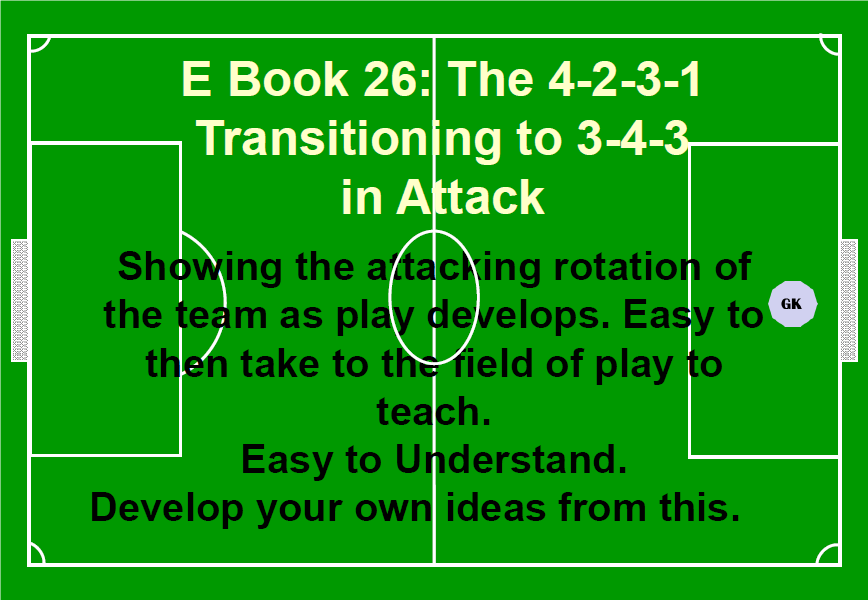
Showing the 4-2-3-1 Transitioning to the 3-4-3 in Attack

The Attacking and Defending Roles and Responsibilities of Each Player in the 4-2-3-1
Soccer Awareness Training Center provides unlimited access to Wayne Harrison's Soccer Awareness systems, training sessions, drills and more. Wayne's system helps develop world class youth soccer players and teams in a systematic and imaginative manner that guarantees performance at the highest level of competition. Join Now

Video Presentation: 6 Phases of Play for 4-2-3-1
In this video, Coach Wayne Harrison explains in a simple way the 6 phases of the 4-2-3-1 style of play.
In this video, Coach Wayne Harrison explains in a simple way the 6 phases of the 4-2-3-1 style of play.

5 Phases of Play for 4-2-3-1
- This is a very simple way to show how the team movement works. The system changes as we advance.
- Players can interchange positions as we develop the play.
- We offer great dynamics and fluidity to the players to allow them to express themselves on the field moving to a very attacking 3-1-3-3.
- With this we can show the discipline also involved when we lose the ball and recover back.
- Teams will develop their style of play within these frameworks, it will never be as picture perfect as this due to the nature of the game. It is more a guide. We teach this from U11 to U18.
- How we do it per team will be determined by the level of play.
- We strive to enable all teams at all levels to be able to master the attacking and defending defining team shapes of 1 and 2.

Book Endorsement from The Institute for Jugendfussball
The 4-2-3-1 is the favored formation of many top teams in world soccer at both club and national team level. This fluid, attack minded system has come to the forefront thanks to its success at the highest levels. Most notably, Spain utilized the 4-2-3-1 in winning both the 2008 European Championship and the 2010 World Cup. Top club sides Arsenal, Real Madrid, Inter Milan and Bayern Munich have also had success with the system. In this book, Wayne Harrison breaks down the 4-2-3-1 and discusses the principles, player roles and responsibilities, variations and adjustments based on the opponent´s strategy.
From The Institute for Jugendfussball:
Today we want to recommend an online-book that covers the 4-2-3-1 System.
Pages: 284 – Author: Wayne Harrison.
Wayne Harrison is the guru of the 4-2-3-1. He uses his experience to compare the system with others. In addition, he analyzes team play at professional level relative to the 4-2-3-1.
INSTITUTE FOR YOUTH SOCCER 06. JUNE 2013
Description:
The 4-2-3-1 is the favored formation of many top teams in world soccer at both club and national team level. This fluid, attack minded system has come to the forefront thanks to its success at the highest levels. Most notably, Spain utilized the 4-2-3-1 in winning both the 2008 European Championship and the 2010 World Cup. Top club sides Arsenal, Real Madrid, Inter Milan and Bayern Munich have also had success with the system. In this book, Wayne Harrison breaks down the 4-2-3-1 and discusses the principles, player roles and responsibilities, variations and adjustments based on the opponent´s strategy.
He also offers a complete coaching plan to implement this system including specific training exercises complete with detailed diagrams and coaching points. This is the most comprehensive coaching manual dealing specifically with the 4-2-3-1 ever written.
Regularly presented in the MYSA “SOCCER TIMES” state newspaper and on the MYSA Coaches Emailing Service.

Comments from World Class Coaching Clinic
Wayne is an outstanding clinician, and was well-received by coaches attending the Nebraska World Class Coaching Seminar. His passion for the game immediately rubbed off on the players he was working with, and they clearly enjoyed the sessions he conducted. He has the ability to convey relevant information to his teams while at the same time fostering an environment for learning by encouraging his players to figure out various situations for themselves. Wayne interacts with players and coaches alike in a thoroughly positive manner, which I am sure contributes toward accelerated learning for any individual fortunate enough to work with him.
Nebraska WORLD CLASS COACHING
International Coaching Seminar
University of Nebraska, Lincoln, June 1&2, 2012
Wayne Harrison: Coaching Clinician presenting:
1. Coaching the 4-2-3-1
2. Counter Attacking in the 4-2-3-1
Wayne is an outstanding clinician, and was well-received by coaches attending the Nebraska World Class Coaching Seminar. His passion for the game immediately rubbed off on the players he was working with, and they clearly enjoyed the sessions he conducted. He has the ability to convey relevant information to his teams while at the same time fostering an environment for learning by encouraging his players to figure out various situations for themselves. Wayne interacts with players and coaches alike in a thoroughly positive manner, which I am sure contributes toward accelerated learning for any individual fortunate enough to work with him.
– Peter Underwood
Assistant Soccer Coach at The University of Nebraska
Youth Director at Capital Soccer Association, Lincoln, NE
UEFA ‘A’ Licensed Coach
Thanks for doing a great job…as usual Wayne. The attendees loved your 4-2-3-1 sessions. We will definitely invite you to present sessions at our upcoming seminars. Thanks again.
– Mike Saif, World Class Coaching

Soccer Symposium for Player Development
On Sunday, April 29, coach Wayne Harrison of CV Manchester Soccer Club presented a coaching symposium focused on his “Thinking Process” of training. The symposium, held at Carmel Creek Elementary School, was open to all interested coaches, parents and players. Harrison shared his views on coaching players to develop “vision” and to play a thinking style of soccer.
A former professional player with Blackpool Football Club in England and Oulu Palloseura in Finland, Harrison also represented Great Britain in the World Student Games in Mexico. His coaching experience includes Youth Director at Blackpool and Al Ain in the United Arab Emirates. Harrison holds the UEFA “A” License, the NSCAA Premier Diploma and a degree in Sports Psychology and Applied Physiology.
The symposium was designed to benefit players and coaches by presenting the 4-2-3-1 style of play favored by many top professional teams, including FC Barcelona, Real Madrid and Arsenal. As important was the focus on developing the thinking process of players and showing the importance of the mind in playing soccer. Harrison explained how to “train the mind” to increase “speed of thought and movement” during a game.
“I felt the clinics were successfully received,” said Harrison, “and very well performed by the players who attended. I would like to thank them for their efforts. I also want to thank Manchester Soccer club, and particularly Directors of Coaching Billy Garton and Jeff Illingworth, for supporting me on this Symposium.”
Coaches from several different clubs attended, and several shared what they had gotten from the day.
“I had a fantastic experience at the Coach Wayne’s soccer clinic,” said fellow CV Manchester coach John Matich. “Wayne Harrison presented relevant information to soccer coaches at many levels. It made me think outside the box, and gave me some great ideas to bring to my own teams, including a clinic on the 4-2-3-1 system which was brilliant.”
“I found the symposium to be very informative,” said RSF Attack Soccer Club coach Shawn Beyer. “The training sessions were clearly run and outlined. [Harrison] offered very useful techniques and tactics to read the game quicker and play the ball faster. Also, it is clear Wayne is up to date on the modern style of play of the great Barcelona team with his understanding of their system played in the 4-2-3-1. I would attend another clinic if offered and took much away from the symposium.”
Warren Schwitkis of San Diego Soccer Club was also enthusiastic about the training from the Symposium. “Wayne Harrison is a detail-oriented guy who cares about the profession, and his coaching clinic symposium reflected this. He does a fantastic job in preparing and delivering a training session. Wayne is clear and concise with the players during the session and also with the coaches surrounding the pitch. I was very impressed with his knowledge.”
“The experience was worthwhile and extremely positive,” said Hector Garcia from Surf Murietta about the symposium. “Although there were many topics on the agenda, Wayne managed to cover all of them in a very organized manner. He was clear in his transmission of concepts while keeping the environment light and the kids engaged. Wayne’s passion for the game and promoting growth is genuine and contagious. I look forward to attending future events.”
Santiago Baltazar, a coach with Olympicos Soccer Club, said, “[Wayne Harrison’s] drills will be very helpful in training our young players to be better players on the field. They will also help us to be better coaches, and we will implement all we have learned from your teaching in our own coaching. I would like to see more clinics from him to help improve my coaching skills and learn more from one of the best.”
“I’ve always felt helping players develop a soccer brain was one of the most important and difficult tasks a coach is faced with,” said Travis Lucero of Encinitas Express. “Watching the progression of training drills Wayne presents to get the players to see the play before it happens is exciting. I can’t wait to start applying these principals to my training sessions.”
In order to further spread the word on his training methods, Harrison had the symposium videotaped to create a DVD presentation that can be used alone or in concert with his eleven books on soccer training. The goal is to provide a better understanding of the training methods through the two mediums. Several coaches who were unable to attend have already approached Harrison about the DVD, and portions of the training will be featured on the CV Manchester website.
“Hopefully coaches and players got some new ideas from the clinics to enhance their abilities and range of knowledge in both the nature of the topics and the style of delivery,” said Harrison. “It is all about focusing on the decision making of the players and not the coaches.”
Harrison has been asked to present his symposium for several clubs in San Diego and Los Angeles and at the World Class Coaching Symposium in Nebraska in June. Later in the year he will travel to Antigua and Panama to share his knowledge and training methods in those countries as well. He is available and excited to share his clinics, and can be reached at wayneharrison@soccerawareness.com.

Coaching Symposium Recap - April 2012
With an overcast day in San Diego, it made for a perfect setting to host my first free coaching symposium with Carmel Valley Manchester Soccer Club. First, I have to thank everyone for coming out to watch and for the Manchester Soccer players that came out to help demonstrate during the clinic. It was a great success.

With an overcast day in San Diego, it made for a perfect setting to host my first free coaching symposium with Carmel Valley Manchester Soccer Club. First, I have to thank everyone for coming out to watch and for the Manchester Soccer players that came out to help demonstrate during the clinic. It was a great success.
Here are a few topics we covered in the three hour clinic:
- TEACHING MOVEMENT “OFF THE BALL” THROUGH THE TRANSITION DIRECTIONAL TARGET GAME
- SPECIFIC PERIPHERAL VISION COACHING SESSION
- 4-2-3-1 Basic Ideas
If you're interested in having Wayne speak at your clinic or event please contact us.


4-2-3-1 Basic Ideas Video
Here is the latest video on the 4-2-3-1, which entails a few basic ideas on the formation. In this video you will see the defensive shape to the attacking team shape of this formation. Please feel free to comment and provide feedback.
Here is the latest video on the 4-2-3-1, which entails a few basic ideas on the formation. In this video you will see the defensive shape to the attacking team shape of this formation. Please feel free to comment and provide feedback.
Enjoy!
Coach Wayne
54 Pages
We want to stay with our own game plan as closely as possible; based on what we practice and to keep it simple for us; as we dictate to our opponents; and we impose OUR WAY on them.
But there will be many occasions where we must change the system of play and we may have to adjust to suit the opponents.
Here are some ideas for you to consider for your team starting with the 13313 and 14231 systems of play.