Welcome to the Soccer Awareness Coaches Corner. Browse through soccer drills, small sided games, tactical thoughts, full sessions and a variety of resources. Posts marked “Training Center Exclusive” are for members only.

3 Best Striker Movements to Get Free - Training Center Exclusive
This is a very good but also a very simple exercise to practice the opposite move.
Strikers usually stand with their back to defenders waiting for the ball, so the defender is in charge, this way a very small movement means they end up facing forward and are then at an advantage.
I believe this is a good way of simplifying movements by the striker in this position and giving them a framework to play from, they may develop their own variations of these three moves but it is a good planning tool to use in training so the players making the delivery at least have an idea what the striker may attempt in terms of his or her movement based on the position of the defender.
*Membership Required
Working Opposites With Movement Of Strikers
A very good but also a very simple exercise to practice the opposite move
Striker (E) comes short and shows for the ball asking for a pass. Defender (F) follows.
Midfielder (C) passes to (D), (D) then passes over the top into (E)’s path as he / she spins.
Defender must play passively. To continue the work once player (E) receives the ball they must beat (F) back to the touchline. Players (C) and (D) go to the middle and the next two take their place.
As the pass is going from (D) to (C) the striker shouts the code word and spins to receive the pass as player (C) is about to pass it. The shout must be early to (C) to make the pass at the exact same time (E) is spinning to receive it.


Develop – The player receiving the pass can get it “short or long”, to keep the defender guessing. If short, combine with the passer to beat the defender.
This is the “Vialli Move”.
Practice it also where (C) receives a pass from (E), has time on the ball, and can take two touches (liken to a game situation) and that player makes the next pass off the opposite move into the space behind the striker (E).
Alternatively (E) has possession, comes short and passes to (C), at the same time as passing (E) shouts the code word and (C) can make a one touch pass in behind, knowing (E) will spin and turn back due to the code word being called. If it isn’t called it can be passed to (E)”s feet or may be passed off to (D).
So, different set ups can be used here, sometimes the ball starts with (E) with a pass layoff, sometimes with (C) with it being passed to (D) and the timing needed and practiced thereof of the runs and passes based on the code word being called (or not).
So, options can be:
The start position is (C) passes to (D), and (E) times their run off that pass and uses the code word and receives a pass in behind them into space.
(C) passes to (D) again as the start position, and (E) times their run off that pass and doesn’t use the code word so gets it feet. Can pass back, check back to the cone to start again.
A different start position where (E) has the ball and passes to (C) and goes short; no code word so gets it to feet or the ball is passed to (D).
Now (E) has the ball again as the start position and passes to (C) and goes short; uses the code word as the pass goes to (C) who immediately passes the ball ONE TOUCH in behind and into space for the spin turn from (E). Lots of different ideas can be used here. Introduce a goal to finish in.
Individual Striker Movements
Strikers usually stand with their back to defenders waiting for the ball, so the defender is in charge, this way a very small movement means they end up facing forward and are then at an advantage.
The movement of the striker, the three ideas, working opposites on the first two.
Short to go long, (opposite run)
Long to come short, (opposite run)
Off the shoulder of the defender. Player A makes a diagonal run away to invite a ball “off / over the shoulder” of the marking defender.
On (1) the striker takes the defender towards the ball to create space behind, either for themselves or a team mate.
On (2) the striker takes the defender away to create space in front and short to check back into for themselves or a team mate.
On (3) Here the striker runs away and invites a ball off or over the shoulder of the defender, in this situation the striker is off the right shoulder of the defender.
The ball may be delivered off (outside) the right shoulder of the defender so it goes wider, or (inside) the left shoulder of the defender so the striker cuts inside the defender either in front or behind them, or moves towards the ball and receives to feet.

“Off The Shoulder” Has Three Further Movements To Consider
So; the striker (10) in this position has three ideas for moves; each of which help the striker to end up in a position where they are facing FORWARD:

A) Away from the defender then back across the defender either in front of them or behind them for the delivery inside the defender. If the defender checks away with the striker, then the striker checks back inside to their right; the defenders left (especially as the defender in this case plants their right foot down and is slightly off balance going to their right; the strikers left) always facing forward.
If not checked by the defender then the striker attacks behind the defender for the diagonal pass inside the defenders start position (on the ground or in the air).
B) Moving and staying off the shoulder for the delivery outside the defender to attack, the player on the ball plays a diagonal pass over the inside shoulder of the defender into the path of the striker facing forward.
The striker by making this move opens up the angle for the pass and gets in line still with the defender so as not to be offside but again facing forward, ready to attack the pass in front of them.
C) Going short to the ball to receive the delivery to feet after first moving not towards but away from the defending player and the ball, and ending up facing forward.
In this case the defender “should” drop off to cover themselves so the striker can’t make a run behind them, but this is the cue for the striker to check to the ball from a wider angle and more open body stance so they receive the ball at their feet; but facing forward with space to run at the defender; not with their back to goal and with their back to the defender. The first movement helps this space be created.
The defender starts in the same position as the striker though it isn’t shown here.
I believe this is a good way of simplifying movements by the striker in this position and giving them a framework to play from, they may develop their own variations of these three moves but it is a good planning tool to use in training so the players making the delivery at least have an idea what the striker may attempt in terms of his or her movement based on the position of the defender.

Switching Play as a Team - Training Center Exclusive
Teams play through each other and must have awareness of where their own players are and where the other team is as they pass through them. Emphasize a good first touch out their feet to set up the next pass or passing first time to a teammate. Always having players realize they must look before they receive the ball.
*Membership Required
Two teams a ball each playing to targets. Once they get to one target they must work to get the ball to the other target. As the player passes to a target they must change over with the target player who comes into play. As below (4) passes to (5) and switches position, already the other players have spread out to attack the other target.

Teams play through each other and must have awareness of where their own players are and where the other team is as they pass through them. Emphasize a good first touch out their feet to set up the next pass or passing first time to a teammate. Always having players realize they must look before they receive the ball.
Ensure as the ball is transferred from one end to the other that all players get a touch on the ball before it gets to the next target.
As the ball is passed to the target and the target player brings the ball out with a good first touch the other players must already be positioning themselves to be in support to transfer the ball to the other target, this means spreading out width wise and length wise to make themselves hard to mark such as in a game. Ensure they don’t turn their backs and run away but keep looking at the ball and open their stance up to receive a pass or at least offer an option. Show the movement across the field as they break out, diagonal runs for example (C & B), no breaking in straight lines and hence easy to mark.
Introduce opposition so the two teams play against each other and make it competitive by keeping score.
Coaching Points:
Look before you receive – where are team mates / other team’s players.
Open body stance – side on to where the ball is coming from.
Check towards the ball – a dummy to fool the defender in a game situation.
If time and space available, let the ball run across the body – switching play without needing to touch the ball. If the space is covered move the ball in another direction with a good first touch.
Pace of the pass – must be such that the player receiving the pass can let the ball run across them and maintain possession of it.
Change direction – switching from one side to the other.
(4) Becomes the new target player with a pass to (5). (5) runs the ball out and (1) and (3) make diagonal runs in front to lose their markers and get free to offer passing options to (5). (2) Runs away from in front of the target to get free to receive a pass, or take defender (B) away from the space (3) is running into. In this situation the best action for (5) is a pass to (3) that can easily score by a pass to the target player (6).

Coaching Points:
Quick Transition from inside to outside player
Immediate Support positions of team mates (movement off the ball)
Decision making by the player on the ball (pass, run, dribble).
Score a goal by passing to the other target player

Fast Paced Directional Transition And Possession Target Game - Training Center Exclusive
GAME OBJECTIVE: Developing movement off the ball offensively, pressing the ball and tracking movement “off the ball” defensively.
This game and its many progressions is designed to get the most out of the thinking processes of the players. Many mental challenges to overcome and learn from.
*Membership Required
This game and its many progressions is designed to get the most out of the thinking processes of the players. Many mental challenges to overcome and learn from.
On gaining possession players must change the point of attack to score a goal.
Coaching Points:
Continuums Model to work off and relate to.
An Awareness of the passing player of where teammates and opponents are positioned AND where the space is (Look and Think Before receiving)
An awareness of the receiving player as to when the passer is ready to pass (Look and Think Before receiving)
Good communication via visual cues through eye contact or aural cues through speaking makes this work (Communication)
Establishing an open stance for greater peripheral vision and an angle of support (body position and feet preparation)
Movement OFF the ball by the players in possession to get free and into open space (Tactical Mobility)
Timing and angle of the runs (Tactical Mobility)
Timing; accuracy and pace of the pass (Technique)
Good receiving and turning technique with an awareness of what is behind before receiving it (Technique, Control and Look and Think)
Move and join in the next phase of play (Tactical Mobility)
If we lose possession try to win it back immediately (Mental and Physical Transition)
And of course the SKILL FACTOR, decision making; is based on all.
Fast paced directional transition and possession target game
GAME OBJECTIVE: Developing movement off the ball offensively, pressing the ball and tracking movement “off the ball” defensively.
RULES:
Players must pass the ball to their target players to score. To score again they have to work the ball back into their own half of the field to be able to return.
Target players have two touches as do side players.

COACHING POINTS:
Creating Space by running off the ball to receive or to help a teammate receive.
Quality of Passing; long and short to targets and to teammates.
Support play: working angles and distances incorporating switching play using the side players.
Receiving and Turning in tight situations and dribbling in 1 v 1 situations.
Quick decision making is required in this session because the numbers are small, the area tight and the transitions rapid.
Develop:
No restriction on touches then 3, 2 or 1 touch, but only if it is on to do one touch.
All outside and target players have one touch only where possible
Switch with target players as they receive the ball.
Switch with outside players
Here is an example of the transition and movement off the ball to make it happen.
(2) passes to target player (8) who brings the ball back into the playing area.
(3) makes a run into the other half of the field on the blind side of (C) to receive the next pass. They need to get the ball into that half to be able to score.
(1) makes a forward run into space to receive the next pass off (3) and passes to target player (7) who can start the play again.
(1) switches with (7) and becomes a target player for the next phase of play.

Elements of play the target game teaches
A) Attacking as a Team and as Individuals.
Creating Space by running off the ball to receive or to help a teammate receive.
Developing quick support play working angles and distances incorporating switching play using the side players.
Passing long and short to targets and to teammates.
Receiving and turning in tight situations and dribbling in 1 v 1 situation’s.
Lots of touches on the ball for the players in this practice.
Quick decision making is required in this session because the numbers are small, the area tight and the transitions rapid.
B) Defending as a Team and as Individuals.
Pressurizing players on the ball to regain possession.
Supporting pressuring players and tracking runners off the ball.
High pressure to regain possession in the attacking half to be able to go straight to the target to score.
C) Transitions from defense to attack and attack to defense, quick decision making and improved concentration as the switch occurs. Interchanges of positions between inside players, targets and side support players
D) As a coach you can work in this session how to defend properly as individuals and a team or how to attack properly as individuals and a team.
Progressions
No restriction on touches then three, two or one touch but only if it is on to do so.
Introduce neutral player so a 5 v 4 overload in the middle if possession isn’t kept easily.
Interchanges of players outside to in, inside to out.
Have one teammate at each end so you are attacking both ends but once you have passed to one target you keep possession and must try to get to the other target. You can’t go back unless the opposition win the ball and then you get it back, only then can you go back to the same target.
To lessen the workload and keep everyone involved have players switch with targets and outside players when they pass to them.
The team can only score if they get an overlap, crossover or 1 – 2 in during the buildup.
No talking so players have to rely on their own vision to play.
Players move into the target zone to receive (timing of run and pass) so we don’t play with actual targets, different players can then become the target player.
Man – Marking – Have the players man mark so they must track a player when they haven’t the ball and they must lose their marker when they have the ball.
To improve the speed of thought reward a successful one touch pass with a goal or point. To score a goal by passing to the target player now reward this with three goals or 3 points.
The team in possession can pass back to the opponents target players to help keep possession of the ball. Liken this to passing back to the keeper in

Directional Awareness Four Team Passing Game - Training Center Exclusive
Objective: Awareness of Teammates and Opponents Positioning on the Field in Advance of Receiving the Ball
We are working on: When and where to pass, Looking before receiving, Awareness of player positions before receiving the ball, Awareness of options on the ball before receiving it, Awareness of Opponents positions before receiving the pass and Maintaining possession of the ball
*Membership Required
Objective:
Awareness of Teammates and Opponents Positioning on the Field in Advance of Receiving the Ball
Coaching Points:

When and where to pass (timing, accuracy, weight)
Looking before receiving
Awareness of player positions before receiving the ball
Awareness of options on the ball before receiving it
Awareness of Opponents positions before receiving the pass
Maintaining possession of the ball
Rules:
Warm Up:
Two balls per inside team (or more). (2)’s pass to (1)’s and (4)’s pass to (3)’s. The two groups work across each other. Four teams working but in pairs.
Directional session now working across each other, needing to know where their teammates are but also where the other numbered players are in the middle. This improves awareness and the peripheral vision of the players.
A good lead in to everyone being free in the area and passing and moving later.
Players need to look before they receive, see what the options are in advance of the ball.
Progressions:
Passing in straight and / or angled lines
Running in straight and / or angled lines
Mixing the two up
Players pass to the end players only, to begin transferring the ball from one side to the other. If both players on the other side have balls at their feet then liken it in a game to the strikers being marked and you have pressure on the ball preventing a forward pass so you have to go back to where you came from, either to the other player you did not receive the pass from or back to the same player.
Passing inside the area to team mates in the buildup not just to the outside players.
Introduce give and go’s with outside players (players then keep the same ball throughout a set time period)
Switching positions with the outside
Passing inside the area first then outside
Outside players can pass to each other on the same side the ball moving and keep the inside players alert as to where the ball is.
Outside players switch positions with and without a ball, if without the ball then they are now moving targets as it would be in a game.
All players communicate with each other to help make each movement and pass successful (above as (4) receives the pass, (3) calls to let him know they are free to receive the next pass.
Ask inside and outside players to pass to space to move players into better positions to receive the pass.
Liken To Working Through The Thirds Of The Field (Defender To Midfielder To Striker And Back)

Above; (2) passes to space to move outside player (1) to receive. (3) Passes to space to move (4) into the path of the pass. (4) And (1) respectively can help (2) and (3) by pointing to where they want the ball if they identify the space to pass it to first.
Where is the space to take my next touch (if it open it could be towards the player they are about to pass to), or can I pass it one touch to (3) on the other side?
Already as this pass is coming in to (3) another (4) player is looking to support the next pass going back.

Competitive: The Game Situation
One ball only. Now we take the session into a game. (2)’s play against (4)’s. It is a 4 v 4 game.
(2) work with (1)’s on the outside and score by completing a pass to the outside players. They then have to get the ball to the other side to score again. (4)’s work with the (3)’s on the outside so teams play in opposite directions. Play to 10 goals then rotate the players so the (1)’s play against the (3)’s. Rotate the teams so the (1)’s play against the (2)’s and the (3)’s against the (4)’s. Here the number (4) team have scored one goal at one end then switched the play to the other end by quick accurate passing to score another goal.
The set up is designed to make it easier to maintain possession because they are going both ways and it is much more difficult to defend against. Players who give the ball away cheaply get punished because of this as it may be a while before they can win it back due to the set up so everyone has to stay focused.

Outside player’s one touch, inside players two or three touch restriction. This forces players to use their awareness to be successful. Outside player has only one touch so as the ball is traveling to them the inside players know this and need to get in position to support early. Player passing to the outside player knows they only have one touch so the weight of the pass must be right.
Progression: To score the player passing to the outside player cannot be the player to receive it back immediately. If they do they maintain possession but it is not a goal. This means at least one other player MUST get into a support position to help the outside players pass (and score a goal).
Progression: the first outside player receiving has to pass to the second outside player, then the inside players have to position and work an angle of support off of the 2nd player.


Develop Spacing as a Team Using Goals as the Focus - Training Center Exclusive
Preview: Score a goal by passing into the free zone to a player moving into it . Player can only stay in the free zone for 3 seconds then they need to move out if they don’t receive the pass because in a real game they would be marked. To establish the theme of spreading out and playing quickly develop the idea of playing quickly by saying every one touch pass results in a goal. This FORCES the players to think much more quickly to try to make a successful ONE TOUCH pass to score a goal; this CONDITION forces / encourages players to play ONE TOUCH, but at the same time they need to make sure they do it at the right time and not for the sake of.
*Membership Required
Set the condition you score a goal by “arriving” in a free zone as the ball arrives. This FORCES / CONDITIONS the players to spread out and move OFF AND AWAY from the ball. Defenders cannot enter the FREE Zone. (3) scores a goal and (2) moves off the ball to receive the next pass to score another goal.

Scoring a goal
(10) Moves to the free zone and receives a pass, defenders cant enter the free zone. Players can only stay in the free zone for 2 seconds then the ball and themselves have to move.

Creating many options
This would be a perfect scenario and unlikely but…… Players move OFF the ball to the free areas and at the same time the condition dictates the theme which is to spread out, this offers up as many options as possible for the player on the ball.

Teaching players to spread out using goals to condition their minds and their movements
Score a goal by passing into the free zone to a player moving into it
Player can only stay in the free zone for 3 seconds then they need to move out if they don’t receive the pass because in a real game they would be marked.
In a real game they move out of the free zone to take a defender away for another player to drop in and get free
Start off playing free and unlimited touches
Reduce this to three touch then two touches.
To establish the theme of spreading out and playing quickly develop the idea of playing quickly by saying every one touch pass results in a goal.
This FORCES the players to think much more quickly to try to make a successful ONE TOUCH pass to score a goal; this CONDITION forces / encourages players to play ONE TOUCH, but at the same time they need to make sure they do it at the right time and not for the sake of
Teaching players to spread out
5 v 5 plus two neutral players and 5 free areas to play to. The idea is for players needing to move to the free areas CONDITIONS the THEME of spreading out.

(10) Moves to the free zone and receives a pass, defenders can’t enter the free zone

Players move OFF the ball to the free areas and at the same time the condition dictates the theme which is to spread out, this offers up as many options as possible for the player on the ball.


A Simple Introduction to The 5 Phases of Play in the 1-4-2-3-1 - Training Center Exclusive
This is a very simple way to show how the team movement works. The system changes as we advance. Players can interchange positions as we develop the play. We offer great dynamics and fluidity to the players to allow them to express themselves on the field. With this we can show the discipline also involved when we lose the ball and recover back.
Teams will develop their style of play within these frameworks, it will never be as picture perfect as this due to the nature of the game. It is more a guide. We teach this from U11 to U18. How we do it per team will be determined by the level of play.
*Membership Required
This is a very simple way to show how the team movement works. The system changes as we advance.
Players can interchange positions as we develop the play.
We offer great dynamics and fluidity to the players to allow them to express themselves on the field.
With this we can show the discipline also involved when we lose the ball and recover back.
Teams will develop their style of play within these frameworks, it will never be as picture perfect as this due to the nature of the game. It is more a guide. We teach this from U11 to U18.
How we do it per team will be determined by the level of play.
The players in our system of play
This is the defending team shape (defending start position) of a 1-4-2-3-1. The positioning of the wing fullbacks defensively is somewhat alien to most set ups in other formations and you have to explain and show in detail to your players how this works and why.

Attacking set up
This is the attacking team shape (attacking “start position”) now essentially a 1-3-3-1-3.
Zone 14 is the area between the opponents back three or four and their midfield.. (6) recovers into the best space centrally that is possible hence I show two positions here as a guide.
We look to exploit Zone 14 between opponents defensive line and their midfield. NB It doesn’t have to be (6) who starts play off every time but for ease of explanation this is how its shown.

Attacking set up showing why Zone 14 is so important
Zone 14 is between the opponents defensive line and midfield line. Sort of no mans land if you like. We must exploit it. Here we show (maybe exaggerated) 3 players in this zone.
We look to exploit Zone 14 between opponents defensive line and their midfield. The question for defenders? Do defenders push out to mark, do midfield players drop back to track? This may cause confusion if done quickly enough.

Inverted runs by wide attackers (7) and (11)
This is the attacking team shape now possibly a 1-2-3-2-3 depending on the moment. This can also be the attacking team shape we change to when we are chasing a game perhaps losing 1-0 and wanting to be more positive in attack. So this now would be the start position.
Center backs (4) and (5) who initially went touchline wide not tuck inside to form a solid back three with (6) to guard against a counter attack should we lose the ball.

Positioning between opponent’s defenders
This is the attacking team shape now possibly a 1-2-3-2-3 depending on the moment. This can also be the attacking team shape we change to when we are chasing a game perhaps losing 1-0 and wanting to be more positive in attack. So this now would be the start position.
Popularly called “Half Spaces” now. Three front players position between opponents and in the spaces as show. (11) Start position must be wide drawing defender (D) wide.

Inverted runs by wing backs (2) and (3)
This is the attacking team shape now possibly a 2-3-2-3 depending on the moment. This can also be the attacking team shape we change to when we are chasing a game perhaps losing 1-0 and wanting to be more positive in attack. So this now would be the start position.
Designed to fool opponents who don’t expect “wing backs” to take up these positions.

Changing of team shape if we lose the ball from this attacking set up
Let’s say we passed the ball forward and lost it on the edge of the opponents penalty area. Immediately both fullbacks tuck inside to offer to fill central spaces and overload the area. (7) presses INSIDE towards (9) and (10).
Leave opponents in wide positions alone and mark the spaces inside. If (A) gets the ball to (B) or (C) by some chance then (2) and (3) have time to adjust and press “as the ball is travelling”. Call it the 6 Second Rule, we try to regain the ball in 6 seconds.

Forcing the ball inside to our strength in numbers
Even in a wide position, based on the pressing player (7) showing the ball inside (blocks the pass to (B); both wing fullbacks tuck inside because the ball is being forced into the central areas.
Take Note: The Ball is in their left touchline area, our right. As a “team” we do not want to be wider than the far post of each goal. This is much more than you likely expect but we are closing all spaces down. This condensing as a team must be IMMEDIATE and FAST.

Forcing the ball wide and adjustment of defenders
(7) Cannot get positioned quickly enough to force the ball inside so forces wide and this means some adjustment behind him or her for the right wing fullback and the right centre back especially.
Take Note: The Ball is in the their left touchline area, our right. As a “team” we do not want to be wider than the far post of each goal. This is much more than you likely expect but we are closing all spaces down. This condensing as a team must be IMMEDIATE and FAST.

Interchange and rotation
Movements up front have been effected creating a diamond of support for striker 9 who becomes 10 and so on. These movements will be described in much more detail later.
Freedom of movement for what is essentially a front 6 players attacking. Moving in 2s where players are close so can rotate within the immediate time and space.

Potential interchange movements
Great rotation between players should cause a lot of confusion in the opponents defending set up. We can establish some set routines initially using a situation to set it off (6 gets the ball to feet with time for example). Like a set play in open play to teach the players simply.
Freedom of movement for what is essentially a front 6 players attacking.

A Preferred Phase Five when losing the ball: A Full Team Press
We may press up from the back too leaving opponents offside; should they get a chance of a counter attack. Defenders must decide in a split second which course of action they take.

Defensive team recovery
Defending and recovering from a 1-3-3-1-3 to a 1-5-4-1 or 1-4-2-3-1 (depending on number (6)’s position).
We cant press high and stop the delivery forward so we drop off and get compact.

Movements off the ball into and around the box
(7) attacks far post first them switches to attack the near post. (9) attacking far post at first then switches to attack the near post. (8) positions behind (7) and (9) centrally for the pull back, (10) positions on the edge of the box, (11) for anything hit too long from (2).

Attacking Movements to get in and around the box for the cross
End Product; attacking 4 areas; the near post, the far post and in behind and beyond. 2nd ball clearance (10) is in position and (3) may also shadow around the box.

Crossing into or around the 2nd Six Yard Box
(2) Out of picture delivers the cross. Players are arriving as LATE as possible and as FAST as possible. Four options for (2) and two players shadowing the box.

Crossing into or around the 2nd Six Yard Box
(2) Out of picture delivers the cross. (7) and (9) don’t necessarily need to cross-over they can both take defenders AWAY from the crossing area and then cut back.

Three player rotation on the edge of the 2nd Six yard box
(2) Out of picture delivers the cross. The three players have rotated positions trying to free up space for each other. Everyone else are in ideal positions for attacking; second ball clearance; and defending the counter attack

Near post player (7) clearing the SPACE for the Far Post player (9)
Here defender (C) follows (7) and leaves the near post space open for (9) to attack it. This is what we are trying to achieve with the 3 player rotation as someone somewhere may get free. (2) has to pick out the best option or just drive it into the box.

Near Post Player getting FREE for a shot on goal
(2) Out of picture delivers the cross. In closer detail here: (7) getting free dropping off into space in the 2nd six yard box to get a one touch shot on goal

Clearing the Near Post SPACE for the far post player (9)
Leaving out most other defenders to make it clearer how (7) taking defender (C) out of the Near Post SPACE releases (9) making the run from the far post. You hope players man mark for this particular move. (9) gets a run on defender (B).


Team Shape Development in 9 v 9 - Training Center Exclusive
Here we show how team shape changes from defending to attacking to then how we start to interchange and rotate players. Distances between defending and attacking are bigger than most think. Players learn how to add fluidity and freedom to team play in terms of their offensive movements and how to compact themselves when defending.
Using the 1-3-3-1-1 is a progressive move to playing the 1-3-3-1-3 in the 11 v 11 hence I am starting with this formation at 9 v 9.
*Membership Required
Subscribe to the Soccer Awareness Training Center to get access to all premium Training Center Exclusive articles.
Here we show how team shape changes from defending to attacking to then how we start to interchange and rotate players.
Distances between defending and attacking are bigger than most think.
Players learn how to add fluidity and freedom to team play in terms of their offensive movements and how to compact themselves when defending.
Using the 1-3-3-1-1 is a progressive move to playing the 1-3-3-1-3 in the 11 v 11 hence I am starting with this formation at 9 v 9.
Team shape from defending to attacking in 1-3-3-1-1
Defensive shape is at the red triangle cones. Attacking shape at yellow triangle cones. Player (6) represents center backs (4) or (5) and player (8) can also represent (6) in their roles in an 11 v 11.

Team shape attacking in 1-3-3-1-1
Defensive shape is at the red triangle cones. Attacking shape at yellow triangle cones.

Team shape from defending to attacking in 1-3-2-3
Defensive shape is at the red triangle cones. Attacking shape at yellow triangle cones. Player (6) represents center backs (4) or (5) and player (8) can also represent (6) in their roles in an 11 v 11.

Team shape attacking in 1-3-2-3
Defensive shape is at the red triangle cones. Attacking shape at yellow triangle cones.

Combinations Movements to Teach
Now center back (6) brings the ball out of defense and central midfielder (10) drops in to cover. Wingbacks (2) or (3) could also drop in to cover (6).

More complex Combinations Movements to Teach
(3) Has several options of a pass in-front of the ball. These are now very advanced movements that the players can practice with or without the ball.

A Cut inside and an overlap by a wing back
Start simply with this two player rotation. (11) cuts inside, this is the CUE for (3) to overlap.

Covering for the attacking fullback (3)
(11) Cuts inside to clear the space for (3).(8) Drops in to cover for (3).
(10) may also drop in to Cover for (8) if necessary in case we lose it and the other team counter attack..


Fast Passing and Dribbling Plays in Fours - Training Center Exclusive
A simple exercise when you have large numbers to work with. Practice lots of different receiving and passing drills here. Players pass and switch with their teammate behind them developing a constant rhythm. Passing with pace to challenge the first touch of the person you pass to. Also develop running with the ball and performing various tricks and dribbles as you move forward.
*Membership Required
A simple exercise when you have large numbers to work with.
Practice lots of different receiving and passing drills here.
Players pass and switch with their teammate behind them, a constant rhythm developed.
1 and 2 touch passing, inside and outside of the foot, double fast touch passing,
Passing with pace to challenge the first touch of the person you pass to.
Also develop running with the ball and performing various tricks and dribbles as you move forward.
Example: The Double touch, scissors, double scissors, Rivelino, double Rivelino;
Lots of touches on the ball at pace for each player
Fast passing plays in fours
A GIVE AND GO: One of the most effective moves in the game is the give and go or 1-2. This game lends itself perfectly to this great combination play. Here (1) and (2) split (A) and (B) with a fast give and go.

(1) Passes to (2) and switches with (3). (2) passes to (3) and switches with (4). Lots and lots of touches on the ball for each player in this exercise..

Fast dribbling plays in fours
(3) Dribbles with the ball to (4) and switches with (4). (4) dribbles to (1) and switches with (1). Lots and lots of touches on the ball for each player in this exercise and as they run across the grid they perform dribbling or turning moves.

Playing Give and Go’s
(3) Passes to (4) and makes an angled run to receive the ball back (a give and go essentially). (3) passes it back to (4) and runs across to the other side.

(4) Receives the ball off (3) and passes to (1) who pays the ball off back to (4) who then passes to (1) again and follows the pass.

Angled Passing and Moving
Angled passing and support. (2) makes an angle of support and (1) passes to (2). After passing to (2), (1) then makes an angled run to get the ball back. (2) plays a one touch give and go and (1) runs the ball out and passes to (4).

(1) And (2) have both run out. (4) Now passes to (3), who has made an angled run to receive,

Angled Passing and Receiving
Two balls going at the same time the players must get a rhythm of passing the two balls. (3) and (4) switch sides each time. 1 and 2 touch passing. Players receive and passing inside.

Players now receive and pass outside, like receiving and spinning away from inside pressure. Check inside (it could be to protect the ball from an opponent using your body), let the ball run across and outside (weight of pass must allow for this) then spin and play 1 touch.

Ideas can be check to the ball to receive having created the space by doing so.

Ideas can be check away to take a defender away from the space to check to the ball to receive having created the space by doing so.



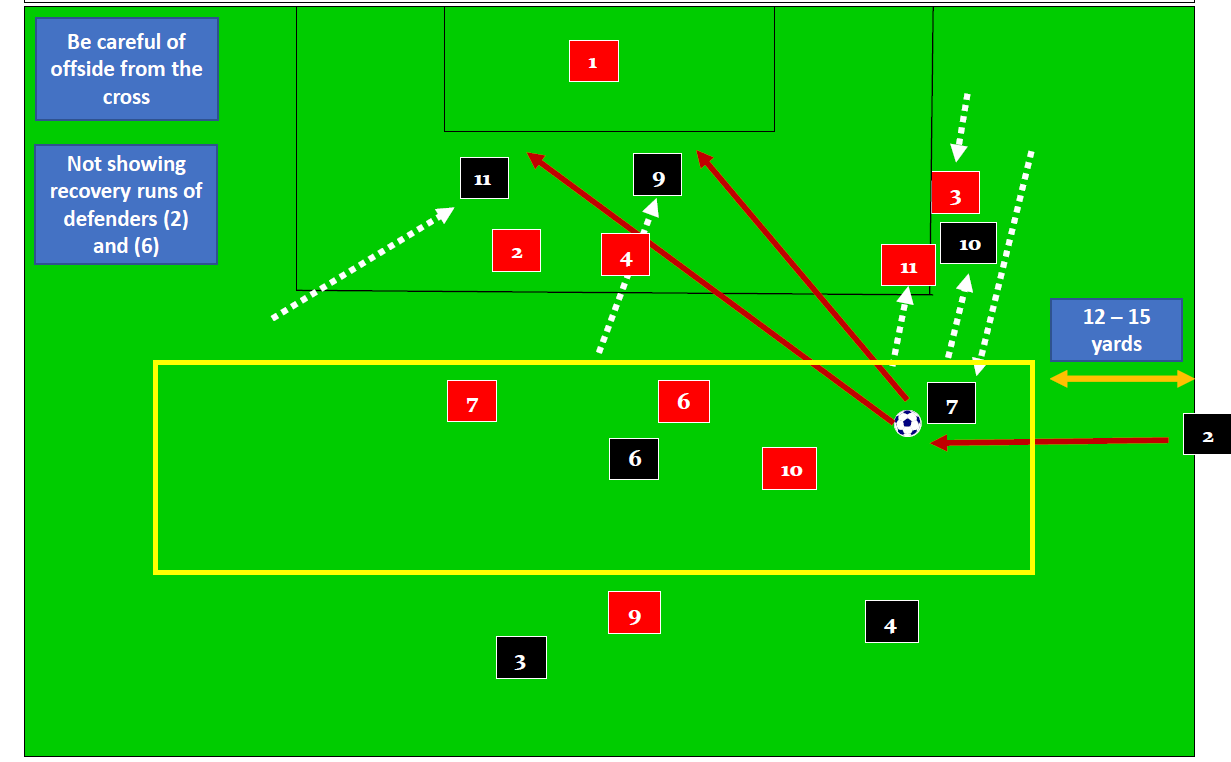


Developing Play from the Back with Right Center Back (5)
Showing how we can attack from the back through the right center back (5). The same can happen with our left center back. This is not an expected play so it can catch opponents out if we develop this idea.
We start with our attacking team shape of Phase 2 of the 5 phases. I am showing potential options of attack we can use and develop knowing we are covered behind so whichever center back gets forward they are confident they are covered. Here opponents play 4-4-2 then 4-3-3.
This is the attacking team shape (attacking “start position”) for a 3-3-1-3. Zone 14 is the area between the opponents back three or four and their midfield.. Here we develop play through (5). (2) and (7) go touchline wide to open up space inside / OR receive the pass wide. (5) has options, Pass wide, pass inside or run forward with the ball.

(5) attacks the open spaces created by teammates in front of him
Space clears for (5) to push up and attack. (8) clears the space inside by taking defender (F) away. (10) makes a
diagonal run into space to get free of (E). Either (2) or (8) drops in to fill in for (5) so (5) knows he is covered behind
so he has FREEDOM TO ATTACK.

Right center back (5) attacks from the back
(5) can feed (10) play inside defender (J) for (7), can play the diagonal pass to (9) who is off the shoulder of (H), the
long switch to (11), or continue his run and play combinations with his players around him. (2) covers for (5).
Opposite left center back (4) tucks inside once (5) has started to attack.

Combinations as (5) advances up the field
(C) presses (5), and (5) can now play a give and go with (10) or even (7). But here, (7) stays wide to keep defender (J)
wide. If defender (J) marks inside then (5) can play with (7) wide and continue you his run into the attacking third.

Striker (9) makes the blind side channel run
(9) Makes the diagonal run and (5) plays him in. (5) can advance into the box or be on the edge of it for any potential
clearances.


Combinations as (5) advances up the field
Defender (J) marks inside so now (7) is free. (5) attacks and plays to (7) who is free due to positioning on the
touchline, and (5) can still continue into the attack knowing he is covered behind. Now we have a 2 v 1 against defender left back (J).

Not showing the dropping back of defenders just to show how we can develop this this shows how we can attack
with a right center back from back to front but still be covered at the back. If it breaks down (5) just drop backs into
(2)s position. Now a shot or cross is available to (5).

We lose it but it’s just a small adjustment to recover back
Simple adjustment if the move doesn’t work so nothing is lost with allowing this freedom of movement forward.
The good part is this type of attacking movement is NOT EXPECTED by opponents.

Opponents play 4-3-3 / 4-5-1
This is the attacking team shape (attacking “start position”) for a 3-3-1-3. Zone 14 is the area between the opponents back
three or four and their midfield.. Here we develop play through (5). (2) and (7) go touchline wide to open up space inside /
OR receive the pass wide. (5) has options, Pass wide, pass inside or run forward with the ball.


Composure Zones to Aid Team Play and Individual Development in a 9 v 9 - Training Center Exclusive
An easy introduction to teaching players to develop play from the back without the pressure they would get in a game situation. Builds confidence and composure in the players and you can increase the pressure as they improve.
Overload at the back. Striker can’t encroach into the 10-yard composure zone. Defenders pass ball across under no pressure until one is free to run it out, attackers can now try to win it back. Defenders can take the ball back into the composure zone for safety and this encourages spreading out and playing from the back. Be patient, keep possession; go forward at the correct moment.
*Membership Required
As an easy introduction to teaching players to develop play from the back without the pressure they would get in a game situation.
Builds confidence and composure in the players and you can increase the pressure as they improve.
Overload at the back. Striker can’t encroach into the 10-yard composure zone. Defenders pass ball across under no pressure until one is free to run it out, attackers can now try to win it back. Defenders can take the ball back into the composure zone for safety and this encourages spreading out and playing from the back. Be patient, keep possession; go forward at the correct moment.

A Transition game maintaining shape and balance throughout the team in a 9 v 9
Building 9 v 9 team play up through various conditions of play
Players stay in their own thirds to establish team shape
Transition between thirds
9 v 9 rotation of players
Possible passing options
Overlap play from wide defenders
Introducing offside
Overload in attack to maintain possession
Transitions between thirds for defending team also
Working with four zones
Players stay in their own thirds to establish team shape
We start with 2 x 1-3-3-1-1 set ups. Players stay in their own zones initially until we get the game going.

Transition between thirds
An example: (6) bring the ball out and creates a 6 v 3 with the neutral player added also. Then a midfield player joins in the attacking third to create a 2 v 3 in there. Defending team players stay in their own zones.

9 v 9 rotation of players
1. Players interchange between zones one at a time always returning to original set-up. Check the balance of the team with and without the ball. We have created a 5 v 3 in midfield zone with player (6) moving up.
2. If they lose possession players either drop back in or you can develop the clinic to include pressing to regain the ball. E.g. If you are losing the game go full high-pressure and PUSH three players into the attacking third, three PLUS A NEUTRAL PLAYER in the midfield third and two in the defensive third.

1. Condition – Can only score if all players are over the defensive third line so reinforcing keeping compact vertically.
2. Restrict number of touches on the ball if they are able to do so to encourage quick passing and movement and to improve the speed of decision-making.
3. Vary play by encouraging defenders to pass directly to the forwards; midfield players can then support them facing the opponent’s goal (easier to support rather than receiving and having to turn with the ball).
4. If you have problems making the session work with equal numbers then reduce the game to a 9 v 5 situation using one forward, one midfielder, two defenders and a keeper on the opponents team until the players are comfortable then go into the full workout.
Possible passing options
1. Player (8) on the ball. 4 possible options to pass forward e.g. to (7), (9), (10, (11) or (N) If can’t go forward because of pressure, can go to the side to (3) or (2) or back to (6), and the keeper to keep possession until the situation allows for a forward pass again (you won’t obviously get all these options to pass but it shows how it can work).
Caution – in attack, be aware of quick counter if opponents win the ball i.e. we have a 2 v 2 at the back.
2. Discussion – You can get so much work into this session, every time you look there may be a new situation to effect. Choose a theme and stick with it and when you have established it with the players, only then move onto another theme (you can again use the same set-up, as it is so flexible).

A Transition game maintaining shape and balance throughout the team
1. To ensure the players have a chance to build up the play from the back have a 3 v 1 overload at each defensive third to begin to session.
2. We are looking to be successful with offensive play building up from the back and this gives it a greater chance of success and thus the positive reinforcement of the players.
3. As they get better at this and gain success you can change it to a 3 v 2 situation so it is more difficult to achieve. Á 3 v 2 means a 9 v 9 situation with the players developing play but staying in their own third to emphasize team shape through the units.

Transitions between thirds
1. Now we are transitioning between thirds and as a defender changes the balance in midfield from a 3 v 3 into a 4 v 3, a midfielder then moves into the attacking third to change the balance from a 1 v 3 into a 2 v 3. (7) Clears the space for (2) to bring the ball forward. (6) And (3) cover across behind the field to support and be in a good position to cover should the move break down. This is clearing the space in front of the ball and filling in behind the ball.
2. (11) Makes a run into the attacking third to be another target for (2) to pass to. If the player can’t go forward and has to play it back ensure the players behind the ball get in positions where they are free to receive it and able to support the player on the ball.

Overlap play from wide defenders
1. Here a full back makes an overlap run to provide an option for (8) to pass to. (2) Passes to (8), (7) clears the space wide to run into for (2) by taking defender (F) inside, and (2) runs onto the return pass from (8). The overlap can occur also from the middle third into the attacking third.
2. Wide defenders need to be constantly encouraged to get into good wide receiving positions to take the ball forward into attacking areas of the field.
3. The fact that (G) can’t track the runner into the middle third yet during this progression helps highlight the importance of this kind of attacking run from a wide area.
4. Likewise, (8) may change the point of attack and (3) can make the overlap run from the other side and on the blind side of striker (G). (8) covers for (3).

Introducing offside
1. Develop – Have offside from the defensive third of the field. (8) Passes the ball forward and (3), (6) and the keeper push up. Striker (G) is left offside.
(8) Passes to,(2) who moves up from the defensive zone to the middle zone to support. This type of transition movement is important because it allows players to move freely between the zones knowing they will have a team mate covering for them. In terms of the opposition this rapid movement and transition makes it difficult for them to pick players up, to read what your team is doing..
2. This means defenders aren’t just defenders, midfielders aren’t just midfielders and attackers aren’t just attackers they work to help each other through the three units of the team and are free to mix the game up. This is total soccer played to encourage the free movement of players throughout the teams.

Overload in attack to maintain possession
1. Here (2) plays the ball to (8) and (7) makes a run off the ball to support in the attacking third. Transitions can depend on the stage of the game; if your team is chasing the game to score being a goal down then (7) would probably stay in the attacking third, not immediately return to help (8) in the middle third but keep an overload in the attacking third situation there but the basis of the session is to show how to maintain a balanced shape in your team.
2. Practice movement (switching) of strikers and midfield players to move defenders around (especially if they man mark), so play isn’t in straight lines all the time.

Transitions between thirds for defending team also
1. Progression – Have players able to transition back into zones from the attacking third to the midfield third, the midfield third to the defensive third. Defenders still cannot move between zones.
2. Develop – Now Allow defending players (as above) to track attacking players into the other zones. When this happens the above situation means the defender (B) follows the striker (9) going short creating space behind for another striker to move into or a midfielder to break forward into (in this case 7 and 11). Ultimately open the game up so the players have no boundaries to use for focus and see if they can work out how to keep that balance and shape on an open field of play.

Working with four zones
1. We have essentially four - thirds to play in. The players can only play in three of the four thirds at any one time.
2. This ensures movement up and down the field maintaining distances between units.
3. Players cannot enter zone 4 until the ball goes into zone 4.

Working with four zones
The ball has been played into zone 4. Here the numbers team has moved forward out of zone 1 and into zone 2 and the whole team has moved forward one zone. This helps them maintain distances between the units and does not allow the team to get too spread out either attacking wise or defensively.

Progression development from start to finish
Set up is as follows; the field is arranged in thirds; defending, midfield and attacking thirds. In the set up we have here we have a 3 v 1, a 4 v 4 + neutral player and a 1 v 3.
Warm up: Objective: 9 v 9 with composure zones to aid team play and individual player development
1. STAY IN OWN THIRD.
Players stay in their own thirds to get a feel for how to maintain shape and how to use width in attack. Spread out in possession in a 3 v 2 overload at the back in the defending third to create a situation where the players are available to receive the ball in space and pass it forward.
2. TRANSITION BETWEEN THIRDS
Players are allowed to transition between thirds but only one at a time. The defending team cannot move between thirds to track the attacking players. When the attacking team loses possession they then become defenders and must immediately drop back into the third they started in. The reason for dropping back and not trying to win it back there and then is because we are working on offensive play and want both teams to have the opportunity to build up play. Can run the ball in, pass it in, or pass it in to a runner from your own third.
3. OVERLAP PLAY FROM WIDE DEFENDERS
This particular type of movement is a very important one to develop in this session and the opportunities presented to do so will be numerous.
4. OFFSIDE FROM THE DEFENDING THIRD
Introduce offside in the final thirds at both ends of the field. This encourages teams to move up as the ball is played forward.
5. OVERLOAD IN ATTACK MAINTAINING POSSESSION
Here we have worked the ball into the attacking third and we leave an overload in this third to regain possession should it be lost. This may depend on the game situation where we are chasing the game being a goal down and have to take chances.
6. TRANSITION BACKWARDS BETWEEN THIRDS
Allow players to transition between thirds coming back as the initial movement, for example a striker may drop back into the middle third to receive. A midfielder may push on into the space the striker created by the movement.
7. TRANSITIONS OF DEFENDING PLAYERS
Allow defenders to track players into the other thirds they venture into. Now all players can move between thirds but still have it only one at a time. This helps highlight how to create space for someone else by the movement of players; a striker comes short, pulls a defender with them and space is created in the area they came from for another striker or a midfielder to move into to receive the pass.
8. FREE PLAY
Open the game up. See if players can maintain their shape without the help of the thirds, if they can transition between units but also keep their balance. Try a game in quarters to establish movement up and down as a team.
9. NUMBER OF TOUCHES RESTRICTION
Introduce a three, two then one touch restriction to see if the players can work more quickly and still gain success. This speeds up there decision making in the game. When it is one touch, condition it so they can take more than one touch (a pass may be so heavy they need two touches) but emphasize they use one touch if it is on to do so. This keeps it realistic.
10. CONCLUSION
We have developed the clinic from working in thirds (or quarters), introduced many progressions to
work up to letting the game go free and observing if the players can incorporate into the free game
situation, all they have learnt.
I would recommend using this clinic on a regular basis and set it up for the scrimmage that is usually done at the end of a coaching clinic session.

Teaching a One Touch Mentality to Improve Player's Decision Making - Training Center Exclusive
To play the game successfully it is vital we keep possession of the ball.
The following presentation is ONE WAY to show how to teach players successful decision making, because the game is about the brain and mind and the thinking processes as much as the body, perhaps more so as the game gets faster and faster.
We have Technical, Tactical, Psychological and Physical and all will be a part of this presentation in terms of decision making, but it will all come down to the “SKILL FACTOR” in my opinion.
*Membership Required
Developing a player's ability to make successful decisions and keep possession of the ball by teaching a One touch mentality
To play the game successfully it is vital we keep possession of the ball.
The following presentation is ONE WAY to show how to teach players successful decision making, because the game is about the brain and mind and the thinking processes as much as the body, perhaps more so as the game gets faster and faster.
We have Technical, Tactical, Psychological and Physical and all will be a part of this presentation in terms of decision making, but it will all come down to the “SKILL FACTOR” in my opinion.
How skillful is the player in maintaining possession of the ball and making the best decisions to keep it?
In my opinion SKILL should be added to the very traditional and historical four elements the player and the game is judged on. There should be FIVE with SKILL being the 5th (and perhaps most important) AND IN A CATEGORY OF ITS OWN.
What is SKILL? Skill is the when, the where, and the why of technique. The decision making process. The ability to problem solve and produce solutions to problems. Yes SKILL (decision making) is all tied into all four elements of game development but does SKILL not deserve to be its own entity? I think it does and will discuss why in this presentation.
On the following continuum I created the thinking process is a major element of it all. So where decision making comes (SKILL) 2nd; and well before technique you see why. For most players; if you think about it; SKILL will likely come after control, so it would be 6th on the continuum. They controlled the ball then looked to see what next to do, often resulting in a rushed decision and / or a bad decision and loss of possession.
Continuums of Development Model
All these factors you get into the game situation
LOOK / OBSERVE / THINK / SCAN: (BEFORE receiving the ball; assessing all options in “Anticipation” not as a Reaction) - If time allows take 2 or 3 looks because the situation may have changed after the first look
SKILL: THE DECISION: (Why; when and where; plus its success or not; and why?)
FOOT PREPARATION: Not flat footed but on your toes and ready for action (Vital)
BODY POSITION: Balanced and open (Vital)
COMMUNICATION: Verbal and visual
CONTROL: If not a one touch pass on, the 1st touch control
TECHNIQUE: The How; the pass, the run, the dribble, the turn, the shot; etc
GAME TEMPO: Do we speed play up / slow it down / does it stay the same?
TACTICAL MOBILITY: Movement off the ball, finding space; 90% of the game
MENTAL AND PHYSICAL TRANSITION: Possession changes, Player tunes in immediately to win it back?
All these aspects of the game relate to Technical, Tactical, Psychological and Physical.
But we want to Add the SKILL FACTOR too.
So this is what will teach the players through the Continuums Model of Development:
Looking before receiving the ball:
Looking away from the ball as well as at it:
Knowing options in advance of receiving:
Weighting the pass correctly to help the receiver:
Getting their foot preparation right (how many play flat footed?? This won’t let them be if they want to be successful).
Getting their body shape right, for the next move; in advance of the ball: OPEN body stance;
Getting into position quickly "Off the ball" to help the player receiving; and it has to be before the receiver gets the ball as they only have one touch to move it on again either to feet or to space: So the second and third phase players are learning to identify the importance of positioning in advance of the ball.
They will recognize what the fault and failure to maintain possession was am I will show some ideas on why losing possession of the ball may happen. It will not be because of pressure or interceptions by defenders because in the early stages there will not be any defenders so the players can play without pressure. It is easy to see for everyone why it works (or not) and how to fix it if they are honest with themselves.
Reasons why a one touch pass may not work?
There are many reasons why a one touch pass doesn’t work. It is not always the fault of the passer; and this has to be established with your players to help build their confidence in any way you can.
But for all reasons it could be due to poor technique, to unprepared body position and feet preparation, to poor communication by the receiver / passer or his or her teammates, to poor positioning by teammates OFF THE BALL for the next phase of play; and ultimately it will be about DECISION Making.
Due to One touch only the decision has to come in advance of the ball, and well in advance of the ball. A decision coming AFTER receiving the ball is most often too late and it will show up clearly in one touch training.
We are really not trying to teach one touch as a way of playing, we are trying to teach a ONE TOUCH MENTALITY by playing one touch. And a one touch mentality relates directly to the thinking process, the decision making, the SKILL FACTOR.
What does that mean? It means we are FORCING players to look around, check over their shoulder, assess their options; make decisions; identify the best decision if they have a couple or more options available, we are FORCING players to LOOK AWAY FROM THE BALL.
Xavi of Barcelona was videoed in a game where they recorded every time he looked AWAY from the ball. In 90 Minutes he looked AWAY from the ball 841 times !!! On average 9 times a minute. WHY? Because every time he got the ball he wanted to have an answer to his next move and maintain possession.
Receiver doesn’t LOOK and make a decision on who to pass to BEFORE receiving the ball so it either sits at their feet after one touch (which makes it totally obvious they haven't assessed their next option) or they pass it for the sake of without thought or decision and give it away.
The Body position and feet preparation were wrong so the receiver isn’t ready to receive the ball. Maybe they saw the next pass, but it wasn’t successful because of this. So the direction / player they passed the ball was a good decision it wasn’t an accurate pass because of not being prepared due to these two reasons.
Poor verbal communication from teammates to help the passer identify where they are but we teach players to learn without this because players most often do not talk to help each other.
Poor Visual and verbal communication by the receiver so doesn’t SEE the next pass early enough (visual), nor calls a players name out to let them know who they are intending passing to (Verbal).
The pass to them was not accurate so even though they knew what they were doing next they were not able to move the ball on successfully. Perhaps they made a great decision on the next pass (which we should focus upon and highlight) but the pass on wasn’t accurate due to the poor pass to them.
The pass to the receiver was accurate but with too much pace on it to them, so moving it on one touch was too difficult and they were unsuccessful.
There were no open passing lanes created by teammates to allow the receiver to play one touch so he or she did not have a decent option to take and therefore gave the ball away.
The decision must be one of two things, a pass to feet or a pass to space, when to space it may have been a great decision by the receiver passing the ball on but their teammate didn’t move to the space to receive it so possession was lost. Emphasize the great decision; even though the ball was given away; it wasn’t the passers fault.
When passing to space it may be a great decision but the weight of pass was too heavy. Emphasize the Great decision.
Three types of soccer player
For the most part, players can be separated into three categories:
1. ·Those who don't know what's happening in a game;
2. ·Those who know what's happening as its happening.
3. ·Those who already know what is going to happen next.
The players, who fit in the first category, really “don't know” what is happening during the game and instead, when the ball comes to them they just kick it away because they don't know what else to do.
The players who fit into the second category are paying attention to what is happening and are always “Reacting” to whatever is happening at that moment.
The players who fit into the third category are the ones who will ultimately be successful. They not only know what is happening at any given time but they are thinking about what the possibilities are next and instead of constantly reacting to a situation; they are being proactive and are dictating what is going to happen next, therefore working “In Anticipation”.
If you want to be successful as a soccer player, you want to be in this third group but the obvious question is: how do you learn how to do this?
First you want to become a student of the game. Watch as many high level soccer games as possible whether in person or on TV. Rather than just watching as a fan, try to figure out why a player did a specific move, where he was on the field, whether it worked or not and then why it worked (or didn't). Then, try to copy the move (assuming it worked) and see if you can use it in a similar type situation. Also, really try to learn from coaches and if you don't understand something be willing to ask additional questions. When you have the chance, play with and against older, more experienced players (but make sure it's not putting yourself in a dangerous situation).
The players who have a general idea of what is going to happen next before receiving the ball (or at least have an idea of what the possibilities are for what is going to happen next) are going to have more fun playing soccer, and be more successful while playing the game.
Which category are you in as a player? If you're not in the third category what are you going to do to get there?
Playing One touch to teach a ONE TOUCH MENTALITY
Coaching Points: Continuums Model to work off and relate to.
An Awareness of the passing player of where the OPPONENTS and his or her OWN PLAYERS ARE; AND where the space is (Look and Think Before receiving)
An awareness of the receiving player as to when the passer is ready to pass (Look and Think Before receiving)
Good communication via visual cues through eye contact or aural cues through speaking makes this work (Communication)
Establishing an open stance in the middle for greater peripheral vision and an angle of support (body position and feet preparation)
Movement OFF the ball by the receiver to get free and into open space (Tactical Mobility)
Timing and angle of the run (Tactical Mobility)
Timing; accuracy and pace of the pass (Technique)
Good receiving and turning technique with an awareness of what is behind before receiving it (Technique, Control and Look and Think)
Move and join in the next phase of play (Tactical Mobility)
If we lose possession try to win it back immediately (Mental and Physical Transition)
And of course the SKILL FACTOR, decision making is based on all.
What does it teach?
Soccer Awareness: Assessing options BEFORE receiving the ball: ALWAYS AN OVERLOAD OF PLAYERS IN POSSESSION
Speeding up thinking and decision making, The SKILL FACTOR
Good Technique,
Mobility, running from deep to exploit space in behind the opponents
Agility and balance
Body position and Foot preparation,
Communication,
The 1st touch, The 2nd touch, and beyond;
Teamwork and support positions,
Collective tactical understanding in a small sided game environment, that equates to the 11 v 11 all over the field in pockets of play;
Positioning OFF the ball,
Problem solving,
And developing creativity and imagination,
Intensity of play,
Physically challenging; Mentally Challenging: Looking AWAY from the ball all the time is tiring mentally as you need to be switched on 100% of the session or you will give the ball away when it arrives;
Developing Angles of support;
Opening up passing lanes by movement off the ball;
Ultimately providing a competitive environment where no one wants to give the ball away and; finally,
The sessions are fun to do. On the flip side often teaching defending and pressing at the same time.
Playing and teaching with a one touch mentality
Two teams a ball each. Two neutral players who play with both teams. Emphasize a One Touch Mentality; the thinking process; by playing One touch initially; but without pressure. So we FORCE them to assess their options BEFORE receiving the ball.

How to be successful
Two teams a ball each. Two neutral players who play with both teams. Emphasize a One Touch Mentality; the thinking process; by playing One touch initially; but without pressure. So we FORCE them to assess their options BEFORE receiving the ball. Using the numbers team, we see the ball about to be passed to (4). (4) is already looking around checking availability of teammates to receive the ball next. Team mates should be moving to get into a passing lane to help (4).

Showing the free spaces
Here we show where players move to in order to help (4). Initially they not in space to receive a pass due to the positioning of the other team. These are just examples they could make other runs equally good. Teammates base their movements on where the space is and where opponents are positioned so they get in open passing lanes as far away from opponents as possible. So in theory (4) has 6 clear options of a pass to keep the ball.

Movement off the ball by teammates
Showing the options available for a pass now. Two ways this can happen: a) Players move off the ball into space to receive, b) The passer (4) passes into a space to force the player off the ball to move into that free space to receive. But it must be a one touch pass by (4) to ensure they looked before they received (some players have this ability naturally, most need to be taught it, this is just ONE way to teach it by playing 1 touch). So a lot of things going through everyone's minds at every moment in the game.

Make it a competitive game that may start UGLY!!
Overload with two neutral players. Now it’s a game situation, with the goal to maintain possession playing one touch but most importantly still focusing on developing that ONE TOUCH MENTALITY. It could get ugly initially with players struggling under pressure to assess options and look away from the ball so the ball constantly changes hands with a loss of possession; but you must perceiver. As this happens you can assess your players as to what is going wrong with each and why (use the Continuums model as a way to do this).

The importance of teaching one touch play: improving one touch play maintaining an awareness of what is in advance and beyond the ball
Linking foot preparation, body position and mental preparation to the technique involved in making a one touch pass leads us to a discussion on one touch play and its benefits. One touch play teaches the value of being able to take your eye off the ball when keeping your eye on the ball can be a disadvantage. To make this work, players need to have good teamwork and positional sense and therefore must work hard for each other to make the options obvious.
And it may be ugly for quite a while; but just let it go. Do not be disheartened and don’t let your players get discouraged. And do not coach, just let them play and work it out for themselves. Tell them you expect it to go wrong more than go right to relax them about it.. They will find with practice that they need to adjust the weight of the pass to help the next player, so foot sensitivity in passing will improve. They will learn this through their own trial and error, not necessarily just what you tell them.
So say nothing; let them FEEL it.
They will find they can't make it work if they just focus and look at the ball all the time.
They will find they can't make it work if their body shape is not right to receive the ball.
They will find they can't make it work if their feet are not ready to receive the ball.
They will find they can’t make it work if their teammates off the ball are not alert.
They will find they can make it work if they start to learn to look away from the ball before they get it; and scan their options in advance of it.
They will find it will work if they get both their body shape and foot preparation right, and in advance of the ball.
They will find it can work if the players off the ball offer early options of support.
They will find they can make it work if their first touch is good (which is a passing touch).
If they only have one touch then it has to be a good one. There are no second chances. This will focus their mind and their body.
Thinking 2 or more moves ahead of the ball
Each player OFF the ball must now be thinking first, I need to move to find space to help (4) before (4) receives the ball. So thinking one move ahead of the ball.
BUT, each player must, as they run into position, be looking away from the space and the ball to assess where EACH of them will next pass the ball, so they are thinking 2 moves ahead.
AND, in the meantime each player assessed initially may have moved AGAIN, by the time this player receives the ball so yet another LOOK away from the ball is needed.
In other words as the player is moving he or she must be constantly looking around as MANY times as possible in the time span of the ball going to (4) and them receiving it.

So reverting back to the Xavi example of 841 looks AWAY from the ball in 90 minutes; that’s about 9 a minute; you can see just in this instant of a few seconds how many times a player may be scanning the whole field with everything around them constantly changing. Hence why this training is so tiring mentally to young players (try it yourself as the coach for 30 minutes even and FEEL it like the kids feel it) but the more they practice the easier it is, the more used to it they become, the more mentally focused and strong they are; the less tired mentally they become, the longer and better their focus is in the game.
Now make it a FREE PLAY game and unlimited touches
Now we have the real test to see; when given the freedom to play and pass, move, dribble and so on, which players make the best decisions in a game of possession. What often happens is they resort to dribbling and losing the ball because they want to keep the ball themselves, the younger the players the more you see this of course. So stop the game and discuss what's happening especially if you see better options they could have made without dribbling. Or they are pressured into making a rushed bad pass because they didn’t look and decided too late where to pass to.

Add Mannequins or tall cones
Here we show players moving between mannequins into passing lanes at the same time avoiding and getting free from opponents (the black pinnied players). Now players have to play thru and between mannequins (or cones) also; this is an even bigger challenge for the players. They have to position to enable players to pass into open passing lanes and for supporting players to move into open passing lanes using the mannequins as reference points. Encourage players to pass AWAY from the mannequins because in a game if the pass is close to them then the ball would be intercepted.

A Competitive Game with goals
1. Here is an interesting way to work on awareness training and passing, movement off the ball, fitness and looking for the penetrating pass. Add triangular goals to score in, this means the game continues after a goal is scored as the ball must be received and possession maintained by another player in the triangle to count as a goal. This ensures continuous play.
2. It is a more directional method of playing and more specific to the game in general. The defenders are NOT allowed inside the triangle so they must be constantly working their way around the triangle trying to cut off the penetrating passes.
3. Attacking all goals encourages “Switching the Field”.
4. So two equal number teams for the greatest challenge and begin with as many touches as possible reducing the number of touches each is allowed as they improve and are able to keep possession effectively. Reducing the number of touches allowed inevitably increases their awareness and forces them to look for options earlier and improves and speeds up their decision making. This should result in them keeping possession more effectively. Or do it the other way around start with one touch and go to free play as I have shown in this presentation but always assessing players decision making and awareness looking AWAY from the ball.

The ultimate outcome from ONE touch mentality training
One touch training is to teach a ONE TOUCH MENTALITY of the thinking process.
It is NOT to teach players to only play one touch. Not at all. Once the head movement, the observation of options BEFORE receiving the ball is established thru One Touch Mentality training then we are ready to open the game up into FREEPLAY.
Now players can do whatever they like, 1 touch pass, 2 touch pass, a dribble, run with the ball, receive and turn, anything they like.
But the objective has been to establish in their minds that 1 touch mentality to enable them to make the best decision possible from potentially several options at this moment in time.
We want great dribblers beating players 1 v 1, we want players who are great at running at defenders with the ball, we want players who are excellent at one touch play, we want players who recognize; thru developing a one touch mentality when; were, how and why to slow the game down, to change the tempo at the correct times in the game; even better if we develop players who are great at all these things.
So having a “one touch mentality” and playing with this thinking process means we can actually achieve the opposite effect of playing as fast as possible; and that is to play more slowly, because that was the correct decision at that moment.


The Three Zone Directional Game - Training Center Exclusive
This game is based on possessing the ball and the movement off it.
We have several progressions we can use to challenge the players these include:
A simple Warm up to get the idea going
Playing through the thirds with targets
Playing through the thirds without targets
Players must stay in their own thirds so we have 3 combination games going at once
We can add free players therefore creating overload situations
More!
*Membership Required
This game is based on possessing the ball and the movement off it.
We have several progressions we can use to challenge the players these include:
A simple Warm up to get the idea going
Playing through the thirds with targets
Playing through the thirds without targets
Players must stay in their own thirds so we have 3 combination games going at once (e.g. 3 v 3, 2 v 2 and 3 v 3 per zone or whatever numbers of players you have).
We can add free players therefore creating overload situations to make it easier for success competitively and to build confidence initially.
No free players to increase the pressure and the challenge.
Players can rotate between zones now. This is more game related in what we want to teach with players have freedom to interchange as long as they are covered by a team mate.
Add a condition to help improve / focus on body position and footwork: If a player faces backwards when receiving the ball they MUST pass that ball backwards and with only one touch allowed.
Man for man marking; 1 v 1s all over the field and in all three zones. Players in possession can rotate and move around their immediate marker has to follow them.
Touch restriction: Unlimited, then 3 then 2 then 1 touch if on to do so.
All through remind players that they MUST scan the field, must check their shoulders for options; to the side or behind them and not just see in front of them.
Use the yes and no check system to highlight for each player if they looked AWAY from the ball before receiving it.
Can play a longer pass from one end zone to another and missing out the middle third if that’s the best option.
Remember Xavi: In 90 Minutes looked AWAY from the ball 841 times. Amazing.
Joke about only needing half a touch to emphasize the importance of this mental skill.
Add goals at each end include keepers (who should have been in the game anyway for their footwork skills) and make it a game situation whatever the numbers are.
3 Zone Game: Playing Through the Thirds with Targets

4 ball warm up. Three zones, 3 v 3, 2 v 2 and 3 v 3.Players are passing and maintaining possession. Condition it to 1 or 2 touches on the ball to challenge the players. Players stay in their own zones initially. Play to the targets.
3 Zone Game: Playing Through the Thirds Without Targets

4 ball warm up. Three zones, 3 v 3, 2 v 2 and 3 v 3.Players are passing and maintaining possession. Condition it to 1 or 2 touches on the ball to challenge the players. Players stay in their own zones initially.
3 Zone Game: Playing Through the Thirds

Each end zone can be a defensive third or attacking third zone depending on where the ball is. Here for example (G) passes out of the defensive third to the middle third to (C) to the attacking third to (B). Now going the other way the end zones are reversed.
3 Zone Game: Making it Competitive

Now we have three zones each with their own combination play battles. 3 v 3, 2 v 2 and 3 v 3 but add two or three free players to help the game flow initially.
3 Zone Game: Making it Competitive with Targets

Now we have three zones each with their own combination play battles. 3 v 3, 2 v 2 and 3 v 3 but add two or three free players to help the game flow initially. Blues play to the blue target and reds to the red target, each team can use the other target as support. You can keep possession and work the ball back through the middle to the defending third after you reach your own target as the game is about maintaining possession and movement off the ball. You can rotate the targets the passer becoming the new target.
3 Zone Game: Making it Competitive: Stay in Own Zones

Only the free players can move between zones so they create overload situations in each zone, could be a 4 v 3 or a 5 v 3 for example.
3 Zone Game: Making it Competitive: Create Overloads

Only the free players can move between zones so they create overload situations in each zone, could be a 4 v 3 or a 5 v 3 for example. Here we have a 4v3, 3v2 and a 4v3.

Only the free players can move between zones here two move to the middle to create a 4 v 2 overload. Looking to move the ball from one end to the other so its a directional game similar to the actual game itself. Whoever is in possession must work to find the best open spaces in advance of the ball.
3 Zone Game: Making it Competitive: Rotation Between Zones

Now all players can move between the 3 zones but we want to maintain the balance in each. So one player moves from the defending third to the middle third a middle third player must move to the defending third. So within our set framework players can interchange positions and also cover for each other and again emulating the actual game situation we want to teach with players having the freedom to change positions and move around the field. Defenders can track them or not.
3 Zone Game: Making it Competitive: Rotation Between Zones and Man for Man Marking

Now we match up players to play 1 v 1 against each other within the game situation. Now all players can move between the 3 zones. The team in possession dictates the movements off the ball, the team without possession have to track their immediate opponents. If they are heavily marked the free players become a greater source of support.
3 Zone Game: Making it Competitive: Conditioning to Encourage Correct Footwork and Body Position

Now if a player receives the ball facing fully backwards they can only play 1 touch and it has to be a pass backwards also. (1) is marked by (C) and has their back to the way we want to go so must pass back, here to (3).


3 Zone Game: Making it Competitive: Conditioning to Encourage Correct Footwork and Body Position

Due to the condition players should begin to think about preparing their bodies to receive and be able to play and SEE forward. And therefore increase their immediate options. (1) here opens up their body position, is light on their feet; and is facing either sideways or forwards but is now in a position to pass forward and not use their body position and feet preparationto narrow down their options.
3 Zone Game: Making it Competitive with Equal Numbers for a more Pressurized Game

Now no free players so the game is much more competitive. Only move to this when you know you can have success. Here we show the players in possession, the blue team moving OFF the ball into new spaces to get free to receive. Players in the other grids are already on the move but must time it right and not do it too early or too late.
3 Zone Game: Making it Competitive Playing from the Defensive Third Directly to the Attacking Third

There is nothing wrong with a good quality long ball if that's the best option at that particular moment. (8) can play it into open space with the right weight and accuracy to move (1) to meet it.
3 Zone Game: Making it Competitive with Equal Numbers for a More Pressurized Game: What not to do

This will happen so check it if it does and address the problem. Players stand still and wait at the edge of their zone for the ball to come. They have no space to work in and are easily marked by the defenders. This isn’t game realistic at all but it will occur due to the set up and them waiting for the ball to transfer from the defending to middle thirds.
3 Zone Game: Making it Competitive with Equal Numbers for a More Pressurized Game: Restrict the Number of Touches on the Ball

Can be with man marking or without. Now we arrive at the moment we want to happen on the field where awareness training kicks in, players scan the field for options IN ADVANCE of the ball. Everything we have practiced up to this point should include a constant reminder of LOOKING AWAY from the ball. So go free and unlimited touches first, and build to 3 to 2 to 1 touch if its on to do so. At 1 touch add free players to help it work if needed.


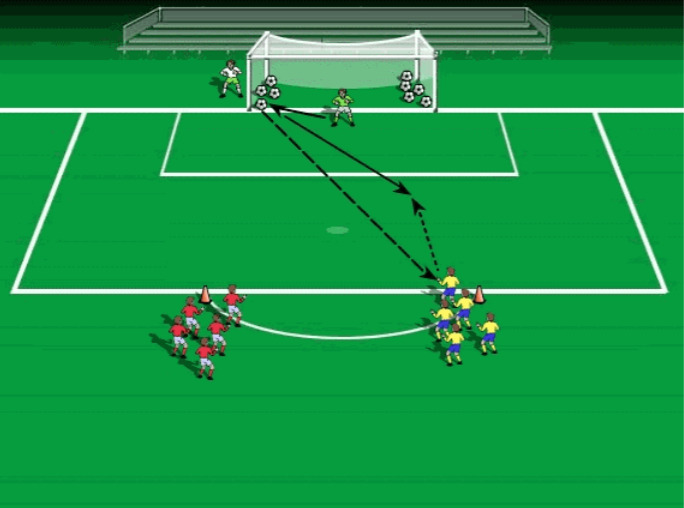


Space Rondos Training a One Touch Mentality - Training Center Exclusive
A great drill for awareness on and off the ball. Passing and moving. Must be one touch and as fast as possible. This one is easy to do on and off the ball.
Objectives:
First touch development
Body positioning
Anticipating situations in advance of the ball
Finding space
Movement OFF the ball
Communication
Mental and physical transitions
*Membership Required
Passing and moving.
Must be one touch and as fast as possible.
A great drill for awareness on and off the ball.
(B) passes to (A) then runs to the free cone the top right of the square.
This one is easy to do on and off the ball.
Objectives:
First touch development
Body positioning
Anticipating situations in advance of the ball
Finding space
Movement OFF the ball
Communication
Mental and physical transitions
A Good Warm Up: Space Rondos using one touch
Passing and moving. Must be one touch and as fast as possible. Here (B) passes to (A) and moved to the free cone. (A) passes to (C) and moves to the free cone. Observation must be away from the ball to see where the free space is BEFORE receiving the pass.

Space Rondos using one touch
One ball, Two balls then 3 balls. Now we add the necessary observation of 2 or 3 balls, as one goes the next one may arrive; so constantly scanning the field.

Players OFF the ball can switch positions now
One ball, Two balls then 3 balls. Now we add the necessary observation of 2 or 3 balls, as one goes the next one may arrive; so constantly scanning the field.

Teaching Anticipation in players
Now we number off each player; you can have 4 to 8 players doing this if you like. If 8 players use 9 cones so always one free one to run to (or more choices if needed). 1 passes to 2, 2 to 3, 3 to 4 and 4 to 5 and so on. So they are watching the player who is passing to them, and scanning where the player they must pass to is at the time; whilst they are moving off the ball too.

Now players position Between the cones (finding space) not on them
Cones represent defenders so players position between them in the best spaces possible. Talk about triangles and diamonds. Pass and move then call stand still. Check positioning.

Now players position Between the cones not on them
Cones represent defenders so players position between them in the best spaces possible. Talk about triangles and diamonds. Pass and move then stand still. Check positioning. Try to position in the biggest space available.
6 points of observation for players:
Team mates positions,
Defenders (cones) positions;
Where Spaces are,
The position of who I'm receiving from,
The position of who I'm passing to,
Where the other balls are which will force each player to consistently scan the field.


Developing “Movement Off The Ball” Through The Directional Passing And Support Three Zone Game - Training Center Exclusive
Awareness of the positions of players in both grids thus ensuring the players have their heads up to see the pass when it is on to do it.
Movement off the ball to make themselves available in both grids to receive a pass.
Quality of short passing in one grid and long passing into the other grid.
Depending on the theme, the development of awareness of when and where to pass, to run with the ball, to make a movement off the ball (third man run for example), to receive and turn with the ball, and so on.
*Membership Required
Running With And Without The Ball
Long Passing (Playing area is 60 by 40)

You can use various numbers of players at each end of the grid in this sequence.
Pass and move in own grid until eye contact with a player in the other grid (or a call) then play a long pass to that player. Balls are constantly changing grids; players have to have awareness in their own grid to receive but also awareness of when a pass is on from the other grid (must have head up and be constantly looking around to see this). If they don’t observe where their own teammates are or those in the other grid are, they won’t be successful with this so they must play with their head up and have the ability to look away from the ball as well as at it, observing all the options that are on both in their own grid and the other one.
Conditions – Ball can’t bounce between grids for chipped or lofted passes, or must be driven along the ground with pace for quick passing.
Develop Running with the Ball across the grids. Pass and move within own grid then a player picks a moment to run and takes it.
Keep balance of balls in each grid. Can start with one in each; try to avoid two in one grid at once. Increase to two balls per grid.
Long pass then follow the ball (supporting the pass) into the other grid so not only balls being transferred but also players. Players must move as quickly as possible to support in the other grid.
Coaching Points:
Awareness of the positions of players in both grids thus ensuring the players have their heads up to see the pass when it is on to do it.
Movement off the ball to make themselves available in both grids to receive a pass.
Quality of short passing in one grid and long passing into the other grid.
Depending on the theme, the development of awareness of when and where to pass, to run with the ball, to make a movement off the ball (third man run for example), to receive and turn with the ball, and so on.
Running With The Ball
The skill practiced here is specifically running with the ball, still identifying passing and moving options but also looking to make a run when the time is right.

Coaching Points for Running with the ball
Head Up – look forward
Good first touch out of feet, 3-4 touches maximum, not dribbling.
Run in a straight line, the quickest route.
Running Style, use the front foot to control the ball using the lace
Passing Then Supporting The Pass
This is like a player passing into a striker and receiving the pass back (one touch if possible for quickness of transition) and then running the ball forward into the attacking third

Third Man Run Development
A player makes a run into the neutral area between the grids; a player on the ball must see this quickly and pass to the player making the run. Try to drop the ball in front of them to run onto. Running player then takes ball into other grid and at the same time this is happening another player goes the opposite way. Start with one ball in each grid and build up.

Progression – the type of runs to be made, straight or diagonal runs. Diagonal passes and straight runs, and diagonal runs and straight passes as above or diagonal runs and diagonal passes. Equate the situation with how to make it difficult for defenders in a game to mark players who make different types of runs. Here above, (F) Passes to (E) but continues the run forward, (E) passes back to (D) who passes into the path of (F) continuing the forward run.
If a player makes a run and doesn’t receive a pass then they work their way back into their own grid. Relate the move to a player making a forward run, they don’t get the pass, they work back, draw a defender with them and then another player makes the run into the space left to receive a through ball.
Receiving and Turning – a player moves out the area and positions side on at an angle to receive and turn (looking before receiving) and take the ball to the other grid. Same happens on the other side.
Coaching Points:
Timing of the 3rd man run off the ball into space
Observation of the run by the player on the ball
Pace, accuracy and timing of the pass in front of the receiving player
Playing Give And Go’s
A player moves into the neutral zone (with a third man run off the ball) and another player on the ball passes to them. The passer then follows and receives a pass back (a 1– 2 move) and then passes the ball into the other grid, both players move into the other grid and join in. On entering, the existing players in this grid must balance things up and look to break in twos the other way as soon as possible.

Progression: Introduce a defender in each grid. This is now a 4 v 1 and only one ball per grid.
As the number of players involved increases so increase the number of balls used so at times two players can be making moves across the free space from the same grid at the same time, hence there is constant movement between grids. The players will get good at passing and moving and being able to look beyond the ball and at the same time making quick decisions the more they practice this session.
Introducing Defenders
Up to now there have been mainly NO OPPOSITION GAMES, SHADOW PLAYS to allow players to develop anticipation, awareness, vision and imagination regarding passing, receiving, support and composure on the ball to name just a few of the many aspects of play this helps develop, we can now introduce DEFENDERS to add pressurizing situations to test the players.

Introduce defenders to put the players under pressure when they pass or run the ball across the middle of the field. It can begin with 2 defenders, then 3 defenders to make it more difficult where defenders can intercept passes or tackle players with the ball.
Use this at every stage of the work out as the players get good at it. This would include:
passing across the area,
running the ball across the area,
third man runs,
passing then support the pass,
playing give and go’s,
receiving and turning, and so on.
This is taking the session to a more competitive level with defenders included now. Now the players not only have to focus on passing, running and supporting in their own zone, and into the other zone, they have to see where the defenders are to get past them.
If a defender intercepts the ball they switch quickly with the player whose pass was intercepted.

Have a 5 v 1 in each zone introducing defenders to make the situation competitive. To begin we can have one ball only then introduce a ball each side.
Players need to get a certain number of passes in before it goes to the other side. It may be that at any one time there will be two balls in one side so this team must get a ball to the other side to balance it as soon as possible.
Can introduce running with the ball across the free zone into the other area, third man running and receiving, passing first then third man running, passing into the other zone then joining in following the pass and so on.
All this results in a more competitive environment to work in for the players with them being put under pressure to test their awareness more thoroughly.
Always attempting to keep the balance in both sides with a ball each.
If a defender wins the ball then the player who gave it away becomes the defender. Have defenders just hold a bib to identify them as defenders so the transitions are quick and effective.
Competitive: Add keepers and have a game.

Teaching a One Touch Mentality Thru the Three Team Awareness Possession Game - Training Center Exclusive
This game and its many progressions are designed to get the most out of the thinking processes of the players. Many mental challenges to overcome and learn from.
We are working on awareness of where the player you receive from is and where the player you pass to is. Because of this players begin to anticipate the pass to them and where it is coming from. Also they must look to where it is going to (where is the player they are passing to?).
We are trying to create a situation where players are looking two moves ahead not just one.
Subscribe to the Soccer Awareness Training Center to get access to all premium Training Center Exclusive articles.
Continuums of Development
LOOK / OBSERVE / THINK (BEFORE receiving the ball; assessing all options in “Anticipation” not as a Reaction) - If time allows take 2 or 3 looks because the situation may have changed after the first look
SKILL: THE DECISION (Why; when and where of Technique; plus its success or not; and why?)
FOOT PREPARATION: Not flat footed but on your toes and ready for action
BODY POSITION: Balanced and open
COMMUNICATION: Verbal and visual
CONTROL: If not a one touch pass on, the 1st touch control
TECHNIQUE: The How; the pass, the run, the dribble, the turn, the shot; etc.
TACTICAL MOBILITY: Movement off the ball, finding space; 90% of the game
MENTAL AND PHYSICAL TRANSITION: Possession changes, Player tunes in immediately to win it back?
Three Team Awareness Possession Game
ALWAYS AN OVERLOAD OF PLAYERS IN POSSESSION
What does it teach?
Soccer Awareness: Assessing options BEFORE receiving the ball
Technique,
Mobility, running form deep to exploit space in behind the opponents
Agility and balance
Body position and Foot preparation,
Communication,
The 1st touch, The 2nd touch, and beyond
Teamwork,
Collective tactical understanding in a small sided game environment,
Positioning OFF the ball,
Problem solving,
And developing creativity and imagination,
Intensity of play,
Physically challenging;
Developing Angles of support;
Opening up passing lanes by movement off the ball;
Speeding up thinking and decision making, The SKILL FACTOR;
Ultimately providing a competitive environment where no one wants to give the ball away and; finally,
The sessions are fun to do. On the flip side often teaching defending and pressing at the same time.
THIS GAME AND ITS MANY PROGRESSIONS IS DESIGNED TO GET THE MOST OUT OF THE THINKING PROCESSES OF THE PLAYERS. MANY MENTAL CHALLENGES TO OVERCOME AND LEARN FROM.
Coaching Points:
Continuums Model to work off and relate to.
An Awareness of the passing player of where the OPPONENTS and his or her OWN PLAYERS ARE AND where the space is (Look and Think Before receiving)
An awareness of the receiving player as to when the passer is ready to pass (Look and Think Before receiving)
Good communication via visual cues through eye contact or aural cues through speaking makes this work (Communication)
Establishing an open stance in the middle for greater peripheral vision and an angle of support (body position and feet preparation)
Movement OFF the ball by the receiver to get free and into open space (Tactical Mobility)
Timing and angle of the run (Tactical Mobility)
Timing; accuracy and pace of the pass (Technique)
Good receiving and turning technique with an awareness of what is behind before receiving it (Technique, Control and Look and Think)
Move and join in the next phase of play (Tactical Mobility)
If we lose possession try to win it back immediately (Mental and Physical Transition)
And of course the SKILL FACTOR, decision making is based on all.
Non-Competitive Awareness Numbers game: Passing in sequence
Awareness of: where the player you receive from is and where the player you pass to is. Because of this players begin to anticipate the pass to them and where it is coming from. Also they must look to where it is going to (where is the player they are passing to?).
We are trying to create a situation where players are looking two moves ahead not just one. For instance as (1) is about to pass to (2), (3) should be looking to support (2) for the next pass already, looking two moves ahead before the ball leaves (1). Peripheral Vision Development results from this.
(3) should recognize if they need to move into a space early or late based on this observation, but know in their mind already what the next best option is. Moving into the space too early in a game situation for example may result in being marked too easily. But knowing in advance “when and where” to move to is an advantage and this game helps players develop this thought process.

Teaching One touch to develop the THINKING PROCESS
Three teams three balls. Passing and moving playing 1 touch only. Use 2 if necessary. 1 touch is successful if a) the player receiving observes his or her options BEFORE receiving the ball and b) teammates move off the ball to be in passing lanes to receive a pass.
The other teams “get in the way” of the spaces so players must ALSO observe where the other 2 team players are.

Teaching One touch to develop the THINKING PROCESS
Coaching points:
Open body stance to allow a yard or more extra space away from defenders by letting the ball run across the body into preconceived space
Looking before receiving to know in advance of the receiving pass; where the defending players are, where the space is, where team mates are free to receive a pass, how many options there are to move the ball on
Movement OFF the ball is a priority both to receive it and after passing it.

Progressions: Increase difficulty for attackers by:
Reducing the zone size.
Decreasing the number of touches on the ball of each player.
Condition the passing to be only to the other attacking teams players e.g. (1) only pass to (2) and vice versa therefore only half the number of passes available per player.
Increase the numbers to suit how many players you have, e.g. 4 v 4 + 4 or 5 v 5 + 5 etc.
Have two balls to play with so as they pass one ball they are now increasing their awareness and vision by looking for the other ball coming.
Ask players to take off their pennies so they really have to look and not be able to use color identification.
No talking or pointing, so players have to rely on their own vision.
Assessing Options
An example of moving into open passing lanes: Here (D) passes to (E). As the ball is traveling, (B) is already on the move to find the best space to support (E) KNOWING (E) has one touch only so has to make a fast decision and be given a good option. (B) positions between the blue and black player and arrives as the ball arrives. At the same time the other players need to be moving also to offer as many options for (B) as possible. Also at the same time as the ball is traveling from (D) to (E), player (B) must be looking AWAY from the ball to see what his or her next options may be and be able to choose the best one available.

Movement OFF the ball to offer options
Bear in mind the other team players are also moving so this is not as simple as it looks as the spaces to play to are constantly changing. Assessing the black players only here, we show as the ball travels from (3) to (4), the other three black players are trying to support (4) in ADVANCE of the ball. Therefore if (4) has assessed these movements and calculated approximately (mentally) where each player will move to then (4) should have numerous choices of a pass to keep possession including passing back to (3).

Offering no options with no movement to support
Exaggerated but just to show how VITAL it is that players move to support the player receiving the ball. Using red players as an example, there are passing lanes to move into to help (D) but red players stand behind opponents so (D) cannot see them nor pass to them. (D) may pass into a passing lane space to MAKE them move but that isn’t ideal, we want everyone thinking and moving together. Lets say in a game situation now (D) may be pressed and lose the ball because no options of a pass are available.

Not assessing options BEFORE receiving the ball
Coaches observe the HEAD MOVEMENT of players as this is a major indicator of if they are scanning the field for options for their next pass or not. If not the obvious will happen a) They will just watch the ball arriving and just focus on it b) They will control and stop the ball at their feet thus meaning a one touch pass is NOT an option now c) They will then lift their head up to see where teammates are d) They will eventually make a pass perhaps needing 2, 3 or 4 touches on the ball e) team mates may be standing still waiting for the pass having already anticipated the best position to be in; but are now too early and marked in a game situation..

Ideas to develop the thinking process
Players passing to different colors so now color coordination and identification is introduced. More difficult for players now, Say, blue passes to red, red passes to black, black passes to blue. This makes observation of the movements of a different color more difficult to process and is a great progressive test for players and really gets the brain cells working overtime.

Forcing movement off the ball thru a Condition
Progression: A ball each team. To keep the sequence going players must move the balls quickly with few touches hence their peripheral vision development improves dramatically.
Add another ball per team. As soon as they have passed one ball off the next one is arriving so quick thinking is needed to make the correct decisions. Divide the field up into six zones and ask players to make a pass in one sixth then they must move to another sixth to receive the next pass. This can cause players to pass long or pass short and vary the range and distance of the passes and the support. Here black (3) passes to black (2) and moves into another zone to receive the next ball that is coming. This may make (4) move into a different zone too.
A Condition: Alternatively have a Condition where no players can occupy the same zone for more than a few seconds to FORCE them to move into another space and develop ROTATION of players. This ensures players get the idea of passing and MOVING off the ball, not passing and then standing.

A Competitive Game
One ball only now. 2 teams play together and one team defends. A 10 v 5 so it should not be too tough a challenge to keep the ball. So whoever gives the ball away their team become the defending team so we have a mindset transition here.
Develop: If too easy then lets say blue and black work together against red. But blue can only pass to black and black can only pass to Blue thus greatly reducing the options of a pass and therefore the decision making of each combined team is much harder.

A Competitive Game: Another challenge
1. Making it more competitive, have each team be the defending team for a certain time span. If they win the ball they try to keep it. Count the number of times they win the ball. The defending team to win the ball the most times wins the game, or alternatively the combined teams which give up the ball the fewest times win the game.
2. Attacking players “individually” count the number of times they give the ball away as an indication to each and every one of them how well they can maintain possession under pressure.

A Competitive Game
Another idea: Lets say you have different level teams then play the two strong teams against each other and have the weaker team pass and move to each other at the same time. To play a weaker team against the stronger team is a challenge so have the weaker team play free and the stronger team play one touch only.

Add Mannequins
Now players have to play thru and between mannequins (or cones) also; this is an even bigger challenge for the players. They have to position to enable players to pass into open passing lanes and for supporting players to move into open passing lanes using the mannequins as reference points. Encourage players to pass AWAY from the mannequins because in a game if the pass is close to them then the ball would be intercepted.

Red and Blue play against black. Here we show players moving between mannequins into passing lanes at the same time avoiding and getting free from opponents (the black pinnied players)

A Competitive Game with goals
1. Here is an interesting way to work on awareness training and passing, movement off the ball, fitness and looking for the penetrating pass. Add triangular goals to score in, this means the game continues after a goal is scored as the ball must be received and possession maintained by another player in the triangle to count as a goal. This ensures continuous play.
2. It is a more directional method of playing and more specific to the game in general. The defenders are NOT allowed inside the triangle so they must be constantly working their way around the triangle trying to cut off the penetrating passes.
3. The combined attacking teams can attack all goals. Attacking all goals encourages “Switching the Field”.
4. Ultimately reduce the game to two equal number teams for the greatest challenge and begin with as many touches as possible reducing the number of touches each is allowed as they improve and are able to keep possession effectively. Reducing the number of touches allowed inevitably increases their awareness and forces them to look for options earlier and improves and speeds up their decision making. This should result in them keeping possession more effectively.

The ultimate outcome from ONE touch mentality training
One touch training is to teach a ONE TOUCH MENTALITY of the thinking process. It is NOT to teach players to only play one touch. Not at all. Once the head movement, the observation of options BEFORE receiving the ball is established thru One Touch Mentality training then we are ready to open the game up into FREEPLAY.
Now players can do whatever they like, 1 touch pass, 2 touch pass, a dribble, run with the ball, receive and turn, anything they like.
But the objective has been to establish in their minds that 1 touch mentality to enable them to make the best decision possible from potentially several options at this moment in time.
We want great dribblers beating players 1 v 1, we want players who are great at running at defenders with the ball, we want players who are excellent at one touch play, we want players who recognize; thru developing a one touch mentality when; were, how and why to slow the game down, to change the tempo at the correct times in the game; even better if we develop players who are great at all these things.
So having a “one touch mentality” and playing with this thinking process means we can actually achieve the opposite effect of playing as fast as possible; and that is to play more slowly, because that was the correct decision at that moment.

Here are 9 ways to distribute from the keeper and play out from the back. We owe it to the players to teach them this as Young as is possible.
I work on this initially practicing all ways to get out. Have opponents only intercepting passes to begin. Then let it go free. When opponents win it back we work on the defending team condensing and defending correctly.
If three or four ways to develop play are done very frequently then it becomes a subconscious decision to move into position so no decision making required as such.
Subscribe to the Soccer Awareness Training Center to get access to all premium Training Center Exclusive articles.