
Never Give Up
/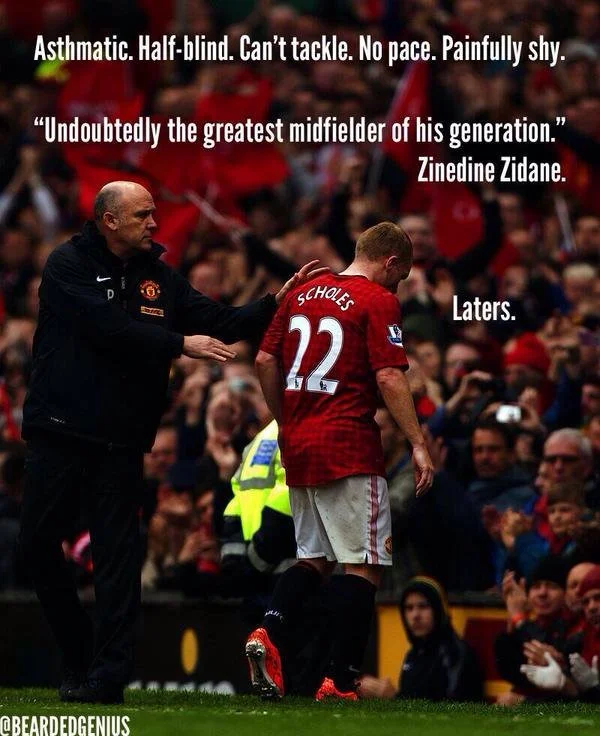
This is what they said about Paul Scholes of Manchester United and England as a kid. Think about what some coaches have said about you then come and work with me and we will prove them wrong.
Read More
Soccer training, soccer drills, articles, soccer training videos and more from Wayne Harrison/Soccer Awareness.
Soccer Awareness training develops SELF THINKING players who are not coach driven; but coach guided, and within this they are allowed to make mistakes without criticism; but rather; encouraged to learn from them.
Welcome to the Soccer Awareness Coaches Corner. Browse through soccer drills, small sided games, tactical thoughts, full sessions and a variety of resources. Posts marked “Training Center Exclusive” are for members only.
This is what they said about Paul Scholes of Manchester United and England as a kid. Think about what some coaches have said about you then come and work with me and we will prove them wrong.
Read MoreScientific research proves; Myelin is produced by a person thinking about and analyzing skill situations themselves; and being trained with self-thought as a major part of the process.
Making and correcting errors; constantly generating solutions to ongoing problems; the game is dynamic; and situations change every second, new decisions have to be made every second. This occurs in deep practice: the more you practice; the more decision making situations you find yourself in; the more thought it takes to solve them; the more myelin is grown, the faster the body and brain processes these; the better the decisions made.
Read MoreWorking with three teams (4 v 4 + 4). Teams (1) and (2) work together to keep the ball from team (3). If team (3) regains possession the team who gave it away becomes the defenders. The defenders reward is they keep the ball and link with the other team.
Read MoreThis session covers when and when not to close down in wide and then central areas. The practice develops into an 11 v 11 game situation, still working with the defending team. The coach serves to the opponents in different locations on the field and the team needs to try to win the ball back individually and collectively.
Read MoreMake the defensive challenge more difficult by putting the midfield in recovering positions to help the back four. The back four can be patient when the ball is in midfield and keep their shape delaying the opponents until the midfield recover back to help.
Read MorePlaying with a midfield four when out of possession is one way of setting up your midfield unit to defend. This session works on the tactical design of this midfield set-up. Once the players get used to the tactical plan allow the defenders to now tackle the opponents and win the ball back as in a game situation.
Read MoreIn this video, Coach Wayne Harrison explains in a simple way the 6 phases of the 4-2-3-1 style of play.
Read MoreWe compared how many touches on the ball a player has in an eleven a side game as opposed to a four a side game. We recorded touches on the ball of an average player and these are the results we came up with.
Read MoreStriker (E) comes short and shows for the ball asking for a pass from (D). Defender (F) follows. Midfielder (D) passes to (C), (D) then passes over the top into (E)’s path as he / she spins. Defender must play passively. To continue the work once player (E) receives the ball they must beat (F) back to the touchline. Players (C) and (D) go to the middle and the next two take their place. As the pass is going from (D) to (C) the striker shouts the code word and spins to receive the pass as player (C) is about to pass it. The shout must be early to (C) to make the pass at the exact same time (E) is spinning to receive it.
Read MoreStriker moves “OFF THE SHOULDER” of the defender. Only a matter of a few yards can open up wonderful space and attacking opportunities.
Read MoreThis is the usual position of the strikers, they stand alongside the defender and do not open the angle up to help them receive a pass, and these are the disadvantages to this.
Read MoreHere the striker runs away and invites a ball off or over the shoulder of the defender, in this situation the striker is off the right shoulder of the defender. The ball may be delivered off (outside) the right shoulder of the defender so it goes wider, or (inside) the left shoulder of the defender so the striker cuts inside the defender either in front or behind them, or moves towards the ball and receives to feet.
Read More#1 - Keep Possession - If players chase for the ball a long time they get frustrated, get tired and commit fouls. So keep possession and force this upon them
Read MoreHow to use the following call in pressing and conditioning play: Up and Hold Calls, Out Call, Drop Call and Slide Call
Read MoreAdd players to the practice. Have the game set up as a normal phase play, attackers against defenders. Attackers have to try to score, defenders try to win the ball back and score in the little goals. The defenders have five passes to score once they win the ball then it goes back to the attacking side.
Read MoreSoccer Awareness developmental training focuses on the concept of the THIRD EYE of Awareness, Imagination and Anticipation in Performance. Soccer Awareness is a highly innovative concept which aims to develop the thinking coach and player. Soccer Awareness focuses on the creation of a player centered environment which encourages autonomy and an ability to make correct decisions within a game specific context.
Soccer Awareness Training Center provides unlimited access to Wayne Harrison's Soccer Awareness systems, training sessions, drills and more. Wayne's system helps the development of all levels of soccer players and teams in a systematic and imaginative manner that guarantees performance at the highest level of competition.
This video is an example of a “One Touch Mentality” game situation U14 boys.
Here are 9 ways to distribute from the keeper and play out from the back. We owe it to the players to teach them this as Young as is possible.
I work on this initially practicing all ways to get out. Have opponents only intercepting passes to begin. Then let it go free. When opponents win it back we work on the defending team condensing and defending correctly.
If three or four ways to develop play are done very frequently then it becomes a subconscious decision to move into position so no decision making required as such.
Linking foot preparation, body position and mental preparation to the technique involved in making a one touch pass leads us to a discussion on one touch play and its benefits.
One touch play teaches the value of being able to take your eye off the ball when keeping your eye on the ball can be a disadvantage.
To make this work, players need to have good teamwork and positional sense and therefore must work hard for each other.
54 Pages
We want to stay with our own game plan as closely as possible; based on what we practice and to keep it simple for us; as we dictate to our opponents; and we impose OUR WAY on them.
But there will be many occasions where we must change the system of play and we may have to adjust to suit the opponents.
Here are some ideas for you to consider for your team starting with the 13313 and 14231 systems of play.
Teaching players to develop a "one touch mentality" in their game, to train the MIND.
To play in "Anticipation" of the ball; both on and off it by Scanning the field constantly to make earlier, faster and more successful decisions in the game.
How do we do this? Here are some sessions to use to help develop this ability.
45 Pages
Using the 1-3-3-1-3 system of play for this, we show how your players can find free spaces between opponents with inverted runs from outside to in. Including how to create freedom of movement within the team framework.
This 295 page ebook includes 17 game situational clinics focused on tactical play and target games. To achieve the given theme successfully, many of the situational games have set conditions to them to force the theme to happen consistently and to maintain the focus of it. As we will explain, a big part of teaching in ALL these games is developing a One Touch Mentality in each players brain. So the “general” theme around all of them will be establishing this thinking process no matter the “specific” theme being taught.
This book is also available to Elite and Premium Members in the Soccer Awareness Training Center. Access Here.
We produced the eBook "Tactical Thoughts on the Development of the 4 v 4, 7 v 7 and 9 v 9 Game Sizes" covering information on team shape and development. We now add this eBook to provide Curriculums in each game size to support the tactical games eBook.
What this eBook offers you:
Its all done here for you, paying attention to the ages of the players and the depth of teaching suitable to them.
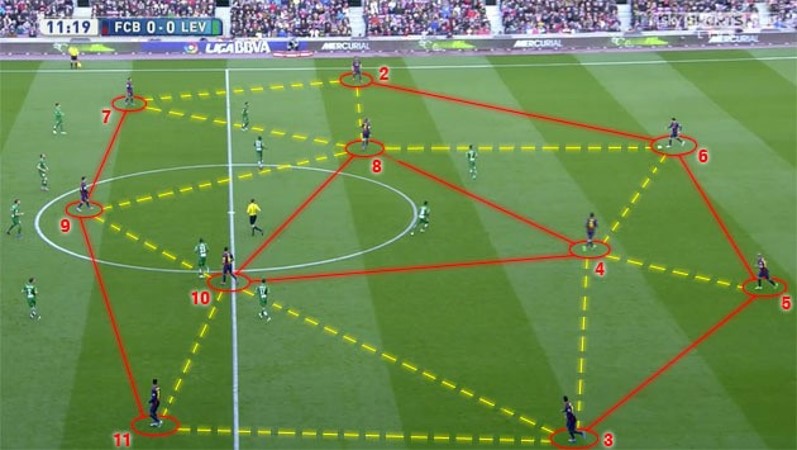
As the program moves from 4 v 4 through to 11 v 11 the focus changes from individual teachings at 4 v 4, to small sided situations at 7 v 7, to Phases of play and tactical needs at 9 v 9; through to team tactical development at 11 v 11.
11 v 11 focuses on advanced training ideas to teach the “team”.
This eBook covers up to 14 weeks of training for each game size presented as one session per week.
All sessions have small sided games scrimmage set ups as close as we can get it to finish to reflect the theme of the session.
This eBook shows how these different size games can be taught and also shows different systems of play that might be useful to you.
The idea I am trying to cultivate is to find a pattern of development that goes from 4 v 4 to 7 v 7 all the way through 9 v 9 to 11 v 11 that educates the players VERY EARLY on how to ultimately play the 11 v 11, a common thread running right through the book.
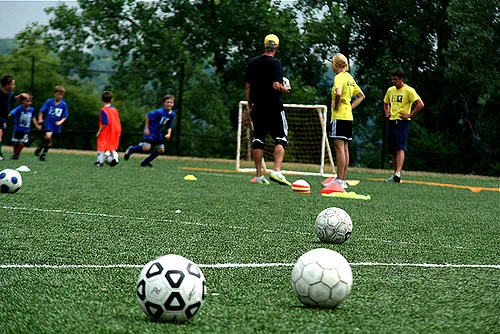


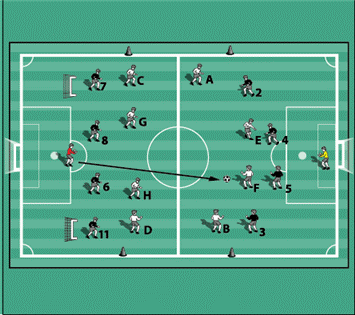






Often players position to receive the ball with their back to play. These session plans show some ideas on how to position and instead "Face Forward" or at least Half Turned or three quarters turned rather than positioning square and facing back.